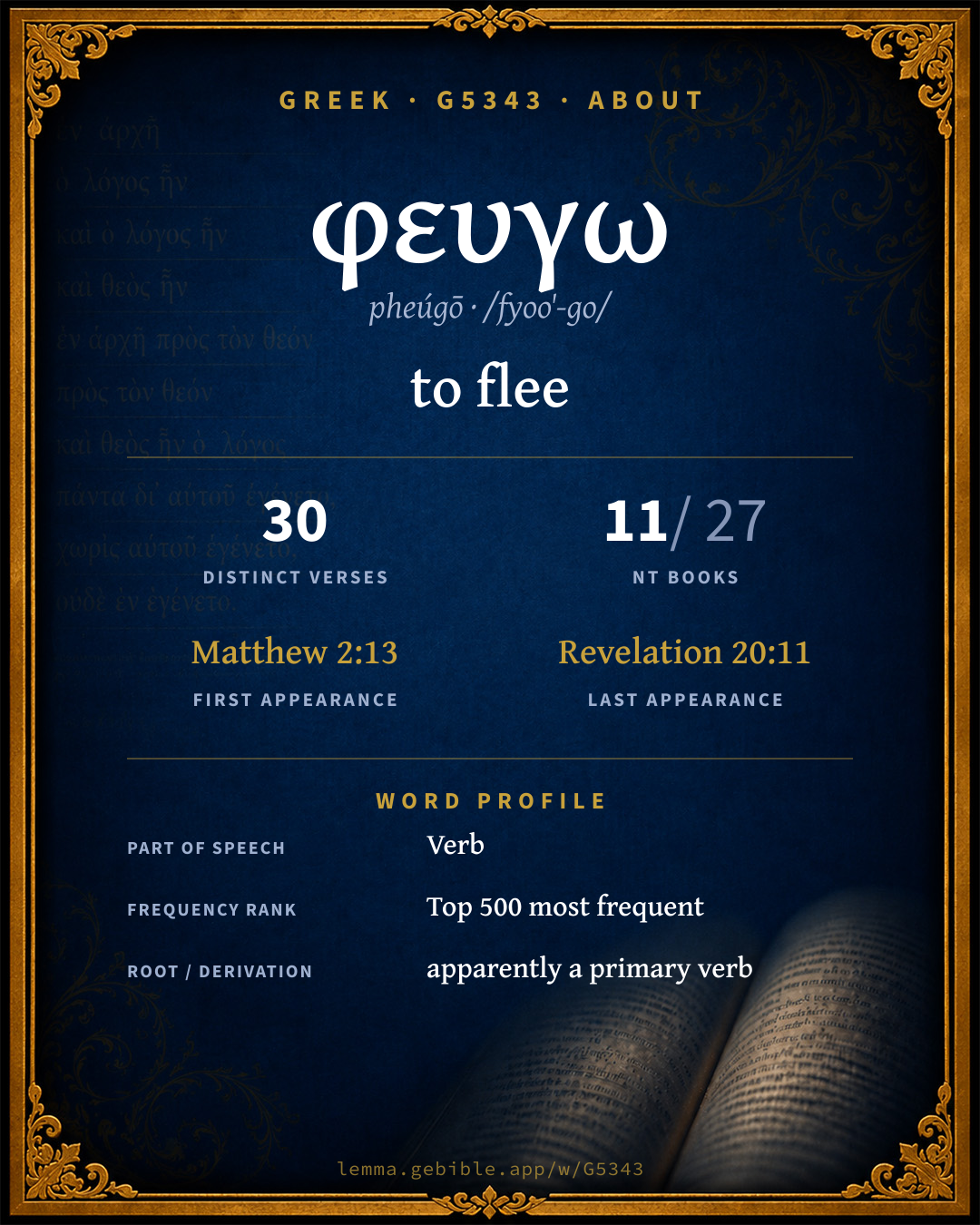
φεύγω
to flee
‘to flee’ is one of 4 main senses fuller range ↓
Full lexicon entry — Thayer's Greek Lexicon
From Thayer's Greek Lexicon
Where this word appears
See every Aorist-tense verb in the Greek New Testament →
Grammar key — what these labels mean
Part of speech
- Verb
- An action or state-of-being word.
Tense
- Aorist
- Action viewed as a simple whole, without regard to duration — often past (perfective aspect).
- Present
- Ongoing or general action in present time (imperfective aspect).
- Future
- Action expected in future time.
Voice
- Active
- The subject performs the action.
- Middle deponent
- Middle in form but active in meaning.
Mood
- Indicative
- States a fact or asks a factual question (the mood of reality).
- Infinitive
- A verbal noun (“to write”), unmarked for person or number.
- Imperative
- Expresses a command or request.
- Subjunctive
- Expresses probability, purpose, or possibility (the mood of contingency).
Person
- 3rd person
- The one spoken about (“he / she / it / they”).
- 2nd person
- The one addressed (“you”).
Number
- Plural
- More than one.
- Singular
- One.
Grammatical forms 10 distinct
- Verb, Aorist, Active, Indicative, 3rd person, Plural 7 times (23%)
- Verb, Aorist, Active, Indicative, 3rd person, Singular 5 times (17%)
- Verb, Aorist, Active, Infinitive 3 times (10%)
- Verb, Present, Active, Indicative, 3rd person, Singular 3 times (10%)
- Verb, Present, Active, Imperative, 2nd person, Plural 3 times (10%)
- Verb, Present, Active, Imperative, 2nd person, Singular 3 times (10%)
- Verb, Present, Active, Imperative, 3rd person, Plural 3 times (10%)
- Verb, Aorist, Active, Subjunctive, 2nd person, Plural 1 time (3%)
+2 more forms (2 occurrences)
Parsed forms decoded from the imported morphology (Robinson–Tischendorf, public domain), counted across 30 parsed occurrences — not distinct verses.
Every verse where G5343 appears — 30 distinct verses across 11 books. Click any verse to open its interlinear word-by-word view. Verse text shown in the World English Bible for context — . Each verse’s Greek form is shown with its reference; the English is not keyword-highlighted, since the data carries no word-level English alignment. Use “Compare translations” on any verse to read it across multiple English versions. This concordance covers the Greek New Testament; Septuagint (Greek Old Testament) occurrences of this word are not indexed here.
Matthew 7 verses
- Matthew 2:13 φεῦγε pres act impv 2sg Now when they had departed, behold, an angel of the Lord appeared to Joseph in a dream, saying, "Arise and take the young child and his mother, and flee into Egypt, and stay there until I tell you, for Herod will seek the young child to destroy him."
- Matthew 3:7 φυγεῖν aor act inf But when he saw many of the Pharisees and Sadducees coming for his baptism, he said to them, "You offspring of vipers, who warned you to flee from the wrath to come?
- Matthew 8:33 ἔφυγον aor act ind 3pl Those who fed them fled, and went away into the city, and told everything, including what happened to those who were possessed with demons.
- Matthew 10:23 φεύγετε pres act impv 2pl But when they persecute you in this city, flee into the next, for most assuredly I tell you, you will not have gone through the cities of Israel, until the Son of Man has come.
- Matthew 23:33 φύγητε aor act subj 2pl You serpents, you offspring of vipers, how will you escape the judgment of Gehenna?
- Matthew 24:16 φευγέτωσαν pres act impv 3pl then let those who are in Judea flee to the mountains.
- Matthew 26:56 ἔφυγον aor act ind 3pl But all this has happened, that the Scriptures of the prophets might be fulfilled." Then all the disciples left him, and fled.
Mark 5 verses
- Mark 5:14 ἔφυγον aor act ind 3pl Those who fed them fled, and told it in the city and in the country. The people came to see what it was that had happened.
- Mark 13:14 φευγέτωσαν pres act impv 3pl But when you see the abomination of desolation, spoken of by Daniel the prophet, standing where it ought not (let the reader understand), then let those who are in Judea flee to the mountains,
- Mark 14:50 ἔφυγον aor act ind 3pl They all left him, and fled.
- Mark 14:52 ἔφυγεν aor act ind 3sg but he left the linen cloth, and fled from them naked.
- Mark 16:8 ἔφυγον aor act ind 3pl They went out, and fled from the tomb, for trembling and astonishment had come on them. They said nothing to anyone; for they were afraid.
Luke 3 verses
- Luke 3:7 φυγεῖν aor act inf He said therefore to the multitudes who went out to be baptized by him, "You offspring of vipers, who warned you to flee from the wrath to come?
- Luke 8:34 ἔφυγον aor act ind 3pl When those who fed them saw what had happened, they fled, and told it in the city and in the country.
- Luke 21:21 φευγέτωσαν pres act impv 3pl Then let those who are in Judea flee to the mountains. Let those who are in the midst of her depart. Let those who are in the country not enter therein.
John 3 verses
- John 6:15 φεύγει pres act ind 3sg Jesus therefore, perceiving that they were about to come and take him by force, to make him king, withdrew again to the mountain by himself.
- John 10:5 φεύξονται fut mid.dep ind 3pl They will by no means follow a stranger, but will flee from him; for they don't know the voice of strangers."
- John 10:12 φεύγει pres act ind 3sg He who is a hired hand, and not a shepherd, who doesn't own the sheep, sees the wolf coming, leaves the sheep, and flees. The wolf snatches the sheep, and scatters them.
Acts 2 verses
- Acts 7:29 ἔφυγεν aor act ind 3sg Moses fled at this saying, and became a stranger in the land of Midian, where he became the father of two sons.
- Acts 27:30 φυγεῖν aor act inf As the sailors were trying to flee out of the ship, and had lowered the boat into the sea, pretending that they would lay out anchors from the bow,
1 Corinthians 2 verses
1 Timothy 1 verse
2 Timothy 1 verse
Hebrews 1 verse
James 1 verse
Revelation 4 verses
- Revelation 9:6 φεύγει pres act ind 3sg In those days people will seek death, and will in no way find it. They will desire to die, and death will flee from them.
- Revelation 12:6 ἔφυγεν aor act ind 3sg The woman fled into the wilderness, where she has a place prepared by God, that there they may nourish her one thousand two hundred sixty days.
- Revelation 16:20 ἔφυγεν aor act ind 3sg Every island fled away, and the mountains were not found.
- Revelation 20:11 ἔφυγεν aor act ind 3sg I saw a great white throne, and him who sat on it, from whose face the earth and the heaven fled away. There was found no place for them.
About this entry
At a glance — auto-summarized from this page’s data, not written by a person. Every figure links to its source below. This summary describes the numbers; it doesn’t interpret them.
φευγω (pheúgō) is a Greek verb most often rendered “to flee.” Its lexical range runs to 4 senses. With 30 verses in 11 books, it is a moderately common word in the Greek New Testament. Debuting at Matthew 2:13, it then recurs through the corpus. From the same root come Φυγελλος and φυγη. The sections below give every sense, occurrence, and version rendering.
Gloss history
Strong's 1890 vs modern scholarship

About this word
Strong's G5343 catalogs a Greek word from the Greek New Testament.
These counts are not copied from any lexicon or concordance. They are computed here, from the morphology-tagged Greek New Testament. What Lemma adds →
- 30
- distinct verses
- The word appears in 30 distinct verses.
- 11 / 27
- NT books
- The word appears in 11 of 27 New Testament books.
- #463
- by frequency
- Top 500 most frequent Greek words (rank 463 of 5,347 Greek words by occurrence).
View all 30 occurrences in the concordance →
Most concentrated in
- Matthew 7 verses 23%
- Mark 5 verses 17%
- Revelation 4 verses 13%
By section of the New Testament
By traditional corpus
Conventional, traditional groupings — biblical authorship is debated, so this is a traditional corpus grouping, not an authorship claim. Some books belong to more than one corpus (Luke is in both the Gospels and the Lukan corpus, and so on), so these shares overlap and need not total 100%. Each figure is a share of the word’s 30 distinct verses.
- Gospels 18 verses · 60%
- Johannine 7 verses · 23%
- Lukan (Luke–Acts) 5 verses · 17%
- Pauline corpus 4 verses · 13%
- Revelation 4 verses · 13%
- Hebrews 1 verse · 3%
- General (Catholic) Epistles 1 verse · 3%
How translations render this word
Counts come from each version’s own published word-to-Strong’s tagging or interlinear alignment — an approximate guide to how each version renders this word, not a word-level alignment the data otherwise carries. Because each total is that version’s own tagged count, the per-version totals vary from one another and need not match the appearance or distinct-verse counts above. These counts may also differ from a printed concordance because Lemma counts each distinctly tagged rendering and does not collapse phrase taggings into a single head-word total. This is a fixed set of word-tagged versions (KJV, ASV, BSB, ULT) and does not change with the reading translation you choose elsewhere. Each version’s license is shown beside its name below (and on Sources).
- King James Version: Flee 11×, Fled 8×, Escaped 2×
- American Standard Version: Flee 11×, Fled 8×, Escaped 2×
- Berean Standard Bible: Flee 8×, Fled 6×, Flee from 3×
- unfoldingWord Literal Text: Flee 11×, Fled 6×, Ran away 4×
King James Version Public Domain
Renders G5343 across 33 tagged occurrences — most commonly:
Plus 6 renderings that appear only once — usually multi-word phrases or single function words the recovered tagging swept in, not distinct renderings.
American Standard Version Public Domain
Renders G5343 across 30 tagged occurrences — most commonly:
Plus 5 renderings that appear only once — usually multi-word phrases or single function words the recovered tagging swept in, not distinct renderings.
Berean Standard Bible Public Domain
Renders G5343 across 29 tagged occurrences — most commonly:
Plus 8 renderings that appear only once — usually multi-word phrases or single function words the recovered tagging swept in, not distinct renderings.
unfoldingWord Literal Text CC BY-SA 4.0
Renders G5343 across 33 tagged occurrences — most commonly:
Plus 9 renderings that appear only once — usually multi-word phrases or single function words the recovered tagging swept in, not distinct renderings.
Senses in Thayer's
The 4 senses Thayer's distinguishes for this word, in lexicon order (not ranked by frequency or importance). The full entry — with sub-senses — is in the Lexicon Entry tab.
- to flee away, seek safety by flight
- metaph. to flee (to shun or avoid by flight) something abhorrent, esp. vices
- to be saved by flight, to escape safely out of danger
- poetically, to flee away, vanish
Word origin
Origin: apparently a primary verb
Apparently a primary verb; to run away (literally or figuratively); by implication to shun ; by analogy to vanish : - escape flee (away).
— Strong’s Exhaustive Concordance (1890), public domain.
Forms in the corpus
The 10 distinct written forms G5343 takes in the Greek New Testament, most frequent first — each parse links to that tense’s occurrences in the concordance.
| Form | Parsing | Example | Uses |
|---|---|---|---|
| ἔφυγον éphygon | Verb, Aorist, Active, Indicative, 3rd person, Plural | Matthew 8:33 | 7 |
| ἔφυγεν éphygen | Verb, Aorist, Active, Indicative, 3rd person, Singular | Mark 14:52 | 5 |
| φευγέτωσαν pheugétōsan | Verb, Present, Active, Imperative, 3rd person, Plural | Matthew 24:16 | 3 |
| φεύγει pheúgei | Verb, Present, Active, Indicative, 3rd person, Singular | John 6:15 | 3 |
| φεύγετε pheúgete | Verb, Present, Active, Imperative, 2nd person, Plural | Matthew 10:23 | 3 |
| φεῦγε pheûge | Verb, Present, Active, Imperative, 2nd person, Singular | Matthew 2:13 | 3 |
| φυγεῖν phygeîn | Verb, Aorist, Active, Infinitive | Matthew 3:7 | 3 |
| φεύξεται pheúxetai | Verb, Future, Middle deponent, Indicative, 3rd person, Singular | James 4:7 | 1 |
| φεύξονται pheúxontai | Verb, Future, Middle deponent, Indicative, 3rd person, Plural | John 10:5 | 1 |
| φύγητε phýgēte | Verb, Aorist, Active, Subjunctive, 2nd person, Plural | Matthew 23:33 | 1 |
Same root — word family
Other Thayer's entries built from the same root as G5343, grouped by Strong’s listed origin. These share a root / origin per the lexicon — not necessarily a shared meaning. Each links to that word’s own entry.
Derived from this word
Compare all same-root words → They share a root, not necessarily a meaning.
Septuagint usage
The same Greek word φευγω appears 173 times in the Greek Old Testament (Septuagint), across 159 verses in 25 books.
- 173
- LXX occurrences
- Tagged occurrences of this Greek word in the Septuagint.
- 159
- verses
- Distinct Septuagint verses containing this word.
- 25 / 39
- OT books
- The word appears in 25 of the 39 Old Testament books.
Sample Septuagint occurrences
- Genesis 14:10 φεύγω
- Exodus 4:3 φεύγω
- Leviticus 26:17 φεύγω
- Numbers 10:34 φεύγω
- Deuteronomy 4:42 φεύγω
- Joshua 7:4 φεύγω
- Judges 1:6 φεύγω
- 1 Samuel 4:10 φεύγω
- 2 Samuel 1:4 φεύγω
- 1 Kings 2:28 φεύγω
- 2 Kings 3:24 φεύγω
- 1 Chronicles 10:1 φεύγω
Septuagint occurrences (same lexeme)
Every verse where the same Strong’s number (G5343) appears in the Greek Septuagint — showing the first 50 of 159. Verse text shown in the World English Bible for context; the Greek form is the matched word — the English is not keyword-highlighted.
- Genesis 14:10 φεύγω Now the valley of Siddim was full of tar pits; and the kings of Sodom and Gomorrah fled, and they fell there, and those who remained fled to the mountain.
- Genesis 39:12 φεύγω She caught him by his garment, saying, "Lie with me!" He left his garment in her hand, and ran outside.
- Genesis 39:13 φεύγω It happened, when she saw that he had left his garment in her hand, and had run outside,
- Genesis 39:15 φεύγω It happened, when he heard that I lifted up my voice and cried, that he left his garment by me, and ran outside."
- Genesis 39:18 φεύγω and it happened, as I lifted up my voice and cried, that he left his garment by me, and ran outside."
- Exodus 4:3 φεύγω He said, "Throw it on the ground." He threw it on the ground, and it became a snake; and Moses ran away from it.
- Exodus 14:5 φεύγω It was told the king of Egypt that the people had fled; and the heart of Pharaoh and of his servants was changed towards the people, and they said, "What is this we have done, that we have let Israel go from serving us?"
- Exodus 14:25 φεύγω He took off their chariot wheels, and they drove them heavily; so that the Egyptians said, "Let's flee from the face of Israel, for Yahweh fights for them against the Egyptians!"
- Exodus 14:27 φεύγω Moses stretched out his hand over the sea, and the sea returned to its strength when the morning appeared; and the Egyptians fled against it. Yahweh overthrew the Egyptians in the midst of the sea.
- Exodus 21:13 φεύγω but not if it is unintentional, but God allows it to happen: then I will appoint you a place where he shall flee.
- Leviticus 26:17 φεύγω I will set my face against you, and you will be struck before your enemies. Those who hate you will rule over you; and you will flee when no one pursues you.
- Leviticus 26:36 φεύγω "'As for those of you who are left, I will send a faintness into their hearts in the lands of their enemies: and the sound of a driven leaf will put them to flight; and they shall flee, as one flees from the sword; and they will fall when no one pursues.
- Numbers 10:34 φεύγω The cloud of Yahweh was over them by day, when they set forward from the camp.
- Numbers 16:34 φεύγω All Israel that were round about them fled at the cry of them; for they said, Lest the earth swallow us up.
- Numbers 24:11 φεύγω Therefore now flee you to your place: I thought to promote you to great honor; but, behold, Yahweh has kept you back from honor.
- Numbers 35:6 φεύγω The cities which you shall give to the Levites, they shall be the six cities of refuge, which you shall give for the manslayer to flee to: and besides them you shall give forty-two cities.
- Numbers 35:11 φεύγω then you shall appoint you cities to be cities of refuge for you, that the manslayer who kills any person unwittingly may flee there.
- Numbers 35:15 φεύγω For the children of Israel, and for the stranger and for the foreigner living among them, shall these six cities be for refuge; that everyone who kills any person unwittingly may flee there.
- Numbers 35:32 φεύγω You shall take no ransom for him who is fled to his city of refuge, that he may come again to dwell in the land, until the death of the priest.
- Deuteronomy 4:42 φεύγω that the manslayer might flee there, who kills his neighbor unawares, and didn't hate him in time past; and that fleeing to one of these cities he might live:
- Deuteronomy 19:4 φεύγω This is the case of the manslayer, that shall flee there and live: whoever kills his neighbor unawares, and didn't hate him in time past;
- Deuteronomy 19:11 φεύγω But if any man hate his neighbor, and lie in wait for him, and rise up against him, and strike him mortally so that he dies, and he flee into one of these cities;
- Deuteronomy 28:7 φεύγω Yahweh will cause your enemies who rise up against you to be struck before you: they shall come out against you one way, and shall flee before you seven ways.
- Deuteronomy 28:25 φεύγω Yahweh will cause you to be struck before your enemies; you shall go out one way against them, and shall flee seven ways before them: and you shall be tossed back and forth among all the kingdoms of the earth.
- Joshua 7:4 φεύγω So there went up there of the people about three thousand men: and they fled before the men of Ai.
- Joshua 8:5 φεύγω and I, and all the people who are with me, will approach to the city. It shall happen, when they come out against us, as at the first, that we will flee before them;
- Joshua 8:6 φεύγω and they will come out after us, until we have drawn them away from the city; for they will say, They flee before us, as at the first: so we will flee before them;
- Joshua 8:20 φεύγω When the men of Ai looked behind them, they saw, and, behold, the smoke of the city ascended up to heaven, and they had no power to flee this way or that way: and the people who fled to the wilderness turned back on the pursuers.
- Joshua 10:11 φεύγω It happened, as they fled from before Israel, while they were at the descent of Beth Horon, that Yahweh cast down great stones from the sky on them to Azekah, and they died: they were more who died with the hailstones than they whom the children of Israel killed with the sword.
- Joshua 10:16 φεύγω These five kings fled, and hid themselves in the cave at Makkedah.
- Judges 1:6 φεύγω But Adoni-bezek fled; and they pursued after him, and caught him, and cut off his thumbs and his great toes.
- Judges 4:15 φεύγω Yahweh confused Sisera, and all his chariots, and all his host, with the edge of the sword before Barak; and Sisera alighted from his chariot, and fled away on his feet.
- Judges 4:17 φεύγω However Sisera fled away on his feet to the tent of Jael the wife of Heber the Kenite; for there was peace between Jabin the king of Hazor and the house of Heber the Kenite.
- Judges 7:21 φεύγω They stood every man in his place round about the camp; and all the host ran; and they shouted, and put [them] to flight.
- Judges 7:22 φεύγω They blew the three hundred trumpets, and Yahweh set every man's sword against his fellow, and against all the host; and the host fled as far as Beth-shittah toward Zererah, as far as the border of Abel Meholah, by Tabbath.
- Judges 8:12 φεύγω Zebah and Zalmunna fled; and he pursued after them; and he took the two kings of Midian, Zebah and Zalmunna, and confused all the host.
- Judges 9:21 φεύγω Jotham ran away, and fled, and went to Beer, and lived there, for fear of Abimelech his brother.
- Judges 9:40 φεύγω Abimelech chased him, and he fled before him, and there fell many wounded, even to the entrance of the gate.
- Judges 9:51 φεύγω But there was a strong tower within the city, and there fled all the men and women, and all they of the city, and shut themselves in, and got them up to the roof of the tower.
- Judges 11:3 φεύγω Then Jephthah fled from his brothers, and lived in the land of Tob: and there were gathered vain fellows to Jephthah, and they went out with him.
- Judges 20:32 φεύγω The children of Benjamin said, They are struck down before us, as at the first. But the children of Israel said, Let us flee, and draw them away from the city to the highways.
- Judges 20:42 φεύγω Therefore they turned their backs before the men of Israel to the way of the wilderness; but the battle followed hard after them; and those who came out of the cities destroyed them in the midst of it.
- Judges 20:45 φεύγω They turned and fled toward the wilderness to the rock of Rimmon: and they gleaned of them in the highways five thousand men, and followed hard after them to Gidom, and struck of them two thousand men.
- Judges 20:47 φεύγω But six hundred men turned and fled toward the wilderness to the rock of Rimmon, and abode in the rock of Rimmon four months.
- 1 Samuel 4:10 φεύγω The Philistines fought, and Israel was struck, and they fled every man to his tent: and there was a very great slaughter; for there fell of Israel thirty thousand footmen.
- 1 Samuel 4:16 φεύγω The man said to Eli, I am he who came out of the army, and I fled today out of the army. He said, How went the matter, my son?
- 1 Samuel 4:17 φεύγω He who brought the news answered, Israel is fled before the Philistines, and there has been also a great slaughter among the people, and your two sons also, Hophni and Phinehas, are dead, and the ark of God is taken.
- 1 Samuel 14:22 φεύγω Likewise all the men of Israel who had hid themselves in the hill-country of Ephraim, when they heard that the Philistines fled, even they also followed hard after them in the battle.
- 1 Samuel 17:31 φεύγω When the words were heard which David spoke, they rehearsed them before Saul; and he sent for him.
- 1 Samuel 19:8 φεύγω There was war again: and David went out, and fought with the Philistines, and killed them with a great slaughter; and they fled before him.
These are occurrences of the same Greek lexeme (G5343) in the Septuagint — not a translation of any one Hebrew word. The store carries no word-level Hebrew↔Greek alignment, so no Hebrew original is asserted here. Counts come from the recovered LXX Strong's tagging — high-frequency vocabulary is well covered, while rare or late forms may be untagged — so they reflect tagged occurrences and may slightly undercount.