Judges 11:3

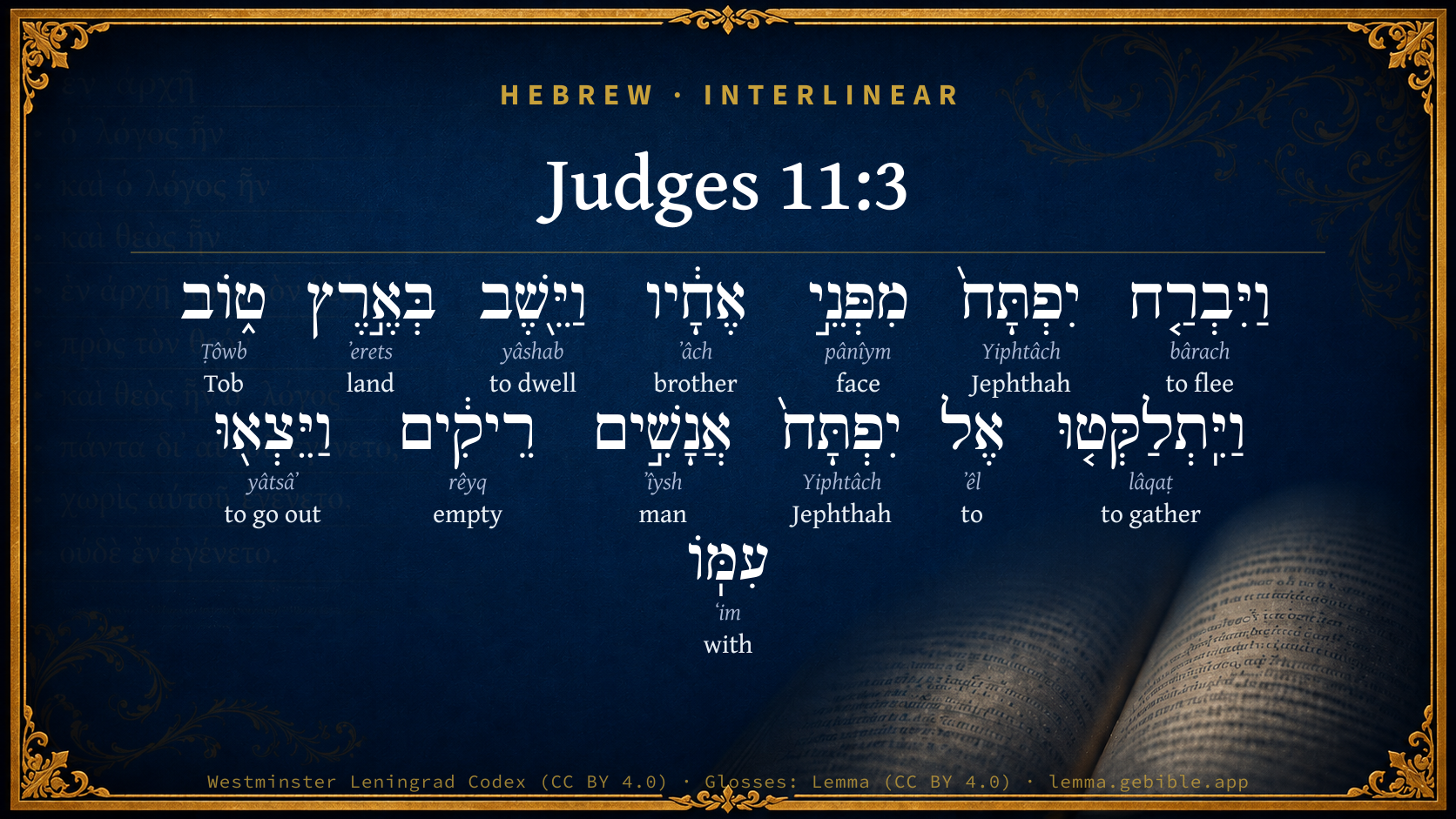
Hebrew (Westminster Leningrad Codex) Judges 11:3 appears in the Hebrew Old Testament. The text above is from the Westminster Leningrad Codex. Each word links to its Strong’s number, a concise gloss, and parsing drawn from the Open Scriptures Hebrew Bible morphology. Click any word for its full Brown-Driver-Briggs (BDB) entry.
Download image
Cite this verse

Judges 11:3 (World English Bible). Public Domain. Lemma interlinear Bible study tool, https://lemma.gebible.app/v/judges/11/3.

Show BibTeX & RIS
BibTeX
RIS
English Translation
Then Jephthah fled from his brothers, and lived in the land of Tob: and there were gathered vain fellows to Jephthah, and they went out with him.
World English Bible · Public Domain
Highlights
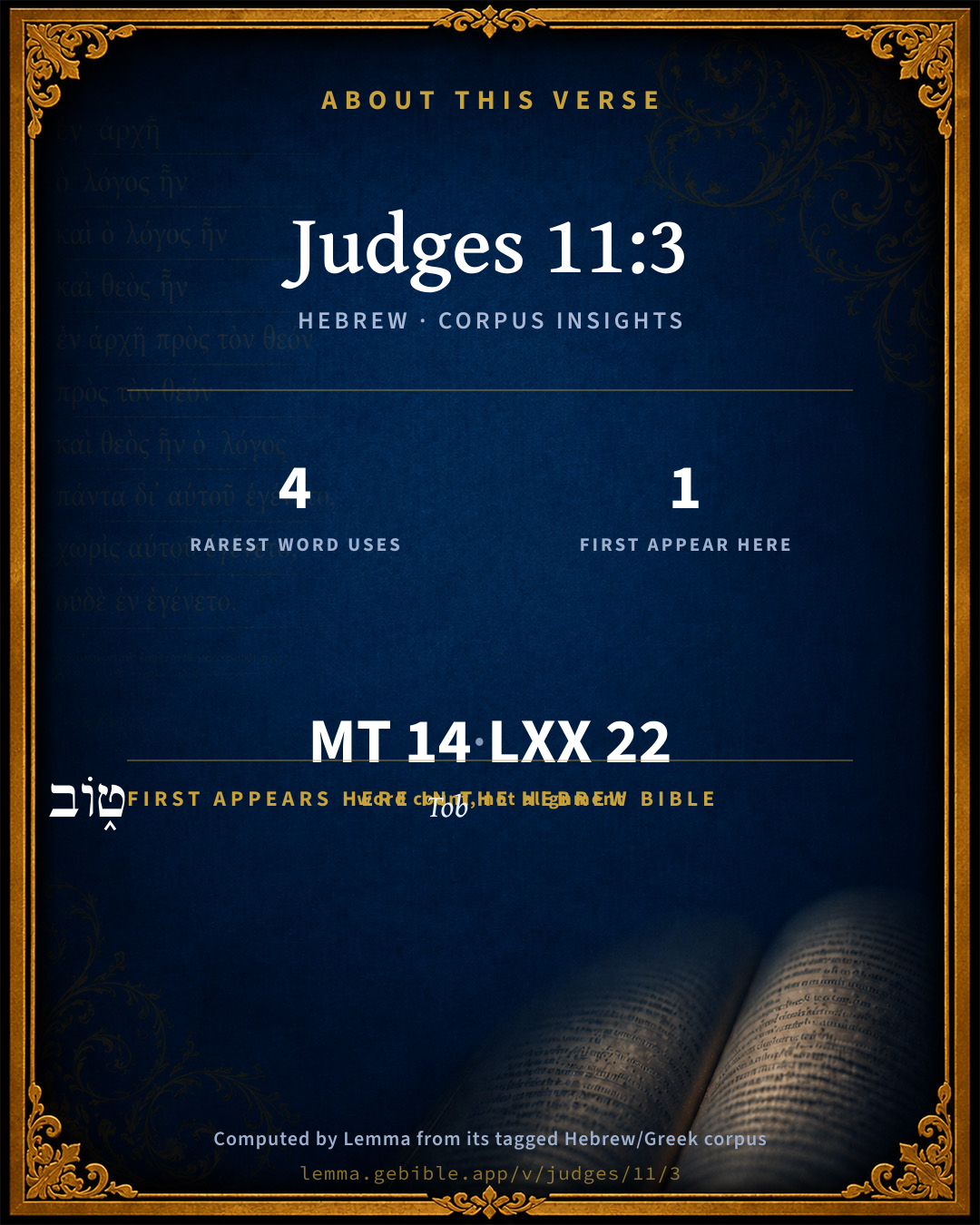
  • 1 first appearance in the Hebrew Bible
Full analysis ↓
Download a study sheet

One document with this verse’s original text, its word-by-word gloss line, the meaning frame, cross-references with their text, attributed commentary, and full source and license credits — printable, and it pastes into notes with its structure intact.

This verse Autodidact and up

Study sheet (.html) Plain text (.txt)

A passage Seminary Student

Up to 50 verses in one chapter. A passage sheet keeps up to 6 commentary sources and 12 cross-references per verse, in the order this page ranks them, and says so on the sheet whenever that leaves anything out. Ask for a single verse and you get the Autodidact verse sheet above.

Everything on this page stays free to read, with no account — the sheet is a download of what is already on screen, not access to it.

Want to remove ads? Support Godless Engineer
Compare translations 3

The same verse in 3 English versions, stacked beneath the original-language interlinear above. Click any original word for its lexicon entry.

Each is an independent rendering of the whole verse — the interlinear is not word-aligned to these translations.

Highlighted words mark where these versions differ — a whole-verse word diff, not a word-by-word alignment.

  • World English Bible Public Domain
    Then Jephthah fled from his brothers, and lived in the land of Tob: and there were gathered vain fellows to Jephthah, and they went out with him.
  • King James Version Public Domain
    Then Jephthah fled from his brethren, and dwelt in the land of Tob: and there were gathered vain men to Jephthah, and went out with him.
  • unfoldingWord Literal Text CC BY-SA 4.0
    So Jephthah fled from the face of his brothers, and he dwelled in the land of Tob. And worthless men collected themselves to Jephthah, and they went out with him.

unfoldingWord Literal Text — © unfoldingWord, licensed CC BY-SA 4.0. Word-aligned USFM3 via Door43 (git.door43.org/unfoldingWord/en_ult).

Versions to compare (up to 4)

3 of 4 selected

Show all 18 translations

Every available English version of this verse, each an independent rendering of the whole verse.

  • World English Bible Public Domain
    Then Jephthah fled from his brothers, and lived in the land of Tob: and there were gathered vain fellows to Jephthah, and they went out with him.
  • Berean Standard Bible Public Domain
    So Jephthah fled from his brothers and settled in the land of Tob, where worthless men gathered around him and traveled with him.
  • Majority Standard Bible Public Domain
    So Jephthah fled from his brothers and settled in the land of Tob, where worthless men gathered around him and traveled with him.
  • King James Version Public Domain
    Then Jephthah fled from his brethren, and dwelt in the land of Tob: and there were gathered vain men to Jephthah, and went out with him.
  • American Standard Version (1901) Public Domain
    Then Jephthah fled from his brethren, and dwelt in the land of Tob: and there were gathered vain fellows to Jephthah, and they went out with him.
  • Revised Version (1885) Public Domain
    Then Jephthah fled from his brethren, and dwelt in the land of Tob: and there were gathered vain fellows to Jephthah, and they went out with him.
  • Geneva Bible (1599) Public Domain
    Then Iphtah fledde from his brethren, and dwelt in the land of Tob: and there gathered idle fellowes to Iphtah, and went out with him.
  • Douay-Rheims (1899) Public Domain
    Then he fled and avoided them and dwelt in the land of Tob: and there were gathered to him needy men, and robbers, and they followed him as their prince.
  • Young's Literal Translation Public Domain
    And Jephthah fleeth from the face of his brethren, and dwelleth in the land of Tob; and vain men gather themselves together unto Jephthah, and they go out with him.
  • Literal Standard Version CC BY-SA 4.0
    And Jephthah flees from the face of his brothers, and dwells in the land of Tob; and vain men gather themselves together to Jephthah, and they go out with him.
  • Unlocked Literal Bible CC BY-SA 4.0
    So Jephthah fled from his brothers and lived in the land of Tob. Lawless men joined Jephthah and they came and went with him.
  • unfoldingWord Literal Text CC BY-SA 4.0
    So Jephthah fled from the face of his brothers, and he dwelled in the land of Tob. And worthless men collected themselves to Jephthah, and they went out with him.
  • Darby Bible Public Domain
    Then Jephthah fled from his brothers, and dwelt in the land of Tob; and worthless fellows collected round Jephthah, and went raiding with him.
  • World Messianic Bible Public Domain
    Then Jephthah fled from his brothers and lived in the land of Tob. Outlaws joined up with Jephthah, and they went out with him.
  • Webster's Bible Public Domain
    Then Jephthah fled from his brethren, and dwelt in the land of Tob: and there were gathered vain men to Jephthah, and they went out with him.
  • Free Bible Version CC BY-SA 4.0
    Jephthah ran away from his brothers and went to live in the land of Tob. A gang of trouble-makers joined him and he led them out on raids.
  • Bible in Basic English Public Domain
    So Jephthah went in flight from his brothers and was living in the land of Tob, where a number of good-for-nothing men, joining Jephthah, went out with him on his undertakings.
  • JPS Tanakh (1917) Public Domain
    Then Jephthah fled from his brethren, and dwelt in the land of Tob; and there were gathered vain fellows to Jephthah, and they went out with him.

Literal Standard Version (2020), Covenant Press — licensed CC BY-SA 4.0. Text via the HelloAO Bible API (eBible.org). Unlocked Literal Bible (unfoldingWord) — licensed CC BY-SA 4.0. Text via the HelloAO Bible API (eBible.org). unfoldingWord Literal Text — © unfoldingWord, licensed CC BY-SA 4.0. Word-aligned USFM3 via Door43 (git.door43.org/unfoldingWord/en_ult). Free Bible Version, Dr. Jonathan Gallagher — licensed CC BY-SA 4.0. Text via the HelloAO Bible API (eBible.org).

Word by word

More ways to search: Search by grammar → Find every occurrence → Compare this word →

Practice this passage: Drill this verse → Learn its vocabulary →

ט֑וֹב
Ṭôwb
H2897
“Tob”
Noun, Proper
Part of Speech
Noun
Type
Proper
Full BDB Definition

Origin: the same as H2896

TWOT: None

Tob = "good" - a region east of the Jordan, north or northeast of Gilead, probably Aramean, location uncertain
  1. וַיִּבְרַ֤ח bârach H1272 “and · to flee” Conjunction + Verb, Qal, Sequential Imperfect, 3rd Person, Masculine, Singular
  2. יִפְתָּח֙ Yiphtâch H3316 “Jephthah” Noun, Proper
  3. מִפְּנֵ֣י pânîym H6440 “from · face(s) of” Preposition + Noun, Common, Both, Plural, Construct
  4. אֶחָ֔יו ʼâch H251 “brothers · his” Noun, Common, Masculine, Plural, Construct + Suffix, Personal, 3rd Person, Masculine, Singular
  5. וַיֵּ֖שֶׁב yâshab H3427 “and · to dwell” Conjunction + Verb, Qal, Sequential Imperfect, 3rd Person, Masculine, Singular
  6. בְּאֶ֣רֶץ ʼerets H776 “in/at · land of” Preposition + Noun, Common, Both, Singular, Construct
  7. וַיִּֽתְלַקְּט֤וּ lâqaṭ H3950 “and · to gather” Conjunction + Verb, Hithpael, Sequential Imperfect, 3rd Person, Masculine, Plural
  8. אֶל ʼêl H413 “to” Preposition
  9. יִפְתָּח֙ Yiphtâch H3316 “Jephthah” Noun, Proper
  10. אֲנָשִׁ֣ים ʼîysh H376 “men” Noun, Common, Masculine, Plural, Absolute
  11. רֵיקִ֔ים rêyq H7386 “empty” Adjective, Adjective, Masculine, Plural, Absolute
  12. וַיֵּצְא֖וּ yâtsâʼ H3318 “and · to go out” Conjunction + Verb, Qal, Sequential Imperfect, 3rd Person, Masculine, Plural
  13. עִמּֽוֹ ʻim H5973 “with · him” Preposition + Suffix, Personal, 3rd Person, Masculine, Singular

About this verse

These counts appear in no published source. They are computed here, from the morphology-tagged text and Lemma’s own curated glosses. What Lemma adds →

14
words
13
distinct lemmas
Historical
section

Notable vocabulary

The rarest word here is ט֑וֹב Tob H2897 — appearing just 4 times in the whole Hebrew Bible.

First appearance in Scripture

This word makes its first canonical appearance in the Hebrew Bible here:

Shared distinctive vocabulary

ט֑וֹב Tob H2897 occurs in 4 verses of the Hebrew Bible. Also found in:

Grammatical profile

  • 4 verbs
  • 7 nouns
  • 1 adjective
  • 2 prepositions

Verb forms

  • וַיִּבְרַ֤ח Qal · Sequential Imperfect
  • וַיֵּ֖שֶׁב Qal · Sequential Imperfect
  • וַיִּֽתְלַקְּט֤וּ Hithpael · Sequential Imperfect
  • וַיֵּצְא֖וּ Qal · Sequential Imperfect

Repetition

A word recurs within this verse — often emphatic in Hebrew:

  • יִפְתָּח֙ Jephthah H3316 ×2

Hebrew & Septuagint length

In English translation the verse runs 27 words from the Hebrew and 27 from the Septuagint (LXX English) — the same length.

A rough comparison of the two English renderings, which tokenize alike — not a word-level alignment.

Word counts can differ between the Hebrew and the Greek without any difference in meaning — e.g. the Hebrew direct-object marker אֵת has no separate Greek word, and Greek often adds the article ὁ.

In the original languages it is 14 Hebrew tokens and 22 Greek tokens — but the two are counted differently (Hebrew bundles its prefixes and suffixes into one token; the Greek is in lemma form), so that isn’t a like-for-like length.

Cross-references

8

Topical passages linked to Judges 11:3 in the Treasury of Scripture Knowledge — connected by theme and wording, ordered by reader-vote popularity; previews shown in the World English Bible.

  • Judges 9:4 They gave him seventy [pieces] of silver out of the house of Baal Berith, with which Abimelech hired vain and light fellows, who followed him.
  • 1 Samuel 22:2 Everyone who was in distress, and everyone who was in debt, and everyone who was discontented, gathered themselves to him; and he became captain over them: and there were with him about four hundred men.
  • 1 Samuel 27:2 David arose, and passed over, he and the six hundred men who were with him, to Achish the son of Maoch, king of Gath.
  • 2 Samuel 10:6 When the children of Ammon saw that they were become odious to David, the children of Ammon sent and hired the Syrians of Beth Rehob, and the Syrians of Zobah, twenty thousand footmen, and the king of Maacah with one thousand men, and the men of Tob twelve thousand men.
  • 2 Samuel 10:8 The children of Ammon came out, and put the battle in array at the entrance of the gate: and the Syrians of Zobah and of Rehob, and the men of Tob and Maacah, were by themselves in the field.
  • Job 30:1–10 "But now those who are younger than I, have me in derision, Whose fathers I would have disdained to put with my sheep dogs.
  • 1 Samuel 30:22–24 Then answered all the wicked men and base fellows, of those who went with David, and said, Because they didn't go with us, we will not give them anything of the spoil that we have recovered, except to every man his wife and his children, that he may lead them away, and depart.
  • Acts 17:5 But the unpersuaded Jews took along some wicked men from the marketplace, and gathering a crowd, set the city in an uproar. Assaulting the house of Jason, they sought to bring them out to the people.

Cross-references courtesy of OpenBible.info (CC BY 4.0).

Hebrew and Greek witnesses Masoretic Hebrew ↔ Greek Septuagint

The same verse in the two great witnesses to the Old Testament, shown verse-for-verse.

These are two independent witnesses, not word-aligned to each other, and the Septuagint is shown in lemma (dictionary) form.

Hebrew Judges 11:3 Masoretic · Westminster Leningrad Codex

וַיִּבְרַ֤ח יִפְתָּח֙ מִפְּנֵ֣י אֶחָ֔יו וַיֵּ֖שֶׁב בְּאֶ֣רֶץ ט֑וֹב וַיִּֽתְלַקְּט֤וּ אֶל יִפְתָּח֙ אֲנָשִׁ֣ים רֵיקִ֔ים וַיֵּצְא֖וּ עִמּֽוֹ

Then Jephthah fled from his brothers, and lived in the land of Tob: and there were gathered vain fellows to Jephthah, and they went out with him.

World English Bible · Public Domain

Greek LXX Judges 11:3 Septuagint · lemma form

καί φεύγω ιεφθαε ἀπό πρόσωπον ἀδελφός αὐτός καί οἰκέω ἐν γῆ τωβ καί συνστρέφω πρός ιεφθαε ἀνήρ κενός καί ἐκἔρχομαι μετά αὐτός

And Jephthae fled from the face of his brethren, and lived in the land of Tob; and vain men gathered to Jephthae, and went out with him.

LXX2012 (modern English Septuagint) · Public Domain

On this verse, Haydock's Catholic Bible Commentary discusses the Septuagint’s reading. Read the note in Commentary ↓

Hebrew: Westminster Leningrad Codex (CC BY 4.0). Greek: Septuagint (public domain); English from LXX2012 (modern English Septuagint) (Public Domain). How the Septuagint differs from the Hebrew →

Targum (Aramaic paraphrase)

1

The Targum is the ancient Jewish Aramaic paraphrase of the Hebrew Scriptures — an interpretive translation, not the Hebrew text itself. Onkelos (literal) and Pseudo-Jonathan (expansive) render the Torah, and Jonathan the Prophets. Coverage is partial: where no permissively-licensed English translation exists for a verse, only the Aramaic is shown. This is verse-level text, not a word-by-word alignment to the Hebrew.

  1. Targum Jonathan Prophets (Joshua–Malachi)
    וַעֲרַק יִפְתַּח מִן קֳדָם אֲחוֹהִי וִיתֵיב בְּאַרְעָא טָבָא וְאִתְכְּנִישׁוּ לְוַת יִפְתַּח גַבְרִין סְרִיקִין וּנְפָקוּ עִמֵיהּ:

    (no public-domain English translation for this verse)

    Targum Jonathan — Aramaic: “Mikraot Gedolot” (public domain). English: “Sefaria Community Translation” (CC0 1.0 (public-domain dedication)); “London "Chaldee Paraphrase," 1871” (public domain). Text via Sefaria.

Commentary

Notes on Judges 11:3 from classic Christian and Jewish commentators (each source and its license shown beneath its notes). The classic Christian expositions comment on the surrounding passage and are grouped to its opening verse, so a note may address several verses; the Jewish commentaries on the Tanakh (Rashi and others) are per-verse, so they appear only where the commentator wrote on this verse.

Lemma curates 59 commentaries, every one of them public domain or Creative Commons licensed, each selected and text-cleaned for this edition rather than reprinted as found. About our sources →

Trapp's Complete Commentary

John Trapp

Jdg 11:3 Then Jephthah fled from his brethren, and dwelt in the land of Tob: and there were gathered vain men to Jephthah, and went out with him.

Ver. 3. Dwelt in the land of Tob.] Or, Of the Tubiemites, as histories call it. Some think it took its name from one Tob, the possessor of it: who might be so surnamed for his goodness, as Aristides was by the Athenians surnamed Justus, and Phocion Bonus. Of Probus the Emperor it was said, Si Probi nomen non haberet, habere cognomen posset: {a} that he was Probus or honest all over.

{a} Flav. Vopisc., in Probo.

John Trapp, A Commentary or Exposition upon All the Books of the Old and New Testament (1647–1656) — public domain. Text from a community e-Sword module.

Joseph Benson's Commentary

Jdg 11:3. Of Tob — The name either of the land, or of the man who was the owner or ruler of it. This place was in or near Gilead, as appears by the speedy intercourse which there was between Jephthah and the Israelites. Vain men — Idle persons, who desired rather to get their living by spoil and rapine, than by honest labour. These evil persons Jephthah managed well, employing them against the enemies of God, and of Israel, that bordered upon them; and particularly against parties of the Ammonites, which made the Israelites more forward to choose him for their chieftain in this war. Went out with him — When he made excursions and attempts upon the enemy.

Joseph Benson's Commentary on the Old and New Testaments (1811–1818) — public domain. Text from a community e-Sword module.

Geneva Bible (1599)

Geneva Bible translators

Where the governor of the country was called Tob.

Joined with him, as some think, against his brethren.

Geneva Bible (1599) marginal notes — public domain. Text via Bolls.life.

Jamieson, Fausset & Brown

Robert Jamieson, A. R. Fausset & David Brown

Jephthah . . . dwelt in the land of Tob--on the north of Gilead, beyond the frontier of the Hebrew territories (Sa2 10:6, Sa2 10:8).

there were gathered vain men to Jephthah--idle, daring, or desperate.

and went out with him--followed him as a military chief. They led a freebooting life, sustaining themselves by frequent incursions on the Ammonites and other neighboring people, in the style of Robin Hood. The same kind of life is led by many an Arab or Tartar still, who as the leader of a band, acquires fame by his stirring or gallant adventures. It is not deemed dishonorable when the expeditions are directed against those out of his own tribe or nation. Jephthah's mode of life was similar to that of David when driven from the court of Saul.

Jamieson, Fausset & Brown — Commentary Critical and Explanatory on the Whole Bible (1871) — public domain (CC PDM 1.0). Text via the HelloAO Bible API.

Adam Clarke's Commentary

Verse 3. There were gathered vain men to Jephthah] אנשים ריקים anashim reykim, empty men - persons destitute of good sense, and profligate in their manners. The word may, however, mean in this place poor persons, without property, and without employment. The versions in general consider them as plunderers.

Adam Clarke's Commentary on the Bible (1810–1826) — public domain. Text from a community e-Sword/MySword module.

Ellicott's Commentary for English Readers

(3) Dwelt in the land of Tob.—A Syrian district on the north-east of Peræa (2Sa_10:6). It is referred to in 1Ma_5:13; 2Ma_12:17. The name means “good,” but lends no sanction to the idle allegories which have been based upon it.

Vain men.—Jdg_9:4.

Went out with him.—Jephthah simply became a sort of Syrian freebooter. His half-heathen origin, no doubt, influenced his character unfavourably, as it had done that of Abimelech.

A Bible Commentary for English Readers, edited by Charles John Ellicott (1878–1897) — public domain. Text from a community e-Sword module.

The Cambridge Bible for Schools and Colleges

gen. ed. J. J. S. Perowne

3. the land of Tob] A Syrian district near the territory of Gilead (Jdg_11:5), 2Sa_10:6; 2Sa_10:8; cf. 1Ma_5:13; 1Ma_5:2 Mace. 12:17 (probably the same place). A town now called eṭ-Ṭaiyibe between Der‘ât and Bostra perhaps preserves the name and indicates the situation.

vain fellows] i.e. worthless fellows, Jdg_9:4, and cf. 1Sa_22:1 f.

The Cambridge Bible for Schools and Colleges (gen. ed. J. J. S. Perowne; Cambridge University Press, 1878–1918) — public domain. Text from a community e-Sword module.

John Gill's Exposition

Then Jephthah fled from his brethren,.... Being ill used by them, and a man of spirit and courage, and could not bear to be treated with contempt, nor to live in a dependence on others, and therefore sought to make himself another way:

and dwelt in the land of Tob; which Kimchi and Ben Gersom think was the name of the lord and owner of the land; Abarbinel interprets it, a good land, as Tob signifies, so the Targum; but others the name of a city or country, and conjecture it may be the same with Ishtob, and which was not far from the children of Ammon, since they sent thither for assistance, Sa2 10:6. Jerom (g) takes it for a country, in which Jephthah dwelt, but says no more of it. Junius says it was on the entrance of Arabia Deserta, in the Apocypha:"Yea, all our brethren that were in the places of Tobie are put to death: their wives and their children also they have carried away captives, and borne away their stuff; and they have destroyed there about a thousand men.'' (1 Maccabees 5:13)"Then departed they from thence seven hundred and fifty furlongs, and came to Characa unto the Jews that are called Tubieni.'' (2 Maccabees 12:17)where the inhabitants of it are called Tobienians or Tubienians:

and there were gathered vain men to Jephthah; not wicked men, but empty men, whose pockets were empty; men without money, as Abarbinel interprets it, had nothing to live upon, no more than Jephthah, and he being a valiant man, they enlisted themselves under him:

and went out with him; not on any bad design, as to rob and plunder, but to get their living by hunting; or rather by making excursions into the enemy's country, and carrying off booty, on which they lived. Josephus (h) says he maintained them at his own expense, and paid them wages.

(g) De loc. Heb. fol. 25. A. (h) Ut supra. (Antiqu. l. 5. c. 7. sect. 7.)

John Gill's Exposition of the Whole Bible (1746–1763) — public domain (CC PDM 1.0). Text via the HelloAO Bible API.

Albert Barnes' Notes on the Bible

The land of Tob - To the north of Gilead, toward Damascus. The readiness with which Jephthah took to the freebooter’s life gives us a lively picture of the unsettled times in which he lived.

Albert Barnes' Notes on the Bible (1834–1885) — public domain. Text from a community e-Sword/MySword module.

Haydock's Catholic Bible Commentary

Tob, to the north of Galaad, of which it is a part. (Josephus) --- It is called Tubim, 1 Machabees v. 13. See 2 Kings x. 6. --- And robbers. This is a farther explication of rekim, poor vain fellows, chap ix. 4. They did not infest the Israelites, but made war on their enemies around; latro, in Latin, often signifies a soldier, particularly such as lived on plunder, as wer reat in Plautus. (Mil. glorios.) Latrocinatus annos decm, mercedem accipio. Some have imagined that Jephte was at the head of some banditti. (St. Augustine, q. 43.) --- But David’s followers were of the same description (1 Kings xxii. 2,) as those of Jephte, men of determined resolution and valour. (Calmet) --- Such a man as Jephte, was therefore a valuable acquisition to the dispirited Israelites; and Providence had inured him to labour, and endued him with extraordinary prudence, notwithstanding his want of education, ver. 12. Necessity has often supplied every deficiency, and produced the most consummate generals. Prince. Hebrew and Septuagint, "and there were gathered unto Jephte vain men, and they went out with him." (Haydock)

George Leo Haydock (1774–1849), Haydock's Catholic Family Bible and Commentary, 1859 edition — public domain. Excludes Psalms (Douay-Rheims chapter numbering differs from Protestant) and Deuterocanonical books (Catholic canon only).

Matthew Poole's English Annotations

The land of Tob, the name either of the land or territory, or of the man who was the owner or ruler of it. This place was in or near Gilead, as appears by the speedy intercourse which here was between Jephthah and the Israelites.

Vain men; idle persons, who desire to get their living rather by spoil and rapine, than by honest and diligent labour. These evilminded persons Jephthah managed well, employing them against the enemies of God and of Israel that bordered upon them; and particularly, upon parties of the Ammonites, which made the Israelites more forward to choose him for their chieftain in this war. Went out with him, when he made excursions and attempts upon his and their enemies.

Matthew Poole's English Annotations on the Holy Bible (1683–1685) — public domain. Text from a community e-Sword/MySword module.

Whedon's Commentary on the Bible

Daniel D. Whedon

3. Fled — Violence and abuse were apparently used in thrusting him out.

Land of Tob — A district lying northeast of Gilead, and apparently between the Syrians and Ammonites. Compare 2Sa_10:6. It has not been identified with any modern name.

Vain men — Loose and desperate characters like those whom Abimelech made his friends.

Jdg_9:4. These eastern deserts were the common resort of such characters. See note on 2Sa_13:37. Jephthah’s mode of life during this period has been aptly compared to that of David when he fled from the court of Saul, and gathered round him a company of lawless characters, (1Sa_22:2,) and also to that of a Scottish border chieftain in the Middle Ages, and that of Robin Hood in England.

Daniel D. Whedon (gen. ed.), Commentary on the Old and New Testaments (1874–1909) — public domain. Text from a community e-Sword module.

The Pulpit Commentary

The land of Tob. This is certainly the same country as is spoken of in Ish-tob, i.e. the men of Tob, of whom 12, 000 were hired by the children of Ammon to fight against David. They are thus named side by side with the men of Beth-Rehob, and Zoba, and Maacah, other small Aramean or Syrian states. (2Sa_10:6, 2Sa_10:8) Tob is again mentioned in all probability in RAPC 1Ma 5:13 2Ma 12:17, and the Thauba of Ptolemy agrees in situation as well as in name with Tob, but no identification with any existing place has been hitherto effected. Vain men, as in Jud_1:9:4.

The Pulpit Commentary (1880–1919), ed. H.D.M. Spence-Jones & Joseph S. Exell — public domain. Text from a community e-Sword module.

John Wesley's Explanatory Notes

Of Tob - The name either of the land, or of the man who was the owner or ruler of it. This place was in, or near Gilead, as appears by the speedy intercourse which here was between Jephthah and the Israelites. Vain men - Idle persons, who desired rather to get their living by spoil and rapine, than by honest labour. These evil persons Jephthah managed well, employing them against the enemies of God, and of Israel, that bordered upon them; and particularly upon parties of the Ammonites, which made the Israelites more forward to chuse him for their chieftain in this war. Went out - When he made excursions and attempts upon the enemy.

John Wesley, Explanatory Notes Upon the Whole Bible (1754–1765) — public domain. Text via the GEBible commentary corpus.

Keil & Delitzsch

C. F. Keil & F. Delitzsch

Jephthah departed from his brothers into the land of Tob, i.e., according to Sa2 10:6, Sa2 10:8, a district in the north-east of Perea, on the border of Syria, or between Syria and Ammonitis, called Τώβιον in 1 Macc. 5:13, or more correctly Τουβίν, according to 2 Macc. 12:17, where loose men gathered round him (cf. Jdg 9:4), and "went out with him," viz., upon warlike and predatory expeditions like the Bedouins.

Keil & Delitzsch — Biblical Commentary on the Old Testament (1861–1891) — public domain (CC PDM 1.0). Text via the HelloAO Bible API. (Old Testament only.)

Lesson kit

Teaching starters — assembled from the data on this page, not authored interpretation. Every prompt links to the verse data it draws on. Edit before teaching.

Judges, in the Historical, opens this verse with 14 words (13 distinct Hebrew lemmas). Its most distinctive word is Ṭôwb (“Tob”). A historical commentator’s framing appears above. Read the whole chapter for the surrounding context.

Discussion questions

  1. How does “Tob” (Ṭôwb) shape what this verse is saying?
  2. This is the first place “Tob” appears in Scripture (first appears here). What does its debut here establish?
  3. How does Judges 11:5, which shares the word «Tob», read alongside this verse?
  4. What does the repetition of “Jephthah” (2× in this one verse) do in this verse?
  5. These translations render this verse differently; the difference is in the English rendering, not the original. What questions does that raise?
  6. «וַיִּבְרַ֤ח» is a Qal Sequential Imperfect verb. How does that grammatical form shape the action described?
  7. Compare how Trapp's Complete Commentary and Joseph Benson's Commentary read this verse. Where do they agree or differ?

Things to notice

Reading settings

Reading text

Shown beneath each verse's original-language words.

Old Testament
Old Testament edition

Read the OT as the Masoretic Hebrew (MT) or the Greek Septuagint (LXX).

English shown for the Greek Septuagint (in the Hebrew ↔ Greek comparison).

Comparing translations? Open the Compare panel on any verse page to stack up to four side by side.