Numbers 24:11

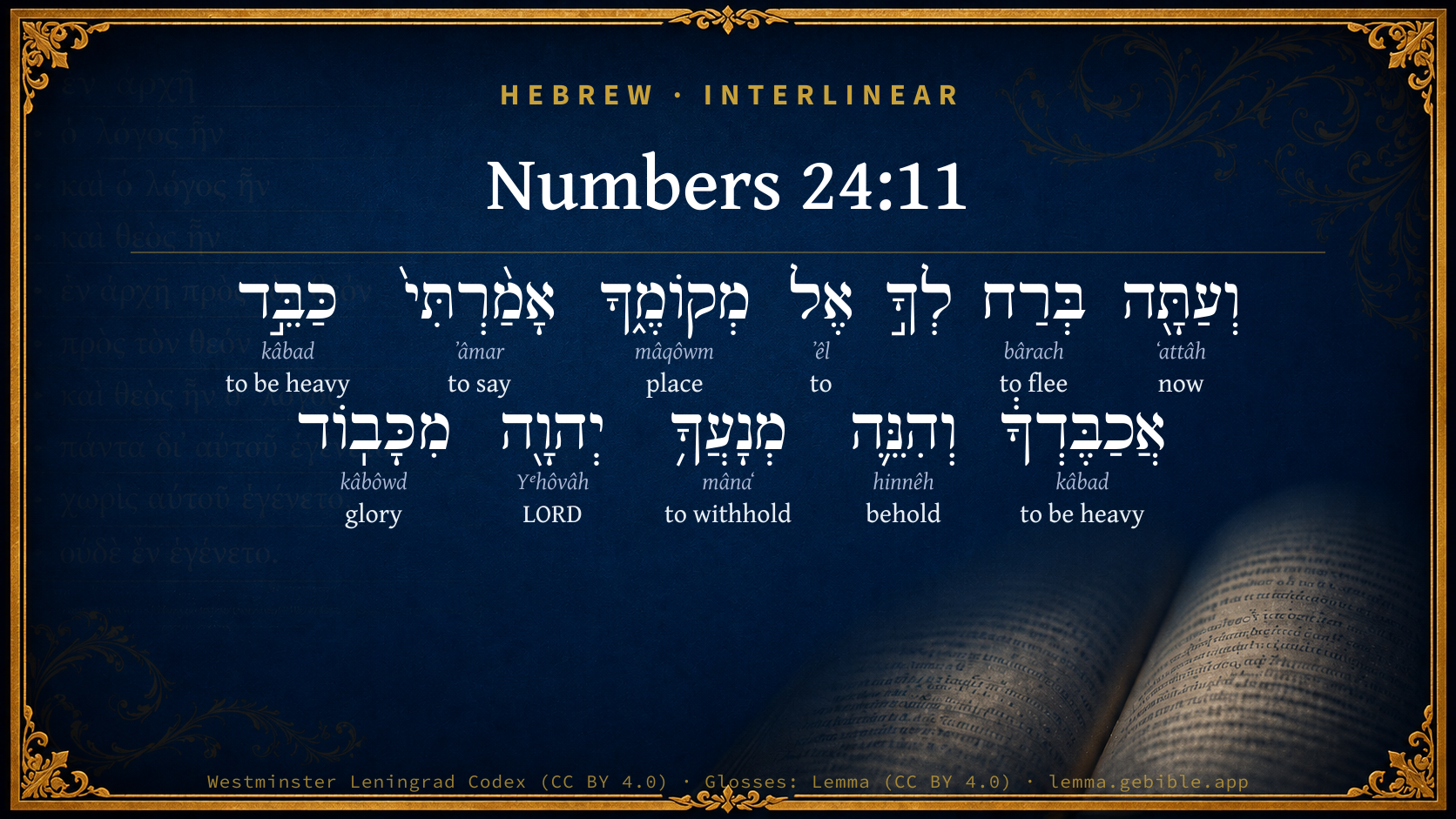
Hebrew (Westminster Leningrad Codex) Numbers 24:11 appears in the Hebrew Old Testament. The text above is from the Westminster Leningrad Codex. Each word links to its Strong’s number, a concise gloss, and parsing drawn from the Open Scriptures Hebrew Bible morphology. Click any word for its full Brown-Driver-Briggs (BDB) entry.
Download image
Cite this verse

Numbers 24:11 (World English Bible). Public Domain. Lemma interlinear Bible study tool, https://lemma.gebible.app/v/numbers/24/11.

Show BibTeX & RIS
BibTeX
RIS
English Translation
Therefore now flee you to your place: I thought to promote you to great honor; but, behold, Yahweh has kept you back from honor.
World English Bible · Public Domain
Download a study sheet

One document with this verse’s original text, its word-by-word gloss line, the meaning frame, cross-references with their text, attributed commentary, and full source and license credits — printable, and it pastes into notes with its structure intact.

This verse Autodidact and up

Study sheet (.html) Plain text (.txt)

A passage Seminary Student

Up to 50 verses in one chapter. A passage sheet keeps up to 6 commentary sources and 12 cross-references per verse, in the order this page ranks them, and says so on the sheet whenever that leaves anything out. Ask for a single verse and you get the Autodidact verse sheet above.

Everything on this page stays free to read, with no account — the sheet is a download of what is already on screen, not access to it.

Want to remove ads? Support Godless Engineer
Compare translations 3

The same verse in 3 English versions, stacked beneath the original-language interlinear above. Click any original word for its lexicon entry.

Each is an independent rendering of the whole verse — the interlinear is not word-aligned to these translations.

Highlighted words mark where these versions differ — a whole-verse word diff, not a word-by-word alignment.

  • World English Bible Public Domain
    Therefore now flee you to your place: I thought to promote you to great honor; but, behold, Yahweh has kept you back from honor.
  • King James Version Public Domain
    Therefore now flee thou to thy place: I thought to promote thee unto great honor; but, lo, the LORD hath kept thee back from honor.
  • unfoldingWord Literal Text CC BY-SA 4.0
    And now, flee for yourself to your place. I said I would honor you greatly, and behold, Yahweh has held you back from honor.”

unfoldingWord Literal Text — © unfoldingWord, licensed CC BY-SA 4.0. Word-aligned USFM3 via Door43 (git.door43.org/unfoldingWord/en_ult).

Versions to compare (up to 4)

3 of 4 selected

Show all 18 translations

Every available English version of this verse, each an independent rendering of the whole verse.

  • World English Bible Public Domain
    Therefore now flee you to your place: I thought to promote you to great honor; but, behold, Yahweh has kept you back from honor.
  • Berean Standard Bible Public Domain
    Therefore, flee at once to your home! I said I would richly reward you, but instead the LORD has denied your reward.”
  • Majority Standard Bible Public Domain
    Therefore, flee at once to your home! I said I would reward you richly, but instead the LORD has denied your reward.”
  • King James Version Public Domain
    Therefore now flee thou to thy place: I thought to promote thee unto great honor; but, lo, the LORD hath kept thee back from honor.
  • American Standard Version (1901) Public Domain
    Therefore now flee thou to thy place: I thought to promote thee unto great honor; but, lo, Jehovah hath kept thee back from honor.
  • Revised Version (1885) Public Domain
    Therefore now flee thou to thy place: I thought to promote thee unto great honour; but, lo, the LORD hath kept thee back from honour.
  • Geneva Bible (1599) Public Domain
    Therefore nowe flee vnto thy place: I thought surely to promote thee vnto honour, but loe, the Lord hath kept thee backe from honour.
  • Douay-Rheims (1899) Public Domain
    Return to thy place. I had determined indeed greatly to honour thee, but the Lord hath deprived thee of the honour designed for thee.
  • Young's Literal Translation Public Domain
    and now, flee for thyself unto thy place; I have said, I do greatly honour thee, and lo, Jehovah hath kept thee back from honour.'
  • Literal Standard Version CC BY-SA 4.0
    and now, flee for yourself to your place; I have said, I greatly honor you, and behold, YHWH has kept you back from honor.”
  • Unlocked Literal Bible CC BY-SA 4.0
    So leave me right now and go home. I said I would greatly reward you, but Yahweh has kept you from getting any reward.”
  • unfoldingWord Literal Text CC BY-SA 4.0
    And now, flee for yourself to your place. I said I would honor you greatly, and behold, Yahweh has held you back from honor.”
  • Darby Bible Public Domain
    And now flee thou to thy place; I said I would very highly honour thee, and behold, Jehovah has kept thee back from honour.
  • World Messianic Bible Public Domain
    Therefore, flee to your place, now! I thought to promote you to great honor; but, behold, the LORD has kept you back from honor.”
  • Webster's Bible Public Domain
    Therefore now flee thou to thy place: I thought to promote thee to great honor; but lo, the LORD hath kept thee back from honor.
  • Free Bible Version CC BY-SA 4.0
    Leave right now! Go home! I promised to pay you well, but the Lord has made sure you wouldn't receive any payment.”
  • Bible in Basic English Public Domain
    Go back quickly to the place you came from: it was my purpose to give you a place of honour, but now the Lord has kept you back from honour.
  • JPS Tanakh (1917) Public Domain
    Therefore now flee thou to thy place; I thought to promote thee unto great honour; but, lo, the LORD hath kept thee back from honour.'

Literal Standard Version (2020), Covenant Press — licensed CC BY-SA 4.0. Text via the HelloAO Bible API (eBible.org). Unlocked Literal Bible (unfoldingWord) — licensed CC BY-SA 4.0. Text via the HelloAO Bible API (eBible.org). unfoldingWord Literal Text — © unfoldingWord, licensed CC BY-SA 4.0. Word-aligned USFM3 via Door43 (git.door43.org/unfoldingWord/en_ult). Free Bible Version, Dr. Jonathan Gallagher — licensed CC BY-SA 4.0. Text via the HelloAO Bible API (eBible.org).

Word by word

More ways to search: Search by grammar → Find every occurrence → Compare this word →

Practice this passage: Drill this verse → Learn its vocabulary →

מְנָעֲךָ֥
mânaʻ
H4513
“to withhold · you”
Verb, Qal, Perfect, 3rd Person, Masculine, Singular + Suffix, Personal, 2nd Person, Masculine, Singular
Part of Speech
Verb
Stem
Qal
Form
Perfect
Person
3rd Person
Gender
Masculine
Number
Singular
Full BDB Definition

Origin: a primitive root

TWOT: 1216

to withhold, hold back, keep back, refrain, deny, keep restrain, hinder - (Qal) to withhold - (Niphal) to be withheld
  1. וְעַתָּ֖ה ʻattâh H6258 “and · now” Conjunction + Adverb
  2. בְּרַח bârach H1272 “flee” Verb, Qal, Imperative, 2nd Person, Masculine, Singular
  3. אֶל ʼêl H413 “to” Preposition
  4. מְקוֹמֶ֑ךָ mâqôwm H4725 “place · your” Noun, Common, Masculine, Singular, Construct + Suffix, Personal, 2nd Person, Masculine, Singular
  5. אָמַ֨רְתִּי֙ ʼâmar H559 “to say” Verb, Qal, Perfect, 1st Person, Common, Singular
  6. כַּבֵּ֣ד kâbad H3513 “to be heavy” Verb, Piel, Infinitive Absolute
  7. אֲכַבֶּדְךָ֔ kâbad H3513 “to be heavy · you” Verb, Piel, Imperfect, 1st Person, Common, Singular + Suffix, Personal, 2nd Person, Masculine, Singular
  8. וְהִנֵּ֛ה hinnêh H2009 “and · behold” Conjunction + Particle, Demonstrative
  9. יְהוָ֖ה Yᵉhôvâh H3068 “LORD” Noun, Proper
  10. מִכָּבֽוֹד kâbôwd H3519 “from · glory” Preposition + Noun, Common, Both, Singular, Absolute

About this verse

These counts appear in no published source. They are computed here, from the morphology-tagged text and Lemma’s own curated glosses. What Lemma adds →

12
words
10
distinct lemmas
Pentateuch
section

Shared distinctive vocabulary

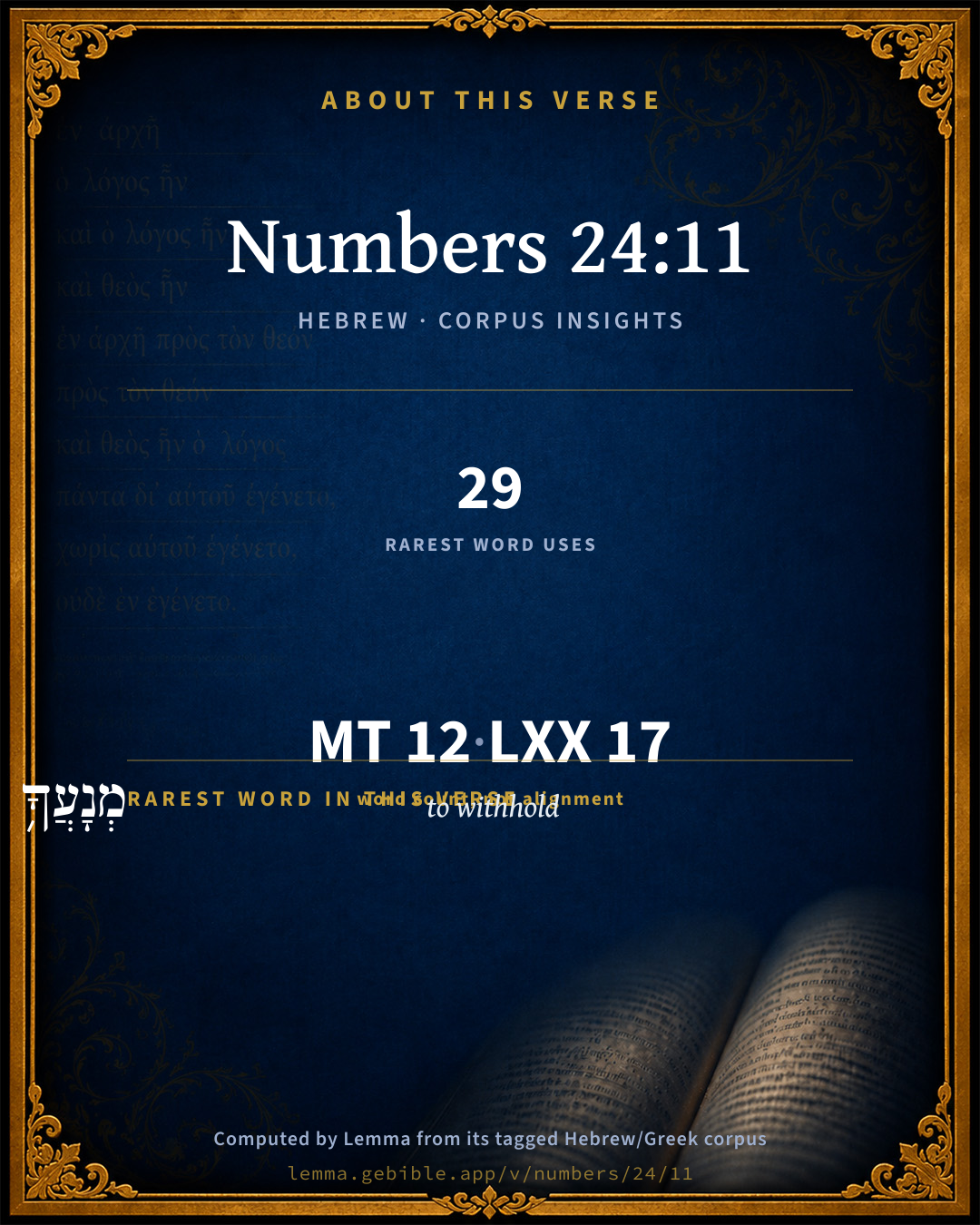
מְנָעֲךָ֥ to withhold H4513 occurs in 29 verses of the Hebrew Bible. Also found in:

Grammatical profile

  • 5 verbs
  • 3 nouns
  • 2 prepositions
  • 1 adverb
  • 1 particle

Verb forms

  • בְּרַח Qal · Imperative
  • אָמַ֨רְתִּי֙ Qal · Perfect
  • כַּבֵּ֣ד Piel · Infinitive Absolute
  • אֲכַבֶּדְךָ֔ Piel · Imperfect
  • מְנָעֲךָ֥ Qal · Perfect

Repetition

A word recurs within this verse — often emphatic in Hebrew:

  • כַּבֵּ֣ד to be heavy H3513 ×2

Hebrew & Septuagint length

In English translation the verse runs 24 words from the Hebrew and 21 from the Septuagint (LXX English) — closely comparable.

A rough comparison of the two English renderings, which tokenize alike — not a word-level alignment.

Word counts can differ between the Hebrew and the Greek without any difference in meaning — e.g. the Hebrew direct-object marker אֵת has no separate Greek word, and Greek often adds the article ὁ.

In the original languages it is 12 Hebrew tokens and 17 Greek tokens — but the two are counted differently (Hebrew bundles its prefixes and suffixes into one token; the Greek is in lemma form), so that isn’t a like-for-like length.

Cross-references

8

Topical passages linked to Numbers 24:11 in the Treasury of Scripture Knowledge — connected by theme and wording, ordered by reader-vote popularity; previews shown in the World English Bible.

  • Numbers 22:17 for I will promote you to very great honor, and whatever you say to me I will do. Please come therefore, and curse this people for me.
  • Numbers 22:37 Balak said to Balaam, Didn't I earnestly send to you to call you? why didn't you come to me? am I not able indeed to promote you to honor?
  • Matthew 19:28–30 Jesus said to them, "Most assuredly I tell you that you who have followed me, in the regeneration when the Son of Man will sit on the throne of his glory, you also will sit on twelve thrones, judging the twelve tribes of Israel.
  • Acts 8:20 But Peter said to him, "May your silver perish with you, because you thought you could obtain the gift of God with money!
  • Philippians 3:8 Yes most assuredly, and I count all things to be loss for the excellency of the knowledge of Christ Jesus, my Lord, for whom I suffered the loss of all things, and count them nothing but refuse, that I may gain Christ
  • Hebrews 11:24–26 By faith, Moses, when he had grown up, refused to be called the son of Pharaoh's daughter,
  • 1 Peter 5:2–3 Shepherd the flock of God which is among you, exercising the oversight, not under compulsion, but voluntarily, not for dishonest gain, but willingly;
  • 2 John 1:8 Watch yourselves, that we don't lose the things which we have accomplished, but that we receive a full reward.

Cross-references courtesy of OpenBible.info (CC BY 4.0).

Hebrew and Greek witnesses Masoretic Hebrew ↔ Greek Septuagint

The same verse in the two great witnesses to the Old Testament, shown verse-for-verse.

These are two independent witnesses, not word-aligned to each other, and the Septuagint is shown in lemma (dictionary) form.

Hebrew Numbers 24:11 Masoretic · Westminster Leningrad Codex

וְעַתָּ֖ה בְּרַח לְךָ֣ אֶל מְקוֹמֶ֑ךָ אָמַ֨רְתִּי֙ כַּבֵּ֣ד אֲכַבֶּדְךָ֔ וְהִנֵּ֛ה מְנָעֲךָ֥ יְהוָ֖ה מִכָּבֽוֹד

Therefore now flee you to your place: I thought to promote you to great honor; but, behold, Yahweh has kept you back from honor.

World English Bible · Public Domain

Greek LXX Numbers 24:11 Septuagint · lemma form

νῦν οὖν φεύγω εἰς ὁ τόπος σύ εἶπον τιμάω σύ καί νῦν στερέω σύ κύριος ὁ δόξα

Now therefore flee to your place: I said, I will honor you, but now the Lord has deprived you of glory.

LXX2012 (modern English Septuagint) · Public Domain

Hebrew: Westminster Leningrad Codex (CC BY 4.0). Greek: Septuagint (public domain); English from LXX2012 (modern English Septuagint) (Public Domain). How the Septuagint differs from the Hebrew →

Targum (Aramaic paraphrase)

2

The Targum is the ancient Jewish Aramaic paraphrase of the Hebrew Scriptures — an interpretive translation, not the Hebrew text itself. Onkelos (literal) and Pseudo-Jonathan (expansive) render the Torah, and Jonathan the Prophets. Coverage is partial: where no permissively-licensed English translation exists for a verse, only the Aramaic is shown. This is verse-level text, not a word-by-word alignment to the Hebrew.

  1. Targum Onkelos Torah (Genesis–Deuteronomy)
    וּכְעַן אִזֵיל לָךְ לְאַתְרָךְ אֲמָרִית יְקָרָא אֲיַקְרִינָךְ וְהָא מְנָעָךְ יְיָ מִן יְקָר

    (no public-domain English translation for this verse)

    Targum Onkelos — Aramaic: “Onkelos Genesis” (public domain); “Onkelos Exodus” (public domain); “Onkelos Leviticus” (public domain); “Onkelos Numbers” (public domain); “Onkelos Deuteronomy” (public domain). English: “Sefaria Community Translation” (CC0 1.0 (public-domain dedication)); “J.W. Etheridge. The Targums of Onkelos and Jonathan Ben Uzziel on the Pentateuch. London: Longmans, Green, 1862” (public domain). Text via Sefaria.

  2. Targum Pseudo-Jonathan Torah (Genesis–Deuteronomy)
    וּכְדוֹן עֲרוֹק לָךְ לְאַתְרָךְ אֲמָרִית מְיַקְרָא אֲיַקְרִינָךְ וְהָא מְנַע יְיָ לְבִלְעָם מִן יְקָרָא

    And now flee to thy place. I had said that honouring I would honour thee; but, behold, the Lord hath kept back Bileam from honour.

    Targum Pseudo-Jonathan — Aramaic: “Targum Jonathan on Genesis” (public domain); “Targum Jonathan on Exodus” (public domain); “Targum Jonathan on Leviticus” (public domain); “Targum Jonathan on Numbers” (public domain); “Targum Jonathan on Deuteronomy” (public domain). English: “The Targum of Jonathan ben Uzziel, trans. J. W. Etheridge, London, 1862” (public domain). Text via Sefaria.

Commentary

Notes on Numbers 24:11 from classic Christian and Jewish commentators (each source and its license shown beneath its notes). The classic Christian expositions comment on the surrounding passage and are grouped to its opening verse, so a note may address several verses; the Jewish commentaries on the Tanakh (Rashi and others) are per-verse, so they appear only where the commentator wrote on this verse.

Lemma curates 59 commentaries, every one of them public domain or Creative Commons licensed, each selected and text-cleaned for this edition rather than reprinted as found. About our sources →

Geneva Bible (1599)

Geneva Bible translators

Thus the wicked burden God when they cannot compass their wicked enterprises.

Geneva Bible (1599) marginal notes — public domain. Text via Bolls.life.

Adam Clarke's Commentary

Verse 11. Lo, the Lord hath kept thee back from honour.] A bitter and impious sarcasm. "Hadst thou cursed this people, I would have promoted thee to great honour; but thou hast chosen to follow the directions of Jehovah rather than mine, and what will he do for thee?"

Adam Clarke's Commentary on the Bible (1810–1826) — public domain. Text from a community e-Sword/MySword module.

Ellicott's Commentary for English Readers

(11) The Lord hath kept thee back from honour.—These words may have been spoken ironically, or Balak may have been convinced of the supernatural influence under which the words of Balaam were uttered. (See Num_23:27, and Note.)

A Bible Commentary for English Readers, edited by Charles John Ellicott (1878–1897) — public domain. Text from a community e-Sword module.

John Gill's Exposition

Therefore now flee thou to thy place,.... His own country, from whence Balak had sent for him, and he came; begone directly, make all haste away; he speaks as one so provoked, that he could not bear him in his presence, and as threatening him if he did not at once get out of his sight:

I thought to promote thee unto great honour; to bestow much wealth and riches upon him, and to prefer him in his court to high offices of honour and dignity; he had promised that he would, and he thought as he said, he was determined upon it, had he performed as he expected:

but, lo, the Lord hath kept thee back from honour; the Lord thou hast so much talked of, and at whose beck and command thou hast been, and by whom thou hast been checked and controlled, he has hindered thee from riches and honour; see what thou hast got, or rather lost, by hearkening to him, and how he will pay thee for it.

John Gill's Exposition of the Whole Bible (1746–1763) — public domain (CC PDM 1.0). Text via the HelloAO Bible API.

Haydock's Catholic Bible Commentary

Honour, or reward.

George Leo Haydock (1774–1849), Haydock's Catholic Family Bible and Commentary, 1859 edition — public domain. Excludes Psalms (Douay-Rheims chapter numbering differs from Protestant) and Deuterocanonical books (Catholic canon only).

Matthew Poole's English Annotations

Flee thou to thy place, whence I sent for thee, Num 22:5. The Lord, whose commands thou hast preferred before my desires and interest; and therefore seek thy recompence from him, and not from me.

Matthew Poole's English Annotations on the Holy Bible (1683–1685) — public domain. Text from a community e-Sword/MySword module.

Whedon's Commentary on the Bible

Daniel D. Whedon

11. Now flee — Away with you immediately! Here is no threat, but rather disgust. Balaam did not obey. Num_31:8.

The Lord hath kept thee back — A piece of stinging irony, scoffing at Balaam’s trust in Jehovah.

Honour — Promised in Num_22:17.

Daniel D. Whedon (gen. ed.), Commentary on the Old and New Testaments (1874–1909) — public domain. Text from a community e-Sword module.

John Wesley's Explanatory Notes

The Lord - Whose commands thou hast preferred before my desires and interest; and therefore seek thy recompence from him, and not from me.

John Wesley, Explanatory Notes Upon the Whole Bible (1754–1765) — public domain. Text via the GEBible commentary corpus.

Lesson kit

Teaching starters — assembled from the data on this page, not authored interpretation. Every prompt links to the verse data it draws on. Edit before teaching.

Numbers, in the Pentateuch, opens this verse with 12 words (10 distinct Hebrew lemmas). Its most distinctive word is mânaʻ (“to withhold”). A historical commentator’s framing appears above. Read the whole chapter for the surrounding context.

Discussion questions

  1. How does “to withhold” (mânaʻ) shape what this verse is saying?
  2. Genesis 30:2 shares the word «to withhold» with this verse. How do the two illuminate each other?
  3. “to be heavy” occurs 2× in this one verse. What is the effect of the repetition?
  4. The translations on this page render this verse differently — a whole-verse word diff, not a word-by-word alignment. What might account for the different wordings?
  5. The verb «בְּרַח» is Qal Imperative. How does its form color the action?
  6. Reading how Geneva Bible (1599) and Adam Clarke's Commentary read this verse, where do the two commentators agree and where do they part?

Things to notice

Reading settings

Reading text

Shown beneath each verse's original-language words.

Old Testament
Old Testament edition

Read the OT as the Masoretic Hebrew (MT) or the Greek Septuagint (LXX).

English shown for the Greek Septuagint (in the Hebrew ↔ Greek comparison).

Comparing translations? Open the Compare panel on any verse page to stack up to four side by side.