
Joshua 10:16

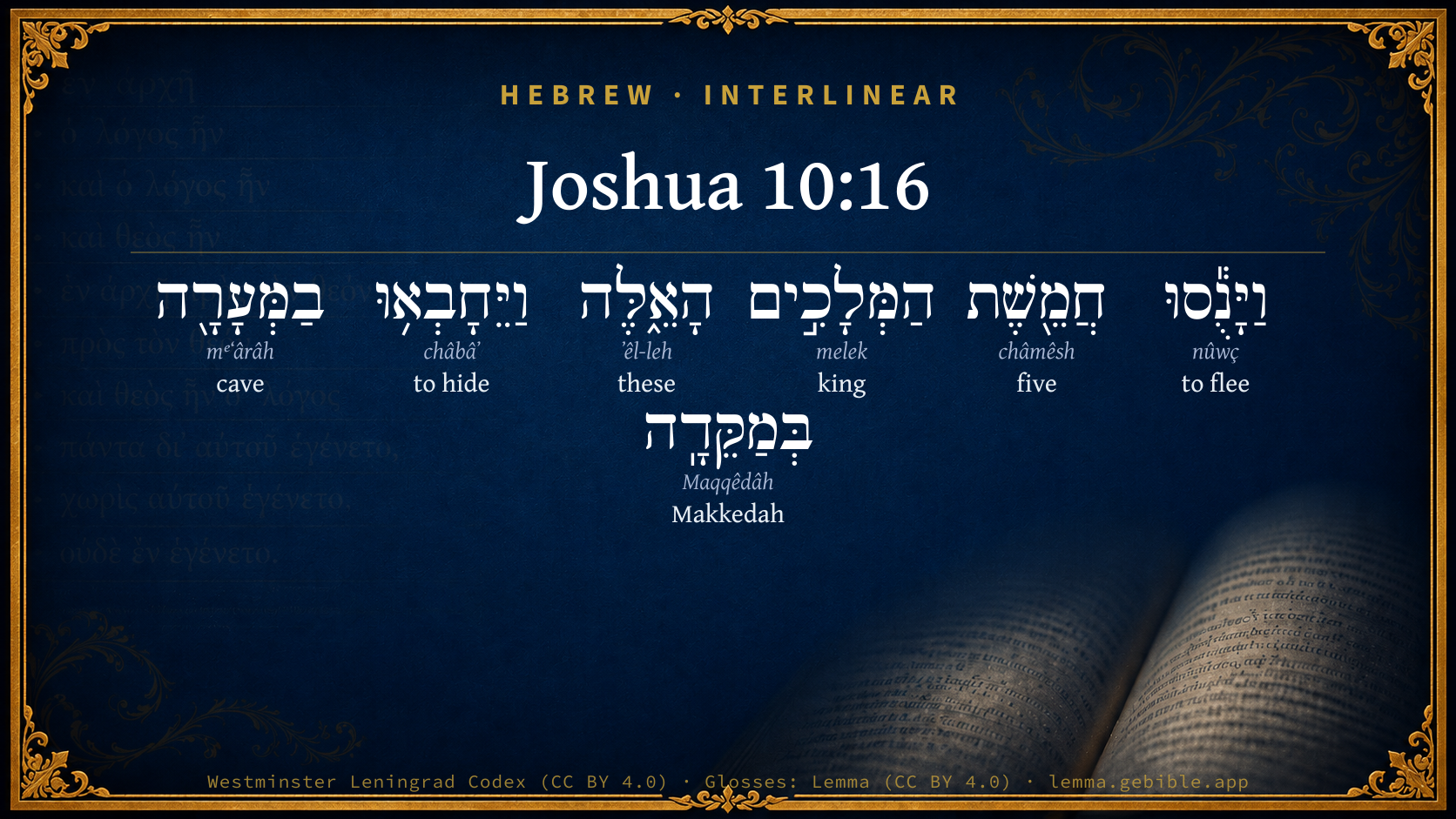
Hebrew (Westminster Leningrad Codex) Joshua 10:16 appears in the Hebrew Old Testament. The text above is from the Westminster Leningrad Codex. Each word links to its Strong’s number, a concise gloss, and parsing drawn from the Open Scriptures Hebrew Bible morphology. Click any word for its full Brown-Driver-Briggs (BDB) entry.
Download image
Cite this verse

Joshua 10:16 (World English Bible). Public Domain. Lemma interlinear Bible study tool, https://lemma.gebible.app/v/joshua/10/16.

Show BibTeX & RIS
BibTeX
RIS
English Translation
These five kings fled, and hid themselves in the cave at Makkedah.
World English Bible · Public Domain
Download a study sheet

One document with this verse’s original text, its word-by-word gloss line, the meaning frame, cross-references with their text, attributed commentary, and full source and license credits — printable, and it pastes into notes with its structure intact.

This verse Autodidact and up

Study sheet (.html) Plain text (.txt)

A passage Seminary Student

Up to 50 verses in one chapter. A passage sheet keeps up to 6 commentary sources and 12 cross-references per verse, in the order this page ranks them, and says so on the sheet whenever that leaves anything out. Ask for a single verse and you get the Autodidact verse sheet above.

Everything on this page stays free to read, with no account — the sheet is a download of what is already on screen, not access to it.

Want to remove ads? Support Godless Engineer
Compare translations 3

The same verse in 3 English versions, stacked beneath the original-language interlinear above. Click any original word for its lexicon entry.

Each is an independent rendering of the whole verse — the interlinear is not word-aligned to these translations.

Highlighted words mark where these versions differ — a whole-verse word diff, not a word-by-word alignment.

  • World English Bible Public Domain
    These five kings fled, and hid themselves in the cave at Makkedah.
  • King James Version Public Domain
    But these five kings fled, and hid themselves in a cave at Makkedah.
  • unfoldingWord Literal Text CC BY-SA 4.0
    And these five kings had fled and hidden themselves in the cave at Makkedah.

unfoldingWord Literal Text — © unfoldingWord, licensed CC BY-SA 4.0. Word-aligned USFM3 via Door43 (git.door43.org/unfoldingWord/en_ult).

Versions to compare (up to 4)

3 of 4 selected

Show all 18 translations

Every available English version of this verse, each an independent rendering of the whole verse.

  • World English Bible Public Domain
    These five kings fled, and hid themselves in the cave at Makkedah.
  • Berean Standard Bible Public Domain
    Now the five kings had fled and hidden in the cave at Makkedah.
  • Majority Standard Bible Public Domain
    Now the five kings had fled and hidden in the cave at Makkedah.
  • King James Version Public Domain
    But these five kings fled, and hid themselves in a cave at Makkedah.
  • American Standard Version (1901) Public Domain
    And these five kings fled, and hid themselves in the cave at Makkedah.
  • Revised Version (1885) Public Domain
    And these five kings fled, and hid themselves in the cave at Makkedah.
  • Geneva Bible (1599) Public Domain
    But the fiue Kings fled and were hid in a caue at Makkedah.
  • Douay-Rheims (1899) Public Domain
    For the five kings were fled, and had hidden themselves in a cave of the city of Maceda.
  • Young's Literal Translation Public Domain
    And these five kings flee, and are hidden in a cave at Makkedah,
  • Literal Standard Version CC BY-SA 4.0
    And these five kings flee, and are hidden in a cave at Makkedah,
  • Unlocked Literal Bible CC BY-SA 4.0
    Now the five kings had escaped and hidden themselves in the cave at Makkedah.
  • unfoldingWord Literal Text CC BY-SA 4.0
    And these five kings had fled and hidden themselves in the cave at Makkedah.
  • Darby Bible Public Domain
    And these five kings fled, and hid themselves in the cave at Makkedah.
  • World Messianic Bible Public Domain
    These five kings fled, and hid themselves in the cave at Makkedah.
  • Webster's Bible Public Domain
    But these five kings fled, and hid themselves in a cave at Makkedah.
  • Free Bible Version CC BY-SA 4.0
    The five kings had run away and hid in a cave at Makkedah.
  • Bible in Basic English Public Domain
    But these five kings went in flight secretly to a hole in the rock at Makkedah.
  • JPS Tanakh (1917) Public Domain
    And these five kings fled, and hid themselves in the cave at Makkedah.

Literal Standard Version (2020), Covenant Press — licensed CC BY-SA 4.0. Text via the HelloAO Bible API (eBible.org). Unlocked Literal Bible (unfoldingWord) — licensed CC BY-SA 4.0. Text via the HelloAO Bible API (eBible.org). unfoldingWord Literal Text — © unfoldingWord, licensed CC BY-SA 4.0. Word-aligned USFM3 via Door43 (git.door43.org/unfoldingWord/en_ult). Free Bible Version, Dr. Jonathan Gallagher — licensed CC BY-SA 4.0. Text via the HelloAO Bible API (eBible.org).

Word by word

More ways to search: Search by grammar → Find every occurrence → Compare this word →

Practice this passage: Drill this verse → Learn its vocabulary →

בְּמַקֵּדָֽה
Maqqêdâh
H4719
“in/at · Makkedah”
Preposition + Noun, Proper
Part of Speech
Preposition + Noun
Type
Proper
Full BDB Definition

Origin: from the same as H5348 in the denominative sense of herding (compare H5349 )

TWOT: None

Makkedah = "place of shepherds" - the location of a cave in Judah where Joshua captured and executed five Canaanite kings during the conquest; located near Bethhoron and Libnah
  1. וַיָּנֻ֕סוּ nûwç H5127 “and · to flee” Conjunction + Verb, Qal, Sequential Imperfect, 3rd Person, Masculine, Plural
  2. חֲמֵ֖שֶׁת châmêsh H2568 “five” Adjective, Cardinal number, Masculine, Singular, Construct
  3. הַמְּלָכִ֣ים melek H4428 “the · kings” Particle, Definite Article + Noun, Common, Masculine, Plural, Absolute
  4. הָאֵ֑לֶּה ʼêl-leh H428 “the · these” Particle, Definite Article + Pronoun, Demonstrative, Common, Plural
  5. וַיֵּחָבְא֥וּ châbâʼ H2244 “and · to hide” Conjunction + Verb, Niphal, Sequential Imperfect, 3rd Person, Masculine, Plural
  6. בַמְּעָרָ֖ה mᵉʻârâh H4631 “in/at the · cave” Preposition, Determined + Noun, Common, Feminine, Singular, Absolute

About this verse

These counts appear in no published source. They are computed here, from the morphology-tagged text and Lemma’s own curated glosses. What Lemma adds →

7
words
7
distinct lemmas
Historical
section

Notable vocabulary

The rarest word here is בְּמַקֵּדָֽה Makkedah H4719 — appearing just 9 times in the whole Hebrew Bible.

Shared distinctive vocabulary

בְּמַקֵּדָֽה Makkedah H4719 occurs in 8 verses of the Hebrew Bible. Also found in:

Grammatical profile

  • 2 verbs
  • 3 nouns
  • 1 adjective
  • 1 pronoun

Verb forms

  • וַיָּנֻ֕סוּ Qal · Sequential Imperfect
  • וַיֵּחָבְא֥וּ Niphal · Sequential Imperfect

Hebrew & Septuagint length

In English translation the verse runs 12 words from the Hebrew and 15 from the Septuagint (LXX English) — closely comparable.

A rough comparison of the two English renderings, which tokenize alike — not a word-level alignment.

Word counts can differ between the Hebrew and the Greek without any difference in meaning — e.g. the Hebrew direct-object marker אֵת has no separate Greek word, and Greek often adds the article ὁ.

Cross-references

12

Topical passages linked to Joshua 10:16 in the Treasury of Scripture Knowledge — connected by theme and wording, ordered by reader-vote popularity; previews shown in the World English Bible.

  • Judges 6:2 The hand of Midian prevailed against Israel; and because of Midian the children of Israel made them the dens which are in the mountains, and the caves, and the strongholds.
  • 1 Samuel 13:6 When the men of Israel saw that they were in a strait (for the people were distressed), then the people did hide themselves in caves, and in thickets, and in rocks, and in coverts, and in pits.
  • 1 Samuel 24:3 He came to the sheep pens by the way, where was a cave; and Saul went in to cover his feet. Now David and his men were abiding in the innermost parts of the cave.
  • 1 Samuel 24:8 David also arose afterward, and went out of the cave, and cried after Saul, saying, My lord the king. When Saul looked behind him, David bowed with his face to the earth, and did obeisance.
  • Psalms 48:4–6 For, behold, the kings assembled themselves, They passed by together.
  • Psalms 139:7–10 Where could I go from your Spirit? Or where could I flee from your presence?
  • Isaiah 2:10–12 Enter into the rock, And hide in the dust, From before the terror of Yahweh, And from the glory of his majesty.
  • Isaiah 2:19–22 Men shall go into the caves of the rocks, And into the holes of the earth, From before the terror of Yahweh, And from the glory of his majesty, When he arises to shake the earth mightily.
  • Isaiah 24:21–22 It shall happen in that day, that Yahweh will punish the host of the high ones on high, and the kings of the earth on the earth.
  • Amos 9:2 Though they dig into Sheol, there my hand will take them; and though they climb up to heaven, there I will bring them down.
  • Micah 7:17 They will lick the dust like a serpent. Like crawling things of the earth they shall come trembling out of their dens. They will come with fear to Yahweh our God, And will be afraid because of you.
  • Revelation 6:15 The kings of the earth, the princes, the commanding officers, the rich, the strong, and every slave and free person, hid themselves in the caves and in the rocks of the mountains.

Cross-references courtesy of OpenBible.info (CC BY 4.0).

Hebrew and Greek witnesses Masoretic Hebrew ↔ Greek Septuagint

The same verse in the two great witnesses to the Old Testament, shown verse-for-verse.

These are two independent witnesses, not word-aligned to each other, and the Septuagint is shown in lemma (dictionary) form.

Hebrew Joshua 10:16 Masoretic · Westminster Leningrad Codex

וַיָּנֻ֕סוּ חֲמֵ֖שֶׁת הַמְּלָכִ֣ים הָאֵ֑לֶּה וַיֵּחָבְא֥וּ בַמְּעָרָ֖ה בְּמַקֵּדָֽה

These five kings fled, and hid themselves in the cave at Makkedah.

World English Bible · Public Domain

Greek LXX Joshua 10:16 Septuagint · lemma form

καί φεύγω ὁ πέντε βασιλεύς οὗτος καί κατακρύπτω εἰς ὁ σπήλαιον ὁ ἐν μακηδα

And these five kings fled, and hid themselves in a cave that is in Makeda.

LXX2012 (modern English Septuagint) · Public Domain

On this verse, The Pulpit Commentary discusses the Septuagint’s reading. Read the note in Commentary ↓

Hebrew: Westminster Leningrad Codex (CC BY 4.0). Greek: Septuagint (public domain); English from LXX2012 (modern English Septuagint) (Public Domain). How the Septuagint differs from the Hebrew →

Targum (Aramaic paraphrase)

1

The Targum is the ancient Jewish Aramaic paraphrase of the Hebrew Scriptures — an interpretive translation, not the Hebrew text itself. Onkelos (literal) and Pseudo-Jonathan (expansive) render the Torah, and Jonathan the Prophets. Coverage is partial: where no permissively-licensed English translation exists for a verse, only the Aramaic is shown. This is verse-level text, not a word-by-word alignment to the Hebrew.

  1. Targum Jonathan Prophets (Joshua–Malachi)
    וְאַפָּכוּ חַמְשָׁא מַלְכַיָא הָאִלֵין וְאִטַמָרוּ בִּמְעַרְתָּא בְּמַקֵדָה:

    (no public-domain English translation for this verse)

    Targum Jonathan — Aramaic: “Mikraot Gedolot” (public domain). English: “Sefaria Community Translation” (CC0 1.0 (public-domain dedication)); “London "Chaldee Paraphrase," 1871” (public domain). Text via Sefaria.

Commentary

Notes on Joshua 10:16 from classic Christian and Jewish commentators (each source and its license shown beneath its notes). The classic Christian expositions comment on the surrounding passage and are grouped to its opening verse, so a note may address several verses; the Jewish commentaries on the Tanakh (Rashi and others) are per-verse, so they appear only where the commentator wrote on this verse.

Lemma curates 59 commentaries, every one of them public domain or Creative Commons licensed, each selected and text-cleaned for this edition rather than reprinted as found. About our sources →

Jamieson, Fausset & Brown

Robert Jamieson, A. R. Fausset & David Brown

THE FIVE KINGS HANGED. (Jos 10:16-27)

these five kings . . . hid themselves in a cave--Hebrew, "the cave."

at Makkedah--The pursuit was continued, without interruption, to Makkedah at the foot of the western mountains, where Joshua seems to have halted with the main body of his troops while a detachment was sent forward to scour the country in pursuit of the remaining stragglers, a few of whom succeeded in reaching the neighboring cities. The last act, probably the next day, was the disposal of the prisoners, among whom the five kings were consigned to the infamous doom of being slain (Deu 20:16-17); and then their corpses were suspended on five trees till the evening.

Jamieson, Fausset & Brown — Commentary Critical and Explanatory on the Whole Bible (1871) — public domain (CC PDM 1.0). Text via the HelloAO Bible API.

Trapp's Complete Commentary

John Trapp

Jos 10:16 But these five kings fled, and hid themselves in a cave at Makkedah.

Ver. 16. But these five kings fled, and hid themselves.] But their covering was too short; divine vengeance discovered them, and brought out to condign punishment. Nemo scelus gerit in pictore, qui non idem Nemesin in tergo. See Amo 9:2 Psa 139:8-10. {See Trapp on "Amo 9:2"} {See Trapp on "Psa 139:8"} {See Trapp on "Psa 139:9"} {See Trapp on "Psa 139:10"}

John Trapp, A Commentary or Exposition upon All the Books of the Old and New Testament (1647–1656) — public domain. Text from a community e-Sword module.

Joseph Benson's Commentary

Jos 10:16. These five kings — hid themselves in a cave — A place of the greatest secrecy; but there is no escaping the eye or hand of God, who here brought them into a net of their own making. At — Hebrew, in, Makkedah — Not in the city, for that was not yet taken; but in the territory of it.

Joseph Benson's Commentary on the Old and New Testaments (1811–1818) — public domain. Text from a community e-Sword module.

Whedon's Commentary on the Bible

Daniel D. Whedon

THE PURSUIT AND SLAUGHTER OF THE AMORITES, Jos_10:16-21.

16. The thread of the narrative, broken at the end of Jos_10:11 by the quotation from the Book of Jasher, is here resumed.

Five kings — See Jos_10:3.

A cave — Caves still abound in that region. Beth-horon signifies a house of caves. Travellers relate that these hiding places are found in all parts of Palestine. “The rocks are perforated in every direction with ‘caves’ and ‘holes’ and ‘pits,’ crevices and fissures sunk deep in the rocky soil.” — Stanley.

Daniel D. Whedon (gen. ed.), Commentary on the Old and New Testaments (1874–1909) — public domain. Text from a community e-Sword module.

The Preacher's Complete Homiletical Commentary

Joseph S. Exell (gen. ed.)

CRITICAL NOTES.—

Jos_10:21. None moved his tongue] A proverbial phrase, intimating that even the most offensive and insolent should be swed into absolute silence (cf. Exo_11:7; also Jdt_11:19).

Jos_10:24. Put your feet upon the necks] The customary token of the triumph of the conquerors and the humiliation of their enemies. Joshua commands it here as an earnest of the victories yet to be won (Jos_10:25). From this custom such passages as Psa_110:1, Isa_26:6, derive their meaning and force.

Jos_10:28. And that day] On the day of the great victory just recorded. The army seems to have returned from Azekah with the intention of encamping for the night at Makkedah (Jos_10:10; Jos_10:21; see also maps, placing Makkedah near to Ramleh). On reaching Makkedah, the people proceeded to slay and hang the five kings (Jos_10:22-26). While the kings were yet suspended on the trees the Israelites attacked and destroyed the city and its inhabitants (Jos_10:28). Then, before encamping for the night, they cut down the bodies of the kings, as the law commanded, and buried them; the account of this being given in Jos_10:27, and before the record of the destruction of Makkedah, to preserve the unity of the paragraph. Thus was the arduous work, of what might well have been a very long day, completed; the sun “going down” (Jos_10:27), at least now, at its appointed time.

MAIN HOMILETICS OF THE PARAGRAPH.—Jos_10:16-28

AFTER THE VICTORY

I. The workers of iniquity vainly attempting to hide themselves. “The five kings fled, and hid themselves in a cave at Makkedah.” Fancy the thoughts which must have filled their minds during the time in which they lay undiscovered. These were the first moments of quiet which they had known for at least two or three days. With what absolute amazement must they have surveyed the dreadful events of the few preceding hours! The change was positively awful both in its completeness and in its suddenness. It must have seemed like a dream. Only a few hours before, Adoni-zedec had sent out his summons for help. Hoham, and Piram, and Japhia, and Debir, had at once mustered their forces, and marched to join the king of Jerusalem. That done, they had proceeded, the evening before, to invest Gibeon. The day was too far advanced to commence operations; so they would wait till the morrow. With the morning light, the army of Joshua burst upon them. The attack was so sudden and so terrible, that panic and slaughter and flight took the place of battle. Then came the awful and destroying storm—huge hailstones which seemed hurled from the hand of an angry God, touching no Israelite, and sparing no Canaanite. Verily Jehovah must be fighting against them. At that stage their one hope must have been in the darkness. Would not the sun and moon, whom they had so often worshipped, hide their light, and thus facilitate the escape of their votaries? Alas! no. The hours passed on, but both sun and moon stood still in the heavens, as though at once to witness and aid in their destruction. How these thoughts, and many similar, must have chased through the minds of the five kings as they gained the welcome silence of the cave near Makkedah! And then, while they indulged in the hope that they had personally escaped, suddenly voices were heard at the cave’s mouth; some of their enemies appeared, and gazed on their five crouching forms; then a messenger entered, and the Israelites withdrew, rolling, however, great stones upon the cave’s mouth, and setting a guard outside. Thus once more the kings were left to darkness and silence, and this time to reflect sadly on the certainty of coming death.

1. They hide vainly, who seek to hide from God. (Cf. Gen_3:8; Job_26:6; Psa_139:7-10; Jer_23:24.)

2. They hide too late, who hide after God’s hand is stretched forth against them. (Cf. Amo_9:1-3.)

3. Only they hide well, who hide IN God. The Gibeonites had done this, and though they had done it singly, and thus brought upon them a confederate army, they were perfectly safe. The five kings had tried to hide from God, and they had failed utterly. Happy is he who can seek refuge in the Rock of Ages, and there say in the joy of conscious safety, “Thou art my hiding-place.” (Cf. Psa_17:8; Psa_27:5.)

II. The servants of the Lord concerning themselves with tokens of Divine favour rather than with their prostrate foes (Jos_10:19) These God-aided Israelites are calm in the very heat of a most exciting victory Joshua thinks, not of vengeance, but of fulfilling to the utmost the commandment of the Lord. More than this, Joshua looks upon the captured kings not merely as enemies to be killed, but as witnesses of God’s further help in triumphing over enemies yet left. He sees in the captive kings one more token that God will give him the victory over enemies yet unsubdued: “The Lord your God hath delivered them into your hand.”

III. The victories of the Lord as bringing to His people, sooner or later, perfect peace from their enemies. “None moved his tongue against any of the children of Israel” (Jos_10:21). When the Lord fought for His people in Egypt, it was with the same result (Exo_11:7). How complete will be the peace of God’s children in their final triumph! Then, indeed, “the beloved of the Lord shall dwell in safety.”

IV. Men, once prominent in sin, suffering in conspicuous shame and peculiar punishment (Jos_10:22-27).

1. The five kings were not suffered to die as their people died. No one of them fell in the battle. The hail, also, spared them each. They who lead in iniquity must expect to be foremost in punishment.

2. The five kings were made in their degradation the sign of the triumphs yet to come (Jos_10:24-25). This was not mere cruelty. Although a customary usage of the time, it was also something more. It was significant of other victories, and was meant to encourage the Israelites: “Thus shall the Lord do,” etc.

V. The wrath of godly men displaying itself, not in vindictive passion and heedless malice, but calmly, and in view of law and justice. (Compare Jos_10:26-27; Deu_21:22-23.) Nothing is more imposing in this terrible mission entrusted to the Israelites, than the solemn and judicial spirit in which it is continually executed. In the very heat and excitement of battle the leaders of Israel steadily maintain the character of God’s servants, and act with the calm demeanour of judges. So far is the spirit of Joshua from offering any excuse for the vindictive zeal which has sometimes been shewn by Christians, that it intensely condemns it. Joshua never forgets that judgment belongs unto the Lord, and that he is merely the Lord’s servant, charged with a terrible and unusual mission.

OUTLINES AND COMMENTS ON THE VERSES

Jos_10:16-18. THE WORKERS OF INIQUITY HIDING THEMSELVES.

I. Like the five kings, wicked men, in times of danger, hide themselves.

1. The wicked often hide themselves by seclusion. They come not to the light, lest their deeds be reproved.

2. The wicked seek to hide themselves by deceit. Although appearing among men, they strive to conceal themselves from men.

3. The wicked sometimes endeavour to hide themselves by false professions of religion. The sacred name of Christ is used as a mask. Even behind the cross, and the form of the agonised Saviour dying thereon, do the wicked try to hide, sinning without remorse so long as they seem to be sinning without danger.

4. The wicked, who have practised hiding all their lives, will still feel the need of hiding when God begins to move towards them in judgment. They will feel the need of hiding more than ever then. “The kings of the earth … hid themselves in the dens and in the rocks of the mountains. And said to the mountains and rocks, Fall on us, and hide us from the face of Him that sitteth on the throne, and from the wrath of the Lamb: for the great day of His wrath is come; and who shall be able to stand?”

II. Like the five kings, they who seek to hide from God will utterly fail. (Cf. preceding outline.)

1. They will hide in vain, who try to hide from God. “There is a recent application of electricity, by which, under the influence of its powerful light, the body can be so illuminated that the workings beneath the surface of the skin can be distinctly seen. Lift up the hand, and it will become almost translucent, the bones and veins clearly appearing. It is so in some sort with God’s introspection of the human heart. His eye, which shines brighter than the sun, searches us and discovers all our weakness and infirmity.” [J. G. Pilkington.]

2. They hide too late, who hide after God’s hand is stretched out for judgment.

3. They only hide safely and well, who hide in God. God graciously invites us to hide in Himself (Isa_26:20-21). Let us respond in the trust of David, who, when hunted by Saul into another cave, cried unto his God: “In the shadow of Thy wings will I make my refuge, until these calamities be overpast.”

Jos_10:19. FIRST PRINCIPLES IN CHRISTIAN WARFARE.

The directions here given by Joshua for this battle with living and personal foes indicate principles which are no less appropriate and important in our conflicts with evil and sinful habits. We shall do well in the battle of life to remind ourselves of the following things:—

I. All the victory of the past should be used as an encouragement for the present. “Stay ye not, but pursue after your enemies.” Past triumphs are not merely for thanks giving. The victories of yesterday are to be strength for to-day. Sin should be pursued and smitten in the hours of its weakness. Sin should on no account be left to take up its abode within us. We may spare it in its weakness, and presently find it too strong for us. “Use is second nature;” thus sin which has become a habit is an enemy in a fortified place. Sin may entrench itself behind our holiest passions and noblest services. Pride gets behind Christian work. Love of self conceals and fortifies itself behind what we call love for souls. Victory is to be utilized for new victories.

II. All the victory of the past is by the Lord, and should assure us of the Lord’s help for the future. As Joshua thought of the help of Jehovah in the hail storm, and in the miracle which extended the day, he could not but say of the enemies which yet remained, “The Lord your God hath delivered them into your hand.” We may well argue thus in sight of our spiritual victories, and in the presence of spiritual enemies which remain unsubdued.

1. Every past triumph over sin gives evidence of Divine help. “Without me ye can do nothing.” This was true at the beginning of our conflict.

2. Every instance of Divine help in the past should assure us of God’s willingness to help in the future. God’s help yesterday is a prophecy and a promise for to-day. The Lord “changes not.”

3. The continuance of Divine help must lead to complete and final victory. Every real triumph of the soldiers of the cross should become to them “an earnest of the future possession.” Thus Jos_10:21 indicates, so far as concerns this battle, a victory which was so complete that no one ventured in any way to molest the victors.

Jos_10:25. THE SONG OF FAITH.

I. An old song. The “new song” is not till the battles are all ended. This is the theme with which the book opens. The song of faith is a fugue, running off, as throughout this book, now in one direction, and now in another, but continually returning to its theme. (Cf. chapters Jos_1:6; Jos_1:9; Jos_8:1; Jos_10:8; Jos_10:25; Jos_11:6; Jos_23:5-6.) The song of faith is not merely the repetition of a single life, but a repetition from one life to another. This assuring utterance was repeated from Abraham (Gen_15:1) to Isaac (Gen_26:2-4), and Jacob (Gen_28:13-15), and Moses (Exo_2:12); it was reiterated by Moses to Joshua (Deu_31:6; Deu_31:23), and by Joshua, again and again, to all Israel. Thus it becomes the established song of the children of faith. It is sung now by David (1Ch_23:13; 1Ch_28:20), and repeatedly to or by his successors, till the angels repeat it to the trembling women at the empty tomb of the Saviour. It is sounded encouragingly into the ears of the “little flock” by Christ on earth, and, not less, is given to cheer disciples by Christ from heaven (Rev_1:17-18). This “Fear not” of the Church of the O. T. is also the song of the Church of the N. T. It is the national anthem in the kingdom of heaven upon earth, and will only give place to the new song before the throne of God.

II. An old song, but one to be ever rendered with new meanings. The trials and triumphs in each singer’s life are to give it a new significance. To Abraham its music would be interpreted by visions and gracious words; to Moses, by mighty miracles; to Joshua, by wonderful victories; and so to every child of God, by his own peculiar mercies and triumphs. Thus, though the song is ever the same, it has its individuality of sweetness and harmony to every particular singer.

III. An old song, the meaning of which is to be more and more incorporated into our life.

1. It can only be learned by the believer. It is said of the new song, “No man could learn that song” but those who were “redeemed from the earth.” None but the heart of faith can “Fear not, and be of good courage” at all times. Not to fear is to believe.

2. It can only be learned gradually, even by him who does believe. Hence the significance of the repetition of this word throughout the book of Joshua. Every new triumph is to be turned into a little more trust.

3. He who best learns it will most, even while yet on earth, enter into the peace of heaven. “We which have believed do enter into rest.” Thus the song of faith is to contribute to a life of faith.

The Preacher's Complete Homiletical Commentary (gen. ed. Joseph S. Exell; Funk & Wagnalls, c. 1892) — public domain (pre-1929). A full-Bible homiletical/sermon-outline anthology covering 65 of 66 books (2 John is absent from the source module). Text from a community e-Sword module.

Tyndale Open Study Notes

Tyndale Open Resources

10:16 The five kings had led the southern coalition against God’s people. • Although the location of Makkedah is uncertain, it was in the same district as Lachish (15:39-41) in the southern part of the western foothills, about twenty-five miles southwest of Jerusalem. Limestone caves are numerous in that region.

Tyndale Open Study Notes — © Tyndale Open Resources, licensed CC BY-SA 4.0. Text via the HelloAO Bible API.

Adam Clarke's Commentary

Verse 16. Hid themselves in a cave] It is very likely that this cave was a fortified place among some rocks; for there were many such places in different parts of Palestine.

Adam Clarke's Commentary on the Bible (1810–1826) — public domain. Text from a community e-Sword/MySword module.

Ellicott's Commentary for English Readers

(16) In a cave.—Literally, in the cave in Makkedah, and so Jos_10:17.

A Bible Commentary for English Readers, edited by Charles John Ellicott (1878–1897) — public domain. Text from a community e-Sword module.

The Cambridge Bible for Schools and Colleges

gen. ed. J. J. S. Perowne

16–27. Flight and Execution of the Five Kings

16. But these five kings] Here the regular historical narrative is resumed. The second stage in the flight was over. “In the lengthened day granted to Joshua’s prayer” now commences the third stage. The tide of fugitives rolled on, hotly pursued by the Israelites through the pass of Lower Beth-horon to Azekah, and thence to Makkedah.

The Cambridge Bible for Schools and Colleges (gen. ed. J. J. S. Perowne; Cambridge University Press, 1878–1918) — public domain. Text from a community e-Sword module.

John Gill's Exposition

And it was told Joshua,.... Either by some of his own people, or by some of the inhabitants of the land in his interest, who had observed it:

saying, the five kings are found hid in a cave at Makkedah: this seems to make it appear that they were others, and not Joshua's soldiers, that found them; for had they, no doubt they would have seized them, and brought them before him, or slain them, unless they chose first to know his will concerning them, next expressed.

John Gill's Exposition of the Whole Bible (1746–1763) — public domain (CC PDM 1.0). Text via the HelloAO Bible API.

Albert Barnes' Notes on the Bible

The thread of the narrative, broken by the four intermediate verses, Jos 10:12-15, is now resumed from Jos 10:11.

Albert Barnes' Notes on the Bible (1834–1885) — public domain. Text from a community e-Sword/MySword module.

Matthew Poole's English Annotations

The

five kings named above, Jos 10:3.

In a cave, as a place of most secrecy or security; but there is no escaping the eye or hand of God, who here brought them into a net of their own making.

At Makkedah, Heb. in Makkedah; not in the city, for that was not yet taken; but in the territory of it; as in Gibeon, Jos 10:10.

Matthew Poole's English Annotations on the Holy Bible (1683–1685) — public domain. Text from a community e-Sword/MySword module.

The Pulpit Commentary

In a cave. "In the cave" according to the Masoretic pointing. So the LXX, to sphlaion . Dr. Maclear remarks on the number of caves in Palestine, (see Gen_19:30 Jud_1:20:47) as well as the well-known caves of Adullam and Engedi, (1Sa_22:1, 1Sa_24:3) and the cave in which a hundred prophets were concealed by Obadiah. (1Ki_18:4) Also see note on Jos_2:22. But Lieut. Conder believes that in this particular neighbourhood there were few caves. See note on Makkedah above, ver. 10. For "these five kings" the original has simply "five kings." The order of the narrative is somewhat interrupted by the introduction of Joshua"s adjuration, and the account of the flight of the five kings. Compare ver. 11 with ver. 20.

The Pulpit Commentary (1880–1919), ed. H.D.M. Spence-Jones & Joseph S. Exell — public domain. Text from a community e-Sword module.

John Wesley's Explanatory Notes

A cave - A place of the greatest secrecy; but there is no escaping the eye or hand of God. At Makkedah - Hebrew. in Makkedah, not in the city, for that was not yet taken; but in the territory of it.

John Wesley, Explanatory Notes Upon the Whole Bible (1754–1765) — public domain. Text via the GEBible commentary corpus.

Keil & Delitzsch

C. F. Keil & F. Delitzsch

The five kings fled and hid themselves in the cave that was a Makkedah. When they were discovered there, Joshua ordered large stones to be rolled before the entrance to the cave, and men to be placed there to watch, whilst the others pursued the enemy without ceasing, and smote their rear (vid., Deu 25:18), and prevented their entering into their cities. He himself remained at Makkedah (Jos 10:21).

Keil & Delitzsch — Biblical Commentary on the Old Testament (1861–1891) — public domain (CC PDM 1.0). Text via the HelloAO Bible API. (Old Testament only.)

Lesson kit

Teaching starters — assembled from the data on this page, not authored interpretation. Every prompt links to the verse data it draws on. Edit before teaching.

Joshua, in the Historical, opens this verse with 7 words (7 distinct Hebrew lemmas). Its most distinctive word is Maqqêdâh (“Makkedah”). A historical commentator’s framing appears above. Read the whole chapter for the surrounding context.

Discussion questions

  1. The word Maqqêdâh carries the sense “Makkedah.” How does it shape the verse?
  2. Joshua 10:10 shares the word «Makkedah» with this verse. How do the two illuminate each other?
  3. The translations on this page render this verse differently — a whole-verse word diff, not a word-by-word alignment. What might account for the different wordings?
  4. The verb «וַיָּנֻ֕סוּ» is Qal Sequential Imperfect. How does its form color the action?
  5. Reading how Jamieson, Fausset & Brown and Trapp's Complete Commentary read this verse, where do the two commentators agree and where do they part?

Things to notice

Reading settings

Reading text

Shown beneath each verse's original-language words.

Old Testament
Old Testament edition

Read the OT as the Masoretic Hebrew (MT) or the Greek Septuagint (LXX).

English shown for the Greek Septuagint (in the Hebrew ↔ Greek comparison).

Comparing translations? Open the Compare panel on any verse page to stack up to four side by side.