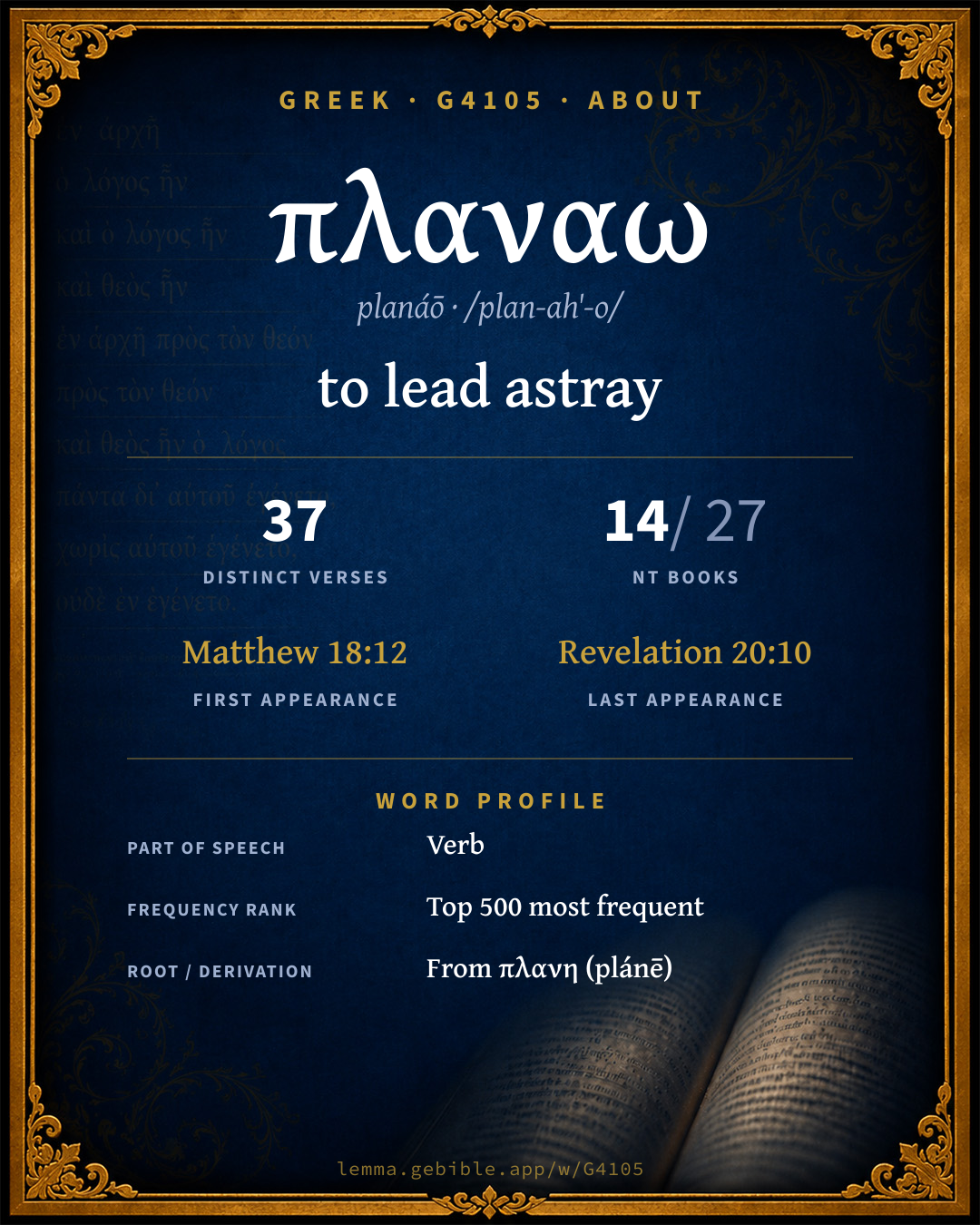
πλανάω
to lead astray
‘to lead astray’ is one of 2 main senses fuller range ↓
Full lexicon entry — Thayer's Greek Lexicon
From Thayer's Greek Lexicon
Where this word appears
See every Present-tense verb in the Greek New Testament →
Grammar key — what these labels mean
Part of speech
- Verb
- An action or state-of-being word.
Tense
- Present
- Ongoing or general action in present time (imperfective aspect).
- Aorist
- Action viewed as a simple whole, without regard to duration — often past (perfective aspect).
- Future
- Action expected in future time.
- Perfect
- A completed past action with continuing present results.
Voice
- Passive
- The subject receives the action.
- Active
- The subject performs the action.
Mood
- Imperative
- Expresses a command or request.
- Participle
- A verbal adjective (“writing,” “having written”).
- Subjunctive
- Expresses probability, purpose, or possibility (the mood of contingency).
- Indicative
- States a fact or asks a factual question (the mood of reality).
- Infinitive
- A verbal noun (“to write”), unmarked for person or number.
Case
- Nominative
- The case of the subject (and the predicate nominative).
- Genitive
- The case of source, possession, or “of” — answers “whose / from what.”
- Accusative
- The case of the direct object and of extent.
- Dative
- The case of the indirect object, means, or location — “to / for / with / in.”
Person
- 2nd person
- The one addressed (“you”).
- 3rd person
- The one spoken about (“he / she / it / they”).
- 1st person
- The speaker (“I / we”).
Gender
- Masculine
- Grammatically masculine.
- Neuter
- Grammatically neuter.
Number
- Plural
- More than one.
- Singular
- One.
Grammatical forms 22 distinct
- Verb, Present, Passive, Imperative, 2nd person, Plural 4 times (10%)
- Verb, Present, Passive, Participle, Nominative, Plural, Masculine 4 times (10%)
- Verb, Aorist, Active, Subjunctive, 3rd person, Singular 3 times (8%)
- Verb, Future, Active, Indicative, 3rd person, Plural 3 times (8%)
- Verb, Present, Active, Indicative, 3rd person, Singular 3 times (8%)
- Verb, Present, Passive, Indicative, 2nd person, Plural 3 times (8%)
- Verb, Aorist, Passive, Indicative, 3rd person, Plural 2 times (5%)
- Verb, Aorist, Passive, Subjunctive, 3rd person, Singular 2 times (5%)
+14 more forms (15 occurrences)
Parsed forms decoded from the imported morphology (Robinson–Tischendorf, public domain), counted across 39 parsed occurrences — not distinct verses.
Every verse where G4105 appears — 37 distinct verses across 14 books. Click any verse to open its interlinear word-by-word view. Verse text shown in the World English Bible for context — . Each verse’s Greek form is shown with its reference; the English is not keyword-highlighted, since the data carries no word-level English alignment. Use “Compare translations” on any verse to read it across multiple English versions. This concordance covers the Greek New Testament; Septuagint (Greek Old Testament) occurrences of this word are not indexed here.
Matthew 7 verses
- Matthew 18:12 πλανηθῇ πλανώμενον aor pass subj 3sg pres pass ptcp acc sg neut "What do you think? If a man has one hundred sheep, and one of them goes astray, doesn't he leave the ninety-nine, go to the mountains, and seek that which has gone astray?
- Matthew 18:13 πεπλανημένοις perf pass ptcp dat pl neut If he finds it, most assuredly I tell you, he rejoices over it more than over the ninety-nine which have not gone astray.
- Matthew 22:29 πλανᾶσθε pres pass ind 2pl But Jesus answered them, "You are mistaken, not knowing the Scriptures, nor the power of God.
- Matthew 24:4 πλανήσῃ aor act subj 3sg Jesus answered them, "Be careful that no one leads you astray.
- Matthew 24:5 πλανήσουσιν fut act ind 3pl For many will come in my name, saying, 'I am the Christ,' and will lead many astray.
- Matthew 24:11 πλανήσουσιν fut act ind 3pl Many false prophets will arise, and will lead many astray.
- Matthew 24:24 πλανηθῆναι aor pass inf For there will arise false christs, and false prophets, and they will show great signs and wonders, so as to lead astray, if possible, even the chosen ones.
Mark 4 verses
- Mark 12:24 πλανᾶσθε pres pass ind 2pl Jesus answered them, "Isn't this because you are mistaken, not knowing the Scriptures, nor the power of God?
- Mark 12:27 πλανᾶσθε pres pass ind 2pl He is not the God of the dead, but of the living. You are therefore badly mistaken."
- Mark 13:5 πλανήσῃ aor act subj 3sg Jesus, answering, began to tell them, "Be careful that no one leads you astray.
- Mark 13:6 πλανήσουσιν fut act ind 3pl For many will come in my name, saying, 'I am he!' and will lead many astray.
Luke 1 verse
John 2 verses
1 Corinthians 2 verses
- 1 Corinthians 6:9 πλανᾶσθε pres pass impv 2pl Or don't you know that the unrighteous will not inherit the Kingdom of God? Don't be deceived. Neither the sexually immoral, nor idolaters, nor adulterers, nor male prostitutes, nor homosexuals,
- 1 Corinthians 15:33 πλανᾶσθε pres pass impv 2pl Don't be deceived! "Evil companionships corrupt good morals."
Galatians 1 verse
2 Timothy 1 verse
Titus 1 verse
Hebrews 3 verses
- Hebrews 3:10 πλανῶνται pres pass ind 3pl Therefore I was displeased with that generation, And said, 'They always err in their heart, But they didn't know my ways;'
- Hebrews 5:2 πλανωμένοις pres pass ptcp dat pl masc The high priest can deal gently with those who are ignorant and going astray, because he himself is also surrounded with weakness.
- Hebrews 11:38 πλανώμενοι pres pass ptcp nom pl masc (of whom the world was not worthy), wandering in deserts, mountains, caves, and the holes of the earth.
James 2 verses
1 Peter 1 verse
2 Peter 1 verse
1 John 3 verses
- 1 John 1:8 πλανῶμεν pres act ind 1pl If we say that we have no sin, we deceive ourselves, and the truth is not in us.
- 1 John 2:26 πλανώντων pres act ptcp gen pl masc These things I have written to you concerning those who would lead you astray.
- 1 John 3:7 πλανάτω pres act impv 3sg Little children, let no one lead you astray. He who does righteousness is righteous, even as he is righteous.
Revelation 8 verses
- Revelation 2:20 πλανᾷ pres act ind 3sg But I have this against you, that you tolerate your woman, Jezebel, who calls herself a prophetess. She teaches and seduces my servants to commit sexual immorality, and to eat things sacrificed to idols.
- Revelation 12:9 πλανῶν pres act ptcp nom sg masc The great dragon was thrown down, the old serpent, he who is called the devil and Satan, the deceiver of the whole world. He was thrown down to the earth, and his angels were thrown down with him.
- Revelation 13:14 πλανᾷ pres act ind 3sg He deceives my own people who dwell on the earth because of the signs he was granted to do in front of the beast; saying to those who dwell on the earth, that they should make an image to the beast who had the sword wound and lived.
- Revelation 18:23 ἐπλανήθησαν aor pass ind 3pl The light of a lamp will shine no more at all in you. The voice of the bridegroom and of the bride will be heard no more at all in you; for your merchants were the princes of the earth; for with your sorcery all the nations were deceived.
- Revelation 19:20 ἐπλάνησεν aor act ind 3sg The beast was taken, and with him the false prophet who worked the signs in his sight, with which he deceived those who had received the mark of the beast and those who worshiped his image. These two were thrown alive into the lake of fire that burns with sulfur.
- Revelation 20:3 πλανήσῃ aor act subj 3sg and cast him into the abyss, and shut it, and sealed it over him, that he should deceive the nations no more, until the thousand years were finished. After this, he must be freed for a short time.
- Revelation 20:8 πλανῆσαι aor act inf and he will come out to deceive the nations which are in the four corners of the earth, Gog and Magog, to gather them together to the war; the number of whom is as the sand of the sea.
- Revelation 20:10 πλανῶν pres act ptcp nom sg masc The devil who deceived them was thrown into the lake of fire and sulfur, where the beast and the false prophet are also. They will be tormented day and night forever and ever.
About this entry
At a glance — auto-summarized from this page’s data, not written by a person. Every figure links to its source below. This summary describes the numbers; it doesn’t interpret them.
πλαναω — transliterated planáō — is a Greek verb carrying the sense “to lead astray.” Translators differ — “deceived” in the King James Version, then “astray” (unfoldingWord Literal Text), as the renderings breakdown shows. The Greek New Testament uses it across 37 verses — moderately common. First canonically at Matthew 18:12, it enters the text early. Catalogued under 2 senses, its meaning is not single-sense. The sections below give every sense, occurrence, and version rendering.
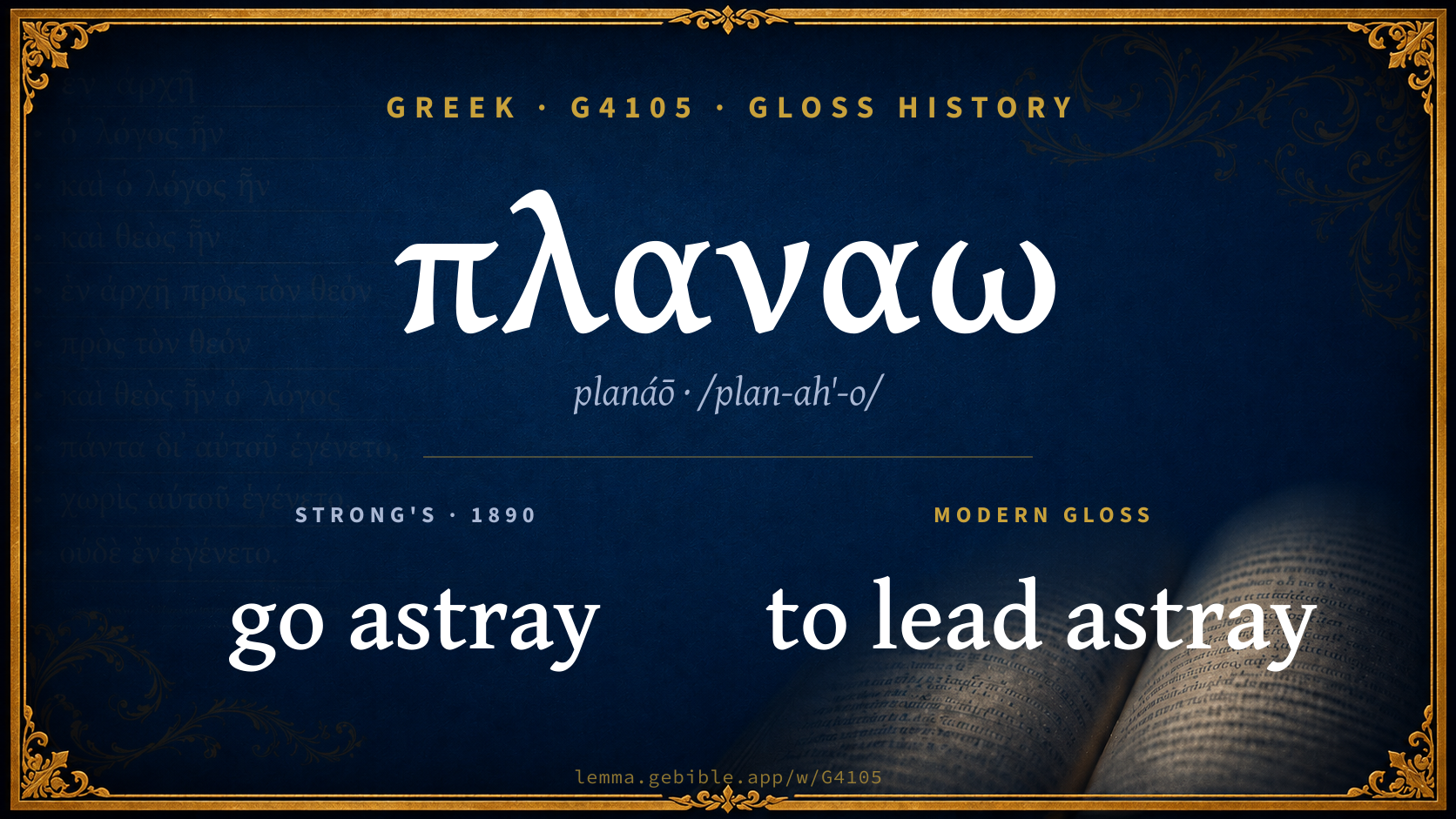
Gloss history
Strong's 1890 vs modern scholarship
About this word
Strong's G4105 catalogs a Greek word from the Greek New Testament.
These counts are not copied from any lexicon or concordance. They are computed here, from the morphology-tagged Greek New Testament. What Lemma adds →
- 37
- distinct verses
- The word appears in 37 distinct verses.
- 14 / 27
- NT books
- The word appears in 14 of 27 New Testament books.
- #385
- by frequency
- Top 500 most frequent Greek words (rank 385 of 5,347 Greek words by occurrence).
View all 37 occurrences in the concordance →
Most concentrated in
- Revelation 8 verses 22%
- Matthew 7 verses 19%
- Mark 4 verses 11%
By section of the New Testament
By traditional corpus
Conventional, traditional groupings — biblical authorship is debated, so this is a traditional corpus grouping, not an authorship claim. Some books belong to more than one corpus (Luke is in both the Gospels and the Lukan corpus, and so on), so these shares overlap and need not total 100%. Each figure is a share of the word’s 37 distinct verses.
- Gospels 14 verses · 38%
- Johannine 13 verses · 35%
- Revelation 8 verses · 22%
- General (Catholic) Epistles 7 verses · 19%
- Pauline corpus 5 verses · 14%
- Hebrews 3 verses · 8%
- Lukan (Luke–Acts) 1 verse · 3%
How translations render this word
Counts come from each version’s own published word-to-Strong’s tagging or interlinear alignment — an approximate guide to how each version renders this word, not a word-level alignment the data otherwise carries. Because each total is that version’s own tagged count, the per-version totals vary from one another and need not match the appearance or distinct-verse counts above. These counts may also differ from a printed concordance because Lemma counts each distinctly tagged rendering and does not collapse phrase taggings into a single head-word total. This is a fixed set of word-tagged versions (KJV, ASV, BSB, ULT) and does not change with the reading translation you choose elsewhere. Each version’s license is shown beside its name below (and on Sources).
- King James Version: Deceived 8×, Err 4×, Be 3×
- American Standard Version: Astray 9×, Deceived 7×, Be 4×
- Berean Standard Bible: Be deceived 4×, Deceive 4×, Deceives 2×
- unfoldingWord Literal Text: Astray 9×, Do 4×, Be deceived 3×
King James Version Public Domain
Renders G4105 across 51 tagged occurrences — most commonly:
Plus 24 renderings that appear only once — usually multi-word phrases or single function words the recovered tagging swept in, not distinct renderings.
American Standard Version Public Domain
Renders G4105 across 51 tagged occurrences — most commonly:
Plus 25 renderings that appear only once — usually multi-word phrases or single function words the recovered tagging swept in, not distinct renderings.
Berean Standard Bible Public Domain
Renders G4105 across 39 tagged occurrences — most commonly:
Plus 25 renderings that appear only once — usually multi-word phrases or single function words the recovered tagging swept in, not distinct renderings.
unfoldingWord Literal Text CC BY-SA 4.0
Renders G4105 across 60 tagged occurrences — most commonly:
Plus 30 renderings that appear only once — usually multi-word phrases or single function words the recovered tagging swept in, not distinct renderings.
Senses in Thayer's
The 2 senses Thayer's distinguishes for this word, in lexicon order (not ranked by frequency or importance). The full entry — with sub-senses — is in the Lexicon Entry tab.
- to cause to stray, to lead astray, lead aside from the right way
- metaph.
Word origin
Derived from πλανη (plánē) (G4106) — error.
From G4106 ; to (properly cause to) roam (from safety truth or virtue): - go astray deceive err seduce wander be out of the way.
— Strong’s Exhaustive Concordance (1890), public domain.
Forms in the corpus
The 21 distinct written forms G4105 takes in the Greek New Testament, most frequent first — each parse links to that tense’s occurrences in the concordance.
Septuagint usage
The same Greek word πλαναω appears 94 times in the Greek Old Testament (Septuagint), across 84 verses in 16 books.
- 94
- LXX occurrences
- Tagged occurrences of this Greek word in the Septuagint.
- 84
- verses
- Distinct Septuagint verses containing this word.
- 16 / 39
- OT books
- The word appears in 16 of the 39 Old Testament books.
Sample Septuagint occurrences
- Genesis 21:14 πλανάω
- Exodus 14:3 πλανάω
- Deuteronomy 4:19 πλανάω
- Judges 16:10 πλανάω
- 2 Kings 4:28 πλανάω
- 2 Chronicles 33:9 πλανάω
- Job 5:2 πλανάω
- Psalms 57:4 πλανάω
- Proverbs 1:10 πλανάω
- Isaiah 3:12 πλανάω
- Jeremiah 23:13 πλανάω
- Ezekiel 13:10 πλανάω
Septuagint occurrences (same lexeme)
Every verse where the same Strong’s number (G4105) appears in the Greek Septuagint — showing the first 50 of 84. Verse text shown in the World English Bible for context; the Greek form is the matched word — the English is not keyword-highlighted.
- Genesis 21:14 πλανάω Abraham rose up early in the morning, and took bread and a bottle of water, and gave it to Hagar, putting it on her shoulder, and gave her the child, and sent her away. She departed, and wandered in the wilderness of Beersheba.
- Genesis 37:15 πλανάω A certain man found him, and behold, he was wandering in the field: and the man asked him, saying, "What are you looking for?"
- Exodus 14:3 πλανάω Pharaoh will say of the children of Israel, 'They are entangled in the land. The wilderness has shut them in.'
- Exodus 23:4 πλανάω "If you meet your enemy's ox or his donkey going astray, you shall surely bring it back to him again.
- Deuteronomy 4:19 πλανάω and lest you lift up your eyes to the sky, and when you see the sun and the moon and the stars, even all the host of the sky, you are drawn away and worship them, and serve them, which Yahweh your God has allotted to all the peoples under the whole sky.
- Deuteronomy 11:28 πλανάω and the curse, if you shall not listen to the commandments of Yahweh your God, but turn aside out of the way which I command you this day, to go after other gods, which you have not known.
- Deuteronomy 13:6 πλανάω If your brother, the son of your mother, or your son, or your daughter, or the wife of your bosom, or your friend, who is as your own soul, entice you secretly, saying, Let us go and serve other gods, which you have not known, you, nor your fathers;
- Deuteronomy 22:1 πλανάω You shall not see your brother's ox or his sheep go astray, and hide yourself from them: you shall surely bring them again to your brother.
- Deuteronomy 27:18 πλανάω Cursed be he who makes the blind to wander out of the way. All the people shall say, Amen.
- Deuteronomy 30:17 πλανάω But if your heart turn away, and you will not hear, but shall be drawn away, and worship other gods, and serve them;
- Judges 16:10 πλανάω Delilah said to Samson, Behold, you have mocked me, and told me lies: now tell me, Please, with which you might be bound.
- Judges 16:13 πλανάω Delilah said to Samson, Hitherto you have mocked me, and told me lies: tell me with which you might be bound. He said to her, If you weave the seven locks of my head with the web.
- Judges 16:15 πλανάω She said to him, How can you say, I love you, when your heart is not with me? you have mocked me these three times, and have not told me in which your great strength lies.
- 2 Kings 4:28 πλανάω Then she said, Did I desire a son of my lord? Didn't I say, Do not deceive me?
- 2 Kings 21:9 πλανάω But they didn't listen: and Manasseh seduced them to do that which is evil more than did the nations whom Yahweh destroyed before the children of Israel.
- 2 Chronicles 33:9 πλανάω Manasseh seduced Judah and the inhabitants of Jerusalem, so that they did evil more than did the nations whom Yahweh destroyed before the children of Israel.
- Job 5:2 πλανάω For resentment kills the foolish man, And jealousy kills the simple.
- Job 6:24 πλανάω "Teach me, and I will hold my peace; Cause me to understand wherein I have erred.
- Job 12:23 πλανάω He increases the nations, and he destroys them. He enlarges the nations, and he leads them captive.
- Job 12:24 πλανάω He takes away understanding from the chiefs of the people of the earth, And causes them to wander in a wilderness where there is no way.
- Job 12:25 πλανάω They grope in the dark without light. He makes them stagger like a drunken man.
- Job 19:4 πλανάω If it is true that I have erred, My error remains with myself.
- Job 38:41 πλανάω Who provides for the raven his prey, When his young ones cry to God, And wander for lack of food?
- Psalms 57:4 πλανάω My soul is among lions. I lie among those who are set on fire, Even the sons of men, whose teeth are spears and arrows, And their tongue a sharp sword.
- Psalms 94:10 πλανάω He who disciplines the nations, won't he punish? He who teaches man knows.
- Psalms 106:4 πλανάω Remember me, Yahweh, with the favor that you show to your people. Visit me with your salvation,
- Psalms 106:40 πλανάω Therefore Yahweh burned with anger against his people. He abhorred his inheritance.
- Psalms 118:110 πλανάω
- Psalms 118:176 πλανάω
- Proverbs 1:10 πλανάω My son, if sinners entice you, don't consent.
- Proverbs 9:12 πλανάω If you are wise, you are wise for yourself. If you mock, you alone will bear it.
- Proverbs 10:17 πλανάω He is in the way of life who heeds correction, But he who forsakes reproof leads others astray.
- Proverbs 12:26 πλανάω A righteous person is cautious in friendship, But the way of the wicked leads them astray.
- Proverbs 13:9 πλανάω The light of the righteous shines brightly, But the lamp of the wicked is snuffed out.
- Proverbs 14:22 πλανάω Don't they go astray who plot evil? But love and faithfulness belong to those who plan good.
- Proverbs 16:6 πλανάω By mercy and truth iniquity is atoned for. By the fear of Yahweh men depart from evil.
- Proverbs 21:16 πλανάω The man who wanders out of the way of understanding Shall rest in the assembly of the dead.
- Proverbs 28:10 πλανάω Whoever causes the upright to go astray in an evil way, He will fall into his own trap; But the blameless will inherit good.
- Proverbs 29:15 πλανάω The rod of correction gives wisdom, But a child left to himself causes shame to his mother.
- Isaiah 3:12 πλανάω As for my people, children are their oppressors, And women rule over them. My people, those who lead you cause you to err, And destroy the way of your paths.
- Isaiah 9:15 πλανάω The elder and the honorable man, he is the head; and the prophet who teaches lies, he is the tail.
- Isaiah 13:14 πλανάω It shall happen, that as the chased roe, and as sheep that no man gathers, they shall turn every man to his own people, and shall flee every man to his own land.
- Isaiah 16:8 πλανάω For the fields of Heshbon languish, [and] the vine of Sibmah; the lords of the nations have broken down the choice branches of it, which reached even to Jazer, which wandered into the wilderness; its shoots were spread abroad, they passed over the sea.
- Isaiah 17:11 πλανάω In the day of your planting you hedge it in, and in the morning you make your seed to blossom; but the harvest flees away in the day of grief and of desperate sorrow.
- Isaiah 19:13 πλανάω The princes of Zoan are become fools, the princes of Memphis are deceived; they have caused Egypt to go astray, who are the corner-stone of her tribes.
- Isaiah 19:14 πλανάω Yahweh has mixed a spirit of perverseness in the midst of her; and they have caused Egypt to go astray in every work of it, as a drunken man staggers in his vomit.
- Isaiah 21:4 πλανάω My heart flutters, horror has frightened me; the twilight that I desired has been turned into trembling to me.
- Isaiah 21:15 πλανάω For they fled away from the swords, from the drawn sword, and from the bent bow, and from the heat of battle.
- Isaiah 22:5 πλανάω For it is a day of confusion, and of treading down, and of perplexity, from the Lord, Yahweh of Hosts, in the valley of vision; a breaking down of the walls, and a crying to the mountains.
- Isaiah 28:7 πλανάω Even these reel with wine, and stagger with strong drink; the priest and the prophet reel with strong drink, they are swallowed up of wine, they stagger with strong drink; they err in vision, they stumble in judgment.
These are occurrences of the same Greek lexeme (G4105) in the Septuagint — not a translation of any one Hebrew word. The store carries no word-level Hebrew↔Greek alignment, so no Hebrew original is asserted here. Counts come from the recovered LXX Strong's tagging — high-frequency vocabulary is well covered, while rare or late forms may be untagged — so they reflect tagged occurrences and may slightly undercount.