
2 Kings 4:28

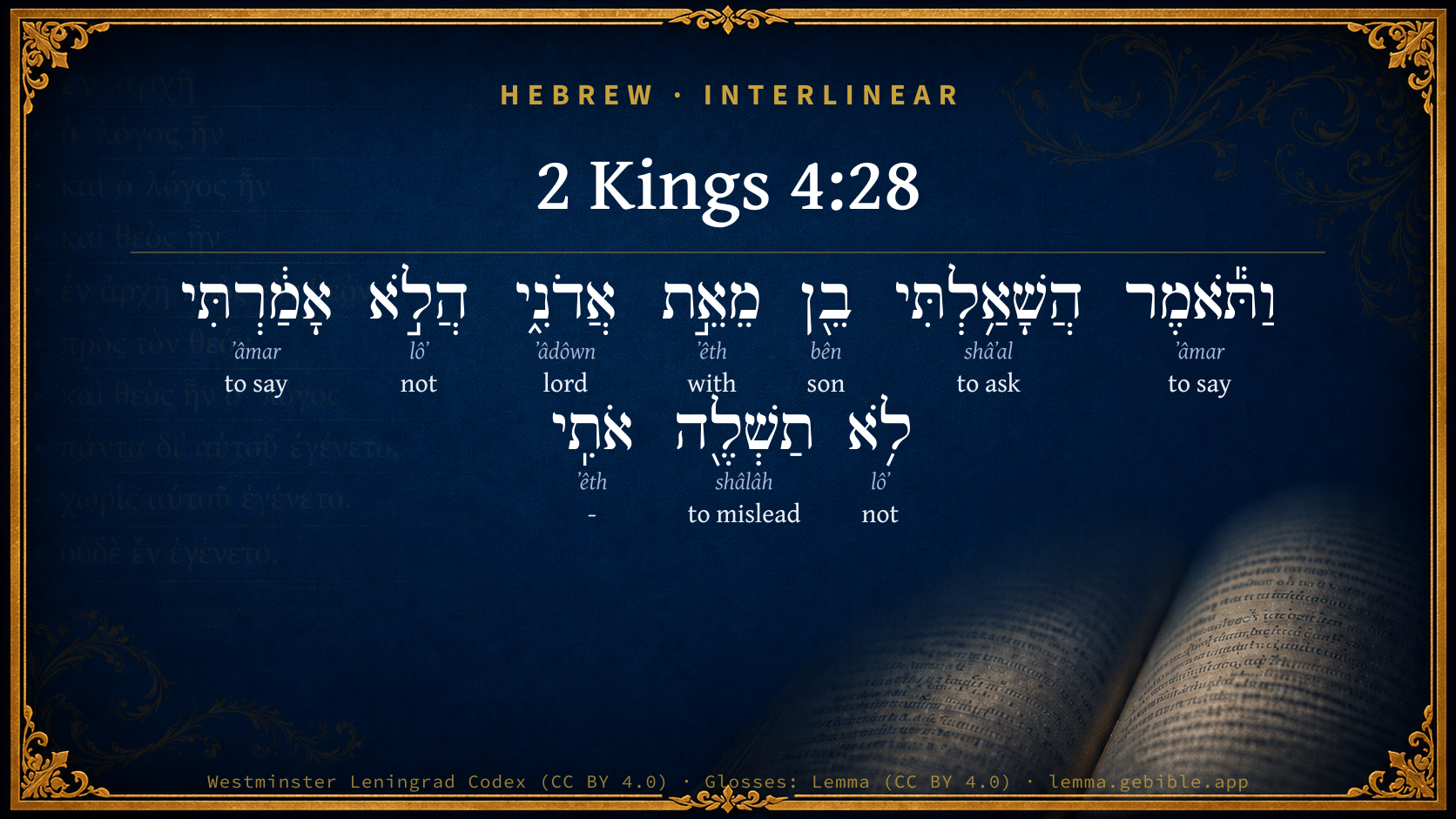
Hebrew (Westminster Leningrad Codex) 2 Kings 4:28 appears in the Hebrew Old Testament. The text above is from the Westminster Leningrad Codex. Each word links to its Strong’s number, a concise gloss, and parsing drawn from the Open Scriptures Hebrew Bible morphology. Click any word for its full Brown-Driver-Briggs (BDB) entry.
Download image
Cite this verse

2 Kings 4:28 (World English Bible). Public Domain. Lemma interlinear Bible study tool, https://lemma.gebible.app/v/2-kings/4/28.

Show BibTeX & RIS
BibTeX
RIS
English Translation
Then she said, Did I desire a son of my lord? Didn't I say, Do not deceive me?
World English Bible · Public Domain
Highlights
  • 1 first appearance in the Hebrew Bible
Full analysis ↓
Download a study sheet

One document with this verse’s original text, its word-by-word gloss line, the meaning frame, cross-references with their text, attributed commentary, and full source and license credits — printable, and it pastes into notes with its structure intact.

This verse Autodidact and up

Study sheet (.html) Plain text (.txt)

A passage Seminary Student

Up to 50 verses in one chapter. A passage sheet keeps up to 6 commentary sources and 12 cross-references per verse, in the order this page ranks them, and says so on the sheet whenever that leaves anything out. Ask for a single verse and you get the Autodidact verse sheet above.

Everything on this page stays free to read, with no account — the sheet is a download of what is already on screen, not access to it.

Want to remove ads? Support Godless Engineer
Compare translations 3

The same verse in 3 English versions, stacked beneath the original-language interlinear above. Click any original word for its lexicon entry.

Each is an independent rendering of the whole verse — the interlinear is not word-aligned to these translations.

Highlighted words mark where these versions differ — a whole-verse word diff, not a word-by-word alignment.

  • World English Bible Public Domain
    Then she said, Did I desire a son of my lord? Didn't I say, Do not deceive me?
  • King James Version Public Domain
    Then she said, Did I desire a son of my lord? did I not say, Do not deceive me?
  • unfoldingWord Literal Text CC BY-SA 4.0
    And she said, “Did I request a son from my lord? Did I not say, ‘Do not deceive me’?”

unfoldingWord Literal Text — © unfoldingWord, licensed CC BY-SA 4.0. Word-aligned USFM3 via Door43 (git.door43.org/unfoldingWord/en_ult).

Versions to compare (up to 4)

3 of 4 selected

Show all 18 translations

Every available English version of this verse, each an independent rendering of the whole verse.

  • World English Bible Public Domain
    Then she said, Did I desire a son of my lord? Didn't I say, Do not deceive me?
  • Berean Standard Bible Public Domain
    Then she said, “Did I ask you for a son, my lord? Didn’t I say, ‘Do not deceive me?’”
  • Majority Standard Bible Public Domain
    Then she said, “Did I ask you for a son, my lord? Didn’t I say, ‘Do not deceive me?’”
  • King James Version Public Domain
    Then she said, Did I desire a son of my lord? did I not say, Do not deceive me?
  • American Standard Version (1901) Public Domain
    Then she said, Did I desire a son of my lord? did I not say, Do not deceive me?
  • Revised Version (1885) Public Domain
    Then she said, Did I desire a son of my lord? did I not say, Do not deceive me?
  • Geneva Bible (1599) Public Domain
    Then she said, Did I desire a sonne of my lord? did I not say, Deceiue me not?
  • Douay-Rheims (1899) Public Domain
    And she said to him: Did I ask a son of my lord? did I not say to thee: Do not deceive me?
  • Young's Literal Translation Public Domain
    And she saith, `Did I ask a son from my lord? did I not say, Do not deceive me?'
  • Literal Standard Version CC BY-SA 4.0
    And she says, “Did I ask for a son from my lord? Did I not say, Do not deceive me?”
  • Unlocked Literal Bible CC BY-SA 4.0
    Then she said, “Did I ask you for a son, my master? Did I not say, 'Do not deceive me'?”
  • unfoldingWord Literal Text CC BY-SA 4.0
    And she said, “Did I request a son from my lord? Did I not say, ‘Do not deceive me’?”
  • Darby Bible Public Domain
    And she said, Did I desire a son of my lord? did I not say, Do not deceive me?
  • World Messianic Bible Public Domain
    Then she said, “Did I ask you for a son, my lord? Didn’t I say, ‘Do not deceive me’?”
  • Webster's Bible Public Domain
    Then she said, Did I ask a son from my lord? did I not say, Do not deceive me.
  • Free Bible Version CC BY-SA 4.0
    “Did I ask you for a son, my lord?” she asked. “Didn't I tell you, ‘Don't tell me lies’?”
  • Bible in Basic English Public Domain
    Then she said, Did I make a request to my lord for a son? did I not say, Do not give me false words?
  • JPS Tanakh (1917) Public Domain
    Then she said: 'Did I desire a son of my lord? did I not say: Do not deceive me?'

Literal Standard Version (2020), Covenant Press — licensed CC BY-SA 4.0. Text via the HelloAO Bible API (eBible.org). Unlocked Literal Bible (unfoldingWord) — licensed CC BY-SA 4.0. Text via the HelloAO Bible API (eBible.org). unfoldingWord Literal Text — © unfoldingWord, licensed CC BY-SA 4.0. Word-aligned USFM3 via Door43 (git.door43.org/unfoldingWord/en_ult). Free Bible Version, Dr. Jonathan Gallagher — licensed CC BY-SA 4.0. Text via the HelloAO Bible API (eBible.org).

Word by word

More ways to search: Search by grammar → Find every occurrence → Compare this word →

Practice this passage: Drill this verse → Learn its vocabulary →

תַשְׁלֶ֖ה
shâlâh
H7952
“to mislead”
Verb, Hiphil, Imperfect, 2nd Person, Masculine, Singular
Part of Speech
Verb
Stem
Hiphil
Form
Imperfect
Person
2nd Person
Gender
Masculine
Number
Singular
Full BDB Definition

Origin: a primitive root [probably identical with H7953 through the idea of educing]

TWOT: None

(Niphal) to be negligent - (Hiphil) to mislead
  1. וַתֹּ֕אמֶר ʼâmar H559 “and · to say” Conjunction + Verb, Qal, Sequential Imperfect, 3rd Person, Feminine, Singular
  2. הֲשָׁאַ֥לְתִּי shâʼal H7592 “to ask” Particle, Interrogative + Verb, Qal, Perfect, 1st Person, Common, Singular
  3. בֵ֖ן bên H1121 “son” Noun, Common, Masculine, Singular, Absolute
  4. מֵאֵ֣ת ʼêth H854 “from · with” Preposition + Preposition
  5. אֲדֹנִ֑י ʼâdôwn H113 “lord · my” Noun, Common, Masculine, Singular, Construct + Suffix, Personal, 1st Person, Common, Singular
  6. הֲלֹ֣א lôʼ H3808 “not” Particle, Interrogative + Particle, Negative
  7. אָמַ֔רְתִּי ʼâmar H559 “to say” Verb, Qal, Perfect, 1st Person, Common, Singular
  8. לֹ֥א lôʼ H3808 “not” Particle, Negative
  9. אֹתִֽי ʼêth H853 “- · me” Particle, Direct Object + Suffix, Personal, 1st Person, Common, Singular

About this verse

These counts appear in no published source. They are computed here, from the morphology-tagged text and Lemma’s own curated glosses. What Lemma adds →

10
words
8
distinct lemmas
Historical
section

Notable vocabulary

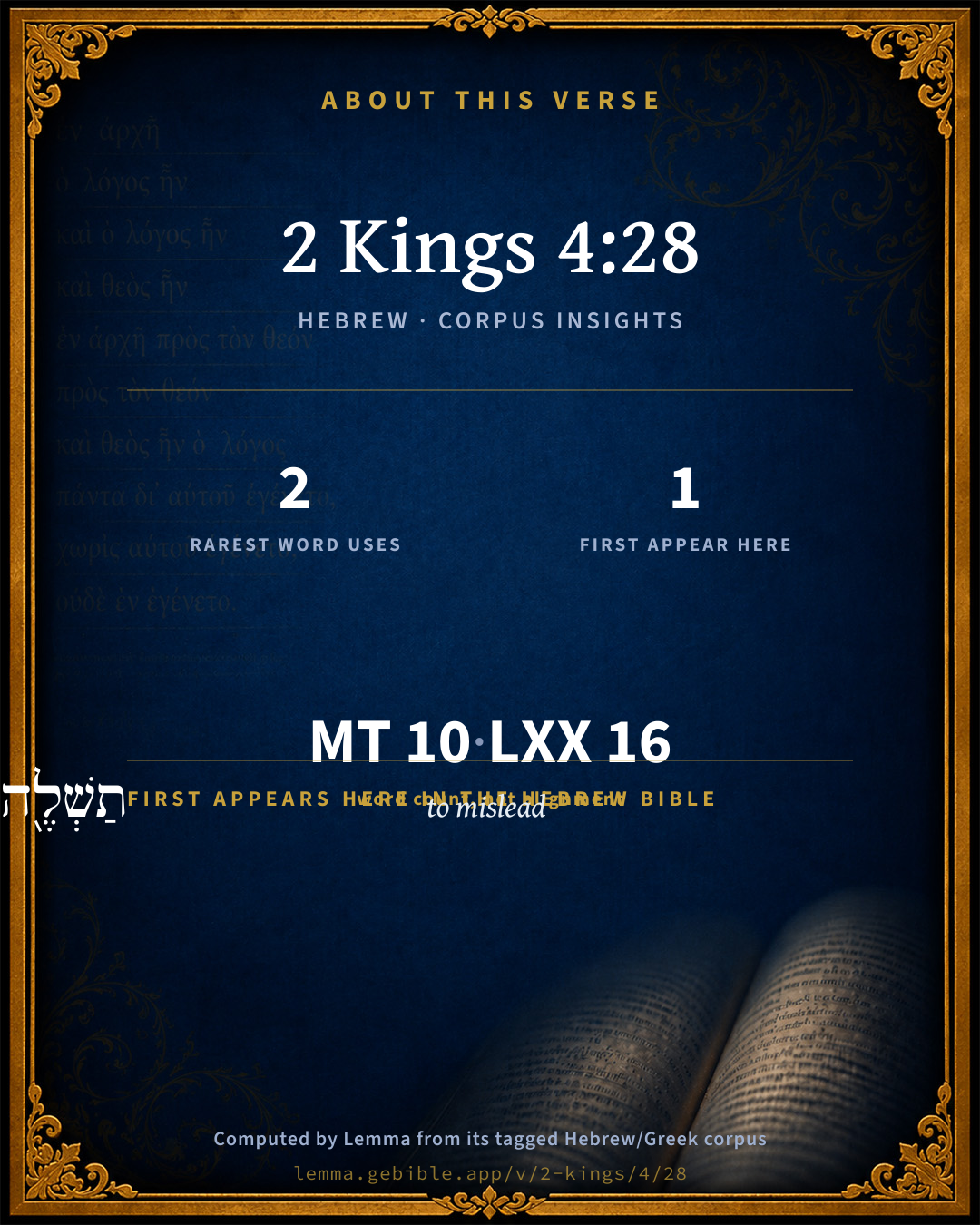
The rarest word here is תַשְׁלֶ֖ה to mislead H7952 — appearing just 2 times in the whole Hebrew Bible.

First appearance in Scripture

This word makes its first canonical appearance in the Hebrew Bible here:

  • תַשְׁלֶ֖ה to mislead H7952

Shared distinctive vocabulary

תַשְׁלֶ֖ה to mislead H7952 occurs in 2 verses of the Hebrew Bible. Also found in:

Grammatical profile

  • 4 verbs
  • 2 nouns
  • 1 preposition
  • 3 particles

Verb forms

  • וַתֹּ֕אמֶר Qal · Sequential Imperfect
  • הֲשָׁאַ֥לְתִּי Qal · Perfect
  • אָמַ֔רְתִּי Qal · Perfect
  • תַשְׁלֶ֖ה Hiphil · Imperfect

Repetition

Words recur within this verse — often emphatic in Hebrew:

  • וַתֹּ֕אמֶר to say H559 ×2
  • הֲלֹ֣א not H3808 ×2

Hebrew & Septuagint length

In English translation the verse runs 18 words from the Hebrew and 22 from the Septuagint (LXX English) — closely comparable.

A rough comparison of the two English renderings, which tokenize alike — not a word-level alignment.

Word counts can differ between the Hebrew and the Greek without any difference in meaning — e.g. the Hebrew direct-object marker אֵת has no separate Greek word, and Greek often adds the article ὁ.

In the original languages it is 10 Hebrew tokens and 16 Greek tokens — but the two are counted differently (Hebrew bundles its prefixes and suffixes into one token; the Greek is in lemma form), so that isn’t a like-for-like length.

Cross-references

2

Topical passages linked to 2 Kings 4:28 in the Treasury of Scripture Knowledge — connected by theme and wording, ordered by reader-vote popularity; previews shown in the World English Bible.

  • Genesis 30:1 When Rachel saw that she bore Jacob no children, Rachel envied her sister. She said to Jacob, "Give me children, or else I will die."
  • 2 Kings 4:16 He said, At this season, when the time comes round, you shall embrace a son. She said, No, my lord, you man of God, do not lie to your handmaid.

Cross-references courtesy of OpenBible.info (CC BY 4.0).

Hebrew and Greek witnesses Masoretic Hebrew ↔ Greek Septuagint

The same verse in the two great witnesses to the Old Testament, shown verse-for-verse.

These are two independent witnesses, not word-aligned to each other, and the Septuagint is shown in lemma (dictionary) form.

Hebrew 2 Kings 4:28 Masoretic · Westminster Leningrad Codex

וַתֹּ֕אמֶר הֲשָׁאַ֥לְתִּי בֵ֖ן מֵאֵ֣ת אֲדֹנִ֑י הֲלֹ֣א אָמַ֔רְתִּי לֹ֥א תַשְׁלֶ֖ה אֹתִֽי

Then she said, Did I desire a son of my lord? Didn't I say, Do not deceive me?

World English Bible · Public Domain

Greek LXX 2 Kings 4:28 Septuagint · lemma form

ὁ δέ εἶπον μή αἰτέω υἱός παρά ὁ κύριος ἐγώ οὐ εἶπον οὐ πλανάω μετά ἐγώ

And she said, Did I ask a son of my lord? For did I not say, Do not deal deceitfully with me?

LXX2012 (modern English Septuagint) · Public Domain

Hebrew: Westminster Leningrad Codex (CC BY 4.0). Greek: Septuagint (public domain); English from LXX2012 (modern English Septuagint) (Public Domain). How the Septuagint differs from the Hebrew →

Targum (Aramaic paraphrase)

1

The Targum is the ancient Jewish Aramaic paraphrase of the Hebrew Scriptures — an interpretive translation, not the Hebrew text itself. Onkelos (literal) and Pseudo-Jonathan (expansive) render the Torah, and Jonathan the Prophets. Coverage is partial: where no permissively-licensed English translation exists for a verse, only the Aramaic is shown. This is verse-level text, not a word-by-word alignment to the Hebrew.

  1. Targum Jonathan Prophets (Joshua–Malachi)
    וַאֲמַרַת הַשְׁאֵילִית בְּרָא מִן רִבּוֹנִי הֲלָא אֲמַרִית לָךְ אִם מִתְיָהֵב לִי בַּר קַיָם אִם לָא לָא תְנַסֵיס יָתִי:

    (no public-domain English translation for this verse)

    Targum Jonathan — Aramaic: “Mikraot Gedolot” (public domain). English: “Sefaria Community Translation” (CC0 1.0 (public-domain dedication)); “London "Chaldee Paraphrase," 1871” (public domain). Text via Sefaria.

Commentary

Notes on 2 Kings 4:28 from classic Christian and Jewish commentators (each source and its license shown beneath its notes). The classic Christian expositions comment on the surrounding passage and are grouped to its opening verse, so a note may address several verses; the Jewish commentaries on the Tanakh (Rashi and others) are per-verse, so they appear only where the commentator wrote on this verse.

Lemma curates 59 commentaries, every one of them public domain or Creative Commons licensed, each selected and text-cleaned for this edition rather than reprinted as found. About our sources →

Trapp's Complete Commentary

John Trapp

2Ki 4:28 Then she said, Did I desire a son of my lord? did I not say, Do not deceive me?

Ver. 28. Did I desire a son of my lord?] Was I too desirous, or unduly importunate? for if so, the loss of the child had been just upon me. Strong affections will be strong afflictions.

Did I not say, Do not deceive me?] Nay, did not you say, Do not lie to me? And was that a fit word to a man of God? was there not something of unbelief in it?

John Trapp, A Commentary or Exposition upon All the Books of the Old and New Testament (1647–1656) — public domain. Text from a community e-Sword module.

Joseph Benson's Commentary

2Ki 4:28. She said, Did I desire a son of my lord? — This child was not given to me upon my immoderate desire, for which I might have justly been thus chastised; but was freely promised to me by thee in God’s name, and from his special grace and favour. Did not I say, Do not deceive me? — With vain hopes of a comfort that I should never have. And I had been much happier if I had never had it, than to lose it so quickly.

Joseph Benson's Commentary on the Old and New Testaments (1811–1818) — public domain. Text from a community e-Sword module.

Tyndale Open Study Notes

Tyndale Open Resources

4:28 The loss of her son undid all the joy she felt at his promised birth and seemed to make that birth a cruel deception.

Tyndale Open Study Notes — © Tyndale Open Resources, licensed CC BY-SA 4.0. Text via the HelloAO Bible API.

Adam Clarke's Commentary

Verse 28. Did I desire a son of my lord?] I expressed no such wish to thee; I was contented and happy; and when thou didst promise me a son, did I not say, Do not deceive me? Do not mock me with a child which shall grow up to be attractive and engaging, but of whom I shall soon be deprived by death.

Adam Clarke's Commentary on the Bible (1810–1826) — public domain. Text from a community e-Sword/MySword module.

Ellicott's Commentary for English Readers

(28) Then.—And; so in 2Ki_4:29; 2Ki_4:35.

Did I desire (ask) a son of my lord?—Only the conclusion of her appeal is given. She says, Better to have had no son, than to have had one and lost him. The opposite of our poet’s

“‘Tis better to have loved and lost,

Than never to have loved at all.”

But this last is the fruit of reflection; her words are the spontaneous outflow of a mother’s poignant sorrow. Or, perhaps, we should understand that grief does not allow her to specify the cause directly; she leaves the prophet to infer that from her questions.

A Bible Commentary for English Readers, edited by Charles John Ellicott (1878–1897) — public domain. Text from a community e-Sword module.

The Cambridge Bible for Schools and Colleges

gen. ed. J. J. S. Perowne

28. Did I desire a son] The words are almost reproachful and make it clear to the prophet that the child is dead. Better had it been for her not to have had the child given to her, than now to have the great sorrow of losing him.

Do not deceive me] She does not use the stronger term which occurs in the earlier part of the narrative (verse 16).

The Cambridge Bible for Schools and Colleges (gen. ed. J. J. S. Perowne; Cambridge University Press, 1878–1918) — public domain. Text from a community e-Sword module.

John Gill's Exposition

Then she said, did I desire a son of my lord?.... It was not at her request she had one, at least the first motion was not from her; the prophet first told her, and assured her she should have one, without her asking for it; she might be pleased with it, and desire the promise might be fulfilled; but it was not an inordinate, importunate, desire of one, in which she had exceeded, that so the taking it away from her might be a correction of her for it:

did I not say, do not deceive me; by giving hopes of a child, and yet have none; and now it was equally the same, or worse, to have one, and then to have it taken away again as soon as had almost; so the Targum,"did I not say unto thee, if a child is given me, let it live, if not, do not trouble or grieve me;''and then, no doubt, she told him plainly the child was dead, and where she had laid it, though not recorded.

John Gill's Exposition of the Whole Bible (1746–1763) — public domain (CC PDM 1.0). Text via the HelloAO Bible API.

Albert Barnes' Notes on the Bible

Great grief shrinks from putting itself into words. The Shunammite cannot bring herself to say, “My son is dead;” but by reproaching the prophet with having “deceived” her, she sufficiently indicates her loss.

Albert Barnes' Notes on the Bible (1834–1885) — public domain. Text from a community e-Sword/MySword module.

Haydock's Catholic Bible Commentary

A son. Better had it been for me not to have become a mother, than to be so soon delivered of my child. (Menochius)

George Leo Haydock (1774–1849), Haydock's Catholic Family Bible and Commentary, 1859 edition — public domain. Excludes Psalms (Douay-Rheims chapter numbering differs from Protestant) and Deuterocanonical books (Catholic canon only).

Matthew Poole's English Annotations

This child was not given to me upon my immoderate desire, for which I might have justly been thus chastised, as Rachel was, Gen 30:1, compared with Gen 35:18; but was freely promised to me by thee in God’s name, and from his special grace and favour; and therefore I trust both thou didst pray for it, and God design it as a blessing, and not as an affliction, as now it proves, unless thou dost obtain the child for me a second time, which I know thou canst do, and I humbly beg thee to do.

Do not deceive me, with vain hopes of a comfort that I should never have? And I had been much happier if I had never had it, than to lose it so quickly. Therefore thou art in some measure concerned to revive my dead hopes, and to continue to me the great blessing which thou hast procured.

Matthew Poole's English Annotations on the Holy Bible (1683–1685) — public domain. Text from a community e-Sword/MySword module.

Whedon's Commentary on the Bible

Daniel D. Whedon

28. Did I desire a son of my lord — She speaks the emotional language of one that is bewildered with a sudden sorrow. So far as appears from what is here written, she did not relate the fact of the child’s death, but left him to infer it from the language of her grief, or learn it by special Divine revelation. But we need not assume that all she said to Elisha is here written.

Daniel D. Whedon (gen. ed.), Commentary on the Old and New Testaments (1874–1909) — public domain. Text from a community e-Sword module.

The Pulpit Commentary

Then she said, Did I desire a son of my lord? did I not say, Do not deceive me? The woman does not directly reveal her grief. Great sorrow is reticent, cannot endure to put itself into words. But she sufficiently indicates the nature of her trouble by the form of her reproach. "Did I ask for a son? Did I make complaint of my childlessness? Had I been importunate, and obtained my son of thee by much asking, I would not have complained. But I did not ask. I did not even snatch greedily at the offer. I demurred. I said, "Do not deceive me." But now thou hast done worse than deceive me. Thou hast kept the word of promise to the ear, and broken it to the hope. It is greater misery to have a child and lose him, than never to have had one at all." All this, and more, seems to be involved in the woman"s words. And the prophet fully understood their meaning.

The Pulpit Commentary (1880–1919), ed. H.D.M. Spence-Jones & Joseph S. Exell — public domain. Text from a community e-Sword module.

John Wesley's Explanatory Notes

She said - This child was not given to me upon my immoderate desire, for which I might have justly been thus chastised, but was freely promised by thee in God's name, and from his special favour. Deceive me - With vain hopes of a comfort that I should never have. And I had been much happier if I had never had it, than to lose it so quickly.

John Wesley, Explanatory Notes Upon the Whole Bible (1754–1765) — public domain. Text via the GEBible commentary corpus.

unfoldingWord translationNotes

Door43 World Missions Community

Did I ask you for a son, my master? Did I not say, 'Do not deceive me'?

The woman uses these rhetorical questions to show that she is upset about what has happened. She is speaking about her conversation with Elisha when he told her that she was going to have a son. These questions may be written as a statement. AT: "I did not ask you to give me a son, but I did ask you not to lie to me!" (See: Rhetorical Question)

Dress for travel

"Get ready to travel"

If you meet any man, do not greet him, and if anyone greets you, do not answer him

Elisha wanted Gehazi to travel as quickly as possible, without even stopping to talk to anyone.

translationWords

deceive

staff

unfoldingWord translationNotes — © Distant Shores Media and the Door43 World Missions Community, licensed CC BY-SA 4.0. Source: git.door43.org/Door43/en_tn.

Rashi

Rabbi Shlomo Yitzchaki (Rashi)

Did I not say. To you, “Do not deceive your maidservant”?

“Do not mislead”? Do not mislead me concerning a mistake.

Rashi on the Tanakh — English translations: “The Judaica Press complete Tanach with Rashi, translated by A. J. Rosenberg” (CC BY 4.0); “Pentateuch with Rashi's commentary by M. Rosenbaum and A.M. Silbermann, 1929-1934” (public domain); “The Metsudah Tanach series, Lakewood, N.J” (CC BY 4.0); and “The Book of Joshua, Metsudah Publications, 1997” (CC BY 4.0). Text via Sefaria.

Lesson kit

Teaching starters — assembled from the data on this page, not authored interpretation. Every prompt links to the verse data it draws on. Edit before teaching.

2 Kings, in the Historical, opens this verse with 10 words (8 distinct Hebrew lemmas). Its most distinctive word is shâlâh (“to mislead”). A historical commentator’s framing appears above. Read the whole chapter for the surrounding context.

Discussion questions

  1. What does “to mislead” (shâlâh) contribute to the verse as a whole?
  2. The word “to mislead” first appears here in Scripture. What is being introduced at this debut?
  3. 2 Chronicles 29:11 shares the word «to mislead» with this verse. How do the two illuminate each other?
  4. “to say” occurs 2× in this one verse. What is the effect of the repetition?
  5. These translations render this verse differently; the difference is in the English rendering, not the original. What questions does that raise?
  6. The verb «וַתֹּ֕אמֶר» is Qal Sequential Imperfect. How does its form color the action?
  7. Reading how Trapp's Complete Commentary and Joseph Benson's Commentary read this verse, where do the two commentators agree and where do they part?

Things to notice

Reading settings

Reading text

Shown beneath each verse's original-language words.

Old Testament
Old Testament edition

Read the OT as the Masoretic Hebrew (MT) or the Greek Septuagint (LXX).

English shown for the Greek Septuagint (in the Hebrew ↔ Greek comparison).

Comparing translations? Open the Compare panel on any verse page to stack up to four side by side.