
James 1:16

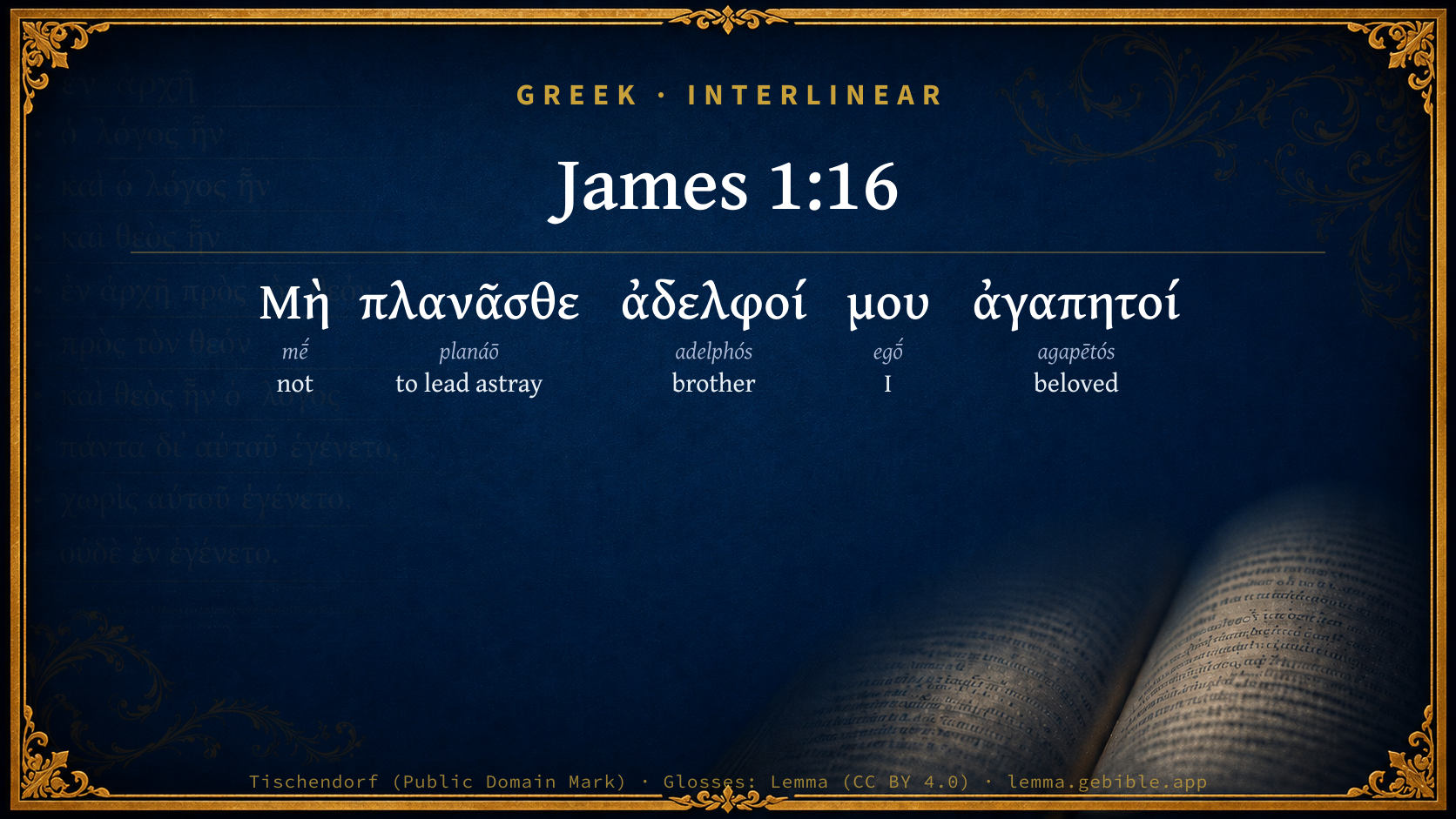
Greek (Tischendorf 8th ed.) James 1:16 appears in the Greek New Testament. The text above is from the Tischendorf 8th edition. Each word links to its Strong’s number and a concise gloss. Click any word for its full Thayer’s Greek Lexicon entry.
Download image
Cite this verse

James 1:16 (World English Bible). Public Domain. Lemma interlinear Bible study tool, https://lemma.gebible.app/v/james/1/16.

Show BibTeX & RIS
BibTeX
RIS
English Translation
Don't be deceived, my beloved brothers.
World English Bible · Public Domain
Download a study sheet

One document with this verse’s original text, its word-by-word gloss line, the meaning frame, cross-references with their text, attributed commentary, and full source and license credits — printable, and it pastes into notes with its structure intact.

This verse Autodidact and up

Study sheet (.html) Plain text (.txt)

A passage Seminary Student

Up to 50 verses in one chapter. A passage sheet keeps up to 6 commentary sources and 12 cross-references per verse, in the order this page ranks them, and says so on the sheet whenever that leaves anything out. Ask for a single verse and you get the Autodidact verse sheet above.

Everything on this page stays free to read, with no account — the sheet is a download of what is already on screen, not access to it.

Want to remove ads? Support Godless Engineer
Compare translations 3

The same verse in 3 English versions, stacked beneath the original-language interlinear above. Click any original word for its lexicon entry.

Each is an independent rendering of the whole verse — the interlinear is not word-aligned to these translations.

Highlighted words mark where these versions differ — a whole-verse word diff, not a word-by-word alignment.

  • World English Bible Public Domain
    Don't be deceived, my beloved brothers.
  • King James Version Public Domain
    Do not err, my beloved brethren.
  • unfoldingWord Literal Text CC BY-SA 4.0
    Do not be led astray, my beloved brothers.

unfoldingWord Literal Text — © unfoldingWord, licensed CC BY-SA 4.0. Word-aligned USFM3 via Door43 (git.door43.org/unfoldingWord/en_ult).

Versions to compare (up to 4)

3 of 4 selected

Show all 19 translations

Every available English version of this verse, each an independent rendering of the whole verse.

  • World English Bible Public Domain
    Don't be deceived, my beloved brothers.
  • Berean Standard Bible Public Domain
    Do not be deceived, my beloved brothers.
  • Majority Standard Bible Public Domain
    Do not be deceived, my beloved brothers.
  • King James Version Public Domain
    Do not err, my beloved brethren.
  • American Standard Version (1901) Public Domain
    Be not deceived, my beloved brethren.
  • Revised Version (1885) Public Domain
    Be not deceived, my beloved brethren.
  • Geneva Bible (1599) Public Domain
    Erre not, my deare brethren.
  • Douay-Rheims (1899) Public Domain
    Do not err, therefore, my dearest brethren.
  • Young's Literal Translation Public Domain
    Be not led astray, my brethren beloved;
  • Literal Standard Version CC BY-SA 4.0
    Do not be led astray, my beloved brothers.
  • Unlocked Literal Bible CC BY-SA 4.0
    Do not be deceived, my beloved brothers.
  • unfoldingWord Literal Text CC BY-SA 4.0
    Do not be led astray, my beloved brothers.
  • Darby Bible Public Domain
    Do not err, my beloved brethren.
  • World Messianic Bible Public Domain
    Don’t be deceived, my beloved brothers.
  • Webster's Bible Public Domain
    Do not err, my beloved brethren.
  • Free Bible Version CC BY-SA 4.0
    My dear friends, don't be deceived.
  • Bible in Basic English Public Domain
    Do not be turned from the right way, dear brothers.
  • Text-Critical English NT CC BY 4.0
    Do not be deceived, my beloved brothers.
  • Tyndale New Testament (1534) Public Domain
    Erre not my deare brethren.

Literal Standard Version (2020), Covenant Press — licensed CC BY-SA 4.0. Text via the HelloAO Bible API (eBible.org). Unlocked Literal Bible (unfoldingWord) — licensed CC BY-SA 4.0. Text via the HelloAO Bible API (eBible.org). unfoldingWord Literal Text — © unfoldingWord, licensed CC BY-SA 4.0. Word-aligned USFM3 via Door43 (git.door43.org/unfoldingWord/en_ult). Free Bible Version, Dr. Jonathan Gallagher — licensed CC BY-SA 4.0. Text via the HelloAO Bible API (eBible.org).

Word by word

More ways to search: Search by grammar → Find every occurrence → Compare this word →

Practice this passage: Drill this verse → Learn its vocabulary →

πλανᾶσθε
planáō
G4105
“to lead astray”
Verb, Present, Passive, Imperative, 2nd person, Plural
Part of Speech
Verb
Tense
Present
Voice
Passive
Mood
Imperative
Person
2nd person
Number
Plural
Full Thayer's Definition

Origin: from G4106

TDNT: 09:48,9

1. to cause to stray, to lead astray, lead aside from the right way a. to go astray, wander, roam about 2. metaph. a. to lead away from the truth, to lead into error, to deceive b. to be led into error c. to be led aside from the path of virtue, to go astray, sin d. to sever or fall away from the truth 1. of heretics e. to be led away into error and sin
  1. Μὴ mḗ G3361 “not” Particle, Negative
  2. ἀδελφοί adelphós G80 “brother” Noun, Vocative, Plural, Masculine
  3. μου egṓ G1473 “I” Personal pronoun, 1st person, Genitive, Singular
  4. ἀγαπητοί agapētós G27 “beloved” Adjective, Vocative, Plural, Masculine

About this verse

These counts appear in no published source. They are computed here, from the morphology-tagged text and Lemma’s own curated glosses. What Lemma adds →

5
words
5
distinct lemmas
General Epistles
section

Shared distinctive vocabulary

πλανᾶσθε to lead astray G4105 occurs in 37 verses of the Greek New Testament. Also found in:
Cross-references

13

Topical passages linked to James 1:16 in the Treasury of Scripture Knowledge — connected by theme and wording, ordered by reader-vote popularity; previews shown in the World English Bible.

  • Galatians 6:7 Don't be deceived. God is not mocked, for whatever a man sows, that will he also reap.
  • James 1:19 So, then, my beloved brothers, let every man be swift to hear, slow to speak, and slow to anger;
  • Colossians 2:8 Be careful that you don't let anyone rob you through his philosophy and vain deceit, after the tradition of men, after the elements of the world, and not after Christ.
  • Philippians 2:12 So then, my beloved, even as you have always obeyed, not only in my presence, but now much more in my absence, work out your own salvation with fear and trembling.
  • Colossians 2:4 Now this I say that no one may delude you with persuasiveness of speech.
  • Hebrews 13:1 Let brotherly love continue.
  • 1 Corinthians 6:9 Or don't you know that the unrighteous will not inherit the Kingdom of God? Don't be deceived. Neither the sexually immoral, nor idolaters, nor adulterers, nor male prostitutes, nor homosexuals,
  • Philippians 4:1 Therefore, my brothers, beloved and longed for, my joy and crown, so stand firm in the Lord, my beloved.
  • 2 Timothy 2:18 men who have erred concerning the truth, saying that the resurrection is already past, and overthrowing the faith of some.
  • James 2:5 Listen, my beloved brothers. Didn't God choose those who are poor in this world to be rich in faith, and heirs of the Kingdom which he promised to those who love him?
  • Mark 12:24 Jesus answered them, "Isn't this because you are mistaken, not knowing the Scriptures, nor the power of God?
  • Matthew 22:29 But Jesus answered them, "You are mistaken, not knowing the Scriptures, nor the power of God.
  • Mark 12:27 He is not the God of the dead, but of the living. You are therefore badly mistaken."

Cross-references courtesy of OpenBible.info (CC BY 4.0).

Commentary

Notes on James 1:16 from classic Christian and Jewish commentators (each source and its license shown beneath its notes). The classic Christian expositions comment on the surrounding passage and are grouped to its opening verse, so a note may address several verses; the Jewish commentaries on the Tanakh (Rashi and others) are per-verse, so they appear only where the commentator wrote on this verse.

Lemma curates 59 commentaries, every one of them public domain or Creative Commons licensed, each selected and text-cleaned for this edition rather than reprinted as found. About our sources →

The Biblical Illustrator

Joseph S. Exell

Jam_1:16

Do not err

A caution against error

I.

WE ARE LIABLE TO ERR.

1. From the weakness of our understandings, and the limited operation of the human faculties.

2. From the awfully mysterious subjects to which our attention is directed.

3. From the impositions and cheats practised upon us.

II. IT IS NOT NECESSARY. If error were involuntary, it would be unnecessary to guard us against it. We need not err--

1. Because we have a comprehensive and an all-sufficient directory.

2. Because we have a perfect Pattern and Exemplar.

3. Because we have an infallible Guide to conduct us into all truth.

III. WE SHOULD RE ON OUR GUARD AGAINST ERROR.

1. Because error is discreditable.

2. Because error is uncomfortable.

3. Because error is unsafe. (Sketches of Sermons.)

Error

1. It is not good to brand things with the name of error till we have proved them to be so. After he had disputed the matter with them, he saith, Err not. General invectives make but superficial impressions; show what is an error, and then call it so. Truly that was the way in ancient times. Loose discourses lose their profit. Blunt iron, that toucheth many points at once, doth not enter, but make a bruise; but a needle, that toucheth but one point, entereth to the quick.

2. We should as carefully avoid errors as vices; a blind eye is worse than a lame foot, yea, a blind eye will cause it; he that hath not light is apt to stumble (Rom_1:26); first they were given up to a vain mind, and then to vile affections. Many, I am persuaded, dally with opinions, because they do not know the dangerous result of them: all false principles have a secret but pestilent influence on the life and conversation.

3. Do not err; that is, do not mistake in this matter, because it is a hard thing to conceive how God concurreth to the act, and not to the evil of the act; bow He should be the author of all things, and not the author of sin; therefore he saith, however it be difficult to conceive, yet Do not err.

(1) You see, then, what need you have to pray for gifts of interpretation, and a door of utterance for your ministers, and a knowing heart for yourselves, that you may not be discouraged by the difficulties that fence up the way of truth. Chrysostom observeth that the saints do not pray, Lord, make a plainer law, but, Lord, open my eyes, that I may see the wonders of Thy law; as David doth.

(2) It showeth how much they are to blame that darken truth, and make the things of God the more obscure.

4. Again, from that Do not err. Take in the weightiness of the matter. Ah! would you err in a business that doth so deeply intrench upon the honour of God? The mistake being so dangerous, he is the more earnest. Oh! do not err. There is nothing more natural to us than to have ill thoughts of God, and nothing more dangerous; all practice dependeth upon it, to keep the glory of God unstained in your apprehensions.

5. From that my beloved brethren. Gentle dealing will best become dissuasives from error. Certainly we bad need to use much tenderness to persons that differ from us, speak to them in silken words. Where the matter is like to displease, the matter should not be bitter: pills must be sugared, that they may go down the better: many a man hath been lost through violence: you engage them to the other party. (T. Manton.)

On self-deception

I. MEN ERR BY ATTACHING GREATER IMPORTANCE TO THE AFFAIRS OF THIS LIFE, THAN TO THOSE OF ETERNITY. HOW many and great privations and dangers will the warrior pass through to gain the honour of a victory I Yet to conquer himself, to win a kingdom that cannot be moved--this never engaged his serious thoughts, never excited his desire,

II. MEN DECEIVE THEMSELVES BY THE HOPE OF A DEATH-BED REPENTANCE. IS it not highly presuming on the patience of God when we expect that God will grant us repentance unto life eternal, in the day of sickness, after we have spent our best days in the service of sin?

III. MEN ERR IN THEIR VIEW OF THE NATURE, THE EVIL, AND THE CONSEQUENCE OF SIN. Every sin, how small or insignificant soever it may seem to us, is an act of black ingratitude for multiplied mercies. It is a provoking of the wrath of God. Again, every sin, however secretly committed, will be brought to light in the day of judgment. The sins of omission as well as the sins of commission; the sins of the heart as well as the sins of the life; all will then be brought forward against every impenitent sinner, and exhibited to an assembled world. The pleasures of sin for a season are purchased at too dear a rate. What are the luxuries of life which drown the soul in perdition, when contrasted with their reward--an eternity of anguish!

IV. MEN ERR IN THEIR VIEW OF THE DIVINE LAW THAT IS, THE MORAL LAW. They are not aware that the law of God is spiritual; that it extends to the secret chambers of the heart; that it condemns everything that the sinner does, says, or thinks, because it is not done, said, or thought, as the law requires. Multitudes erroneously imagine that the law is of no force, or, at least, that its exactions are greatly relaxed, since the death of Christ. This is a fundamental. The law of God, being a transcript of His own unchangeable holiness, is itself unchangeable. It will be the standard by which the righteous Judge will at the last day critically try all actions, words, and affections of men.

V. MEN ERR AND DECEIVE THEMSELVES IN THE VIEW OF THEIR OWN CHARACTER. They imagine that though they are not what they ought to be, yet they are not so bad as others, and have a good heart, and mean well. If they are wrong, what must become of thousands? Some conclude that their state is good, because they are born of Christian parents, educated in a Christian land, admitted to Christian ordinances (Rev_3:17).

VI. MEN ERR IN THEIR APPREHENSION OF THE CHARACTER OF GOD. They think Him to be altogether such an one as themselves. They venture upon sin, and presumptuously flatter themselves that God is not so rigid as to notice everything they do amiss. They foolishly conclude that because the Lord delayeth the execution of His threatenings, He will not pour out His fury on the ungodly. Application:

1. To those who may be under the influence of self-deception. If you are deceived, you neither will seek safety nor apprehend any danger: and if you are not undeceived before you die, you will be awfully convinced, but too late, of your fatal error.

2. To those who feel the vast importance of their souls concerns, and are anxious to be preserved from error. Do you abandon the vain refuge of lies in which you once sought shelter? If it be so, we may pronounce your case a hopeful one. Yet rest not in present attainments; but press forward to the mark. Examine yourselves. Adopt the prayer of the Psalmist (Psa_139:23-24). (E. Edwards.)

Errors concerning God to be avoided

This verse emphasises the importance of having correct views of God. In regard to other things, wander into the forests of falsehood so far as one may, the man who holds the truth as to God can never be finally lost. And yet how few seem to appreciate that. Any philosophy of physical science is unsound and untrustworthy in proportion to its holding unsound relations to the truth as to God. The same is true in civil life: heresies in doctrine, errors in morals, and wrongs in life are to be traced almost invariably to some mistake of the truth as to God. Let a man be right here, and he has formed a hasp on which he may bang the first link of any chain of thought or action or life which he may be able to forge in time and in eternity. Do not wander from the great central truth as to God. (C. F. Deems, D. D.)

The Biblical Illustrator, edited by Joseph S. Exell (c. 1880s–1900s) — public domain. Text from a community e-Sword module.

Joseph Benson's Commentary

Jas 1:16-17. Do not err, &c. — By supposing that God is the author of sin, or that any thing which is sinful in the heart or conduct of man can, with truth, be ascribed to him: as well might darkness and coldness be attributed to the sun. It is indeed a grievous error to ascribe the evil, and not the good, which we receive, to God. No evil, but every good gift — Of every kind: whatever is beautiful, excellent, and good in any creature in the universe; all the members and senses of our bodies, and all our temporal blessings; and every perfect gift — Every gift of truth and grace, whatever tends to holiness and happiness here or hereafter; is from above — From heaven, not from earth, much less from hell; and cometh down from the Father of lights — Whether material or spiritual, in the kingdom of grace and glory; the author of all truth, knowledge, wisdom, holiness, and happiness. The appellation of Father is here used with peculiar propriety. It follows in the next verse, he begat us. With whom is no variableness — In his understanding; or shadow of turning — In his will; but he is immutably wise and good, holy and happy. He infallibly discerns all good and evil, and invariably loves the one and hates the other. There is in both the Greek words here used a metaphor taken from the heavenly bodies, particularly proper, where the Father of lights is mentioned; both words are applicable to any celestial body which has a daily vicissitude of day and night, and sometimes longer days, sometimes longer nights. In God is nothing of this kind. He is mere light. If there be any such vicissitude in us, it is from ourselves, not from him. “Will he give us holy desires at one time, and evil inclinations at another? No: he always gives us what is good, and nothing but good. It is blasphemous, therefore, as well as absurd, to suppose that God either tempts or constrains men to sin, on purpose that he may have a pretence for making them miserable. Some are of opinion that in the word παραλλαγη, translated variableness, there is an allusion to the parallaxes of the heavenly bodies. But as these were not known to the common people, the apostle, in a letter addressed to them, would hardly introduce a reference to such things.” — Macknight.

Joseph Benson's Commentary on the Old and New Testaments (1811–1818) — public domain. Text from a community e-Sword module.

The Preacher's Complete Homiletical Commentary

Joseph S. Exell (gen. ed.)

CRITICAL AND EXEGETICAL NOTES

Jas_1:17. Father of lights.—The luminaries of heaven; as symbols of all kinds of lights, natural, intellectual, spiritual. Shadow of turning.—Or shadow that is cast by turning. The terms “variableness” and “shadow of turning” distinctly refer to the movements of the heavenly bodies, and decide the idea of James in speaking of God as “Father of lights.”

Jas_1:18. Begat.—More lit. “brought He us forth.” Word of truth.—Not here the personal Logos, but the revealed word, the medium of the Divine sanctifying. Firstfruits.—See Lev_23:10; Deu_26:2.

MAIN HOMILETICS OF THE PARAGRAPH.—Jas_1:16-18

The Helpfulness of cherishing Right Thoughts of God.—The tone of every life is given by the idea that is entertained of God. This is abundantly illustrated by comparing the moral life of Pagans and heathen with the gods whom they acknowledge. But it may be also illustrated by the philosophical misrepresentations, and the ignorant caricatures, of the God of Christianity. In whatever sense men make their own gods, “they that made them are like unto them.” The moral conduct never can rise higher than the moral conception of the deity worshipped. Then how much is done for humanity when the revelation is made of a holy God! How much is done when that holiness is seen to be a human possibility, because realised in the Divine Man, the Lord Jesus.

I. God is good, and the ultimate Source of all good.—The apprehension of this is the foundation of morality. We start with the affirmation of goodness in God. “None is good save one, that is God.”

1. Everything that is good in the world has the God-stamp upon it. “Every good gift, and every perfect boon, is from above.”

2. Everything in the world that is good has the permanent stamp upon it. Evil is in its nature temporary. It needs to be changed into good. Good is in its nature permanent, for it does not need to be changed into anything.

3. Everything in the world that is good is an active force, working at the removal of evil. The highest good that the good God works is making typically good people.

(1) God is the source of good.

(2) God is always the source of good.

(3) But He is the source only of perfect good. That perfect good may be within our power of estimating, or it may be beyond it, and then we are thrown back on our primary conviction of His essential goodness. If God is good, what He does must be good, though it may not seem good.

II. God is the Father of lights, who casts not shadows.—“With whom there can be no variation, neither shadow that is cast by turning.” St. James has in mind the movements, and changing appearances, and uncertain shining of sun and moon and stars. There are sun shadows cast by the varying relative positions of earth and sun and moon. God is thought of as Father of lights, Originator of all lights, eternal Light, who abides, never moves to cast a shadow. His agents may cast shadows; He never does. For ever and for ever shine forth from Him unqualified benedictions. Men may turn those benedictions into curses, but that can never alter the fact that they are benedictions. Earthly atmospheres may dim and defile the rays of the sun, but only by adding some evil to them; the rays are still pure, life-giving rays.

1. God Himself is light.

2. God is the Father (Author) of lights, all lights. Everything that is good, pure, true, right, is in sonship to God. And over everything that is good He has a fatherly care and concern. Whensoever we stand to the good, we stand with God. Whensoever we suffer for the good, we suffer with God. If anything in life is perplexing, and we scarcely know whether to call it evil or good, there is always this sufficing test to apply to it—does it prefer the shadow or the light? Everything that loves the light is of God.

III. God is the Author of the new life in man, and that life is light like Himself.—Illustrate from the voice, “Let there be light,” which broke up the chaos of the material earth. That voice speaks life to dead souls, light to bring order into the chaos of fallen human nature. We are made “light in the Lord.” And some are so made that they might become “light-bearers,” “holding forth the word of life.” Or to use the figure of Jas_1:18, to be “a kind of firstfruits of His creatures.”

Learn—

1. That there is peril of deception in regard to God.

2. That peril is great when we only look around us.

3. That peril is great when we take up only man’s view of God.

4. That peril is great if, without help from Divine revelation, we try to read human history.

5. That peril is relieved when we follow the teachings of the inspired word.

6. That peril is for ever removed when we come into those personal relations with the Father of lights, which He graciously permits.

SUGGESTIVE NOTES AND SERMON SKETCHES

Jas_1:16. The Peril of Deception.—“Be not deceived, my beloved brethren.” The particular peril St. James has in mind is the peril of being deceived as to the character of God. Right thoughts of God are at the basis of right living. Wrong thoughts of God make possible lives of self-indulgence and sin. Therefore, from the time of the first temptation in Eden, the policy of the evil one has been to suggest wrong thoughts of God, to deceive with regard to the character and requirements of God.

I. There is peril of deception from one-sided, and therefore imperfect, teachings about God. They may exaggerate His holy severities, or they may exaggerate His loving-kindnesses.

II. There is peril of deception when man makes himself the standard of God.—This reproach is given, “Thou thoughtest that I was altogether such an one as thyself.” Man must rise from himself to conceive of God; but he must never match God by himself, or limit God to what he knows of himself. He is not altogether such an one as we are. In the image of God was man created, on purpose that he might rise from the knowledge of himself to the knowledge of God.

III. There is peril of deception when man trusts to what nature can teach, and refuses the help of revelation. It is not that nature witnesses incorrectly; it does witness imperfectly. It is true as far as it goes; it is unsatisfactory because it cannot go far enough.

IV. There is peril of deception when undue reliance is placed on the teachings of man.—It is not merely that there are false teachers; there are also sectarian teachers, who force on attention particular views of God as the foundation of their exclusive views. Safeguard amid the perils of being deceived concerning the being and character of God is obtained through maintaining—

1. Personal relations with God;

2. Simple-minded confidence in God’s revelations of Himself in and through His inspired word. No man needs to be deceived. Any man will be easily deceived who wishes to be deceived, or allows himself to be put off his guard.

Jas_1:16-17. God the Only Source of All Good.—There is much evil in the world. Why does God permit this? We are called to feel and maintain that He does all things well, that however He may permit He does not do evil; but that, on the contrary, all good, and nothing but good, is to be ascribed to Him. We need to have just views of this matter, since for want of them we greatly err.

I. The true character of the Deity.—He is declared to be the only and the unchanging source of all good.

1. He is the only source of all good. All light proceeds from the sun. So there is no “good and perfect gift” but proceeds from God—

(1) in nature;

(2) in providence;

(3) in grace. All works for the benefit, the welfare, of His people.

2. He is the unchanging source of all good. The sun has its changes, annual and diurnal; but Jehovah, the Father of all heavenly lights, changes not. His light may be intercepted by a cloud, but He Himself remains the same.

II. The errors we run into for want of duly adverting to it.—We err exceedingly—

1. In a way of self-vindication. “Let no man say, when he is tempted, I am tempted of God. Every man is tempted when he is drawn away of his own lust and enticed.” James adds, “Do not err.” Evil is from ourselves, and good is from God.

2. In a way of self-dependence. We are prone to look for some good in ourselves, instead of seeking all good from God alone. Satan himself may as well look for these things in himself as we. All our springs are in God.

3. In a way of self-applause. We are no less prone to take to ourselves credit from what is good than to shift off from ourselves blame in what is evil. If there is any good in us, it is from Christ that we have received it. If we have attained to anything more than ordinary, we must say, “He that hath wrought us for the self-same thing is God.” Even if we equalled the apostle Paul we must say, “By the grace of God”; and in reference to every individual act, “Not I, but the grace of God.”

Application.—“Do not err.” Be aware of your tendencies; correct them. If you arrogate anything to yourselves, you will rob God; and in robbing Him, you will eventually, and to your utter ruin, rob yourselves.—Charles Simeon, M.A.

Jas_1:17. Father of Lights.—God is the Father of all lights—the light of the natural world, the sun, the moon, and stars, shining in the heavens; the light of reason and conscience; the light of His law; the light of prophecy, shining in a dark place; the light of the gospel shining throughout the world; the light of apostles, confessors, martyrs, bishops, and priests, preaching that gospel to all nations; the light of the Holy Ghost shining in our hearts; the light of the heavenly city: God is the Father of them all. He is the everlasting Father of the everlasting Son, who is the Light of the world.—Bishop Words-worth.

Light is God.—To the turning of our planet from the sun we owe our knowledge of the universe. In the symbolism of its darkness and light we have our sublimest revelation of God. Light, which is called God, and is God, issues for ever from the infinite bosom of His darkness. Darkness and light are both alike to Him; for He is as much one as the other. The Son of God, the only begotten Light, reveals the “Father of lights,” as suns reveal the ether. God presents Himself in the Light, but also conceals Himself, as we both present and hide ourselves in our garments. “Thou coverest Thyself with light as with a garment.” As the infinite ether is hidden by the daylight, even so is God hidden by the light of the angelic heavens, which reveals Him. Therefore all those who dwell in the eternal light worship the unseen God, and live “as seeing the invisible.” They know that light is but His effluence. They worship the Light, as God, and again, with silent ineffable adoration, they worship what is behind the Light.—John Pulsford.

Sun and Cloud.—As the sun is the same in its nature and influences, though the earth and clouds, oft interposing, make-it seem to us as varying by its rising and setting, and by its different appearances, or entire withdrawment, when the change is not in it, so God is unchangeable, and our changes and shadows are not from any mutability or shadowy alterations in Him, but from ourselves.—Baxter.

Shadow of Turning.—With Him is nothing analogous to those optical delusions, those periodical obscurations, those vicissitudes of seasons, which attend the annual and diurnal course of the sun. St. James incidentally controverts that doctrine of fatalism in the Pharisees, which ascribed the conditions of men to the influence of the heavenly bodies.

Jas_1:18. Pain and Death in Nature.—The very struggles which all animated beings make against pain and death show that pain and death are not a part of the proper laws of their nature, but rather a bondage imposed on them from without; thus every groan and fear is an unconscious prophecy of liberation from the power of evil.—Dean Howson.

Firstfruits of the Creatures.

I. Firstfruits to show the possibility of harvest.—Suppose that never before this year had the fields of earth waved with the golden grain; that now, for the first time, with measured step and waving hand, the husbandman moved to and fro over his fields, scattering the precious seeds. How intently he would watch those fields in the after-weeks! One or two blades force their way through the soil; they grow quickly in one warm, moist corner. The ears form and bud, and swell, and ripen early there; and the husbandman carries home those firstfruits as the assurance that there can be a harvest from his sowing.

II. Firstfruits assure us of the character of the harvest.—Examine carefully those quickly ripened first-fruits. You can judge from them what will be the quality and the extent of the harvest. The same blights have swept over the field as have smitten those firstfruits. There has been the same soil, the same culture, the same dew and rain and sunshine. You can tell from the handful of firstfruits whether the barns will be loaded and the yield will be enriching. Do these firstfruits stand well? Are they strong in the stalk, full in the ear, free from mildew and rust? Then soon you shall see the whole valley waving in the summer breeze, and reflecting the golden glory of the summer sky. You shall hear the sharp cutting of the reapers, as they gather in the precious grain. Are those firstfruits thin and speckled, and small, and unsteady on the stalk? Then there is a wail of despair in the soul, for the harvest will scarcely repay the cost of ingathering. St. James calls the first Jewish Christians the “firstfruits of his creatures.” There is a promise for the race in every unusually good man; then what promise there must be in Christ!

Firstfruits of the Human Harvest.—There are always some favourable situations in a country where the harvest ripens quickly. This is especially the case in Palestine, parts of which are tropical or sub-tropical. The interest of “firstfruits” lies in their implying “after-fruits.” But to a Jew, with the feelings and associations of Mosaism, a peculiar interest attached to “firstfruits,” and by the term a special thing was understood. The fruit of all manner of trees, for the first three years, was not to be eaten, nor any profit made of it; in the fourth year it was to be holy, and used only to praise the Lord, being either given to the priests, or solemnly eaten by the owners before the Lord in Jerusalem; in the fifth year it might be eaten, and made use of for profit, and thenceforward every year. Explain man’s harvest of the earth and harvest of the sea. He only reaps and gathers in what God provides for him. Then it is most befitting that he should make first acknowledgment to God. From Cain and Abel show the natural impulse which leads man to make his thank-offering. A portion of the very blessing God has given us is the best thank-offering. Explain God’s harvest of the earth. He “would have all men to be saved.” The Redeemer shall “see of the travail of His soul, and be satisfied.” Early Church a kind of firstfruits. First seals to a ministry. First converts in a revival. First decided ones in a family. Firstfruits are an assurance—the harvest is coming. First-fruits are an evidence—of what the harvest will be. Firstfruits are an inspiration—to keep on working for the larger and fuller return. Close with the argument of the apostle—“For this cause I obtained mercy, that in me a chief might Jesus Christ shew forth all His long-suffering, for an ensample of them which should hereafter believe on Him unto eternal life” (1Ti_1:16). Work out the answers to these questions: Who are the first saved ones among us? What ought they to be to God, to themselves, and to others? They should be “proofs” and “patterns.”

The Preacher's Complete Homiletical Commentary (gen. ed. Joseph S. Exell; Funk & Wagnalls, c. 1892) — public domain (pre-1929). A full-Bible homiletical/sermon-outline anthology covering 65 of 66 books (2 John is absent from the source module). Text from a community e-Sword module.

Bengel's Gnomon

Johann Albrecht Bengel

Jas 1:16. [10]Μὴ πλανᾶσθε, do not err) It is a great error to attribute to God the evils which we receive, and not the goods. It is the part of love, to lead us away from this error. A faithful admonition. Comp. ch. Jas 5:19.

[10] Μὴ οὖν is the reading of the Alexandr. and the Lat. Vers. This one example will show that I do not attribute too much weight to the agreement of these two, when unsupported by other evidence; for I have not wished to indicate this various reading in the margin of the text.

Vulg. has “Nolite itaque errare.”—E.

Bengel's Gnomon of the New Testament — English translation (T&T Clark, Edinburgh, 1860) — public domain. Text from a community e-Sword module.

Meyer's Critical & Exegetical Commentary

Heinrich August Wilhelm Meyer

Jam_1:16 introduces the statement which follows as one particularly important. Not only the exhortation: μὴ πλανᾶσθε, but also the added address: ἀδελφοί μου ἀγαπητοί, shows how important this observation appeared to the author. A new line of thought, unconnected with the preceding, does not indeed begin with this verse; μὴ πλανᾶσθε must not therefore be considered, with Hornejus, Gebser, and others, only as the concluding formula to what goes before. Theile correctly observes: ubi antecedentia respicit, nunquam finit cohortationem, sed ita interpositum est, ut continuet ac firmet, nunc illustrando, nunc cavendo. The same formula is found in 1Co_6:9; 1Co_15:33; Gal_6:7 (similarly 1Jn_3:7); in all those places it precedes a thought certain to the Christian conscience, by which a preceding expression is confirmed in opposition to a false opinion: this is also the case here. Grotius inserts an entirely foreign reference when he says: hoc vult: ne putate vestrum studium sufficere sine precibus; see Luk_18:1. There is here no reference whatever to prayer.

Meyer — Critical and Exegetical Commentary on the New Testament — English translation by Peter Christie, edited by Frederick Crombie (T&T Clark, 1880) — public domain. Text from a community e-Sword module.

Geneva Bible (1599)

Geneva Bible translators

Another reason taken of contraries: God is the author of all goodness, and so, that he is always like himself; how then can he be thought to be author of evil?

Geneva Bible (1599) marginal notes — public domain. Text via Bolls.life.

Jamieson, Fausset & Brown

Robert Jamieson, A. R. Fausset & David Brown

Do not err in attributing to God temptation to evil; nay (as he proceeds to show), "every good," all that is good on earth, comes from God.

Jamieson, Fausset & Brown — Commentary Critical and Explanatory on the Whole Bible (1871) — public domain (CC PDM 1.0). Text via the HelloAO Bible API.

Adam Clarke's Commentary

Verse 16. Do not err] By supposing that God is the author of sin, or that he impels any man to commit it.

Adam Clarke's Commentary on the Bible (1810–1826) — public domain. Text from a community e-Sword/MySword module.

John Calvin's Commentaries

16 Do not err. This is an argument from what is opposite; for as God is the author of all good, it is absurd to suppose him to be the author of evil. To do good is what properly belongs to him, and according to his nature; and from him all good things come to us. Then, whatever evil he does, is not agreeable to his nature. But as it sometimes happens, that he who quits himself well through life, yet in some things fails, he meets this doubt by denying that God is mutable like men. But if God is in all things and always like himself, it hence follows that well-doing is his perpetual work.

John Calvin's Commentaries (1540-1563) — public domain. Text from the Calvin Translation Society English edition (1840s-50s) via the Christian Classics Ethereal Library (ccel.org). Calvin's coverage is partial (roughly two-thirds of the Bible); uncommented books and verses are honest gaps, never fabricated. The 19th-century editor's footnotes and remarks are omitted so the notes are faithfully Calvin's own voice.

Ellicott's Commentary for English Readers

(16) Do not err, my beloved brethren.—Thus far James the Wise has declared what God is not, what qualities are alien to Him; but this is only a negative aspect of the truth, and he now would show the positive—namely, that God is the Author of all and every good. And this lesson he introduces with a caution to his brethren beloved, not to err. He is most earnest and emphatic. “Be not ye deceived,” however much the world may wander in delusive paths. A marked change from the dreadful tenor of the last verse is here made to bright reflections on the gifts of God; and a new incentive to endurance is found in the happy thoughts of His goodness.

A Bible Commentary for English Readers, edited by Charles John Ellicott (1878–1897) — public domain. Text from a community e-Sword module.

The Cambridge Bible for Schools and Colleges

gen. ed. J. J. S. Perowne

16–18. God and His perfect gifts

16. Do not err …] The absolute goodness of God had been presented so far on its negative side as excluding all origination of evil. But the writer feels that that is but a partial view. It has a brighter aspect, more full of hope and blessing, and the error against which he protests is chiefly hurtful as excluding that aspect from its due influence on faith and conduct.

The Cambridge Bible for Schools and Colleges (gen. ed. J. J. S. Perowne; Cambridge University Press, 1878–1918) — public domain. Text from a community e-Sword module.

John Gill's Exposition

Do not err, my beloved brethren. For to make God the author of sin, or to charge him with being concerned in temptation to sin, is a very great error, a fundamental one, which strikes at the nature and being of God, and at the perfection of his holiness: it is a denying of him, and is one of those damnable errors and heresies, which bring upon men swift destruction; and therefore to be guarded against, rejected, and abhorred by all that profess any regard unto him, his name and glory.

Do not err, my beloved brethren. For to make God the author of sin, or to charge him with being concerned in temptation to sin, is a very great error, a fundamental one, which strikes at the nature and being of God, and at the perfection of his holiness: it is a denying of him, and is one of those damnable errors and heresies, which bring upon men swift destruction; and therefore to be guarded against, rejected, and abhorred by all that profess any regard unto him, his name and glory.

James 1:17

jam 1:17

jam 1:17

jam 1:17Every good gift and every perfect gift,.... Whether of nature, providence, or grace, and especially the latter; spiritual gifts given along with Christ, or spiritual blessings in him; every such gift is; as the Vulgate Latin version reads, the "best" gift; better than those which only relate to the present life: and is "perfect" such as the gifts of righteousness, remission of sins, adoption, regeneration, and eternal life. The Jews say (k), that the good things of this world are not truly good, in comparison of the good things of the world to come, and are not , "a perfect good." And every such an one is from above; is not from a man's self, from the creature, or from below, but from heaven, and from God who dwells there:

and cometh down from the Father of lights; or author of lights; of all corporeal light; as the sun, moon, and stars; of all natural, rational, and moral light, in angels and men; of all spiritual light, or the light of grace in regenerate persons; and of eternal light, the light of glory in the spirits of just then made perfect:

with whom is no variableness, nor shadow of turning: as there is in that great luminary, the sun in the firmament, which has its parallaxes, eclipses, and turnings, and casts its shadow; it rises and sets, appears and disappears every day; and it comes out of one tropic, and enters into another at certain seasons of the year: but with God, who is light itself, and in him is no darkness at all, there is no change, nor anything like it; he is changeable in his nature, perfections, purposes, promises, and gifts; wherefore he being holy, cannot turn to that which is evil; nor can he, who is the fountain of light, be the cause of darkness, or admit of any in him; and since every good and perfect gift comes from him, evil cannot proceed from him, nor can he tempt any to it.

(k) Tzeror Hammor, fol. 23. 2, 3.

John Gill's Exposition of the Whole Bible (1746–1763) — public domain (CC PDM 1.0). Text via the HelloAO Bible API.

Trapp's Complete Commentary

John Trapp

16 Do not err, my beloved brethren.

Ver. 16. Do not err] Wander not, as wandering stars, to whom is reserved the blackness of darkness for ever, Jdg 1:13, by seeking to father your faults upon God, as Adam did, Gen 3:12.

John Trapp, A Commentary or Exposition upon All the Books of the Old and New Testament (1647–1656) — public domain. Text from a community e-Sword module.

Albert Barnes' Notes on the Bible

Do not err, my beloved brethren - This is said as if there were great danger of error in the point under consideration. The point on which he would guard them, seems to have been in respect to the opinion that God was the author of sin, and that the evils in the world are to be traced to him. There was great danger that they would embrace that opinion, for experience has shown that it is a danger into which men are always prone to fall. Some of the sources of this danger have been already alluded to. Notes, Jam 1:13. To meet the danger he says that, so far is it from being true that God is the source of evil, he is in fact the author of all that is good: every good gift, and every perfect gift Jam 1:17, is from him, Jam 1:18.

Albert Barnes' Notes on the Bible (1834–1885) — public domain. Text from a community e-Sword/MySword module.

Haydock's Catholic Bible Commentary

Do not err, nor deceive yourselves by yielding to temptation; beg God his supporting grace, for every good gift is from him. (Witham)

George Leo Haydock (1774–1849), Haydock's Catholic Family Bible and Commentary, 1859 edition — public domain. Excludes Psalms (Douay-Rheims chapter numbering differs from Protestant) and Deuterocanonical books (Catholic canon only).

Matthew Poole's English Annotations

Viz. in imputing your sins to God, and saying, that when you are tempted you are tempted of him.

Matthew Poole's English Annotations on the Holy Bible (1683–1685) — public domain. Text from a community e-Sword/MySword module.

Whedon's Commentary on the Bible

Daniel D. Whedon

16. Do not err—A solemn warning against the current doctrine of errorists, that God is the evil source of evil. Our apostle declares that God is the invariable author of good.

Daniel D. Whedon (gen. ed.), Commentary on the Old and New Testaments (1874–1909) — public domain. Text from a community e-Sword module.

The Pulpit Commentary

Vers. 16-18. The connection of thought with what goes before appears to be this. God cannot be the author of temptation, which thus leads to sin and death, because all good and perfect gifts, and these only, come from him.

Do not err; better, be act deceived; mh planasqe. The same formula is also found in 1Co_6:9 1Co_15:33; Gal_6:7.

Vers. 16, 17.

All good is from God.

The exhortation of ver. 16 introduces additional confirmation of the truth that God cannot tempt men to sin. He is the Author of all good. He not only abhors evil, but from him come those gracious influences which destroy it. Three shades of thought appear in the argument of ver. 17.

I CONSIDER HIS GIFTS. Each of these is "perfect" in its matter, and good" in the manner of its bestowal. While raw sins (ver. 14) and ripe sins (ver. 15) alike spring from one"s "own lust," "every good gift and every perfect boon is from above." All temporal blessings come from God; and even in this lower province his bounty is supreme. But especially he is the Author of all spiritual blessings every good gift of grace, and every perfect boon of glory. Jesus Christ came down from heaven. The Holy Spirit is from above. Ministering angels descend the stairway "whose top reacheth to heaven." The regenerated are born from above (ver. 18; (Joh_3:3) The graces of the new life are from God: e.g. wisdom, to bear trials (ver. 5); single-mindedness, to rise above outward circumstances (ver. 8); steadfast endurance of temptation (ver. 12). And, at last, "the holy city, new Jerusalem, shall come down out of heaven from God." It is impossible, then, that God, the universal Benefactor, can be in any way responsible for a man"s sin.

II CONSIDER HIS WORKS. He is "the Father of the lights." What a splendid title! and how suggestive of the purity of God! He is Light in his own nature, and he is Light in all his relations to the universe. He made the starry lights to which, indeed, the expression seems primarily to refer. He is the Author of all intellectual and spiritual illumination all Urim and Thummim, "lights and perfections." "The first creature of God in the works of the days was the light of the sense; the last was the light of reason; and his sabbath work ever since is the illumination of his Spirit" (Lord Bacon). Thus Jesus Christ, as Mediator, is "the Light of the world;" and, in relation to the absolute God whom he reveals, he is "Light of light." His people, again, are children of light;" they reflect the luster of the Sun of righteousness. In God "is no darkness at all;" but sin is darkness, so it cannot proceed from him. He is only "the Father of the lights.

III CONSIDER HIS NATURE. The expressions in the last two clauses have almost an astronomical savor. They have evidently been suggested by the mention of the upper starry lights. The thought which they present is that, while God is the Creator of sun, moon, and stars, he is not subject, like them, to revolutions and mutations. "With him can be no variation;" literally, "parallax." Parallax, in astronomy, denotes the apparent displacement of a star from its true position; but with "the Father of the lights" there can be no parallax, no real change of place or purpose. "God is always in the meridian." The shadow of the Almighty is not "cast by turning." Astronomy treats of the revolutions and eclipses of the heavenly bodies; while piety reposes upon the unchangeable-ness of the eternal Light. Being in his own nature immutable, God will be "bounteous still to give us only good." He never has been, nor could be, the author of sin.

LESSONS.

1. Be grateful for God"s gifts.

2. Admire his works.

3. Rejoice in his faithfulness.

4. See that these sentiments fructify in holiness of life. C.J.

The Pulpit Commentary (1880–1919), ed. H.D.M. Spence-Jones & Joseph S. Exell — public domain. Text from a community e-Sword module.

John Wesley's Explanatory Notes

Do not err - It is a grievous error to ascribe the evil and not the good which we receive to God.

John Wesley, Explanatory Notes Upon the Whole Bible (1754–1765) — public domain. Text via the GEBible commentary corpus.

Kretzmann's Popular Commentary

Paul E. Kretzmann

God’s Fatherhood and the Obligations of Sonship.

God’s fatherhood and the acceptance of His Word:

v. 16. Do not err, my beloved brethren.

v. 17. Every good gift and every perfect gift is from above, and cometh down from the father of Lights, with whom is no variableness, neither shadow of turning.

v. 18. Of His own will begat He us with the Word of Truth, that we should be a kind of first-fruits of His creatures.

v. 19. Wherefore, my beloved brethren, let every man be swift to hear, slow to speak, slow to wrath;

v. 20. for the wrath of man worketh not the righteousness of God.

v. 21. Wherefore, lay a part all filthiness and superfluity of naughtiness, and receive with meekness the engrafted Word, which is able to save your souls.

The first sentence serves as a transition between the two paragraphs: Make no mistake about this, my beloved brethren. It is a solemn and touching appeal which the apostle makes, since so much depends upon the proper understanding of these facts. To think that God can in any way be made responsible for sin is a thought which so strongly savors of blasphemy that all Christians must flee the very suggestion. Man alone is responsible for the evil which is found in his heart and which comes forth in the various transgressions of the divine will.

So far as God is concerned, we must always maintain: Every good gift and every perfect endowment is ever coming down from the Father of Lights, with whom there is not existing a change, nor shadow-casting of a turning. God is the Source, the Father of Lights; everything that is truly light and brings light comes from Him. There is no spiritual enlightenment nor anything that has value in a spiritual manner possible without His almighty power. The continual bestowing of good things, the ceaseless shower of spiritual endowments and blessings wherewith He blesses the hearts of men, comes down from Him. Thus He is the Author of all that is excellent and perfect. He can, therefore, not deny Himself; He cannot change His essence and properties; in His case the peculiar entering into part-shadow or loss of brilliancy as it takes place in some of the heavenly bodies is out of the question. The moon may have her phases and the sun his eclipses, but our God shines upon His spiritual children in undimmed glory, 1Jn 1:5. God’s merciful countenance is never hidden from His children, without change and interruption He causes His face to shine upon us.

Of the many splendid gifts of God the apostle names that which is highest and best: Because He willed it, He begot us through the Word of Truth, to be a kind of first-fruits among His creatures. God’s good and gracious will, according to which He wants all men to be saved and to come to the knowledge of the truth, we Christians have experienced. He begot us, we became His children through the Word of Truth, the Gospel, 1Pe 1:23. When the Gospel was proclaimed to us, the merciful will of God, through this means of grace, took us out of our natural, sinful life, and placed us into a new, divine life. By faith we have been regenerated, born anew, become the children of God. And one of God’s purposes in working this change in us was to have us be a kind of first-fruits among His creatures. Just as the first-fruits of every harvest in Judea were consecrated to the Lord, thus we Christians have been set apart from the sinful world to be creatures of God, in whom the image of God is being renewed, through whom God is truly honored. We are His workmanship, created in Christ Jesus unto good works, Eph 2:10.

In view of this grace, however, of which we have become partakers, the apostle admonishes: You know that, my beloved brethren; but let every man be quick to hear, slow to speak, slow to wrath, for the wrath of man does not promote the righteousness of God. The facts which the apostle had just laid before them were truths with which the Jewish Christians were familiar, and of whose soundness they should always assure themselves again, since upon this knowledge and understanding rested their whole Christianity. The fruit of such knowledge would be sure to follow, for a person realizing what he owes to the Word of Truth would certainly always be ready and eager to hear the Word, finding it impossible to learn too much of its glorious message. Just the opposite behavior, however, is expected of a Christian, so far as his neighbor is concerned. He should be reluctant to speak, he should hold back from saying anything in wrath. If he finds that anger is arising in his heart, he should control himself, lest his wrath get the better of his new spiritual nature and cause him to sin. For while there is a righteous indignation over sin which will cause persons in positions of authority to rebuke every form of trespass with all holy severity, it remains true of every form of wrath that it does not work and promote the righteousness of God; its outbursts do not meet with the approval of God, but rather with His condemnation, since they cannot be made to agree with His holy and righteous will.

Knowing the danger of unwarranted anger, the apostle adds the general warning: Wherefore, laying aside all foulness and excess of malice, receive in gentleness the implanted Word, which is able to save your souls. As new creatures, as children of God, the Christians have a continual battle with their old evil nature, which insists upon rearing its head and endeavoring to lead them into every form of uncleanness and sin. But foulness of every kind and manifold wickedness is incompatible with that condition of heart and mind which God expects from His children, just as is all anger and violence. The disposition of the believers rather is this, that they daily and ever again receive the implanted Word, accept anew the message of their salvation and sanctification as it is brought to them in the Gospel. The seed which has sprouted in their hearts is supposed to grow into a strong, healthy plant, and therefore it is necessary that they hear and learn the Word, which alone is able to save their souls, day after day, never growing weary of its wonderful truths. This action on the part of the believers requires meekness, gentleness, humility, because the pride of man’s heart, his self-righteousness, and his general disinclination to the way of salvation will always insist upon standing in his way. But the prize held out to the believers, the everlasting bliss in the presence of God, is of a nature to inspire them with ever new thoughts of their home above and thus to enable them to combat the attacks of their carnal nature successfully.

Paul E. Kretzmann, Popular Commentary of the Bible (1921–1924) — public domain. Text from a community e-Sword module.

Burkitt's Expository Notes on the New Testament

William Burkitt

As if he had said, "Be not deceived about the causes of good and evil; sin and death are certainly from ourselves. Let us therefore never ascribe either our sins or our temptations unto God: but every good and perfecting gift is of God’s free donation and grace, even from above, from the Father of lights, (both of the light of nature, and the light of grace), with whom is no variableness, neither shadow of turning from good to evil; he is unchangeable in his nature and being, and in his attributes and properties."

Learn hence, 1. That we are very prone to err in our notions and apprehensions, as touching the authors of good and evil; too ready to conclude either God or Satan to be the author of the sin we commit, and ourselves the authors of the good we do: Do not err my beloved brethren, in this matter.

Learn, 2. That as sin, which is nothing but evil and imperfection, is not from God, but wholly from ourselves, and our own corrupt hearts; so whatever is good, perfect, or praiseworthy, is wholly from God, and not from ourselves; we are neither by nature inclined to that which is good, nor are we able of ourselves to perform it; both inclination and ability are from God, who is the fountain of goodness and perfection, and can never cease to be so, for with him is no variableness, nor shadow of turning.

Learn, 3. That God being the infinite Father of lights, he hath no eclipses or decreases, no shadows or mixtures of darkness, but always shines with a settled and constant brightness, always is, and was, and to all eternity will be, immutably the same, and never undergo the least change, either of his essence and being, or of his properties and perfections: With whom is no variableness, nor shadow of turning.

As nothing argues greater imperfection than inconstancy and change, so the greater and more glorious the divine perfections are, the greater blemish and imperfection would mutability be; were God changeable, it would darken all his other perfections, and raise the foundation of all religion; for who could either fear or love, trust or serve that being who is fickle and inconstant! What security could there be in his promises? And who would regard the terror of his threatenings, were he not invariable, and without shadow of changing.

William Burkitt's Expository Notes on the New Testament (1700–1703) — public domain. Text from a community e-Sword module.

Godbey's Commentary on the New Testament

William B. Godbey

ARGUMENT 3

PARALLAX

16, 17. Here the Apostle warns us against deceivers who oppose the truth he here reveals in the two works of grace, regeneration for the sinner, and sanctification for the Christian. He here certifies that two gifts come down from God out of heaven, i.e., “the good,” regeneration, and the perfect, sanctification. “With whom there is no parallax nor shadow of change.” Parallax is the angle which a planet makes with the sun. The argument here is that we should have no parallax with the glorious Sun of Righteousness. You all know that your shadow lengthens as you advance from the equator to the poles. It is significantly true in the spiritual as well as in the physical world. North pole churches are the blight of Christianity in the present age of secular ecclesiasticism. God wants us all to live under the equator, where we cast no shadow; as your shadow is simply the measure of your distance from God. O, the long shadows, cast by the popular churches. They rival each other with the high steeple, whose long shadow is the measure of their own condemnation. In equatorial latitudes flowers never fade, fruits never fail, winter never comes and summer ever lasts. So long as you cast any shadow with God, you are not ready to meet Him. Complete consecration puts you in line with God, and forever obliterates your shadow. Sanctification comes spontaneously, responsive to simple faith, when you are entirely consecrated. While out on the college campus on a beautiful, moonless, starlit night, observing the heavenly bodies with a telescope, responsive to my request to see the planet Jupiter, the professor continued to move the telescope hither and thither, exploring the celestial vaults, when suddenly a flood of light sweeps down. Behold, that beautiful and majestic planet, fourteen hundred times as large as this world, encircled with majestic belts, and traversed by brilliant satellites, suddenly burst upon an enraptured vision. Even so, the moment you get in line with God His light shines through you, dissipating forever all your doubt about the witness of the Spirit.

18... “That we should become first fruit of His creatures.” Throughout the Bible the millennium is contemplated as the heavenly harvest. Satan’s long, dark night followed the eclipse of Eden’s bright day, destined in due time to be superseded by the glorious millennium Sabbath. Rom 13:12. During this dreary, dark night of Satan’s reign and hell’s harvest, the saved have been few. Luk 13:23. The millennium will be earth’s glorious, heavenly harvest, of which the few who are plucked as brands from the burning, during these dark centuries, are but the first fruits.

19. James is a wonderfully practical preacher, elucidating every ramification of domestic as well as public life. Empty talk has been a snare to millions. Many people fall into idle gossip, and soon talk their religion all away. We should all do more — infinitely more — thinking than talking. Ten minutes — five in prayer and five in religious conversation — is ample time for a pastoral visit. Many preachers backslide, and cause their members to backslide, by unprofitable conversation.

William B. Godbey, Commentary on the New Testament (1896–1900) — public domain. Text from a community e-Sword module.

The People's New Testament

B. W. Johnson

16–18. Do not err. Either about the source of sin or of all good gifts.

B. W. Johnson's The People's New Testament with Notes (1889–1891) — public domain. Electronic text from the Christian Classics Ethereal Library (CCEL) ThML edition.

Alford’s Greek Testament

Henry Alford

16-18.] The idea that God tempts to sin has been as yet only negatively contradicted. But so far is it from this being so, that He is the Author of all good.

16.] Do not err (some have ended the paragraph with these words: some have begun a new one. But Theile (in Huther) rightly remarks of this formula, “Ubi antecedentia respicit, nunquam finit cohortationem, sed ita interpositum est, ut continuet et firmet, nunc illustrando, nunc cavendo.” It occurs in reff.: see also 1Jn 3:7 (μηδεὶς πλανάτω ὑμᾶς). Still we must not take Theile’s further exposition, “Nolite in alterum errorem abstrahi, ut nempe bona quoque a summo numine abjudicetis:” for this does not lie in the context), my beloved brethren (both this earnest address, and the caution, shew how important the Writer feels this to be, which he is about to enunciate):

Henry Alford, The Greek Testament (1849–1861) — public domain. Text from a community e-Sword module.

International Critical Commentary

16-18. God, on the other hand, sends solely and consistently good gifts, as befits the relation of a father to his first-born.

16. μὴ πλανᾶσθε. “Do not err,” “be not deceived.” As in 1Co 6:9, 1Co 15:33, Gal 6:7, used to introduce a pointed utterance. Cf. Ign. Php_3, Eph. 16, which may, however, be dependent on 1Co 6:9.

On ἀδελφοί, which here is used to add to the emphasis, see note on v. 2, and cf. 2:5, 3:12.

International Critical Commentary — older volumes (1896–1929), various authors — public domain. Text from a community e-Sword module.

Lesson kit

Teaching starters — assembled from the data on this page, not authored interpretation. Every prompt links to the verse data it draws on. Edit before teaching.

James, in the General Epistles, opens this verse with 5 words (5 distinct Greek lemmas). Its most distinctive word is planáō (“to lead astray”). A historical commentator’s framing appears above. Read the whole chapter for the surrounding context.

Discussion questions

  1. The word planáō carries the sense “to lead astray.” How does it shape the verse?
  2. Matthew 18:12 shares the word «to lead astray» with this verse. How do the two illuminate each other?
  3. These translations render this verse differently. What is at stake in choosing one wording over another?
  4. Reading how The Biblical Illustrator and Joseph Benson's Commentary read this verse, where do the two commentators agree and where do they part?

Things to notice

Reading settings

Reading text

Shown beneath each verse's original-language words.

Old Testament
Old Testament edition

Read the OT as the Masoretic Hebrew (MT) or the Greek Septuagint (LXX).

English shown for the Greek Septuagint (in the Hebrew ↔ Greek comparison).

Comparing translations? Open the Compare panel on any verse page to stack up to four side by side.