
Isaiah 28:7

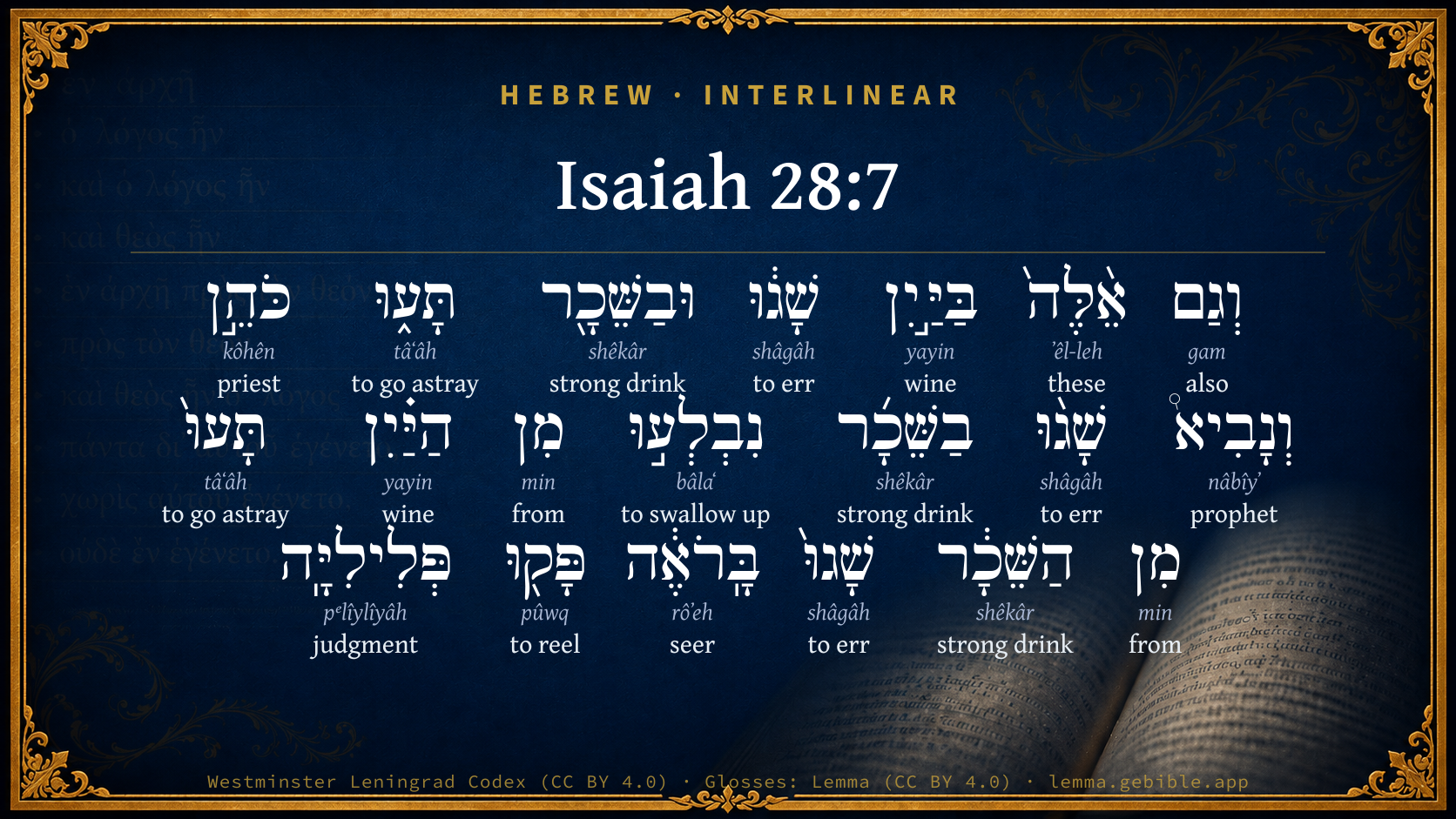
Hebrew (Westminster Leningrad Codex) Isaiah 28:7 appears in the Hebrew Old Testament. The text above is from the Westminster Leningrad Codex. Each word links to its Strong’s number, a concise gloss, and parsing drawn from the Open Scriptures Hebrew Bible morphology. Click any word for its full Brown-Driver-Briggs (BDB) entry.
Download image
Cite this verse

Isaiah 28:7 (World English Bible). Public Domain. Lemma interlinear Bible study tool, https://lemma.gebible.app/v/isaiah/28/7.

Show BibTeX & RIS
BibTeX
RIS
English Translation
Even these reel with wine, and stagger with strong drink; the priest and the prophet reel with strong drink, they are swallowed up of wine, they stagger with strong drink; they err in vision, they stumble in judgment.
World English Bible · Public Domain
Highlights
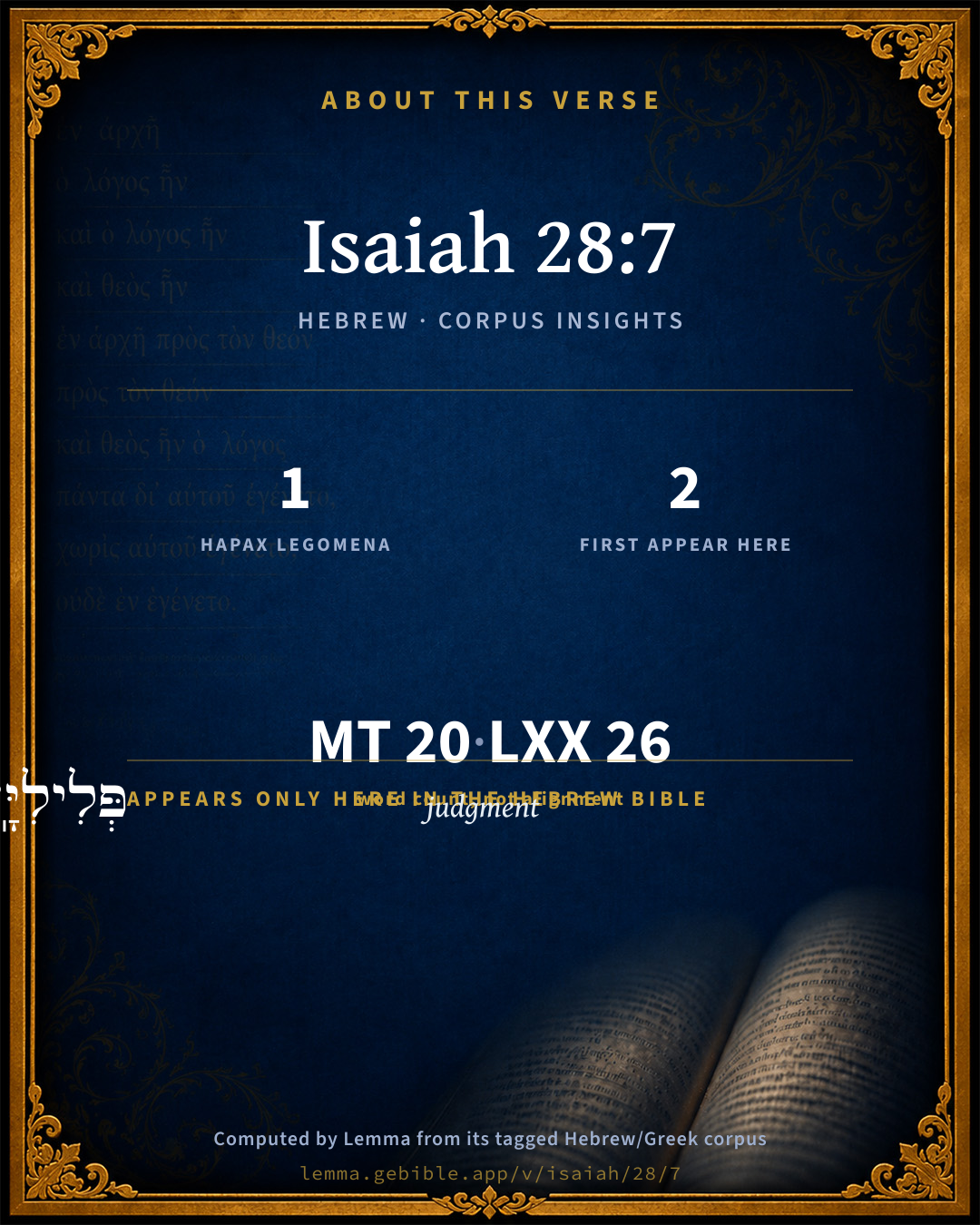
  • 1 hapax legomenon — only here in the Hebrew Bible
  • 2 first appearances in the Hebrew Bible
Full analysis ↓
Download a study sheet

One document with this verse’s original text, its word-by-word gloss line, the meaning frame, cross-references with their text, attributed commentary, and full source and license credits — printable, and it pastes into notes with its structure intact.

This verse Autodidact and up

Study sheet (.html) Plain text (.txt)

A passage Seminary Student

Up to 50 verses in one chapter. A passage sheet keeps up to 6 commentary sources and 12 cross-references per verse, in the order this page ranks them, and says so on the sheet whenever that leaves anything out. Ask for a single verse and you get the Autodidact verse sheet above.

Everything on this page stays free to read, with no account — the sheet is a download of what is already on screen, not access to it.

Want to remove ads? Support Godless Engineer
Compare translations 3

The same verse in 3 English versions, stacked beneath the original-language interlinear above. Click any original word for its lexicon entry.

Each is an independent rendering of the whole verse — the interlinear is not word-aligned to these translations.

Highlighted words mark where these versions differ — a whole-verse word diff, not a word-by-word alignment.

  • World English Bible Public Domain
    Even these reel with wine, and stagger with strong drink; the priest and the prophet reel with strong drink, they are swallowed up of wine, they stagger with strong drink; they err in vision, they stumble in judgment.
  • King James Version Public Domain
    But they also have erred through wine, and through strong drink are out of the way; the priest and the prophet have erred through strong drink, they are swallowed up of wine, they are out of the way through strong drink; they err in vision, they stumble in judgment.
  • unfoldingWord Literal Text CC BY-SA 4.0
    And these also stagger with wine, and they reel with beer. The priest and the prophet stagger with beer; they are swallowed up with wine. They reel with beer, they stagger in vision, they stumble judgment.

unfoldingWord Literal Text — © unfoldingWord, licensed CC BY-SA 4.0. Word-aligned USFM3 via Door43 (git.door43.org/unfoldingWord/en_ult).

Versions to compare (up to 4)

3 of 4 selected

Show all 18 translations

Every available English version of this verse, each an independent rendering of the whole verse.

  • World English Bible Public Domain
    Even these reel with wine, and stagger with strong drink; the priest and the prophet reel with strong drink, they are swallowed up of wine, they stagger with strong drink; they err in vision, they stumble in judgment.
  • Berean Standard Bible Public Domain
    These also stagger from wine and stumble from strong drink: Priests and prophets reel from strong drink and are befuddled by wine. They stumble because of strong drink, muddled in their visions and stumbling in their judgments.
  • Majority Standard Bible Public Domain
    These also stagger from wine and stumble from strong drink: Priests and prophets reel from strong drink and are befuddled by wine. They stumble because of strong drink, muddled in their visions and stumbling in their judgments.
  • King James Version Public Domain
    But they also have erred through wine, and through strong drink are out of the way; the priest and the prophet have erred through strong drink, they are swallowed up of wine, they are out of the way through strong drink; they err in vision, they stumble in judgment.
  • American Standard Version (1901) Public Domain
    And even these reel with wine, and stagger with strong drink; the priest and the prophet reel with strong drink, they are swallowed up of wine, they stagger with strong drink; they err in vision, they stumble in judgment.
  • Revised Version (1885) Public Domain
    But these also have erred through wine, and through strong drink are gone astray; the priest and the prophet have erred through strong drink, they are swallowed up of wine, they are gone astray through strong drink; they err in vision, they stumble in judgment.
  • Geneva Bible (1599) Public Domain
    But they haue erred because of wine, and are out of the way by strong drinke: the priest and the prophet haue erred by strong drinke: they are swallowed vp with wine: they haue gone astraye through strong drinke: they faile in vision: they stumble in iudgement.
  • Douay-Rheims (1899) Public Domain
    But these also have been ignorant through wine, and through drunkenness have erred: the priest and the prophet have been ignorant through drunkenness, they are swallowed up with wine, they have gone astray in drunkenness, they have not known him that seeth, they have been ignorant of judgment.
  • Young's Literal Translation Public Domain
    And even these through wine have erred, And through strong drink have wandered, Priest and prophet erred through strong drink, They have been swallowed up of the wine, They wandered because of the strong drink, They have erred in seeing, They have stumbled judicially.
  • Literal Standard Version CC BY-SA 4.0
    And even these have erred through wine, || And have wandered through strong drink, || Priest and prophet erred through strong drink, || They have been swallowed up of the wine, || They wandered because of the strong drink, || They have erred in seeing, || They have stumbled judicially.
  • Unlocked Literal Bible CC BY-SA 4.0
    But even these reel with wine, and stagger with strong drink. The priest and the prophet reel with strong drink, and they are swallowed up by wine. They stagger with strong drink, staggering in vision and reeling in decision.
  • unfoldingWord Literal Text CC BY-SA 4.0
    And these also stagger with wine, and they reel with beer. The priest and the prophet stagger with beer; they are swallowed up with wine. They reel with beer, they stagger in vision, they stumble judgment.
  • Darby Bible Public Domain
    But these also have erred through wine, and through strong drink are they gone astray. The priest and the prophet have erred through strong drink; they are overpowered by wine, they are gone astray through strong drink; they have erred in vision, they have stumbled [in] judgment.
  • World Messianic Bible Public Domain
    They also reel with wine, and stagger with strong drink. The priest and the prophet reel with strong drink. They are swallowed up by wine. They stagger with strong drink. They err in vision. They stumble in judgment.
  • Webster's Bible Public Domain
    But they also have erred through wine, and through strong drink are out of the way; the priest and the prophet have erred through strong drink, they are overwhelmed with wine, they are out of the way through strong drink; they err in vision, they stumble in judgment.
  • Free Bible Version CC BY-SA 4.0
    But these people also drink so much wine and beer that they sway from side to side and stumble over. Even priests and prophets stagger along, their minds muddled by beer and wine. Because of the drink they are confused about visions and make mistakes when they give decisions.
  • Bible in Basic English Public Domain
    And further, these are uncertain through wine, and have gone out of the right way through strong drink: the priest and the prophet are uncertain through strong drink, they are overcome by wine, they have gone out of the way through strong drink; their vision is false, they go wrong in their decisions.
  • JPS Tanakh (1917) Public Domain
    But these also reel through wine, and stagger through strong drink; the priest and the prophet reel through strong drink, they are confused because of wine, they stagger because of strong drink; they reel in vision, they totter in judgment.

Literal Standard Version (2020), Covenant Press — licensed CC BY-SA 4.0. Text via the HelloAO Bible API (eBible.org). Unlocked Literal Bible (unfoldingWord) — licensed CC BY-SA 4.0. Text via the HelloAO Bible API (eBible.org). unfoldingWord Literal Text — © unfoldingWord, licensed CC BY-SA 4.0. Word-aligned USFM3 via Door43 (git.door43.org/unfoldingWord/en_ult). Free Bible Version, Dr. Jonathan Gallagher — licensed CC BY-SA 4.0. Text via the HelloAO Bible API (eBible.org).

Word by word

More ways to search: Search by grammar → Find every occurrence → Compare this word →

Practice this passage: Drill this verse → Learn its vocabulary →

פְּלִילִיָּֽה
pᵉlîylîyâh
H6417
“judgment”
Noun, Common, Feminine, Singular, Absolute
Part of Speech
Noun
Type
Common
Gender
Feminine
Number
Singular
State
Absolute
Full BDB Definition

Origin: from H6416

TWOT: 1776e

the giving a decision, pronouncement of judgment, reasoning
  1. וְגַם gam H1571 “and · also” Conjunction + Particle, Accusative
  2. אֵ֨לֶּה֙ ʼêl-leh H428 “these” Pronoun, Demonstrative, Common, Plural
  3. בַּיַּ֣יִן yayin H3196 “in/at the · wine” Preposition, Determined + Noun, Common, Masculine, Singular, Absolute
  4. שָׁג֔וּ shâgâh H7686 “to err” Verb, Qal, Perfect, 3rd Person, Common, Plural
  5. וּבַשֵּׁכָ֖ר shêkâr H7941 “and · in/at the · strong drink” Conjunction + Preposition, Determined + Noun, Common, Masculine, Singular, Absolute
  6. תָּע֑וּ tâʻâh H8582 “to go astray” Verb, Qal, Perfect, 3rd Person, Common, Plural
  7. כֹּהֵ֣ן kôhên H3548 “priest” Noun, Common, Masculine, Singular, Absolute
  8. וְנָבִיא֩ nâbîyʼ H5030 “and · prophet” Conjunction + Noun, Common, Masculine, Singular, Absolute
  9. שָׁג֨וּ shâgâh H7686 “to err” Verb, Qal, Perfect, 3rd Person, Common, Plural
  10. בַשֵּׁכָ֜ר shêkâr H7941 “in/at the · strong drink” Preposition, Determined + Noun, Common, Masculine, Singular, Absolute
  11. נִבְלְע֣וּ bâlaʻ H1104 “to swallow up” Verb, Niphal, Perfect, 3rd Person, Common, Plural
  12. מִן min H4480 “from” Preposition
  13. הַיַּ֗יִן yayin H3196 “the · wine” Particle, Definite Article + Noun, Common, Masculine, Singular, Absolute
  14. תָּעוּ֙ tâʻâh H8582 “to go astray” Verb, Qal, Perfect, 3rd Person, Common, Plural
  15. מִן min H4480 “from” Preposition
  16. הַשֵּׁכָ֔ר shêkâr H7941 “the · strong drink” Particle, Definite Article + Noun, Common, Masculine, Singular, Absolute
  17. שָׁגוּ֙ shâgâh H7686 “to err” Verb, Qal, Perfect, 3rd Person, Common, Plural
  18. בָּֽרֹאֶ֔ה rôʼeh H7203 “in/at the · seer” Preposition, Determined + Noun, Common, Masculine, Singular, Absolute
  19. פָּק֖וּ pûwq H6328 “to reel” Verb, Qal, Perfect, 3rd Person, Common, Plural

About this verse

These counts appear in no published source. They are computed here, from the morphology-tagged text and Lemma’s own curated glosses. What Lemma adds →

20
words
13
distinct lemmas
Prophets
section

Notable vocabulary

1 hapax legomenon — a word that appears only here in the entire Hebrew Bible:

  • פְּלִילִיָּֽה judgment H6417

First appearance in Scripture

These words make their first canonical appearance in the Hebrew Bible here:

  • פָּק֖וּ to reel H6328
  • פְּלִילִיָּֽה judgment H6417

Shared distinctive vocabulary

פָּק֖וּ to reel H6328 occurs in 2 verses of the Hebrew Bible. Also found in:

Grammatical profile

  • 7 verbs
  • 9 nouns
  • 1 pronoun
  • 2 prepositions
  • 1 particle

Verb forms

  • שָׁג֔וּ Qal · Perfect
  • תָּע֑וּ Qal · Perfect
  • שָׁג֨וּ Qal · Perfect
  • נִבְלְע֣וּ Niphal · Perfect
  • תָּעוּ֙ Qal · Perfect
  • שָׁגוּ֙ Qal · Perfect
  • פָּק֖וּ Qal · Perfect

Repetition

Words recur within this verse — often emphatic in Hebrew:

  • שָׁג֔וּ to err H7686 ×3
  • וּבַשֵּׁכָ֖ר strong drink H7941 ×3
  • בַּיַּ֣יִן wine H3196 ×2
  • תָּע֑וּ to go astray H8582 ×2
  • מִן from H4480 ×2

Hebrew & Septuagint length

In English translation the verse runs 38 words from the Hebrew and 42 from the Septuagint (LXX English) — closely comparable.

A rough comparison of the two English renderings, which tokenize alike — not a word-level alignment.

Word counts can differ between the Hebrew and the Greek without any difference in meaning — e.g. the Hebrew direct-object marker אֵת has no separate Greek word, and Greek often adds the article ὁ.

In the original languages it is 20 Hebrew tokens and 26 Greek tokens — but the two are counted differently (Hebrew bundles its prefixes and suffixes into one token; the Greek is in lemma form), so that isn’t a like-for-like length.

Cross-references

25

Topical passages linked to Isaiah 28:7 in the Treasury of Scripture Knowledge — connected by theme and wording, ordered by reader-vote popularity; previews shown in the World English Bible.

  • Isaiah 56:10–12 His watchmen are blind, they are all without knowledge; they are all mute dogs, they can't bark; dreaming, lying down, loving to slumber.
  • Luke 21:34 "So be careful, or your hearts will be loaded down with carousing, drunkenness, and cares of this life, and that day will come on you suddenly.
  • Proverbs 20:1 Wine is a mocker, and beer is a brawler; Whoever is led astray by them is not wise.
  • Ecclesiastes 10:17 Happy are you, land, when your king is the son of nobles, And your princes eat in due season, For strength, and not for drunkenness!
  • Isaiah 19:14 Yahweh has mixed a spirit of perverseness in the midst of her; and they have caused Egypt to go astray in every work of it, as a drunken man staggers in his vomit.
  • Matthew 24:29 But immediately after the oppression of those days, the sun will be darkened, the moon will not give its light, the stars will fall from the sky, and the powers of the heavens will be shaken;
  • Psalms 107:27 They reel back and forth, and stagger like a drunken man, And are at their wits' end.
  • Isaiah 3:12 As for my people, children are their oppressors, And women rule over them. My people, those who lead you cause you to err, And destroy the way of your paths.
  • Jeremiah 14:14 Then Yahweh said to me, The prophets prophesy lies in my name; I didn't send them, neither have I commanded them, neither spoke I to them: they prophesy to you a lying vision, and divination, and a thing of nothing, and the deceit of their own heart.
  • Jeremiah 23:13 I have seen folly in the prophets of Samaria; they prophesied by Baal, and caused my people Israel to err.
  • Jeremiah 23:16 Thus says Yahweh of Hosts, Don't listen to the words of the prophets who prophesy to you: they teach you vanity; they speak a vision of their own heart, and not out of the mouth of Yahweh.
  • Micah 2:11 If a man walking in a spirit of falsehood lies: 'I will prophesy to you of wine and of strong drink;' He would be the prophet of this people.
  • Leviticus 10:9–10 "Drink no wine nor strong drink, you, nor your sons with you, when you go into the Tent of Meeting, that you don't die: it shall be a statute forever throughout your generations:
  • Proverbs 31:4–5 It is not for kings, Lemuel; It is not for kings to drink wine; Nor for princes to say, 'Where is strong drink?'
  • Isaiah 5:11 Woe to those who rise up early in the morning, that they may follow strong drink; Who stay late into the night, until wine inflames them!
  • Isaiah 5:22 Woe to those who are mighty to drink wine, And champions at mixing strong drink;
  • Isaiah 9:15–16 The elder and the honorable man, he is the head; and the prophet who teaches lies, he is the tail.
  • Isaiah 22:13 and behold, joy and gladness, killing oxen and killing sheep, eating flesh and drinking wine: let us eat and drink, for tomorrow we shall die.
  • Isaiah 24:2 It shall be, as with the people, so with the priest; as with the servant, so with his master; as with the maid, so with her mistress; as with the buyer, so with the seller; as with the creditor, so with the debtor; as with the taker of interest, so with the giver of interest to him.
  • Isaiah 29:11 All vision is become to you as the words of a book that is sealed, which men deliver to one who is learned, saying, Read this, I pray you; and he says, I can't, for it is sealed:
  • Lamentations 2:4 He has bent his bow like an enemy, he has stood with his right hand as an adversary, Has killed all that were pleasant to the eye: In the tent of the daughter of Zion he has poured out his wrath like fire.
  • Ezekiel 13:7 Haven't you seen a false vision, and haven't you spoken a lying divination, in that you say, Yahweh says; but I have not spoken?
  • Ezekiel 44:21 Neither shall any of the priests drink wine, when they enter into the inner court.
  • Hosea 4:11–12 Prostitution, wine, and new wine take away understanding.
  • Ephesians 5:28 Even so ought husbands also to love their own wives as their own bodies. He who loves his own wife loves himself.

Cross-references courtesy of OpenBible.info (CC BY 4.0).

Hebrew and Greek witnesses Masoretic Hebrew ↔ Greek Septuagint

The same verse in the two great witnesses to the Old Testament, shown verse-for-verse.

These are two independent witnesses, not word-aligned to each other, and the Septuagint is shown in lemma (dictionary) form.

Hebrew Isaiah 28:7 Masoretic · Westminster Leningrad Codex

וְגַם אֵ֨לֶּה֙ בַּיַּ֣יִן שָׁג֔וּ וּבַשֵּׁכָ֖ר תָּע֑וּ כֹּהֵ֣ן וְנָבִיא֩ שָׁג֨וּ בַשֵּׁכָ֜ר נִבְלְע֣וּ מִן הַיַּ֗יִן תָּעוּ֙ מִן הַשֵּׁכָ֔ר שָׁגוּ֙ בָּֽרֹאֶ֔ה פָּק֖וּ פְּלִילִיָּֽה

Even these reel with wine, and stagger with strong drink; the priest and the prophet reel with strong drink, they are swallowed up of wine, they stagger with strong drink; they err in vision, they stumble in judgment.

World English Bible · Public Domain

Greek LXX Isaiah 28:7 Septuagint · lemma form

οὗτος γάρ οἶνος πλανάω εἰμί πλανάω διά ὁ σίκερα ἱερεύς καί προφήτης ἐκἵστημι διά ὁ οἶνος σείω ἀπό ὁ μέθη ὁ σίκερα πλανάω οὗτος εἰμί φάσμα

For these have trespassed through wine; they have erred through strong drink: the priest and the prophet are mad through strong drink, they are swallowed up by reason of wine, they have staggered through drunkenness; they have erred: this is their vision.

LXX2012 (modern English Septuagint) · Public Domain

Hebrew: Westminster Leningrad Codex (CC BY 4.0). Greek: Septuagint (public domain); English from LXX2012 (modern English Septuagint) (Public Domain). How the Septuagint differs from the Hebrew →

Targum (Aramaic paraphrase)

1

The Targum is the ancient Jewish Aramaic paraphrase of the Hebrew Scriptures — an interpretive translation, not the Hebrew text itself. Onkelos (literal) and Pseudo-Jonathan (expansive) render the Torah, and Jonathan the Prophets. Coverage is partial: where no permissively-licensed English translation exists for a verse, only the Aramaic is shown. This is verse-level text, not a word-by-word alignment to the Hebrew.

  1. Targum Jonathan Prophets (Joshua–Malachi)
    וְאַף אִלֵין בְּחַמְרָא רְווֹ וּבְעַתִּיקָא אִסְתַּלְעֲמוּ כַהֲנָא וְסָפַּר רְווֹ מִן עַתִּיק אִסְתַּלְעֲמוּ מִן חֲמַר טְעוֹ מִן עַתִּיק אִתְפְּנִיאוּ בָּתַר מֵיכַל בְּסִיס טְעוֹ דַיָנְהָא:

    But verily these are drunk with wine, they are swallowed up of old wine: the priest and the scribe are drunk, in old wine they are swallowed up: on account of wine they have erred; they are turned after sweet food; their judges have erred.

    Targum Jonathan — Aramaic: “Mikraot Gedolot” (public domain). English: “Sefaria Community Translation” (CC0 1.0 (public-domain dedication)); “London "Chaldee Paraphrase," 1871” (public domain). Text via Sefaria.

Commentary

Notes on Isaiah 28:7 from classic Christian and Jewish commentators (each source and its license shown beneath its notes). The classic Christian expositions comment on the surrounding passage and are grouped to its opening verse, so a note may address several verses; the Jewish commentaries on the Tanakh (Rashi and others) are per-verse, so they appear only where the commentator wrote on this verse.

Lemma curates 59 commentaries, every one of them public domain or Creative Commons licensed, each selected and text-cleaned for this edition rather than reprinted as found. About our sources →

Trapp's Complete Commentary

John Trapp

Isa 28:7 But they also have erred through wine, and through strong drink are out of the way; the priest and the prophet have erred through strong drink, they are swallowed up of wine, they are out of the way through strong drink; they err in vision, they stumble [in] judgment.

Ver. 7. But they also have erred through wine.] Judah had caught this disease of Ephraim, as the English are said to have done of the drunken Dutchmen. Sin is more contagious and catching than the plague. The Hebrew word importeth an alienation of mind. {Pro 20:1 Hos 11:2-3; Hos 11:12 Jer 23:9} Vino sapientia obscuratur, Wisdom is voided by wine, said Alphonsus, King of Arragon.

They are swallowed up of wine, they are out of the way through strong drink.] Errarunt propter Shecar: they are bucked in beer; they are drowned in drink, like as George, Duke of Clarence, was drowned in a butt of malmsey {a} by his own election. Nam sicut athletico potore dignum erat, ut potando moreretur, elegit, saith mine author; for, being condemned to die by his brother King Edward IV, he chose that kind of death, as becoming to a stout drunkard.

They err in vision.] The prophets do.

They stumble in judgment.] The priests do, for they were to interpret the law, and to decide differences. Drunkenness in rulers is a capital sin, and maketh the land reel.

{a} A strong sweet wine, originally the product of the neighbourhood of Monemvasia (Napoli di Malvasia) in the Morea; but now obtained from Spain, the Azores, and the islands of Madeira and the Canaries, as well as from Greece.

John Trapp, A Commentary or Exposition upon All the Books of the Old and New Testament (1647–1656) — public domain. Text from a community e-Sword module.

The Biblical Illustrator

Joseph S. Exell

Isa_28:7-8

But they also have erred through wine

Swallowed up of wine

This is how all debasement continues, aggravates itself, and brings itself to shameful issue.

No man begins at the point of being swallowed up in any evil: he approaches it almost stealthily, he touches it experimentally, he retains for a certain time his self-control in relation to it,--he will handle it, but easily, so that he can set it down again should it so please him. But at the end there is swallowing up, destruction--death is in the cup, and death must be drunk up by those who put their lips to the forbidden vessel. When Edward IV condemned his own brother, George Duke of Clarence, to be killed, we are told that the duke desired to be drowned in a butt of Malmsey, and the historian well adds, as became so stout a drunkard. To this end may men come who never dreamed of coming to it, who meant to show the world how easy it would be to toy with the devil, to touch him, set him back, smile at him, laugh at him, use him as a dog, bind him as a slave; and to all these initial usages will the devil submit himself, knowing that at some fatal unsuspected moment he will lasso the man who supposes he can take him captive, and he will carry him away to the chambers of death. (J. Parker, D. D.)

Erred through wine

Preaching in London, the Rev. Egerton Young, so long a missionary to the Hudson Bay Indians, said he would like to bring some of his converts to this land, but he dared not until the temperance cause was more advanced. One native preacher had been brought over, but kind friends thought that he required a little stimulant after the fatigue of the meeting, and the poor Indian had gone back with such a taste for spirits that he had to be expelled from his office, and finally died a drunken outcast. (Australian Sunday School Teacher.)

Intemperance a pestilence

No pestilence has ever destroyed so many millions of men, women, and children as intemperance; for a pestilence comes and goes, and often at long intervals, but intemperance is a fixed and permanent plague, always spreading, and always destroying our people, body and soul. (Cardinal Manning.)

Intemperance a peril to national life

On the east coast of our country the sea has been encroaching for centuries. Acre after acre of corn land has tumbled down into the waves, and churches, threatened by every high tide, are pointed out which, at the time of their erection, stood a mile from the sea. And by a similar process of encroachment and destruction fruitful sections of our national life are broken down and churned in the raging flood of this terrible curse, and places are not unknown in which the very church itself threatens to topple into ignominy and ruin. (T. G. Selby.)

Drunkenness degrades

Dr. Louis A. Banks tells how a drunkard in New Orleans was reformed. A friend of his, who was a stenographer, sat down in a corner of the saloon in which he was carousing, and made a full shorthand report of every word he said. The next morning the stenographer copied the whole thing neatly and sent it round to his office. In less than ten minutes he came tearing with his eyes fairly standing out of their sockets. Great heavens, he gasped, what is this? Its a stenographic report of your monologue at the restaurant last evening, and gave him a brief explanation. Did I really talk like that? he asked faintly. I assure you it is an absolutely verbatim report, was the reply. He turned pale and walked out. He never drank another drop. (Christian Age.)

The degradation of drunkenness

It is told by Victor Hugo that in the capital of Burgundy the corporation had four silver goblets. When a prince or any distinguished person passed through their city they were offered wine in these silver goblets. The wine of Burgundy is very famous, but the people knew not only its merits, but its dangers. On the first goblet was inscribed a monkey, on the second a lion, on the third a sheep, and on the fourth a swine. This meant to denote the degrees of drunkenness which their wine produced. (G. H. Morrison, M. A.)

The Biblical Illustrator, edited by Joseph S. Exell (c. 1880s–1900s) — public domain. Text from a community e-Sword module.

Joseph Benson's Commentary

Isa 28:7. But they also have erred — But, alas! Judah is guilty of the same sins with Israel, therefore they also must expect the same calamities, of which he speaks afterward. The priest — To whom strong drink was expressly forbidden in the time of their sacred ministrations; and the prophet — The teachers, who should have been patterns of sobriety to the people, and to whom sobriety was absolutely necessary for the right discharge of their office; have erred — In their conversation and in their holy administrations. They are swallowed up of wine — They are, as we say, drowned in it. They err in vision — The prophets miscarry in their sacred employment of prophesying or teaching, which is sometimes called vision. They stumble in judgment — The priests mistake in pronouncing the sentence of the law, which was their duty.

Joseph Benson's Commentary on the Old and New Testaments (1811–1818) — public domain. Text from a community e-Sword module.

Tyndale Open Study Notes

Tyndale Open Resources

28:7-13 The focus returns to the lamentable present situation in Israel (and Judah). The leaders and people will be ensnared by their own schemes.

28:7 The priests and prophets led the people astray. • Intoxicating beverages such as wine and alcohol were prohibited for priests while fulfilling their duties (Lev 10:9).

Tyndale Open Study Notes — © Tyndale Open Resources, licensed CC BY-SA 4.0. Text via the HelloAO Bible API.

Geneva Bible (1599)

Geneva Bible translators

Meaning, the hypocrites which were among them, and were altogether corrupt in life and doctrine, which is here meant by drunkenness and vomiting.

Geneva Bible (1599) marginal notes — public domain. Text via Bolls.life.

Jamieson, Fausset & Brown

Robert Jamieson, A. R. Fausset & David Brown

Though Judah is to survive the fall of Ephraim, yet "they also" (the men of Judah) have perpetrated like sins to those of Samaria (Isa 5:3, Isa 5:11), which must be chastised by God.

erred . . . are out of the way--"stagger . . . reel." Repeated, to express the frequency of the vice.

priest . . . prophet--If the ministers of religion sin so grievously, how much more the other rulers (Isa 56:10, Isa 56:12)!

vision--even in that most sacred function of the prophet to declare God's will revealed to them.

judgment--The priests had the administration of the law committed to them (Deu 17:9; Deu 19:17). It was against the law for the priests to take wine before entering the tabernacle (Lev 10:9; Eze 44:21).

Jamieson, Fausset & Brown — Commentary Critical and Explanatory on the Whole Bible (1871) — public domain (CC PDM 1.0). Text via the HelloAO Bible API.

Ellicott's Commentary for English Readers

(7) But they also have erred through . . .—Better, yet these also reel . . . Isaiah acts on the method of Nathan when he said, “Thou art the man.” He has painted the drunkards of Ephraim; now he turns and paints in yet darker colours the drunkards of Judah. Priests were seen reeling to their services, prophets reeling in the very act of their counterfeit inspiration. The threefold iteration of the word for “reel” emphasises the scandals of the scene. The sins of the sons of Eli, those of which Micah (Isa_2:11) had spoken, were reproduced in all their enormity. The most loathsome features of their drunkenness are printed in Isa_28:8 with a boldness which is almost photographic. The prohibition of wine during the time when the priests were on duty (Lev_10:1-9) adds to the guilt thus represented.

A Bible Commentary for English Readers, edited by Charles John Ellicott (1878–1897) — public domain. Text from a community e-Sword module.

The Cambridge Bible for Schools and Colleges

gen. ed. J. J. S. Perowne

7. the priest and the prophet] Better: priest and prophet. These are specially mentioned as the spiritual leaders of the people, who opposed Isaiah in the name of Jehovah, and backed up the plans of the politicians with the pretended authority of Divine revelation.

swallowed up of wine] Perhaps, “confused by wine,” see on Isa_3:12.

are out of the way] R.V. have gone astray—see Isa_19:14.

vision (a peculiar form in the Hebr.) refers to the function of the prophets; judgment (lit. “judicial matters”) to that of the priests (cf. Deu_17:8 ff; Deu_19:17; Eze_44:24). It is not asserted that the prophets have no visions, but only that, through self-indulgence, they lack the capacity to discern their real significance.

The Cambridge Bible for Schools and Colleges (gen. ed. J. J. S. Perowne; Cambridge University Press, 1878–1918) — public domain. Text from a community e-Sword module.

John Gill's Exposition

For all tables are full of vomit and filthiness,.... The one signifies what is spued out of a man's mouth, his stomach being overcharged, and the other his excrements; and both give a just, though nauseous, idea of a drunken man. This vice was very common; men of all ranks and degrees were infected with it, rulers and people; and no wonder that the common people ran into it, when such examples were set them; the tables of the priests, who ate of the holy things in the holy place, and the tables of the prophets, who pretended to see visions, and to prophesy of things to come, were all defiled through this prevailing sin;

so that there is no place clean or free from vomit and filthiness, no table, or part of one, of prince, prophet, priest, and people; the Targum adds,

"pure from rapine or violence.''

R. Simeon, as De Dieu observes, makes "beli Makom" to signify "without God", seeing God is sometimes with the Jews called Makom, "place", because he fills all places; and as if the sense was, their tables were without God, no mention being made of him at their table, or in their table talk, or while eating and drinking; but this does not seem to be the sense of the passage. Vitringa interprets this of schools and public auditoriums, where false doctrines were taught, comparable to vomit for filthiness; hence it follows:

John Gill's Exposition of the Whole Bible (1746–1763) — public domain (CC PDM 1.0). Text via the HelloAO Bible API.

Albert Barnes' Notes on the Bible

But they also have erred through wine - In the previous verses the prophet had said that the kingdom of Judah should be saved, while that of Ephraim should be destroyed. Yet he does not deny that they also were guilty of crimes for which punishment would come upon them. To portray these crimes, and to declare the certain judgment which awaited them, is the design of the remainder of the chapter. The word rendered ‘have erred’ (שׁגוּ shâgû) refers usually to the fact that people “stagger” or “reel” through wine, and is applied commonly to those who are intoxicated Pro 20:1. The subsequent part of this verse shows, however, that it does not refer merely to the fact that they stagger and reel as intemperate people do, but that it had an effect on their ‘vision’ and ‘judgment;’ that is, it disqualified them for the discharge of their duties as priests and as prophets. In this part of the verse, however, the simple idea is, that they reel or stagger through wine, that is, they are addicted to intoxication. In the subsequent part of the verse the prophet states the effect in producing indistinctness of vision and error of judgment.

And through strong drink - (see the note at Isa 5:11).

They are out of the way - (תעוּ tā‛û). They wander; stagger; reel (compare the notes at Isa 19:14).

The priest and the prophet - Probably these persons are specified to denote the higher classes of society. It is probable that the prophet also designs to indicate the enormity of the sins of the nation, from the fact that those who were especially devoted to religion, and who were supposed to have immediate communication with God, were addicted to intemperance.

They are swallowed up of wine - They are completely absorbed by it (see the note at Isa 25:7); they not only themselves indulge in its use, but they are themselves, as it were, swallowed up by it, so that their reason, and strength, and virtue are all gone - as a vessel is absorbed in a maelstrom or whirlpool.

They err in vision - For the sense of the word ‘vision,’ see the note at Isa 1:1. The prophet here states the effect of the use of wine and strong drink on their mental and moral powers. It was the office of the prophets to declare the will of God; probably also to explain the sense of the sacred Scriptures, and to address the people on their duty. Here the prophet says that the effect of their intemperance was that they had themselves no correct and clear views of the truth, and that they led the people into error.

They stumble in judgment - There were many important subjects on which the priests sat in judgment among the Hebrews, particularly in all matters pertaining to religion. By the influence of intoxicating liquors they were disqualified for the high and holy functions of their office; and the consequence was, that the nation was corrupt, and was exposed to the heavy judgments of God.

Albert Barnes' Notes on the Bible (1834–1885) — public domain. Text from a community e-Sword/MySword module.

Haydock's Catholic Bible Commentary

These also. The kingdom of Juda. (Challoner) --- Ezechias could not correct every abuse; though what is here specified, regards rather the reigns of his successors.

George Leo Haydock (1774–1849), Haydock's Catholic Family Bible and Commentary, 1859 edition — public domain. Excludes Psalms (Douay-Rheims chapter numbering differs from Protestant) and Deuterocanonical books (Catholic canon only).

Matthew Poole's English Annotations

But, alas! Judah is guilty of the same sins with Israel, and therefore they also must expect the same calamities; of which he speaks afterward. They run into the same excess of wine and strong drink, whereby they besot themselves, and fall into many errors and miscarriages, both in sacred and civil things. The many emphatical phrases and repetitions of the same thing in other words, in this verse, seem to evince that he here speaks of drunkenness, properly so called, although he afterward chargeth them with ignorance, and error, and stupidity; which also were the companions, and in part the effects, of that sin.

The priest, to whom strong drink was expressly forbidden in the time of their sacred ministrations, lest they should thereby be led into errors in their work, Lev 10:9,10.

The prophet; the teachers, who should have been patterns of sobriety to the people, and to whom sobriety was absolutely necessary for the right discharge of their office.

Have erred in their conversation, and in their holy administrations.

They are swallowed up; they are, as we say, drowned in it; their senses and reason are swallowed up and lost in it. They design only to swallow it, but indeed are swallowed up by it.

They err in vision; the prophets miscarry in their sacred employment of prophesying or teaching, which is called vision, Pro 29:18, and elsewhere.

They stumble in judgment; the priests mistake in pronouncing the sentence of the law, which was their duty, Deu 17:9-11.

Matthew Poole's English Annotations on the Holy Bible (1683–1685) — public domain. Text from a community e-Sword/MySword module.

Whedon's Commentary on the Bible

Daniel D. Whedon

7, 8. But they also — With these words the prophet passes from Ephraim to Judah. He had just said that Judah should be spared while Ephraim should be sacked and destroyed. But even Judah is guilty of drunkenness. Those of them who are of the anti-reform party, false prophet and priest, even these err or stagger in vision, that is, while prophesying; and stumble, that is, blunder grievously, in giving judgment, or adjudicating cases, and all through strong drink.

Priest and the prophet — Both these classes were to be found in the worldly, anti-spiritual party, which also absorbed the higher classes of society in Jerusalem. The true prophet was in the minority, hence unpopular and persecuted, though even a king, as did Hezekiah, might favour his cause.

Tables are… vomit — The terms here are used of the extreme effects of drunkenness. Hyperbole is common among orientals, and is allowable for reaching the depths of the thought in hand, and to present a mirror before real baseness.

Daniel D. Whedon (gen. ed.), Commentary on the Old and New Testaments (1874–1909) — public domain. Text from a community e-Sword module.

The Pulpit Commentary

Vers. 7-10. JUDAH"S SINFULNESS. The reformation effected by Hezekiah was but a half-reformation. It put away idolatry, but it left untouched a variety of moral evils, as:

1. Drunkenness. Judah was no whir behind Ephraim in respect of this vice. The very priests and "prophets" gave way to the disgusting habit, and came drunk to the most solemn functions of religious teaching and hearing causes.

2. Scorn and mockery of God"s true prophets. The teaching of Isaiah was made light of by the officials of the priestly and prophetic orders, who claimed to be quite as competent to instruct men in their duties as himself. They seem to have ridiculed the mode of his teaching its catch-words, as they thought them, and its insistence on minutiae.

They also. Judah, no less than Ephraim (see vers. 1, 3). It has been questioned whether literal intoxication is meant, and suggested that Judah "imitated the pride and unbelief and spiritual intoxication of Ephraim" (Kay). But the numerous passages which tax both the Israelites and the Jews of the period with drunkenness, (Isa_5:11, 22 22:13 Hos_4:11 Hos_7:5 Amo_6:6, etc.) are best understood literally. Orientals (e.g, the Persians) are often given to such indulgence. Have erred through wine; rather, reel with wine. Are out of the way; or, stagger. The verbs express the physical effects of intoxication. The priest and the prophet. Priests were forbidden by the Law to drink any wine or strong drink previously to their taking part in the service of the tabernacle, (Lev_10:9) and the prohibition was always understood to apply afortiori to the temple. (Eze_44:21) Prophets might have been expected to act in the spirit of the command given to priests. By "prophets" here Isaiah means, not persons especially called of God, but official members of the prophetical order. Of these there were always many in Judah, who had no strong sense of religion. (see Isa_29:10 Jer_5:13, 31 Eze_13:2-16 Amo_2:12 Zep_3:4, etc.) They err in vision; rather, they reel in the vision. They are drunken, even in the very exercise of their prophetical office when they see, and expound, their visions. They stumble in judgment; or, they stagger when pronouncing judgment (Delitzsch).

Persons in authority had been specially warned not to drink wine before the hearing of causes. (Pro_31:4, Pro_31:5)

Vers. 7-13. The mockers and the prophet.

Here, it appears, the scene changes to Jerusalem. And we should compare the picture of drunkenness and luxury with that in Amo_6:1-7 and Mic_2:11.

I THE PRIESTS AND PROPHETS OF THE TIME. They are seen reeling and staggering in the midst of, or as they come from, their most sacred functions. It is a strong and indignant description of drunkenness in general. (cf. Pro_20:1) What more humiliating than the spectacle! To have "put an enemy in one"s mouth to steal away one"s brains," to be the thrall of one"s own brutal appetites, and a "scoured dish of liquor"! "Ebrius urgeris multis miser undique curls Atque animi incerto fluitans errore vagaris.

How much worse the vice in those who need all the clearness of the brain, all the composure of the nerves, for the discharge of their high office! They should be filled" with another spirit" than this. The effect of the bodily intoxication must be to cloud the judgment, to confuse the perception of truth. And how truly the proverb must apply, Like people, like priest"! If such the habits of the representatives of the people, what must the people themselves have been?

II THE SPIRIT OF MOCKERY. (Vers. 9, 10.) "The drunkards mock Isaiah over their cups. Does he not know what respectable persons he is dealing with not like children, who need leading-strings, but educated priests and prophets?" (Cheyne). They scoff at him by taking up words often on his mouth. Whom would he teach knowledge? This designates prophetic preaching. (see Isa_1:8 Isa_33:6) And tidings? Another word for revelation, for something heard from Jehovah". (ver. 22; cf. Isa_21:10 Isa_53:1) Then they ridicule his manner. He is always harping upon the same string," always dwelling upon the same commonplaces of morality and religion. It is childish repetition," say they. But, in fact, the preacher must keep dwelling upon a few main points, so easily do they slip by us!". (Heb_2:1) "Here a little, and there a little," it is a true description of popular preaching. It may seem foolishness" to a scientifically trained understanding; but it has pleased God to save many by means of it. The gospel requires us to receive it as little children, and little by little, a saying here, and there a verse, and again a proverb; this is how little children learn.

III REPLY OF THE PROPHET. He "retorts their own language upon them. Yes; it shall be, in fact, as you say. This childish monotone shall indeed sound in your ears. The description which you give of the revelations of Jehovah shall be exactly applicable to the harsh laconic commands of a merciless invader. For Assyrian, though closely allied to Hebrew, was sufficiently different from it both in grammar and in vocabulary to seem a "stammering" or "barbarous" tongue to Isaiah"s contemporaries. The common diplomatic and commercial language of Syria and Assyria was Aramaic" (see Isa_36:11) (Cheyne). (For the word rendered "stammer," i.e. speak unintelligibly, as in a foreign tongue, Isa_33:19 Pro_1:26 Pro_17:5 Psa_2:4 Psa_59:9 Job_22:19) The lessons which the people refuse to heed when taught them in their native tongue, shall be pressed home upon them in the harsh accents of the barbarian. "Since the Divine patience has been lost upon them, a stronger way shall be taken to force their attention. God will thunder in their ears what to them will appear jargon, the language of a foreign nation!" How prophetic the words in general! The ill taste on our part which makes truth unpalatable in its simplicity and gentle persuasiveness will be sorely criticized when we are forced to listen to hoarse and rude accents. The prophet"s burden had been of rest rest to the weary; of refreshment by hearty faith in Jehovah. (Isa_30:15; cf. Jer_6:16) And now the old words, "line upon line," etc., will come back upon memory and conscience, to be enforced by retreat, and flight, and fall, and captivity. He that hath ears to hear, let him hear." If truth sound barbarous, it is because we have not the true listening faculty. If it be not sweet to the taste as honey, it is because the stomach is disordered. If the Word profit not, it is because men do not mix it with faith," i.e. with obedient and loving dispositions. A willful ignorance and blindness alone deprives of spiritual benefits; a stubbornness in turning away from the offered light, and choosing to remain in darkness. J. (cf. Isa_8:16 Isa_6:9 Isa_29:11 Mar_4:12)

The moral deterioration of self-indulgent habits.

"They err in vision, they stumble in judgment." Isaiah treats wine and strong drink in much the same way as we do now. To him it was the prominent instance, and so it could be made the type, of self-indulgence, which has many forms and many expressions. Certain very manifest degradations follow on indulgence in strong drink, or in opium, or in morphia, and in these cases oppressive illustrations are given of the evils that attend lesser or less apparent indulgences. An ever-working law applies to all cases, small as well as great; but we may more easily trace the working in the great. This may be shown by some careful accounts of the deterioration of mind and character following on drink-indulgence in men, and even more painfully in women. Terrible stories of the ruin of character wrought by opium-smoking in China can be given. And recently, very painful revelations have been made of the existence of a degrading morphio-mania, especially among the upper classes. Persons who have had morphia injected under the skin, to relieve pain, find a craving for it created; they indulge the passion, and the result is utter mental and moral helplessness, and a certain, dreadful death. In measure, the law of deterioration applies to indulgence in eating, in drinking tea, in matters of sensual passion, in craving for newspapers, in seeking pleasure, and even in matters of play or of hobby. As soon as the indulgence in anything gets established it begins to degrade. A man loses his manhood as soon as any thing is allowed to gain control over him; and with lost manhood comes dimmed vision and stumbling judgment. The moral consequences of self-indulgence may be fully treated under four divisions.

I PHYSICAL EFFECTS ON BODIES. This must be considered, because we are every day coming better to understand the close connection between bodily conditions and moral states. The moral habit becomes tightly fixed by an actual bodily bias, an actual tendency of nerve and muscle to do again what has been done once.

II MORAL EFFECT ON WILLS. There is an actual weakening of will-force. The power to say "No" fades and dies out, and the will is borne away wheresoever mere appetite leads.

III PRACTICAL EFFECT ON CONDUCT. Wherever moral control is limited conduct becomes dangerous or disgraceful.

IV FINAL EFFECT ON FATE. Whatever the view taken of the future state, they are at terrible disadvantage in it even if it be a continuous reforming condition who start on it degraded by self-indulgence. R.T.

The Pulpit Commentary (1880–1919), ed. H.D.M. Spence-Jones & Joseph S. Exell — public domain. Text from a community e-Sword module.

John Wesley's Explanatory Notes

But - Judah is guilty of the same sins with Israel, therefore they also must expect the same calamities; of which he speaks afterward. The prophet - The teachers, who should have been patterns of sobriety to the people. They err - The prophets miscarry in their sacred employment. Stumble - The priests mistake in pronouncing the sentence of the law, which was their duty.

John Wesley, Explanatory Notes Upon the Whole Bible (1754–1765) — public domain. Text via the GEBible commentary corpus.

Keil & Delitzsch

C. F. Keil & F. Delitzsch

With the words, "and they also," the prophet commences the second half of the address, and passes from Ephraim to Judah. "And they also reel with wine, and are giddy with meth; priest and prophet reel with meth, are swallowed up by wine: they are giddy with meth, reel when seeing visions, stagger when pronouncing judgment. For all tables are full of filthy vomit, without any more place." The Judaeans are not less overcome with wine than the Ephraimites, and especially the rulers of Judah. In wicked violation of the law of God, which prohibited the priests from drinking strong drink when performing priestly service, and that on pain of death (Lev 10:9, cf., Eze 44:21), they were intoxicated even in the midst of their prophetic visions (הראה, literally "the thing seeing," then the act of seeing; equivalent to ראי, like חזה in Isa 28:15 = חזוּת; Olshausen, 176, c), and when passing judicial sentences. In the same way Micah also charges the prophets and priests with being drunkards (Mic 3:1., cf., Isa 2:11). Isaiah's indignation is manifested in the fact, that in the words which he uses he imitates the staggering and stumbling of the topers; like the well-known passage, Sta pes sta mi pes stas pes ne labere mi pes. Observe, for example, the threefold repetition of shâgu - tâghu, shâgu - tâghu, shâgu - pâqu. The hereditary priests and the four prophets represent the whole of the official personages. The preterites imply that drunkenness had become the fixed habit of the holders of these offices. The preposition בּ indicates the cause ("through," as in Sa2 13:28 and Est 1:10), and min the effect proceeding from the cause (in consequence of wine). In v. 8 we can hear them vomit. We have the same combination of the and צ in the verb kotzen, Gothic kozan. All the tables of the carousal are full, without there being any further room (cf., Isa 5:8); everything swims with vomit. The prophet paints from nature, here without idealizing. He receives their conduct as it were in a mirror, and then in the severest tones holds up this mirror before them, adults though they were.

Keil & Delitzsch — Biblical Commentary on the Old Testament (1861–1891) — public domain (CC PDM 1.0). Text via the HelloAO Bible API. (Old Testament only.)

J. A. Alexander on Isaiah

Joseph Addison Alexander

“And (yet) these also (or even these) through wine have erred, and through strong drink have gone astray. Priest and Prophet have erred through strong drink, have been swallowed up of wine, have been led astray by strong drink, have erred in vision, have wavered in judgment.” Having predicted in the foregoing verse, that when Ephraim fell Judah should continue to enjoy the protection of Jehovah, the Prophet now describes even this favored remnant as addicted to the same sins which had hastened the destruction of the ten tribes, viz. sensual indulgence and the spiritual evils which it generates. The meaning then is that the Jews, although distinguished from the ten tribes by God’s sparing mercy, should nevertheless imitate them in their sins. There is great probability in the suggestion, that the prophecy refers to the national deterioration in the reign of Manasseh. The Priest and Prophet are named as the leaders of the people, and as those who were peculiarly bound to set a better example. The reference to judgment in the last clause may be explained, either on the ground that the Priest and Prophet represent the rulers of the people in general, or because the Priests themselves exercised judicial functions in certain prescribed cases (Deu 17:9; Deu 19:17). The use of strong drinks was expressly forbidden to the priests in the discharge of their official functions (Lev 10:9; Eze 44:21).

Joseph Addison Alexander, The Prophecies of Isaiah (1846–1847; New York: Scribner, 1870–1878) — public domain. Text from a community e-Sword module.

unfoldingWord translationNotes

Door43 World Missions Community

But even these

"But even the leaders"

The priest and the prophet

This does not mean a specific priest or prophet. It refers to priests and prophets in general. AT: "The priests and the prophets" (See: Generic Noun Phrases)

reel with wine, and stagger with strong drink

These two phrases mean basically the same thing and emphasize that the priests and the prophets cannot do their job because they are very drunk. AT: "stumble around because they are drunk" (See: Parallelism)

they are swallowed up by wine

Their drinking so much that they can no longer think properly is spoken of as if the wine swallowed them. This can be stated in active form. AT: "the wine is causing them to be confused" (See: Metaphor and Active or Passive)

staggering in vision and reeling in decision

Just like they are too drunk to walk correctly, they are too drunk to understand the visions God gives them or to make good decisions.

translationWords

wine

strong drink

priest

prophet

vision

unfoldingWord translationNotes — © Distant Shores Media and the Door43 World Missions Community, licensed CC BY-SA 4.0. Source: git.door43.org/Door43/en_tn.

Rashi

Rabbi Shlomo Yitzchaki (Rashi)

These too who sit in judgment and return the war in this generation, i.e., the best and most esteemed among them, erred because of wine, for now there is no good in them.

they erred against the seer They mocked the words of the prophets. Jonathan renders: with eating delicacies, which they saw as a pleasure to them.

they caused justice to stumble (פָּקוּ פְּלִילֶיהָ), they caused justice to stumble.

פָּקוּ is an expression similar to (Nahum 2:11), “The stumbling (פִּיק) of knees”; (I Sam. 25:31) “A stumbling block (פּוּקָה).”

Rashi on the Tanakh — English translations: “The Judaica Press complete Tanach with Rashi, translated by A. J. Rosenberg” (CC BY 4.0); “Pentateuch with Rashi's commentary by M. Rosenbaum and A.M. Silbermann, 1929-1934” (public domain); “The Metsudah Tanach series, Lakewood, N.J” (CC BY 4.0); and “The Book of Joshua, Metsudah Publications, 1997” (CC BY 4.0). Text via Sefaria.

Ibn Ezra

Rabbi Abraham ibn Ezra

They also, etc. There are also some of the men of Judah that have erred through wine, etc.

The priest, whose duty it is to teach; the prophets, whose duty it is to exhort the people.

בראה In the words of the prophet, who rebukes the people; בדברי הראה ═ בראה.

פקו פליליה, they pervert judgment; by the subject they the judges are meant, and the verb פקו has a transitive meaning; or the words of the judgment are unstable, דברי the words of being supplied. I prefer this latter explanation; for פקו is intr.; comp. ופיק ברכים, and the tottering of the knees. (Nahum 2:11.

Ibn Ezra on the Tanakh — English translations: “Sefaria Community Translation” (CC0 1.0 (public-domain dedication)); “Yalkut, Sifsei Chachomim Chumash, Metsudah Publications, 2009” (CC BY 4.0); and “Commentary of Ibn Ezra on Isaiah - trans. by M. Friedlander, 1873” (public domain). Text via Sefaria.

Lesson kit

Teaching starters — assembled from the data on this page, not authored interpretation. Every prompt links to the verse data it draws on. Edit before teaching.

Isaiah, in the Prophets, opens this verse with 20 words (13 distinct Hebrew lemmas). Its most distinctive word is pᵉlîylîyâh (“judgment”). A historical commentator’s framing appears above. Read the whole chapter for the surrounding context.

Discussion questions

  1. What does “judgment” (pᵉlîylîyâh) contribute to the verse as a whole?
  2. This verse holds 1 word here found nowhere else in the Hebrew Bible. What might the rare word draw attention to?
  3. 2 words here appear for the first time in Scripture. What is being introduced at this debut?
  4. Jeremiah 10:4 shares the word «to reel» with this verse. How do the two illuminate each other?
  5. “to err” occurs 3× in this one verse. What is the effect of the repetition?
  6. These translations render this verse differently; the difference is in the English rendering, not the original. What questions does that raise?
  7. The verb «שָׁג֔וּ» is Qal Perfect. How does its form color the action?
  8. Reading how Trapp's Complete Commentary and The Biblical Illustrator read this verse, where do the two commentators agree and where do they part?

Things to notice

  • 1 word in this verse appears nowhere else in the Hebrew Bible.
  • 2 words make their first canonical appearance in Scripture here.
  • This verse counts 20 Hebrew ↔ 26 Greek words.
  • These translations choose different wording for 13 words in this verse.
  • “to err” occurs 3× in this single verse.

Reading settings

Reading text

Shown beneath each verse's original-language words.

Old Testament
Old Testament edition

Read the OT as the Masoretic Hebrew (MT) or the Greek Septuagint (LXX).

English shown for the Greek Septuagint (in the Hebrew ↔ Greek comparison).

Comparing translations? Open the Compare panel on any verse page to stack up to four side by side.