Judges 16:10

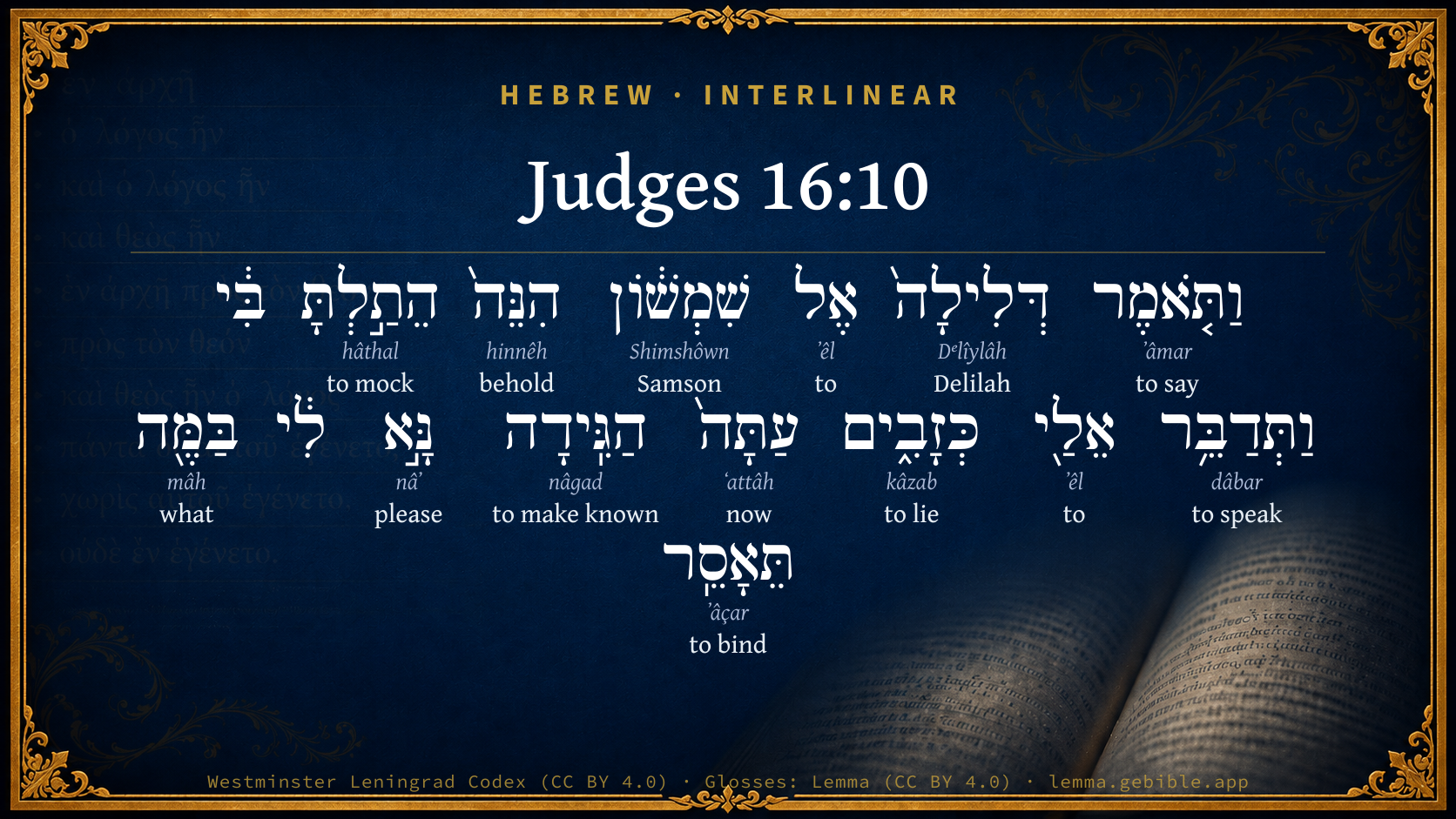
Hebrew (Westminster Leningrad Codex) Judges 16:10 appears in the Hebrew Old Testament. The text above is from the Westminster Leningrad Codex. Each word links to its Strong’s number, a concise gloss, and parsing drawn from the Open Scriptures Hebrew Bible morphology. Click any word for its full Brown-Driver-Briggs (BDB) entry.
Download image
Cite this verse

Judges 16:10 (World English Bible). Public Domain. Lemma interlinear Bible study tool, https://lemma.gebible.app/v/judges/16/10.

Show BibTeX & RIS
BibTeX
RIS
English Translation
Delilah said to Samson, Behold, you have mocked me, and told me lies: now tell me, Please, with which you might be bound.
World English Bible · Public Domain
Download a study sheet

One document with this verse’s original text, its word-by-word gloss line, the meaning frame, cross-references with their text, attributed commentary, and full source and license credits — printable, and it pastes into notes with its structure intact.

This verse Autodidact and up

Study sheet (.html) Plain text (.txt)

A passage Seminary Student

Up to 50 verses in one chapter. A passage sheet keeps up to 6 commentary sources and 12 cross-references per verse, in the order this page ranks them, and says so on the sheet whenever that leaves anything out. Ask for a single verse and you get the Autodidact verse sheet above.

Everything on this page stays free to read, with no account — the sheet is a download of what is already on screen, not access to it.

Want to remove ads? Support Godless Engineer
Compare translations 3

The same verse in 3 English versions, stacked beneath the original-language interlinear above. Click any original word for its lexicon entry.

Each is an independent rendering of the whole verse — the interlinear is not word-aligned to these translations.

Highlighted words mark where these versions differ — a whole-verse word diff, not a word-by-word alignment.

  • World English Bible Public Domain
    Delilah said to Samson, Behold, you have mocked me, and told me lies: now tell me, Please, with which you might be bound.
  • King James Version Public Domain
    And Delilah said unto Samson, Behold, thou hast mocked me, and told me lies: now tell me, I pray thee, wherewith thou mightest be bound.
  • unfoldingWord Literal Text CC BY-SA 4.0
    And Delilah said to Samson, “Behold, you have deceived me and spoken lies to me. Now please declare to me in what you may be bound.”

unfoldingWord Literal Text — © unfoldingWord, licensed CC BY-SA 4.0. Word-aligned USFM3 via Door43 (git.door43.org/unfoldingWord/en_ult).

Versions to compare (up to 4)

3 of 4 selected

Show all 18 translations

Every available English version of this verse, each an independent rendering of the whole verse.

  • World English Bible Public Domain
    Delilah said to Samson, Behold, you have mocked me, and told me lies: now tell me, Please, with which you might be bound.
  • Berean Standard Bible Public Domain
    Then Delilah said to Samson, “You have mocked me and lied to me! Now please tell me how you can be tied up.”
  • Majority Standard Bible Public Domain
    Then Delilah said to Samson, “You have mocked me and lied to me! Now please tell me how you can be tied up.”
  • King James Version Public Domain
    And Delilah said unto Samson, Behold, thou hast mocked me, and told me lies: now tell me, I pray thee, wherewith thou mightest be bound.
  • American Standard Version (1901) Public Domain
    And Delilah said unto Samson, Behold, thou hast mocked me, and told me lies: now tell me, I pray thee, wherewith thou mightest be bound.
  • Revised Version (1885) Public Domain
    And Delilah said unto Samson, Behold, thou hast mocked me, and told me lies: now tell me, I pray thee, wherewith thou mightest be bound.
  • Geneva Bible (1599) Public Domain
    After Delilah saide vnto Samson, See, thou hast mocked mee and tolde mee lies. I pray thee nowe, tell me wherewith thou mightest be bound.
  • Douay-Rheims (1899) Public Domain
    And Dalila said to him: Behold thou hast mocked me, and hast told me a false thing: but now at least tell me wherewith thou mayest be bound.
  • Young's Literal Translation Public Domain
    And Delilah saith unto Samson, `Lo, thou hast played upon me, and speakest unto me lies; now, declare, I pray thee, to me, wherewith thou art bound.'
  • Literal Standard Version CC BY-SA 4.0
    And Delilah says to Samson, “Behold, you have played on me, and speak lies to me; now, please declare to me with what you are bound.”
  • Unlocked Literal Bible CC BY-SA 4.0
    Then Delilah said to Samson, “This is how you have deceived me and told me lies. Please, tell me how you can be overpowered.”
  • unfoldingWord Literal Text CC BY-SA 4.0
    And Delilah said to Samson, “Behold, you have deceived me and spoken lies to me. Now please declare to me in what you may be bound.”
  • Darby Bible Public Domain
    And Deli'lah said to Samson, "Behold, you have mocked me, and told me lies; please tell me how you might be bound."
  • World Messianic Bible Public Domain
    Delilah said to Samson, “Behold, you have mocked me, and told me lies. Now please tell me how you might be bound.”
  • Webster's Bible Public Domain
    And Delilah said to Samson, Behold, thou hast mocked me, and told me lies: now tell me, I pray thee, with what thou mayest be bound.
  • Free Bible Version CC BY-SA 4.0
    Later Delilah said to Samson, “You've made me look stupid, telling me these lies! So now please tell me what can be used to tie you up.”
  • Bible in Basic English Public Domain
    Then Delilah said to Samson, See, you have been making sport of me with false words; now, say truly how may you be put in bands?
  • JPS Tanakh (1917) Public Domain
    And Delilah said unto Samson: 'Behold, thou hast mocked me, and told me lies; now tell me, I pray thee, wherewith thou mightest be bound.'

Literal Standard Version (2020), Covenant Press — licensed CC BY-SA 4.0. Text via the HelloAO Bible API (eBible.org). Unlocked Literal Bible (unfoldingWord) — licensed CC BY-SA 4.0. Text via the HelloAO Bible API (eBible.org). unfoldingWord Literal Text — © unfoldingWord, licensed CC BY-SA 4.0. Word-aligned USFM3 via Door43 (git.door43.org/unfoldingWord/en_ult). Free Bible Version, Dr. Jonathan Gallagher — licensed CC BY-SA 4.0. Text via the HelloAO Bible API (eBible.org).

Word by word

More ways to search: Search by grammar → Find every occurrence → Compare this word →

Practice this passage: Drill this verse → Learn its vocabulary →

דְּלִילָה֙
Dᵉlîylâh
H1807
“Delilah”
Noun, Proper
Part of Speech
Noun
Type
Proper
Full BDB Definition

Origin: from H1809

TWOT: None

Delilah = "feeble" - the Philistine mistress of Samson who betrayed the secret of his great strength, and by cutting his hair, enfeebled him and delivered him to the Philistines
  1. וַתֹּ֤אמֶר ʼâmar H559 “and · to say” Conjunction + Verb, Qal, Sequential Imperfect, 3rd Person, Feminine, Singular
  2. אֶל ʼêl H413 “to” Preposition
  3. שִׁמְשׁ֔וֹן Shimshôwn H8123 “Samson” Noun, Proper
  4. הִנֵּה֙ hinnêh H2009 “behold” Particle, Demonstrative
  5. הֵתַ֣לְתָּ hâthal H2048 “to mock” Verb, Hiphil, Perfect, 2nd Person, Masculine, Singular
  6. וַתְּדַבֵּ֥ר dâbar H1696 “and · to speak” Conjunction + Verb, Piel, Sequential Imperfect, 2nd Person, Masculine, Singular
  7. אֵלַ֖י ʼêl H413 “to · me” Preposition + Suffix, Personal, 1st Person, Common, Singular
  8. כְּזָבִ֑ים kâzab H3576 “liars” Noun, Common, Masculine, Plural, Absolute
  9. עַתָּה֙ ʻattâh H6258 “now” Adverb
  10. הַגִּֽידָה nâgad H5046 “make known” Verb, Hiphil, Imperative, 2nd Person, Masculine, Singular + Suffix, h
  11. נָּ֣א nâʼ H4994 “please” Particle, Interjection
  12. בַּמֶּ֖ה mâh H4100 “in/at · what” Preposition + Particle, Interrogative
  13. תֵּאָסֵֽר ʼâçar H631 “to bind” Verb, Niphal, Imperfect, 2nd Person, Masculine, Singular

About this verse

These counts appear in no published source. They are computed here, from the morphology-tagged text and Lemma’s own curated glosses. What Lemma adds →

16
words
13
distinct lemmas
Historical
section

Notable vocabulary

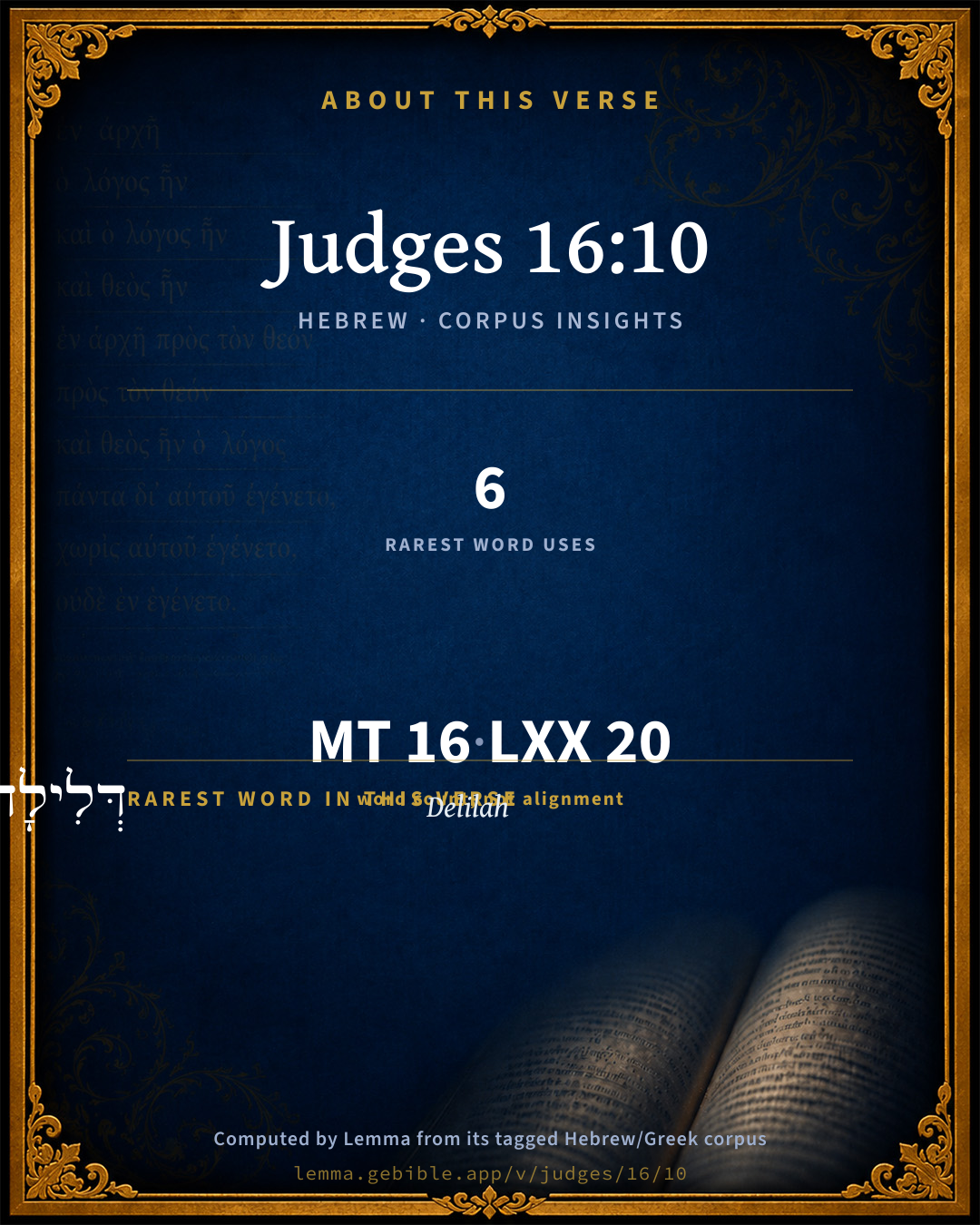
The rarest word here is דְּלִילָה֙ Delilah H1807 — appearing just 6 times in the whole Hebrew Bible.

Shared distinctive vocabulary

דְּלִילָה֙ Delilah H1807 occurs in 6 verses of the Hebrew Bible. Also found in:

Grammatical profile

  • 5 verbs
  • 3 nouns
  • 4 prepositions
  • 1 adverb
  • 3 particles

Verb forms

  • וַתֹּ֤אמֶר Qal · Sequential Imperfect
  • הֵתַ֣לְתָּ Hiphil · Perfect
  • וַתְּדַבֵּ֥ר Piel · Sequential Imperfect
  • הַגִּֽידָה Hiphil · Imperative
  • תֵּאָסֵֽר Niphal · Imperfect

Repetition

A word recurs within this verse — often emphatic in Hebrew:

  • אֶל to H413 ×2

Hebrew & Septuagint length

In English translation the verse runs 23 words from the Hebrew and 23 from the Septuagint (LXX English) — the same length.

A rough comparison of the two English renderings, which tokenize alike — not a word-level alignment.

Word counts can differ between the Hebrew and the Greek without any difference in meaning — e.g. the Hebrew direct-object marker אֵת has no separate Greek word, and Greek often adds the article ὁ.

In the original languages it is 16 Hebrew tokens and 20 Greek tokens — but the two are counted differently (Hebrew bundles its prefixes and suffixes into one token; the Greek is in lemma form), so that isn’t a like-for-like length.

Cross-references

7

Topical passages linked to Judges 16:10 in the Treasury of Scripture Knowledge — connected by theme and wording, ordered by reader-vote popularity; previews shown in the World English Bible.

  • Judges 16:13 Delilah said to Samson, Hitherto you have mocked me, and told me lies: tell me with which you might be bound. He said to her, If you weave the seven locks of my head with the web.
  • Proverbs 24:28 Don't be a witness against your neighbor without cause. Don't deceive with your lips.
  • Ezekiel 33:31 They come to you as the people comes, and they sit before you as my people, and they hear your words, but don't do them; for with their mouth they show much love, but their heart goes after their gain.
  • Luke 22:48 But Jesus said to him, "Judas, do you betray the Son of Man with a kiss?"
  • Judges 16:7 Samson said to her, If they bind me with seven green cords that were never dried, then shall I become weak, and be as another man.
  • Judges 16:15–17 She said to him, How can you say, I love you, when your heart is not with me? you have mocked me these three times, and have not told me in which your great strength lies.
  • Proverbs 23:7–8 For as he thinks about the cost, so he is. "Eat and drink!" he says to you, But his heart is not with you.

Cross-references courtesy of OpenBible.info (CC BY 4.0).

Hebrew and Greek witnesses Masoretic Hebrew ↔ Greek Septuagint

The same verse in the two great witnesses to the Old Testament, shown verse-for-verse.

These are two independent witnesses, not word-aligned to each other, and the Septuagint is shown in lemma (dictionary) form.

Hebrew Judges 16:10 Masoretic · Westminster Leningrad Codex

וַתֹּ֤אמֶר דְּלִילָה֙ אֶל שִׁמְשׁ֔וֹן הִנֵּה֙ הֵתַ֣לְתָּ בִּ֔י וַתְּדַבֵּ֥ר אֵלַ֖י כְּזָבִ֑ים עַתָּה֙ הַגִּֽידָה נָּ֣א לִ֔י בַּמֶּ֖ה תֵּאָסֵֽר

Delilah said to Samson, Behold, you have mocked me, and told me lies: now tell me, Please, with which you might be bound.

World English Bible · Public Domain

Greek LXX Judges 16:10 Septuagint · lemma form

καί εἶπον δαλιδα πρός σαμψων ἰδού πλανάω ἐγώ καί λαλέω πρός ἐγώ ψευδής νῦν οὖν ἀναἀγγέλλω ἐγώ ἐν τίς δέω

And Dalida said to Sampson, Behold, you have cheated me, and told me lies; now then tell me wherewith you shall be bound.

LXX2012 (modern English Septuagint) · Public Domain

Hebrew: Westminster Leningrad Codex (CC BY 4.0). Greek: Septuagint (public domain); English from LXX2012 (modern English Septuagint) (Public Domain). How the Septuagint differs from the Hebrew →

Targum (Aramaic paraphrase)

1

The Targum is the ancient Jewish Aramaic paraphrase of the Hebrew Scriptures — an interpretive translation, not the Hebrew text itself. Onkelos (literal) and Pseudo-Jonathan (expansive) render the Torah, and Jonathan the Prophets. Coverage is partial: where no permissively-licensed English translation exists for a verse, only the Aramaic is shown. This is verse-level text, not a word-by-word alignment to the Hebrew.

  1. Targum Jonathan Prophets (Joshua–Malachi)
    וַאֲמַרַת דְלִילָה לְשִׁמְשׁוֹן הָא שְׁקַרְתָּ בִּי וּמַלֵילְתָּא עִמִי כַּדְבִין כְּעַן חַוֵי כְעַן לִי בְּמַה תִּתְאַסָר:

    (no public-domain English translation for this verse)

    Targum Jonathan — Aramaic: “Mikraot Gedolot” (public domain). English: “Sefaria Community Translation” (CC0 1.0 (public-domain dedication)); “London "Chaldee Paraphrase," 1871” (public domain). Text via Sefaria.

Commentary

Notes on Judges 16:10 from classic Christian and Jewish commentators (each source and its license shown beneath its notes). The classic Christian expositions comment on the surrounding passage and are grouped to its opening verse, so a note may address several verses; the Jewish commentaries on the Tanakh (Rashi and others) are per-verse, so they appear only where the commentator wrote on this verse.

Lemma curates 59 commentaries, every one of them public domain or Creative Commons licensed, each selected and text-cleaned for this edition rather than reprinted as found. About our sources →

Trapp's Complete Commentary

John Trapp

Jdg 16:10 And Delilah said unto Samson, Behold, thou hast mocked me, and told me lies: now tell me, I pray thee, wherewith thou mightest be bound.

Ver. 10. And told me lies.] Delilah may give Samson the lie: she may say anything, do anything to him: as Omphale or Jole might clap Hercules on the cheeks, or beat him about the head with her slipper: whereas, if another had done half so much, it would not have been borne with more patience than Robert Earl of Essex took a cuff on the ear from Queen Elizabeth. He laid his hand upon his sword, saith Mr Camden, and swore a great oath that he neither could nor would swallow so great an indignity, nor would he have borne it at King Henry VIII’s hand.

John Trapp, A Commentary or Exposition upon All the Books of the Old and New Testament (1647–1656) — public domain. Text from a community e-Sword module.

Geneva Bible (1599)

Geneva Bible translators

Though her falsehood tended to make him lose his life, yet his affection so blinded him, that he could not beware.

Geneva Bible (1599) marginal notes — public domain. Text via Bolls.life.

Jamieson, Fausset & Brown

Robert Jamieson, A. R. Fausset & David Brown

And Delilah said--To avoid exciting suspicion, she must have allowed some time to elapse before making this renewed attempt.

Jamieson, Fausset & Brown — Commentary Critical and Explanatory on the Whole Bible (1871) — public domain (CC PDM 1.0). Text via the HelloAO Bible API.

Ellicott's Commentary for English Readers

(10) Now tell me, I pray thee.—Delilah would, of course, tell Samson that the scene had been merely playful jest, and that she had said “Philistines upon thee, Samson!” only to be delighted with one fresh exhibition of his great strength, if he really had not revealed the secret. She would represent her desire to know as due only to loving curiosity.

A Bible Commentary for English Readers, edited by Charles John Ellicott (1878–1897) — public domain. Text from a community e-Sword module.

John Gill's Exposition

And Delilah said unto Samson,.... Not on the same day, but some time after, as Kimchi observes, when an opportunity offered, and he was in like circumstances as before; for had she immediately attacked him, it might have created some suspicion in him of a design against him:

behold, thou hast mocked me, and told me lies; deceived her with lies, by telling her the other day that if he was bound with green withs, he should become as weak as other men; which she, out of curiosity as she might pretend, had tried, and had found to be false; and which, she might add, was an argument of want of true love to her, to mock her in such a manner:

now tell me, I pray thee, wherewith thou mightest be bound; so as to be held.

John Gill's Exposition of the Whole Bible (1746–1763) — public domain (CC PDM 1.0). Text via the HelloAO Bible API.

Whedon's Commentary on the Bible

Daniel D. Whedon

10. Told me lies — This charge would have little effect coming on one from the lips of a harlot. My moral character, Samson might have said, will compare well with yours.

Daniel D. Whedon (gen. ed.), Commentary on the Old and New Testaments (1874–1909) — public domain. Text from a community e-Sword module.

The Pulpit Commentary

Wherewith, or rather, as in ver. 8, by what means.

The Pulpit Commentary (1880–1919), ed. H.D.M. Spence-Jones & Joseph S. Exell — public domain. Text from a community e-Sword module.

unfoldingWord translationNotes

Door43 World Missions Community

This is how you have deceived me and told me lies.

Deceiving and lying mean the same thing and are stated to emphasize how angry Delilah felt. AT: "You have greatly deceived me!" (See: Parallelism)

you can be overpowered

This can be stated in active form. AT: "people can overpower you"

The Philistines are upon you

The phrase "upon you" means that they are there to capture him. AT: "The Philistines are here to capture you" (See: Idiom)

lying in wait

This means that they were hiding and waiting for the right moment to attack. AT: "waiting to attack him" (See: Idiom)

like they were a piece of thread

The author describes how easily Samson broke the ropes by comparing it to him breaking a piece of thread. AT: "as easily as if they were only a piece of thread" (See: Simile)

translationWords

Delilah

Samson

deceive

works

Philistines

unfoldingWord translationNotes — © Distant Shores Media and the Door43 World Missions Community, licensed CC BY-SA 4.0. Source: git.door43.org/Door43/en_tn.

Lesson kit

Teaching starters — assembled from the data on this page, not authored interpretation. Every prompt links to the verse data it draws on. Edit before teaching.

Judges, in the Historical, opens this verse with 16 words (13 distinct Hebrew lemmas). Its most distinctive word is Dᵉlîylâh (“Delilah”). A historical commentator’s framing appears above. Read the whole chapter for the surrounding context.

Discussion questions

  1. The word Dᵉlîylâh carries the sense “Delilah.” How does it shape the verse?
  2. Judges 16:4 shares the word «Delilah» with this verse. How do the two illuminate each other?
  3. “to” occurs 2× in this one verse. What is the effect of the repetition?
  4. These translations render this verse differently. What is at stake in choosing one wording over another?
  5. The verb «וַתֹּ֤אמֶר» is Qal Sequential Imperfect. How does its form color the action?
  6. Reading how Trapp's Complete Commentary and Geneva Bible (1599) read this verse, where do the two commentators agree and where do they part?

Things to notice

Reading settings

Reading text

Shown beneath each verse's original-language words.

Old Testament
Old Testament edition

Read the OT as the Masoretic Hebrew (MT) or the Greek Septuagint (LXX).

English shown for the Greek Septuagint (in the Hebrew ↔ Greek comparison).

Comparing translations? Open the Compare panel on any verse page to stack up to four side by side.