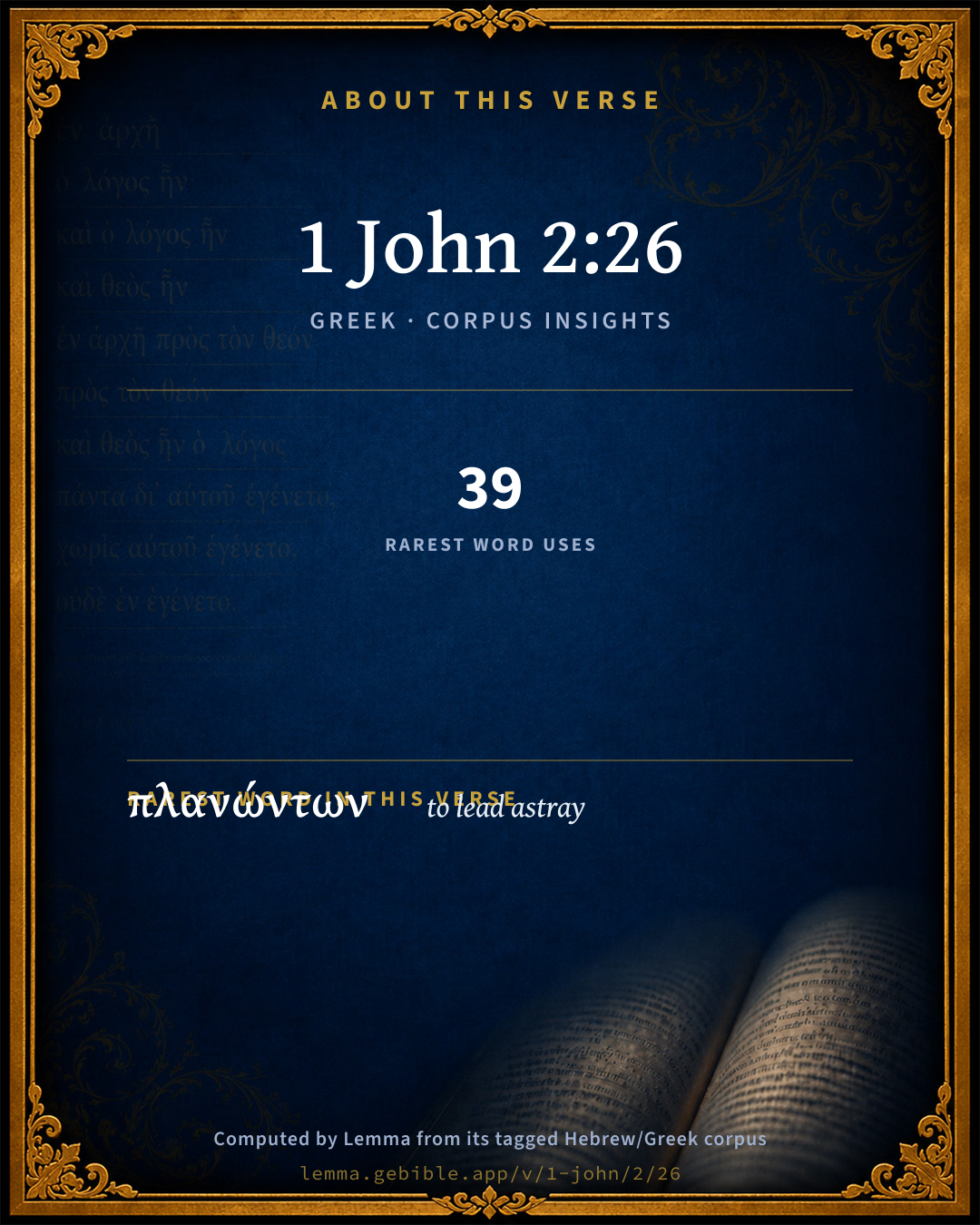
1 John 2:26

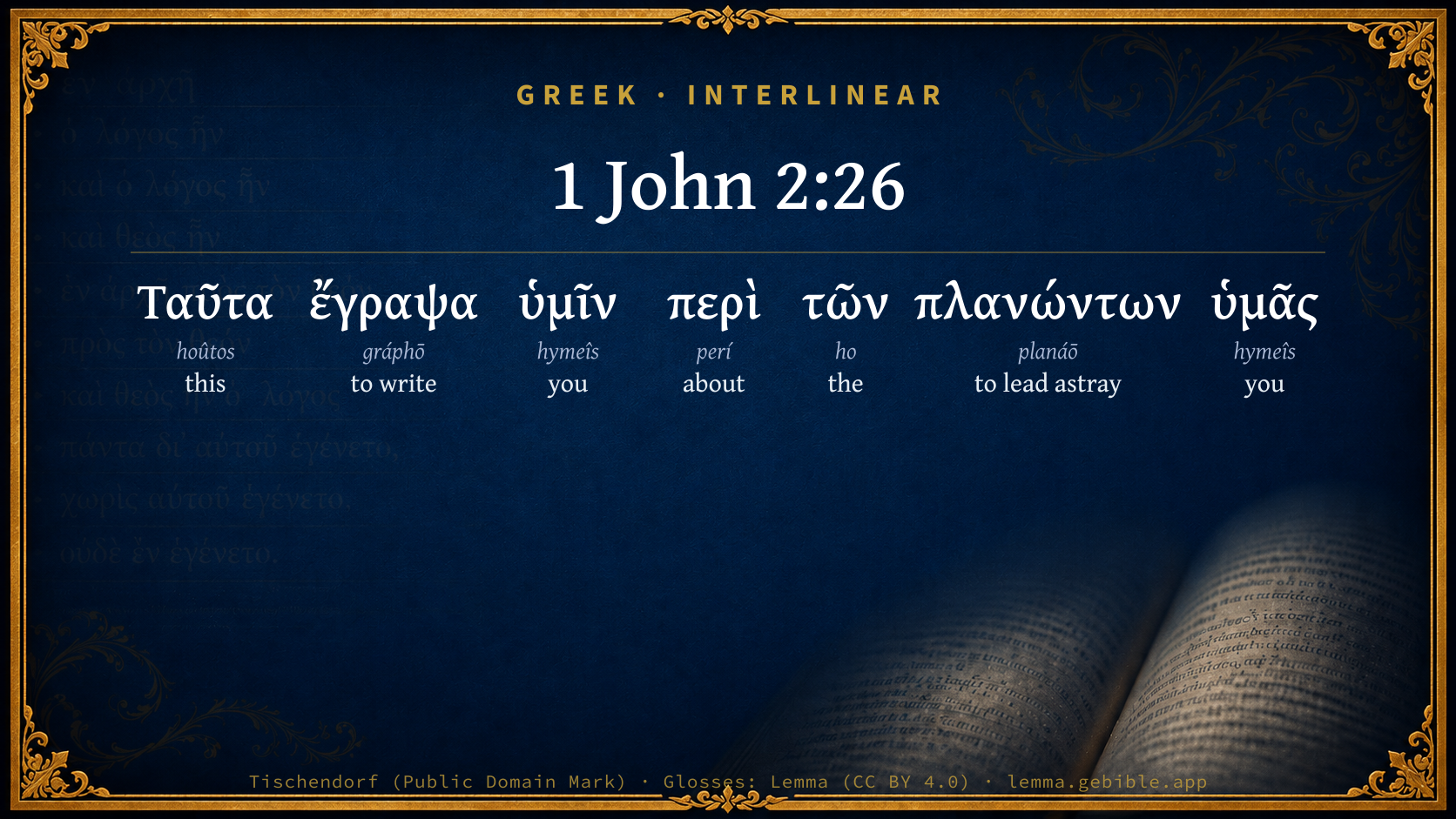
Greek (Tischendorf 8th ed.) 1 John 2:26 appears in the Greek New Testament. The text above is from the Tischendorf 8th edition. Each word links to its Strong’s number and a concise gloss. Click any word for its full Thayer’s Greek Lexicon entry.
Download image
Cite this verse

1 John 2:26 (World English Bible). Public Domain. Lemma interlinear Bible study tool, https://lemma.gebible.app/v/1-john/2/26.

Show BibTeX & RIS
BibTeX
RIS
English Translation
These things I have written to you concerning those who would lead you astray.
World English Bible · Public Domain
Download a study sheet

One document with this verse’s original text, its word-by-word gloss line, the meaning frame, cross-references with their text, attributed commentary, and full source and license credits — printable, and it pastes into notes with its structure intact.

This verse Autodidact and up

Study sheet (.html) Plain text (.txt)

A passage Seminary Student

Up to 50 verses in one chapter. A passage sheet keeps up to 6 commentary sources and 12 cross-references per verse, in the order this page ranks them, and says so on the sheet whenever that leaves anything out. Ask for a single verse and you get the Autodidact verse sheet above.

Everything on this page stays free to read, with no account — the sheet is a download of what is already on screen, not access to it.

Want to remove ads? Support Godless Engineer
Compare translations 3

The same verse in 3 English versions, stacked beneath the original-language interlinear above. Click any original word for its lexicon entry.

Each is an independent rendering of the whole verse — the interlinear is not word-aligned to these translations.

Highlighted words mark where these versions differ — a whole-verse word diff, not a word-by-word alignment.

  • World English Bible Public Domain
    These things I have written to you concerning those who would lead you astray.
  • King James Version Public Domain
    These things have I written unto you concerning them that seduce you.
  • unfoldingWord Literal Text CC BY-SA 4.0
    I have written these things to you about the ones leading you astray.

unfoldingWord Literal Text — © unfoldingWord, licensed CC BY-SA 4.0. Word-aligned USFM3 via Door43 (git.door43.org/unfoldingWord/en_ult).

Versions to compare (up to 4)

3 of 4 selected

Show all 19 translations

Every available English version of this verse, each an independent rendering of the whole verse.

  • World English Bible Public Domain
    These things I have written to you concerning those who would lead you astray.
  • Berean Standard Bible Public Domain
    I have written these things to you about those who are trying to deceive you.
  • Majority Standard Bible Public Domain
    I have written these things to you about those who are trying to deceive you.
  • King James Version Public Domain
    These things have I written unto you concerning them that seduce you.
  • American Standard Version (1901) Public Domain
    These things have I written unto you concerning them that would lead you astray.
  • Revised Version (1885) Public Domain
    These things have I written unto you concerning them that would lead you astray.
  • Geneva Bible (1599) Public Domain
    These things haue I written vnto you, concerning them that deceiue you.
  • Douay-Rheims (1899) Public Domain
    These things have I written to you, concerning them that seduce you.
  • Young's Literal Translation Public Domain
    These things I did write to you concerning those leading you astray;
  • Literal Standard Version CC BY-SA 4.0
    These things I wrote to you concerning those leading you astray;
  • Unlocked Literal Bible CC BY-SA 4.0
    I have written these things to you about those who would lead you astray.
  • unfoldingWord Literal Text CC BY-SA 4.0
    I have written these things to you about the ones leading you astray.
  • Darby Bible Public Domain
    These things have I written to you concerning those who lead you astray:
  • World Messianic Bible Public Domain
    These things I have written to you concerning those who would lead you astray.
  • Webster's Bible Public Domain
    These things have I written to you concerning them that seduce you.
  • Free Bible Version CC BY-SA 4.0
    I'm writing this to warn you against those who want to lead you astray.
  • Bible in Basic English Public Domain
    I am writing these things to you about those whose purpose is that you may be turned out of the true way.
  • Text-Critical English NT CC BY 4.0
    I have written these things to you concerning those who are trying to deceive you.
  • Tyndale New Testament (1534) Public Domain
    This have I written vnto you concernynge the that disceave you.

Literal Standard Version (2020), Covenant Press — licensed CC BY-SA 4.0. Text via the HelloAO Bible API (eBible.org). Unlocked Literal Bible (unfoldingWord) — licensed CC BY-SA 4.0. Text via the HelloAO Bible API (eBible.org). unfoldingWord Literal Text — © unfoldingWord, licensed CC BY-SA 4.0. Word-aligned USFM3 via Door43 (git.door43.org/unfoldingWord/en_ult). Free Bible Version, Dr. Jonathan Gallagher — licensed CC BY-SA 4.0. Text via the HelloAO Bible API (eBible.org).

Word by word

More ways to search: Search by grammar → Find every occurrence → Compare this word →

Practice this passage: Drill this verse → Learn its vocabulary →

πλανώντων
planáō
G4105
“to lead astray”
Verb, Present, Active, Participle, Genitive, Plural, Masculine
Part of Speech
Verb
Tense
Present
Voice
Active
Mood
Participle
Case
Genitive
Number
Plural
Gender
Masculine
Full Thayer's Definition

Origin: from G4106

TDNT: 09:48,9

1. to cause to stray, to lead astray, lead aside from the right way a. to go astray, wander, roam about 2. metaph. a. to lead away from the truth, to lead into error, to deceive b. to be led into error c. to be led aside from the path of virtue, to go astray, sin d. to sever or fall away from the truth 1. of heretics e. to be led away into error and sin
  1. Ταῦτα hoûtos G3778 “this” Demonstrative pronoun, Accusative, Plural, Neuter
  2. ἔγραψα gráphō G1125 “to write” Verb, Aorist, Active, Indicative, 1st person, Singular
  3. ὑμῖν hymeîs G5210 “you” Personal pronoun, 2nd person, Dative, Plural
  4. περὶ perí G4012 “about” Preposition
  5. τῶν ho G3588 “the” Article, Genitive, Plural, Masculine
  6. ὑμᾶς hymeîs G5210 “you” Personal pronoun, 2nd person, Accusative, Plural

About this verse

These counts appear in no published source. They are computed here, from the morphology-tagged text and Lemma’s own curated glosses. What Lemma adds →

7
words
6
distinct lemmas
General Epistles
section

Shared distinctive vocabulary

πλανώντων to lead astray G4105 occurs in 37 verses of the Greek New Testament. Also found in:

Repetition

A word recurs within this verse:

  • ὑμῖν you G5210 ×2

Cross-references

12

Topical passages linked to 1 John 2:26 in the Treasury of Scripture Knowledge — connected by theme and wording, ordered by reader-vote popularity; previews shown in the World English Bible.

  • 2 Peter 2:1–3 But there also arose false prophets among the people, as among you also there will be false teachers, who will secretly bring in destructive heresies, denying even the Master who bought them, bringing on themselves swift destruction.
  • 2 John 1:7 For many deceivers have gone out into the world, those who don't confess that Jesus Christ came in the flesh. This is the deceiver and the Antichrist.
  • Acts 20:29–30 For I know that after my departure, vicious wolves will enter in among you, not sparing the flock.
  • 1 John 3:7 Little children, let no one lead you astray. He who does righteousness is righteous, even as he is righteous.
  • Mark 13:22 For there will arise false christs and false prophets, and will show signs and wonders, that they may lead astray, if possible, even the chosen ones.
  • Colossians 2:8 Be careful that you don't let anyone rob you through his philosophy and vain deceit, after the tradition of men, after the elements of the world, and not after Christ.
  • 2 Corinthians 11:13–15 For such men are false apostles, deceitful workers, masquerading as Christ's apostles.
  • 1 Timothy 4:1 But the Spirit says expressly that in later times some will fall away from the faith, paying attention to seducing spirits and doctrines of demons,
  • Proverbs 12:26 A righteous person is cautious in friendship, But the way of the wicked leads them astray.
  • Colossians 2:18 Let no one rob you of your prize by a voluntary humility and worshipping of the angels, dwelling in the things which he has not seen, vainly puffed up by his fleshly mind,
  • 2 Timothy 3:13 But evil men and impostors will grow worse and worse, deceiving and being deceived.
  • Ezekiel 13:10 Because, even because they have seduced my people, saying, Peace; and there is no peace; and when one builds up a wall, behold, they daub it with whitewash:

Cross-references courtesy of OpenBible.info (CC BY 4.0).

Commentary

Notes on 1 John 2:26 from classic Christian and Jewish commentators (each source and its license shown beneath its notes). The classic Christian expositions comment on the surrounding passage and are grouped to its opening verse, so a note may address several verses; the Jewish commentaries on the Tanakh (Rashi and others) are per-verse, so they appear only where the commentator wrote on this verse.

Lemma curates 59 commentaries, every one of them public domain or Creative Commons licensed, each selected and text-cleaned for this edition rather than reprinted as found. About our sources →

The Biblical Illustrator

Joseph S. Exell

1Jn_2:26-28

These things have I written unto you concerning them that seduce you

I.

The danger (1Jn_2:26). The term employed is most significant of danger seduce you. Those to whom he refers would come to the disciples not as open enemies, but as professed friends. The history of the Church furnishes a melancholy illustration and confirmation of these remarks. Satan appears sometimes under the guise of an angel of light. Assaults are again made on the passions and the appetites and the peculiar propensities of men, so as to entice them from the paths of purity and propriety into forbidden courses.

II. Such being the danger of disciples, the apostle next instructs them wherein their safety lies (1Jn_2:27).

1. The security of the believer is at once ascribed to the grace of the Holy Spirit. No being but the Spirit of God can keep the soul. Our own strength is weakness, and our wisdom folly.

2. The very promise of the Spirit is made in the text, which encourages us to confide in Him. He abideth in you. There He is with His unerring wisdom to guide in every movement.

3. Observe next how independent He is said to render the man in whom He abideth. Ye need not that any man teach you; the same anointing teacheth you of all things. This certainly does not mean that he is made presumptuous and unwilling to be taught by others, as though he needed not their help. He is engaged in teaching the very persons whom he congratulates as independent of human teaching. Nor is there any inconsistency between his views and his practice. He taught the disciples, and they were grateful for his instructions, and were much edified by them. Yet, supposing him to be withdrawn from them, it did not follow that they must remain in ignorance. The Spirit could teach by hint or without him. Even an apostle could not open the mind to apprehend a single truth unless the Spirit employed and blessed him.

4. It is, therefore, declared that he is safe. Ye shall abide in Him. Seeing the Spirit abides in him, he shall abide in Christ.

III. This leads us to consider the apostles view of the believers duty (1Jn_2:28). It does not follow that because the Spirit abides in us, and maintains His own work, we are set free from any responsibility. Rather, it is the very reverse. Since the Spirit dwells in us, we are the more called upon to be diligent and faithful. We are left without excuse, seeing we are under the power of Him who is infinitely wise, and powerful to direct and sustain us.

1. In order to preserve the health of the body we use the utmost diligence to procure necessary food, and so should we do for the soul.

2. As we freely use the food we have secured for the body, so let us do with our spiritual food.

3. As when we have partaken of the food which our industry has provided, we employ our strength in the active duties of our calling, so let us be diligent and active in serving God.

IV. The reasons assigned and the motives urged. That when He shall appear we may have confidence, and not be ashamed before Him at His coming. The fact is assumed that Christ shall appear, and two most solemn reflections are founded on it. Christ will appear. This is the plain and repeated testimony of the Divine Word. Well may we cry, Who shall stand when He appeareth? The two cases described in the words before us reveal how it shall be in the solemn hour.

1. Some shall have confidence. They believed in Him. They continued in Him. They see the Lord in the air, and, raised from the grave, they go to meet Him with gladness. Of all beings He is the very one they are most desirous to behold.

2. How awful it will be to be ashamed in that day! Ashamed of unbelief! Ashamed of sin! Ashamed of ourselves! Ashamed of slighted opportunities, neglected privileges, and lost souls! (James Morgan, D. D.)

But the anointing which ye have received of Him abideth in you, and ye need not that any man teach you.

The guileless spirit, through the abiding Messianic unction and illumination of the Holy Ghost, abiding in Christ, so as to have confidence at His coming

I. The provision made for our abiding in him is the anointing which we receive of Him abiding in us.

1. It is in us; it is an inward anointing. Not with oil on the head, but with the Holy Ghost in the heart, we are anointed; as He from whom we receive the anointing was Himself anointed.

2. This anointing is permanent--it abideth in you. It is not a fitful emotion or wayward impulse, a rapture of excitement, alternating perhaps with deep depression. It partakes more of the nature of a calm, constant, settled conviction. There may be more or less of the vivid sense of this anointing, at different seasons and in different circumstances; the signs of it may be more or less clearly discernible, and the hold we have of it in our consciousness may be more or less strong. But it abideth in us, keeping God and eternity still before us as realities, in our sorest trials and darkest horns, causing us, as we fall back upon it, like David in his recovery from doubting despondency, to exclaim (Psa_77:10).

3. This anointing is sufficient in and of itself; its teaching needs no corroboration from anyone; it has a Divine self-evidencing power of its own that makes him who receives it independent of human testimony: ye need not that any man teach you.

4. The teaching of this anointing is complete and thorough, all embracing, all-comprehensive; it teacheth you of all things. It is not partial or one-sided, as human teaching on Divine subjects is apt to be, but full-orbed, well rounded, like a perfect circle. It needs the Divine anointing of which we speak to teach, to unfold, to exhaust, all that is in the song of the angels, Glory to God in the highest, and on earth peace, good will toward men.

5. Finally, this anointing is truth, and is no lie. It carries with it, and in it, an assurance not to be called in question or shaken--an assurance, one may say, infallibly sure.

II. The motive urged for your abiding in Christ is the hope or prospect of His appearing, His coming. It is urged very earnestly and affectionately. John might have kept to the mode of address which he has been using, and to which in the next verse he returns; as an apostle exhorting his disciples, a teacher instructing his scholars, speaking authoritatively or ex cathedra. But when the end of all comes in view he cannot separate himself from them. We are to be together with the Lord, you and we--you disciples and we apostles; you scholars and we teachers. And for this end we would have you to abide in Him, that we may have confidence together when He appears. Let me be ever asking myself, at every moment, If He were to appear now, would I have confidence? If He were to come into my house, my room, and show Himself, and speak to me face to face, would I have confidence? Could I meet His look of love without embarrassment? Only if He found me abiding in Him; doing whatever I might be doing in His name, giving thanks unto God even the Father by Him; only if He found me keeping Him in my heart. (R. S. Candlish, D. D.)

The anointing by Christ

I. This anointing is a gift. It is the anointing which ye have received. It is contrasted in the context with the transient possessions of worldly men. To these, what seems to be solid melts into air; what seems to be permanent vanishes away.

II. This anointing is a heart-cleansing gift. Those who have it mortify the deeds of the body through the Spirit (Rom_8:13), and purify themselves even as Christ is pure (chap. 3:3). Not through any natural power of willing and working, but through the Spirit, they are able to do these things.

III. This anointing is a heart-enlarging gift. A mans calling and election once made sure to his own mind, the sphere of his studies becomes enlarged. It is not written, One thing have I desired of the Lord that I may be saved, but (Psa_27:4).

IV. This anointing is a heart-cheering gift. It is the oil of gladness (Psa_45:7), the oil of joy (Isa_61:3), the source of joy unspeakable, never-ending, and glorious (1Pe_1:8).

V. This anointing was a gift divinely given to Christ. As to His human nature He was richly endued. The Spirit of God rested upon Him (Isa_11:2; Joh_1:32-33). He was therewith anointed above his fellows (Psa_45:7)

VI. This anointing is a gift divinely given to His people. It is the anointing which ye have received of Him--not only as a proof that they are chosen in Him before the foundation of the world, but also as their instructor and guide (Eph_1:4; 1Pe_1:2).

VII. This anointing is a distinguishing gift. It is the anointing which ye have received. As the anointing under the law, which is no doubt alluded to in the text, was of a sweet savour, so we, as many as are anointed with His Spirit, are thereby made a sweet savour of Christ (2Co_2:15). As that anointing oil was sprinkled upon Aaron and his sons (who represent the Church, as pointedly distinguished from the rest of the congregation), so Christ sends the comforter to His disciples, whom He pointedly distinguishes from the world (Joh_14:16-17). As the anointing oil was forbidden to be poured upon the flesh of man (Exo_30:25-33), so the Holy Ghost cannot be received by the world, which, in the present dispensation, seeth Him not, neither knoweth Him.

VIII. This anointing is a permanent gift. It is the anointing which abideth in you. It is permanent as opposed to those proffers of grace, so called, which, depending on the volition of the creature, are worse than precarious. This distinctive mark cannot suffer abrasure or be blown away. Its permanence is chiefly shown by the vitality of our union to Christ (Joh_15:5), by the reality of our participation in the Divine nature (2Pe_1:4), by the eternity of the life of which the Spirit is the demonstrator and source (1Jn_5:11), and by the stability of the covenant under which that life is promised (1Jn_2:25).

IX. This anointing is a truthful gift. It is truth. It is truthful as opposed to those false misgivings, whether from the flesh or the devil, which frequently trouble the Christian. It is truthful, also, as opposed to the shadows of the law. It is truthful, also, as opposed to the lies and hypocrisy of false professors.

X. This anointing is a sufficient gift. Giving sufficiency to that spiritual judgment, that noble and inestimable endowment, which alone can distinguish truth from error. (The Evangelical Preacher.)

Teacheth,

That was a true word spoken of the prophet (Isa_54:13). It is certain that the amount of peace which we enjoy will be largely in proportion to the amount of teaching which we receive, and appropriate, at the hands of the Lord. As the many objects of fear which, in the mind of the savage, people all lonely places, disappear when he is instructed in truer science, so do doubts and misgivings vanish as the soul comes to understand its true standing in Jesus. It is very beautiful to remark the direct teaching agency of the Lord in this passage, and to remember that it is vouchsafed to all His children. He takes equal care over each. He perhaps takes most care over the stupid ones, putting the lesson in successive modifications, that it may be brought down to their capacity. It is His chosen business to make you know His will, and if He cannot do it in one way, He will in another. But as the Psalmist very fitly says, we are oftenest taught by chastening (Psa_94:12). If you have been praying to know more of Christ, do not be surprised if He takes you aside into a desert place, or leads you into a furnace of pain.

1. Christ teaches by the Holy Ghost. It is unmistakable that He is referred to in the reference to the anointing which we have received. The Holy Spirit is, so to speak, the medium by which Jesus dwells in the surrendered heart, and operates through it and in it.

2. This teaching is inward. There are doubtless many lessons taught by Providence. But, after all, the meaning of outward events is a riddle, until He opens the dark saying on the harp. And the teaching is therefore so quiet, so unobtrusive, so hidden, that many an earnest seeker may think that nothing is being taught or acquired, as the months go on. But we cannot gauge the true amounts of progress which we are making from year to year--the teaching is so thoroughly a secret matter between God and the Spirit. But when some great crisis supervenes, some trial, some duty, and the spirit puts forth powers of which it had seemed incapable, there is a swift discovery of the results, which had been slowly accruing during previous years.

3. The main end of this teaching is to secure our abiding in Christ. Even as it hath taught you, ye shall abide in Him. All Christian progress begins, continues, and has its fruition here. Severed from Jesus we can do nothing. Abiding in Jesus we partake of the root and fatness of His glorious life. All His fulness slowly enters into us. (F. B. Meyer, B. A.)

The Biblical Illustrator, edited by Joseph S. Exell (c. 1880s–1900s) — public domain. Text from a community e-Sword module.

Joseph Benson's Commentary

1Jn 2:26-27. These things — From 1Jn 2:21; have I written unto you — St. John, according to his custom, begins and ends with the same form, and having finished a kind of parenthesis, (1Jn 2:21-26,) continues (1Jn 2:27) what he said 1Jn 2:20; concerning them that would seduce you — That is, I say it to arm you against the solicitations of those who endeavour to draw you from the truth and grace of the gospel; from the experience and practice of real Christianity. But the anointing — The spirit of illumination; which ye have received of him — Who hath given you the promise of eternal life; abideth in you — Continually and powerfully; and — In consequence thereof; ye need not that any man teach you — Namely, the principles of Christ’s religion, and things necessary to salvation; (see on Jer 31:34; Heb 8:11;) but as the same anointing teacheth you — Which is always the same, always consistent with itself. See on 1Jn 2:20. But this does not exclude men’s need of being taught by them that partake of the same anointing, much less their need of being put in remembrance of the things they already know, and being confirmed therein. Teacheth you of all things — Which it is necessary for you to know; and is truth — Certain and infallible; and is no lie — Like that which antichrist teaches. And as it — The truth I speak of; hath taught you, ye shall abide in him — In Christ, and in the belief and profession of his truth. The whole discourse, from 1Jn 2:18 to this, is peculiarly adapted to young Christians, whom he terms little children.

Joseph Benson's Commentary on the Old and New Testaments (1811–1818) — public domain. Text from a community e-Sword module.

Bengel's Gnomon

Johann Albrecht Bengel

1Jn 2:26. Ταῦτα ἔγραψα, These things have I written) these things from 1Jn 2:21. John, as his practice is, begins and concludes with the same form of words; and having as it were ended his parenthesis, he continues the 20th verse in the 27th.—πλανώντων, them who seduce) that is, endeavour to seduce you.

Bengel's Gnomon of the New Testament — English translation (T&T Clark, Edinburgh, 1860) — public domain. Text from a community e-Sword module.

Meyer's Critical & Exegetical Commentary

Heinrich August Wilhelm Meyer

1Jn_2:26. ταῦτα refers to all that the apostle has written about the antichrists from 1Jn_2:18 down. In calling them here οἱ πλανῶντες ὑμᾶς, he gives it to be understood that their efforts were directed to seduce the Church from the truth of the gospel to their lie; that their purpose had actual effect (Braune) is not indicated by the verb.1Jn_2:27. In the first part of this verse the apostle testifies to his readers that they do not need any teacher, in which he goes back to what he had already expressed in 1Jn_2:20-21.

καὶ ὑμεῖς] καί is here used just as in 1Jn_2:20.

On the anacolouthon, see on 1Jn_2:24.

τὸ χρῖσμα ὃ ἐλάβετε ἀπʼ αὐτοῦ] τὸ χρῖσμα is, with Braune, to be regarded as the accusative, for the juxtaposition of two nominatives could not be explained; the apostle probably had an ἔχετε in his mind, instead of which, however, he then wrote μένει ἐν ὑμῖν; αὐτοῦ, i.e. Χριστοῦ; so the context demands; αὐτός, 1Jn_2:25. Herein lies a proof that τοῦ ἁγίου in 1Jn_2:20 is to be understood of Christ.

ἐν ὑμῖν μένει] The indicative, instead of which the imperative is used in 1Jn_2:24, expresses the certain confidence of the apostle.

καὶ οὐ χρείαν ἔχετε] This sentence, which by καί is made co-ordinate with the preceding, stands to it in the relation of conclusion; meaning: since, as is not to be doubted, the Spirit is in youand abidingyou do not need; Bengel describes this relation correctly by: et ideo.

ἵνα τις διδάσκῃ ὑμᾶς] ἵνα is used here, as not unfrequently in the N. T., in an enfeebled signification; only in an artificial way could the original force of purpose of this particle be here retained; while this force sometimes passes over into that of object, this is still further weakened, so that the clause beginning with ἵνα is the object which completes the idea of the verb; so it is here; comp. especially Heb_5:12 : χρείαν ἔχετε τοῦ διδάσκειν ὑμᾶς; in other passages χρ. ἔχειν is used even with the simple infinitive, Mat_3:14; Mat_14:16; 1Th_1:8; 1Th_4:9; with ἵνα as here, Joh_16:30.[179]

Several commentators suppose here a reference to the false teachers, so that in the words of the apostle there lies a warning against those who wish to impose themselves on the Church as teachers; so a Lapide, Spener, (τίς = who may make pretence of a new revelation), Sander, Gerlach, Besser, and others. But it is more appropriate (according to 1Jn_2:21) to refer the apostles word to a teaching proceeding from himself or other apostolic teachers; so Hornejus, de Wette-Brückner, Lücke, Düsterdieck, Braune, etc.only we must not restrict the generally expressed thought merely to instruction about the false teachers, even though it is intended with special reference to that.[180] Believers need no human teacher in order that the divine truth may be made known to them. They have received, with the word which was declared unto them (ὃ ἤκουσαν), the χρῖσμα, which leads them εἰς πᾶσαν τὴν ἀλήθειαν; therefore the apostle frequently in this Epistle emphasizes the fact that he does not want to instruct them, but is writing to them what they already know (οἴδατε πάντα, 1Jn_2:20). John thereby assumes believing readers, in whose hearts that which they have heard from the beginning is preserved true and uncorrupted. Nothing new therefore can be proclaimed to the believers, but only that which they already possess in faith may be brought to a clearer consciousness.[181]

ἈΛΛʼ Ὡς ΤῸ ΑὐΤῸ ΧΡῖΣΜΑ Κ.Τ.Λ.] In this second part of the verse the first question is about the construction. Lücke, Ewald, de Wette, Neander, Düsterdieck, Braune (and previously Oecumenius and Theophylact) think that the whole to the end of the verse forms one period, in which the premise ἀλλʼ ὡς … διδάσκει is resumed by the words ΚΑῚ ΚΑΘῺς ἘΔΊΔΑΞΕΝ ὙΜῖΝ, and has its conclusion in ΜΕΝΕῖΤΕ (or ΜΈΝΕΤΕ) ἘΝ ΑὐΤῷ, and in which the words ΚΑῚ ἈΛΗΘῈς … ΨΕῦΔΟς contain a parenthetical adjunct. The difficulty that in the resumed premise ΚΑΊ is put instead of ἈΛΛΆ, ΚΑΘΏς instead of Ὡς, and the aorist ἘΔΊΔΑΞΕΝ instead of the present ΔΙΔΆΣΚΕΙ, can certainly be easily got over by the fact that the apostle wanted not simply to repeat the thought, but at the same time to bring out a new phase of the subject; but the additional ΠΕΡῚ ΠΆΝΤΩΝ, which does not stand in any relationship whatever to the conclusion ΜΕΝΕῖΤΕ (ΜΈΝΕΤΕ), is decidedly opposed to this construction; to this is added that ἈΛΛΆ indicates that the apostle wants to express a contrast to the οὐ χρείαν ἔχετε κ.τ.λ., that is, a clause in which the teaching of the ΧΡῖΣΜΑ is described as such as removes the need of any other (human) teacher; finally, that the subordinate clause ΚΑῚ ΟὐΚ ἜΣΤΙ ΨΕῦΔΟς conjoined with ἈΛΗΘΈς ἘΣΤΙ raises this thought above the level of a mere parenthetical adjunct, and stamps it as a leading thought. For these reasons it is preferable, with Luther, Calvin, Baumgarten-Crusius, Sander, Brückner, Besser, and in general most of the commentators, to divide the whole into two parts, and to regard ΚΑῚ ἈΛΗΘ. ἘΣΤΙ … ΨΕῦΔΟς as the conclusion of the first part; Luther: but as the anointing teaches you all things, it is true, and is no lie; and, etc.[182]

ὡς refers not so much to the form and fashion, as to the substance of the teaching.

ΤῸ ΑὐΤῸ ΧΡῖΣΜΑ] ΤῸ ΑὐΤΌ is not idem semper, non aliud atque aliud, sed sibi constans et idem apud sanctos omnes (Bengel; so also Erdmann), but: just the same χρῖσμα, namely Ὁ ἘΛΆΒΕΤΕ. Still the reading ΑὐΤΟῦ might be preferable, for it seems unnecessary to emphasize the fact that the ΧΡῖΣΜΑ is the same that they have received, and no other.

ΠΕΡῚ ΠΆΝΤΩΝ is used in the same sense as ΠΆΝΤΑ, 1Jn_2:20.

ΚΑῚ ἈΛΗΘΈς ἘΣΤΙ Κ.Τ.Λ.] ΚΑΊ before the conclusion, as in 1Jn_2:24 : then it is also true, etc.; it brings out prominently the idea ἀληθές; ἀληθές is referred to ΤῸ ΧΡῖΣΜΑ by Lücke, de Wette, Brückner, Düsterdieck, Ebrard, Ewald, Braune, and others; but the substantive ΨΕῦΔΟς is opposed to this connection, for it cannot be referred to ΤῸ ΧΡῖΣΜΑ, inasmuch as it is considered by John as a person (ΔΙΔΆΣΚΕΙ), and must neither be arbitrarily explained, with Beza, by ΨΕΥΔΈς, nor, with Braune, be separated from ἈΛΗΘΈς (and there is no lie in it); Oecumenius, Theophylact, Luther, Neander, Besser, Erdmann, and others, have therefore rightly referred ἈΛΗΘΈς Κ.Τ.Λ. to that which the ΧΡῖΣΜΑ teaches. Because this is true, and is no ΨΕῦΔΟς, therefore believers do not need any teacher besides, but they may rely entirely upon the teaching of the ΧΡῖΣΜΑ. To this thought the apostle further adds a new one, in which he goes back to the end of 1Jn_2:24.

ΚΑῚ ΚΑΘΏς] ΚΑΘΏς, as distinct from Ὡς, means: in proportion as.

ἐδίδαξεν ὑμᾶς] namely, ἈΠʼ ἈΡΧῆς.

ΜΈΝΕΤΕ (ΜΕΝΕῖΤΕ) ἘΝ ΑὐΤῷ] The Recepta μενεῖτε is taken by Socinus, a Lapide, Lorinus, Semler, and others, in the sense of the imperative; others retain the future meaning, as in 1Jn_2:24; thus Beza says: mihi videtur omnino servanda Futuri propria significatio ut est optime sperantis; as the apostle thereby expresses his good confidence, the future accordingly has the vim consolandi (Bengel). The correct reading, however, is ΜΈΝΕΤΕ, which, corresponding to the preceding ΜΈΝΕΙ and ἜΧΕΤΕ, is not imperative (Ewald, Braune), but indicative (Brückner), and as such it expresses the firm conviction of the apostle that they, according to the constant instruction of the ΧΡῖΣΜΑ, abide ἘΝ ΑὐΤῷ, i.e. in Christ (Erasmus erroneously: = ἐν τῷ χρίσματι, and Baumgarten-Crusius: in the teaching which the ΧΡῖΣΜΑ communicates to them). In favour of this view is also the exhortation of 1Jn_2:28 herewith connected.[183]

[179] At the most it may be said that ἵνα is used with the verb χρείαν ἔχειν, because that of which one is in need may be regarded as the object of his need; on the other hand, it is unsuitable when Braune says: the teaching is here regarded as the object and purpose for the sake of the position of him who is to be taught.

[180] Lücke paraphrases the passage: The reason why I do not write any more about the false teachers, is that I assume that that holy unction of the Spirit remains in you; and if that is so, you do not need that any one shall instruct you further on the subject.

[181] Several commentators rightly remark here, that in the statement of the apostle there is no foundation for the error of the enthusiasts, inasmuch as John does not separate the teaching of the χρῖσμα and the apostolic word from one another, but places them in the closest connection.

[182] Ebrard makes ὡς dependent upon ἔγραψα, ver. 26; it is true he himself admits that this gives a laxe and legere form of speech, but he thinks that there is nothing strange in this, because the apostle is speaking to children in quite childlike language. But what childs understanding would be capable of supplying with the words: but as the same anointing teacheth you of all things, the thought: sc. I have said to you?

[183] Myrberg on ver. 28: Sperantis verba illa sunt, quae paullo ante leguntur; haec adhortantis, quod novum quoddam initium dicendi indicat.

1Jn_2:26-27. Conclusion of the section on the antichrists.

Meyer — Critical and Exegetical Commentary on the New Testament — English translation by Peter Christie, edited by Frederick Crombie (T&T Clark, 1880) — public domain. Text from a community e-Sword module.

Expositor's Greek Testament

ed. W. Robertson Nicoll

1Jn 2:26 . ἔγραψα , see note on 1Jn 2:21 . τῶν πλανώντων , the heretical teachers. Pres. partic., “are leading astray” but unsuccessfully.

The Expositor's Greek Testament, edited by W. Robertson Nicoll (1897–1910) — public domain. Text from a community e-Sword module.

Geneva Bible (1599)

Geneva Bible translators

The same Spirit which endueth the elect with the knowledge of the truth, and sanctifieth them, giveth them therewithal the gift of perseverance, to continue to the end.

Geneva Bible (1599) marginal notes — public domain. Text via Bolls.life.

Jamieson, Fausset & Brown

Robert Jamieson, A. R. Fausset & David Brown

These things-- (Jo1 2:18-25).

have I written--resumed from Jo1 2:21 and Jo1 2:14.

seduce you--that is, are trying to seduce or lead you into error.

Jamieson, Fausset & Brown — Commentary Critical and Explanatory on the Whole Bible (1871) — public domain (CC PDM 1.0). Text via the HelloAO Bible API.

Adam Clarke's Commentary

Verse 26. These things have I written] Either meaning the whole epistle, or what is contained in the preceding verses, from the beginning of the 18th to the end of the 25th. 1Jo 2:18-25

Them that seduce you.] Περι των πλανωντων ὑμας· That is, the deceivers that were among them, and who were labouring to pervert the followers of Christ.

Adam Clarke's Commentary on the Bible (1810–1826) — public domain. Text from a community e-Sword/MySword module.

John Calvin's Commentaries

26 These things have I written unto you The apostle excuses himself again for having admonished them who were well endued with knowledge and judgment. But he did this, that they might apply for the guidance of the Spirit, lest his admonition should be in vain; as though he had said, “I indeed do my part, but still it is necessary that the Spirit of God should direct you in all things; for in vain shall I, by the sound of my voice, beat your ears, or rather the air, unless he speaks within you.”

When we hear that he wrote concerning seducers, we ought always to bear in mind, that it is the duty of a good and diligent pastor not only to gather a flock, but also to drive away wolves’ for what will it avail to proclaim the pure gospel, if we connive at the impostures of Satan? No one, then, can faithfully teach the Church, except he is diligent in banishing errors whenever he finds them spread by seducers. What he says of the unction having been received from him, I refer to Christ.

John Calvin's Commentaries (1540-1563) — public domain. Text from the Calvin Translation Society English edition (1840s-50s) via the Christian Classics Ethereal Library (ccel.org). Calvin's coverage is partial (roughly two-thirds of the Bible); uncommented books and verses are honest gaps, never fabricated. The 19th-century editor's footnotes and remarks are omitted so the notes are faithfully Calvin's own voice.

The Cambridge Bible for Schools and Colleges

gen. ed. J. J. S. Perowne

26. These things have I written unto you] ‘These things’ probably mean the warnings about the antichrists, not the whole Epistle. ‘I have written’, or ‘I wrote’, is the epistolary aorist as in 1Jn_2:21.

that seduce you] Better, that lead you astray, i.e. that are endeavouring to do so. It is the active of the verb which is used in 1Jn_1:8 (see note there); and the present participle, which indicates the tendency and habit, but not the success, of the antichristian teachers.

The Cambridge Bible for Schools and Colleges (gen. ed. J. J. S. Perowne; Cambridge University Press, 1878–1918) — public domain. Text from a community e-Sword module.

John Gill's Exposition

These things have I written unto you,.... The little children, who were most likely to be imposed upon by antichrists and deceivers:

concerning them that seduce you. The Syriac, Arabic, and Ethiopic versions render it, "for them that seduce you"; not that they were actually seduced and carried away with the error of the wicked; for though God's elect may be staggered and waver, and be tossed to and fro by false teachers, and their doctrines, yet they cannot be totally and finally deceived: but the sense is, these men endeavoured to seduce them: they lay in wait to deceive, and attempted to deceive them, by walking in craftiness, and handling the word of God deceitfully; and therefore that they might be known, and so shunned and avoided, the apostle points them out, and shows who they are; that they are such who deny that Jesus is the Christ, and do not own neither the Father nor the Son; in doing which he acted the part of a tender Father, a faithful shepherd, and a careful monitor.

John Gill's Exposition of the Whole Bible (1746–1763) — public domain (CC PDM 1.0). Text via the HelloAO Bible API.

Trapp's Complete Commentary

John Trapp

26 These things have I written unto you concerning them that seduce you.

Ver. 26. That seduce you] That carry you into byways, highways to hell.

John Trapp, A Commentary or Exposition upon All the Books of the Old and New Testament (1647–1656) — public domain. Text from a community e-Sword module.

Albert Barnes' Notes on the Bible

These things have I written unto you concerning them that seduce you - Respecting their character, and in order to guard you against their arts. The word “seduce” means to lead astray; and it here refers to those who would seduce them “from the truth,” or lead them into dangerous error. The apostle does not mean that they had actually seduced them, for he states in the following verse that they were yet safe; but he refers to the fact that there was danger that they might be led into error.

Albert Barnes' Notes on the Bible (1834–1885) — public domain. Text from a community e-Sword/MySword module.

Matthew Poole's English Annotations

So much he thought requisite to be said, in respect of their danger by seducers, though their safety was principally to depend upon what he next mentions... See Poole on "1Jo 2:27".

Matthew Poole's English Annotations on the Holy Bible (1683–1685) — public domain. Text from a community e-Sword/MySword module.

Whedon's Commentary on the Bible

Daniel D. Whedon

26. These… written—Reviewing from 1Jn_2:20.

Them that seduce you—The deniers of the bodily Jesus.

Daniel D. Whedon (gen. ed.), Commentary on the Old and New Testaments (1874–1909) — public domain. Text from a community e-Sword module.

The Pulpit Commentary

Verse 18-23, as distinct from what now follows. The present participle twn planwntwn indicates the continual attempt of these false teachers to lead the "little children" astray.

Egraya, as in verse 21, is the "epistolary aorist". (see on 2Jn_1:4)

The Pulpit Commentary (1880–1919), ed. H.D.M. Spence-Jones & Joseph S. Exell — public domain. Text from a community e-Sword module.

John Wesley's Explanatory Notes

These things - From 1 John ii, 21. I have written to you - St. John, according to his custom, begins and ends with the same form, and having finished a kind of parenthesis, 1 John ii, 20-26, continues, ii, 27, what he said in the twentieth verse, concerning them that would seduce you.

John Wesley, Explanatory Notes Upon the Whole Bible (1754–1765) — public domain. Text via the GEBible commentary corpus.

Kretzmann's Popular Commentary

Paul E. Kretzmann

Abiding in Christ:

v. 26. These things have I written unto you concerning them that seduce you.

v. 27. But the anointing which ye have received of Him abideth in you, and ye need not that any man teach you; but as the same anointing teacheth you of all things, and is truth, and is no lie, and even as it hath taught you, ye shall abide in Him.

v. 28. And now, little children, abide in Him, that, when He shall appear, we may have confidence, and not be ashamed before Him at His coming’.

v. 29. If ye know that He is righteous, ye know that every one that doeth righteousness is born of Him.

The entire discussion as it had been carried on by the apostle in the last paragraphs had been in the interest of his readers: These things I wrote to you concerning those that lead you into error. That was his solicitude; he knew that there were men always on the lookout to lead souls astray from the truth in Christ, and therefore he lifted up his voice in such solemn warning. For in spite of all the scorn that is affected by the false teachers as they sneer about orthodoxy, we know that everyone who forsakes the Word of the Gospel concerning Christ, the Son of God, will not remain in the fellowship of God. and cannot inherit eternal life.

As for the Christians, the apostle expresses his confidence: And as for you, the anointing which you have received from Him remains in you, and you have no need that anyone should teach you; rather, as His anointing teaches you about everything, and it is true and is no lie; and even as it taught you, abide in Him. The believers whom St. John addresses have received and experienced the enlightening grace of the Holy Spirit. This anointing was not a mere temporary experience, whose effects might soon have worn off. By virtue of it, as it was applied to them in the Word of the Gospel, the Holy Spirit exerted His power in them. It was but necessary for them to follow His leading in the Word. This anointing, this enlightening work of the Spirit in the Word gave them all the information which they needed in any situation in life, and thus, in just that form it was true, without the slightest bit of falsehood or lying. Therefore they should heed the teaching of the Gospel at all times, in all circumstances, and thus abide in Him, in their Savior Jesus Christ. To genuine believers the mere suggestion that Christ should not be considered the eternal Son of God, the Savior of the world, is so blasphemous that they turn from its very breath with loathing and disgust. Jesus Christ is the everlasting foundation of our faith.

This being true, the appeal of the apostle strikes us with full force: And now, little children, abide in Him, in order that, when He is manifested, we may have boldness and not be ashamed before Him at His coming. St. John has enumerated every reason which ought to induce us to cling with all our heart to our Lord and Savior Jesus Christ. His urgent admonition, therefore, comes as the climax of the chapter. To abide in Him, firm, steadfast, unwavering; that is our glorious privilege. Moreover, it is a necessity, for although the manifestation of the Lord on the last day is certain, the time of His coming is not known. By remaining steadfastly in His Word and faith unto the end we acquire that boldness, fearlessness, confidence which will cause us to hail His coming with all joy. There will be no hanging of our heads in shame if we have followed the apostle’s injunction, but we shall look up, lifting up our heads with joy, since our salvation is certain. His coming will be the signal for the culmination of our redemption.

And another point must not be overlooked by the Christians: If you know that He is just, you understand also that everyone who practices righteousness is born of Him. The coming of the Lord to Judgment reminds the Christians of His justice, of His righteousness. With this thought in mind, the Christian will not foolishly depend upon the mercy of God and in the mean time lead a life as it suits his old evil nature. Because he knows Christ to be righteous and just, therefore he will arrange his entire life so as to be found in works of righteousness. That is the certain result of the righteousness of faith, namely, righteousness of life. Being born of Him, being regenerated by the power of the Holy Spirit in the Word, a believer is bound to be engaged in thinking and speaking and doing that which pleases the Lord. These facts cannot be taught too often or learned too well.

Summary.In discussing Christ’s propitiation and its influence upon the life of the ’believers, the apostle shows what the keeping of His commandments includes, namely, abiding in the light of His power; he appeals to all classes among the Christians in warning against the love of the world and of antichristian doctrines and practices; in concluding, he once more shows the need of abiding in Christ.

Paul E. Kretzmann, Popular Commentary of the Bible (1921–1924) — public domain. Text from a community e-Sword module.

Burkitt's Expository Notes on the New Testament

William Burkitt

Observe here the pious care which St. John expresses for their preservation from heretics and seducers, These things have I written to you concerning them that seduce you.

That is, to arm them against the seducers then amongst them; intimating, that men are naturally prone to error, yea, to fundamental errors.

2. That to be seduced by, and led into such errors, is dangerous and destructive.

3. That it is the special duty, and ought to be the singular care of the ministers of Christ, to warn their people of, and arm them against errors and erroneous persons, against seducers and seduction; These things I write concerning them that seduce you; that is, those who endeavor to seduce you.

Observe next, The encouragement which St. John gives them against these seducers, and their seduction, the anointing which ye have received from Christ; that is, from the special illumnination of his spirit, this abideth in you, teaching you all things necessary for you to know, so that you need not any man to teach you; that is, any new doctrine, any new fundamental principles of faith.

Note here, That Christians, savingly enlightened by the Spirit of God, need no new gospel or doctrine to be instructed in; but they need farther teaching still, in order to their better improvement in what they know; vain therefore are the Quakers, and other sectaries’ arguments drawn from hence, against all ministerial teaching; because the Spirit teaches, man must not teach: Whereas the Spirit teaches mediately by man, and not immediately by itself. When these seducers can show that they have such an immediate and extraordinary affatus of the Holy Spirit, as was vouchsafed to the primitive Christians, then let them cry down the necessity of ministerial teaching, not before.

William Burkitt's Expository Notes on the New Testament (1700–1703) — public domain. Text from a community e-Sword module.

The People's New Testament

B. W. Johnson

26–29. These things have I written, etc. All these words about Anti-Christ; all from verse 18 to the end of the chapter is to put them on their guard against false teachers.

B. W. Johnson's The People's New Testament with Notes (1889–1891) — public domain. Electronic text from the Christian Classics Ethereal Library (CCEL) ThML edition.

Cambridge Greek Testament for Schools and Colleges

26. ταῦτα ἔγραψα. This is not parallel to ἔγραψα in 1Jn 2:14; 1Jn 2:21 where there is no ταῦτα. Here the reference must be to the Epistle, or rather to the section about the antichrists (18–25): 1Jn 2:14 probably refers in all three sentences to the Gospel: 1Jn 2:21 is doubtful, but is best taken in conjunction with this as referring to the paragraph in which it occurs.

τῶν πλανώντων. That lead you astray, i.e. that are endeavouring to do so: see on 1Jn 1:8. Thus Satan is called ὁ πλανῶν τὴν οἰκουμένην ὅλην. In both cases the present participle expresses habitual effort, not success. In such cases the participle with the article is almost a substantive, and as such loses all notion of time. Winer, 444.

Cambridge Greek Testament for Schools and Colleges (Cambridge University Press, 1896; 21 vols, various authors incl. Carr, Maclear, Plummer, Farrar, Lumby, Moule, M. R. James, Simcox) — public domain. Text from a community e-Sword module.

Westcott on Hebrews & the Epistles of John

Brooke Foss Westcott

26. Tatra] These things, the clear unfolding of the true character and significance of the false teachers in relation to the Church (vv. 18—25).

ἔγραψα] See Ὁ. 14 note.

τῶν πλανώντων)] gut seducunt vos V., them that would lead you astray, who are actively engaged in the effort: 6. lil. 7; Apoc. xiii. 14, xii. 9.

St John has spoken of the false

teachers under their spiritual aspect as ‘antichrists’; he now speaks of them under their outward aspect as leading men away from the fellowship of the Christian Society.

Brooke Foss Westcott (1825–1901), The Epistle to the Hebrews (1889) and The Epistles of St John (1883) — public domain (pre-1929). Text recovered from Internet Archive / Google Books OCR scans. Westcott’s Gospel of John commentary is not included (its OCR lost the chapter running-heads required for reliable verse-keying). Some Greek quoted in the Hebrews volume is imperfectly rendered by the OCR.

Lesson kit

Teaching starters — assembled from the data on this page, not authored interpretation. Every prompt links to the verse data it draws on. Edit before teaching.

1 John, in the General Epistles, opens this verse with 7 words (6 distinct Greek lemmas). Its most distinctive word is planáō (“to lead astray”). A historical commentator’s framing appears above. Read the whole chapter for the surrounding context.

Discussion questions

  1. How does “to lead astray” (planáō) shape what this verse is saying?
  2. Matthew 18:12 shares the word «to lead astray» with this verse. How do the two illuminate each other?
  3. “you” occurs 2× in this one verse. What is the effect of the repetition?
  4. The translations on this page render this verse differently — a whole-verse word diff, not a word-by-word alignment. What might account for the different wordings?
  5. Reading how The Biblical Illustrator and Joseph Benson's Commentary read this verse, where do the two commentators agree and where do they part?

Things to notice

  • These translations choose different wording for 9 words in this verse.
  • “you” occurs 2× in this single verse.
  • 6 distinct Greek lemmas span 7 words in this verse.

Reading settings

Reading text

Shown beneath each verse's original-language words.

Old Testament
Old Testament edition

Read the OT as the Masoretic Hebrew (MT) or the Greek Septuagint (LXX).

English shown for the Greek Septuagint (in the Hebrew ↔ Greek comparison).

Comparing translations? Open the Compare panel on any verse page to stack up to four side by side.