Isaiah 21:4

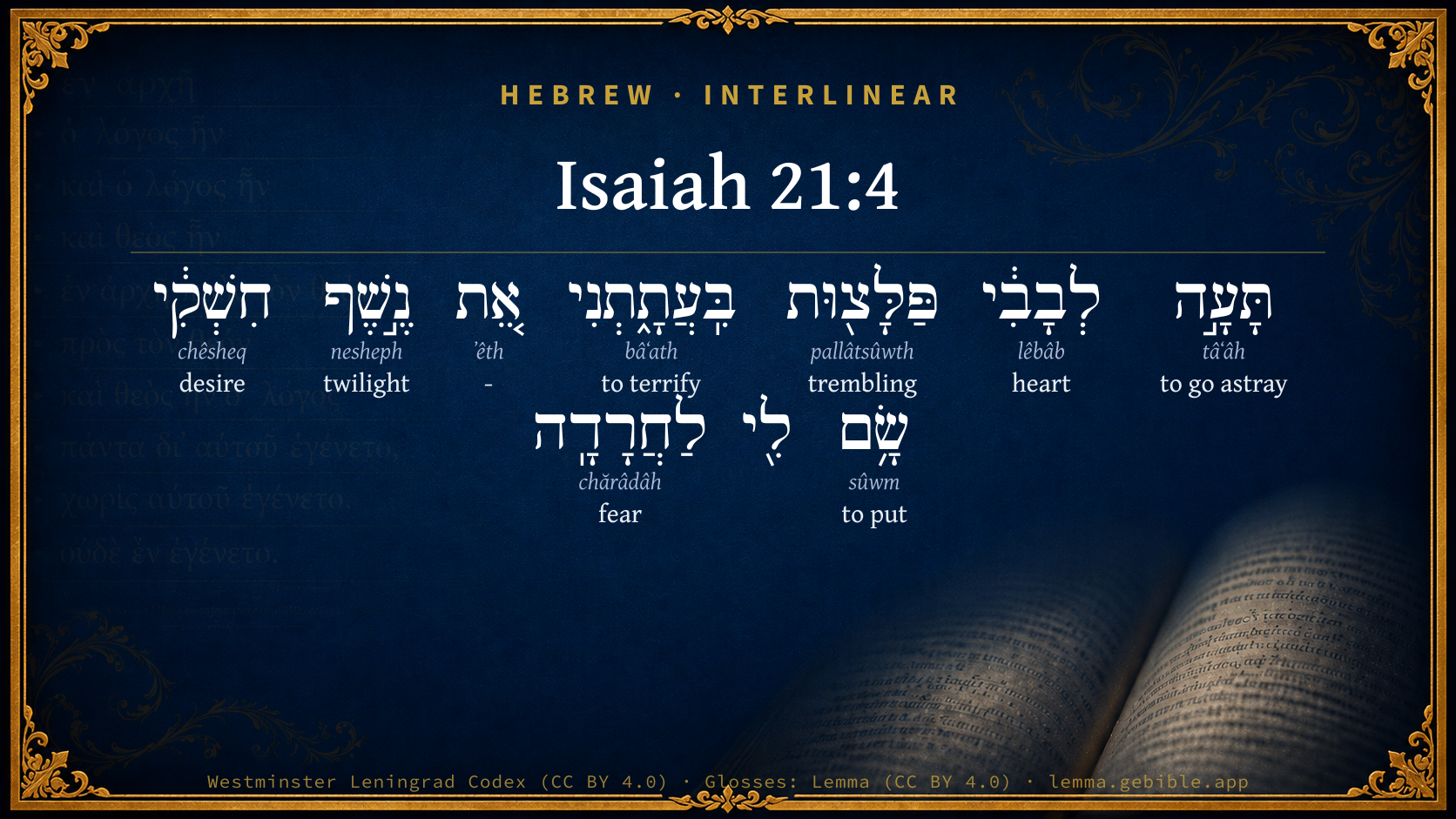
Hebrew (Westminster Leningrad Codex) Isaiah 21:4 appears in the Hebrew Old Testament. The text above is from the Westminster Leningrad Codex. Each word links to its Strong’s number, a concise gloss, and parsing drawn from the Open Scriptures Hebrew Bible morphology. Click any word for its full Brown-Driver-Briggs (BDB) entry.
Download image
Cite this verse

Isaiah 21:4 (World English Bible). Public Domain. Lemma interlinear Bible study tool, https://lemma.gebible.app/v/isaiah/21/4.

Show BibTeX & RIS
BibTeX
RIS
English Translation
My heart flutters, horror has frightened me; the twilight that I desired has been turned into trembling to me.
World English Bible · Public Domain
Download a study sheet

One document with this verse’s original text, its word-by-word gloss line, the meaning frame, cross-references with their text, attributed commentary, and full source and license credits — printable, and it pastes into notes with its structure intact.

This verse Autodidact and up

Study sheet (.html) Plain text (.txt)

A passage Seminary Student

Up to 50 verses in one chapter. A passage sheet keeps up to 6 commentary sources and 12 cross-references per verse, in the order this page ranks them, and says so on the sheet whenever that leaves anything out. Ask for a single verse and you get the Autodidact verse sheet above.

Everything on this page stays free to read, with no account — the sheet is a download of what is already on screen, not access to it.

Want to remove ads? Support Godless Engineer
Compare translations 3

The same verse in 3 English versions, stacked beneath the original-language interlinear above. Click any original word for its lexicon entry.

Each is an independent rendering of the whole verse — the interlinear is not word-aligned to these translations.

Highlighted words mark where these versions differ — a whole-verse word diff, not a word-by-word alignment.

  • World English Bible Public Domain
    My heart flutters, horror has frightened me; the twilight that I desired has been turned into trembling to me.
  • King James Version Public Domain
    My heart panted, fearfulness affrighted me: the night of my pleasure hath he turned into fear unto me.
  • unfoldingWord Literal Text CC BY-SA 4.0
    My heart wanders; horror terrifies me. The twilight of my desire, he has made trembling for me.

unfoldingWord Literal Text — © unfoldingWord, licensed CC BY-SA 4.0. Word-aligned USFM3 via Door43 (git.door43.org/unfoldingWord/en_ult).

Versions to compare (up to 4)

3 of 4 selected

Show all 18 translations

Every available English version of this verse, each an independent rendering of the whole verse.

  • World English Bible Public Domain
    My heart flutters, horror has frightened me; the twilight that I desired has been turned into trembling to me.
  • Berean Standard Bible Public Domain
    My heart falters; fear makes me tremble. The twilight of my desire has turned to horror.
  • Majority Standard Bible Public Domain
    My heart falters; fear makes me tremble. The twilight I desired has turned to horror.
  • King James Version Public Domain
    My heart panted, fearfulness affrighted me: the night of my pleasure hath he turned into fear unto me.
  • American Standard Version (1901) Public Domain
    My heart fluttereth, horror hath affrighted me; the twilight that I desired hath been turned into trembling unto me.
  • Revised Version (1885) Public Domain
    My heart panteth, horror hath affrighted me: the twilight that I desired hath been turned into trembling unto me.
  • Geneva Bible (1599) Public Domain
    Mine heart failed: fearefulnesse troubled me: the night of my pleasures hath he turned into feare vnto me.
  • Douay-Rheims (1899) Public Domain
    My heart failed, darkness amazed me: Babylon my beloved is become a wonder to me.
  • Young's Literal Translation Public Domain
    Wandered hath my heart, trembling hath terrified me, The twilight of my desire He hath made a fear to me,
  • Literal Standard Version CC BY-SA 4.0
    My heart has wandered, trembling has terrified me, || He has made the twilight of my desire a fear to me,
  • Unlocked Literal Bible CC BY-SA 4.0
    My heart pounds; I shake with fear. Twilight was my desire, but it brought me terror.
  • unfoldingWord Literal Text CC BY-SA 4.0
    My heart wanders; horror terrifies me. The twilight of my desire, he has made trembling for me.
  • Darby Bible Public Domain
    My heart panteth, horror affrighteth me: the night of my pleasure hath he turned into trembling unto me.
  • World Messianic Bible Public Domain
    My heart flutters. Horror has frightened me. The twilight that I desired has been turned into trembling for me.
  • Webster's Bible Public Domain
    My heart panted, fearfulness affrighted me: the night of my pleasure hath he turned into fear to me.
  • Free Bible Version CC BY-SA 4.0
    My mind falters; I shake in panic. The night I looked forward to has become terrifying.
  • Bible in Basic English Public Domain
    My mind is wandering, fear has overcome me: the evening of my desire has been turned into shaking for me.
  • JPS Tanakh (1917) Public Domain
    My heart is bewildered, terror hath overwhelmed me; the twilight that I longed for hath been turned for me into trembling.

Literal Standard Version (2020), Covenant Press — licensed CC BY-SA 4.0. Text via the HelloAO Bible API (eBible.org). Unlocked Literal Bible (unfoldingWord) — licensed CC BY-SA 4.0. Text via the HelloAO Bible API (eBible.org). unfoldingWord Literal Text — © unfoldingWord, licensed CC BY-SA 4.0. Word-aligned USFM3 via Door43 (git.door43.org/unfoldingWord/en_ult). Free Bible Version, Dr. Jonathan Gallagher — licensed CC BY-SA 4.0. Text via the HelloAO Bible API (eBible.org).

Word by word

More ways to search: Search by grammar → Find every occurrence → Compare this word →

Practice this passage: Drill this verse → Learn its vocabulary →

פַּלָּצ֖וּת
pallâtsûwth
H6427
“trembling”
Noun, Common, Feminine, Singular, Absolute
Part of Speech
Noun
Type
Common
Gender
Feminine
Number
Singular
State
Absolute
Full BDB Definition

Origin: from H6426

TWOT: 1778a

shuddering, trembling
  1. תָּעָ֣ה tâʻâh H8582 “to go astray” Verb, Qal, Perfect, 3rd Person, Masculine, Singular
  2. לְבָבִ֔י lêbâb H3824 “heart · my” Noun, Common, Masculine, Singular, Construct + Suffix, Personal, 1st Person, Common, Singular
  3. בִּֽעֲתָ֑תְנִי bâʻath H1204 “to terrify · me” Verb, Piel, Perfect, 3rd Person, Feminine, Singular + Suffix, Personal, 1st Person, Common, Singular
  4. אֵ֚ת ʼêth H853 “-” Particle, Direct Object
  5. נֶ֣שֶׁף nesheph H5399 “twilight of” Noun, Common, Masculine, Singular, Construct
  6. חִשְׁקִ֔י chêsheq H2837 “desire · my” Noun, Common, Masculine, Singular, Construct + Suffix, Personal, 1st Person, Common, Singular
  7. שָׂ֥ם sûwm H7760 “to put” Verb, Qal, Perfect, 3rd Person, Masculine, Singular
  8. לַחֲרָדָֽה chărâdâh H2731 “to/for · fear” Preposition + Noun, Common, Feminine, Singular, Absolute

About this verse

These counts appear in no published source. They are computed here, from the morphology-tagged text and Lemma’s own curated glosses. What Lemma adds →

10
words
9
distinct lemmas
Prophets
section

Notable vocabulary

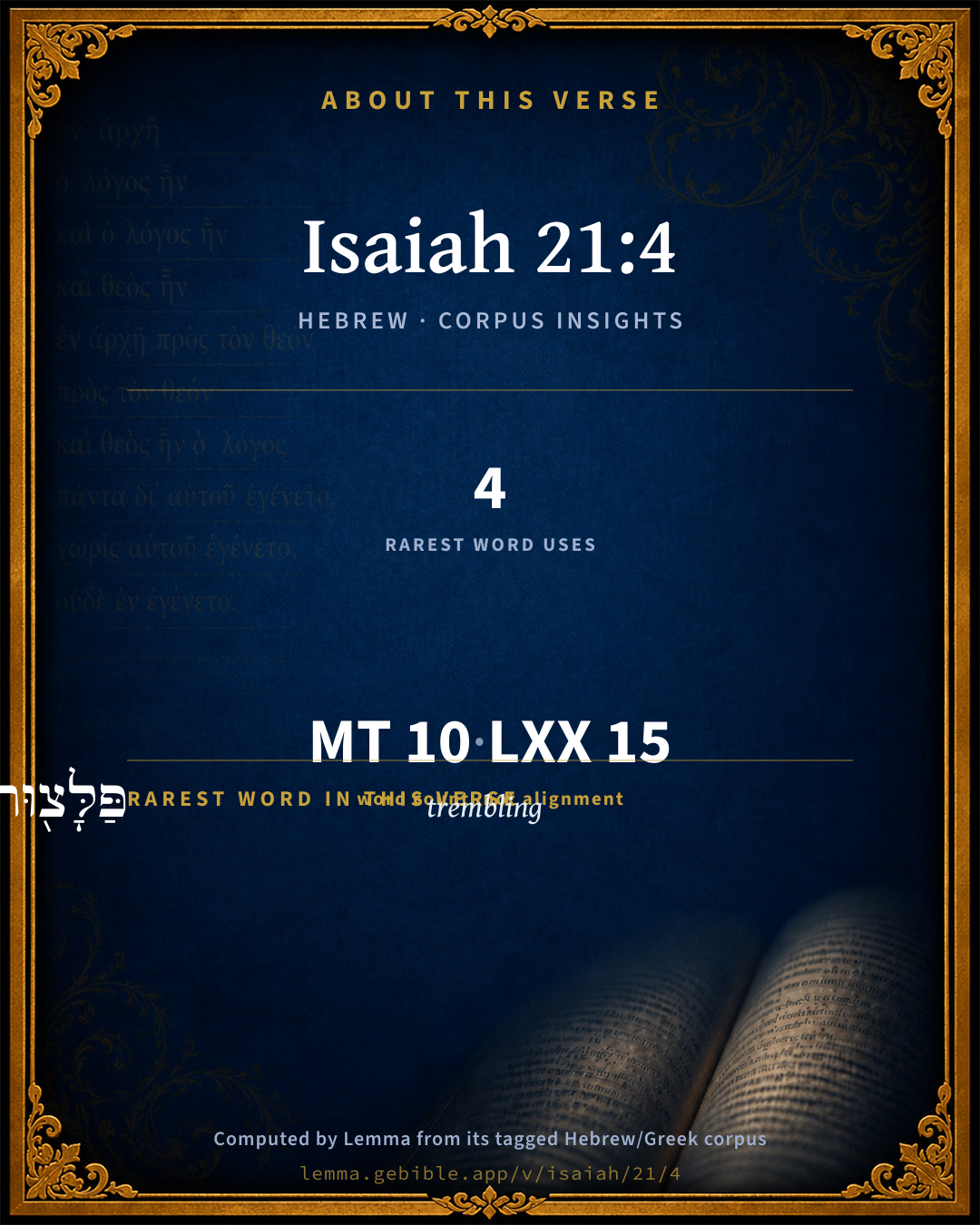
The rarest word here is פַּלָּצ֖וּת trembling H6427 — appearing just 4 times in the whole Hebrew Bible.

Shared distinctive vocabulary

פַּלָּצ֖וּת trembling H6427 occurs in 4 verses of the Hebrew Bible. Also found in:

Grammatical profile

  • 3 verbs
  • 5 nouns
  • 1 preposition
  • 1 particle

Verb forms

  • תָּעָ֣ה Qal · Perfect
  • בִּֽעֲתָ֑תְנִי Piel · Perfect
  • שָׂ֥ם Qal · Perfect

Hebrew & Septuagint length

In English translation the verse runs 19 words from the Hebrew and 13 from the Septuagint (LXX English) — the Septuagint runs noticeably shorter here. See the side-by-side →

A rough comparison of the two English renderings, which tokenize alike — not a word-level alignment.

Word counts can differ between the Hebrew and the Greek without any difference in meaning — e.g. the Hebrew direct-object marker אֵת has no separate Greek word, and Greek often adds the article ὁ.

In the original languages it is 10 Hebrew tokens and 15 Greek tokens — but the two are counted differently (Hebrew bundles its prefixes and suffixes into one token; the Greek is in lemma form), so that isn’t a like-for-like length.

Cross-references

14

Topical passages linked to Isaiah 21:4 in the Treasury of Scripture Knowledge — connected by theme and wording, ordered by reader-vote popularity; previews shown in the World English Bible.

  • Luke 21:34–36 "So be careful, or your hearts will be loaded down with carousing, drunkenness, and cares of this life, and that day will come on you suddenly.
  • Deuteronomy 28:67 In the morning you shall say, Would it were even! and at even you shall say, Would it were morning! for the fear of your heart which you shall fear, and for the sight of your eyes which you shall see.
  • 1 Samuel 25:36–38 Abigail came to Nabal; and, behold, he held a feast in his house, like the feast of a king; and Nabal's heart was merry within him, for he was very drunken: therefore she told him nothing, less or more, until the morning light.
  • 2 Samuel 13:28–29 Absalom commanded his servants, saying, Mark you now, when Amnon's heart is merry with wine; and when I tell you, Smite Amnon, then kill him; don't be afraid; haven't I commanded you? be courageous, and be valiant.
  • Esther 5:12 Haman said moreover, Yes, Esther the queen did let no man come in with the king to the banquet that she had prepared but myself; and tomorrow also am I invited by her together with the king.
  • Esther 7:6–10 Esther said, An adversary and an enemy, even this wicked Haman. Then Haman was afraid before the king and the queen.
  • Job 21:11–13 They send forth their little ones like a flock. Their children dance.
  • Isaiah 5:11–14 Woe to those who rise up early in the morning, that they may follow strong drink; Who stay late into the night, until wine inflames them!
  • Jeremiah 51:39 When they are heated, I will make their feast, and I will make them drunken, that they may rejoice, and sleep a perpetual sleep, and not wake, says Yahweh.
  • Jeremiah 51:57 I will make drunk her princes and her wise men, her governors and her deputies, and her mighty men; and they shall sleep a perpetual sleep, and not wake up, says the King, whose name is Yahweh of Hosts.
  • Daniel 5:1 Belshazzar the king made a great feast to a thousand of his lords, and drank wine before the thousand.
  • Daniel 5:5 In the same hour came forth the fingers of a man's hand, and wrote over against the lampstand on the plaster of the wall of the king's palace: and the king saw the part of the hand that wrote.
  • Nahum 1:10 For entangled like thorns, and drunken as with their drink, they are consumed utterly like dry stubble.
  • Daniel 5:30 In that night Belshazzar the Chaldean King was slain.

Cross-references courtesy of OpenBible.info (CC BY 4.0).

Hebrew and Greek witnesses Masoretic Hebrew ↔ Greek Septuagint

The same verse in the two great witnesses to the Old Testament, shown verse-for-verse.

Here the Septuagint runs noticeably shorter than the Hebrew — LXX2012 (modern English Septuagint) 13 words vs World English Bible 19. A rough length comparison of the two English translations, not a word-level alignment — read both below.

These are two independent witnesses, not word-aligned to each other, and the Septuagint is shown in lemma (dictionary) form.

Hebrew Isaiah 21:4 Masoretic · Westminster Leningrad Codex

תָּעָ֣ה לְבָבִ֔י פַּלָּצ֖וּת בִּֽעֲתָ֑תְנִי אֵ֚ת נֶ֣שֶׁף חִשְׁקִ֔י שָׂ֥ם לִ֖י לַחֲרָדָֽה

My heart flutters, horror has frightened me; the twilight that I desired has been turned into trembling to me.

World English Bible · Public Domain

Greek LXX Isaiah 21:4 Septuagint · lemma form

ὁ καρδία ἐγώ πλανάω καί ὁ ἀνομία ἐγώ βαπτίζω ὁ ψυχή ἐγώ ἐπιἵστημι εἰς φόβος

My heart wanders, and transgression overwhelms me; my soul is occupied with fear.

LXX2012 (modern English Septuagint) · Public Domain

On this verse, Haydock's Catholic Bible Commentary discusses the Septuagint’s reading. Read the note in Commentary ↓

Hebrew: Westminster Leningrad Codex (CC BY 4.0). Greek: Septuagint (public domain); English from LXX2012 (modern English Septuagint) (Public Domain). How the Septuagint differs from the Hebrew →

Targum (Aramaic paraphrase)

1

The Targum is the ancient Jewish Aramaic paraphrase of the Hebrew Scriptures — an interpretive translation, not the Hebrew text itself. Onkelos (literal) and Pseudo-Jonathan (expansive) render the Torah, and Jonathan the Prophets. Coverage is partial: where no permissively-licensed English translation exists for a verse, only the Aramaic is shown. This is verse-level text, not a word-by-word alignment to the Hebrew.

  1. Targum Jonathan Prophets (Joshua–Malachi)
    טְעָה לִבְּהוֹן עָקָא וּבִיעוּתִין אַחֲדוּנוּן אֲתַר בֵּית רוֹחְצָנֵיהוֹן הֲוָה לְהוֹן לִתְבַר:

    Their heart is bewildered; distress and terrors have seized them, because the place of their confidence hath become destruction unto them.

    Targum Jonathan — Aramaic: “Mikraot Gedolot” (public domain). English: “Sefaria Community Translation” (CC0 1.0 (public-domain dedication)); “London "Chaldee Paraphrase," 1871” (public domain). Text via Sefaria.

Commentary

Notes on Isaiah 21:4 from classic Christian and Jewish commentators (each source and its license shown beneath its notes). The classic Christian expositions comment on the surrounding passage and are grouped to its opening verse, so a note may address several verses; the Jewish commentaries on the Tanakh (Rashi and others) are per-verse, so they appear only where the commentator wrote on this verse.

Lemma curates 59 commentaries, every one of them public domain or Creative Commons licensed, each selected and text-cleaned for this edition rather than reprinted as found. About our sources →

Trapp's Complete Commentary

John Trapp

Isa 21:4 My heart panted, fearfulness affrighted me: the night of my pleasure hath he turned into fear unto me.

Ver. 4. My heart panted.] Or, Fluttereth to and fro, as not able to keep in its place. Viro impio calamitatibus presso nihil desperatius est. Nothing is more hopeless and crest fallen than a wicked man in distress: for what reason? his life and hopes end together.

The night of my pleasure hath he turned into fear.] That dreadful and dismal night, {Dan 5:1-31} intended for a revelling night, and dedicated to the honour of Shac: but the handwriting on the wall and the irruption of the Persians marred the mirth.

John Trapp, A Commentary or Exposition upon All the Books of the Old and New Testament (1647–1656) — public domain. Text from a community e-Sword module.

Geneva Bible (1599)

Geneva Bible translators

He prophesieth the death of Belshazzar, as Dan. 5:30, who in the midst of his pleasures was destroyed.

Geneva Bible (1599) marginal notes — public domain. Text via Bolls.life.

Jamieson, Fausset & Brown

Robert Jamieson, A. R. Fausset & David Brown

panted--"is bewildered" [BARNES].

night of my pleasure--The prophet supposes himself one of the banqueters at Belshazzar's feast, on the night that Babylon was about to be taken by surprise; hence his expression, "my pleasure" (Isa 14:11; Jer 51:39; Dan. 5:1-31).

Jamieson, Fausset & Brown — Commentary Critical and Explanatory on the Whole Bible (1871) — public domain (CC PDM 1.0). Text via the HelloAO Bible API.

Ellicott's Commentary for English Readers

(4) The night of my pleasure . . .—The words point to the prophet’s longing for the darkness of night, either as a time of rest from his labour, or, more probably, for contemplation and prayer (Psa_119:148), and to the invasion of that rest by the vision of terror. The suggestion that the prophet speaks as identifying himself with the Babylonians, and refers to the capture of their city during a night of revelry (Dan_5:1; Dan_5:30; Herod., i. 121; Xenoph. Cyrop., vii. 23), is hardly tenable.

A Bible Commentary for English Readers, edited by Charles John Ellicott (1878–1897) — public domain. Text from a community e-Sword module.

The Cambridge Bible for Schools and Colleges

gen. ed. J. J. S. Perowne

4. My heart panted] lit. strayeth; as we should say “my reason reels.” “Heart,” as often, is used of the intellect. fearfulness] R.V. horror.

the night of my pleasure] i.e. “my pleasant evening hours,” favourable for visionary communications and therefore dear to a prophet. (Job_4:13).

hath he turned] Better: “is turned”; or “it (the vision) turns.”

fear] trembling (as R.V.).

The Cambridge Bible for Schools and Colleges (gen. ed. J. J. S. Perowne; Cambridge University Press, 1878–1918) — public domain. Text from a community e-Sword module.

John Gill's Exposition

My heart panted,.... Fluttered about, and could hardly keep its place: or, "my mind wandered" (r); like a person in distraction and confusion, that knew not what to think say or do:

fearfulness affrighted me; the terror of Cyrus's army seized him, of its irruption into the city, and of his being destroyed by it; the writing on the wall threw him into a panic, and the news of the Medes and Persians being entered the city increased it:

the night of my pleasure hath he turned into fear unto me; in which he promised himself so much pleasure, at a feast he had made for his princes, wives, and concubines; either in honour of his god, as some think (s), being an annual one; or, as Josephus ben Gorion (t) says, on account of the victory he had obtained over the Medes and Persians; and so was quite secure, and never in the least thought of destruction being at hand; but in the midst of all his revelling, mirth, and jollity, the city was surprised and taken, and he slain, Dan 5:1. So mystical Babylon, in the midst of her prosperity, while she is saying that she sits a queen, and knows no sorrow, her judgment and plagues shall come upon her, Rev 18:7.

(r) "erravit cor meum", Montanus; "errat animus meus", Junius & Tremellius; "errat cor meum", Piscator. (s) Vid. Herodot. l. 1. c. 191. Xenophon. l. 7. c. 23. (t) L. 1. c. 5. p. 24. Ed. Braithaupt.

John Gill's Exposition of the Whole Bible (1746–1763) — public domain (CC PDM 1.0). Text via the HelloAO Bible API.

Albert Barnes' Notes on the Bible

My heart panted - Margin, ‘My mind wandered.’ The Hebrew word rendered ‘panted’ (תעה tâ‛âh) means to wander about; to stagger; to be giddy; and is applied often to one that staggers by being intoxicated. Applied to the heart, it means that it is disquieted or troubled. The Hebrew word “heart” here is to be taken in the sense of “mind.”

The night of my pleasure - There can be no doubt that the prophet here refers to the night of revelry and riot in which Babylon was taken. The prophet calls it the night of “his” pleasure, because he represents himself as being “in” Babylon when it should be taken, and, therefore, uses such language as an inhabitant of Babylon would use. “They” would call it the night of their pleasure, because it was set apart to feasting and revelry.

Hath he turned into fear - God has made it a night of consternation and alarm. The prophet here refers to the fact that Babylon would be taken by Cyrus during that night, and that consternation and alarm would suddenly pervade the affrighted and guilty city (see Dan. 5).

Albert Barnes' Notes on the Bible (1834–1885) — public domain. Text from a community e-Sword/MySword module.

Haydock's Catholic Bible Commentary

Babylon. Protestants, "the night of my pleasure hath he turned into fear unto me." Septuagint, "My soul is turned into fear." (Haydock)

George Leo Haydock (1774–1849), Haydock's Catholic Family Bible and Commentary, 1859 edition — public domain. Excludes Psalms (Douay-Rheims chapter numbering differs from Protestant) and Deuterocanonical books (Catholic canon only).

Matthew Poole's English Annotations

The night of my pleasure; the night, in which I used to have a sweet repose and sleep. He seems to have had this vision in a night. But withal this horror of the prophet by night was typical, and did signify that grievous horror and destruction which should befall the Babylonians in a night of great feasting and jollity, as it did, Dan 5:1,30.

Hath he, God, who showed him that vision,

turned into fear unto me; into a time and matter of fear.

Matthew Poole's English Annotations on the Holy Bible (1683–1685) — public domain. Text from a community e-Sword/MySword module.

The Pulpit Commentary

My heart panted; rather, my heart trembleth, or fluttereth. The night of my pleasure; i.e. "the night, wherein, I am wont to enjoy peaceful and pleasant slumbers."

The Pulpit Commentary (1880–1919), ed. H.D.M. Spence-Jones & Joseph S. Exell — public domain. Text from a community e-Sword module.

John Wesley's Explanatory Notes

The night - In which I used to have sweet repose. He seems to have had this vision in a night. But withal this signified that horror and destruction, which should befall the Babylonians in a night of feasting and jollity. He - God, who shewed him that vision.

John Wesley, Explanatory Notes Upon the Whole Bible (1754–1765) — public domain. Text via the GEBible commentary corpus.

J. A. Alexander on Isaiah

Joseph Addison Alexander

“My heart wanders (reels, or is bewildered); horror appalls me; the twilight (night or evening) of my pleasure (or desire) he has put for (or converted into) fear (or trembling) for me.” There are two interpretations of the last clause. One supposes it to mean that the night desired as a time of rest is changed into a time of terror; the other, that a night of festivity is changed into a time of terror. That the court was reveling when Cyrus took the city, is stated in the general by Herodotus and Xenophon, and in full detail by Daniel. That the two first, however, did not derive their information from the Prophet, may be inferred from their not mentioning the writing on the wall, which would have seemed incredible to neither of them.

Joseph Addison Alexander, The Prophecies of Isaiah (1846–1847; New York: Scribner, 1870–1878) — public domain. Text from a community e-Sword module.

Rashi

Rabbi Shlomo Yitzchaki (Rashi)

fright (פַּלָּצוּת). fright.

the evening of my desire The night that I longed for, for rejoicing and for a banquet. In the Book of Josipon we find that he was happy since his troops had defeated the army of Persia. (Book 1, ch. 5) That night He made for me into trembling, as it is said (Dan. 5:1): “King Belshazzar made a great feast...They drank wine...(verse 4). On that very night, King Belshazzar was slain...(verse 30).” (6:1) “And Darius the Mede received the kingdom.”

Rashi on the Tanakh — English translations: “The Judaica Press complete Tanach with Rashi, translated by A. J. Rosenberg” (CC BY 4.0); “Pentateuch with Rashi's commentary by M. Rosenbaum and A.M. Silbermann, 1929-1934” (public domain); “The Metsudah Tanach series, Lakewood, N.J” (CC BY 4.0); and “The Book of Joshua, Metsudah Publications, 1997” (CC BY 4.0). Text via Sefaria.

Ibn Ezra

Rabbi Abraham ibn Ezra

פלצות Boasting. Comp. מפלצתה her pride (1 Kings 15:13); the meaning of the whole phrase is: The boasting of the Persians terrified me; it may also be rendered trembling; comp. יתפלצון they tremble (Job 9:6).

The night of my pleasure. The night in which he drank out of the holy vessels. Hath he turned, into fear unto me. Belshazzar was frightened when Daniel read to him the miraculous writing (Dan. 5:3)

Ibn Ezra on the Tanakh — English translations: “Sefaria Community Translation” (CC0 1.0 (public-domain dedication)); “Yalkut, Sifsei Chachomim Chumash, Metsudah Publications, 2009” (CC BY 4.0); and “Commentary of Ibn Ezra on Isaiah - trans. by M. Friedlander, 1873” (public domain). Text via Sefaria.

Lesson kit

Teaching starters — assembled from the data on this page, not authored interpretation. Every prompt links to the verse data it draws on. Edit before teaching.

Isaiah, in the Prophets, opens this verse with 10 words (9 distinct Hebrew lemmas). Its most distinctive word is pallâtsûwth (“trembling”). The Greek Septuagint runs shorter here. A historical commentator’s framing appears above. Read the whole chapter for the surrounding context.

Discussion questions

  1. How does “trembling” (pallâtsûwth) shape what this verse is saying?
  2. Job 21:6 shares the word «trembling» with this verse. How do the two illuminate each other?
  3. Compared with the Hebrew, the Septuagint runs shorter here. What questions does that raise?
  4. The translations on this page render this verse differently — a whole-verse word diff, not a word-by-word alignment. What might account for the different wordings?
  5. The verb «תָּעָ֣ה» is Qal Perfect. How does its form color the action?
  6. Reading how Trapp's Complete Commentary and Geneva Bible (1599) read this verse, where do the two commentators agree and where do they part?

Things to notice

Reading settings

Reading text

Shown beneath each verse's original-language words.

Old Testament
Old Testament edition

Read the OT as the Masoretic Hebrew (MT) or the Greek Septuagint (LXX).

English shown for the Greek Septuagint (in the Hebrew ↔ Greek comparison).

Comparing translations? Open the Compare panel on any verse page to stack up to four side by side.