Hebrews 6:18

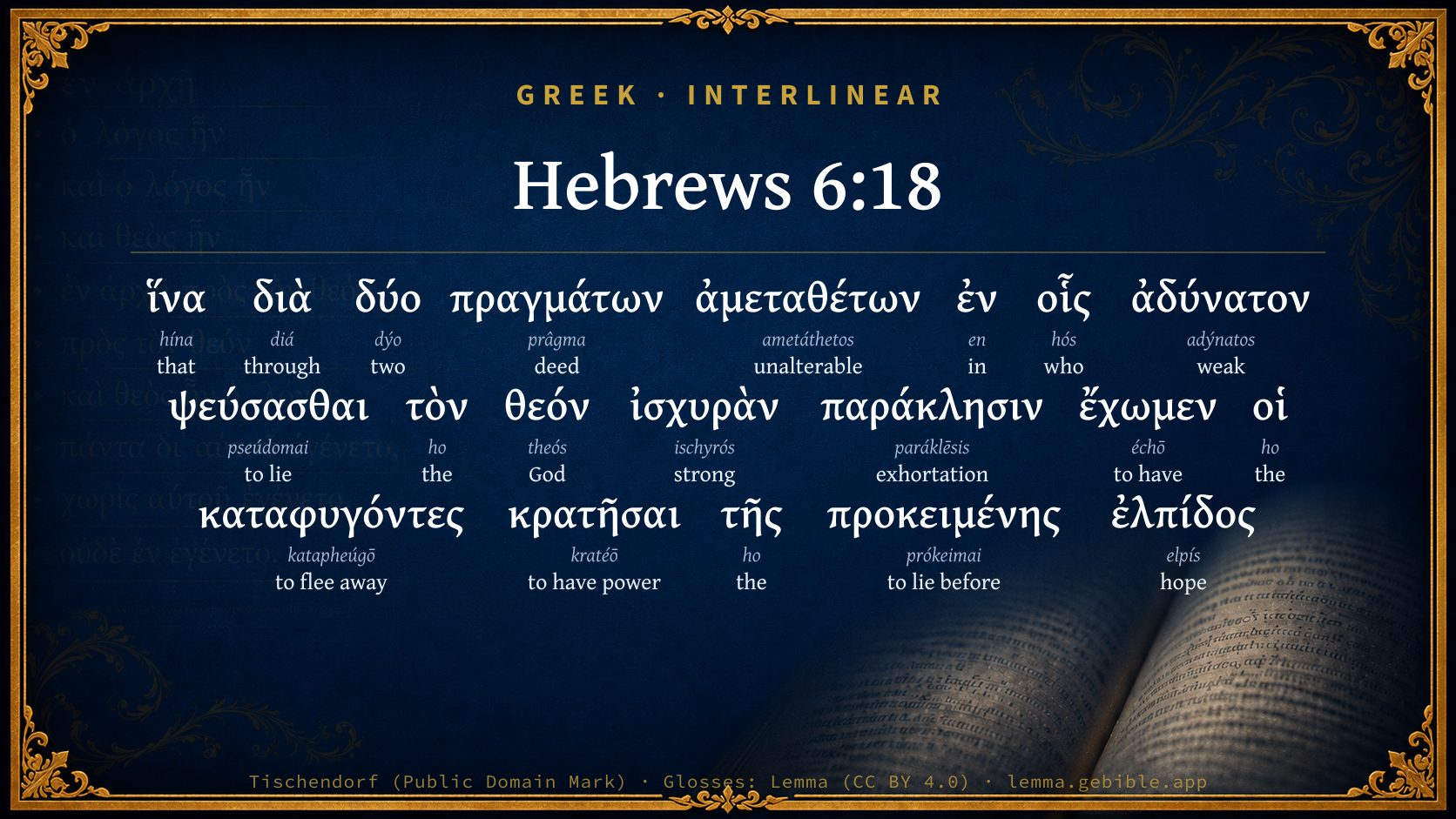
Greek (Tischendorf 8th ed.) Hebrews 6:18 appears in the Greek New Testament. The text above is from the Tischendorf 8th edition. Each word links to its Strong’s number and a concise gloss. Click any word for its full Thayer’s Greek Lexicon entry.
Download image
Cite this verse

Hebrews 6:18 (World English Bible). Public Domain. Lemma interlinear Bible study tool, https://lemma.gebible.app/v/hebrews/6/18.

Show BibTeX & RIS
BibTeX
RIS
English Translation
that by two immutable things, in which it is impossible for God to lie, we may have a strong encouragement, who have fled for refuge to take hold of the hope set before us.
World English Bible · Public Domain
Download a study sheet

One document with this verse’s original text, its word-by-word gloss line, the meaning frame, cross-references with their text, attributed commentary, and full source and license credits — printable, and it pastes into notes with its structure intact.

This verse Autodidact and up

Study sheet (.html) Plain text (.txt)

A passage Seminary Student

Up to 50 verses in one chapter. A passage sheet keeps up to 6 commentary sources and 12 cross-references per verse, in the order this page ranks them, and says so on the sheet whenever that leaves anything out. Ask for a single verse and you get the Autodidact verse sheet above.

Everything on this page stays free to read, with no account — the sheet is a download of what is already on screen, not access to it.

Want to remove ads? Support Godless Engineer
Compare translations 3

The same verse in 3 English versions, stacked beneath the original-language interlinear above. Click any original word for its lexicon entry.

Each is an independent rendering of the whole verse — the interlinear is not word-aligned to these translations.

Highlighted words mark where these versions differ — a whole-verse word diff, not a word-by-word alignment.

  • World English Bible Public Domain
    that by two immutable things, in which it is impossible for God to lie, we may have a strong encouragement, who have fled for refuge to take hold of the hope set before us.
  • King James Version Public Domain
    That by two immutable things, in which it was impossible for God to lie, we might have a strong consolation, who have fled for refuge to lay hold upon the hope set before us:
  • unfoldingWord Literal Text CC BY-SA 4.0
    so that by two unchangeable things, in which things impossible for God to lie, we, the ones having fled for refuge, might have a strong encouragement to hold firmly the hope set before;

unfoldingWord Literal Text — © unfoldingWord, licensed CC BY-SA 4.0. Word-aligned USFM3 via Door43 (git.door43.org/unfoldingWord/en_ult).

Versions to compare (up to 4)

3 of 4 selected

Show all 19 translations

Every available English version of this verse, each an independent rendering of the whole verse.

  • World English Bible Public Domain
    that by two immutable things, in which it is impossible for God to lie, we may have a strong encouragement, who have fled for refuge to take hold of the hope set before us.
  • Berean Standard Bible Public Domain
    Thus by two unchangeable things in which it is impossible for God to lie, we who have fled to take hold of the hope set before us may be strongly encouraged.
  • Majority Standard Bible Public Domain
    Thus by two unchangeable things in which it is impossible for God to lie, we who have fled to take hold of the hope set before us may be strongly encouraged.
  • King James Version Public Domain
    That by two immutable things, in which it was impossible for God to lie, we might have a strong consolation, who have fled for refuge to lay hold upon the hope set before us:
  • American Standard Version (1901) Public Domain
    that by two immutable things, in which it is impossible for God to lie, we may have a strong encouragement, who have fled for refuge to lay hold of the hope set before us:
  • Revised Version (1885) Public Domain
    that by two immutable things, in which it is impossible for God to lie, we may have a strong encouragement, who have fled for refuge to lay hold of the hope set before us;
  • Geneva Bible (1599) Public Domain
    That by two immutable things, wherein it is vnpossible that God should lye, we might haue strong consolation, which haue our refuge to lay holde vpon that hope that is set before vs,
  • Douay-Rheims (1899) Public Domain
    That by two immutable things, in which it is impossible for God to lie, we may have the strongest comfort, who have fled for refuge to hold fast the hope set before us.
  • Young's Literal Translation Public Domain
    that through two immutable things, in which `it is' impossible for God to lie, a strong comfort we may have who did flee for refuge to lay hold on the hope set before `us',
  • Literal Standard Version CC BY-SA 4.0
    that through two immutable things, in which [it is] impossible for God to lie, we may have a strong comfort, having fled for refuge, to lay hold on the hope being set before [us],
  • Unlocked Literal Bible CC BY-SA 4.0
    He did this so that by two unchangeable things—with which it is impossible for God to lie—we, who have fled for refuge, will have a strong encouragement to hold firmly to the hope set before us.
  • unfoldingWord Literal Text CC BY-SA 4.0
    so that by two unchangeable things, in which things impossible for God to lie, we, the ones having fled for refuge, might have a strong encouragement to hold firmly the hope set before;
  • Darby Bible Public Domain
    that by two unchangeable things, in which [it was] impossible that God should lie, we might have a strong encouragement, who have fled for refuge to lay hold on the hope set before us,
  • World Messianic Bible Public Domain
    that by two immutable things, in which it is impossible for God to lie, we may have a strong encouragement, who have fled for refuge to take hold of the hope set before us.
  • Webster's Bible Public Domain
    That by two immutable things, in which it was impossible for God to lie, we might have a strong consolation, who have fled for refuge to lay hold upon the hope set before us:
  • Free Bible Version CC BY-SA 4.0
    So by these two actions that can't be changed, and since it's impossible for God to lie, we can have total confidence, having run for safety to take hold of the hope God presented to us.
  • Bible in Basic English Public Domain
    So that we, who have gone in flight from danger to the hope which has been put before us, may have a strong comfort in two unchanging things, in which it is not possible for God to be false;
  • Text-Critical English NT CC BY 4.0
    so that by two unchangeable things, in which it is impossible for God to lie, we who have fled for refuge would have strong encouragement to take hold of the hope set before us.
  • Tyndale New Testament (1534) Public Domain
    that by two immutable thinges (in which it was vnpossible that god shuld lye) we myght have parfect consolacion which have fled for to holde fast the hope that is set before vs

Literal Standard Version (2020), Covenant Press — licensed CC BY-SA 4.0. Text via the HelloAO Bible API (eBible.org). Unlocked Literal Bible (unfoldingWord) — licensed CC BY-SA 4.0. Text via the HelloAO Bible API (eBible.org). unfoldingWord Literal Text — © unfoldingWord, licensed CC BY-SA 4.0. Word-aligned USFM3 via Door43 (git.door43.org/unfoldingWord/en_ult). Free Bible Version, Dr. Jonathan Gallagher — licensed CC BY-SA 4.0. Text via the HelloAO Bible API (eBible.org).

Word by word

More ways to search: Search by grammar → Find every occurrence → Compare this word →

Practice this passage: Drill this verse → Learn its vocabulary →

ἀμεταθέτων
ametáthetos
G276
“unalterable”
Adjective, Genitive, Plural, Neuter
Part of Speech
Adjective
Case
Genitive
Number
Plural
Gender
Neuter
Full Thayer's Definition

Origin: from G1 (as a negative particle) and a derivative of G3346

TDNT: None

1. not transposed, not to be transferred, fixed, unalterable
  1. ἵνα hína G2443 “that” Conjunction
  2. διὰ diá G1223 “through” Preposition
  3. δύο dýo G1417 “two” Adjective, Numeral (indeclinable)
  4. πραγμάτων prâgma G4229 “deed” Noun, Genitive, Plural, Neuter
  5. ἐν en G1722 “in” Preposition
  6. οἷς hós G3739 “who” Relative pronoun, Dative, Plural, Neuter
  7. ἀδύνατον adýnatos G102 “weak” Adjective, Nominative, Singular, Neuter
  8. ψεύσασθαι pseúdomai G5574 “to lie” Verb, Aorist, Middle deponent, Infinitive
  9. τὸν ho G3588 “the” Article, Accusative, Singular, Masculine
  10. θεόν theós G2316 “God” Noun, Accusative, Singular, Masculine
  11. ἰσχυρὰν ischyrós G2478 “strong” Adjective, Accusative, Singular, Feminine
  12. παράκλησιν paráklēsis G3874 “exhortation” Noun, Accusative, Singular, Feminine
  13. ἔχωμεν échō G2192 “to have” Verb, Present, Active, Subjunctive, 1st person, Plural
  14. οἱ ho G3588 “the” Article, Nominative, Plural, Masculine
  15. καταφυγόντες katapheúgō G2703 “to flee away” Verb, Aorist, Active, Participle, Nominative, Plural, Masculine
  16. κρατῆσαι kratéō G2902 “to have power” Verb, Aorist, Active, Infinitive
  17. τῆς ho G3588 “the” Article, Genitive, Singular, Feminine
  18. προκειμένης prókeimai G4295 “to lie before” Verb, Present, Middle or Passive deponent, Participle, Genitive, Singular, Feminine
  19. ἐλπίδος elpís G1680 “hope” Noun, Genitive, Singular, Feminine

About this verse

These counts appear in no published source. They are computed here, from the morphology-tagged text and Lemma’s own curated glosses. What Lemma adds →

20
words
18
distinct lemmas
General Epistles
section

Notable vocabulary

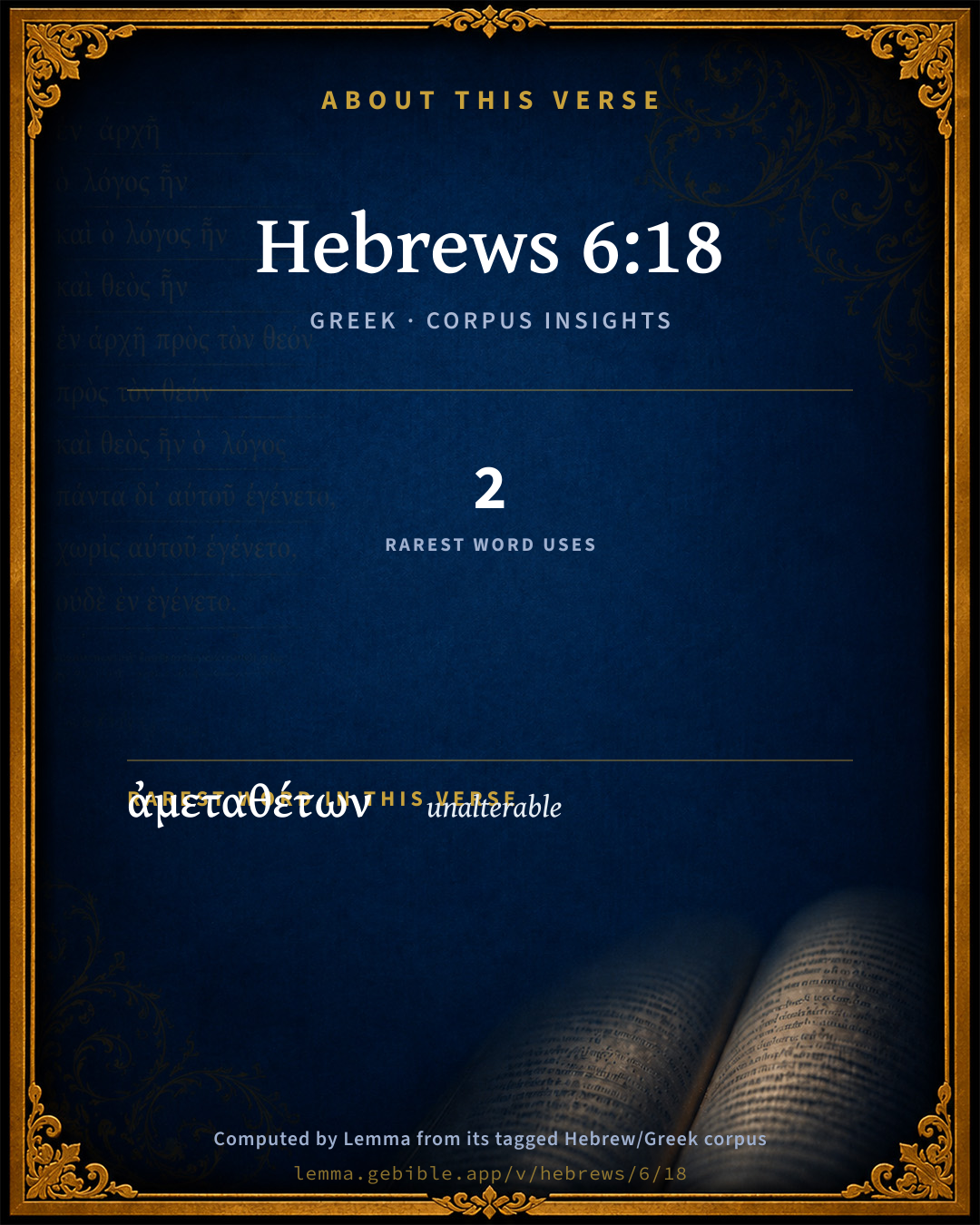
The rarest word here is ἀμεταθέτων unalterable G276 — appearing just 2 times in the whole Greek New Testament.

Shared distinctive vocabulary

ἀμεταθέτων unalterable G276 occurs in 2 verses of the Greek New Testament. Also found in:

Repetition

A word recurs within this verse:

Cross-references

43

Topical passages linked to Hebrews 6:18 in the Treasury of Scripture Knowledge — connected by theme and wording, ordered by reader-vote popularity; previews shown in the World English Bible.

  • Numbers 23:19 God is not a man, that he should lie, Neither the son of man, that he should repent: Has he said, and will he not do it? Or has he spoken, and will he not make it good?
  • Titus 1:2 in hope of eternal life, which God, who can't lie, promised before eternal times;
  • 1 Samuel 15:29 Also the Strength of Israel will not lie nor repent; for he is not a man, that he should repent.
  • 2 Timothy 2:13 If we are faithless, He remains faithful. He can't deny himself.
  • Romans 3:4 May it never be! Yes, let God be found true, but every man a liar. As it is written, "That you might be justified in your words, And might prevail when you come into judgment."
  • Psalms 46:1 God is our refuge and strength, A very present help in trouble.
  • Joshua 20:3 that the manslayer who kills any person unwittingly [and] unawares may flee there: and they shall be to you for a refuge from the avenger of blood.
  • Isaiah 32:1–2 Behold, a king shall reign in righteousness, and princes shall rule in justice.
  • Isaiah 51:12 I, even I, am he who comforts you: who are you, that you are afraid of man who shall die, and of the son of man who shall be made as grass;
  • 1 John 1:10 If we say that we haven't sinned, we make him a liar, and his word is not in us.
  • Hebrews 12:1–2 Therefore let us also, seeing we are surrounded by so great a cloud of witnesses, lay aside every weight and the sin which so easily entangles us, and let us run with patience the race that is set before us,
  • Numbers 35:11–15 then you shall appoint you cities to be cities of refuge for you, that the manslayer who kills any person unwittingly may flee there.
  • 1 Kings 2:28 The news came to Joab; for Joab had turned after Adonijah, though he didn't turn after Absalom. Joab fled to the Tent of Yahweh, and caught hold on the horns of the altar.
  • Proverbs 4:13 Take firm hold of instruction. Don't let her go. Keep her, for she is your life.
  • Isaiah 56:4 For thus says Yahweh of the eunuchs who keep my Sabbaths, and choose the things that please me, and hold fast my covenant:
  • Isaiah 64:7 There is none who calls on your name, who stirs up himself to take hold of you; for you have hid your face from us, and have consumed us by means of our iniquities.
  • Zechariah 9:12 Turn to the stronghold, you prisoners of hope! Even today I declare that I will restore double to you.
  • Romans 3:25 whom God set forth to be an atoning sacrifice, through faith in his blood, for a demonstration of his righteousness through the passing over of prior sins, in God's forbearance;
  • 2 Corinthians 1:5–7 For as the sufferings of Christ abound to us, even so our comfort also abounds through Christ.
  • 1 Timothy 1:1 Paul, an apostle of Christ Jesus according to the commandment of God our Savior, and Christ Jesus our hope;
  • Hebrews 3:11 As I swore in my wrath, 'They will not enter into my rest.'"
  • Psalms 110:4 Yahweh has sworn, and will not change his mind: "You are a priest forever in the order of Melchizedek."
  • Romans 15:5 Now the God of patience and of encouragement grant you to be of the same mind one with another according to Christ Jesus,
  • 1 Timothy 6:12 Fight the good fight of faith. Lay hold of the eternal life to which you were called, and you confessed the good confession in the sight of many witnesses.
  • 1 John 5:10 He who believes in the Son of God has the testimony in himself. He who doesn't believe God has made him a liar, because he has not believed in the testimony that God has given concerning his Son.
  • Genesis 19:22 Hurry, escape there, for I can't do anything until you get there." Therefore the name of the city was called Zoar.
  • Isaiah 27:5 Or else let him take hold of my strength, that he may make peace with me; [yes], let him make peace with me.
  • Isaiah 66:10–13 Rejoice you with Jerusalem, and be glad for her, all you who love her: rejoice for joy with her, all you who mourn over her;
  • Matthew 24:35 Heaven and earth will pass away, but my words will not pass away.
  • Luke 2:25 Behold, there was a man in Jerusalem whose name was Simeon. This man was righteous and devout, looking for the consolation of Israel, and the Holy Spirit was on him.
  • Colossians 1:23 if it is so that you continue in the faith, grounded and steadfast, and not moved away from the hope of the Gospel which you heard, which is being proclaimed in all creation under heaven; of which I, Paul, was made a servant.
  • Colossians 1:27 to whom God was pleased to make known what are the riches of the glory of this mystery among the Gentiles, which is Christ in you, the hope of glory;
  • 1 Thessalonians 1:10 and to wait for his Son from heaven, whom he raised from the dead-- Jesus, who delivers us from the wrath to come.
  • Hebrews 11:7 By faith, Noah, being warned about things not yet seen, moved with godly fear, prepared an ark for the saving of his house, through which he condemned the world, and became heir of the righteousness which is according to faith.
  • Psalms 62:8 Trust in him at all times, you people. Pour out your heart before him. God is a refuge for us. Selah.
  • Proverbs 3:18 She is a tree of life to those who lay hold of her. Happy is everyone who retains her.
  • Matthew 3:7 But when he saw many of the Pharisees and Sadducees coming for his baptism, he said to them, "You offspring of vipers, who warned you to flee from the wrath to come?
  • 2 Corinthians 5:18–21 But all things are of God, who reconciled us to himself through Jesus Christ, and gave to us the ministry of reconciliation;
  • Philippians 2:1 If there is therefore any exhortation in Christ, if any consolation of love, if any fellowship of the Spirit, if any tender mercies and compassion,
  • Colossians 1:5 because of the hope which is laid up for you in the heavens, of which you heard before in the word of the truth of the Gospel,
  • 2 Thessalonians 2:16–17 Now our Lord Jesus Christ himself, and God our Father, who loved us and gave us eternal comfort and good hope through grace,
  • Hebrews 3:6 but Christ is faithful as a Son over his house; whose house we are, if we hold fast our confidence and the glorying of our hope firm to the end.
  • Hebrews 7:21 (for they indeed have been made priests without an oath), but he with an oath by him that says of him, "The Lord swore and will not change his mind, 'You are a priest forever, According to the order of Melchizedek'".

Cross-references courtesy of OpenBible.info (CC BY 4.0).

Commentary

Notes on Hebrews 6:18 from classic Christian and Jewish commentators (each source and its license shown beneath its notes). The classic Christian expositions comment on the surrounding passage and are grouped to its opening verse, so a note may address several verses; the Jewish commentaries on the Tanakh (Rashi and others) are per-verse, so they appear only where the commentator wrote on this verse.

Lemma curates 59 commentaries, every one of them public domain or Creative Commons licensed, each selected and text-cleaned for this edition rather than reprinted as found. About our sources →

Joseph Benson's Commentary

Heb 6:18-19. That by two immutable things in either, much more in both, of which it was impossible for God to lie — To alter his purpose and disappoint our expectation; we might have a strong consolation — A powerful argument to believe the promise with a confidence excluding all doubt and fear, and might receive a great comfort thereby; who have fled for refuge — Who, under a consciousness of our sinfulness and guilt, depravity, weakness, and wretchedness, have betaken ourselves for safety from deserved wrath; to lay hold on the hope — The promise (so confirmed by an oath) which is the ground of our hope; set before us in Christ — Through whom alone we can have salvation, present and eternal; which hope — In and through Christ, our righteousness and sanctification; we have as an anchor of the soul — The apostle here alludes to an anchor, which when cast, both preserves the vessel from losing the ground she has gained, and keeps her steady amid the winds and waves, when the art and skill of the mariners are overcome, and they cannot steer the ship in its right course, nor could otherwise preserve it from rocks, shelves, or sand- banks; both sure — Ασφαλη, safe, that will not fail, or may with confidence be trusted to, the matter of which it is formed being solid, and the proportion of it suited to the burden of the ship; and steadfast — Βεβαιαν, firm against all opposition, which no violence of winds or storms can either break or move from its hold; and which entereth into that within the veil — He alludes to the veil which divided the holy place of the Jewish tabernacle or temple from the most holy: and thus he slides back to the priesthood of Christ. But he does not speak of that which was within the veil, namely, the ark and mercy-seat, the tables of stone, and cherubim, the work of men’s hands, but of the things signified by them; God himself on a throne of grace, and the Lord Christ, as the high-priest of the church, at his right hand: or the Father as the author, the Lord Jesus as the purchaser, and the covenant as the conveyer of all grace; which were all typically represented by the things within the veil. And the apostle makes use of this allusion to instruct the Hebrews in the nature and use of the old tabernacle institutions; and from thence in the true nature of the priesthood of Christ, to which he is now returning. The meaning is, that the believer’s hope lays hold on God himself, on a throne of grace and on Christ as the High-Priest of the church, who is in heaven itself, the place of God’s presence, typified by the holy of holies.

Joseph Benson's Commentary on the Old and New Testaments (1811–1818) — public domain. Text from a community e-Sword module.

Bengel's Gnomon

Johann Albrecht Bengel

Heb 6:18. Δύο, two) The one the promise, the other the oath.—ἐν οἷς, in which) This refers to δύο, two.—ἰσχυρὰν, strong) So as that it may swallow up all strife (contradiction) arising from distrust. Βεβαίαν, firm, stedfast, follows, ver, 19. Both words are joined, ch. Heb 9:17. Ἰσχυρὸς implies that strength by which a man is able to inflict hard blows on his enemy: βέβαιος, that firmness by which he does not allow himself to be moved from the position which he occupies.—οἱ καταφυγόντες, who have fled for refuge) as from a shipwreck: ἄγκυραν, an anchor, follows.—προκειμένης) set before us. The same word occurs, ch. Heb 12:1-2.

Bengel's Gnomon of the New Testament — English translation (T&T Clark, Edinburgh, 1860) — public domain. Text from a community e-Sword module.

Meyer's Critical & Exegetical Commentary

Heinrich August Wilhelm Meyer

Heb_6:18. Indication of purpose to ἐμεσίτευσεν ὅρκῳ, Heb_6:17, and consequently parallel to the participial clause there, περισσότερον βουλόμενος ἐπιδ. τοῖς κληρονόμ. τῆς ἐπ. τὸ ἀμετάθετον τῆς βουλῆς αὐτοῦ, but no mere repetition of the same, since the divine purpose, which was there presented purely objectively in relation to Christians, is now subjectively turned in relation to them.

διὰ δύο πραγμάτων ἀμεταθέτων] by virtue of two unalterable facts, namely, by virtue of the promise and the oath. Against the connection (comp. Heb_6:13; Heb_6:17) Reuss: lune de ces choses cest la parole évangélique apportée par Christ, lautre le serment typique donné à Abraham.

δύο] See Winer, Gramm., 7 Aufl. p. 63; Buttmann, Gramm. des neutest. Sprachgebr. p. 25.

ἐν οἷς ἀδύνατον ψεύσασθαι θεόν] in which (i.e. in connection with their fulfilment) it is impossible that God should have lied (deceived). For God is faithful. His bare word is trustworthy; how much more thus when He confirms it by an oath! To supply a ἡμᾶς to ψεύσασθαι (Heinrichs) is inadmissible.

παράκλησιν] not consolation (Vulgate, Luther, Calvin, Jac. Cappellus, Piscator, Schlichting, Grotius, Owen, Böhme, Ebrard, Bloomfield, Bisping, and the majority), but, as the hortatory tendency of our whole section requires: encouragement (Oecumenius, Theophylact, Estius, Semler, Carpzov, Stuart, Bleek, Tholuck, de Wette, Delitzsch, Alford, Conybeare, Maier, Moll, Kurtz, and others).

Upon παράκλησιν ἔχωμεν, not upon οἱ καταφυγόντες (Primasius, Erasmus, Beza, Schlichting, Grotius, Akersloot, Wolf, Carpzov, Abresch, Schulz, Böhme, Kuinoel, Klee, de Wette, Ebrard, Bloomfield, Bisping, Delitzsch, Riehm (Lehrbegr. des Hebräerbr. p. 749), Alford, Moll, Kurtz, Ewald, MCaul, and many others), does κρατῆσαι τῆς προκειμένης ἐλπίδος depend; so that οἱ καταφυγόντες is to be taken, with Oecumenius, Camerarius, Cameron, Seb. Schmidt, Heinrichs, Bleek, Maier, Hofmann, and others, absolutely.

οἱ καταφυγόντες] those who have fled, with the subordinate notion of having found refuge, thus the sheltered, saved ones. As regards the sense, the expression is to be thus filled up: we who have fled out of the sinful world, and have fled to God. As an analogon is compared οἱ σωζόμενοι (Act_2:47, al.).

κρατῆσαι τῆς προκειμένης ἐλπίδος] to hold fast (Luther, Schulz, Stuart, Bleek, Conybeare, Maier, Moll, Hofmann, and others) to the hope lying in readiness. To interpret κρατῆσαι as to lay hold (Wolf, Tholuck, de Wette, Alford, Kurtz, Ewald, al.), with a right combining with παράκλησιν, is forbidden by the connection; comp. Heb_6:11, according to which the readers already possess the ἐλπίς, but not as yet any πληροφορία thereof; comp. further the διὰ μακροθυμίας, Heb_6:12, and μακροθυμήσας, Heb_6:15.

τῆς προκειμένης ἐλπίδος is not the same thing as τῆς ἐλπίδος τῶν προκειμένων, to the hope of the blessings of salvation which lie before us, which await us (Bleek, de Wette, Tholuck, Maier), in such wise that a mingling of the objective notion of ἐλπίς with the subjective notion thereof would have to be assumed. Still less are we at liberty, with Grotius, Seb. Schmidt, Wittich, Peirce, Limborch, Heinrichs, Böhme, Kuinoel, Klee, Bloomfield, Alford, Hofmann, and others, to interpret ἐλπίς in itself alone as res sperata (comp. Col_1:5). On the contrary, Heb_6:19 points to the Christian hope in the subjective sense. As προκειμένη, however, lying at hand, or existing in readiness, this is characterized, since it is already infused into the Christians, has already been communicated to them as a blessing for possession, with their reception of Christianity.

Meyer — Critical and Exegetical Commentary on the New Testament — English translation by Peter Christie, edited by Frederick Crombie (T&T Clark, 1880) — public domain. Text from a community e-Sword module.

Expositor's Greek Testament

ed. W. Robertson Nicoll

Heb 6:18 . The motive of this procedure on God’s part has already been indicated in βουλόμενος , but now it is more fully declared. ἵνα διὰ δύο … ἐλπίδος “that by two immutable things in which it is impossible for God to lie, we may have a strong encouragement, who fled for refuge to hold fast the hope set before us”. The two immutable things are God’s promise and His oath. It is impossible for God to break His promise, impossible also for him to falsify His oath. Both of these were given that even weak men might have strong encouragement. The emphasis is on ἰσχυρὰν , no ordinary encouragement. Interpreters are divided as to the construction of κρατῆσαι , Œcumenius, Bleek, Lünemann, and others maintaining its dependence on παράκλησιν , encouragement to hold fast the hope; while others, as Beza, Tholuck, Delitzsch, Weiss, construe it with καταφυγόντες as in A.V. “who have fled for refuge to lay hold upon the hope”. If this latter construction be not adopted, καταφυγ . is left undefined and must be taken in an absolute sense, which is unwarranted. It is the word used in the LXX (Deu 4:42 ; Deu 19:5 ; Jos 20:9 ) for fleeing from the avenger to the asylum of the cities of refuge. So here Christians are represented as fleeing from the threatened danger and laying hold of that which promises safety. κρατῆσαι (aor. of single act) must therefore be rendered “to lay hold of” and not, as in Heb 4:14 , “hold fast”. The former meaning is much more frequent than the latter. τῆς προκειμένης ἐλπίδος , the hope, that is, the object of hope is set before us as the city of refuge was set before the refugee and it is laid hold of by the hope it excites. προκειμ . is used of any object of ambition, “de praemiis laborum ac certaminum” (Wetstein, with examples). Cf. Col 1:5 , τὴν ἐλπίδα τὴν ἀποκειμένην ὑμῖν ἐν τοῖς οὐρανοῖς .

The Expositor's Greek Testament, edited by W. Robertson Nicoll (1897–1910) — public domain. Text from a community e-Sword module.

Jamieson, Fausset & Brown

Robert Jamieson, A. R. Fausset & David Brown

immutable--Translate, as in Heb 6:17, "unchangeable."

impossible . . . to lie--"ever to lie"; this is the force of the Greek aorist [ALFORD]. His not being able to deny Himself is a proof, not of weakness, but of strength incomparable.

consolation--under doubts and fears, and so "encouragement," literally, "exhortation."

fled for refuge--as if from a shipwreck; or, as one fleeing to one of the six cities of refuge. Kadesh, that is, holy, implies the holiness of Jesus, our Refuge. Shechem, that is, shoulder, the government is upon his shoulder (Isa 9:6). Hebron, that is, fellowship, believers are called into the fellowship of Christ. Bezer, that is, a fortress, Christ is so to all who trust in Him. Ramoth, that is, high, for Him hath God exalted with His right hand (Act 5:31). Golan, that is, joy, for in Him all the saints are justified and shall glory.

lay hold upon the hope--that is, the object of our hope, as upon a preservative from sinking.

set before us--as a prize for which we strive; a new image, namely, the race course (Heb 12:1-2).

Jamieson, Fausset & Brown — Commentary Critical and Explanatory on the Whole Bible (1871) — public domain (CC PDM 1.0). Text via the HelloAO Bible API.

Adam Clarke's Commentary

Verse 18. That by two immutable things] The promise and oath of God: the promise pledged his faithfulness and justice; the oath, all the infinite perfections of his Godhead, for he sware by himself. There is a good saying in Beracoth on Ex 32:13, fol. 32: Remember Abraham, Isaac, and Israel, thy servants, to whom thou swarest by thine own self. "What is the meaning of by thine own self? Rab. Eleazar answered, Thus said Moses to the holy blessed God, Lord of all the world. If thou hadst sworn to them by the heavens and the earth, then I should have said, As the heavens and the earth shall pass away, so may thy oath pass away. But now thou hast sworn unto them by thy great name, which liveth, and which endureth for ever, and for ever and ever; therefore thy oath shall endure for ever, and for ever and ever."

This is a good thought; if God had sworn by any thing finite, that thing might fail, and then the obligation would be at an end, but he has sworn by what is infinite, and cannot fail; therefore his oath is of eternal obligation.

We might have a strong consolation] There appears to be an allusion here to the cities of refuge, and to the persons who fled to them for safety. As the person who killed his neighbour unawares was sure if he gained the city of refuge he should be safe, and had strong consolation in the hope that he should reach it, this hope animated him in his race to the city; he ran, he fled, knowing that, though in danger the most imminent of losing his life, yet, as he was now acting according to an ordinance of God, he was certain of safety provided he got to the place.

It is easy to apply this to the case of a truly penitent sinner. Thou hast sinned against God and against thy own life! The avenger of blood is at thy heels! Jesus hath shed his blood for thee, he is thy intercessor before the throne; flee to him! Lay hold on the hope of eternal life which is offered unto thee in the Gospel! Delay not one moment! Thou art never safe till thou hast redemption in his blood! God invites thee! Jesus spreads his hands to receive thee! God hath sworn that he willeth not the death of a sinner; then he cannot will thy death: take God's oath, take his promise; credit what he hath spoken and sworn! Take encouragement! Believe on the Son of God, and thou shalt not perish, but have everlasting life!

Adam Clarke's Commentary on the Bible (1810–1826) — public domain. Text from a community e-Sword/MySword module.

John Calvin's Commentaries

18. That by two immutable things, etc. What God says as well as what he swears is immutable. (Psalm 12:6; Numb. 23:19.) It may be with men far otherwise; for their vanity is such that there cannot be much firmness in their word. But the word of God is in various ways extolled; it is pure and without any dross, like gold seven times purified. Even Balaam, though an enemy, was yet constrained to bring this testimony,

“God is not like the sons of men that he should lie, neither like men that he should repent: has he then said, and shall he not do it? Has he spoken, and shall he not make it good?” (Numbers 23:19.)

The word of God, then, is a sure truth, and in itself authoritative, (αὐτόπιστος self-worthy of trust.) But when an oath is added it is an overplus added to a full measure. We have, then, this strong consolation, that God, who cannot deceive when he speaks, being not content with making a promise, has confirmed it by an oath.

Who have fled for refuge, etc. By these words he intimates that we do not truly trust in God except when we forsake every other protection and flee for refuge to his sure promise, and feel assured that it is our only safe asylum. Hence by the word flee is set forth our poverty and our need; for we flee not to God except when constrained. But when he adds the hope set before us, he intimates that we have not far to go to seek the aid we want, for God himself of his own free will meets us and puts as it were in our hand what we are to hope for; it is set before us. But as by this truth he designed to encourage the Jews to embrace the Gospel in which salvation was offered to them; so also he thus deprived the unbelieving, who rejected the favor presented to them, of every excuse. And doubtless this might have been more truly said after the promulgation of the Gospel than under the Law: “There is now no reason for you to say, ‘Who shall ascent into heaven? Or, Who shall descend into the deep? Or, Who shall pass over the sea? For nigh is the word, it is in thy mouth and in thy heart.’” (Deuteronomy 30:12; Romans 10:6.)

But there is a metonymy in the word hope, for the effect is put for the cause; and I understand by it the promise on which our hope leans or relies, for I cannot agree with those who take hope here for the thing hoped for — by no means: and this also must be added, that the Apostle speaks not of a naked promise, suspended as it were in the air, but of that which is received by faith; or, if you prefer a short expression, the hope here means the promise apprehended by faith. By the word laying hold, as well as by hope, he denotes firmness.

John Calvin's Commentaries (1540-1563) — public domain. Text from the Calvin Translation Society English edition (1840s-50s) via the Christian Classics Ethereal Library (ccel.org). Calvin's coverage is partial (roughly two-thirds of the Bible); uncommented books and verses are honest gaps, never fabricated. The 19th-century editor's footnotes and remarks are omitted so the notes are faithfully Calvin's own voice.

Ellicott's Commentary for English Readers

(18) Two immutable things.—The promise and the oath.

Consolation.—Rather, encouragement. For us, rather than for Abraham alone, was the encouragement designed; for us, who (as men in danger of their lives flee to the sanctuary) “fled for refuge to lay hold upon the hope set before us” in the promise. Up to this point we read of what God has done; here of what must be done by man. The laying hold expresses the “faith,” and implies the “patient waiting” (Heb_6:12); by it we become true “heirs of the promise” (Heb_6:17).

A Bible Commentary for English Readers, edited by Charles John Ellicott (1878–1897) — public domain. Text from a community e-Sword module.

The Cambridge Bible for Schools and Colleges

gen. ed. J. J. S. Perowne

18. by two immutable things] Namely, by the oath and by the word of God. The Targums for “By Myself” have “By My Word have I sworn.”

in which it was impossible for God to lie] St Clement of Rome says “Nothing is impossible to God, except to lie” (Ep. ad Cor. 27). “God that cannot lie” (Tit_1:2. Comp. Num_23:19).

consolation] Rather, “encouragement.”

who have fled for refuge] As into one of the refuge-cities of old. Num_35:11.

to lay hold upon the hope set before us] “The hope” is here (by a figure called metonymy) used for “the object of hope set before us as a prize” (comp. Heb_10:23); “the hope which is laid up for us in heaven,” Col_1:5.

The Cambridge Bible for Schools and Colleges (gen. ed. J. J. S. Perowne; Cambridge University Press, 1878–1918) — public domain. Text from a community e-Sword module.

John Gill's Exposition

Which hope we have as an anchor of the soul,.... This world is as a sea; the church in it, and so every believer, is as a ship; the port that is bound unto is heaven; Christ is the pilot, and hope is the anchor: an anchor is cast on a bottom, out of sight; and when the ship is in a calm, or in danger of a rock, or near the shore; but is of no service without a cable: and when cast aright, keeps the ship steady: so hope is cast on Christ; whence he is often called hope itself, because he is the ground and foundation of it, and who is at present unseen to bodily eyes; and the anchor of hope without the cable of faith is of little service; but being cast aright on Christ, keeps the soul steady and immovable: in some things there is a difference between hope and an anchor; an anchor is not of so much use in tempests as in a calm, but hope is; the cable may be cut or broke, and so the anchor be useless, but so it cannot be with faith and hope; when the ship is at anchor, it does not move forward, but it is not so with the soul, when hope is in exercise; the anchor of hope is not cast on anything below, but above; and here it is called the anchor of the soul, to distinguish it from any other, and to show the peculiar benefit of it to the soul. Pythagoras makes use of the same metaphor (x);

"riches (he says) are a weak anchor, glory: is yet weaker; the body likewise; principalities, honours, all these are weak and without strength; what then are strong anchors? prudence, magnanimity, fortitude; these no tempest shakes.''

But these philosophical moral virtues are not to be compared with the Christian's grace of hope, which is

both sure and steadfast; it is in itself a grace firm and stable; it is permanent and can never be lost: and it is still more sure and steadfast, by virtue of what it is fixed upon, the person, blood, and righteousness of Christ; and by the immutability, faithfulness, and power of God it is concerned with; and through the aboundings and discoveries of divine love, grace, and mercy; and from the instances of grace to the vilest of sinners:

and which entereth into that within the vail; the holy of holies, heaven itself; in allusion to the vail which divided between the holy and the holy of holies: the things within the vail, or in heaven, which hope entering into fixes upon, are the person of Christ, who is entered there, and appears in the presence of God for his people; his blood which he has carried along with him, and by which he is entered there; his justifying righteousness, by which the law is fulfilled, the two tables of stone in the ark of the testimony; the sweet incense of his mediation, which is continually offered up by him; the mercy seat, or throne of grace, on which Jehovah sits as the God of grace; and all the glories of heaven; all which hope is concerned with, and receives strength and rigour from: and their being within the vail, is expressive of their hiddenness and invisibility at present, and of their safety and security, as well as of their sacredness; and this shows a difference between the hope of believers and others, whose hope fixes upon things short of these; and likewise the great privilege of a believer, who being made a priest unto God, has liberty and boldness to enter into the holiest of all. The Jews (y) speak of a vail in the world to come, which some are worthy to enter into.

(x) Apud Stobaeum, Serm. I. (y) Zohar in Gen. fol. 73. 3.

John Gill's Exposition of the Whole Bible (1746–1763) — public domain (CC PDM 1.0). Text via the HelloAO Bible API.

Trapp's Complete Commentary

John Trapp

18 That by two immutable things, in which it was impossible for God to lie, we might have a strong consolation, who have fled for refuge to lay hold upon the hope set before us:

Ver. 18. We might have strong] Such as swalloweth up all worldly griefs, as Moses’ serpent did the sorcerers’ serpents, or as the fire doth the fuel. The sacraments are God’s visible oaths unto us; he taketh, as it were, the body and blood of his Son into his hand, and solemnly sweareth to bestow upon us all the purchase of Christ’s passion. Should not therefore the joy of the Lord be our strength? Neh 8:10. The comforts of philosophy are λεσχαι και φλυαοαι (as Plato hath it, as Socrates found it when he was to die), that is, toys and trifles. Nescio quomodo imbecillior est medicina quam morbus, saith Cicero, the disease is too hard for the medicine. But the consolations of God are strong in themselves, and should not be small with us, Job 15:11.

To lay hold upon the hope, &c.] Gr. κοατησαι, to lay hold by main force, and so to hold as not to lose our hold, when the devil would pull it from us. It is our faith that he fights against, our hope that he would shred us off. Look to it.

John Trapp, A Commentary or Exposition upon All the Books of the Old and New Testament (1647–1656) — public domain. Text from a community e-Sword module.

Albert Barnes' Notes on the Bible

That by two immutable things - What the “two immutable things” here referred to are, has been made a matter of question among commentators. Most expositors, as Doddridge, Whitby, Rosenmuller, Koppe, and Calvin, suppose that the reference is to the promise and the oath of God, each of which would be a firm ground of the assurance of salvation, and in each of which it would be impossible for God to lie. Prof. Stuart supposes that the reference is to “two oaths” - the oath made to Abraham, and that by which the Messiah was made High Priest according to the order of Melchizedek; Psa 110:4; Heb 5:6, Heb 5:10. He supposes that thus the salvation of believers would be amply secured, by the promise that Abraham should have a Son, the Messiah, in whom all the families of the earth would be blessed, and in the oath that this Son should be High Priest forever. But to this interpretation it may be objected that the apostle seems to refer to two things distinct from each other in their nature, and not to two acts of the same kind. There are two kinds of security referred to, whereas the security furnished according to this interpretation would be the same - that arising from an oath. However numerous the oaths might be, still it would be security of the same kind, and if one of them were broken no certainty could be derived from the other. On the supposition, however, that he refers to the “promise” and the “oath,” there would be two kinds of assurance of different kinds. On the supposition that the “promise” was disregarded - if such a supposition may be made still there would be the security of the “oath” - and thus the assurance of salvation was two-fold. It seems to me, therefore, that the apostle refers to the “promise” and to the “oath” of God, as constituting the two grounds of security for the salvation of his people. Those things were both unchangeable, and when his word and oath are once passed, what he promises is secure.

In which it was impossible for God to lie - That is, it would be contrary to his nature; it is not for a moment to be supposed; compare Tit 1:2, “God - that cannot lie.” The impossibility is a “moral” impossibility, and the use of the word here explains the sense in which the words “impossible, cannot,” etc., are often used in the Scriptures. The meaning here is, that such was the love of God for truth; such his holiness of character, that he “could” not speak falsely.

We might have a strong consolation - The strongest of which the mind can conceive. The consolation of a Christian is not in his own strength; his hope of heaven is not in any reliance on his own powers. His comfort is, that God has “promised” eternal life to his people, and that He cannot prove false to his word; Tit 1:2.

Who have fled for refuge - Referring to the fact that one charged with murder fled to the city of refuge, or laid hold on an altar for security. So we guilty and deserving of death have fled to the hopes of the gospel in the Redeemer.

To lay hold upon - To seize and hold fast - as one does an altar when he is pursued by the avenger of blood.

The hope set before us - The hope of eternal life offered in the gospel. This is set before us as our refuge, and to this we flee when we feel that we are in danger of death. On the nature of hope, see the notes on Eph 2:12.

Albert Barnes' Notes on the Bible (1834–1885) — public domain. Text from a community e-Sword/MySword module.

Matthew Poole's English Annotations

That by two immutable things: another end of the Mediator’s oath is here added, God’s oath and a promise spoken to before, which are firm and stedfast to eternity; heaven and earth may pass away, but they cannot.

In which it was impossible for God to lie, i.e. to cease to be himself, for essential truth to become a lie is impossible, it is utterly inconsistent with his nature. He is incapable to deceive, or speak against his mind, Num 23:19; 1Sa 15:29; Psa 89:35; Tit 1:2; and it is as impossible for him to violate his promise or oath.

We might have a strong consolation; such as will vanquish all doubts, fears, jealousies, sorrows, distractions, putting the heart into a quiet, peaceful, settled frame, and stablishing it in it, whatsoever temptations, trials, or persecutions it may meet with from without or within to perplex it.

Who have fled for refuge to lay hold upon the hope set before us: but it is the heart of a persevering believer, not of common professors, which is so strongly settled and comforted by them; such who flee to take hold of them; having cleared their right to them, and possessing their souls of them by faith, so to hold fast, as who would no more leave, than Joab would the horns of the altar, being a far greater security than it, or any city of refuge whatsoever; retreating to, and keeping in, this strong hold, nothing can interrupt their comfort. or hurt them, Job 13:15,16; Pr 18:10.

The hope set before them is that eternal, good, and blessed state which is reserved in heaven for believers, the object of their hope set out to their view and prosecution as a prize in the promise, 1Pe 1:3,4; by a metonymy of the effect for the cause, hope and good hoped for are joined together for our pursuit.

Matthew Poole's English Annotations on the Holy Bible (1683–1685) — public domain. Text from a community e-Sword/MySword module.

Whedon's Commentary on the Bible

Daniel D. Whedon

18. Two immutable things—His partyship and his mediatorship; his position as promiser and as juror.

Impossible for God to lie—The whole foundation of the persevering believer’s hope of glory is the absolutely bound veracity of God. We…

who have fled for refuge—Greek, we refugees.

Daniel D. Whedon (gen. ed.), Commentary on the Old and New Testaments (1874–1909) — public domain. Text from a community e-Sword module.

John Wesley's Explanatory Notes

That by two unchangeable things - His promise and his oath, in either, much more in both of which, it was impossible for God to lie, we might have strong consolation - Swallowing up all doubt and fear. Who have fled - After having been tossed by many storms. To lay hold on the hope set before us - On Christ, the object of our hope, and the glory we hope for through him.

John Wesley, Explanatory Notes Upon the Whole Bible (1754–1765) — public domain. Text via the GEBible commentary corpus.

The People's New Testament

B. W. Johnson

18. That by two immutable things. By his word of promise, and by his oath, neither of which could ever be broken. Strong consolation. In the absolute certainty of God's promises who have fled for refuge. Fled from the wrath revealed against sin to the Gospel with its promises and blessed hopes.

B. W. Johnson's The People's New Testament with Notes (1889–1891) — public domain. Electronic text from the Christian Classics Ethereal Library (CCEL) ThML edition.

Cambridge Greek Testament for Schools and Colleges

18. διὰ δύο. Namely, by the oath and by the word of God. The Targums for “By Myself” have “By My Word have I sworn.”

ἀδύνατον ψεύσασθαι θεόν. St Clement of Rome says “Nothing is impossible to God, except to lie” (Ep. ad Cor. 27). “God that cannot lie” (Tit 1:2. Comp. Num 23:19).

παράκλησιν, “encouragement.”

καταφυγόντες. As into one of the refuge-cities of old. Num 35:11.

ἐλπίδος. “The hope” is here (by a figure called metonymy) used for “the object of hope set before us as a prize” (comp. Heb 10:23); “the hope which is laid up for us in heaven,” Col 1:5.

Cambridge Greek Testament for Schools and Colleges (Cambridge University Press, 1896; 21 vols, various authors incl. Carr, Maclear, Plummer, Farrar, Lumby, Moule, M. R. James, Simcox) — public domain. Text from a community e-Sword module.

Alford’s Greek Testament

Henry Alford

18.] that by means of two (δύο is here undeclinable, but not, as Delitzsch states, always in N. T. We have δύσιν in ch. 10:28: Mat 6:24; Mat 22:40: Act 12:6 al.) unchangeable things (ποίου καὶ ποίου; τοῦ τε εἰπεῖν καὶ ὑποσχέσθαι, τοῦ τε ὅρκον προσθεῖναι τῇ ὑποσχέσει. Chrys., Thl.: δύο πράγματα τὸν λόγον καὶ τὸν ὅρκον εἴρηκε. καὶ μόνῳ γὰρ λόγῳ χρώμενος ὁ θεὸς πληροῖ τὴν ὑπόσχεσιν· πολλῷ δὲ μᾶλλον ὅρκον συνάπτων τῷ λόγῳ, Thdrt. Similarly Œc., Schol. Matth., Primas., Erasm., Calov., Beza, Schlichting, and almost all recent expositors. Primasius mentions an idea that one is the promise accompanied by the oath, the other the completion of the promise. Stuart thinks that the two oaths are meant, that to Abraham, and that to Christ by which He is constituted a priest after the order of Melchisedek, and refers to Storr as agreeing in substance with him. But this cannot be the meaning. For the Writer is not recounting God’s promises made by oath, on which our Christian hope is founded: for thus he might say not two but many (e. g. “The Lord hath sworn unto David and will not repent: Of the fruit of thy body will I set upon thy seat”): but he is impressing on us the strength of that method of assurance which God has been pleased to give us, in that He has not only promised (in both cases in question) but also confirmed it by an oath), in which (“quæ quum adsint,” as Böhme in Bl.: bei denen: much as ἐν ᾧ above [as the material of the lie, if it were possible]) it is impossible for God ever (this force is given by the aor. which distributes the proposition into separate incidents) to lie (in each and either of them, it is out of all question that falsehood should be suspected in Him. The stress is on ψεύσασθαι, not on θεόν) we may have strong encouragement (see below), who have fled for refuge to lay hold on the hope set before us (so (except “consolation” for ‘encouragement’) E. V. and in my opinion rightly. The construction, and with it the meaning of παράκλησις, is much controverted. The above view is that of Primas., Erasm., Beza, Schlicht., Grot., Wolf, Schulz, Böhme, Kuinoel, De Wette, Ebrard, Bisping, Tholuck, Delitzsch, and many others. On the other hand Œc. (οἱ καταφυγόντες· εἰς αὐτόν φησι. κρατῆσαι· ἰσχυρὰν παράκλησιν ἔχωμεν εἰς τὸ κρατῆσαι τῆς προκειμένης ἐλπίδος), Thl. (παράκλησιν· παραίνεσιν μεγάλην κ. προτροπήν.… ποῦ δὲ ἔχομεν τὴν προτροπήν; εἰς τὸ κρατῆσαι κ.τ.λ.), (Chrys. gives no exposition), Camerarius, Camero, Seb. Schmidt, Heinrichs, Bleek, Lünem., Conybeare, Stuart, al. make κρατῆσαι dependent on παράκλησιν, which they render “exhortation,” “encouragement.” This necessitates making καταφυγόντες absolute, “we who have fled for refuge:” but from what, or to what? There is nothing in the context here, which could lead to this absolute use of such an expression. But if it be joined with εἰς τὸ κρατῆσαι, the idea of flying to an asylum is at once given, and the figure easily and naturally introduced. Besides which, had παράκλησις, meaning ‘exhortation’ or ‘encouragement,’ been followed by a verb, ‘to hold fast,’ this could hardly have been expressed by an aorist: being an abiding condition, it must be present. Whereas now, we have fled to refuge in order to lay hold of—the whole Christian state in one act, which justifies the aorist. As regards the separate words, παράκλησις need not mean “consolation,” but may here also be taken in the same sense as in the other two passages of our Epistle (reff.), viz. ‘encouragement’ or ‘exhortation,’ without an infinitive following. Of these, the former is that which best bears absolute use in English, and I have therefore adopted it. καταφεύγω (see reff. and Jer_27 (50) 5: Ps. 142:9) is generally used in the sense of flying for refuge: so Herod. ii. 113, of Paris, when shipwrecked in Egypt, and a suppliant in the temple of Hercules: vi. 75, of the Argives who had fled for sanctuary to the temple of Argos. See especially Raphel’s note here. For κρατεῖν, see on ref.: where observe the present, giving the sense ‘hold fast.’ τῆς προκειμένης ἐλπίδος is not an easy expression. The verb προκεῖσθαι is often used of a prize proposed for a contest,—πρό giving the sense of coram, as in ‘propono:’ so Herod. ix. 101, ὥς σφι καὶ αἱ νῆσοι καὶ ὁ Ἑλλήσποντος ἄεθλα προέκειτο, and in numerous examples in Bl. from Xen., Polyb., Ælian, Jos., Philo. So in ch. 12:2, τῆς προκειμένης αὐτῷ χαρᾶς. Hence it seems most natural to take ἐλπίς here objectively, or very nearly so;—hope, as embodying the thing hoped for. And especially is this so, when we compare Col 1:5, τὴν ἐλπίδα τὴν ἀποκειμένην ὑμῖν ἐν τοῖς οὐρανοῖς, and Tit 2:13, προσδεχόμενοι τὴν μακαρίαν ἐλπίδα. Those who take κρατῆσαι for “to hold fast,” are obliged here to regard τῆς προκειμένης ἐλπίδος as equivalent to τῆς ἐλπίδος τῶν προκειμένων: so Bleek: which is very forced: or, as Lünem., to regard ἐλπίς itself as a subjective quality made objective, which, as a privilege or a possession, is ready for and proposed to us in the Christian covenant. Calvin gives a curious explanation: “In vocabulo spei est metonymia: effectus enim pro causa accipitur: nam ego promissionem intelligo cui spes nostra innititur”):

Henry Alford, The Greek Testament (1849–1861) — public domain. Text from a community e-Sword module.

Vincent's Word Studies in the New Testament

Marvin R. Vincent

Two immutable things [δυο πραγματων αμεταθετων] . His word and his oath.

Strong consolation [ισχυραν παρακλησιν] . jIscirov strong implies indwelling strength embodied or put forth either aggressively or as an obstacle to resistance; as an army or a fortress. For consolation rend. encouragement, and see on Luk 6:24; 1Co 14:3.

Who have fled for refuge [οι καταφυγοντες] . Only here and Act 14:6. The compound verb is well rendered by A. V., since, as distinguished from the simple feugein to flee, it expresses flight to a definite place or person for safety. Hence often used in connection with an altar or a sanctuary. The distinction between the simple and the compound verb is illustrated in Hdt 4:23, where, speaking of the barbarous tribe of the Iyrcae, he says, "Whoever flees [φευγων] and betakes himself for refuge [καταφυγη] to them, receives wrong from no one." So Xen., Hellen. 1, 6, 16 "Conon fled [εφευγε] in swift vessels, and betakes himself for refuge [καταφευγει] to Mitylene."

To lay hold upon the hope set before us [κρατησαι της προκειμενης] . For krathsai to lay fast hold, see on Mr 7:3; Act 3:11; Col 2:19. Prokeimenhv lying before or set before; destined or appointed. Mostly in Hebrews. Comp. 2Co 8:12; Jude 1:7. 198

Marvin R. Vincent, Word Studies in the New Testament (1887–1900) — public domain. Text from a community e-Sword/MySword module.

Westcott on Hebrews & the Epistles of John

Brooke Foss Westcott

18. ἕνα... σχ. παράκ. ἔχ. ol καταφ....} ἐλαί.. «τὸ may have strong encouragement who fled...Latt. ut /fortisetmum solacium habeamus qui conSugimus...The whole context shews that παράκλησιν is to be understood as encouragement to maintain with boldnoss a position bosct by difficulties, and not simply passive consolation. The word occurs again in the Epistle 6. xii. 5; xiii. 22.

The opithet (ἰσχυράν) is unusual (comp. v. 7 κραυγὴ lox. [xi. 341. It doscribes that which possesses absolute might, and not simply strength sufficient for a particular task. Oompare 2 Cor. x. 10; Apoo. xviii. 2, 10; xix. 6; Lk. xv. 14 (not Matt. xiv. 30).

For the order see ix. 12; and distinguish the predicative use in vil. 24.

On ἔχωμεν Chrysostom says with ἑαυτοῦ σκοπεῖ ἀλλ’ ὅπως τοὺς ἀνθρώπους πείσῃ. Comp. 1 John ii. 1 note.

διὰ δύο πραγμ. dp.] by two immutable things, the promise and the oath (oo. 13,17). Πρᾶγμα may mean either object (c. x. 1; xi. 1) or fact, action (Acts τ. 4; Luke i. 1).

ἐν ols ddvy, ψεύσ.) That the promise of God should fail is as inconceivable as that His oath should fail. Hemust

(c) Tho promise fulfilled in the exaltation of the Son of man (19, 20).

19,20. The promise has been fulfilled for humanity in the Son of man. Hopo thorefure can now ontor into the very Presence of God where‘ Jesus’

is, a High-pricat for ever.

Brooke Foss Westcott (1825–1901), The Epistle to the Hebrews (1889) and The Epistles of St John (1883) — public domain (pre-1929). Text recovered from Internet Archive / Google Books OCR scans. Westcott’s Gospel of John commentary is not included (its OCR lost the chapter running-heads required for reliable verse-keying). Some Greek quoted in the Hebrews volume is imperfectly rendered by the OCR.

Lesson kit

Teaching starters — assembled from the data on this page, not authored interpretation. Every prompt links to the verse data it draws on. Edit before teaching.

Hebrews, in the General Epistles, opens this verse with 20 words (18 distinct Greek lemmas). Its most distinctive word is ametáthetos (“unalterable”). A historical commentator’s framing appears above. Read the whole chapter for the surrounding context.

Discussion questions

  1. What does “unalterable” (ametáthetos) contribute to the verse as a whole?
  2. How does Hebrews 6:17, which shares the word «unalterable», read alongside this verse?
  3. What does the repetition of “the” (3× in this one verse) do in this verse?
  4. The translations on this page render this verse differently — a whole-verse word diff, not a word-by-word alignment. What might account for the different wordings?
  5. Compare how Joseph Benson's Commentary and Bengel's Gnomon read this verse. Where do they agree or differ?

Things to notice

Reading settings

Reading text

Shown beneath each verse's original-language words.

Old Testament
Old Testament edition

Read the OT as the Masoretic Hebrew (MT) or the Greek Septuagint (LXX).

English shown for the Greek Septuagint (in the Hebrew ↔ Greek comparison).

Comparing translations? Open the Compare panel on any verse page to stack up to four side by side.