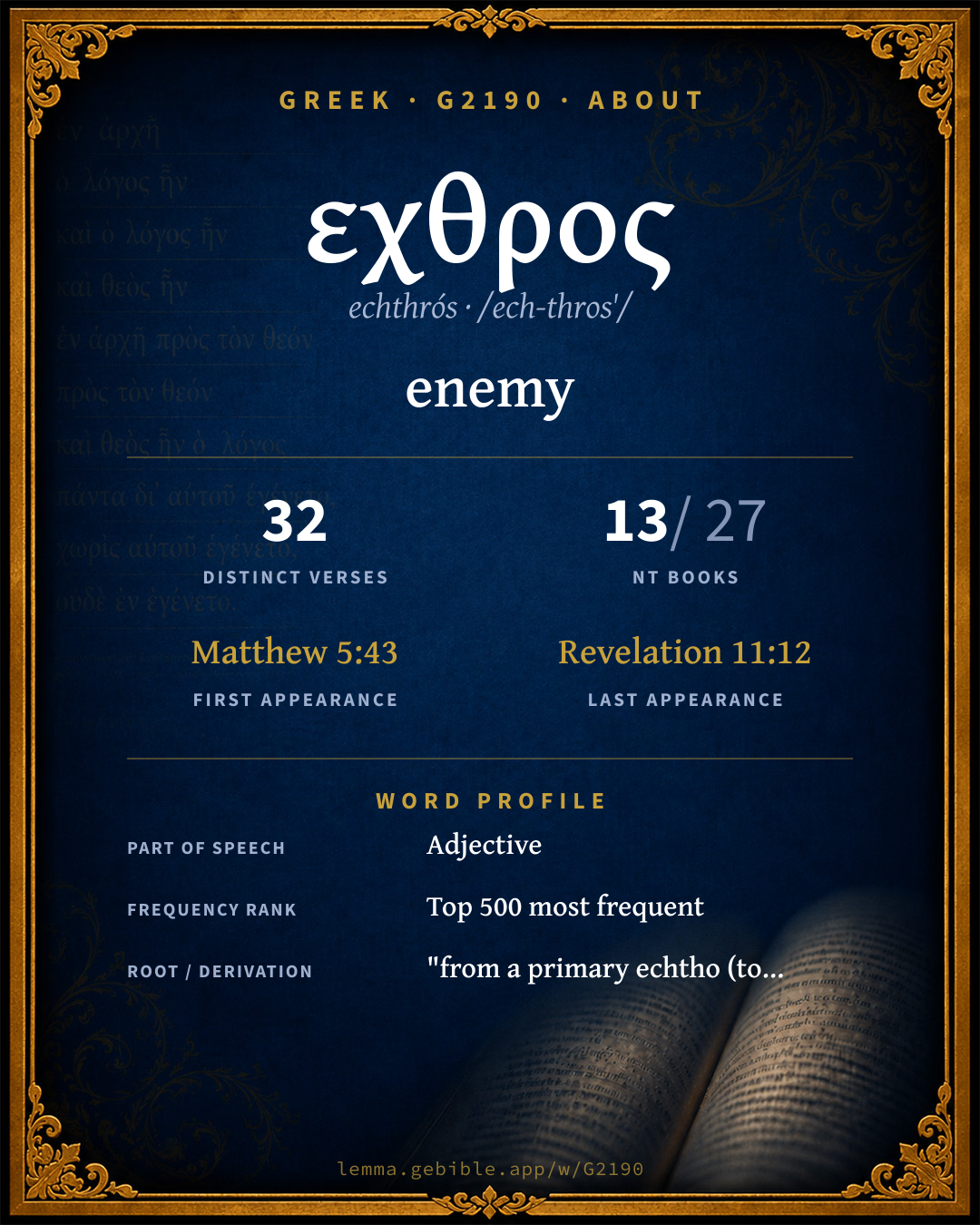
ἐχθρός
enemy
‘enemy’ is one of 2 main senses fuller range ↓
Full lexicon entry — Thayer's Greek Lexicon
From Thayer's Greek Lexicon
Where this word appears
See every Accusative-case word in the Greek New Testament →
Grammar key — what these labels mean
Part of speech
- Adjective
- A word that describes or qualifies a noun.
Case
- Accusative
- The case of the direct object and of extent.
- Nominative
- The case of the subject (and the predicate nominative).
- Genitive
- The case of source, possession, or “of” — answers “whose / from what.”
- Vocative
- The case of direct address (“O Lord”).
Gender
- Masculine
- Grammatically masculine.
Number
- Plural
- More than one.
- Singular
- One.
Grammatical forms
- Adjective, Accusative, Plural, Masculine 13 times (41%)
- Adjective, Nominative, Singular, Masculine 7 times (22%)
- Adjective, Nominative, Plural, Masculine 6 times (19%)
- Adjective, Accusative, Singular, Masculine 2 times (6%)
- Adjective, Genitive, Plural, Masculine 2 times (6%)
- Adjective, Genitive, Singular, Masculine 1 time (3%)
- Adjective, Vocative, Singular, Masculine 1 time (3%)
Parsed forms decoded from the imported morphology (Robinson–Tischendorf, public domain), counted across 32 parsed occurrences — not distinct verses.
Every verse where G2190 appears — 32 distinct verses across 13 books. Click any verse to open its interlinear word-by-word view. Verse text shown in the World English Bible for context — . Each verse’s Greek form is shown with its reference; the English is not keyword-highlighted, since the data carries no word-level English alignment. Use “Compare translations” on any verse to read it across multiple English versions. This concordance covers the Greek New Testament; Septuagint (Greek Old Testament) occurrences of this word are not indexed here.
Matthew 7 verses
- Matthew 5:43 ἐχθρόν adj acc sg masc "You have heard that it was said, 'You shall love your neighbor, and hate your enemy.'
- Matthew 5:44 ἐχθροὺς adj acc pl masc But I tell you, love your enemies, bless those who curse you, do good to those who hate you, and pray for those who mistreat you and persecute you,
- Matthew 10:36 ἐχθροὶ adj nom pl masc A man's foes will be those of his own household.
- Matthew 13:25 ἐχθρὸς adj nom sg masc but while people slept, his enemy came and sowed darnel also among the wheat, and went away.
- Matthew 13:28 ἐχθρὸς adj nom sg masc "He said to them, 'An enemy has done this.' "The servants asked him, 'Do you want us to go and gather them up?'
- Matthew 13:39 ἐχθρὸς adj nom sg masc The enemy who sowed them is the devil. The harvest is the end of the age, and the reapers are angels.
- Matthew 22:44 ἐχθρούς adj acc pl masc 'The Lord said to my Lord, Sit on my right hand, Until I make your enemies a footstool for your feet?'
Mark 1 verse
Luke 8 verses
- Luke 1:71 ἐχθρῶν adj gen pl masc Salvation from our enemies, and from the hand of all who hate us;
- Luke 1:74 ἐχθρῶν adj gen pl masc To grant to us that we, being delivered out of the hand of our enemies, should serve him without fear,
- Luke 6:27 ἐχθροὺς adj acc pl masc "But I tell you who hear: love your enemies, do good to those who hate you,
- Luke 6:35 ἐχθροὺς adj acc pl masc But love your enemies, and do good, and lend, expecting nothing back; and your reward will be great, and you will be children of the Most High; for he is kind toward the unthankful and evil.
- Luke 10:19 ἐχθροῦ adj gen sg masc Behold, I give you authority to tread on serpents and scorpions, and over all the power of the enemy. Nothing will in any way hurt you.
- Luke 19:27 ἐχθρούς adj acc pl masc But bring those enemies of mine who didn't want me to reign over them here, and kill them before me.'"
- Luke 19:43 ἐχθροί adj nom pl masc For the days will come on you, when your enemies will throw up a barricade against you, surround you, hem you in on every side,
- Luke 20:43 ἐχθρούς adj acc pl masc Until I make your enemies the footstool of your feet."'
Acts 2 verses
Romans 3 verses
- Romans 5:10 ἐχθροὶ adj nom pl masc For if, while we were enemies, we were reconciled to God through the death of his Son, much more, being reconciled, we will be saved by his life.
- Romans 11:28 ἐχθροὶ adj nom pl masc Concerning the Gospel, they are enemies for your sake. But concerning the election, they are beloved for the fathers' sake.
- Romans 12:20 ἐχθρός adj nom sg masc Therefore "If your enemy is hungry, feed him. If he is thirsty, give him a drink. For in doing so, you will heap coals of fire on his head."
1 Corinthians 2 verses
Galatians 1 verse
Philippians 1 verse
Colossians 1 verse
2 Thessalonians 1 verse
Hebrews 2 verses
James 1 verse
Revelation 2 verses
- Revelation 11:5 ἐχθροὺς adj acc pl masc If anyone desires to harm them, fire proceeds out of their mouth and devours their enemies. If anyone desires to harm them, he must be killed in this way.
- Revelation 11:12 ἐχθροὶ adj nom pl masc I heard a loud voice from heaven saying to them, "Come up here!" They went up into heaven in the cloud, and their enemies saw them.
About this entry
At a glance — auto-summarized from this page’s data, not written by a person. Every figure links to its source below. This summary describes the numbers; it doesn’t interpret them.
εχθρος (echthrós) is a Greek adjective most often rendered “enemy.” It first appears in Matthew 5:43. Spanning 32 verses in 13 books, it ranks among the moderately common words of the Greek New Testament. Luke dominates its distribution — 8 of 32 verses. Its lexical range runs to 2 senses. For the data behind this summary, explore the sense tree and the renderings breakdown below.
Gloss history
Strong's 1890 vs modern scholarship
About this word
Strong's G2190 catalogs a Greek word from the Greek New Testament.
These counts are not copied from any lexicon or concordance. They are computed here, from the morphology-tagged Greek New Testament. What Lemma adds →
- 32
- distinct verses
- The word appears in 32 distinct verses.
- 13 / 27
- NT books
- The word appears in 13 of 27 New Testament books.
- #438
- by frequency
- Top 500 most frequent Greek words (rank 438 of 5,347 Greek words by occurrence).
View all 32 occurrences in the concordance →
By section of the New Testament
By traditional corpus
Conventional, traditional groupings — biblical authorship is debated, so this is a traditional corpus grouping, not an authorship claim. Some books belong to more than one corpus (Luke is in both the Gospels and the Lukan corpus, and so on), so these shares overlap and need not total 100%. Each figure is a share of the word’s 32 distinct verses.
- Gospels 16 verses · 50%
- Lukan (Luke–Acts) 10 verses · 31%
- Pauline corpus 9 verses · 28%
- Johannine 2 verses · 6%
- Hebrews 2 verses · 6%
- Revelation 2 verses · 6%
- General (Catholic) Epistles 1 verse · 3%
How translations render this word
Counts come from each version’s own published word-to-Strong’s tagging or interlinear alignment — an approximate guide to how each version renders this word, not a word-level alignment the data otherwise carries. Because each total is that version’s own tagged count, the per-version totals vary from one another and need not match the appearance or distinct-verse counts above. These counts may also differ from a printed concordance because Lemma counts each distinctly tagged rendering and does not collapse phrase taggings into a single head-word total. This is a fixed set of word-tagged versions (KJV, ASV, BSB, ULT) and does not change with the reading translation you choose elsewhere. Each version’s license is shown beside its name below (and on Sources).
- King James Version: Enemies 17×, Enemy 10×, Foes 2×
- American Standard Version: Enemies 18×, Enemy 9×
- Berean Standard Bible: Enemies 19×, Enemy 11×
- unfoldingWord Literal Text: Enemies 20×, Enemy 10×
King James Version Public Domain
Renders G2190 across 32 tagged occurrences — most commonly:
Plus 3 renderings that appear only once — usually multi-word phrases or single function words the recovered tagging swept in, not distinct renderings.
American Standard Version Public Domain
Renders G2190 across 33 tagged occurrences — most commonly:
Plus 6 renderings that appear only once — usually multi-word phrases or single function words the recovered tagging swept in, not distinct renderings.
Berean Standard Bible Public Domain
Renders G2190 across 32 tagged occurrences — most commonly:
Plus 2 renderings that appear only once — usually multi-word phrases or single function words the recovered tagging swept in, not distinct renderings.
unfoldingWord Literal Text CC BY-SA 4.0
Renders G2190 across 34 tagged occurrences — most commonly:
Plus 4 renderings that appear only once — usually multi-word phrases or single function words the recovered tagging swept in, not distinct renderings.
Senses in Thayer's
The 2 senses Thayer's distinguishes for this word, in lexicon order (not ranked by frequency or importance). The full entry — with sub-senses — is in the Lexicon Entry tab.
- hated, odious, hateful
- hostile, hating, and opposing another
Word origin
Origin: "from a primary echtho (to hate); hateful (passively, odious, or actively, hostile)"
From a primary word ἔχθω echthō (to hate ); hateful (passively odious or actively hostile ); usually as a noun an adversary (especially Satan ): - enemy foe.
— Strong’s Exhaustive Concordance (1890), public domain.
Forms in the corpus
The 11 distinct written forms G2190 takes in the Greek New Testament, most frequent first — each parse links to that case’s occurrences in the concordance.
| Form | Parsing | Example | Uses |
|---|---|---|---|
| ἐχθροὺς echthroùs | Adjective, Accusative, Plural, Masculine | Matthew 5:44 | 7 |
| ἐχθρούς echthroús | Adjective, Accusative, Plural, Masculine | Matthew 22:44 | 6 |
| ἐχθρὸς echthròs | Adjective, Nominative, Singular, Masculine | Matthew 13:25 | 6 |
| ἐχθροὶ echthroì | Adjective, Nominative, Plural, Masculine | Matthew 10:36 | 5 |
| ἐχθρῶν echthrō̂n | Adjective, Genitive, Plural, Masculine | Luke 1:71 | 2 |
| ἐχθροί echthroí | Adjective, Nominative, Plural, Masculine | Luke 19:43 | 1 |
| ἐχθροῦ echthroû | Adjective, Genitive, Singular, Masculine | Luke 10:19 | 1 |
| ἐχθρόν echthrón | Adjective, Accusative, Singular, Masculine | Matthew 5:43 | 1 |
| ἐχθρός echthrós | Adjective, Nominative, Singular, Masculine | Romans 12:20 | 1 |
| ἐχθρὲ echthrè | Adjective, Vocative, Singular, Masculine | Acts 13:10 | 1 |
| ἐχθρὸν echthròn | Adjective, Accusative, Singular, Masculine | 2 Thessalonians 3:15 | 1 |
Same root — word family
Other Thayer's entries built from the same root as G2190, grouped by Strong’s listed origin. These share a root / origin per the lexicon — not necessarily a shared meaning. Each links to that word’s own entry.
Derived from this word
Compare all same-root words → They share a root, not necessarily a meaning.
Septuagint usage
The same Greek word εχθρος appears 334 times in the Greek Old Testament (Septuagint), across 321 verses in 28 books.
- 334
- LXX occurrences
- Tagged occurrences of this Greek word in the Septuagint.
- 321
- verses
- Distinct Septuagint verses containing this word.
- 28 / 39
- OT books
- The word appears in 28 of the 39 Old Testament books.
Sample Septuagint occurrences
- Genesis 14:20 ἐχθρός
- Exodus 15:6 ἐχθρός
- Leviticus 26:7 ἐχθρός
- Numbers 10:9 ἐχθρός
- Deuteronomy 1:42 ἐχθρός
- Joshua 7:8 ἐχθρός
- Judges 2:14 ἐχθρός
- 1 Samuel 2:1 ἐχθρός
- 2 Samuel 3:18 ἐχθρός
- 1 Kings 3:11 ἐχθρός
- 2 Kings 17:39 ἐχθρός
- 1 Chronicles 12:18 ἐχθρός
Septuagint occurrences (same lexeme)
Every verse where the same Strong’s number (G2190) appears in the Greek Septuagint — showing the first 50 of 321. Verse text shown in the World English Bible for context; the Greek form is the matched word — the English is not keyword-highlighted.
- Genesis 14:20 ἐχθρός and blessed be God Most High, who has delivered your enemies into your hand." Abram gave him a tenth of all.
- Genesis 49:8 ἐχθρός "Judah, your brothers will praise you: Your hand will be on the neck of your enemies; Your father's sons will bow down before you.
- Exodus 15:6 ἐχθρός Your right hand, Yahweh, is glorious in power, Your right hand, Yahweh, dashes the enemy in pieces.
- Exodus 15:9 ἐχθρός The enemy said, 'I will pursue, I will overtake, I will divide the spoil. My desire shall be satisfied on them. I will draw my sword, my hand shall destroy them.'
- Exodus 23:4 ἐχθρός "If you meet your enemy's ox or his donkey going astray, you shall surely bring it back to him again.
- Exodus 23:5 ἐχθρός If you see the donkey of him who hates you fallen down under his burden, don't leave him, you shall surely help him with it.
- Exodus 23:22 ἐχθρός But if you indeed listen to his voice, and do all that I speak, then I will be an enemy to your enemies, and an adversary to your adversaries.
- Leviticus 26:7 ἐχθρός You shall chase your enemies, and they shall fall before you by the sword.
- Leviticus 26:8 ἐχθρός Five of you shall chase a hundred, and a hundred of you shall chase ten thousand; and your enemies shall fall before you by the sword.
- Leviticus 26:17 ἐχθρός I will set my face against you, and you will be struck before your enemies. Those who hate you will rule over you; and you will flee when no one pursues you.
- Leviticus 26:25 ἐχθρός I will bring a sword upon you, that will execute the vengeance of the covenant; and you will be gathered together within your cities: and I will send the pestilence among you; and you will be delivered into the hand of the enemy.
- Leviticus 26:32 ἐχθρός I will bring the land into desolation; and your enemies that dwell therein will be astonished at it.
- Leviticus 26:34 ἐχθρός Then the land will enjoy its sabbaths as long as it lies desolate and you are in your enemies' land. Even then the land will rest and enjoy its sabbaths.
- Leviticus 26:36 ἐχθρός "'As for those of you who are left, I will send a faintness into their hearts in the lands of their enemies: and the sound of a driven leaf will put them to flight; and they shall flee, as one flees from the sword; and they will fall when no one pursues.
- Leviticus 26:37 ἐχθρός They will stumble over one another, as it were before the sword, when no one pursues: and you will have no power to stand before your enemies.
- Leviticus 26:38 ἐχθρός You will perish among the nations, and the land of your enemies will eat you up.
- Leviticus 26:39 ἐχθρός Those of you who are left will pine away in their iniquity in your enemies' lands; and also in the iniquities of their fathers shall they pine away with them.
- Leviticus 26:41 ἐχθρός I also walked contrary to them, and brought them into the land of their enemies: if then their uncircumcised heart is humbled, and they then accept the punishment of their iniquity;
- Leviticus 26:44 ἐχθρός Yet for all that, when they are in the land of their enemies, I will not reject them, neither will I abhor them, to destroy them utterly, and to break my covenant with them; for I am Yahweh their God;
- Numbers 10:9 ἐχθρός When you go to war in your land against the adversary who oppresses you, then you shall sound an alarm with the trumpets; and you shall be remembered before Yahweh your God, and you shall be saved from your enemies.
- Numbers 10:34 ἐχθρός The cloud of Yahweh was over them by day, when they set forward from the camp.
- Numbers 14:42 ἐχθρός Don't go up, for Yahweh isn't among you; that you not be struck down before your enemies.
- Numbers 23:11 ἐχθρός Balak said to Balaam, What have you done to me? I took you to curse my enemies, and, behold, you have blessed them altogether.
- Numbers 24:8 ἐχθρός God brings him forth out of Egypt; He has as it were the strength of the wild-ox: He shall eat up the nations his adversaries, Shall break their bones in pieces, Smite [them] through with his arrows.
- Numbers 24:10 ἐχθρός Balak's anger was kindled against Balaam, and he struck his hands together; and Balak said to Balaam, I called you to curse my enemies, and, behold, you have altogether blessed them these three times.
- Numbers 24:18 ἐχθρός Edom shall be a possession, Seir also shall be a possession, [who were] his enemies; While Israel does valiantly.
- Numbers 32:21 ἐχθρός and every armed man of you will pass over the Jordan before Yahweh, until he has driven out his enemies from before him,
- Numbers 35:23 ἐχθρός or with any stone, by which a man may die, not seeing him, and cast it on him, so that he died, and he was not his enemy, neither sought his harm;
- Deuteronomy 1:42 ἐχθρός Yahweh said to me, Tell them, Don't go up, neither fight; for I am not among you; lest you be struck before your enemies.
- Deuteronomy 6:19 ἐχθρός to thrust out all your enemies from before you, as Yahweh has spoken.
- Deuteronomy 12:10 ἐχθρός But when you go over the Jordan, and dwell in the land which Yahweh your God causes you to inherit, and he gives you rest from all your enemies round about, so that you dwell in safety;
- Deuteronomy 20:1 ἐχθρός When you go forth to battle against your enemies, and see horses, and chariots, [and] a people more than you, you shall not be afraid of them; for Yahweh your God is with you, who brought you up out of the land of Egypt.
- Deuteronomy 20:3 ἐχθρός and shall tell them, Hear, Israel, you draw near this day to battle against your enemies: don't let your heart faint; don't be afraid, nor tremble, neither be scared of them;
- Deuteronomy 20:4 ἐχθρός for Yahweh your God is he who goes with you, to fight for you against your enemies, to save you.
- Deuteronomy 20:14 ἐχθρός but the women, and the little ones, and the cattle, and all that is in the city, even all the spoil of it, shall you take for a prey to yourself; and you shall eat the spoil of your enemies, which Yahweh your God has given you.
- Deuteronomy 21:10 ἐχθρός When you go forth to battle against your enemies, and Yahweh your God delivers them into your hands, and you carry them away captive,
- Deuteronomy 23:10 ἐχθρός If there be among you any man, who is not clean by reason of that which happens him by night, then shall he go abroad out of the camp, he shall not come within the camp:
- Deuteronomy 23:15 ἐχθρός You shall not deliver to his master a servant who is escaped from his master to you:
- Deuteronomy 25:19 ἐχθρός Therefore it shall be, when Yahweh your God has given you rest from all your enemies round about, in the land which Yahweh your God gives you for an inheritance to possess it, that you shall blot out the memory of Amalek from under the sky; you shall not forget.
- Deuteronomy 28:7 ἐχθρός Yahweh will cause your enemies who rise up against you to be struck before you: they shall come out against you one way, and shall flee before you seven ways.
- Deuteronomy 28:25 ἐχθρός Yahweh will cause you to be struck before your enemies; you shall go out one way against them, and shall flee seven ways before them: and you shall be tossed back and forth among all the kingdoms of the earth.
- Deuteronomy 28:31 ἐχθρός Your ox shall be slain before your eyes, and you shall not eat of it: your donkey shall be violently taken away from before your face, and shall not be restored to you: your sheep shall be given to your enemies, and you shall have none to save you.
- Deuteronomy 28:48 ἐχθρός therefore shall you serve your enemies whom Yahweh shall send against you, in hunger, and in thirst, and in nakedness, and in want of all things: and he shall put a yoke of iron on your neck, until he have destroyed you.
- Deuteronomy 28:53 ἐχθρός You shall eat the fruit of your own body, the flesh of your sons and of your daughters, whom Yahweh your God has given you, in the siege and in the distress with which your enemies shall distress you.
- Deuteronomy 28:55 ἐχθρός so that he will not give to any of them of the flesh of his children whom he shall eat, because he has nothing left him, in the siege and in the distress with which your enemy shall distress you in all your gates.
- Deuteronomy 28:57 ἐχθρός and toward her young one who comes out from between her feet, and toward her children whom she shall bear; for she shall eat them for want of all things secretly, in the siege and in the distress with which your enemy shall distress you in your gates.
- Deuteronomy 28:68 ἐχθρός Yahweh will bring you into Egypt again with ships, by the way of which I said to you, You shall see it no more again: and there you shall sell yourselves to your enemies for bondservants and for bondmaids, and no man shall buy you.
- Deuteronomy 30:7 ἐχθρός Yahweh your God will put all these curses on your enemies, and on those who hate you, who persecuted you.
- Deuteronomy 32:27 ἐχθρός Were it not that I feared the provocation of the enemy, Lest their adversaries should judge wrongly, Lest they should say, Our hand is exalted, Yahweh has not done all this.
- Deuteronomy 32:31 ἐχθρός For their rock is not as our Rock, Even our enemies themselves being judges.
These are occurrences of the same Greek lexeme (G2190) in the Septuagint — not a translation of any one Hebrew word. The store carries no word-level Hebrew↔Greek alignment, so no Hebrew original is asserted here. Counts come from the recovered LXX Strong's tagging — high-frequency vocabulary is well covered, while rare or late forms may be untagged — so they reflect tagged occurrences and may slightly undercount.