
Luke 19:43

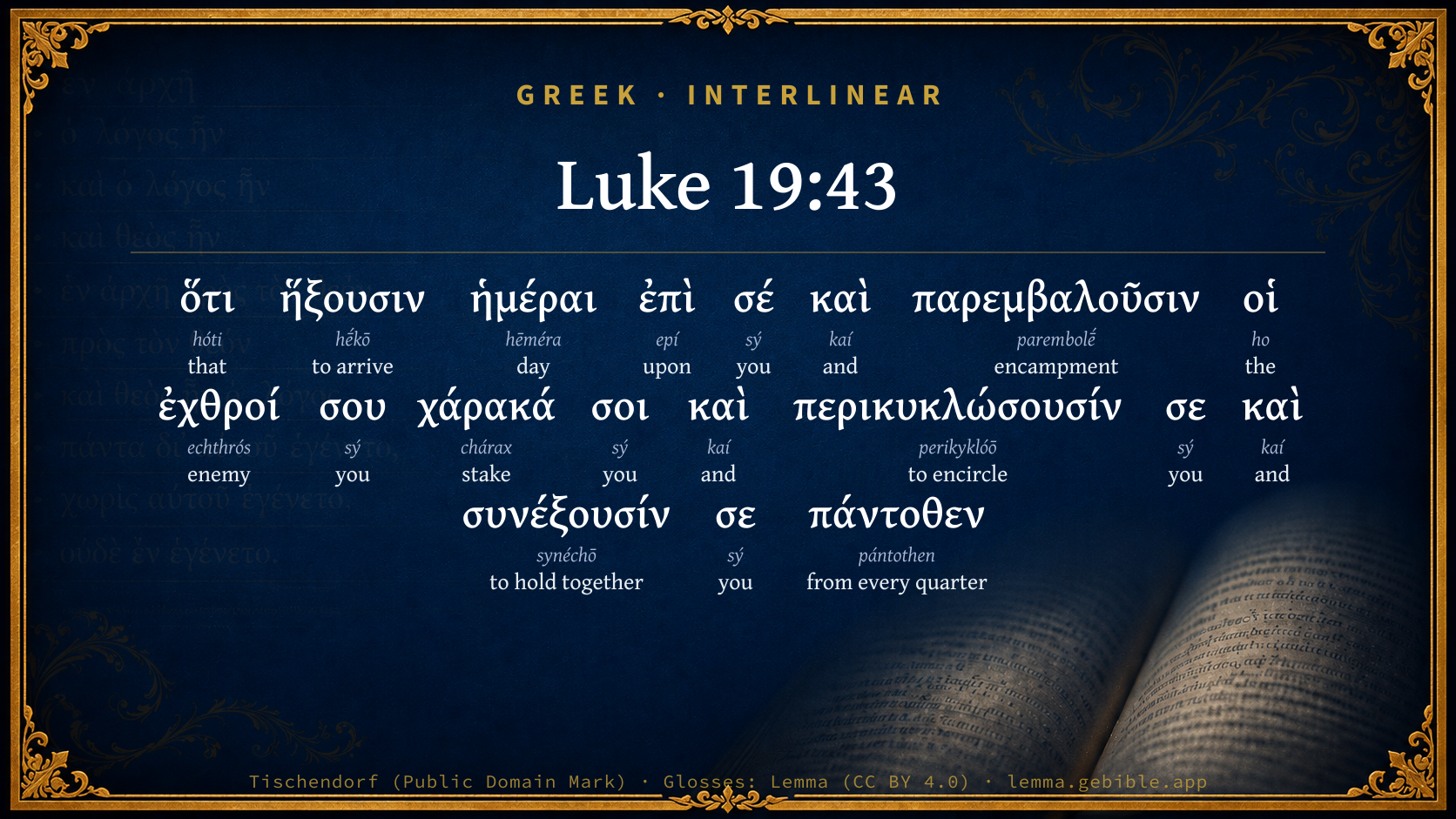
Greek (Tischendorf 8th ed.) Luke 19:43 appears in the Greek New Testament. The text above is from the Tischendorf 8th edition. Each word links to its Strong’s number and a concise gloss. Click any word for its full Thayer’s Greek Lexicon entry.
Download image
Cite this verse

Luke 19:43 (World English Bible). Public Domain. Lemma interlinear Bible study tool, https://lemma.gebible.app/v/luke/19/43.

Show BibTeX & RIS
BibTeX
RIS
English Translation
For the days will come on you, when your enemies will throw up a barricade against you, surround you, hem you in on every side,
World English Bible · Public Domain
Highlights
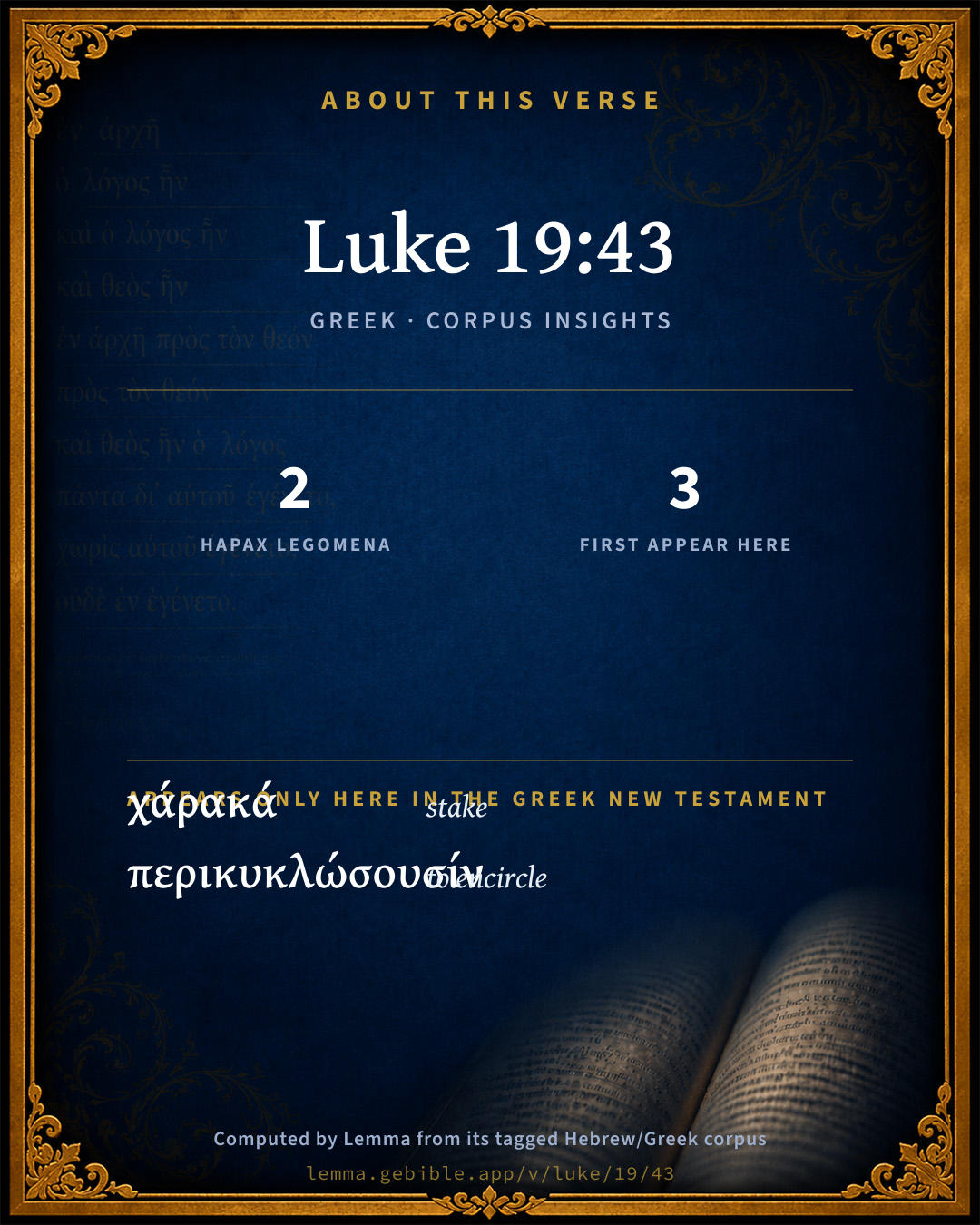
  • 2 hapax legomena — only here in the Greek New Testament
  • 3 first appearances in the Greek New Testament
Full analysis ↓
Download a study sheet

One document with this verse’s original text, its word-by-word gloss line, the meaning frame, cross-references with their text, attributed commentary, and full source and license credits — printable, and it pastes into notes with its structure intact.

This verse Autodidact and up

Study sheet (.html) Plain text (.txt)

A passage Seminary Student

Up to 50 verses in one chapter. A passage sheet keeps up to 6 commentary sources and 12 cross-references per verse, in the order this page ranks them, and says so on the sheet whenever that leaves anything out. Ask for a single verse and you get the Autodidact verse sheet above.

Everything on this page stays free to read, with no account — the sheet is a download of what is already on screen, not access to it.

Want to remove ads? Support Godless Engineer
Compare translations 3

The same verse in 3 English versions, stacked beneath the original-language interlinear above. Click any original word for its lexicon entry.

Each is an independent rendering of the whole verse — the interlinear is not word-aligned to these translations.

Highlighted words mark where these versions differ — a whole-verse word diff, not a word-by-word alignment.

  • World English Bible Public Domain
    For the days will come on you, when your enemies will throw up a barricade against you, surround you, hem you in on every side,
  • King James Version Public Domain
    For the days shall come upon thee, that thine enemies shall cast a trench about thee, and compass thee round, and keep thee in on every side,
  • unfoldingWord Literal Text CC BY-SA 4.0
    For days will come upon you, and your enemies will build a barricade around you, and they will surround you and press in on you from every side.

unfoldingWord Literal Text — © unfoldingWord, licensed CC BY-SA 4.0. Word-aligned USFM3 via Door43 (git.door43.org/unfoldingWord/en_ult).

Versions to compare (up to 4)

3 of 4 selected

Show all 19 translations

Every available English version of this verse, each an independent rendering of the whole verse.

  • World English Bible Public Domain
    For the days will come on you, when your enemies will throw up a barricade against you, surround you, hem you in on every side,
  • Berean Standard Bible Public Domain
    For the days will come upon you when your enemies will barricade you and surround you and hem you in on every side.
  • Majority Standard Bible Public Domain
    For the days will come upon you when your enemies will barricade you and surround you and hem you in on every side.
  • King James Version Public Domain
    For the days shall come upon thee, that thine enemies shall cast a trench about thee, and compass thee round, and keep thee in on every side,
  • American Standard Version (1901) Public Domain
    For the days shall come upon thee, when thine enemies shall cast up a bank about thee, and compass thee round, and keep thee in on every side,
  • Revised Version (1885) Public Domain
    For the days shall come upon thee, when thine enemies shall cast up a bank about thee, and compass thee round, and keep thee in on every side,
  • Geneva Bible (1599) Public Domain
    For the dayes shall come vpon thee, that thine enemies shall cast a trench about thee, and compasse thee round, and keepe thee in on euery side,
  • Douay-Rheims (1899) Public Domain
    For the days shall come upon thee, and thy enemies shall cast a trench about thee, and compass thee round, and straiten thee on every side,
  • Young's Literal Translation Public Domain
    `Because days shall come upon thee, and thine enemies shall cast around thee a rampart, and compass thee round, and press thee on every side,
  • Literal Standard Version CC BY-SA 4.0
    Because days will come on you, and your enemies will cast a rampart around you, and surround you around, and press you on every side,
  • Unlocked Literal Bible CC BY-SA 4.0
    For the days will come upon you when your enemies will build a barricade around you, and surround you, and press in on you from every side.
  • unfoldingWord Literal Text CC BY-SA 4.0
    For days will come upon you, and your enemies will build a barricade around you, and they will surround you and press in on you from every side.
  • Darby Bible Public Domain
    for days shall come upon thee, that thine enemies shall make a palisaded mound about thee, and shall close thee around, and keep thee in on every side,
  • World Messianic Bible Public Domain
    For the days will come on you when your enemies will throw up a barricade against you, surround you, hem you in on every side,
  • Webster's Bible Public Domain
    For the days shall come upon thee, that thy enemies shall cast a trench about thee, and encompass thee, and keep thee in on every side,
  • Free Bible Version CC BY-SA 4.0
    The time is coming upon you when your enemies will besiege you, building ramps to attack you, encircling you and closing you in from every side.
  • Bible in Basic English Public Domain
    For the time will come when your attackers will put a wall round you, and come all round you and keep you in on every side,
  • Text-Critical English NT CC BY 4.0
    For the days will come upon yoʋ when yoʋr enemies build a barricade around yoʋ and encircle yoʋ, hemming yoʋ in on every side.
  • Tyndale New Testament (1534) Public Domain
    For the dayes shall come vpo the that thy enemys shall cast a banke aboute the and compasse the rounde and kepe the in on every syde

Literal Standard Version (2020), Covenant Press — licensed CC BY-SA 4.0. Text via the HelloAO Bible API (eBible.org). Unlocked Literal Bible (unfoldingWord) — licensed CC BY-SA 4.0. Text via the HelloAO Bible API (eBible.org). unfoldingWord Literal Text — © unfoldingWord, licensed CC BY-SA 4.0. Word-aligned USFM3 via Door43 (git.door43.org/unfoldingWord/en_ult). Free Bible Version, Dr. Jonathan Gallagher — licensed CC BY-SA 4.0. Text via the HelloAO Bible API (eBible.org).

Word by word

More ways to search: Search by grammar → Find every occurrence → Compare this word →

Practice this passage: Drill this verse → Learn its vocabulary →

χάρακά
chárax
G5482
“stake”
Noun, Accusative, Singular, Masculine
Part of Speech
Noun
Case
Accusative
Number
Singular
Gender
Masculine
Full Thayer's Definition

Origin: from charasso (to sharpen to a point, akin to G1125 through the idea of scratching)

TDNT: None

1. a pale or stake, a palisade 2. a palisade or rampart a. pales between which earth, stones, trees, and timbers are heaped and packed together
  1. ὅτι hóti G3754 “that” Conjunction
  2. ἥξουσιν hḗkō G2240 “to arrive” Verb, Future, Active, Indicative, 3rd person, Plural
  3. ἡμέραι hēméra G2250 “day” Noun, Nominative, Plural, Feminine
  4. ἐπὶ epí G1909 “upon” Preposition
  5. σέ sý G4771 “you” Personal pronoun, 2nd person, Accusative, Singular
  6. καὶ kaí G2532 “and” Conjunction
  7. παρεμβαλοῦσιν parembolḗ G3925 “encampment” Verb, Future, Active, Indicative, 3rd person, Plural
  8. οἱ ho G3588 “the” Article, Nominative, Plural, Masculine
  9. ἐχθροί echthrós G2190 “enemy” Adjective, Nominative, Plural, Masculine
  10. σου sý G4771 “you” Personal pronoun, 2nd person, Genitive, Singular
  11. σοι sý G4771 “you” Personal pronoun, 2nd person, Dative, Singular
  12. καὶ kaí G2532 “and” Conjunction
  13. περικυκλώσουσίν perikyklóō G4033 “to encircle” Verb, Future, Active, Indicative, 3rd person, Plural
  14. σε sý G4771 “you” Personal pronoun, 2nd person, Accusative, Singular
  15. καὶ kaí G2532 “and” Conjunction
  16. συνέξουσίν synéchō G4912 “to hold together” Verb, Future, Active, Indicative, 3rd person, Plural
  17. σε sý G4771 “you” Personal pronoun, 2nd person, Accusative, Singular
  18. πάντοθεν pántothen G3840 “from every quarter” Adverb

About this verse

These counts appear in no published source. They are computed here, from the morphology-tagged text and Lemma’s own curated glosses. What Lemma adds →

19
words
13
distinct lemmas
Gospels
section

Notable vocabulary

2 hapax legomena — words that appear only here in the entire Greek New Testament:

  • χάρακά stake G5482
  • περικυκλώσουσίν to encircle G4033

First appearance in Scripture

These words make their first canonical appearance in the Greek New Testament here:

  • παρεμβαλοῦσιν encampment G3925
  • χάρακά stake G5482
  • περικυκλώσουσίν to encircle G4033

Shared distinctive vocabulary

πάντοθεν from every quarter G3840 occurs in 3 verses of the Greek New Testament. Also found in:
Repetition

Words recur within this verse:

Cross-references

12

Topical passages linked to Luke 19:43 in the Treasury of Scripture Knowledge — connected by theme and wording, ordered by reader-vote popularity; previews shown in the World English Bible.

  • Luke 21:20–24 "But when you see Jerusalem surrounded by armies, then know that its desolation is at hand.
  • Isaiah 29:1–4 Ho Ariel, Ariel, the city where David encamped! add you year to year; let the feasts come round:
  • Ezekiel 4:2 and lay siege against it, and build forts against it, and cast up a mound against it; set camps also against it, and plant battering rams against it round about.
  • Ezekiel 26:8 He shall kill with the sword your daughters in the field; and he shall make forts against you, and cast up a mound against you, and raise up the buckler against you.
  • Deuteronomy 28:49–58 Yahweh will bring a nation against you from far, from the end of the earth, as the eagle flies; a nation whose language you shall not understand;
  • Isaiah 37:33 Therefore thus says Yahweh concerning the king of Assyria, He shall not come to this city, nor shoot an arrow there, neither shall he come before it with shield, nor cast up a mound against it.
  • Jeremiah 6:3–6 Shepherds with their flocks shall come to her; they shall pitch their tents against her round about; they shall feed everyone in his place.
  • Daniel 9:26–27 After the sixty-two weeks the Anointed One shall be cut off, and shall have nothing: and the people of the prince who shall come shall destroy the city and the sanctuary; and the end of it shall be with a flood, and even to the end shall be war; desolations are determined.
  • Matthew 23:37–39 "Jerusalem, Jerusalem, who kills the prophets, and stones those who are sent to her! How often would I have gathered your children together, even as a hen gathers her chickens under her wings, and you would not!
  • Psalms 37:12–13 The wicked plots against the just, And gnashes at him with his teeth.
  • Matthew 22:7 When the king heard that, he was angry, and he sent his armies, destroyed those murderers, and burned their city.
  • 1 Thessalonians 2:15–16 who killed both the Lord Jesus and their own prophets, and drove us out, and didn't please God, and are contrary to all men;

Cross-references courtesy of OpenBible.info (CC BY 4.0).

Commentary

Notes on Luke 19:43 from classic Christian and Jewish commentators (each source and its license shown beneath its notes). The classic Christian expositions comment on the surrounding passage and are grouped to its opening verse, so a note may address several verses; the Jewish commentaries on the Tanakh (Rashi and others) are per-verse, so they appear only where the commentator wrote on this verse.

Lemma curates 59 commentaries, every one of them public domain or Creative Commons licensed, each selected and text-cleaned for this edition rather than reprinted as found. About our sources →

Tyndale Open Study Notes

Tyndale Open Resources

19:43-44 Jesus foretold the siege and destruction of Jerusalem by the Romans in AD 70. The Jewish historian Josephus describes the horrific suffering of the inhabitants of Jerusalem during the Roman siege (War 5.1.1–7.1.1). • will not leave a single stone in place: This is an image of total devastation.

Tyndale Open Study Notes — © Tyndale Open Resources, licensed CC BY-SA 4.0. Text via the HelloAO Bible API.

Bengel's Gnomon

Johann Albrecht Bengel

Luk 19:43. Ἡμέραι) days, which shall be many: because thou dost not regard the one day. See Luk 19:42.—καὶ, καὶ, καὶ, and, and, and) Three degrees of the straits to which they would be reduced.—συνέξουσι, keep thee in, press hard upon) Titus built a wall round the city, and thereby precluded the possibility of egress.

Bengel's Gnomon of the New Testament — English translation (T&T Clark, Edinburgh, 1860) — public domain. Text from a community e-Sword module.

Expositor's Greek Testament

ed. W. Robertson Nicoll

Luk 19:43 . ὅτι , for, because, introducing a prophetic picture of coming ruin, either to explain the εἰ ἔγνως = what you would have escaped had you but known; or to substantiate the assertion of judicial blindness = no hope of your seeing now; your fate sealed; judgment days will surely come ( ἥξουσιν ἡμέραι ). Then follows an awful picture of these judgment days in a series of clauses connected by a fivefold καὶ , the first being = when. The description recalls Isa 29:3 so closely that the use of such definite phrases before the event is quite conceivable, although many critics think the prophecy so certainly ex eventu as to use it for fixing the date of the Gospel. χάρακα , a palisade (here only in N.T.). Titus did erect a palisaded mound around Jerusalem, and, after it was destroyed by the Jews in a sortie, he built a wall.

The Expositor's Greek Testament, edited by W. Robertson Nicoll (1897–1910) — public domain. Text from a community e-Sword module.

Jamieson, Fausset & Brown

Robert Jamieson, A. R. Fausset & David Brown

a trench--a rampart; first of wood, and when this was burnt, a built wall, four miles in circuit, built in three days--so determined were they. This "cut off all hope of escape," and consigned the city to unparalleled horrors. (See JOSEPHUS, Wars of the Jews, 6.2; 12.3,4.) All here predicted was with dreadful literally fulfilled.

Jamieson, Fausset & Brown — Commentary Critical and Explanatory on the Whole Bible (1871) — public domain (CC PDM 1.0). Text via the HelloAO Bible API.

Adam Clarke's Commentary

Verse 43. Cast a trench about thee] This was literally fulfilled when this city was besieged by Titus. Josephus gives a very particular account of the building of this wall, which he says was effected in three days, though it was not less than thirty-nine furlongs in circumference; and that, when this wall and trench were completed, the Jews were so enclosed on every side that no person could escape out of the city, and no provision could be brought in, so that they were reduced to the most terrible distress by the famine which ensued. The whole account is well worth the reader's attention. See Josephus, War, book v. chap. xxii. sec. 1, 2, 3.

Adam Clarke's Commentary on the Bible (1810–1826) — public domain. Text from a community e-Sword/MySword module.

Ellicott's Commentary for English Readers

(43) The days shall come upon thee. We again come upon a cluster of words peculiar, as far as the New Testament is concerned, to St. Luke, and belonging to the higher forms of historical composition.

Shall cast a trench about thee.—The Greek substantive means primarily a stake, then the “stockade” or “palisade” by which the camp of a besieging army was defended, then the earth-work upon which the stockade was fixed. In the latter case, of course, a trench was implied, but the word meant the embankment rather than the excavation. The better MSS. give for “cast” a verb which more distinctly conveys the idea of an encampment.

A Bible Commentary for English Readers, edited by Charles John Ellicott (1878–1897) — public domain. Text from a community e-Sword module.

The Cambridge Bible for Schools and Colleges

gen. ed. J. J. S. Perowne

43. the days] often used of troublous times, like the Latin tempora.

shall cast a trench about thee] Rather, shall surround thee with a palisade, Isa_29:3-4; Isa_37:33, LXX. Literally fulfilled forty years afterwards at the siege of Jerusalem, when Titus surrounded the city first with a palisaded mound (vallum and agger), and then with a wall of masonry.

keep thee in on every side] The blockade established was so terribly rigid that myriads of the Jews perished of starvation.

The Cambridge Bible for Schools and Colleges (gen. ed. J. J. S. Perowne; Cambridge University Press, 1878–1918) — public domain. Text from a community e-Sword module.

John Gill's Exposition

And he went into the temple,.... Being come into the city, he alighted from the colt he rode on, and having committed it to the care of a proper person to return it to the owner, he went up directly to the temple, of which he was the Lord and proprietor, and where he had some work to do the few days he had to live.

And began to cast out them that sold therein, and them that bought; that traded in sheep, and oxen, and doves; see Joh 2:15. The Ethiopic version adds here, as there, "and overthrew, the tables of the money changers, and the seats of them that sold doves".

John Gill's Exposition of the Whole Bible (1746–1763) — public domain (CC PDM 1.0). Text via the HelloAO Bible API.

Trapp's Complete Commentary

John Trapp

43 For the days shall come upon thee, that thine enemies shall cast a trench about thee, and compass thee round, and keep thee in on every side,

Ver. 43. For the days shall come] God hath his days for vengeance, as man hath his day for repentance. There is a prime of every man’s life and of every man’s ministry. The Levite lingered so long that he lost his concubine, she came short home; so doth many a man’s soul for like reason.

Shall cast a trench about thee] Because, like the wild ass, thou wouldest not otherwise be tamed and kept within compass of God’s commandments.

John Trapp, A Commentary or Exposition upon All the Books of the Old and New Testament (1647–1656) — public domain. Text from a community e-Sword module.

Haydock's Catholic Bible Commentary

And compass thee, &c. Christ’s prophecy is a literal description of what happened to Jerusalem, under Titus. (Witham)

George Leo Haydock (1774–1849), Haydock's Catholic Family Bible and Commentary, 1859 edition — public domain. Excludes Psalms (Douay-Rheims chapter numbering differs from Protestant) and Deuterocanonical books (Catholic canon only).

Matthew Poole's English Annotations

It is a plain prophecy of the final destruction of Jerusalem by the Roman armies, which came to pass within less than forty years after. The cause of that dreadful judgment is assigned,

because thou knewest not the time of thy visitation. God’s visitations are either of wrath or mercy; of wrath, Exo 32:34; Lev 26:16; Jer 15:3; of mercy, Jer 29:10. It is plain that our Saviour useth the term here in the latter, not the former sense; and that by God’s visitation of this people here, is meant his visiting them with his prophets, by John the Baptist, and by himself. Their not knowing of it (here intended) was their not making use of it, not receiving and embracing the gospel. The contempt of the gospel is the great, cause of all those miseries which come upon people in this life, or shall come upon them in that life which is to come.

Matthew Poole's English Annotations on the Holy Bible (1683–1685) — public domain. Text from a community e-Sword/MySword module.

Whedon's Commentary on the Bible

Daniel D. Whedon

43. The days shall come—We have here one of the most striking predictions ever uttered.

A trench—A ridge or low wall of earthworks, flung up from a ditch made by the excavation.

Daniel D. Whedon (gen. ed.), Commentary on the Old and New Testaments (1874–1909) — public domain. Text from a community e-Sword module.

John Wesley's Explanatory Notes

Thine enemies shall cast a trench about thee, and compass thee around - All this was exactly performed by Titus, the Roman general.

John Wesley, Explanatory Notes Upon the Whole Bible (1754–1765) — public domain. Text via the GEBible commentary corpus.

Burkitt's Expository Notes on the New Testament

William Burkitt

Here we have a prophetical prediction of the total and final destruction of the city of Jerusalem by the Roman armies, who begirt the city round, burnt the temple, starved the people, and brought such ruin and destruction upon the place, as no history could ever parallel: the reason is assigned, because they knew not the time of their visitation; that is, the time when God visited them with his gospel, first by the ministry of John, then by the preaching of Christ himself, and afterwards by his disciples and apostles.

Hence learn,

1. That when God gives his gospel to a people, he gives that people a merciful and a gracious visitation.

2. That for a people not to know, but to neglect the time of their gracious visitation, is a God-provoking, and a wrath-procuring sin: Because thou knowest not the time of thy visitation, therefore the time shall come, that thine enemies shall lay thee even with the ground, and not leave one stone upon another; which, history tells us, was literally fulfilled, when Turnus Rufus, with his plough, ploughed up the very foundation stones upon which the temple stood. Lord, how has sin laid the foundation of ruin in the most flourishing cities and kingdoms! Here we have a prophetical prediction of the total and final destruction of the city of Jerusalem by the Roman armies, who begirt the city round, burnt the temple, starved the people, and brought such ruin and destruction upon the place, as no history could ever parallel: the reason is assigned, because they knew not the time of their visitation; that is, the time when God visited them with his gospel, first by the ministry of John, then by the preaching of Christ himself, and afterwards by his disciples and apostles.

Hence learn,

1. That when God gives his gospel to a people, he gives that people a merciful and a gracious visitation.

2. That for a people not to know, but to neglect the time of their gracious visitation, is a God-provoking, and a wrath-procuring sin: Because thou knowest not the time of thy visitation, therefore the time shall come, that thine enemies shall lay thee even with the ground, and not leave one stone upon another; which, history tells us, was literally fulfilled, when Turnus Rufus, with his plough, ploughed up the very foundation stones upon which the temple stood. Lord, how has sin laid the foundation of ruin in the most flourishing cities and kingdoms!

William Burkitt's Expository Notes on the New Testament (1700–1703) — public domain. Text from a community e-Sword module.

unfoldingWord translationNotes

Door43 World Missions Community

Connecting Statement:

Jesus continues speaking.

For

What follows is the reason for Jesus' sadness.

the days will come upon you when your enemies

This indicates that they will experience difficult times. Some languages do not talk about time "coming." AT: "in the future these things will happen to you: Your enemies" or "soon you will endure troublesome times. Your enemies"

you ... your

The word "you" is singular because Jesus is speaking to the city as he would to a woman. But if this would be unnatural in your language, you could use a plural form of "you" to refer to the people of the city. (See: Forms of You and Apostrophe)

barricade

This refers to a wall to keep the people from getting out of the city.

They will strike you down to the ground and your children with you

Jesus is speaking to the people of the city as if he were speaking to the city itself as he would speak to a woman. He speaks of the people who live in the city as if they are the woman's children, and thus the city's children. To strike down a city is to destroy its walls and buildings, and to strike down its children is to kill those who live in it. AT: "They will completely destroy you and kill all who live in you" or "They will completely destroy your city and kill all of you" (See: Apostrophe)

They will not leave one stone upon another

"They will not leave any of the stones in place." This is a hyperbole to express that the enemies will completely destroy the city, which is built of stones. (See: Hyperbole and Generalization)

you did not recognize it

"you did not acknowledge"

translationWords

adversary

God

save

unfoldingWord translationNotes — © Distant Shores Media and the Door43 World Missions Community, licensed CC BY-SA 4.0. Source: git.door43.org/Door43/en_tn.

Cambridge Greek Testament for Schools and Colleges

43. ἡμέραι. Often used of troublous times, like the Latin tempora.

περιβαλοῦσιν … χάρακά σοι. ‘Shall surround thee with a palisade,’ Isa 29:3-4; Isa 37:33, LXX[336] χάραξ in Polybius means a palisaded mound. Literally fulfilled forty years afterwards at the siege of Jerusalem, when Titus surrounded the city first with a palisaded mound (vallum and agger), and then with a wall of masonry. Hence the ‘pale’ of Wyclif and the ‘mound’ of Tyndale were better than the ‘trench’ of the A.V[337], Genevan, and Rhemish. The Jews in one of their furious sorties destroyed this χάραξ, and then Titus built the wall.

[336] LXX. Septuagint.

[337] A.V. Authorised Version.

συνέξουσίν σε πάντοθεν. The blockade established was so terribly rigid that myriads of the Jews perished of starvation.

Cambridge Greek Testament for Schools and Colleges (Cambridge University Press, 1896; 21 vols, various authors incl. Carr, Maclear, Plummer, Farrar, Lumby, Moule, M. R. James, Simcox) — public domain. Text from a community e-Sword module.

Alford’s Greek Testament

Henry Alford

43.] ὅτι declares, not ‘the things hidden from thine eyes,’ so that it should be rendered, ‘namely, that the days shall come,’ &c.: but the awful reason which there was for the fervent wish just expressed—for, or because.

χάρακα, a mound with palisades. The account of its being built is in Jos. B. J. v. 6. 2. When the Jews destroyed this, Titus built a wall round them (ib. 12. 2),—see Isa 29:2, Isa 29:3, Isa 29:4,—to which our Lord here tacitly refers.

Henry Alford, The Greek Testament (1849–1861) — public domain. Text from a community e-Sword module.

International Critical Commentary

43. ὅτι ἥξουσιν ἡμέραι. “Because days will come”; not “the days” (AV. RV.): see on 5:35 and 17:22. Dies multi, quia unum diem non observas (Beng.). The ὅτι probably depends upon εἰ επγνως “Would that thou hadst known in time; because the consequences (now inevitable) of not knowing are terrible.” Or ὅτι may introduce the explanation of νῦν δὲ ἐκρύβη: “They are bid from thine eyes, because the very reverse of peace will certainly come upon thee.” But in any case ὅτι is “because, for,” not “that.” For the constr. see Bless, Gr. p. 256.

It is not easy to decide between παρεμβαλοῦσιν (א C* L), which Tisch. and WH. prefer, and περιβαλοῦσιν (TR. with A B etc.). D has καὶ βαλοῦσιν ἐπὶ σέ. In LXX παρεμβάλλειν is freq. for “to encamp”: Num 1:50, Num 1:2:17, Num 1:27, Num 1:3:38, Num 1:33:10, Num 1:11, Num 1:12, Num 1:13, etc. Here it would mean “cast up in front” or “plant in beside,” rather than “surround.” In Vulg., through carelessness on Jerome’s part, circumdabunt is used to translate both περιβαλοῦσιν and περικυκλώσουσιν, although earlier Lat. texts distinguish. Similarly we have pressura for both ἀναγκη (21:23) and συνοχή (21:25). For a converse inaccuracy see on 24:14.

Χάρακα. From meaning a single stake (vallus), χάραξ comes mean, not only a “palisade” (vallum) but a “rampart” or “palisaded mound” (vallum and agger combined). This is its meaning here: comp. Isa 37:33; Eze 4:2, 26:8; Jos. Vita, xliii. In Eze 4:2 we have περιβαλεῖς ἐπʼ αὐτὴν χάρακα “Pale” (Wic.), “rampars” (Gen.), and “bank” (Tyn. Cov. RV.) are all preferable to “trench” (Rhem. AV.). It is said that these details show that the prophecy has been re-worded to fit the event more precisely and that therefore this Gospel was written after a.d. 70. The argument is precarious, although the conclusion is probable. At any rate it is worthy of note that neither here nor elsewhere does Lk. call attention to the fulfilment of the prophecy, as he does in the case of Agabus (Act 11:28). To those who assume that Jesus was unable to foresee the siege of Jerusalem, the amount of detail in the prediction is not of much moment. But it is not logical to maintain that Jesus could foresee the siege, but could not have foreseen these details; or to maintain that He would make known the coming siege, but would not make known the details. What is there in these details which is not common to all sieges? Given the siege, any one might add them. Il n’est pas nécessaire pour cela d’etre prophète (Godet). Moreover it is possible that Jesus is freely reproducing Isa 29:3: καὶ κυκλώσω ἐπὶ σέ, καὶ βαλῶ ἐπὶ σὲ χάρακα, καὶ θήσω περὶ σὲ πύργους. In both cases note the solemn effect of the simple coordination of sentences with καί: here we have καί five times. Note also the impressive repetition of the pronoun: we have σου, σοι, or σε ten times in two verses. For the fulfilment of this prophecy see Jos. B. J. v. 6. 2, 12. 2. The Jews burnt the palisade, and then Titus replaced it with a wall. See Hastings, D.B. i. p. 30.

συνέξουσίν σε πάντοθεν. One of Lk.’s favourite verbs: 4:38, 8:37, 45, 12:50, 22:63; Act 7:57, Act 18:5, Act 28:8. It is possibly medical (Hobart, p. 3). The adv. occurs elsewhere in N.T. in Mar 1:45 and Heb 9:4 only: it is rare in LXX. This “keeping in on every side” was so severe that thousands died of famine (Jos. B. J. v. 12. 3, vi. 1. 1).

International Critical Commentary — older volumes (1896–1929), various authors — public domain. Text from a community e-Sword module.

Vincent's Word Studies in the New Testament

Marvin R. Vincent

A trench [χαρακα] . Rev., correctly, as Tynd., a bank. Only here in New Testament. The word literally means a pointed stake, used in fortifying the intrenchments of a camp, and thence the palisade itself. In fortifying a camp or besieging a city, a ditch was dug round the entire circuit, and the earth from it thrown up into a wall, upon which sharp stakes were fixed. Every Roman soldier carried three or four of these stakes on the march. Wyc., with pale.

Keep thee in [συνεξουσιν] . See on ch. Luk 4:38.

Marvin R. Vincent, Word Studies in the New Testament (1887–1900) — public domain. Text from a community e-Sword/MySword module.

Lesson kit

Teaching starters — assembled from the data on this page, not authored interpretation. Every prompt links to the verse data it draws on. Edit before teaching.

Luke, in the Gospels, opens this verse with 19 words (13 distinct Greek lemmas). Its most distinctive word is chárax (“stake”). A historical commentator’s framing appears above. Read the whole chapter for the surrounding context.

Discussion questions

  1. What does “stake” (chárax) contribute to the verse as a whole?
  2. This verse holds 2 words here found nowhere else in the Greek New Testament. What might the rare words draw attention to?
  3. 3 words here appear for the first time in Scripture. What is being introduced at this debut?
  4. Mark 1:45 shares the word «from every quarter» with this verse. How do the two illuminate each other?
  5. “you” occurs 5× in this one verse. What is the effect of the repetition?
  6. These translations render this verse differently; the difference is in the English rendering, not the original. What questions does that raise?
  7. Reading how Tyndale Open Study Notes and Bengel's Gnomon read this verse, where do the two commentators agree and where do they part?

Things to notice

  • 2 words in this verse appear nowhere else in the Greek New Testament.
  • 3 words make their first canonical appearance in Scripture here.
  • These translations choose different wording for 20 words in this verse.
  • “you” occurs 5× in this single verse.
  • 13 distinct Greek lemmas span 19 words in this verse.

Reading settings

Reading text

Shown beneath each verse's original-language words.

Old Testament
Old Testament edition

Read the OT as the Masoretic Hebrew (MT) or the Greek Septuagint (LXX).

English shown for the Greek Septuagint (in the Hebrew ↔ Greek comparison).

Comparing translations? Open the Compare panel on any verse page to stack up to four side by side.