
Romans 12:20

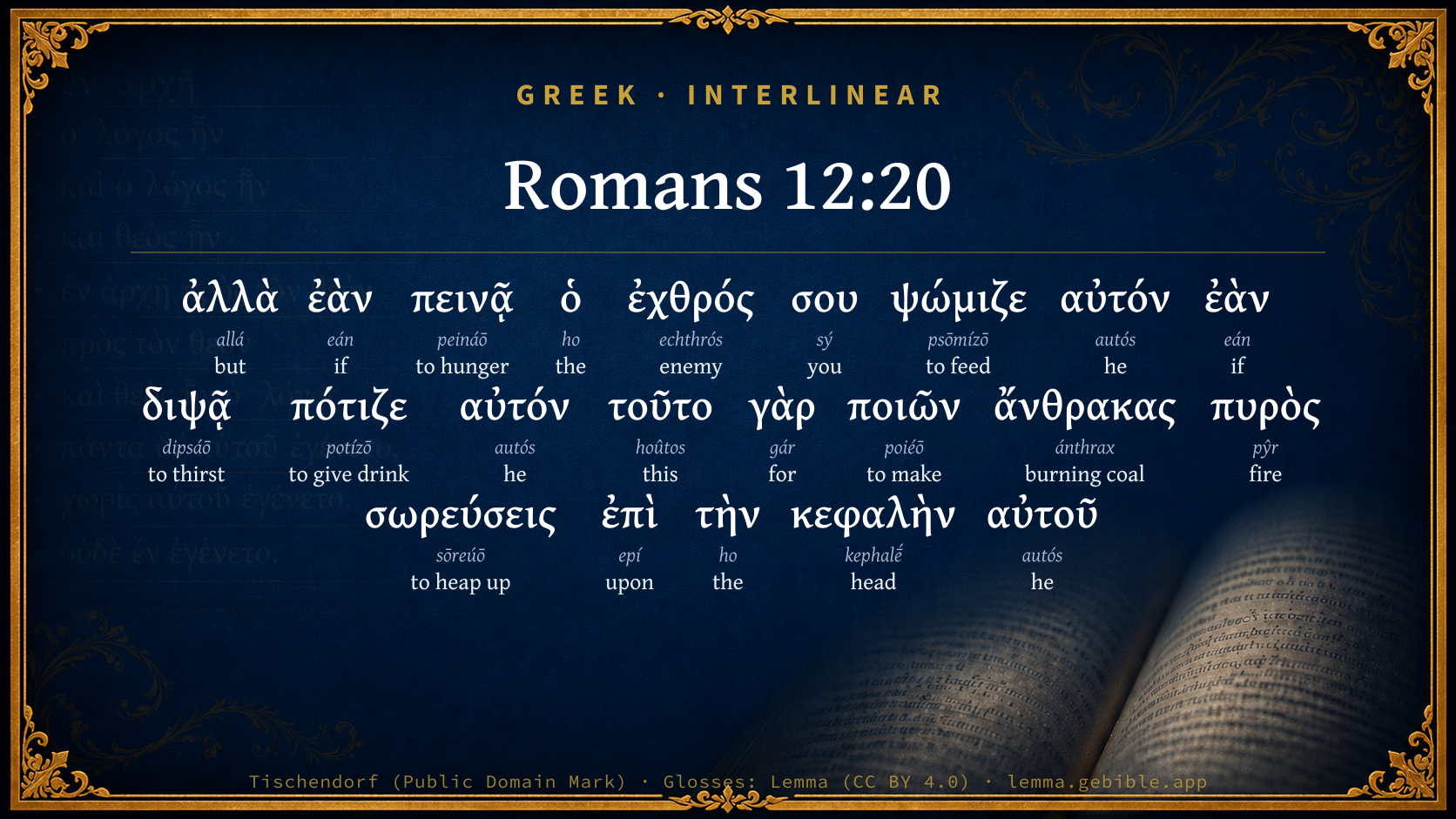
Greek (Tischendorf 8th ed.) Romans 12:20 appears in the Greek New Testament. The text above is from the Tischendorf 8th edition. Each word links to its Strong’s number and a concise gloss. Click any word for its full Thayer’s Greek Lexicon entry.
Download image
Cite this verse

Romans 12:20 (World English Bible). Public Domain. Lemma interlinear Bible study tool, https://lemma.gebible.app/v/romans/12/20.

Show BibTeX & RIS
BibTeX
RIS
English Translation
Therefore "If your enemy is hungry, feed him. If he is thirsty, give him a drink. For in doing so, you will heap coals of fire on his head."
World English Bible · Public Domain
Highlights
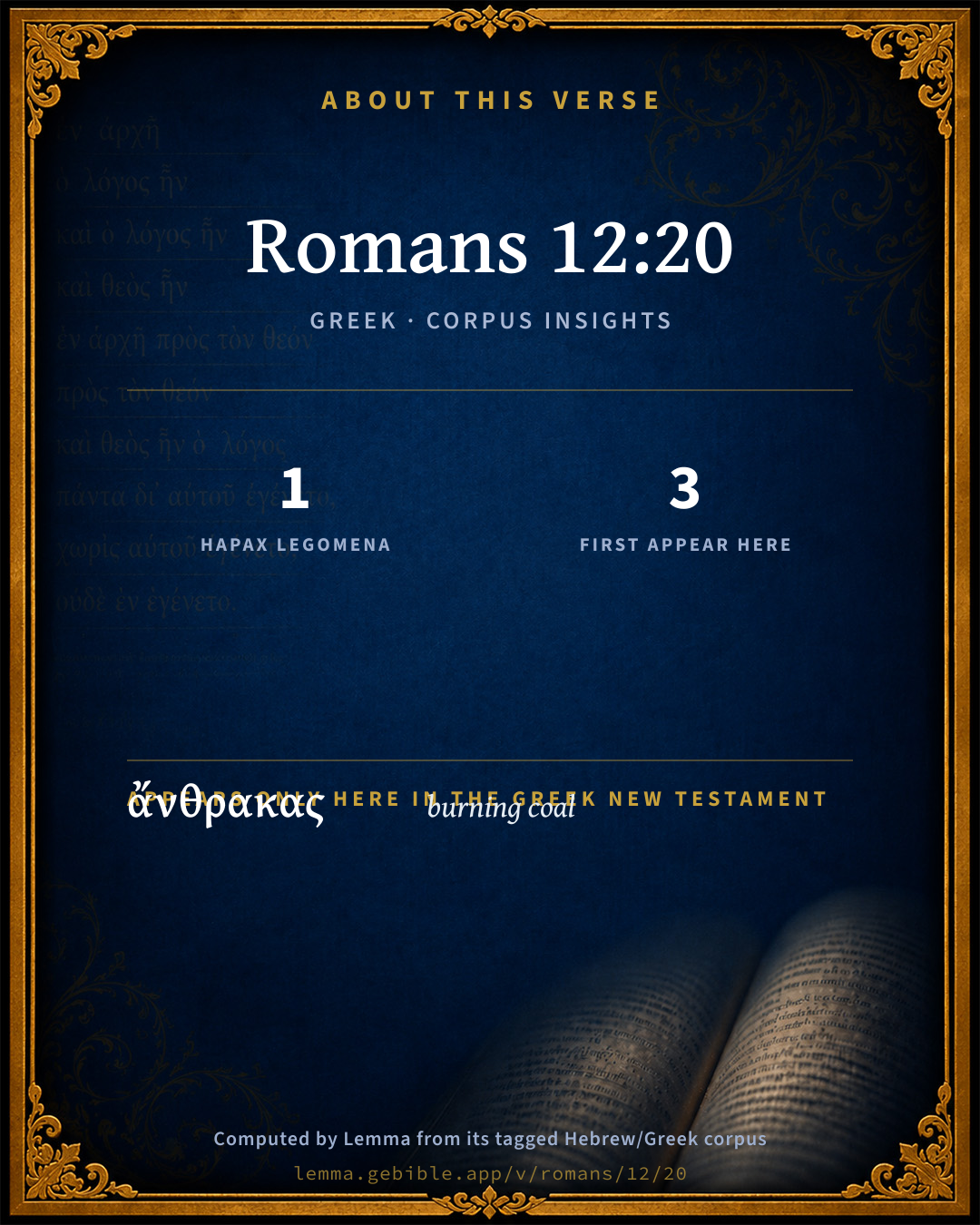
  • 1 hapax legomenon — only here in the Greek New Testament
  • 3 first appearances in the Greek New Testament
Full analysis ↓
Download a study sheet

One document with this verse’s original text, its word-by-word gloss line, the meaning frame, cross-references with their text, attributed commentary, and full source and license credits — printable, and it pastes into notes with its structure intact.

This verse Autodidact and up

Study sheet (.html) Plain text (.txt)

A passage Seminary Student

Up to 50 verses in one chapter. A passage sheet keeps up to 6 commentary sources and 12 cross-references per verse, in the order this page ranks them, and says so on the sheet whenever that leaves anything out. Ask for a single verse and you get the Autodidact verse sheet above.

Everything on this page stays free to read, with no account — the sheet is a download of what is already on screen, not access to it.

Want to remove ads? Support Godless Engineer
Compare translations 3

The same verse in 3 English versions, stacked beneath the original-language interlinear above. Click any original word for its lexicon entry.

Each is an independent rendering of the whole verse — the interlinear is not word-aligned to these translations.

Highlighted words mark where these versions differ — a whole-verse word diff, not a word-by-word alignment.

  • World English Bible Public Domain
    Therefore "If your enemy is hungry, feed him. If he is thirsty, give him a drink. For in doing so, you will heap coals of fire on his head."
  • King James Version Public Domain
    Therefore if thine enemy hunger, feed him; if he thirst, give him drink: for in so doing thou shalt heap coals of fire on his head.
  • unfoldingWord Literal Text CC BY-SA 4.0
    But, “If your enemy is hungry, feed him. If he is thirsty, give him a drink. For doing this, you will heap coals of fire on his head.”

unfoldingWord Literal Text — © unfoldingWord, licensed CC BY-SA 4.0. Word-aligned USFM3 via Door43 (git.door43.org/unfoldingWord/en_ult).

Versions to compare (up to 4)

3 of 4 selected

Show all 19 translations

Every available English version of this verse, each an independent rendering of the whole verse.

  • World English Bible Public Domain
    Therefore "If your enemy is hungry, feed him. If he is thirsty, give him a drink. For in doing so, you will heap coals of fire on his head."
  • Berean Standard Bible Public Domain
    On the contrary, “If your enemy is hungry, feed him; if he is thirsty, give him a drink. For in so doing, you will heap burning coals on his head.”
  • Majority Standard Bible Public Domain
    Therefore, “If your enemy is hungry, feed him; if he is thirsty, give him a drink. For in so doing, you will heap burning coals on his head.”
  • King James Version Public Domain
    Therefore if thine enemy hunger, feed him; if he thirst, give him drink: for in so doing thou shalt heap coals of fire on his head.
  • American Standard Version (1901) Public Domain
    But if thine enemy hunger, feed him; if he thirst, give him to drink: for in so doing thou shalt heap coals of fire upon his head.
  • Revised Version (1885) Public Domain
    But if thine enemy hunger, feed him; if he thirst, give him to drink: for in so doing thou shalt heap coals of fire upon his head.
  • Geneva Bible (1599) Public Domain
    Therefore, if thine enemie hunger, feede him: if he thirst, giue him drinke: for in so doing, thou shalt heape coales of fire on his head.
  • Douay-Rheims (1899) Public Domain
    But if thy enemy be hungry, give him to eat; if he thirst, give him to drink. For, doing this, thou shalt heap coals of fire upon his head.
  • Young's Literal Translation Public Domain
    I will recompense again, saith the Lord;' if, then, thine enemy doth hunger, feed him; if he doth thirst, give him drink; for this doing, coals of fire thou shalt heap upon his head;
  • Literal Standard Version CC BY-SA 4.0
    I will repay again, says the LORD”; if, then, your enemy hungers, feed him; if he thirsts, give him drink; for doing this, you will heap coals of fire on his head.
  • Unlocked Literal Bible CC BY-SA 4.0
    “But if your enemy is hungry, feed him. If he is thirsty, give him a drink. For if you do this, you will heap coals of fire on his head.”
  • unfoldingWord Literal Text CC BY-SA 4.0
    But, “If your enemy is hungry, feed him. If he is thirsty, give him a drink. For doing this, you will heap coals of fire on his head.”
  • Darby Bible Public Domain
    If therefore thine enemy should hunger, feed him; if he should thirst, give him drink; for, so doing, thou shalt heap coals of fire upon his head.
  • World Messianic Bible Public Domain
    Therefore “If your enemy is hungry, feed him. If he is thirsty, give him a drink; for in doing so, you will heap coals of fire on his head.”
  • Webster's Bible Public Domain
    Therefore if thy enemy hungereth, feed him; if he thirsteth, give him drink: for in so doing thou shalt heap coals of fire on his head.
  • Free Bible Version CC BY-SA 4.0
    If those who hate you are hungry, give them food; if they're thirsty, give them a drink; for by doing so you pile fiery coals on their heads.
  • Bible in Basic English Public Domain
    But if one who has hate for you is in need of food or of drink, give it to him, for in so doing you will put coals of fire on his head.
  • Text-Critical English NT CC BY 4.0
    Therefore, “if yoʋr enemy is hungry, feed him; if he is thirsty, give him something to drink; for by doing so, yoʋ will heap coals of fire on his head.”
  • Tyndale New Testament (1534) Public Domain
    Therfore yf thyn enemy honger fede him: yf he thurst geve him drinke. For in so doynge thou shalt heape coles of fyre on his heed:

Literal Standard Version (2020), Covenant Press — licensed CC BY-SA 4.0. Text via the HelloAO Bible API (eBible.org). Unlocked Literal Bible (unfoldingWord) — licensed CC BY-SA 4.0. Text via the HelloAO Bible API (eBible.org). unfoldingWord Literal Text — © unfoldingWord, licensed CC BY-SA 4.0. Word-aligned USFM3 via Door43 (git.door43.org/unfoldingWord/en_ult). Free Bible Version, Dr. Jonathan Gallagher — licensed CC BY-SA 4.0. Text via the HelloAO Bible API (eBible.org).

Word by word

More ways to search: Search by grammar → Find every occurrence → Compare this word →

Practice this passage: Drill this verse → Learn its vocabulary →

ἄνθρακας
ánthrax
G440
“burning coal”
Noun, Accusative, Plural, Masculine
Part of Speech
Noun
Case
Accusative
Number
Plural
Gender
Masculine
Full Thayer's Definition

Origin: of uncertain derivation

TDNT: None

1. a burning or live coal
  1. ἀλλὰ allá G235 “but” Conjunction
  2. ἐὰν eán G1437 “if” Conditional
  3. πεινᾷ peináō G3983 “to hunger” Verb, Present, Active, Subjunctive, 3rd person, Singular
  4. ὁ ho G3588 “the” Article, Nominative, Singular, Masculine
  5. ἐχθρός echthrós G2190 “enemy” Adjective, Nominative, Singular, Masculine
  6. σου sý G4771 “you” Personal pronoun, 2nd person, Genitive, Singular
  7. ψώμιζε psōmízō G5595 “to feed” Verb, Present, Active, Imperative, 2nd person, Singular
  8. αὐτόν autós G846 “he” Personal pronoun, Accusative, Singular, Masculine
  9. ἐὰν eán G1437 “if” Conditional
  10. διψᾷ dipsáō G1372 “to thirst” Verb, Present, Active, Subjunctive, 3rd person, Singular
  11. πότιζε potízō G4222 “to give drink” Verb, Present, Active, Imperative, 2nd person, Singular
  12. αὐτόν autós G846 “he” Personal pronoun, Accusative, Singular, Masculine
  13. τοῦτο hoûtos G3778 “this” Demonstrative pronoun, Accusative, Singular, Neuter
  14. γὰρ gár G1063 “for” Conjunction
  15. ποιῶν poiéō G4160 “to make” Verb, Present, Active, Participle, Nominative, Singular, Masculine
  16. πυρὸς pŷr G4442 “fire” Noun, Genitive, Singular, Neuter
  17. σωρεύσεις sōreúō G4987 “to heap up” Verb, Future, Active, Indicative, 2nd person, Singular
  18. ἐπὶ epí G1909 “upon” Preposition
  19. τὴν ho G3588 “the” Article, Accusative, Singular, Feminine
  20. κεφαλὴν kephalḗ G2776 “head” Noun, Accusative, Singular, Feminine
  21. αὐτοῦ autós G846 “he” Personal pronoun, Genitive, Singular, Masculine

About this verse

These counts appear in no published source. They are computed here, from the morphology-tagged text and Lemma’s own curated glosses. What Lemma adds →

22
words
18
distinct lemmas
Pauline Epistles
section

Notable vocabulary

1 hapax legomenon — a word that appears only here in the entire Greek New Testament:

  • ἄνθρακας burning coal G440

First appearance in Scripture

These words make their first canonical appearance in the Greek New Testament here:

  • ψώμιζε to feed G5595
  • ἄνθρακας burning coal G440
  • σωρεύσεις to heap up G4987

Shared distinctive vocabulary

ψώμιζε to feed G5595 occurs in 2 verses of the Greek New Testament. Also found in:
Repetition

Words recur within this verse:

Cross-references

10

Topical passages linked to Romans 12:20 in the Treasury of Scripture Knowledge — connected by theme and wording, ordered by reader-vote popularity; previews shown in the World English Bible.

  • Proverbs 25:21–22 If your enemy is hungry, give him food to eat; If he is thirsty, give him water to drink:
  • Matthew 5:44 But I tell you, love your enemies, bless those who curse you, do good to those who hate you, and pray for those who mistreat you and persecute you,
  • Luke 6:27 "But I tell you who hear: love your enemies, do good to those who hate you,
  • Exodus 23:4–5 "If you meet your enemy's ox or his donkey going astray, you shall surely bring it back to him again.
  • 2 Kings 6:22 He answered, You shall not strike them: would you strike those whom you have taken captive with your sword and with your bow? set bread and water before them, that they may eat and drink, and go to their master.
  • 1 Samuel 24:16–19 It came to pass, when David had made an end of speaking these words to Saul, that Saul said, Is this your voice, my son David? Saul lifted up his voice, and wept.
  • 1 Samuel 26:21 Then said Saul, I have sinned: return, my son David; for I will no more do you harm, because my life was precious in your eyes this day: behold, I have played the fool, and have erred exceedingly.
  • Song of Solomon 8:6–7 Set me as a seal on your heart, As a seal on your arm; For love is strong as death. Jealousy is as cruel as Sheol; Its flashes are flashes of fire, A very flame of Yahweh.
  • Psalms 140:10 Let burning coals fall on them. Let them be thrown into the fire, Into miry pits, from where they never rise.
  • Psalms 120:4 Sharp arrows of the mighty, With coals of juniper.

Cross-references courtesy of OpenBible.info (CC BY 4.0).

Where the printed editions differ

1 variant

Places in this verse where the major printed Greek editions disagree on the wording in a way that affects the translation — a comparison of editions, not a manuscript-by-manuscript collation. The editions are the modern critical texts (Nestlé-Aland 28/27, SBL, Westcott-Hort, Tregelles, Tyndale House) and the traditional texts behind the KJV (the Textus Receptus and the Byzantine/Majority text). It is not a claim about which reading is original.

  1. Different wording
    ἀλλ᾽

    “On the contrary”

    In NA28NA27TynSBLWHTreg Not in TRByz

    οὖν (oun) 'therefore' occurs in traditional manuscripts (TR+Byz) instead of ἀλλ᾽ (all᾽) 'On the contrary' in older manuscripts (NA28+NA27+Tyn+SBL+WH+Treg)

Textual data: Translators Amalgamated Greek New Testament (STEPBible TAGNT) · CC BY 4.0.

Commentary

Notes on Romans 12:20 from classic Christian and Jewish commentators (each source and its license shown beneath its notes). The classic Christian expositions comment on the surrounding passage and are grouped to its opening verse, so a note may address several verses; the Jewish commentaries on the Tanakh (Rashi and others) are per-verse, so they appear only where the commentator wrote on this verse.

Lemma curates 59 commentaries, every one of them public domain or Creative Commons licensed, each selected and text-cleaned for this edition rather than reprinted as found. About our sources →

The Preacher's Complete Homiletical Commentary

Joseph S. Exell (gen. ed.)

CRITICAL NOTES

Rom_12:20.—Here are figurative expressions for the general duties of benevolence.

Rom_12:21.—He is conquered by evil who wishes another to sin. He has sinned himself who strives to make another sin. Love is the conqueror. We cannot always tell where it prevails. If it do not seem to succeed in this world, it shall triumph in the world to come. How the early Church triumphed! Justin Martyr says: “That we who have given our names to Jesus do not draw back our profession while we are beheaded, crucified, exposed to wild beasts, and tortured by hooks, fire, and all kinds of torture, is sufficiently manifest; and the more that such tortures are exercised upon us, so much the more do others become believers and worshippers of the true religion through the name of Jesus.”

MAIN HOMILETICS OF THE PARAGRAPH.—Rom_12:20-21

Remedial punishment.—In this section, which treats of Christian morals, St. Paul refers three times to the book of Proverbs—another example of his respect, in every point, for the Old Testament. In Rom_12:20 we find an almost verbal repetition of Solomon’s advice: “If thine enemy hunger, give him bread to eat; and if he be thirsty, give him water to drink: for thou shalt heap coals of fire on his head, and the Lord will reward thee.” The corrupt precept of the Jews was, “Thou shalt love thy neighbour and hate thine enemy.” The Lord gave a new commandment: “But I say unto you, Love your enemies, bless them that persecute you, do good to them that hate you, and pray for them that despitefully use you, and persecute you; that ye may be the children of your Father which is in heaven.” That which Jesus taught He practised.

I. A method of punishment which is novel.—To return good for good is human; to return evil for evil is carnal; to return evil for good is devilish; to return good for evil is divine. This last is peculiar to Christianity,—peculiar, we should say, to a small portion of Christendom; so peculiar that when it is practised it strikes the world with astonishment. Too often we try to kill our enemies with shells and grape-shot, and not with sweet loaves and refreshing drinks. Too often our highest pitch of goodness is to make an effort to be kind to our enemies. We shake hands, but the hand wants the loving grasp; we utter words, but there is in them no heart and little love.

II. A method of punishment which is severe.—The figure “coals of fire” is common among the Arabs and Hebrews to denote a vehement pain. If there be any sensitiveness left in the enemy, he will be severely punished by deeds of kindness. In the highest sense the enemy is not punished whose physical nature merely is tortured. The enemy is punished when the moral nature is made ashamed and sees the enormity of his hostile attacks.

III. A method of punishment which is remedial.—Human methods of punishment are for the most part repressive and not remedial; divine methods are intended to be remedial. Meyer observes that in the expression “coals of fire” there is no allusion whatever to the idea of softening or melting the object. Some of our commentators are very dogmatic. Dogma is good when it furnishes satisfactory reasons for its position. Surely Meyer’s interpretation opens out the way for an ingenious method of revenge. Once we saw the picture of the inquisitor who killed the man by hope; here is the Christian feeding the man in order to kill him. We cannot believe that punishment without a remedial purpose is part of the divine teaching. These “coals of fire” must both punish and soften. Whether Meyer be correct or not, we are sure that this kind of punishment is likely to lead to repentance and salvation. Divine justice is preventive; divine love is remedial and reforming. The stripes of the cat-o’-nine-tails hurt and degrade; the stripes of love hurt and reform and ennoble. The coals of fire which revengeful disciples invoke would consume; the coals of fire which Christ pours forth consume the evil and develop the good.

IV. A method of punishment which has a beneficial reflex action.—The man who tries to do good, even though his effort may fail, gets good. When we seek to do harm to our enemies, we do great harm to ourselves. On earth’s battle-fields, in a moral sense at least, victory is not differenced from defeat; fiendish passions rage through the embattled hosts; there is no difference. He that overcomes evil with good overcomes three enemies at once—the devil, his adversary, and himself. The self-conqueror is the noblest and mightiest. The very effort to kindle coals of fire is beneficial. All effort is beneficial which has a noble purpose. We want love’s fires glowing in this frozen world—coals of fire, not from beneath, but from above. Earth’s colliers may refuse coals of fire when anger is provoked, when bad passions are in the ascendant; heaven’s workmen toil the harder to produce coals of fire when the world is cold, when enmity is great. Love’s coals of fire blazing from every mountain top, burning in every valley, shining in every home, warming every heart, would make a world over which angels would raise their gladdest songs.

SUGGESTIVE COMMENTS ON Rom_12:20-21

Treating an enemy kindly is beneficial.—This method of treating an enemy is prescribed, not merely because it is abstractly right in principle, but also as the best practical means of a specific beneficial result. Do him good in return for evil, for thou shalt heap coals of fire on his head. The idea of a furnace is introduced here with reference to the smelting and moulding of ore, and not to the torture of living creatures. The coals of fire suggest, not the pain of punishment to the guilty, but the benefit of getting his heart softened and the dross removed from his character. Love poured out in return for hatred will be what the burning coals are to the ore—it will melt and purify. In the smelting of metals, whether on a large or small scale, it is necessary that the burning coals should be above the ore as well as beneath it. The melting fuel and the rude stones are mingled together, and brought into contact particle by particle throughout the mass. It is thus that the resistance of the stubborn material is overcome and the precious separated from the vile. The analogy gives the expressive view both of the injurer’s hardness and the power of the forgiver’s love. Christians meet much obdurate evil in the world. It is not their part either peevishly to fret or proudly to plan revenge. The Lord has in this matter distinctly traced the path for His disciples, and hedged it in. It is their business to render good for evil; to pile forgiveness over injuries, layer upon layer, as diligently and patiently as those swarthy labourers heave loads of coal over the iron ore within the furnace, and not merely in conformity with the abstract idea of transcendental virtue, but with the object as directly utilitarian as that which the miner pursues. The Christian’s aim, like the miner’s, is to melt, and so make valuable the substance which in its present state is hard in itself and hurtful to those it touches. The Americans have on this subject a tract entitled The Man who killed his Neighbour. It contains, in the form of a narrative, many practical suggestions on the act of overcoming evil with good. It is with kindness—modest, thoughtful, generous, unwearied kindness—that the benevolent countryman kills his churlish neighbour; and it is only the old evil man he kills, leaving a new man to lead a very different life in the same village after the dross has been purged away. If any one desire to try this work, he must bring to it at least these two qualifications—modesty and patience. If he proceed with the air of superiority and the consciousness of his own virtue, he will never make one step of progress. The subject will day by day grow harder in his hands. But even though the successive acts of kindness should be genuine, the operator must lay his account with a tedious process and with many disappointments. Many instances of good rendered for evil may seem to have been thrown away, and no symptom of penitence appear in the countenance or conduct of the evildoer; but be not weary in well-doing, for in due season you shall reap if you faint not. Although your enemy have resisted your deeds of kindness even unto seventy times seven, it does not follow that all or that any part of this has been lost. At last the enmity will suddenly give way and flow down in penitence at some single act, perhaps not greater than any of those which preceded it, but every one that preceded contributed to the great result.—Arnot.

The conquest of evil.—Among sacred writers St. Paul is especially remarkable for his great gift of sympathy with human nature and human thought. In the case before us he has been inculcating a long list of difficult duties as belonging to a serious Christian life. Do not the difficulties which lie in the way of them appear to such as you and I to be almost insurmountable? This is the undercurrent of our thoughts, and St. Paul meets it by his closing words, which are not, mark you, so much an additional precept as a summing up of all the precepts that have gone before by a practical appeal to a general principle “Be not overcome of evil, but overcome evil with good.” Now here are implied two things about evil—first, its aggressive strength, and, next, our capacity for not merely resisting but subduing it. Evil is the creature repudiating the law of its being by turning away its desire from Him who is the source, the centre, the end of its existence. If it be urged that God, in making a man free, must have foreseen that man would thus abuse his freedom, it must be replied that God’s horizons are wider than ours, and that we may not unreasonably believe that He foresaw, in the very cure of evil, a good which would more than compensate for its existence—that, if sin abounded, grace would much more abound. If one thing be more wonderful than another amid the many mysteries which surround the presence of evil in the world of the good and gracious God, it is the enthusiasm with which it is propagated. It has at this hour in this great city its earnest missionaries and apostles. It creates and disseminates whole literatures: here reasoning, refining, in every sense presentable; there passionate, blasphemous, revolting. It makes its converts, and then in turn it adroitly enlists them in the work of conversion. It retreats—when for the moment it does retreat—only that it presently may advance the better. Everywhere it gives a thinking man the impression, not of being simply an inert obstacle to goodness, but of being the energetic, intelligent, onward movement of some personal activity. “Be not overcome of evil.” It is not, then, a resistless invader; it is not invincible, for it is not the work of an eternal being or principle. Strong as it is, it is strictly a product of created wills. If the Oriental belief in a second principle be true, we might resign ourselves to evil as inevitable; if the pantheistic belief in the identification of God with all created activity, we might learn to regard it with complacency. As Christians we know evil to be both hateful and not invincible. It is our duty to abhor it; yet it is also our duty and within our power to overcome it. True it often beleaguers the soul like an investing force, which, besides cutting off supplies of strength from without, has its allies too truly in our weakness and passions within, and ever and anon makes an assault which might even prove fatal. But, for all that, it is not our master. It may be conquered, not by its own weapons, but by weapons of another kind—as the apostle says, “with good.” Good, like evil, is not a mere abstraction; it is at bottom a living person. If evil be personified in Satan, good is personified in the divine Christ; and Satan, if conquered, must be conquered by the aid of his living, personal Antagonist. Christ and His cleansing blood, Christ and the grace of His Spirit, Christ and the virtues which Christ creates in man, are more than a match for evil, whether in our own heart or in society around us. His patience is stronger than human violence, His gentleness than the brutal rudeness of man, His humility than the world’s lofty scorn, His divine charity than its cruelty and hatred.—Canon Liddon.

ILLUSTRATIONS TO CHAPTER 12

Rom_12:20. Revenge.—During the American revolutionary war there was living in Pennsylvania Peter Miller, pastor of a little Baptist church. Near the church lived a man who secured an unenviable notoriety by his abuse of Miller and the Baptists. He was also guilty of treason, and was for this sentenced to death. No sooner was the sentence pronounced than Peter Miller set out on foot to visit General Washington at Philadelphia to intercede for the man’s life. He was told that his prayer for his friend could not be granted. “My friend!” exclaimed Miller, “I have not a worse enemy living than that man.” “What!” rejoined Washington; “you have walked sixty miles to save the life of your enemy? That in my judgment puts the matter in a different light. I will grant you his pardon.” The pardon was at once made out, and Miller at once proceeded on foot to a place fifteen miles distant, where the execution was to take place on the afternoon of the same day. He arrived just as the man was being carried to the scaffold, who, seeing Miller in the crowd, remarked, “There is old Peter Miller. He has walked all the way from Ephrata to have his revenge gratified to-day by seeing me hung.” These words were scarcely spoken before Miller gave him his pardon, and his life was spared.

Rom_12:21. Forgiveness.—The Caliph Hassan, son of Hali, being at table, a slave accidentally dropped a dish of meat, which, being very hot, severely burnt him. The slave, affrighted, instantly fell on his knees before his lord, and repeated these words of the Alcoran: “Paradise is for those who restrain their anger.” “I am not angry with thee,” replied the caliph. “And for those who forgive offences,” continued the slave. “I forgive thee,” added the caliph. “But above all for those who return good for evil,” said the slave. “I set thee at liberty,” rejoined the caliph, “and give thee ten dinaras.” Shall we say we have not seen so great charity, no, not in Christendom? We remember with satisfaction a Cranmer of whom it was affirmed, “Do that man an ill-turn, and you will make him your friend for ever.”

Rom_12:21. Tikhon, the poor man’s friend.—We know not that we have read a finer instance of the overcoming of evil with good, and of wrath and pride with humility and love, than in the following incident related of Tikhon bishop of Varonej, in Russia. Tikhon, a very holy man, promoted many reforms among clergy and laity. He was pre-eminently the poor man’s friend, and was among the first, if not the first of all, who wrote in favour of the serfs, and who urged that emancipation of them which some time after (about sixty years after his death) was actually accomplished. “As a friend of serfs,” relates Mr. Hepworth Dixon, “he one day went to the house of a prince, in the district of Varonej, to point out some wrong which they were suffering on his estate, and to beg him, for the sake of Jesus, to be tender with the poor. The prince got angry with his guest for putting the thing so plainly into words, and in the midst of some sharp speech between them struck him in the face. Tikhon rose up and left the house; but when he had walked some time he began to see that he, no less than his host, was in the wrong. ‘This man,’ he said to himself, ‘has done a deed of which, on cooling down, he will feel ashamed. Who has caused him to do that wrong? It was my doing,’ sighed the reformer, turning on his heel and going straight back into the house. Falling at the prince’s feet, Tikhon craved his pardon for having stirred him into wrath and caused him to commit a sin. The prince was so astonished that he knelt down by the good man, and, kissing his hands, implored his forgiveness and benediction. From that hour, it is said, the prince was another man, noticeable through all the province of Varonej for his kindness to the serfs.” Which of us, in daily life, will do as Tikhon did, and overcome by humility?

The Preacher's Complete Homiletical Commentary (gen. ed. Joseph S. Exell; Funk & Wagnalls, c. 1892) — public domain (pre-1929). A full-Bible homiletical/sermon-outline anthology covering 65 of 66 books (2 John is absent from the source module). Text from a community e-Sword module.

Tyndale Open Study Notes

Tyndale Open Resources

12:20-21 A simple act of Christian kindness can often bring a hostile person to repentance before God and restore fellowship between people.

Tyndale Open Study Notes — © Tyndale Open Resources, licensed CC BY-SA 4.0. Text via the HelloAO Bible API.

Bengel's Gnomon

Johann Albrecht Bengel

Rom 12:20. Εὰν οὖν πεινᾷ—ψώμιζε—αὐτοῦ) LXX. Pro 25:21-22, εὰν πεινᾷ—τρέφε [ψώμιζε in LXX. ed. by Holmes and Bos] αὐτοῦ, ὁ δὲ Κύριος ΑΝΤΑΠΟΔΩΣΕΙ σοι ἀγαθά. If he hunger, feed him [his head], and the Lord will repay thy good deeds. The apostles applied the phrase, it is written more to doctrines, than to morals.—ἐχθρὸς, an enemy) This especially holds good of a bitter and violent enemy.—ψώμιζε, feed) with thy hand. So LXX., 2Sa 13:5. Thus will even thy iron-hearted enemy be softened.—ἄνθρακας πυρὸς, coals of fire) The end of all vengeance is that an enemy may be brought to repent, and that an enemy may deliver himself into the hands of the avenger. A man will very easily attain both objects, if he treat his enemy with kindness. Both are described in this remarkable phrase; for it is such a repentance as that, which in the greatest degree burns; 4 Esd. 16:53, and an enemy becomes willingly the property of his avenger; you will then have him entirely in your power [ready at your nod to obey].—ἐπὶ τὴν κεφαλὴν αὐτοῦ, upon his head) i.e. upon himself, upon him wholly, in that part too where he will feel it most.

Bengel's Gnomon of the New Testament — English translation (T&T Clark, Edinburgh, 1860) — public domain. Text from a community e-Sword module.

Meyer's Critical & Exegetical Commentary

Heinrich August Wilhelm Meyer

Rom_12:20. Without οὖν (see the critical notes), but thus the more in conformity with the mode of expression throughout the whole chapter, which proceeds for the most part without connectives, there now follows what the Christianseeing that he is not to avenge himself, but to let Gods wrath have its wayhas rather to do in respect of his enemy.

The whole verse is borrowed from Pro_25:21-22, which words Paul adopts as his own, closely from the LXX.

ψώμιζε] feed him, give him to eat. See on 1Co_13:1; Grimm on Wis_16:20. The expression is affectionate. Comp. 2Sa_13:5; Bengel: manu tua. Sir_7:32

ἄνθρακας πυρὸς σωρεύς. ἐπὶ τὴν κεφ. αὐτοῦ] figurative expression of the thought: painful shame and remorse wilt thou prepare for him. So, in substance, Origen, Augustine, Jerome, Ambrosiaster, Pelagius, Erasmus, Luther, Wolf, Bengel, and others, including Tholuck, Baumgarten-Crusius, Rückert, Reiche, Köllner, de Wette, Olshausen, Fritzsche, Philippi, Reithmayr, Bisping, Borger, van Hengel, Hofmann; comp. Linder in the Stud. u. Krit. 1862, p. 568 f. Glowing coals are to the Oriental a figure for pain that penetrates and cleaves to one, and in particular, according to the context, for the pain of remorse, as here, where magnanimous beneficence heaps up the coals of fire. Comp. on the subject-matter, 1Sa_24:17 ff. See the Arabic parallels in Gesenius in Rosenmüllers Repert. I. p. 140, and generally Tholuck in loc.; Gesenius, Thesaur. I. p. 280. Another view was already prevalent in the time of Jerome, and is adopted by Chrysostom, Theodoret, Oecumenius, Theophylact, Photius, Beza, Camerarius, Estius, Grotius, Wetstein, and others, including Koppe, Böhme, Hengstenberg (Authent. d. Pentat. II. p. 406 f.),namely, that the sense is: Thou wilt bring upon him severe divine punishment. Certainly at 4 Esr. 16:54 the burning of fiery coals on the head is an image of painful divine punishment; but there this view is just as certainly suggested by the context, as here (see esp. Rom_12:21) and in Prov. l.c., the context is opposed to it. For the condition nisi resipiscat would have, in the first place, to be quite arbitrarily supplied; and how could Paul have conceived and expressed so unchristian a motive for beneficence towards enemies! The saving clauses of expositors regarding this point are fanciful and quite unsatisfactory.

Meyer — Critical and Exegetical Commentary on the New Testament — English translation by Peter Christie, edited by Frederick Crombie (T&T Clark, 1880) — public domain. Text from a community e-Sword module.

Expositor's Greek Testament

ed. W. Robertson Nicoll

Rom 12:20 . ἀλλὰ : On the contrary, as opposed to self-avenging, and even to the merely passive resignation of one’s case to God. ἐὰν πεινᾷ κ . τ . λ . Pro 25:21 f. exactly as in LXX. The meaning of “heaping burning coals on his head” is hardly open to doubt. It must refer to the burning pain of shame and remorse which the man feels whose hostility is repaid by love. This is the only kind of vengeance the Christian is at liberty to contemplate. Many, however, have referred to 4 Esdr. 16:54 ( Non dicat peccator se non peccasse; quoniam carbones ignis comburet super caput ejus, qui dicit: non peccavi coram Domino Deo et gloria ipsius ), and argued that the coals of fire are the Divine judgments which the sinner will bring on himself unless he repents under the constraint of such love. But (1) there is nothing said here about the essential condition, “unless he repents”; this is simply imported; and (2) the aim of the Christian’s love to his enemy is thus made to be the bringing down of Divine judgment on him which is not only absurd in itself, but in direct antagonism to the spirit of the passage.

The Expositor's Greek Testament, edited by W. Robertson Nicoll (1897–1910) — public domain. Text from a community e-Sword module.

Hodge's Commentary on Romans, Ephesians & First Corinthians

Charles Hodge

Rom_12:20

Therefore, if thine enemy hungry, feed him; if he thirst, give him drink, etc. That is, instead of avenging ourselves by returning evil for evil, we must return good for evil. The expressions, feed him and give him drink, are obviously not to be confined to their literal meaning, nor even to the discharge of the common offices of humanity; they are figurative expressions for all the duties of benevolence. It is not enough, therefore, that we preserve an enemy from perishing; we must treat him with all affection and kindness.

For in so doing thou shalt heap coals of fire upon his head. This whole verse is taken from Pro_25:21, Pro_25:22, If thine enemy be hungry, give him bread to eat; and if he be thirsty, give him water to drink: for thou shalt heap coals of fire upon his head, and the Lord shall reward thee. The common and natural meaning of the expression, to heap coals of fire upon any one, is to inflict the greatest pain upon him, to punish him most severely; see Psa_140:10, Let burning coals fall upon them; Psa_11:6, Upon the wicked he shall rain coals (פַּחִים for פַּתֲמִים), fire and brimstone, and an horrible tempest; Eze_10:2; 2 Esdras 16:53, Let not the wicked deny that he has sinned, for coals of fire shall burn upon the head of him who denies that he has sinned against the Lord God. The most probable explanation of this figurative expression is, that the allusion is to the lightning or fire from heaven, which is the symbol of the divine vengeance. To rain fire upon any one, is to visit him with the severest and surest destruction. This explanation is much more natural than to suppose the allusion is to the practice of throwing fire-brands upon the heads of the besiegers of a city, or to the fusing of metals.

There are three leading interpretations of this interesting clause. The first, which is perhaps the oldest, and very generally received, is, that Paul means to say that our enemies will be much more severely punished if we leave them in the hands of God. than if we undertake to avenge ourselves. Treat your enemy kindly, for in so doing you secure his being punished by God in the severest manner. The revolting character of this interpretation, which every one must feel, is mitigated by the remark, that the enemy is not to be thus treated from any wish or intention of drawing down the divine wrath upon him; it is only meant that such will be the consequence. But this remark does not meet the difficulty. This clause is so connected with the preceding, that it must be understood as assigning the motive or reason for the discharge of the duty enjoined: Treat thine enemy kindly, for in so doing, etc. The second interpretation is, that by heaping coals of fire on his head, is meant, you will cause him pain, i.e. the pain of remorse and shame. So Tholuck, and many other commentators. The third, which seems much the most simple and natural, is, for in so doing, you will take the most effectual method of subduing him. To heap coals of fire on any one, is a punishment which no one can bear; he must yield to it. Kindness is no less effectual; the most malignant enemy cannot always withstand it. The true and Christian method, therefore, to subdue an enemy is, to overcome evil with good. This interpretation, which suits so well the whole context, seems to be rendered necessary by the following verse, which is a repetition of the previous injunctions in plainer and more general terms. The sentiment which the verse thus explained expresses, is also more in harmony with the spirit of the gospel. Vincere dulce et praeclaram est. Optimam autem vincendi rationem sapientissime docet Salomo (Pro_25:21) jubens nos esurientibus inimicis cibum, sitientibus potum praebere: quia beneficiis eos devincientes fortius superabimus, quam qui hostem a vallo et moenibus flammis superjectis arcent et repellunt. De Brais.

Among the numerous striking classical illustrations of the sentiment of this verse, quoted by Wetstein, are the following: Justinus, 11:12, 8, Tunc Darius se ratus vere victum, cum post praelia etiam beneficiis ab hoste superaretur. Caesar ap. Cic. ad Atticum, 9:8, Haec nova sit ratio vincendi, ut misericordia nos muniamus, id quemadmodum fieri possit, nonnulla mi in mentem veniunt, et multa reperiri possunt. Seneca de Beneficiis, 7:31, Vincit malos pertinax bonitas, nec quisquam tam duri infestique adversus diligenda animi est, ut etiam vi victus bonos non amet. 32, Ingratus est huic ipsi beneficium dabo iterum, et tanquam bonus agricola cura cultuque sterilitatem soli vincam. De Ira, 2:39, Non enim ut in beneficiis honestum est merita meritis repensare, ita injurias injuriis; illic vinci turpe est, hic vincere.

Charles Hodge — Commentary on Romans (1835), First Corinthians (1857), and Ephesians (1856) — public domain. Text from a community e-Sword module.

Geneva Bible (1599)

Geneva Bible translators

After this sort doth Solomon point out the wrath of God which hangeth over a man.

Geneva Bible (1599) marginal notes — public domain. Text via Bolls.life.

Jamieson, Fausset & Brown

Robert Jamieson, A. R. Fausset & David Brown

if thine enemy hunger, &c.--This is taken from Pro 25:21-22, which without doubt supplied the basis of those lofty precepts on that subject which form the culminating point of the Sermon on the Mount.

in so doing thou shalt heap coals of fire on his head--As the heaping of "coals of fire" is in the Old Testament the figurative expression of divine vengeance (Psa 140:10; Psa 11:6, &c.), the true sense of these words seems to be, "That will be the most effectual vengeance--a vengeance under which he will be fain to bend" (So ALFORD, HODGE, &c.). Rom 12:21 confirms this.

Jamieson, Fausset & Brown — Commentary Critical and Explanatory on the Whole Bible (1871) — public domain (CC PDM 1.0). Text via the HelloAO Bible API.

Adam Clarke's Commentary

Verse 20. If thine enemy hunger, feed him] Do not withhold from any man the offices of mercy and kindness; you have been God's enemy, and yet God fed, clothed, and preserved you alive: do to your enemy as God has done to you. If your enemy be hungry, feed him; if he be thirsty, give him drink: so has God dealt with you. And has not a sense of his goodness and long-suffering towards you been a means of melting down your heart into penitential compunction, gratitude, and love towards him? How know you that a similar conduct towards your enemy may not have the same gracious influence on him towards you? Your kindness may be the means of begetting in him a sense of his guilt; and, from being your fell enemy, he may become your real friend! This I believe to be the sense of this passage, which many have encumbered with difficulties of their own creating. The whole is a quotation from Prov 25:21; Prov 25:22, in the precise words of the Septuagint; and it is very likely that the latter clause of this verse, Thou shalt heap coals of fire upon his head, is a metaphor taken from smelting metals. The ore is put into the furnace, and fire put both under and over, that the metal may be liquefied, and, leaving the scoriae and dross, may fall down pure to the bottom of the furnace. This is beautifully expressed by one of our own poets, in reference to this explanation of this passage:-

"So artists melt the sullen ore of lead,

By heaping coals of fire upon its head.

In the kind warmth the metal learns to glow,

And pure from dross the silver runs below."

It is most evident, from the whole connection of the place and the apostle's use of it, that the heaping of the coals of fire upon the head of the enemy is intended to produce not an evil, but the most beneficial effect; and the following verse is an additional proof of this.

Adam Clarke's Commentary on the Bible (1810–1826) — public domain. Text from a community e-Sword/MySword module.

John Calvin's Commentaries

20. If therefore, etc. He now shows how we may really fulfill the precepts of not revenging and of not repaying evil, even when we not only abstain from doing injury but when we also do good to those who have done wrong to us; for it is a kind of an indirect retaliation when we turn aside our kindness from those by whom we have been injured. Understand as included under the words meat and drink, all acts of kindness. Whatsoever then may be thine ability, in whatever business thy enemy may want either thy wealth, or thy counsel, or thy efforts, thou oughtest to help him. But he calls him our enemy, not whom we regard with hatred, but him who entertains enmity towards us. And if they are to be helped according to the flesh, much less is their salvation to be opposed by imprecating vengeance on them.

Thou shalt heap coals of fire, etc. As we are not willing to lose our toil and labor, he shows what fruit will follow, when we treat our enemies with acts of kindness. But some by coals understand the destruction which returns on the head of our enemy, when we show kindness to one unworthy, and deal with him otherwise than he deserves; for in this manner his guilt is doubled. Others prefer to take this view, that when he sees himself so kindly treated, his mind is allured to love us in return. I take a simpler view, that his mind shall be turned to one side or another; for doubtless our enemy shall either be softened by our benefits, or if he be so savage that nothing can tame him, he shall yet be burnt and tormented by the testimony of his own conscience, on finding himself overwhelmed with our kindness.

John Calvin's Commentaries (1540-1563) — public domain. Text from the Calvin Translation Society English edition (1840s-50s) via the Christian Classics Ethereal Library (ccel.org). Calvin's coverage is partial (roughly two-thirds of the Bible); uncommented books and verses are honest gaps, never fabricated. The 19th-century editor's footnotes and remarks are omitted so the notes are faithfully Calvin's own voice.

Ellicott's Commentary for English Readers

(20) Thou shalt heap coals of fire.—Comp. Psa_18:12-14, where the phrase “coals of fire” is used of the divine vengeance. So here, but in a strictly metaphorical sense, it means, “Thou shalt take the best and most summary vengeance upon him.” There may be the underlying idea of awakening in the adversary the pangs of shame and remorse.

A Bible Commentary for English Readers, edited by Charles John Ellicott (1878–1897) — public domain. Text from a community e-Sword module.

The Cambridge Bible for Schools and Colleges

gen. ed. J. J. S. Perowne

20. Therefore if thine enemy, &c.] Here again is an O. T. quotation, (Pro_25:21-22; nearly verbatim with LXX.,) introduced by the Apostle’s “therefore,” as a practical inference from the previous principles.

thou shalt heap coals of fire on his head] This phrase has been explained (1) of burning shame produced by requital of good for evil; (2) of the melting of the evil-doer’s heart by such conduct, as of metal by fire; (3) of the result of a spirit of love as producing at length the “incense” of prayer and praise (as from censer-coals) from the conquered heart. (The last is suggested in the Speaker’s Commentary, on Proverbs 25) A simpler, yet more inclusive, explanation is Alford’s: “in thus doing, you will be taking the most effectual vengeance;” the idea of vengeance being, in the Christian’s view, transformed, so as to become in fact the victory of love. Q. d., “You shall thus secure exactly that sort of vengeance which alone a servant of God can desire.”—The clause “and the Lord shall reward thee,” in Proverbs 25, is omitted; not as if not true (for the Gospel distinctly teaches that “good works, which are the fruits of faith, and follow after justification, … are pleasing and acceptable to God in Christ[45];”) but as not pertinent to the context here, where the ruling motive understood throughout is “the mercies of God.”

[45] Art. xii. of the Church of England.

The Cambridge Bible for Schools and Colleges (gen. ed. J. J. S. Perowne; Cambridge University Press, 1878–1918) — public domain. Text from a community e-Sword module.

John Gill's Exposition

Therefore if thine enemy hunger, feed him,.... These words are taken from Pro 25:21, and to be understood, as a Jewish (o) writer observes, according to "their literal sense"; though some of the Rabbins explain them in an allegorical way, of the corruption of nature. The Alexandrian copy and some others, and the Vulgate Latin version, reads "but if"; so far should the saints be from meditating revenge upon their enemies, that they should do good unto them, as Christ directs, Mat 5:44, by feeding them when hungry, and giving drink unto them when thirsty:

if he thirst give him drink; which includes all offices of humanity and beneficence to be performed unto them: the reason, or argument inducing hereunto is,

for in so doing, thou shalt heap coals of fire on his head; not to do him hurt, not to aggravate his condemnation, as if this would be a means of bringing down the wrath of God the more fiercely on him, which is a sense given by some; as if this would be an inducement to the saints to do such acts of kindness; which is just the reverse of the spirit and temper of mind the apostle is here cultivating; but rather the sense is, that by so doing, his conscience would be stung with a sense of former injuries done to his benefactor, and he be filled with shame on account of them, and be brought to repentance for them, and to love the person he before hated, and be careful of doing him any wrong for the future; all which may be considered as a prevailing motive to God's people to act the generous part they are here moved to: in the passage referred to, Pro 25:21, "bread" and "water" are mentioned as to be given, which include all the necessaries of life: and it is added for encouragement, "and the Lord shall reward thee". The sense given of this passage by some of the Jewish commentators on it agrees with what has been observed in some measure; says one (p) of them,

"when he remembers the food and drink thou hast given him, thou shall burn him, as if thou puttest coals upon his head to burn him, , and "he will take care of doing thee any ill";''

that is, for the time to come: and another of them observes (q) that

"this matter will be hard unto him, as if thou heapest coals on his head to burn him, , "because of the greatness of his shame", on account of the good that he shall receive from thee, for the evil which he hath rendered to thee.''

This advice of showing kindness to enemies, and against private revenge, is very contrary to the dictates of human nature, as corrupted by sin. The former of these Julian the emperor represents (r) as a "paradox", though he owns it to be lawful, and a good action, to give clothes and food to enemies in war; and the latter, to revenge an injury, he says (s), is a law common to all men, Greeks and Barbarians; but the Gospel and the grace of God teach us another lesson.

(o) Jarchi in Prov. xxv. 21. (p) R. Aben Ezra in loc. (q) R. Levi ben Gersom in loc. Vid. Tzeror Hammor, fol. 147. 2. (r) Fragment. inter opera, par. 1. p. 533. (s) Ad Atheniens. p. 501.

John Gill's Exposition of the Whole Bible (1746–1763) — public domain (CC PDM 1.0). Text via the HelloAO Bible API.

Trapp's Complete Commentary

John Trapp

20 Therefore if thine enemy hunger, feed him; if he thirst, give him drink: for in so doing thou shalt heap coals of fire on his head.

Ver. 20. Thou shalt heap] Thou shalt melt him, and make him thy friend for ever.

John Trapp, A Commentary or Exposition upon All the Books of the Old and New Testament (1647–1656) — public domain. Text from a community e-Sword module.

Albert Barnes' Notes on the Bible

Therefore, if thine enemy hunger ... - This verse is taken almost literally from Pro 25:21-22. Hunger and thirst here are put for want in general. If thine enemy is needy in any way, do him good, and supply his needs. This is, in spirit, the same as the command of the Lord Jesus Mat 5:44, “Do good to them that hate you,” etc.

In so doing - It does not mean that we are to do this “for the sake” of heaping coals of fire on him, but that this will be the result.

Thou shalt heap ... - Coals of fire are doubtless emblematical of “pain.” But the idea here is not that in so doing we shall call down divine vengeance on the man; but the apostle is speaking of the natural effect or result of showing him kindness. Burning coals heaped on a man’s head would be expressive of intense agony. So the apostle says that the “effect” of doing good to an enemy would be to produce pain. But the pain will result from shame, remorse of conscience, a conviction of the evil of his conduct, and an apprehension of divine displeasure that may lead to repentance. To do this, is not only perfectly right, but it is desirable. If a man can be brought to reflection and true repentance, it should be done. In regard to this passage we may remark,

(1) That the way to promote “peace” is to do good even to enemies.

(2) The way to bring a man to repentance is to do him good. On this principle God is acting continually. He does good to all, even to the rebellious; and he designs that his goodness should lead people to repentance; Rom 2:4. People will resist wrath, anger, and power; but “goodness” they cannot resist; it finds its way to the heart; and the conscience does its work, and the sinner is overwhelmed at the remembrance of his crimes.

(3) If people would act on the principles of the gospel, the world would soon be at peace. No man would suffer himself many times to be overwhelmed in this way with coals of fire. It is not human nature, bad as it is; and if Christians would meet all unkindness with kindness, all malice with benevolence, and all wrong with right, peace would soon pervade the community, and even opposition to the gospel might soon die away.

Albert Barnes' Notes on the Bible (1834–1885) — public domain. Text from a community e-Sword/MySword module.

Haydock's Catholic Bible Commentary

Thou shalt heap coals of fire on his head. This figurative way of speaking is differently expounded. Some say, inasmuch as by this means thou shalt make him liable to greater punishments from God. Others, as St. Jerome and St. Augustine, by coals of fire, understand kindnesses and benefits, which shall touch the heart, and inflame the affections even of thy enemies, which shall make them sorry for what they have done, and become thy friends. (Witham)

George Leo Haydock (1774–1849), Haydock's Catholic Family Bible and Commentary, 1859 edition — public domain. Excludes Psalms (Douay-Rheims chapter numbering differs from Protestant) and Deuterocanonical books (Catholic canon only).

Matthew Poole's English Annotations

If thine enemy hunger, feed him; if he thirst, give him drink: q.d. Instead of rendering evil for evil to thine adversary, do him good for evil: see following verse.

Thou shalt heap coals of fire on his head; i.e. either make him relent, or bring down the greater vengeance from God upon him. This is taken out of Pro 25:21,22; See Poole on "Pro 25:21-22".

Matthew Poole's English Annotations on the Holy Bible (1683–1685) — public domain. Text from a community e-Sword/MySword module.

Whedon's Commentary on the Bible

Daniel D. Whedon

20. Heap coals of fire—Doing him good for evil is the true Christian man’s vengeance; it destroys your enemy by making him repent of his malignity and become a better man. It is a very likely way not to kill him, but to kill the enmity in him.

Daniel D. Whedon (gen. ed.), Commentary on the Old and New Testaments (1874–1909) — public domain. Text from a community e-Sword module.

John Wesley's Explanatory Notes

Feed him - With your own hand: if it be needful, even put bread into his mouth. Heap coals of fire upon his head - That part which is most sensible. "So artists melt the sullen ore of lead, By heaping coals of fire upon its head; In the kind warmth the metal learns to glow, And pure from dross the silver runs below." Prov. xxv, 21, &c.

John Wesley, Explanatory Notes Upon the Whole Bible (1754–1765) — public domain. Text via the GEBible commentary corpus.

Burkitt's Expository Notes on the New Testament

William Burkitt

As if the apostle had said, "Instead of revenge, render kindness; return courtesies for injuries, affability for affronts: If thy enemy hunger, feed him." The words, as some critics observe, signify to feed their young ones. So doing, thou shalt heap coals of fire upon his head.

By coals of fire, 1. some understand an heart-melting fire: as if the apostle had said, "By thy kindness thou wilt melt and mollify his spirit towards thee, as hardest metals are melted by coals of fire: it must be a very stony heart indeed that this fire will not melt, a very disingenuous nature that meekness will not mollify. Clemency will melt an enemy, and even force him by a sweet compulsion to become a friend, though of a rough and rugged disposition."

2. By coals of fire heaped upon the head, others understand a sin-punishing fire. Thou shalt heap coals of fire, that is, the fire of divine vengeance, upon his head, by making his malice and hatred against thee more inexcusable.

Learn hence, 1. That to conquer and overcome an enemy by love and kindness, is a noble conquest; and a glorious victory, to melt him down by obliging favours into a good affection.

Learn, 2. That if an enemy, after such kind offices, will persevere in his enmity against us, the event will certainly be this: by our patience towards him, and forbearance of him, we shall engage the wrath of God against him, and heap coals of fire, that is, the divine vengeance, upon him.

William Burkitt's Expository Notes on the New Testament (1700–1703) — public domain. Text from a community e-Sword module.

Godbey's Commentary on the New Testament

William B. Godbey

20. “But if thine enemy hunger, feed him; if he thirst, give him drink, for in doing this you will heap coals of fire on his head,” i. e., you can literally burn him out and conquer him by kindness till he will almost die of shame, feeling mean as a sheep-killing dog; he will gladly seek to do you every possible favor.

William B. Godbey, Commentary on the New Testament (1896–1900) — public domain. Text from a community e-Sword module.

McGarvey & Pendleton's Commentaries

J. W. McGarvey

But [instead of avenging] if thine enemy hunger, feed him; if he thirst, give him to drink: for in so doing thou shalt heap coals of fire upon his head . [Quoted from Pro_25:21-22 LXX., where the words, "And Jehovah will reward thee," are added. Simply to forbear from avenging is only half a victory. The full conquest is to return good for evil ( Luk_6:27-30 ). In feeding enemies we are like God, who daily feeds sinners, and the conduct of God is our law ( Mat_5:44-48 ). Heaping coals of fire is a figure derived from the crucible, where they were heaped upon the hard metal till it softened and melted. Kindness is not utterly lost on beasts, but with man it ought always to prevail, for it heaps coals upon the head, or seat of intelligence, filling the mind with the vehement pangs and pains of conscience, the torments of shame, remorse and self-reproach. The most effectual way of subduing an enemy is by the unbearable punishment of unfailing kindness--it is God's way. "The logic of kindness," says Johnson, "is more powerful than the logic of argument." The same thought is now repeated by the apostle without a figure.]

J. W. McGarvey (with Philip Y. Pendleton), Commentaries on the New Testament (The Fourfold Gospel, 1914; Acts; and the epistles) — public domain. Text from a community e-Sword/MySword module.

The People's New Testament

B. W. Johnson

20. If thine enemy hunger, feed him. This is the spirit of Christ's command, to return good for evil. Compare Prov. 25:21, 23. Thou shalt heap coals of fire on his head. Thou wilt by this kindness most readily subdue him, and make him feel most keenly the wrong he has done.

B. W. Johnson's The People's New Testament with Notes (1889–1891) — public domain. Electronic text from the Christian Classics Ethereal Library (CCEL) ThML edition.

Cambridge Greek Testament for Schools and Colleges

20. ἐὰν πεινᾷ κ.τ.λ. Pro 25:21; for ψώμιζε cf. 1Co 13:3.

ἄνθρακας πυρὸς κ.τ.λ. The context in Prov. and here forbids us to take this as a symbol of mere punishment or vengeance. The ‘coals of fire’ are pains, but healing pains, of remorse and repentance. Lid. qu. Jerome and Aug. in support of this interpretation; cf. 1Pe 2:15; 1Pe 3:16.

Cambridge Greek Testament for Schools and Colleges (Cambridge University Press, 1896; 21 vols, various authors incl. Carr, Maclear, Plummer, Farrar, Lumby, Moule, M. R. James, Simcox) — public domain. Text from a community e-Sword module.

Alford’s Greek Testament

Henry Alford

20.] The οὖν would mean ‘quod cum ita sit;’—carrying on the sentence with the assumption of the last thing stated. This perhaps may not have been understood, and hence may have arisen the alteration or omission of οὖν in the mss. But the evidence is very strong for its omission.

What is meant by ἄνθρακας πυρὸς σωρεύσεις? The expression ἄνθρ. πυρ. occurs more than once in Psa_18, of the divine punitive judgments. Can those be meant here? Clearly not, in their bare literal sense. For however true it may be, that ingratitude will add to the enemy’s list of crimes, and so subject him more to God’s punitive judgment, it is impossible that to bring this about should be set as a precept, or a desirable thing among Christians. Again, can the expression be meant of the glow and burn of shame which would accompany, even in the case of a profane person, the receiving of benefits from an enemy? This may be meant; but is not probable, as not sufficing for the majesty of the subject. Merely to make an enemy ashamed of himself, can hardly be upheld as a motive for action. I understand the words, ‘For in this doing, you will be taking the most effectual vengeance;’ as effectual as if you heaped coals of fire on his head.

Henry Alford, The Greek Testament (1849–1861) — public domain. Text from a community e-Sword module.

International Critical Commentary

20. ἀλλὰ Ἐὰν πεινᾷ ὁ ἐχθρός σου κ.τ.λ. Taken from the LXX; cf. Pro 25:21, Pro 25:22, agreeing exactly with the text of B, but varying somewhat from that of A א. The term ἄνθρακες πυρός clearly means ‘terrible pangs or pains,’ cf. Psa 139:11 (140:11).(LXX); 4 (5) Ezra 16:54 Non dicat peccator se non peccasse, quoniam carbones ignis comburet super caput eius qui dicit: Non peccavi coram domino et gloria ipsius. But with what purpose are we to ‘heap coals of fire on his head’? Is it (1) that we may be consoled for our kind act by knowing that he will be punished for his misdeeds? This is impossible, for it attributes a malicious motive, which is quite inconsistent with the context both here and in the O. T. In the latter the passage proceeds, ‘And the Lord shall reward thee,’ implying that the deed is a good one; here we are immediately told that we are not to be ‘overcome of evil, but overcome evil with good,’ which clearly implies that we are to do what is for our enemies’ benefit. (2) Coals of fire must, therefore, mean, as most commentators since Augustine have said, ‘the burning pangs of shame,’ which a man will feel when good is returned for evil, and which may produce remorse and penitence and contrition. Potest enim fieri ut animus ferus ac barbarus inimici, si sentiat beneficium nostrum, si humanitatem, si affectum, si pietatem videat, compunctionem cordis capiat, commissi poenitudinem gerat, et ex hoc ignis in eo quidem succendatur, qui eum pro commissi conscientia torqueat et adurat: et isti erunt carbones ignis, qui super caput eius ex nostro misericordiae et pietatis opere congregantur, Origen.

International Critical Commentary — older volumes (1896–1929), various authors — public domain. Text from a community e-Sword module.

Vincent's Word Studies in the New Testament

Marvin R. Vincent

Feed [ψωμιζε] . See on sop, Joh 13:26. The citation from Pro 25:21, 22, closely follows both Hebrew and Septuagint.

Shalt heap [σωρευσεις] . Only here and 2Ti 3:6.

Coals of fire. Many explain : The memory of the wrong awakened in your enemy by your kindness, shall sting him with penitence. This, however, might be open to the objection that the enemy 's pain might gratify the instinct of revenge. Perhaps it is better to take it, that kindness is as effectual as coals of fire. Among the Arabs and Hebrews the figure of "coals of fire" is common as a symbol of divine punishment (Psa 18:13). "The Arabians call things which cause very acute mental pain, burning coals of the heart and fire in the liver" (Thayer, "Lexicon "). Thomas De Quincey, referring to an author who calls this" a fiendish idea, "says :" I acknowledge that to myself, in one part of my boyhood, it did seem a refinement of malice. My subtilizing habits, however, even in those days, soon suggested to me that this aggravation of guilt in the object of our forgiveness was not held out as the motive to the forgiveness, but as the result of it; secondly, that perhaps no aggravation of his guilt was the point contemplated, but the salutary stinging into life of his remorse hitherto sleeping " (" Essays on the Poets "). ===Rom13

CHAPTER XIII

On the circumstances which are supposed to have called out the first part of this chapter, see Farrarr, "Life and Work of Paul," 2, 260 sqq.

Marvin R. Vincent, Word Studies in the New Testament (1887–1900) — public domain. Text from a community e-Sword/MySword module.

Godet's Commentaries

Frédéric Louis Godet

Vv. 20, 21. “Therefore, if thine enemy hunger, feed him; if he thirst, give him drink; for in so doing thou shalt heap coals of fire on his head. Be not overcome of evil, but overcome evil with good.”

The connection: But if, in the Alex., would signify: “But, far from avenging thyself, if the opportunity of doing good to thine enemy present itself, seize it.” The connection: Therefore if, in the Byzs., is somewhat more difficult to apprehend; but it is precisely this fact which speaks in its favor: “Thou oughtest not to avenge thyself; consequently, if the occasion present itself of doing good to thine enemy, seize it; for to neglect it would in itself be an act of revenge.” The Greco-Latin reading: if (simply), merely adds doing good to forbearance; it is the least probable.

The precept is taken, like so many others in this chapter, from the Book of Proverbs; comp. Pro 25:21-22. It is impossible to suppose that in this book the precept is an encouragement to heap benefits on the head of the evil-doer in order to aggravate the punishment with which God shall visit him (Chrys., Grot., Hengst., etc.). For we read in the same book, Pro 24:17 : “Rejoice not when thine enemy falleth; and let not thine heart be glad when he stumbleth.” Not to be guilty of a self-contradiction, the author would therefore have required to add in our passage: “if thine enemy repent not.” In any case, Paul could not quote this saying in such a sense. For how would acting thus be “to overcome evil with good” (Pro 24:21)? There is here, therefore, rather a fine irony at the expense of him who would cherish in his heart a desire of vengeance: “Thou wouldst avenge thyself? Be it; and here is the way in which God permits thee to do so: Heap benefits on thine enemy; for thereby thou shalt cause him the salutary pain of shame and regret for all the evil he has done thee; and thou shalt light up in his heart the fire of gratitude instead of that of hatred.” The figure coals of fire is common among the Arabs and Hebrews to denote a vehement pain; but, as Meyer observes, it contains no allusion whatever to the idea of melting or softening the object.

Frédéric Louis Godet — Commentaries on Luke, John, Romans, and 1 Corinthians — English translation (T&T Clark, Edinburgh, 1870s–1890s) — public domain. Text from a community e-Sword module.

Lesson kit

Teaching starters — assembled from the data on this page, not authored interpretation. Every prompt links to the verse data it draws on. Edit before teaching.

Romans, in the Pauline Epistles, opens this verse with 22 words (18 distinct Greek lemmas). Its most distinctive word is ánthrax (“burning coal”). A historical commentator’s framing appears above. Read the whole chapter for the surrounding context.

Discussion questions

  1. What does “burning coal” (ánthrax) contribute to the verse as a whole?
  2. 1 word here appears nowhere else in the Greek New Testament. Why might the author reach for such rare wording?
  3. 3 words make their first appearance in Scripture here. What does this debut establish?
  4. How does 1 Corinthians 13:3, which shares the word «to feed», read alongside this verse?
  5. What does the repetition of “he” (3× in this one verse) do in this verse?
  6. These translations render this verse differently; the difference is in the English rendering, not the original. What questions does that raise?
  7. Compare how The Preacher's Complete Homiletical Commentary and Tyndale Open Study Notes read this verse. Where do they agree or differ?

Things to notice

  • 1 word in this verse appears nowhere else in the Greek New Testament.
  • 3 words make their first canonical appearance in Scripture here.
  • These translations choose different wording for 7 words in this verse.
  • “he” occurs 3× in this single verse.
  • 18 distinct Greek lemmas span 22 words in this verse.

Reading settings

Reading text

Shown beneath each verse's original-language words.

Old Testament
Old Testament edition

Read the OT as the Masoretic Hebrew (MT) or the Greek Septuagint (LXX).

English shown for the Greek Septuagint (in the Hebrew ↔ Greek comparison).

Comparing translations? Open the Compare panel on any verse page to stack up to four side by side.