
1 Corinthians 15:26

Greek (Tischendorf 8th ed.) 1 Corinthians 15:26 appears in the Greek New Testament. The text above is from the Tischendorf 8th edition. Each word links to its Strong’s number and a concise gloss. Click any word for its full Thayer’s Greek Lexicon entry.
Download image
Cite this verse

1 Corinthians 15:26 (World English Bible). Public Domain. Lemma interlinear Bible study tool, https://lemma.gebible.app/v/1-corinthians/15/26.

Show BibTeX & RIS
BibTeX
RIS
English Translation
The last enemy that will be abolished is death.
World English Bible · Public Domain
Download a study sheet

One document with this verse’s original text, its word-by-word gloss line, the meaning frame, cross-references with their text, attributed commentary, and full source and license credits — printable, and it pastes into notes with its structure intact.

This verse Autodidact and up

Study sheet (.html) Plain text (.txt)

A passage Seminary Student

Up to 50 verses in one chapter. A passage sheet keeps up to 6 commentary sources and 12 cross-references per verse, in the order this page ranks them, and says so on the sheet whenever that leaves anything out. Ask for a single verse and you get the Autodidact verse sheet above.

Everything on this page stays free to read, with no account — the sheet is a download of what is already on screen, not access to it.

Want to remove ads? Support Godless Engineer
Compare translations 3

The same verse in 3 English versions, stacked beneath the original-language interlinear above. Click any original word for its lexicon entry.

Each is an independent rendering of the whole verse — the interlinear is not word-aligned to these translations.

Highlighted words mark where these versions differ — a whole-verse word diff, not a word-by-word alignment.

  • World English Bible Public Domain
    The last enemy that will be abolished is death.
  • King James Version Public Domain
    The last enemy that shall be destroyed is death.
  • unfoldingWord Literal Text CC BY-SA 4.0
    The last enemy to be abolished: death.

unfoldingWord Literal Text — © unfoldingWord, licensed CC BY-SA 4.0. Word-aligned USFM3 via Door43 (git.door43.org/unfoldingWord/en_ult).

Versions to compare (up to 4)

3 of 4 selected

Show all 19 translations

Every available English version of this verse, each an independent rendering of the whole verse.

  • World English Bible Public Domain
    The last enemy that will be abolished is death.
  • Berean Standard Bible Public Domain
    The last enemy to be destroyed is death.
  • Majority Standard Bible Public Domain
    The last enemy to be destroyed is death.
  • King James Version Public Domain
    The last enemy that shall be destroyed is death.
  • American Standard Version (1901) Public Domain
    The last enemy that shall be abolished is death.
  • Revised Version (1885) Public Domain
    The last enemy that shall be abolished is death.
  • Geneva Bible (1599) Public Domain
    The last enemie that shalbe destroyed, is death.
  • Douay-Rheims (1899) Public Domain
    And the enemy death shall be destroyed last: For he hath put all things under his feet. And whereas he saith,
  • Young's Literal Translation Public Domain
    the last enemy is done away -- death;
  • Literal Standard Version CC BY-SA 4.0
    The last enemy is done away with—death.
  • Unlocked Literal Bible CC BY-SA 4.0
    The last enemy to be destroyed is death.
  • unfoldingWord Literal Text CC BY-SA 4.0
    The last enemy to be abolished: death.
  • Darby Bible Public Domain
    [The] last enemy [that] is annulled [is] death.
  • World Messianic Bible Public Domain
    The last enemy that will be abolished is death.
  • Webster's Bible Public Domain
    The last enemy that shall be destroyed is death.
  • Free Bible Version CC BY-SA 4.0
    The last enemy that will be destroyed is death.
  • Bible in Basic English Public Domain
    The last power to come to an end is death.
  • Text-Critical English NT CC BY 4.0
    The last enemy to be abolished is death.
  • Tyndale New Testament (1534) Public Domain
    The last enemye that shalbe destroyed is deeth.

Literal Standard Version (2020), Covenant Press — licensed CC BY-SA 4.0. Text via the HelloAO Bible API (eBible.org). Unlocked Literal Bible (unfoldingWord) — licensed CC BY-SA 4.0. Text via the HelloAO Bible API (eBible.org). unfoldingWord Literal Text — © unfoldingWord, licensed CC BY-SA 4.0. Word-aligned USFM3 via Door43 (git.door43.org/unfoldingWord/en_ult). Free Bible Version, Dr. Jonathan Gallagher — licensed CC BY-SA 4.0. Text via the HelloAO Bible API (eBible.org).

Word by word

More ways to search: Search by grammar → Find every occurrence → Compare this word →

Practice this passage: Drill this verse → Learn its vocabulary →

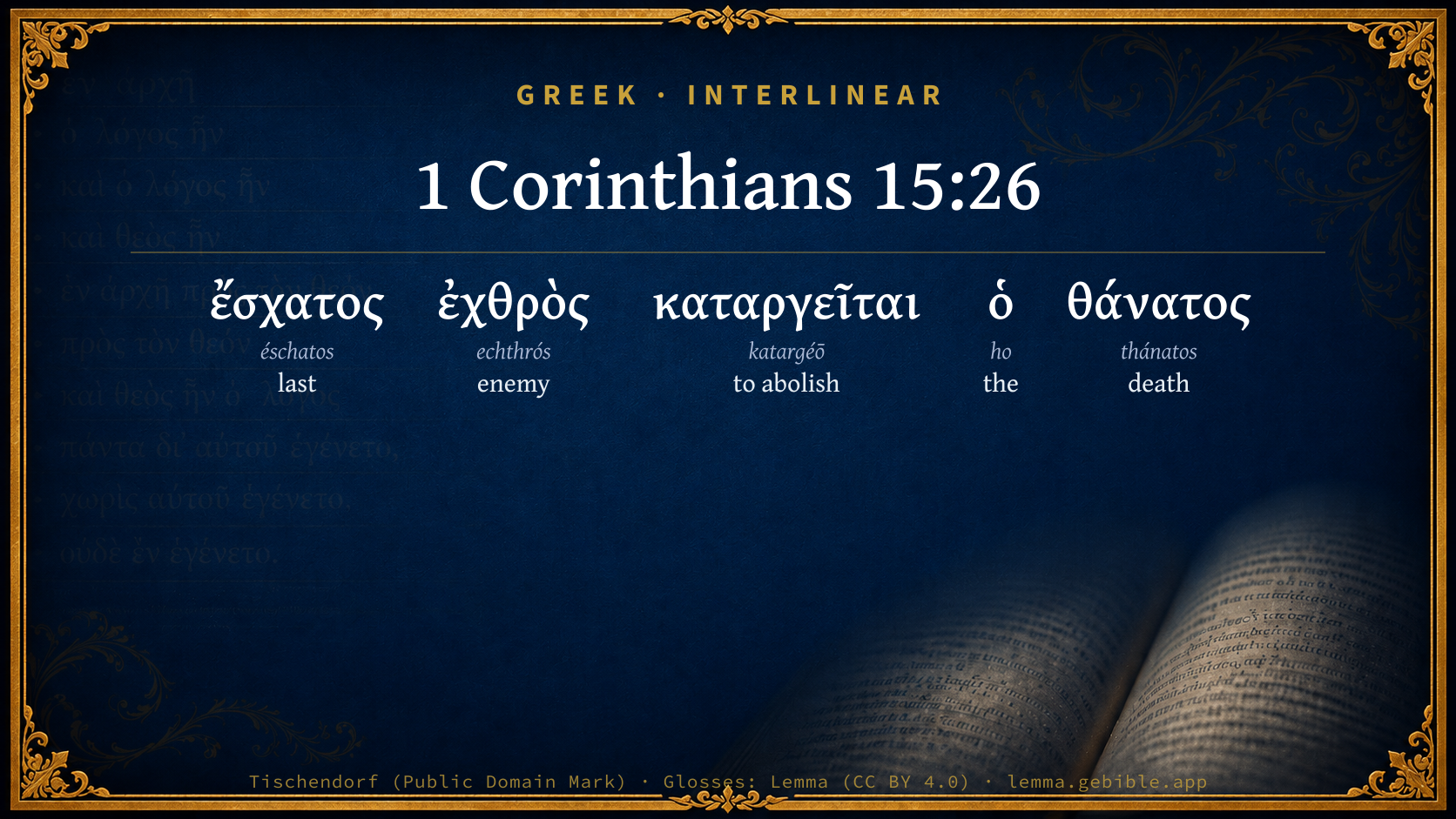
καταργεῖται
katargéō
G2673
“to abolish”
Verb, Present, Passive, Indicative, 3rd person, Singular
Part of Speech
Verb
Tense
Present
Voice
Passive
Mood
Indicative
Person
3rd person
Number
Singular
Full Thayer's Definition

Origin: from G2596 and G691

TDNT: 08:32,8

1. to render idle, unemployed, inactivate, inoperative a. to cause a person or thing to have no further efficiency b. to deprive of force, influence, power 2. to cause to cease, put an end to, do away with, annul, abolish a. to cease, to pass away, be done away b. to be severed from, separated from, discharged from, loosed from any one c. to terminate all intercourse with one
  1. ἔσχατος éschatos G2078 “last” Adjective, Nominative, Singular, Masculine, Superlative
  2. ἐχθρὸς echthrós G2190 “enemy” Adjective, Nominative, Singular, Masculine
  3. ὁ ho G3588 “the” Article, Nominative, Singular, Masculine
  4. θάνατος thánatos G2288 “death” Noun, Nominative, Singular, Masculine

About this verse

These counts appear in no published source. They are computed here, from the morphology-tagged text and Lemma’s own curated glosses. What Lemma adds →

5
words
5
distinct lemmas
Pauline Epistles
section

Shared distinctive vocabulary

καταργεῖται to abolish G2673 occurs in 26 verses of the Greek New Testament. Also found in:
Cross-references

8

Topical passages linked to 1 Corinthians 15:26 in the Treasury of Scripture Knowledge — connected by theme and wording, ordered by reader-vote popularity; previews shown in the World English Bible.

  • 2 Timothy 1:10 but has now been revealed by the appearing of our Savior, Christ Jesus, who abolished death, and brought life and immortality to light through the Gospel.
  • 1 Corinthians 15:55 "Death, where is your sting? Hades, where is your victory?"
  • Revelation 21:4 He will wipe away from them every tear from their eyes. Death will be no more; neither will there be mourning, nor crying, nor pain, any more. The first things have passed away."
  • Revelation 20:14 Death and Hades were thrown into the lake of fire. This is the second death, the lake of fire.
  • Isaiah 25:8 He has swallowed up death forever; and the Lord Yahweh will wipe away tears from off all faces; and the reproach of his people will he take away from off all the earth: for Yahweh has spoken it.
  • Hebrews 2:14 Since then the children have shared in flesh and blood, he also himself in like manner partook of the same, that through death he might bring to nothing him who had the power of death, that is, the devil,
  • Hosea 13:14 I will ransom them from the power of Sheol. I will redeem them from death! Death, where are your plagues? Sheol, where is your destruction? Compassion will be hidden from my eyes.
  • Luke 20:36 For they can't die any more, for they are like the angels, and are children of God, being children of the resurrection.

Cross-references courtesy of OpenBible.info (CC BY 4.0).

Commentary

Notes on 1 Corinthians 15:26 from classic Christian and Jewish commentators (each source and its license shown beneath its notes). The classic Christian expositions comment on the surrounding passage and are grouped to its opening verse, so a note may address several verses; the Jewish commentaries on the Tanakh (Rashi and others) are per-verse, so they appear only where the commentator wrote on this verse.

Lemma curates 59 commentaries, every one of them public domain or Creative Commons licensed, each selected and text-cleaned for this edition rather than reprinted as found. About our sources →

The Biblical Illustrator

Joseph S. Exell

1Co_15:26

The last enemy that shall be destroyed is death

Death, the last enemy, shall be destroyed

I.

The nature of that enemy. Consider--

1. The dissolution of the human frame. The body is a wonderful machine, which bears the mark of Divine wisdom and skill. If we look upon the Goths and Vandals as the enemies of society because they destroyed the ancient monuments of art, what must we think of death?

2. Death puts an end to all that is terrestrial. All schemes and thoughts that relate only to time are destroyed. As much, therefore, as the world is worth, so much is death to be considered as a formidable foe. Say, ye ambitious, ye lovers of wealth or pleasure, what will these things avail you when you are summoned to meet this last enemy?

3. It dissolves the tenderest ties of nature and affection. Death tears asunder husbands and wives, parents and children, etc. One part of the mortal compound is left by him to mourn while the other part is mingled with corruption. Death so mars the features that the most passionate admirers of beauty are constrained to say, Bury my dead out of my sight. All the fruits of friendship are withered by his breath. Nor is there any union so closely formed but it will be cut asunder by this great enemy.

4. Its moral or eternal consequences (1Co_15:56). The death of the body is by no means the full infliction of the penalty of the Divine law. It is but a preparation; like knocking off the chains and fetters from a prisoner who is about to be led forth to the place of execution (Rom_6:23).

5. There are many properties of this enemy which give him the pre-eminence of terror.

(1) He is an inexorable enemy. Others may be bribed by riches, soothed by flatteries, moved by the tears and sorrows of a suppliant, or reconciled by a mediator; but not he.

(2) Death is an impartial enemy. Other enemies have particular grounds of quarrel; they do not oppose the whole of the species, but some individual, or individuals; but every one of the human race is the object of his enmity; his arrows will level all in the dust.

(3) Like other great monarchs he also has harbingers to herald his approach--pains, afflictions, diseases, etc.

(4) As these are his forerunners, so he has dreadful instruments for destruction--famine, pestilence, war, the lightning, and the earthquake. The air, the elements, food, etc., are often converted into instruments of death,

II. Why he is called the last enemy. To denote the completeness of the Redeemers conquest: nothing remains after the last.

1. This is the last enemy of the Church of God in its collective capacity. Persecution shall cease, affliction be removed, fears and terrors of conscience quelled, temptations overcome, and Satan subdued: still the triumphs of death will remain; a large portion of what the Lord has redeemed will remain under His dominion; the bodies of believers will continue in the grave till the final consummation of all things.

2. He is the last enemy of every believer. The Christian obtains a hope of pardon; he goes on conquering one temptation after another, but he knows that, after all, his body must come under the power of this enemy, and remain for a season in his dark domain.

3. To other men what ought I to say of the last enemy? However long they have escaped his power, he will meet them at last, and they must conquer him or be defeated and lost for ever.

III. Christ has conquered this enemy in part and will ultimately destroy him. Note--

1. The degrees and stages by which Christ conquers death.

(1) By His incarnation and passion He purchased a right, in behalf of the human race, to conquer death. Power and right are two distinct things; and, among men, the former is frequently opposed to the latter. Christ, as God, had power to put down death; but it was necessary, in order that it might be put down fitly and properly, that such an expiation should be made as would remove the guilt on account of which mankind were doomed to die (Heb_2:10; Heb_2:14-15).

(2) Christ, by His Spirit, gives the earnest and the pledge of victory over the last enemy: He takes away the power of sin, which is the sting of death, and He communicates the principle of life. Whoever is enabled, through the Spirit, to lay hold of Jesus Christ by faith lays hold of Him who is the resurrection and the life.

2. When these preparatory measures have taken place the empire of death shall be sapped to the foundation. It has, indeed, been a widely extended empire, founded on, or spreading over, the ruins of all other empires: it has comprehended within its domains all the seed of Adam: it has continued from age to age. But the final stroke will produce the entire overthrow of this wide and lasting dominion.

Conclusion: What is the proper improvement of this subject?

1. To raise our eyes in adoration and gratitude to the conqueror of death.

2. To elevate believers above the sorrows and afflictions of time! This enemy is the last; when he is destroyed, the field will be quite clear; the vast field of eternity will be free from every molestation. (R. Hall, M.A.)

The last enemy destroyed

Consider death as--

I. An enemy.

1. It is always repugnant to the nature of living creatures to die. God has made self-preservation one of the first laws of our nature. We are bound to prize life.

2. It entered into the world through our worst enemy--viz., sin. It came not in accordance to the course of nature, but according to the course of evil. Physiologists have said that they do not detect any particular reason why man should die at fourscore years. The same wheels which have gone on for forty years might have continued their revolutions even for centuries, so far as their own self-renewing power is concerned.

3. It embitters existence.

4. It has made fearful breaches in our daily comforts. The widow has lost her stay; the children have been left desolate. O death! thou art the cruel enemy of our hearths and homes.

5. It has taken away from us One who is dearer to us than all others. On yonder Cross behold deaths most dreadful work. Could it not spare Him? Were there not enough of us?

6. It bears us away from all our prized possessions. These things, said one, as he walked through his grand estate, make it hard to die. When the rich man has made his fortune he wins six foot of earth and nothing more, and what less hath he who died a pauper?

7. It carries us away from choice society.

8. It breaks up all our enjoyments and employments and successes.

9. It is accompanied with many pains, infirmities, and since the decay and utter dissolution of the body is in itself a most terrible thing, we are alarmed at the prospect of it. He is an enemy, nay the enemy, the very worst enemy that our fears could conjure up, for we could fight with Satan and overcome him, but who can overcome death?

II. The last enemy.

1. The dreaded reserve of the army of hell. When Satan shall have brought up every other adversary, and all these shall have been overcome through the blood of the Lamb, then the last, the strongest, the most terrible, shall assail us! The soldiers of the Cross have pursued the foe up to the city walls, as if the Lord had said to his soldier, There are more laurels yet to win.

2. But if death be the last enemy we have not to fight with him now; we have other enemies, and in attending to these we shall best be found prepared to die. To live well is the way to die well.

3. Notice--for herein lies the savour of the thought--it is the last enemy. Picture our brave soldiers at the battle of Waterloo; for many weary hours they have been face to face with the foe; now the commander announces that they have only to endure one more onslaught. How cheerfully do the ranks close! The last enemy! Soldiers of Christ, do not the words animate you? Courage! the tide must turn after this, it is the highest wave that now dashes over thee.

4. Having overcome death, peace is proclaimed, the sword is sheathed, the banners furled, and you are for ever more than a conqueror through Him that loved you.

III. An enemy to be destroyed. At the resurrection, deaths castle, the tomb, will be demolished, and all its captives must go free. But although this is a great truth with regard to the future, I desire just to conduct you over the road by which Christ has, in effect, virtually destroyed death already. He has taken away--

1. The shame of death. A man might hold his head low in the presence of angels who could not die, but now we can talk of death in the presence of archangels and not be ashamed, for Jesus died.

2. The sting of death. Christmas Evans represents the monster as driving its dart right through the Saviour, till it stuck in the Cross on the other side, and so has never been able to draw it out again.

3. Its slavery. The bondage of death arises from mans fearing to die.

4. Its greatest sorrows. Death snatches us away from the society of those we love, but it introduces us into nobler society far. We leave the imperfect Church on earth, but for the perfect Church in heaven. We leave possessions, but death gives us infinitely more than he takes away. Death takes us from sacred employments; but he ushers us into nobler. If death doth but give us a sight of Jesus, then let him come when he wills, we will scarcely call him enemy again. An enemy destroyed in this case becomes a friend.

IV. The last enemy that wilt be destroyed. Do not, therefore, give yourself so much concern if you do not feel death to be destroyed in you at present. Remember that dying grace is of no value in living moments. Expect that if your faith is not faith enough to die with, yet as a grain of mustard seed it will grow, and enable you to die triumphantly when dying time comes. You have many enemies who are not destroyed, e.g., inbred sins. Look well to them. Until they are all gone you must not expect death to be destroyed, for he is the last to die. Expect to lose thy dear ones still, for death is not destroyed. Hold them with a loose hand; do not count that to be freehold which are only leasehold; do not call that yours which is only lent you. And then remember that you too must die. (C. H. Spurgeon)

.

The last enemy destroyed

Note--

I. What death the apostle here speaks of and styles an enemy. We may view this death with reference to--

1. The creature it divides. We live by the conjunction of soul and body, and the separation of them is death.

2. The state it puts an end to. We are here in a state of probation, wherein heaven is to be won or lost. Death ends this state.

3. What follows upon it (Ecc_12:7).

II. What kind of enemy it is.

1. A common enemy: common to young and old, rich and poor, saints and sinners.

2. A hidden enemy. We know that there is such an enemy; but know not when it will make its assault upon us.

3. An enemy we are always liable to. In the midst of life we are in death.

4. A most powerful and irresistible enemy. There is no defence against its stroke, nor way to escape or prevent it.

5. An authorised enemy. It comes by commission from heaven, and acts according to His order, in whose hand all our times are.

6. An inexorable enemy. No wealth can bribe, nor eloquence persuade, nor cries or entreaties move, nor holiness awe, or otherwise prevail with it to spare.

7. A formidable enemy. And it may be said to be so in regard of

(1) Its forerunners, the sicknesses, pains, and wearisome restless days and nights that load it on.

(2) What it is, and comes to do, and of what follows upon it.

III. The rank death holds among our enemies. It is the last. This intimates

1. That there are others that we are not to overlook and be unconcerned about. A Christians life is a continual warfare, and he is to finish the conflict by dying.

2. Whatever enemies go before it, death, to a believer, will be the last. After this the warfare will be over.

IV. That it is to be destroyed.

1. The way of its destruction is to be by the resurrection.

2. Of this we are secured by Christs death and resurrection, whereby He hath laid the foundation of His peoples happiness, and hath obtained all power in heaven and earth to complete it.

V. Death, as it is to be destroyed, is to be destroyed last. (D. Wilcox.)

The last enemy destroyed

1. Death is represented in Scripture under very different, aspects; at one time he is the king of terrors--at another a slave; now in full possession of all his power--and then spoiled and abolished. In one place you will find the inspired writer speaking of it as a gainful thing to die, whilst in another he seems to shrink from dissolution. There is no great difficulty in understanding why these opposite representations should thus be given. If he still reign, it is by sufferance, no longer by right, as a minister employed by God in the effecting certain purposes, and not as a ruler exercising undisputed supremacy.

2. But whilst there is this variety we may safely say that death is never represented as desirable in itself. Death may, in some sense, be made to perform towards us the part of a friend; but, nevertheless, death is never set before us in Scripture as a friend, but invariably as an enemy. It came into the world with sin, constituting the burden of the curse which sin had provoked; and though, through the interference of Christ, provision has been made for the complete removal of the curse, death still retains so much of its original character that it cannot be regarded as anything but a foe. Consider--

I. With what justice death is styled an enemy.

1. Coming into households and filling them with mourning, marring the might and withering the beauty of man, snatching away the wise in the midst of their searchings after knowledge, and the useful ere they have half perfected their benevolent plans, what enemy is so destructive as death? What conqueror ever made such ravages? Whose progress ever caused so much terror? Witness the tears of orphans and widows; witness the rapid pains which attend the taking down of the earthly house of this tabernacle; witness the dishonours of the grave. And if we consider that death sends the immortal part to the judgment-seat of God, cutting off all opportunities for repentance, no language can exaggerate this enemys office.

2. But death is an enemy even to the righteous. Is it nothing that the soul has to go alone into the invisible world, without that body, through whose organs it has seen and heard and gathered in knowledge while a sojourner below? We do not dispute that the soul will have great enjoyment in the separate state. The saint has exchanged labour for repose, danger for security; but in making the exchange he has laid aside his weapons as well as his anxieties, and must rest in comparative inactivity till the voice of the Son of Man revivify his lost members. Then count it not strange that we suppose the souls of the buried saints crying out like those which St. John saw beneath the altar. How long, O Lord, how long? These souls do not feel that every enemy is yet trampled under foot, though they do feel the final conquest to be as certain as though already were the last foe annihilated.

II. Why is the destruction of this enemy deferred?

1. Certainly this does seem strange. We cannot but feel that so complete was the victory won by the Redeemer that death might have been at once annihilated. The original curse was exhausted when that sinless One who made Himself our substitute expired on the Cross, and it would only be allowing the consequences of Christs work to take immediate and continued effect, had He been the last human being who died. We know that numbers are to be living on the earth at the time of Christs second appearing, and that these are to escape death altogether, and to become instantaneously what they would have been had they undergone dissolution, and we may certainly learn from this that there might be universally the swallowing up of mortality in life.

2. And it is very interesting to consider why this is not the case. Were it so--

(1) Men would still have to live a period of probation; but the difference would be, that when the period of probation came to a close, there would be no intermediate state. The righteous and unrighteous would disappear altogether from the scene, the one entering immediately body and soul into heaven, the other into hell. But now there is something so humiliating about death and the grave, something which so demonstrates the evil of sin, that we feel as though it would be to take from us what is most wholesome and instructive to substitute the process of translation for the process of dissolution. It is hardly possible now to put away altogether some such thought as this--What must sin be, which could bring such a doom on a creature that was made in the likeness of God!

(2) There would be no resurrection, and a resurrection is just that article of faith which lays a vast demand on our submissiveness and belief. We can afford to spare nothing which tends to show the nature of transgression or to lead us to the simply taking the Almighty at His word.

(3) Survivors would miss much comfort, and be liable to great errors. We appear not to have lost all connection with the dead, so long as we have their graves. And over and above all this the vanishing away of matter would be very likely to induce a persuasion that man was actually annihilated, or give rise to theories as to the nonentity of matter.

(4) There could be no general resurrection, and of all the wonderful proofs of Divine almightiness, probably none is to be compared with this: and this besides will constitute the majestic triumph of Christ. He who was a Man of sorrows and refused a resting-place shall speak the word and bid Himself be attended as a conqueror by multitudes. And shall we doubt that the spirits of the righteous in the separate state thankfully forego the being advanced at once to their summit of happiness, inasmuch as the delay is to contribute to the splendour of His final manifestation. (H. Melvill, B.D.)

Christ the Destroyer of death

I. Death an enemy.

1. It was so born. Death is the child of our direst foe, for sin when it is finished bringeth forth death. Sin entered into the world and death by sin.

2. It does an enemys work. It tears in pieces that comely handiwork of God, the fabric of the human body. This Vandal spares no work of life, however full of wisdom, or beauty, for it looseth the silver cord and breaketh the golden bowl. Whither can we go to find no sepulchres? The tear of the bereaved, the wail of the widow, and the moan of the orphan--these have been deaths war music, and he has found therein a song of victory. War is nothing better than death holding carnival, and devouring his prey a little more in haste than is his common wont. Death has done the work of an enemy--

(1) To those of us who have as yet escaped his arrows. Those who have lately stood around a new-made grave and buried half their hearts can tell you what an enemy death is. What head of a family among us has not had to say to him, Me thou hast bereaved again and again! Especially is death an enemy to the living when he invades Gods house. The most useful ministers and most earnest workers are taken away.

(2) To those who die. All that a man hath will he give for his life, yet death cannot be bribed. When death cometh even to the good man he is attended by such terrible heralds and grim outriders as do greatly scare us. And what comes he to do to our bodies? He comes to take the light from the eyes, the hearing from the ears, the speech from the tongue, the activity from the hand, and the thought from the brain.

3. It is a subtle enemy, lurking everywhere, even in the most harmless things.

4. It is an enemy whom none of us will be able to avoid, take what by-paths we may, nor can we escape from him when our hour is come.

5. Sudden, too, full often, are its assaults.

II. An enemy to be destroyed.

1. Christ has already subdued death.

(1) By having delivered His people from spiritual death. And you hath He quickened who were dead in trespasses and sins.

(2) By restoring certain individuals to life.

(3) By removing from it its penal character through His death on the Cross. Why die the saints then? Because their bodies must be changed ere they can enter heaven. Flesh and blood as they are cannot inherit the kingdom of God.

(4) By His resurrection. As surely as Christ rose so did He guarantee as an absolute certainty the resurrection of all His saints.

(5) By the work of His Spirit in the saints, who enables them to face the last enemy without alarm.

2. But death in the sense meant by the text is not destroyed yet. He is to be destroyed, and how will that be?

(1) At the coming of Christ, those who are alive and remain shall not see death. But in the case of the sleeping ones, death shall be destroyed, for they shall rise from the tomb. The resurrection is the destruction of death.

(2) Those who rise will not be one whit the worse for having died. There will be no trace upon them of the feebleness of old age, none of the marks of long and wearying sickness.

(3) There shall be no more death. Christ being raised from the dead dieth no more, death hath no more dominion over Him; and so also the quickened ones, His own redeemed, they too shall die no more. Because I live, ye shall live also.

III. Death is to be destroyed last.

1. Because he came in last he must go out last. First came the devil, then sin, then death. Death is not the worst of enemies. It were better to die a thousand times than to sin.

2. Death is the last enemy to each individual Christian; therefore leave him to be the last. You do not want dying grace till dying moments. Ask for living grace, and glorify Christ thereby, and then you shall have dying grace when dying time comes.

3. Why is death left to the last? Because Christ can make much use of him.

(1) There are, perhaps, no sermons like the deaths which have happened in our households.

(2) If there had been no death the saints would not have had the opportunity to exhibit the highest ardour of their love. Where has love to Christ triumphed most? Why, in the death of the martyrs at the stake and on the rack. So is it in their measure with saints who die from ordinary deaths; they would have had no such test for faith and work for patience as they now have if there had been no death.

(3) Without death we should not be so conformed to Christ as we shall be if we fall asleep in Him.

(4) Death brings the saints home. He does but come to them and whisper his message, and in a moment they are supremely blessed. (C. H. Spurgeon.)

The last enemy destroyed

There is an enemy before every one of us, and we are all advancing to encounter him; let each ask himself, In what spirit, in what strength, under whose banner, and with what hope?

I. I will mention three reasons why death should be called an enemy. First, because of his probable antecedents. Secondly, because of his certain concomitants. And thirdly, because of his possible consequences. A brief word upon each.

1. The latest stage of earthly life is commonly a time of trial--a very valley of humiliation. The consciousness of reduced strength must be very trying to a man of vigour.

2. Still the antecedents of death are but probable; he himself may prevent them by an earlier stroke than is usual. But of the concomitants of death we cannot say even this. They are certain; they must be. And what are they? I will name but one--separation. Death is loneliness in its strongest sense.

3. I hasten to the consequences of death. I called the antecedents probable. I called the concomitants certain. I must call the consequences (blessed be God) only possible. Still that possibility is dreadful. I suppose a man to be pondering the old question--What shall be after death? What shall I be, and where? An anxious and (apart from the gospel) an indeterminable inquiry. Only there is something within me which seems to tell me that I shall be after death. Can I be quite sure that things done in the body will not influence or affect that future existence? Can I be quite sure that words which have done injury to others, and imaginations which have done injury to myself, may not, in some strange way, be bearing fruit in that state into which death shall usher me? And if all this be (as we are at this moment supposing it to be) less than certain, still is not the possibility serious enough? Does it not make me feel that enemy is the only name befitting him who is to introduce me into a condition, at the very worst, so mysterious and so critical?

II. We thank Jesus Christ for not requiring us to do violence to natural convictions, by changing the appellation of that terrific foe, whom each one of us has inevitably to encounter. But we thank Him still more for having revealed to us one way of meeting and conquering this foe; yea, for words stronger far than any promise of resistance or of victory--The last enemy that shall be destroyed is Death!

1. The foundation is laid for the individual destruction of death, when a man heartily believes in Jesus Christ as his Saviour. A young man is alarmed by the first touch of serious illness--none so timid on this point--lest it should run on into that which is fatal. And the feeling lasts; which of us has got over it? But whenever in any particular instance a man turns heartily to Christ as his Saviour, then is the foundation laid, in his case, for that which St. Paul here calls the destruction or the abolition of death.

2. Again, we read at the end of this chapter, that the sting of death is sin. And we must distinguish at all times between what is called the guilt of sin and what we all understand by the power of sin. It is sad that we should be obliged to do so. But, unhappily, all experience tells us--and we need the warning most of all for ourselves--that a person may take to himself the comforts of the gospel without knowing anything really of its living strength. Therefore I say that we must separate that first step towards the destruction of death--faith in the merits of Jesus Christ--from this second step, the habitual growing mastery over self and sin by the power of the Holy Spirit of God, given to all who ask for Him in the name of Jesus.

3. The next step carries us far onward; it is a death-bed cheered by the sense of a Saviours presence. This is the result of the other two.

4. And yet, thus far, although death has been boldly encountered, and although, in one sense, he has been vanquished, yet to the end, in another sense, the victory has remained with him. The lifeless body has been left his prey; he has carried it off, he has triumphed over it, he has made it his very sport and trophy. Not till all the dead shall have been raised in newness of life can the Destroyer of death be said to have fulfilled His mission. Till then, death may have been overruled, may have been made tolerable, may have been even, in certain cases, converted into an instrument of blessing; as when the same apostle said, I have a desire to depart, and to be with Christ, which is far better; but never till then will death have been abolished and annihilated; never till then will the corruptible have put on incorruption, and mortality have been swallowed up of life. (Dean Vaughan.)

The Biblical Illustrator, edited by Joseph S. Exell (c. 1880s–1900s) — public domain. Text from a community e-Sword module.

Bengel's Gnomon

Johann Albrecht Bengel

1Co 15:26. Ἔσχατος, the last) A pregnant announcement. Death is an enemy; is an enemy, who is destroyed; is the enemy, who is destroyed last of all; last moreover, that is, after Satan, Heb 2:14; and after sin, 1Co 15:56. For they acquired their strength in the same order; and Satan brought in sin, sin produced death. Those enemies have been destroyed; therefore also death is destroyed. It may be said, Does not the same principle hold good as to all the enemies alike? for in so far as all the others have been destroyed, death has been also destroyed, 2Ti 1:10, therefore inasmuch as death remains, the other enemies still remain, and therefore death is not destroyed last. Ans. Christ, in so far as He formerly engaged with His enemies, first overcame Satan by His death; next sin, in His death; lastly death, in His resurrection; and in the same order, in which He destroys His enemies, He delivers believers from their power. Again, it may be said, how is death destroyed last, if the resurrection of the dead precedes the destruction of ALL RULE?” Ans. The resurrection is immediately followed by the judgment, with which the destruction of all rule is connected; and the destruction of death and hell immediately succeeds this. The order of destruction is described, Rev 19:20; Rev 20:10; Rev 20:14. Moreover the expression ought to be taken in a reduplicative sense. The enemies will be destroyed, as enemies. For even after all this, Satan will still be Satan, hell will still be hell, the goats will still be accursed. They will indeed be first destroyed, before death, the last enemy; not that they may altogether cease to be, as death shall; not that they may cease to be what they are called, namely Satan, hell, accursed; but that they may be no longer enemies, resisting, and able to oppose, for they will be completely subdued, rendered powerless, taken captive, visited with punishment, put under the feet of our Lord. The destruction of ALL RULE ought not to be reckoned as the destruction [i.e. annihilation] of enemies; moreover the destruction of the power of our enemies according to Rev 19:20 is accomplished even before the destruction of death, which the destruction of ALL authority and of ALL rule straightway follows. The good angels are also then to obtain exemption from service.—ἐχθρὸς, enemy) Death, an enemy; therefore it was not at first natural to man. Those, who denied the resurrection, also denied the immortality of the soul. The defence of the former includes the defence of the latter.—καταργεῖται, is destroyed) The present for the future.—ὁ θάνατος, death) Hell is also included in the mention of death, so far as it is to be destroyed, 1Co 15:55.

Bengel's Gnomon of the New Testament — English translation (T&T Clark, Edinburgh, 1860) — public domain. Text from a community e-Sword module.

Meyer's Critical & Exegetical Commentary

Heinrich August Wilhelm Meyer

1Co_15:26. More precise definition of the ἄχρις οὖ, by specification of the enemy who is last of all to be brought to nought. As last enemy (whose removal is dealt with after all the others, so that then none is left remaining) is death done away (by Christ), inasmuch, namely, as after completion of the raising of the dead (of the non-Christians also, see on 1Co_15:22) the might of death shall be taken away, and now there occurs no more any state of death, or any dying. The present sets it before us as realized. Olshausen imports arbitrarily the idea that in ἔσχατος there lies a reference not simply to the time of the victory, but also to the greatness of the resistance. To understand Satan (Heb_2:14) to be meant by θάνατος, with Usteri, Lehrbegr. p. 373, and others, following Pelagius, is without warrant from linguistic usage, and without ground from the context. As regards the personification of the death, which is done away, comp. Rev_20:14; Isa_25:8.

Meyer — Critical and Exegetical Commentary on the New Testament — English translation by Peter Christie, edited by Frederick Crombie (T&T Clark, 1880) — public domain. Text from a community e-Sword module.

Expositor's Greek Testament

ed. W. Robertson Nicoll

1Co 15:26 . ἔσχατος ἐχθρὸς καταργεῖται ὁ θάνατος : “(As) last enemy death is abolished” in other words, “is abolished last among these enemies”. ἔσχατος is the emphatic part of the predicate; and καταργ . (see 1Co 1:28 ) is in pr [2385] tense, of what is true now in God’s determination, in the fixed succession of things ( cf. 1Co 3:13 ). Death personified, as in 1Co 15:55 , Isa 25:8 , Rev 20:14 . If all enemies must be subdued, and death is last to fall, then“the end” (1Co 15:24 ) cannot be until Christ has delivered His own from its power and thus broken Death’s sceptre. This ver. should close with a full stop. Καταργεῖται ὁ θάνατος is the Christian counter-position to the Ἀνάστασις οὐκ ἔστιν of Cor [2386] philosophy; the τινὲς of 1Co 15:12 say, “There is no resurrection”; P. replies, “There is to be no death ”. The dogma of unbelief has been confuted in fact by Christ’s bodily resurrection (1Co 15:13 ff.); in experience , by the saving effect thereof in Christians (1Co 15:17 ); and now finally in principle , by its contrariety to the purpose and scope of redemption (1Co 15:21-26 ), which finds its goal in the death of Death. Hofmann makes τὸ τέλος in 1Co 15:24 adverbial to 1Co 15:26 (“at last,” cf. 1Pe 3:8 ), with the ὅταν clauses as its definitions and the γὰρ clause parenthetical: “then finally , when etc., when etc. (for etc.), as last enemy death is abolished”. His construction is too artificial to be sustained; but he sees rightly that this ver. is the climax of the Apostle’s argument.

[2385] present tense.

[2386] Corinth, Corinthian or Corinthians.

The Expositor's Greek Testament, edited by W. Robertson Nicoll (1897–1910) — public domain. Text from a community e-Sword module.

Hodge's Commentary on Romans, Ephesians & First Corinthians

Charles Hodge

1Co_15:26

The last enemy (that) shall be destroyed (is) death.

Death shall reign until the resurrection. Then men shall never more be subject to his power. Then death shall be swallowed up in victory, Luk_20:36. Neither shall they die any more, 2Ti_1:10 Rev_20:14.

Charles Hodge — Commentary on Romans (1835), First Corinthians (1857), and Ephesians (1856) — public domain. Text from a community e-Sword module.

Geneva Bible (1599)

Geneva Bible translators

The shutting up of the argument, which is taken from the whole to the part: for if all his enemies shall be put under his feet, then must it needs be that death also shall be subdued under him.

Geneva Bible (1599) marginal notes — public domain. Text via Bolls.life.

Jamieson, Fausset & Brown

Robert Jamieson, A. R. Fausset & David Brown

shall be--Greek, "is done away with" (Rev 20:14; compare Rev 1:18). It is to believers especially this applies (Co1 15:55-57); even in the case of unbelievers, death is done away with by the general resurrection. Satan brought in sin, and sin brought in death! So they shall be destroyed (rendered utterly powerless) in the same order (Co1 15:56; Heb 2:14; Rev 19:20; Rev 20:10, Rev 20:14).

Jamieson, Fausset & Brown — Commentary Critical and Explanatory on the Whole Bible (1871) — public domain (CC PDM 1.0). Text via the HelloAO Bible API.

Adam Clarke's Commentary

Verse 26. The last enemy] Death, shall be destroyed; καταργειται, shall be counter-worked, subverted, and finally overturned. But death cannot be destroyed by there being simply no farther death; death can only be destroyed and annihilated by a general resurrection; if there be no general resurrection, it is most evident that death will still retain his empire. Therefore, the fact that death shall be destroyed assures the fact that there shall be a general resurrection; and this is a proof, also, that after the resurrection there shall be no more death.

Adam Clarke's Commentary on the Bible (1810–1826) — public domain. Text from a community e-Sword/MySword module.

The Cambridge Bible for Schools and Colleges

gen. ed. J. J. S. Perowne

26. The last enemy that shall be destroyed is death] Cf. Rev_20:14. Death shall be the last of all, because (Rom_6:23) it is the ‘wages of sin,’ and must continue to exist until sin has come to an end. Then what we know as death, the separation of soul and body, the dissolution of the complex nature of man into its constituent elements, shall henceforth cease to be.

The Cambridge Bible for Schools and Colleges (gen. ed. J. J. S. Perowne; Cambridge University Press, 1878–1918) — public domain. Text from a community e-Sword module.

John Gill's Exposition

And when all things shall be subdued unto him,.... For all things as yet are not put under him in fact; though in right God the Father has given to him an authoritative power over all things, and a right to dispose of them at his pleasure; but all things are not actually and in their full extent subject to him, yet they will be when the last enemy is destroyed: and

then shall the Son also himself be subject unto him that put all things under him; which must be interpreted and understood with great care and caution; not in the Sabellian sense, of refunding of the characters of the Son, and so of the Father unto God; when they suppose these characters, which they imagine to be merely nominal, bare names, will be no more, and God shall be all; but as the Father will always remain a father, so the Son will remain a son; for, as the Son of the Highest, he will reign over his people for ever, and he the Son, as a priest, is consecrated for ever, more: nor in the Eutychian sense, of the change of the human mature into the divine, in which they fancy it will be swallowed up, and God will be all; but Christ will always continue as a man; he went up to heaven as such, and he will return as a man, and be visible to all in the human nature, and in that be the object of the wonderful vision of the saints to all eternity: nor in the Arian sense, according to the divine nature, as if he was in that inferior to the Father, when he is equal with him, has all the perfections he has, and the whole fulness of the Godhead dwelling in him; it is much better and safer to understand it as it commonly is of him, as man; though in this sense, he was always subject to his Father, ever since he was incarnate, whereas this seems to respect something peculiar at this time. Others therefore think, that the church, the mystical body of Christ, is here meant, which in all its members, and these both in soul and body, will be presented and delivered up to God; but the words are spoken of him under whom all things are put, which is not true of the church; and though that is sometimes called Christ, yet never the Son; and besides, the church has been always subject to God, though indeed, it will not be in all its members, and in every respect subject until this time: it is best, therefore to understand it of the Son's giving up the account of his mediatorial kingdom and concerns to his Father; when it will appear that he has in the whole of his conduct and administration been subject to him; that he has in all things acted in his name, done all by his power, and to his honour and glory; and now having accomplished all he undertook and was intrusted with, gives in his account, delivers up his charge, and resigns his office; all which will be plain proofs of his subjection: when I say he will resign or lay aside his office as Mediator, my meaning is not that he will cease to be God-man and Mediator; but that he will cease to administer that office as under God, in the manner he now does: he will be the prophet of the church, but he will not teach by his Spirit, and word, and ordinances as now, but will himself be the immediate light of the saints, he will be a priest for ever, the virtue of his sacrifice and intercession will always remain, but he will not plead and intercede as he now does; he will also reign for ever over and among his saints, but his kingdom will not be a vicarious one, or administered as it now is; nor be only in his hands as Mediator, but with God, Father, Son, and Spirit:

that God may be all in all; for by God is not meant the Father personally, but God essentially considered, Father, Son, and Spirit, who are the one true and living God; to whom all the saints will have immediate access, in whose presence they will be, and with whom they shall have uninterrupted fellowship, without the use of such mediums as they now enjoy; all the three divine Persons will have equal power and government in and over all the saints; they will sit upon one and the same throne; there will be no more acting by a delegated power, or a derived authority: God will be all things to all his saints, immediately without the use of means; he will be that to their bodies as meat and clothes are, without the use of them; and all light, glory, and happiness to their souls, without the use of ordinances, or any means; he will then be all perfection and bliss, to all the elect, and in them all, which he now is not; some are dead in trespasses and sins, and under the power of Satan; the number of them in conversion is not yet completed; and, of those that are called many are in a state of imperfection, and have flesh as well as spirit in them; and of those who are fallen asleep in Christ, though their separate spirits are happy with him, yet their bodies lie in the grave, and under the power of corruption and death; but then all being called by grace, and all being raised, and glorified in soul and body, God will be all in all: this phrase expresses both the perfect government of God, Father, Son, and Spirit, over the saints to all eternity, and their perfect happiness in soul and body, the glory of all which will be ascribed to God; and it will be then seen that all that the Father has done in election, in the council and covenant of peace, were all to the glory of his grace; and that all that the Son has done in the salvation of his people, is all to the glory of the divine perfections: and that all that the Spirit of God has wrought in the saints, and all that they have done under his grace and influence, are all to the praise and glory of God, which will in the most perfect manner be given to the eternal Three in One. The Jews have some expressions somewhat like this, as when they say (i) of God,

"things future, and things that are past, are together with thee; what is from everlasting and to everlasting, or from the beginning of the world to the end of it, these are "all" of them in thee, and thou art "in" them "all".''

So "all", is with the Cabalistic doctors (k), the name of the Lord. And he is so called because all things are in him; "Jovis omnia plena".

(i) R. Judah in Shir Hajichud, fol. 341. 1. apud Seder Tephillot, Ed Basil. (k) Lex. Cabalist. p. 474, 475, 652. Shaare Orah, fol. 6. 1.

John Gill's Exposition of the Whole Bible (1746–1763) — public domain (CC PDM 1.0). Text via the HelloAO Bible API.

Trapp's Complete Commentary

John Trapp

26 The last enemy that shall be destroyed is death.

Ver. 26. That shall be destroyed] It is already to the saints swallowed up in victory, so that they may say to it, as Jacob did to Esau, "Surely I have seen thy face as the face of God." This Esau, death, meets a member of Christ with kisses instead of frowns, and guards him home, as he did Jacob to his father’s house.

John Trapp, A Commentary or Exposition upon All the Books of the Old and New Testament (1647–1656) — public domain. Text from a community e-Sword module.

Albert Barnes' Notes on the Bible

The last enemy that shall be destroyed is death - The other foes of God should be subdued “before” the final resurrection. The enmity of the human heart should be subdued by the triumphs of the gospel. The scepter of Satan should be broken and wrested from him. The false systems of religion that had tyrannized over people should be destroyed. The gospel should have spread everywhere, and the world be converted to God. And nothing should remain but to “subdue” or destroy death, and that would be by the resurrection. It would be:

(1) Because the resurrection would be a triumph over death, showing that there was one of greater power, and that the sceptre would be wrested from the hands of death.

(2) Because death would cease to reign. No more would ever die. All that should be raised up would live forever; and the effects of sin and rebellion in this world would be thus forever ended, and the kingdom of God restored. Death is here personified as a tyrant, exercising despotic power over the human race; and “he” is to be subdued.

Albert Barnes' Notes on the Bible (1834–1885) — public domain. Text from a community e-Sword/MySword module.

Matthew Poole's English Annotations

If death be an enemy, (as we usually judge), that also must be destroyed; and there is no other way to destroy death, but by the causing of a resurrection from the dead. So that the apostle proveth the resurrection from the necessity of Christ’s reigning until all his enemies be destroyed, of which death is one; for it keeps the bodies of the members of Christ from their union with their souls, and with Christ, who is the Head of the whole believer, the body as well as the soul.

Matthew Poole's English Annotations on the Holy Bible (1683–1685) — public domain. Text from a community e-Sword/MySword module.

Whedon's Commentary on the Bible

Daniel D. Whedon

26. The last enemy—Literally, the last enemy shall be abolished, death. The word for abolished is the same as we have so rendered in 1Co_15:24. This is annihilation of death by the universal resurrection. So Rev_20:14, “Death and hades were cast into the lake of fire;”

Rev_21:4, “and there shall be no more death.” Death is an enemy to man, brought in by sin; an enemy to Christ, to whom Christ had first to submit, in order last to conquer and destroy.

Daniel D. Whedon (gen. ed.), Commentary on the Old and New Testaments (1874–1909) — public domain. Text from a community e-Sword module.

The Pulpit Commentary

The last enemy that shall be destroyed is death. This rendering might imply that other enemies should still exist, though Death should be the last who would be destroyed. The original is more forcible, and implies, "Last of enemies doomed to annulment is Death;" or, as in Tyndale"s version, "Lastly, Death the enemy shall be destroyed;" or, as in the Rhemish Version, "And at the last, Death the enemy scal be distried." The present, "is being annulled," is the praesens futurascens, or the present of which the accomplishment is regarded as already begun and continuing by an inevitable law. Death and Hades and the devil, "who hath the power of death," are all doomed to abolition (2Ti_1:10; Hebrews. Rev_20:14)

Man"s last enemy.

For each individual death is the last enemy, in the sense of being the worst, the one unconquerable enemy; and it is the last in time, so far as time concerns our earthly sphere. The apostle"s thought is, that he who has proved himself able to mate and master death, by his own resurrection, must be able to master sin, all the evils which sin brings, and all the lesser consequences of sin"s reign. Christ"s miracles of raising the dead, as well as his own resurrection, confirm his power to mate and master man"s greatest enemy. Scripture teaches us to regard our Lord"s resurrection as a final and irremediable conquest of death for us and on our behalf (see Act_2:24; vers. 21, 55, 56; Eph_4:8; 2Ti_1:10; Heb_2:14; Rev_1:18) By that resurrection he abolishes death, and gains the mastery over all that death symbolizes to us.

I CHRIST IS THE CONQUEROR OF DEATH ITSELF. It was no design of Christ"s to destroy death altogether, and pluck from it its commission to the human race. He left it still to bite, but took away its sting, its hopelessness, and its relation to human sin. We shall die though Christ has conquered death; but death has now become the messenger of our Saviour, who would call us to himself, not the foe who drags us down to our doom. Even while this may be said, it must be admitted that death keeps a bitter enemy, dreaded still by men, even Christian men. We are impressed with the certainty of its coming. "There is no discharge from that war." The exceptions have been so few, and they have been made on such distinct grounds, that none of us can hold one moment"s hope that we shall escape it. There is the humbling power of an irresistible destiny hanging over us all. And the certainty is blended with a most painful uncertainty as to the time or mode of its appearing for us. Death may be lurking in every journey. Morning, noon, and night it chooses for its visits. It "reaps the bearded grain," and the scythe sweeps down also "the flowers that grow between." Death can also put on repulsive and hideous forms. It can come as accident, as loathsome disease, as plague. And the separations it makes from loves and friendships add greatly to the bitterness with which we think of it. No wonder that so many of us are "all our lifetime in bondage, through fear of death." Then he who would be the Saviour of men must do something to deliver men from the power and fear of death. He must deliver men from that part of death which has come as a consequence of sin. In our human nature he submitted to death, when it grasped him in its most dreadful forms; but when he was fairly in its grasp, he lifted up his power as Samson, when he awoke, snapped asunder the cords that bound him he broke asunder the bars and gates; he "led captivity captive;" and rose, showing us our foe conquered, his arrows broken, his sting gone. Looked at now from Christ"s point of view, the aspects of death are all changed. It is still "certain," but only because the Father wants all his children gathered safely home. It is still "uncertain," but only because such uncertainty is an important part of the Father"s training. It puts on "repulsive forms," but only because Christian love needs severe testings. It involves "separations," but earthly separations are necessary to perfect the unities of heaven, whence they go no more out forever. So, for the Christian, death is already virtually destroyed.

II CHRIST IS THE CONQUEROR OF THAT WHICH DEATH SYMBOLIZES TO US. Scripture personifies death, and makes it the embodiment of all human ills. "Sin, when it is finished, bringeth forth death," some kind of death. All trouble is a little death; all disease is a little death. These things are symbolized in physical death.

1. Death is our ideal of loneliness. It is our great lonely time. Our best beloved must stand back from the gate while we go through alone. There are many lonely times in the course of our lives. Times when friends forsake; times of doubt; times of grief. But Christ, in mastering death, the height of loneliness, mastered all lesser phases of it for us. He is with us in death, and we know that we can be nowhere alone he is with us.

1. Death is the ideal of all bad, untoward circumstances. We think of it as the sad time, when all things seem to be against us. But life is full of such

2. times. Still, our Lord is the Master of all circumstances, and however wild and wanton the storms of life may seem, he holds the helm, and will bring us through to the desired haven.

3. Death is the great sorrow, the ideal of all sorrows. But to him who rose from the dead it is given to wipe the tear from every eye, to quiet every heaving heart, and shed abroad the "peace that passeth understanding." For the disciples of Christ death the bitter, stinging thing death is gone; and there is nothing whatever left now in the world that can be overwhelming. Christ conquered all our foes when he conquered death. R.T.

The Pulpit Commentary (1880–1919), ed. H.D.M. Spence-Jones & Joseph S. Exell — public domain. Text from a community e-Sword module.

John Wesley's Explanatory Notes

The last enemy that is destroyed is death - Namely, after Satan, Heb. ii, 14, and sin, ver. 56, are destroyed. In the same order they prevailed. Satan brought in sin, and sin brought forth death. And Christ, when he of old engaged with these enemies, first conquered Satan, then sin, in his death; and, lastly, death, in his resurrection. In the same order he delivers all the faithful from them, yea, and destroys these enemies themselves. Death he so destroys that it shall be no more; sin and Satan, so that they shall no more hurt his people.

John Wesley, Explanatory Notes Upon the Whole Bible (1754–1765) — public domain. Text via the GEBible commentary corpus.

Burkitt's Expository Notes on the New Testament

William Burkitt

Observe here, 1. What sin had subjected the human nature to, and that is, death; sin brought mortality into our natures, and the wages of sin is death.

Observe, 2. That death is an enemy to humanity, an enemy to the whole race of mankind, both to body and soul, to the righteous and to the wicked; to the body, by turning that which is the glory of the creation in a moment into rottenness and putrefaction; to the soul, by occasioning its separation from the body, towards which it has so strong and affectionate an inclination and desire, as its old companion.

Death is also an enemy to the righteous, as it blunts the edge of his desires after heaven, and abates that joy which he should have in the believing thoughts and apprehensions of heaven; and it is an enemy to the wicked, as it is a passage to everlasting misery, by their falling immediately into the hands of the living God, from whose mouth they receive a final sentence to depart accursed into everlasting fire, prepared for the devil and his angels.

Observe, 3. That this enemy is the last enemy; it is so to the children of God; when they have overcome death, they have overcome all their enemies at once, and especially their worst enemy, sin, which they could never overcome before fully.

Blessed be God, though death came into the world by sin, yet sin shall go out of the world by death.

Note, 4. This last enemy shall be destroyed, by losing its sting that it cannot annoy, by losing its terror that it cannot amaze, by losing its power that it cannot destroy; and by losing its very being, it shall be finally abolished and destroyed, by a resurrection from the dead.

Note, 5. The destroyer of death, this last enemy, is Christ, I will ransom them from the power of the grave, I will redeem them from death. Hos 13:14. Christ has conquered death meritoriously by his satisfaction, victoriously by his satisfaction, victoriously by his resurrection.

6. The scope and drift of the apostle’s argument in this assertion: and that is, to prove the necessity of his resurrection. The argument lies thus: Christ must reign till all his enemies are destroyed; but death is one of these enemies, the last of them which keeps the believer’s body from union with his soul, and from communion with Christ: therefore death must be destroyed; and there is no other way to destroy death but by a resurrection from the dead, which is the truth our apostle strongly proves throughout this chapter.

William Burkitt's Expository Notes on the New Testament (1700–1703) — public domain. Text from a community e-Sword module.

Godbey's Commentary on the New Testament

William B. Godbey

26. “The last enemy, death, is being destroyed.” The Son of God entered upon the mediatorial reign for the purpose of putting down the rebellion in the Divine empire. Therefore He is going to reign until all opposition to the perfect, pure and holy administration of the Heavenly Father is established throughout the universe. As 1Co 15:24 says, “He is going to put down all rule, authority and power,” i. e., all human and Satanic power, rule and authority antagonistical to Divine rule, authority and power. Death temporal, spiritual and eternal is a great and irreconcilable enemy to Him who is the life of the universe. Hence Jesus came to destroy death, and as the Greek says, “Death is being destroyed.” The constant work of salvation in millions of souls is incessantly destroying the spiritual, eternal and temporal death which Satan put in them in the Fall. While the Millennial reign will bring a glorious and unprecedented victory into this world, and lock up Satan and Hell a thousand years, yet he will be let loose again. There is no doubt but a degree of physical suffering, sin and temporal death will be on the earth during the Millennium, as all the coming generations will be born with inherent depravity in their hearts, which is the essence of spiritual death, hence the final consummation of the mediatorial victory will not come till the end of time (1Co 15:24), when the final resurrection will take place

(Rev 20:11-15), immediately followed by the general judgment, in which the Son will preside, thus winding up all the momentous affairs of the mediatorial kingdom, consummating the ultimate destruction of death, temporal, spiritual and eternal, appertaining to all the loyal subjects of the mediatorial reign, thus bringing an end to mortality and probation; finally casting Satan and all of the fallen angels, who are not included in the restitutionary economy, and to all the inmates of Hell who forfeited their probation rejecting mediatorial grace, into the “lake of fire” which Jesus mentions repeatedly in His gospels as located eis to skotos to exooteron, i. e., into the darkness which is without, i. e., into the void immense lying clear beyond the remotest reaches of solitary illumination through the combined irradiation of one hundred and seventeen millions of glowing suns. Thus in the grand finale, death temporal, spiritual and eternal in all the voluntary subjects of mediatorial grace will be destroyed, mortality and probation forever eliminated from this world. Simultaneously with the progress of the final Judgment, this earth will undergo a purgatorial cremation (2Pe 3:10), consummating a perfect and final salvation from all the effects of sin, mortality, death and diabolical occupancy during the period of its rebellion and expatriation from the Celestial Empire. The normal effect of this final, fiery purgation, accompanied by the creative presence of Omnipotence, will be the complete renovation of the earth and Heaven — the firmament (Revelation 21), and its reannexation back to the Celestial Empire, whence it was wrested by Satan with a view of adding it to Hell.

William B. Godbey, Commentary on the New Testament (1896–1900) — public domain. Text from a community e-Sword module.

McGarvey & Pendleton's Commentaries

J. W. McGarvey

The last enemy that shall be abolished is death . [ 2Ti_1:10 ; Heb_2:14 ; Rev_20:14 ]

J. W. McGarvey (with Philip Y. Pendleton), Commentaries on the New Testament (The Fourfold Gospel, 1914; Acts; and the epistles) — public domain. Text from a community e-Sword/MySword module.

The People's New Testament

B. W. Johnson

26. The last enemy … is death. See Rev. 20:12–14. The order there of closing events is the resurrection, the judgment, and the casting of Death and Hell (hades—the grave) into the lake of fire.

B. W. Johnson's The People's New Testament with Notes (1889–1891) — public domain. Electronic text from the Christian Classics Ethereal Library (CCEL) ThML edition.

Cambridge Greek Testament for Schools and Colleges

26. ἔσχατος ἐχθρὸς καταργεῖται ὁ θάνατος. θάνατος is emphatic. Therefore the sense of the passage is best given in English thus, Death, the last enemy, is brought to nought. Cf. Rev 20:6; Rev 20:14. The οὐκ ἔχει ἐξουσίαν of this last passage (taking ἐξουσία in the sense of power, as in Rev 9:10; Rev 9:19) is precisely equivalent to this passage. Whatever may be held to be the meaning of ‘the second death’ in Rev 20:6, it cannot be explained so as to contradict this passage, where death is used in the ordinary sense of the dissolution of the union between soul and body.

Cambridge Greek Testament for Schools and Colleges (Cambridge University Press, 1896; 21 vols, various authors incl. Carr, Maclear, Plummer, Farrar, Lumby, Moule, M. R. James, Simcox) — public domain. Text from a community e-Sword module.

Alford’s Greek Testament

Henry Alford

26.] Connect ἔσχατ. ἐχθρός together; not as Bloomf., “last of all, the enemy Death is to be destroyed,” which is ungrammatical. If ἔσχ. is to stand alone, ἐχθρὸς καταργεῖται must be “is destroyed as an enemy.” Death is the last enemy, as being the consequence of sin: when he is overcome and done away with, the whole end of Redemption is shewn to have been accomplished. Death is personified, as in Rev 20:14.

καταργεῖται,—pres., either as a prophetic certainty as παραδιδοῖ above,—or as an axiomatic truth.

Henry Alford, The Greek Testament (1849–1861) — public domain. Text from a community e-Sword module.

International Critical Commentary

26. ἔσχατος ἐχθρὸς καταργεῖται ὁ θάνατος. No article; there can be only one last: comp. ἐσχάτη ὥρα (1Jn 2:18). ‘As the last enemy, Death is brought to nought—is done away’: present tense of what is certain. Death is brought to nought when all his victims are restored to life. This same truth is expressed by St John in symbolical language when he says that Death and Hades were cast into the Lake of Fire (Rev 20:14, where see Swete).* As vv. 54, 55 show, St Paul probably has in his mind Isa 25:8 and Hos 13:14. Here καταργεῖται seems to imply total destruction; but, whatever may be said on other grounds for the theory of the ultimate annihilation of the wicked, it can hardly be said that the destruction of Death lends support to it. See Beet, Last Things, pp. 236 f.; Langton Clarke, The Eternal Saviour Judge, pp. 91, 181, 306, 336; Briggs, The Messiah of the Apostles, pp. 114 f. B. Weiss contends that the depriving Death of all power does not exclude the possibility that those who have definitely rejected salvation will, in accordance with God’s will, remain in death because they remain in sin. But it is only because God wills it that Death ever has any power. Does He will that in certain cases that power should continue for ever?

International Critical Commentary — older volumes (1896–1929), various authors — public domain. Text from a community e-Sword module.

Godet's Commentaries

Frédéric Louis Godet

Vv. 26. “The last enemy which is destroyed is death.”

The literal rendering is: “As last enemy, death is destroyed.” Here is the consummation of the reign and of the judgment exercised by Christ over the powers opposed to God. Death is impersonal, no doubt, but its reign nevertheless does violence to the Divine glory, and after the personal powers have been put down (1Co 15:24-25), this gloomy power of death must be destroyed, that God’s glory may shine forth freely throughout the entire domain of existence. This judgment of death consists of two acts. Firstly, all beings who have become its prey must be rescued from it; this is what will be effected by the final and universal resurrection, which will bring to the light the third rank of the risen. In the second place, death must no longer have power to make new victims; this will be the result of the resurrection itself, which, by transforming our perishable into incorruptible bodies, will put them for ever beyond the reach of death. — The apostle declares that this will be the enemy last conquered. Why so? Because the power of death rests on certain profound bases of a moral nature, which must be taken away before the throne of this enemy can fall. Death is an effect; the suppression of the effect supposes that of the causes. The apostle will explain this more clearly in 1Co 15:56. It was so in the life of Christ, in which the victory over sin and Satan, during His life, and the victory over the law and condemnation, in His death, became the foundation of His resurrection. It must be the same also for mankind (see at 1Co 15:56).

Without this last victory of the Divine work, there would remain in human existence a domain, that of the body, to which Divine power would not have penetrated, and in which God’s work, conquered for a time, had not taken its revenge. This is why the body of the last man must participate in the victory over death, as well as that of Christ Himself; comp. Rev 20:12-13, where there is a magnificent description of the general resurrection in which the Messianic kingdom of Jesus will issue.

As Edwards rightly observes, it follows from this passage that death will continue to reign over the earth between the Advent and the end.

It has been asked whether, in the final judgment which will follow the universal resurrection, there will only be the condemned. This might be inferred from the fact that all who are Christ’s are raised at the time of the Advent (1Co 15:23). But is it not allowable to think with Luthardt, that among the multitudes who have gone down, and who go down daily, to the place of the dead, without having known the gospel or expressly rejected it, there will be individuals who shall yet accept it; for it is said that it will be preached to them also (1Pe 3:19; 1Pe 4:6), and Jesus positively declared that there is still pardon in the other world for the man who has not committed the blasphemy against the Holy Spirit (Mat 12:32). The judgment which will follow the universal resurrection will therefore have a double issue, as Jesus expressly says (Mat 25:46, and as appears from Rev 20:15).

Frédéric Louis Godet — Commentaries on Luke, John, Romans, and 1 Corinthians — English translation (T&T Clark, Edinburgh, 1870s–1890s) — public domain. Text from a community e-Sword module.

Lesson kit

Teaching starters — assembled from the data on this page, not authored interpretation. Every prompt links to the verse data it draws on. Edit before teaching.

1 Corinthians, in the Pauline Epistles, opens this verse with 5 words (5 distinct Greek lemmas). Its most distinctive word is katargéō (“to abolish”). A historical commentator’s framing appears above. Read the whole chapter for the surrounding context.

Discussion questions

  1. What does “to abolish” (katargéō) contribute to the verse as a whole?
  2. How does Luke 13:7, which shares the word «to abolish», read alongside this verse?
  3. The translations on this page render this verse differently — a whole-verse word diff, not a word-by-word alignment. What might account for the different wordings?
  4. Compare how The Biblical Illustrator and Bengel's Gnomon read this verse. Where do they agree or differ?

Things to notice

Reading settings

Reading text

Shown beneath each verse's original-language words.

Old Testament
Old Testament edition

Read the OT as the Masoretic Hebrew (MT) or the Greek Septuagint (LXX).

English shown for the Greek Septuagint (in the Hebrew ↔ Greek comparison).

Comparing translations? Open the Compare panel on any verse page to stack up to four side by side.