1 Corinthians 15:25

Greek (Tischendorf 8th ed.) 1 Corinthians 15:25 appears in the Greek New Testament. The text above is from the Tischendorf 8th edition. Each word links to its Strong’s number and a concise gloss. Click any word for its full Thayer’s Greek Lexicon entry.
Download image
Cite this verse

1 Corinthians 15:25 (World English Bible). Public Domain. Lemma interlinear Bible study tool, https://lemma.gebible.app/v/1-corinthians/15/25.

Show BibTeX & RIS
BibTeX
RIS
English Translation
For he must reign until he has put all his enemies under his feet.
World English Bible · Public Domain
Download a study sheet

One document with this verse’s original text, its word-by-word gloss line, the meaning frame, cross-references with their text, attributed commentary, and full source and license credits — printable, and it pastes into notes with its structure intact.

This verse Autodidact and up

Study sheet (.html) Plain text (.txt)

A passage Seminary Student

Up to 50 verses in one chapter. A passage sheet keeps up to 6 commentary sources and 12 cross-references per verse, in the order this page ranks them, and says so on the sheet whenever that leaves anything out. Ask for a single verse and you get the Autodidact verse sheet above.

Everything on this page stays free to read, with no account — the sheet is a download of what is already on screen, not access to it.

Want to remove ads? Support Godless Engineer
Compare translations 3

The same verse in 3 English versions, stacked beneath the original-language interlinear above. Click any original word for its lexicon entry.

Each is an independent rendering of the whole verse — the interlinear is not word-aligned to these translations.

Highlighted words mark where these versions differ — a whole-verse word diff, not a word-by-word alignment.

  • World English Bible Public Domain
    For he must reign until he has put all his enemies under his feet.
  • King James Version Public Domain
    For he must reign, till he hath put all enemies under his feet.
  • unfoldingWord Literal Text CC BY-SA 4.0
    For he must reign until he has put all the enemies under his feet.

unfoldingWord Literal Text — © unfoldingWord, licensed CC BY-SA 4.0. Word-aligned USFM3 via Door43 (git.door43.org/unfoldingWord/en_ult).

Versions to compare (up to 4)

3 of 4 selected

Show all 19 translations

Every available English version of this verse, each an independent rendering of the whole verse.

  • World English Bible Public Domain
    For he must reign until he has put all his enemies under his feet.
  • Berean Standard Bible Public Domain
    For He must reign until He has put all His enemies under His feet.
  • Majority Standard Bible Public Domain
    For He must reign until He has put all His enemies under His feet.
  • King James Version Public Domain
    For he must reign, till he hath put all enemies under his feet.
  • American Standard Version (1901) Public Domain
    For he must reign, till he hath put all his enemies under his feet.
  • Revised Version (1885) Public Domain
    For he must reign, till he hath put all his enemies under his feet.
  • Geneva Bible (1599) Public Domain
    For he must reigne till hee hath put all his enemies vnder his feete.
  • Douay-Rheims (1899) Public Domain
    For he must reign, until he hath put all his enemies under his feet.
  • Young's Literal Translation Public Domain
    for it behoveth him to reign till he may have put all the enemies under his feet --
  • Literal Standard Version CC BY-SA 4.0
    For it is necessary for Him to reign until He may have put all the enemies under His feet.
  • Unlocked Literal Bible CC BY-SA 4.0
    For he must reign until he has put all his enemies under his feet.
  • unfoldingWord Literal Text CC BY-SA 4.0
    For he must reign until he has put all the enemies under his feet.
  • Darby Bible Public Domain
    For he must reign until he put all enemies under his feet.
  • World Messianic Bible Public Domain
    For he must reign until he has put all his enemies under his feet.
  • Webster's Bible Public Domain
    For he must reign, till he hath put all enemies under his feet.
  • Free Bible Version CC BY-SA 4.0
    Christ has to rule until he has put all his enemies under his feet.
  • Bible in Basic English Public Domain
    For his rule will go on till he has put all those who are against him under his feet.
  • Text-Critical English NT CC BY 4.0
    For he must reign until he has put all his enemies under his feet.
  • Tyndale New Testament (1534) Public Domain
    For he must raygne tyll he have put all his enemyes vnder his fete.

Literal Standard Version (2020), Covenant Press — licensed CC BY-SA 4.0. Text via the HelloAO Bible API (eBible.org). Unlocked Literal Bible (unfoldingWord) — licensed CC BY-SA 4.0. Text via the HelloAO Bible API (eBible.org). unfoldingWord Literal Text — © unfoldingWord, licensed CC BY-SA 4.0. Word-aligned USFM3 via Door43 (git.door43.org/unfoldingWord/en_ult). Free Bible Version, Dr. Jonathan Gallagher — licensed CC BY-SA 4.0. Text via the HelloAO Bible API (eBible.org).

Word by word

More ways to search: Search by grammar → Find every occurrence → Compare this word →

Practice this passage: Drill this verse → Learn its vocabulary →

βασιλεύειν
basileúō
G936
“to reign”
Verb, Present, Active, Infinitive
Part of Speech
Verb
Tense
Present
Voice
Active
Mood
Infinitive
Full Thayer's Definition

Origin: from G935

TDNT: 10:51,0

1. to be king, to exercise kingly power, to reign a. of the governor of a province b. of the rule of the Messiah c. of the reign of Christians in the millennium 2. metaph. to exercise the highest influence, to control
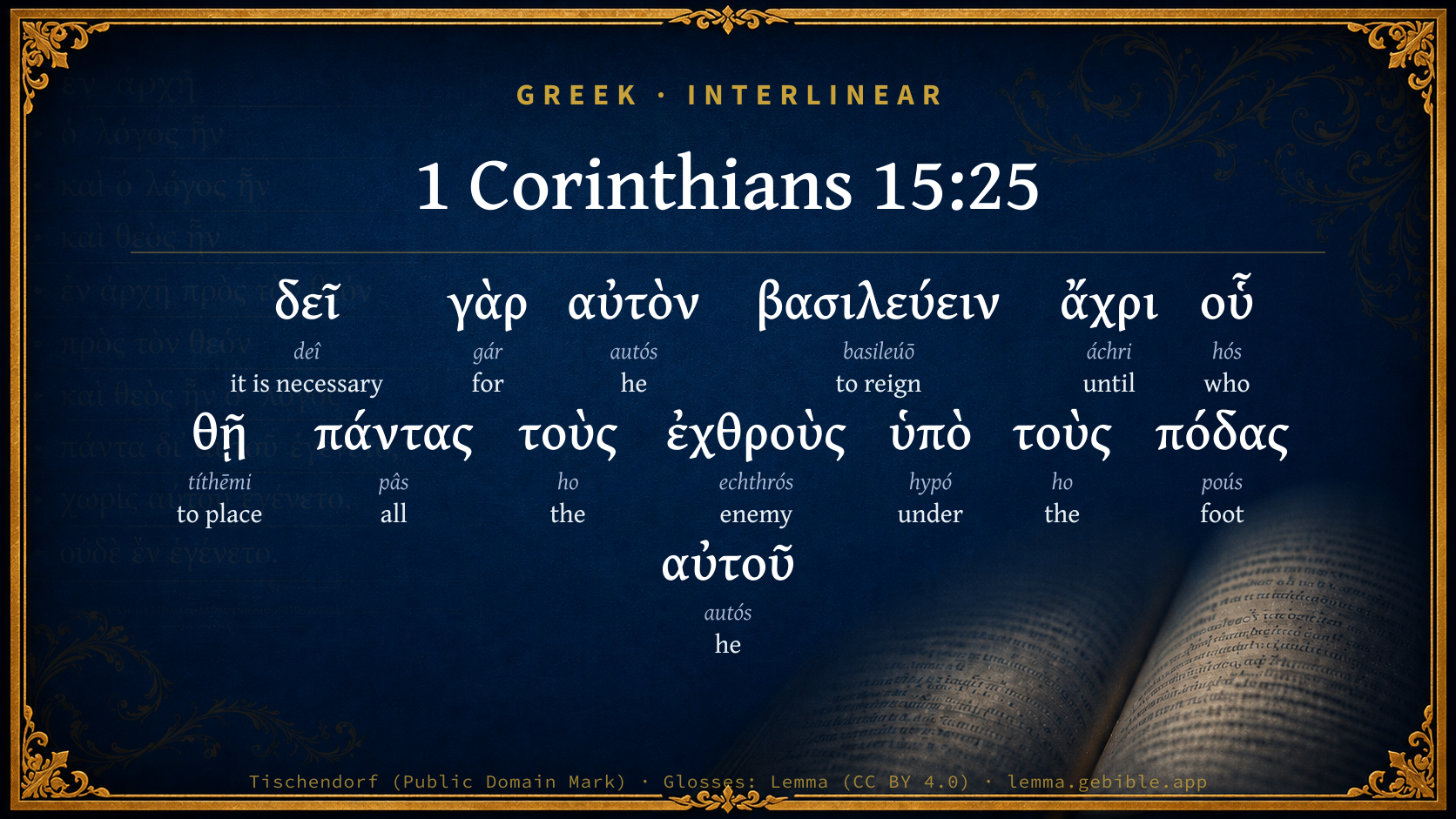
  1. δεῖ deî G1163 “it is necessary” Verb, Present, Active, Indicative, 3rd person, Singular
  2. γὰρ gár G1063 “for” Conjunction
  3. αὐτὸν autós G846 “he” Personal pronoun, Accusative, Singular, Masculine
  4. ἄχρι áchri G891 “until” Adverb
  5. οὗ hós G3739 “who” Relative pronoun, Genitive, Singular, Masculine
  6. θῇ títhēmi G5087 “to place” Verb, Aorist, Active, Subjunctive, 3rd person, Singular
  7. πάντας pâs G3956 “all” Adjective, Accusative, Plural, Masculine
  8. τοὺς ho G3588 “the” Article, Accusative, Plural, Masculine
  9. ἐχθροὺς echthrós G2190 “enemy” Adjective, Accusative, Plural, Masculine
  10. ὑπὸ hypó G5259 “under” Preposition
  11. τοὺς ho G3588 “the” Article, Accusative, Plural, Masculine
  12. πόδας poús G4228 “foot” Noun, Accusative, Plural, Masculine
  13. αὐτοῦ autós G846 “he” Personal pronoun, Genitive, Singular, Masculine

About this verse

These counts appear in no published source. They are computed here, from the morphology-tagged text and Lemma’s own curated glosses. What Lemma adds →

14
words
12
distinct lemmas
Pauline Epistles
section

Notable vocabulary

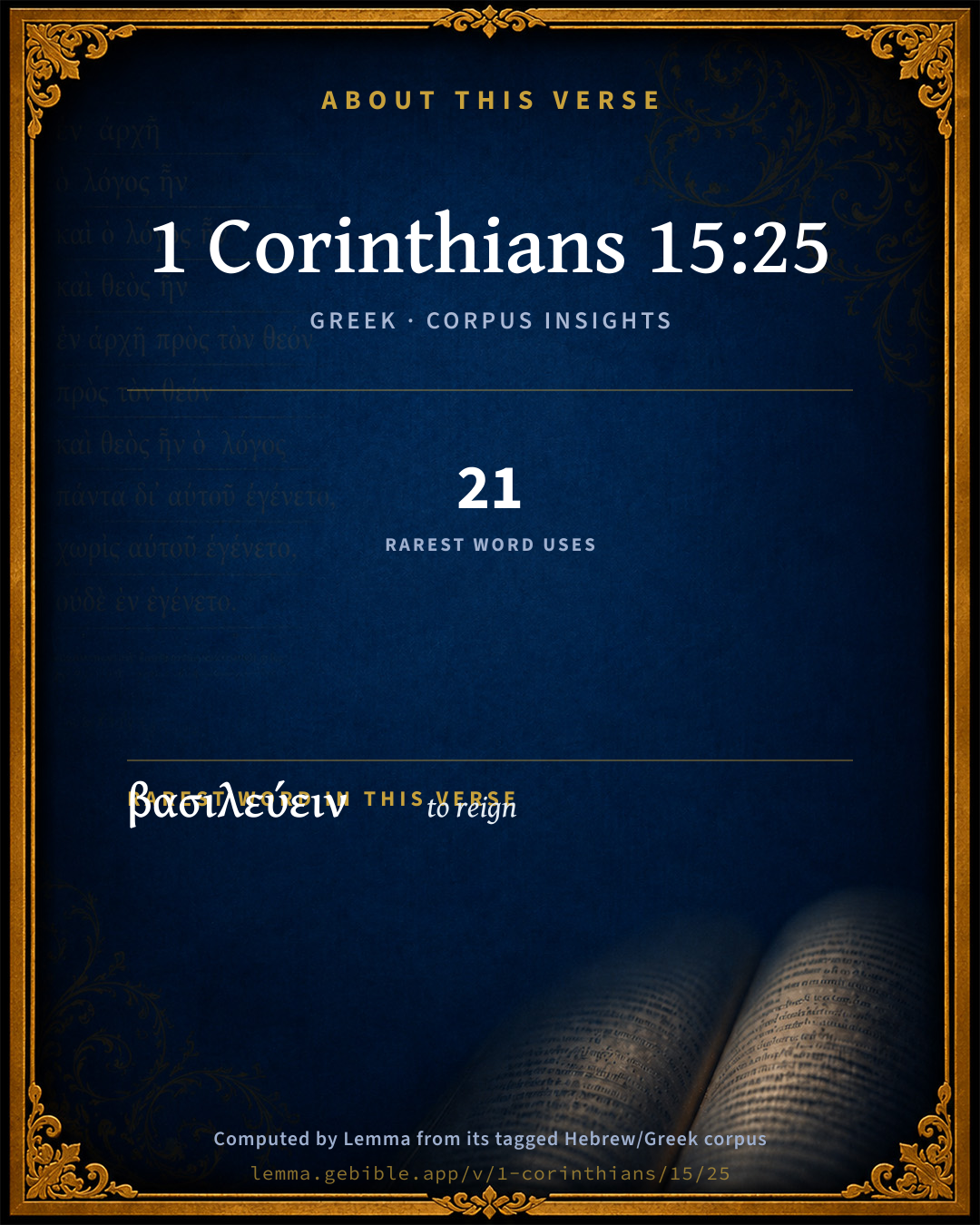
The rarest word here is βασιλεύειν to reign G936 — appearing just 21 times in the whole Greek New Testament.

Shared distinctive vocabulary

βασιλεύειν to reign G936 occurs in 18 verses of the Greek New Testament. Also found in:

Repetition

Words recur within this verse:

  • αὐτὸν he G846 ×2
  • τοὺς the G3588 ×2

Cross-references

10

Topical passages linked to 1 Corinthians 15:25 in the Treasury of Scripture Knowledge — connected by theme and wording, ordered by reader-vote popularity; previews shown in the World English Bible.

  • Psalms 110:1 Yahweh says to my Lord, "Sit at my right hand, Until I make your enemies your footstool for your feet."
  • Hebrews 10:12–13 but he, when he had offered one sacrifice for sins for ever, sat down on the right hand of God;
  • Matthew 22:44 'The Lord said to my Lord, Sit on my right hand, Until I make your enemies a footstool for your feet?'
  • Psalms 2:6–10 "Yet I have set my king on my holy hill of Zion."
  • Hebrews 1:13 But of which of the angels has he said at any time, "Sit at my right hand, Until I make your enemies the footstool of your feet?"
  • Ephesians 1:22 He put all things in subjection under his feet, and gave him to be head over all things for the assembly,
  • Psalms 45:3–6 Gird your sword on your thigh, mighty one: Your splendor and your majesty.
  • Mark 12:36 For David himself said in the Holy Spirit, 'The Lord said to my Lord, Sit at my right hand, Until I make your enemies the footstool of your feet.'
  • Acts 2:34 For David didn't ascend into the heavens, but he says himself, 'The Lord said to my Lord, "Sit by my right hand,
  • Luke 20:42–43 David himself says in the book of Psalms, 'The Lord said to my Lord, "Sit at my right hand,

Cross-references courtesy of OpenBible.info (CC BY 4.0).

Commentary

Notes on 1 Corinthians 15:25 from classic Christian and Jewish commentators (each source and its license shown beneath its notes). The classic Christian expositions comment on the surrounding passage and are grouped to its opening verse, so a note may address several verses; the Jewish commentaries on the Tanakh (Rashi and others) are per-verse, so they appear only where the commentator wrote on this verse.

Lemma curates 59 commentaries, every one of them public domain or Creative Commons licensed, each selected and text-cleaned for this edition rather than reprinted as found. About our sources →

The Biblical Illustrator

Joseph S. Exell

1Co_15:25

For He must reign, till He hath put all enemies under His feet.

The reign of Christ

This world is His battlefield now; and when this conflict is at an end there will be an end to something else, He shall reign till--, and no longer.

I. Who are Christs enemies?

1. All those agencies in the world which are opposed to God. Christ is on the throne for God; so that whatever in evil spirits, in bad men, in society, in institutions, habits, experiences, is warring against God, is against Christ, and He is against it.

2. All those agencies in the world which are against us. He is on the throne for us. Our cause is His. Every evil which injures or threatens us.

(1) All our intellectual enemies--ignorance or error.

(2) All our moral enemies--sin in every form.

(3) All our physical enemies--pain, sickness, disease, death--all these are included among Christs enemies.

3. We may answer the question by referring to Christs life in the flesh. He came here to do battle; and all His life He was engaged in the conflict, attacking--not men; He never touched a man in any way but to bless him--but He was in conflict with all the powers of evil of which men were the instruments and victims. And the battle is still the same. Through His true people He is now carrying on the war with ignorance, unrighteousness, pain. And we may be sure that He will be victorious, not only because it is said in the Bible, and we therefore believe it, but because it is God that is engaged in the conflict.

II. What should be our supremest cares in reference to this great conflict?

1. To be ourselves delivered. We must each ask himself, will He put my enemies under His feet? It depends on whether you will let Him undertake for you. Your faith must lay hold of His strength.

2. To take our part in it on His side. In this great conflict there is no neutrality. And for what reasons should it be our great care to range ourselves in this battle on His side? Because--

(1) It is an honourable service. Frenchmen speak with no unnatural pride of having served under the Great Napoleon. Something of the lustre of the name and achievements of the great captain is reflected in his humblest follower. And so it is in the spiritual conflict.

(2) Christ has a claim upon our service. It is our cause that He is contending for, and it cost Him His life.

(3) It is a strife for goodness and human happiness.

(4) There is victory with that side.

3. To engage ourselves in that part of the field where spiritual evils are the enemies combated against. Noble is it to follow Christ in the war He waged with physical evils; but the noblest work is to spread Christs truth, for where that is spread all evils diminish. And further, what is the life of the body compared with the life of the soul? (D. Thomas, B.A.)

Christs conquests

This world is a vast stage erected for the display consummation of a mighty design by the power of the Lord Jesus. Scripture has distinctly affirmed that all things were created by Him and for Him. The world was made for Jesus; and man, the most distinguished of its tenants, was called into existence chiefly that he might add to the Mediators glory. In His glory the eternal blessedness of millions is involved; and the consummation of His mighty work will be the seal and fulness of the felicity of the redeemed. Now in the management of this stupendous design, the Mediator is pursuing His way to the glory which awaits Him through the midst of foes. There are foes in whose destruction we may not be able to trace any of that consolation which it is the apostles object to afford. The priests and Scribes of Israel constituted themselves His personal enemies, and the stone which the builders rejected has fallen upon them and crushed them to powder; but our comfort or advantage appears to be this, that the enemies rather of the Saviours cause than of His person are spoken of; and with that cause Jesus has so entirely identified Himself, that He reckons hostility to it as hostility against Himself. There is--

I. Satan, who from the first has evinced himself the foe of the cause of Jesus. But his power is day by day contracting; and one by one are his strongholds wrested out of his hands. His most formidable opposition was his personal struggle with the Saviour, in which he enjoyed a momentary triumph; but it was a triumph which placed a lever underneath the foundations of his throne. The gospel of which that days achievement forms both the power and the theme, has gone forth under the sanction of the Redeemers command, over those tracts and territories where the god of this world had long held unbroken sway. And the means by which the Saviour has enlarged His kingdom are marvellous. Satan, as he was upon the day of the worlds redemption, is defeated with his own weapons. Though covetousness may have sent ships to far distant shores, and rapine may have subjugated one country to another, and injustice may have torn the slave from kindred and from home--still see we not, that in more territories being laid open to the inroads of the gospel, and other influences being brought to bear upon benighted lands, that Satan has been foiled by superior wisdom, and the empire of the Mediator increased by his defeated policy!

II. Corruption in the hearts of Gods believing people. The Mediators most glorious title is the King of Saints; and that which chiefly prevents Him from being so now, in the fulness and majesty of the expression, is the existence of that secret and unholy principle in the hearts of Christians. But this corruption under the laws of the Mediators reign is destined at length to be totally dethroned. The work of subduing it is one of mystery and time, and for the subduing of it Jesus has a train of instrumentalities at His disposal. By troubles, trials, disappointments, the hand of illness and bereavements. In every child of God it is daily waxing more feeble, which shows that, ultimately, it must be utterly extinguished, for Jesus must reign, etc.

III. The ungodly. These may not all take Paine for their text-book, or Voltaire for their leader; but yet from the circumstance of their being unconverted; they must be reckoned among His enemies. The carnal mind is enmity against God--They that are in the flesh cannot please God. Now such the Mediator will put under His feet. Contrary to the usual course of His government, He will do little towards effecting this object here. But, while an enemy remains unpunished, the throne of the Mediator must stand.

IV. Death. The trophy and the triumph of the Satanic hosts. It was among the firstfruits of their victory. But in the arrangements of the Mediators rule this enemy is destined for destruction! Even now is his power abridged, and his strength much departed from him; for Jesus has gone down into deaths domains, and, in the dark seclusion of the tomb, passed through a conflict with him, from which He has returned a conqueror! And this victory He perpetuates in the persons of the members of His kingdom; for there is not one of them who feels not that death, though he may awe, can no longer terrify. Even upon this world, death to them has ceased to be an enemy; but oh! if we would see him, not simply shorn of his strength, but stripped of his existence, we must throw forward our glance to the resurrection morning. That hour shall see all enemies subdued. (Dean Boyd.)

The victories of Christianity

How real was the faith of St. Paul! Only some twenty years had passed since the Crucifixion. The memory of it was fresh; the shame and stigma recent. Nevertheless, the apostle declares his faith not only in the resurrection of Jesus, but in His universal dominion. The vividness and reality of the apostles faith was common to all the Christians of that first age, and is very quickening and reassuring to ours. When St. Paul wrote these words the believers were but a handful. As yet they had mastered no stronghold of the enemy. In but three or four of the great cities of the world they had barely effected a lodgment. At Rome they had scarcely as yet been heard of. And yet says the apostle, He must reign, etc. The apostles great word is now in course of fulfilment. Though even yet we by no means see all things put under Christ, still the pledge has been already afforded of victory in every kind and over every form of opposition. We have but to pursue the advantages we have gained.

I. The earliest triumphs of Christianity over idolatry are the pledge to us of her ultimate victory over every form of heathenism.

1. The two great historical triumphs were--

(1) Over classic paganism and other old-world idolatries. When Paul and Barnabas set forth from Antioch on the first missionary advance, the whole world was wholly given to idolatry. Heaven, earth, ocean, and the great underworld teemed with divinities. Idolatry coloured all life, embraced every relation of being, held all things whatsoever under its spell and its thraldom. How wonderful an undertaking, then, was it for the obscure missionaries to set forth upon their errand! Can we wonder greatly that John and Mark shrank back from such an enterprise? And what must have been the courage and faith of Paul when, in the renowned eve of Greece, he stood up, without a friend or comrade, to challenge alike philosophers and idolaters? or when he undertook at Corinth--the lascivious and the worldly--to preach Christ and Him crucified, as Wisdom, Righteousness, and Sanctification, and Redemption? or when he planted himself at Ephesus, where all the inhabitants were fanatics in their worship of their great goddess? But the word of God everywhere grew mightily and prevailed. And so with the other Christian pioneers. The work spread and leapt from province to province, from shore to shore, from age to age. About the beginning of the second century, Pliny wrote that in Bithynia the new faith had so spread that the temples were everywhere deserted. Half a century later Justin Martyr testifies that there was no nation in whose language prayers and thanksgivings were not offered to God in the name of Jesus. Yet a little later--Tertullian grandly boasts that, though but a people of yesterday, the Christians had filled every place except the heathen temples. For three centuries did the Roman State keep up a relentless persecution, but all in vain. At length, Diocletian having exhausted in vain all the resources of power and cruelty, the Christian Church came forth finally victorious.

(2) Scarcely, however, was this struggle over before another began. After the destruction of the Western Empire by the barbarian invaders, Christianity had to address itself anew to the task of conquering the conquerors of the world. But the Northern tribes in succession came within the pale of Christian profession. The Christian faith survived the wreck of all things else. A deep, dense night rested upon the face of the mingled nations. But the Spirit of God in the midst of the thick darkness was moving upon the chaotic waters, and by the results, when the curtain began to lift, we know that the work was going on. The victory over the Northern barbarians won Europe for Christ, and we inherit its results in the purer, more vigorous and enlightened Christianity of to-day.

2. These things being so, how can we doubt what the results must be of the contest now being waged by Christianity against heathenism? The Christianity of the present day is in all respects superior to that of the age of Constantine, and to that which overcame the heathenism of the Goth, the Teuton, and the Kelt.

(1) How then can the heathenism of India and China withstand it? As a matter of fact, the progress of Christianity in some parts of India, and especially in Ceylon, during the last forty years has been such as to demonstrate that in less time than it took for our holy religion to vanquish Roman idolatry the heathenism of India shall yet yield to the power of Christs gospel. As for China, we have hardly taken hold of its fringe, but we have already seen enough to prove that the power of Christianity needs only to be faithfully applied by an adequate missionary force, and China, like all the world besides, must yield to the gospel.

(2) As for the barbarian idolatries of to-day, we have evidence all the world over how surely and swiftly they are vanquished by the word of Christ. The negro race has already largely yielded to the truth. New Zealanders and American Indians, Fijian and Burmese have accepted the faith of Jesus. Everywhere the like result must follow.

II. In the past successes of Christianity we have a pledge of the triumph of free and pure Christian faith over Popish tyranny and corruption.

I. Popery proper, the special creation of the Roman Ecclesiastical Court and Empire, is a priestly growth and usurpation. It is a selfish corruption--and throughout there has been a struggling protest against it. There has been a lay mind in continual revolt, and many even among the priesthood abhor the yoke by which they are bound. The pretensions of the Papacy are doubtless as arrogant and as blasphemous as ever. But this is perfectly consistent with the real weakening of the Roman power. Pius IX could not enact the part of a Hildebrand, though he did summon a so-called OEcumenical Council. He could claim for himself infallibility, but he could not set his foot upon the neck of princes nor cast an interdict over an empire. He could not even prevent his holy city from being wrested from his hands and made the capital of a free kingdom. The Pope is no longer the great Potentate of the world.

2. The effect of the Vatican Council has been to produce alienation in the minds of the noblest among those who felt the spell and attraction of a Church so ancient, so vast, and in many respects so grand in its memories and its achievements.

3. Immense was the power of the Papacy, forty years ago, over every Catholic country of Europe. Now there is scarcely one land in which religion is not, at least professedly, free, and the gospel of Christ in its purity is not more or less preached.

4. Now if the Christianity of the fourth century prevailed to subdue the Imperial heathenism of Rome, much more shall the purer, more powerful, and better organised evangelical Christian life and truth of to-day prevail over this Papal heathenism. What is needed is that the truth and the falsehood should be distinctly defined and discriminated, that the gospel should be known as gospel, and the heathen superstition discerned as heathen superstition. If we cannot yet say that Babylon is fallen--though assuredly some of its grandest towers have been overthrown never to be restored--we may at least be confident that the politico-ecclesiastic power of Rome is now at an end, and that she can no longer, as in the past, cause the nations to drink of the mingled cup of her abominations.

III. The past victories of Christianity over heathen and sceptical philosophy are the pledge of its future triumphs. It is often said that science is the great enemy of faith. But science, as such, has nothing to say as to the contents of Revelation or the articles of our faith. Its proper sphere lies wholly apart. Some of the profoundest men of science have found no incompatibility whatever between their science and the faith of a Christian. It remains, accordingly, that the sources of scepticism must be in what are called philosophical doubts or in historical criticism.

1. Whether Atheistic or Pantheistic in its form, Philosophical Scepticism can never extensively prevail. It has many times striven to assert itself against the Christian faith, but always only to be defeated. Of old the philosophy of Epicurus and his school was overborne by the living witness of Christianity. The philosophers, whether Stein or Platonic, could not arrest the triumphant progress of St. Paul. The Pantheistical Neo-Platonism of Alexandria did its utmost to oppose the power of Christianity, but in the end was entirely overthrown. In modern times Hume found his subtlety vain against the rising tide of evangelical faith and power. The infidelity of France was rebuked and put to shame by the horrors of the French Revolution, so manifestly the fruit of French infidelity. And to-day what is the weight, the force, of speculative philosophy in comparison of the living powers and forces of Christianity, which were never so mighty as they are at this present time?

2. As to historical criticism, the essential arguments on behalf of Christianity to-day are the same as those which triumphed in the last century. The forms of objection are, doubtless, varied, and the details differ, but the nature of them is essentially the same, and the answer is essentially the same. The victory won in the last century will not be lost in this. And to-day the vaunting foes of Christianity are boldly met, and the battle is turned to the gate. Never was there so goodly a company of Christian believers gathered from every rank of life, and including not only men of ordinary capacity and of average character and influence, but the highest intellects and the most influential personalities in the land. (J. H. Rigg, D.D.)

Good news for loyal subjects

Must is for the king; and concerning King Jesus there is a Divine necessity that He must reign. He was once the King of misery--in that kingdom He reigned supreme. That thorn-crown is pre-eminent in the sorrows which it signifies. To-day He is the King of glory, enthroned far above all principalities and powers. He must reign because He is God. The Lord reigneth must ever stand a truth. He must reign as man; for the Lord has made a covenant with David that of his seed there should sit upon the throne of Israel for ever a King to rule in righteousness, and Jesus of Nazareth is that King. He must reign also as the Mediator. At this time the sovereignty of the world is committed to His keeping, the headship of His Church, the government of providence, the ruling of heaven, and earth, and hell, as the mediatorial monarch.

I. What are thy reasons for this must? The lamb as seen by John had seven horns of power, and here are seven reasons why he should possess the throne for ever.

1. His empire in itself is such as to ensure perpetuity. There have been many empires of which men said that if they were overthrown, the very pillars of the earth would be removed; yet in due time they were swept away. Christ must reign because--

(1) His reign over the human mind is based upon truth. At one time Plato reigned supreme over thoughtful minds; then Aristotle; but another philosophy supplanted him, to be in its turn subverted by the next. Things which were accounted sure and wise are now ridiculed. And why? Because these systems of philosophy and thought have not been based upon truth. But the truth which Jesus taught, reads as if it were delivered but yesterday. Christianity is as suitable to the nineteenth century as to the first.

(2) His dominion over human hearts is based upon love. Napoleon said at St. Helena:--My empire has passed away. I founded it upon the sword, and it is gone. Jesus Christ established an empire upon love, and it will last for ever. His person is the incarnation of love, His teachings are the doctrines of love, His precepts are the rule of love, His Spirit is the creator of love, His whole religion is saturated with love, and because of this His kingdom cannot be moved.

(3) It is the one great remedy which this sad woe-begone world requires. The world is like the troubled sea that cannot rest, and there is but one foot which can tread its waves, and but one voice which can say, Peace, be still. Jesus is the true liberator of captive nations. The agonising groans of earth demand the sovereignty of Jesus, and therefore we believe that He must reign, for God will yet give His creature what it needs. His Father decrees it. Up till now God has maintained the throne of His Son. Read Psa_2:1-12 and see.

3. Divine justice demands it. The Father promised that He should be a leader and a commander of the people, and determined as the result of His humiliation that He should mount to a superior throne as the Son of man and the Son of God. Shall God belie His word?

4. It is inwrought into the order of providence. A few months ago the trees were bare; but it was in the order of providence that there should be a spring, and here it is. We cannot say that in any one day it seemed to make any great advance. Even when the days lengthened we saw no great progress, but, surely and steadily the veins of the trees were filled with sap and the buds first swelled and then revealed their glories. So Christs reigning is woven into the warp and woof of providence, and though He has not yet drawn all men unto Him, it is coming.

5. The Holy Spirit has been given to the Church to subserve this glorious end. He can soften the most obdurate, He can turn to kindness the most cruel, and lead into light the most darkened. Now, the possession of the Holy Spirit is the Churchs treasury. Here is her battleaxe, and here are her weapons of war. You who preach Christ, or teach Him in the school, do not become discouraged under difficulties, when you recollect that you are workers together with God.

6. Christ is naturally the chief of the human race. He is the chief among ten thousand and the altogether lovely. There is none to rival Him.

7. The power to reign belongs to Him. All power is given unto Me in heaven and in earth. Go ye, therefore, saith He, and teach all nations. Jesus Christ is no puny pretender to the throne, nor a rightful owner without power to win His own, but as His cause is good, His arm is strong. Ours is no desperate warfare, but a royal crusade, in which every soldier is even now a priest and a king, and is on the way to the banquetting-halls where men feast with God, and Jesus for ever and ever wears the fadeless diadem.

II. The encouragement to be gathered from this must. If Christ must reign, then--

1. All our enemies shall be subdued,

(1) Now, you are called to fight daily with sin, and here is your consolation, Jesus must reign. The Christ in you must bruise Satan under your feet. He shall put His foot on the neck of my pride, and shall command my every thought and wish. Where I cannot rule, Jesus can. Jesus has made us kings and priests that we may reign over the triple monarchy of our nature--spirit, soul, and body, and that, by our self-conquest, He may be undisputed sovereign of the Isle of Man. Corruption is very strong, but Christ is stronger.

(2) When the last enemy appears in view, it shall only be an opportunity for new triumphs, when the Lord of life shall reveal Himself with renewed splendour.

2. Our efforts are, after all, not in vain. If Christ must reign, then every soldier who fights for Christ is contributing to the victory, and every one who in any way advances the cause is working with sure and great results.

3. What becomes of us is of no consequence at all. If He will only take me into the royal galley, and let me pull till I have no more life left, I will be satisfied, if I may but row my Lord towards His throne, and have but the smallest share in making Him glorious in the eyes of men and angels. What cares my heart for herself if she may but see Jesus set on high? How this ought to inspirit all of you who grow downhearted about the cause of Christ! Do you not believe in the gospel as the power of God?

III. An admonition.

1. Jesus must reign. You have been opposing Him, have you? You are kicking against the pricks with naked feet: you are stumbling upon this stone, and you will be broken; and if the stone shall take to rolling down, like a massive rock, on you, it will grind you to powder.

2. If Jesus Christ must reign, then you who have never submitted yourselves to Him to accept Him as your monarch, will find His reign as terrible as it is sure. He will reign over you, either by your own consent or without it. (C. H. Spurgeon.)

The Biblical Illustrator, edited by Joseph S. Exell (c. 1880s–1900s) — public domain. Text from a community e-Sword module.

Joseph Benson's Commentary

1Co 15:25-27. For he must reign — Because so it is written, Psa 110:1; till he — God the Father; hath put all enemies under his feet — That is, till he hath utterly subdued them to Christ, that he may destroy them. The last enemy that shall be destroyed is death — That enemy which continues, in some measure, to hold the subjects of Christ under his dominion, even when the temptations of the world, and the malice of Satan, can hold them no longer, and when every remainder of corrupt nature and human infirmity has long since ceased in the perfect holiness of the intermediate state. Macknight, who renders this verse, the last enemy, death, shall be destroyed, observes, that “the common version of this passage implies that there are some enemies who shall not be destroyed, which is wrong: for all enemies shall be destroyed, 1Co 15:25.” Nor is it true in every sense, that “because death is called the last enemy, it is to be last destroyed: for if the destruction of death is to be accomplished by the resurrection, the devil and his angels, and wicked men, are to be judged and punished after the dead are raised. In Chrysostom’s opinion, death is called the last enemy, because he entered into the world after the devil and sin entered.” For Satan brought in sin, and sin brought forth death. There is a sense, however, in which it may be affirmed that death is the last enemy that is destroyed; for when Christ engaged these enemies, he first conquered Satan, namely, in his temptation, then sin in his death, and lastly, death in his resurrection. In the same order he delivers all the faithful from them, yea, and destroys their power. Death he so destroys, that it shall exist no more; sin and Satan, so that they shall no more hurt his people. For he hath put all things under his feet — Agreeably to what is said, Psa 8:6. But — As is sufficiently evident; when he saith all things are put under him — In the last-mentioned passage, and as is implied in many others; he — The Father; is excepted, who did put all things under him — This declaration concerning the Father’s not being subject to the Son, was intended to prevent us from interpreting what is said of the extent of the Son’s dominion, in such a manner as to fancy that he is in any respect superior to the Father.

Joseph Benson's Commentary on the Old and New Testaments (1811–1818) — public domain. Text from a community e-Sword module.

Tyndale Open Study Notes

Tyndale Open Resources

15:25 This paraphrase of Ps 110:1 is applied to Jesus (cp. Heb 1:13). • beneath his feet: In the ancient Near East, victorious kings were depicted with their feet on the necks of their defeated enemies.

Tyndale Open Study Notes — © Tyndale Open Resources, licensed CC BY-SA 4.0. Text via the HelloAO Bible API.

Bengel's Gnomon

Johann Albrecht Bengel

1Co 15:25. Δεῖ, He must) for it has been foretold.—αὐτὸν, He) Christ.—βασιλεύειν, reign) ררה, reign Thou in the midst of Thy enemies, Psa 110:2.—ἄχρις οὗ ἄν, until) There will be no further need of the mediatorial reign.—θῇ, He hath put) viz. the Father.—πάντας, all) Paul brings in this, to prepare for a transition to what follows.—τοὺς ἐχθροὺς, enemies) bodily and spiritual, supply His, from that expression, His feet, to wit, the Son’s: but it is now elegantly elliptical; since Christ has long ago destroyed these enemies, in so far as they were the enemies of Christ; He will destroy them [their destruction is still future], in so far as they are our enemies. The remaining part of His victory bears the same relation to His triumph already achieved, as any frontier or corner does to the whole extent of any human monarchy which has been subdued.

Bengel's Gnomon of the New Testament — English translation (T&T Clark, Edinburgh, 1860) — public domain. Text from a community e-Sword module.

Meyer's Critical & Exegetical Commentary

Heinrich August Wilhelm Meyer

1Co_15:25-28. Establishment of the fact that Christ will not deliver up the kingdom until after the doing away of every dominion, etc. (1Co_15:25-27, down to πόδας αὐτοῦ), but that then this abdication will assuredly follow (1Co_15:27-28).

For He must (it is necessary in accordance with the divine counsel) reign (wield the Messianic government) until, etc. The emphasis of the sentence as it advances falls on this until, et.

ἄχρις οὗ κ.τ.λ.] words taken from Psa_110:1,a Messianic psalm, according to Christ Himself (Mat_22:43 f.),which Paul does not quote, but appropriates for himself. The subject to θῇ is not God (so even Hofmann), but Christ (so Rückert, de Wette, Osiander, Neander, Ewald, Maier, comp. already Chrysostom), which is necessarily required by the preceding αὐτόν, and by καταργήσῃ in 1Co_15:24, to which θῇ κ.τ.λ. corresponds.[54] Not till 1Co_15:27 does God come in as the subject without violence and in harmony with the contex.

ἄχρις οὗ indicates the terminus ad quem of the dominion of Christ, after which epoch this dominion will have ceased; see on 1Co_15:24. The strange shifts which have been resorted to in order to maintain here the subsequent continuance of the rule of Christ (οὗ τῆς βασιλείας οὐκ ἔσται τέλος was added to the Nicene Creed in opposition to Marcellus in the second Oecumenical Council), may be seen in Estius and Flatt. His kingdom continues, but not His regency, 1Co_15:24. The seeming contradiction to Luk_1:33 (Dan_7:14) is got rid of by the consideration that the government of Christ lasts on into the αἰὼν μέλλων, and that after its being given over to the Father, the kingdom itself will have its highest and eternal completion (1Co_15:28); thus that prophecy receives its eschatological fulfilment.

[54] We are not, however, on this account to write πόδας αὑτοῦ instead of π. αὐτοῦ; the pronoun has proceeded from the standpoint of the writer.

Meyer — Critical and Exegetical Commentary on the New Testament — English translation by Peter Christie, edited by Frederick Crombie (T&T Clark, 1880) — public domain. Text from a community e-Sword module.

Expositor's Greek Testament

ed. W. Robertson Nicoll

1Co 15:25 sustains the representation of the τέλος just given by prophetic words of Scripture ( cf. 1Co 15:3 f.): “For He must needs reign, until He has put all the enemies underneath His feet”. Not till every enemy of God is vanquished can Christ’s existing kingdom reach its end. P. is thinking of the culmination, not the cessation, of Christ’s kingship (see note on παραδιδῷ , 1Co 15:24 ). πάντας is added to the text of the Psalmist, as if to say: “ Every one of the foes proscribed in the Messiah’s charter must submit, before He can present to His Father a perfect kingdom”; see parls., for other applications of this cardinal O.T. dictum. On δεῖ , see note to 1Co 8:2 . ἄχρις οὗ radically “up to,” rather than “until, (the time at) which” in later Gr [2377] takes sbj [2378] of future contingency dispensing with ἄν (Wr [2379] , p. 371) .The words of Psa 110 . are freely adapted: θῇ gets its subject from αὐτόν , viz. Christ not God , as imported by Est., Bz [2380] , Bg [2381] , Hf [2382] , Gd [2383] , to suit the Ps.; it is parl [2384] in tense-construction to καταργήσῃ (1Co 15:24 , see note).

[2377] Greek, or Grotius’ Annotationes in N.T.

[2378] subjunctive mood.

[2379] Winer-Moulton’s Grammar of N.T. Greek (8th ed., 1877).

[2380] Beza’s Nov. Testamentum: Interpretatio et Annotationes (Cantab., 1642).

[2381] Bengel’s Gnomon Novi Testamenti.

[2382] J. C. K. von Hofmann’s Die heilige Schrift N.T. untersucht , ii. 2 (2te Auflage, 1874).

[2383] F. Godet’s Commentaire sur la prem. Ép. aux Corinthiens (Eng. Trans.).

[2384] parallel.

The Expositor's Greek Testament, edited by W. Robertson Nicoll (1897–1910) — public domain. Text from a community e-Sword module.

Hodge's Commentary on Romans, Ephesians & First Corinthians

Charles Hodge

1Co_15:25

For he must reign, till he hath put all enemies under his feet.

This verse assigns the reason why Christ cannot relinquish his dominion over the universe as mediator until the end comes, and why he will then deliver it up. He must reign until the purpose for which he was invested with this universal dominion is accomplished. As in Psa_110:1-7 it is said to the Messiah, Sit thou on my right hand until I make thy enemies thy footstool, many assume that God is the subject of the verb has put. The meaning would then be, He must reign until God has put all his enemies under his feet. But this is inconsistent with the context. Christ is to put down all rule, authority and power, 1Co_15:24, and he reigns until he has accomplished that work. The two modes of representation are perfectly consistent. The Father created the world, though he did it through the Son, Heb_1:3. The work, therefore, is sometimes ascribed to the one and sometimes to the other. In like manner the Father subdues the powers of darkness, but it is through Christ to whom all power in heaven and earth has been committed. It is therefore equally proper to say that God makes the enemies of Christ his footstool, and that Christ himself puts his enemies under his feet. The enemies who are to be thus subdued are not only intelligent beings hostile to Christ, but all the forms of evil, physical and moral, because death is specially included. By subduing, however, is not meant destroying or banishing out of existence. The passage does not teach that Christ is to reign until all evil is banished from the universe. Satan is said to be subdued, when deprived of his power to injure the people of God. And evil in like manner is subdued when it is restrained within the limits of the kingdom of darkness.

Charles Hodge — Commentary on Romans (1835), First Corinthians (1857), and Ephesians (1856) — public domain. Text from a community e-Sword module.

Geneva Bible (1599)

Geneva Bible translators

Christ is considered here, as he appeared in the form of a servant, in which respect he ruleth the Church as head, and that because this power was given him of his Father.

Geneva Bible (1599) marginal notes — public domain. Text via Bolls.life.

Jamieson, Fausset & Brown

Robert Jamieson, A. R. Fausset & David Brown

must--because Scripture foretells it.

till--There will be no further need of His mediatorial kingdom, its object having been realized.

enemies under his feet-- (Luk 19:27; Eph 1:22).

Jamieson, Fausset & Brown — Commentary Critical and Explanatory on the Whole Bible (1871) — public domain (CC PDM 1.0). Text via the HelloAO Bible API.

Adam Clarke's Commentary

Verse 25. For he must reign, c.] This is according to the promise, Ps 110:1: "The Lord said unto my Lord, Sit thou at my right hand, until I make thine enemies thy footstool." Therefore the kingdom cannot be given up till all rule and government be cast down. So that while the world lasts, Jesus, as the Messiah and Mediator, must reign and all human beings are properly his subjects, are under his government, and are accountable to him.

Adam Clarke's Commentary on the Bible (1810–1826) — public domain. Text from a community e-Sword/MySword module.

Ellicott's Commentary for English Readers

(25) He must reign.—It is a moral consequence. God must triumph, and so the Son must reign and conquer till that triumph be complete. Some suggest that the force of these words is that He must reign, &c., because it has been prophesied (Ps. ex.); but the more obvious truth is that it was prophesied because it is morally necessary.

A Bible Commentary for English Readers, edited by Charles John Ellicott (1878–1897) — public domain. Text from a community e-Sword module.

The Cambridge Bible for Schools and Colleges

gen. ed. J. J. S. Perowne

25. For he must reign] i.e. Christ as Man and Mediator. For at present we can only discern God through the medium of Christ’s Humanity. Cf. St Joh_12:45; Joh_14:9. In the end, we shall be able to ‘see Him as He is,’ 1Jn_3:2. For the present He must reign in His Church, in His sacraments and ordinances, in His ministers, ecclesiastical and secular (Rom_13:4; Rom_13:6), all of them (see last note) the reflex of His power as He sits at God’s Right Hand.

till he hath put all enemies under his feet] Either (1) the Father, Who put all things under His Son, or (2) Christ, Who puts all things under His own feet. The analogy of Psa_110:1 (cf. St Mat_22:44) would cause us to suppose the former; the grammatical construction, as well as the course of the argument, the latter. The enemies are all who ‘oppose and exalt themselves above all that is called God or an object of worship’ (2Th_2:4), and therein especially pride of rank, wealth, intellect, reason, whatever casts off or disowns the universal empire of God. Cf. Eph_1:21-22; Php_2:10; Php_3:21 (in the Greek); Heb_1:4. “This passage,” says Cyril of Jerusalem, “no more implies a cessation of the reign of Christ than the words ‘from Adam until Moses’ (Rom_5:14) imply a ‘cessation of sin after Moses.’ ”

The Cambridge Bible for Schools and Colleges (gen. ed. J. J. S. Perowne; Cambridge University Press, 1878–1918) — public domain. Text from a community e-Sword module.

John Gill's Exposition

The last enemy that shall be destroyed is death. Not eternal death; for though that is abolished by Christ with respect to his own people, who shall never be hurt by it, and over whom it shall have no power; yet the wicked will always be subject to it, and under the dominion of it: but a corporeal one is here meant; which is an enemy, the fruit, effect, and wages of sin; the penalty and curse of the law; is contrary to human nature, and destructive of the work of God's hands: it is, indeed, through the blood, righteousness, and sacrifice of Christ, become the friend of his people; it is disarmed of its sting, and ceases to be a penal evil; it is the saints' passage to glory, what frees them from the troubles of this world, and is their way to the joys of another; but yet in itself is formidable to nature, and disagreeable to it: and it is the last enemy; it is so both in its rise and duration; it appeared as an enemy last; Satan was the first enemy of mankind, who attacked, tempted, and ruined the first parents of human nature, and all their posterity in them; and by this means, sin, the next enemy, came into the world of men; and, last of all, death, with its numerous train of calamities, either going before, attending, or following of it: and as it was the last enemy that came into the world, it is the last that will go out of it; for when the saints are rid of Satan, and clear of sin, they will remain in the grave under the power of a corporeal death till the resurrection, and then that will be "destroyed": for the saints will be raised to an immortal life, never to die more, and to an enjoyment of everlasting life, in the utmost glory and happiness; and though the wicked when they rise, they will rise to damnation, to shame and contempt, yet their worm will never die, nor their fire be quenched; they will always live, though in torment, there will be no more corporeal death, neither among the righteous nor the wicked; it will be utterly abolished: and thus the apostle, though he seems to digress from his subject awhile, by relating the several things which will either immediately or quickly follow the second coming of Christ; yet at the same time has it in view, and proves the doctrine of the resurrection of the dead, which must needs be, or death cannot be said to be destroyed, and by degrees returns to his subject again.

The last enemy that shall be destroyed is death. Not eternal death; for though that is abolished by Christ with respect to his own people, who shall never be hurt by it, and over whom it shall have no power; yet the wicked will always be subject to it, and under the dominion of it: but a corporeal one is here meant; which is an enemy, the fruit, effect, and wages of sin; the penalty and curse of the law; is contrary to human nature, and destructive of the work of God's hands: it is, indeed, through the blood, righteousness, and sacrifice of Christ, become the friend of his people; it is disarmed of its sting, and ceases to be a penal evil; it is the saints' passage to glory, what frees them from the troubles of this world, and is their way to the joys of another; but yet in itself is formidable to nature, and disagreeable to it: and it is the last enemy; it is so both in its rise and duration; it appeared as an enemy last; Satan was the first enemy of mankind, who attacked, tempted, and ruined the first parents of human nature, and all their posterity in them; and by this means, sin, the next enemy, came into the world of men; and, last of all, death, with its numerous train of calamities, either going before, attending, or following of it: and as it was the last enemy that came into the world, it is the last that will go out of it; for when the saints are rid of Satan, and clear of sin, they will remain in the grave under the power of a corporeal death till the resurrection, and then that will be "destroyed": for the saints will be raised to an immortal life, never to die more, and to an enjoyment of everlasting life, in the utmost glory and happiness; and though the wicked when they rise, they will rise to damnation, to shame and contempt, yet their worm will never die, nor their fire be quenched; they will always live, though in torment, there will be no more corporeal death, neither among the righteous nor the wicked; it will be utterly abolished: and thus the apostle, though he seems to digress from his subject awhile, by relating the several things which will either immediately or quickly follow the second coming of Christ; yet at the same time has it in view, and proves the doctrine of the resurrection of the dead, which must needs be, or death cannot be said to be destroyed, and by degrees returns to his subject again.

1 Corinthians 15:27

co1 15:27

co1 15:27

co1 15:27For he hath put all things under his feet,.... This is a reason proving that all enemies, and death itself, shall be put under the feet of Christ, and is taken out of Psa 8:6 which is spoken of one that is styled man, and the son of man; and is to be understood not of Adam in a state of innocence; for the word there used signifies a frail mortal man, which he then was not, nor could he be called the son of man; and though the earth was subdued and subject to him, and he had dominion over the fish of the sea, the fowls of the air, and every living thing that moveth on the earth, yet all creatures were not subject to him in this large sense, in which it is here and elsewhere explained by the apostle; and much less of man in his fallen state, who instead of having all things under his feet, is become like the beasts that perish; many of them: are unsubdued to him, and he is even in fear of them, and he himself is subject to corruption and vanity: but of the man Christ Jesus, who took and bore all the sinless infirmities of human nature; is often called the son of man; of whom God was mindful, and whom lie visited in his state of humiliation, at the time of his death, resurrection, and exaltation; who was made through sufferings of death a little lower, or a little while lower than the angels, but now crowned with glory and honour; in whose days God ordained strength and praise out of the mouths of babes and sucklings, to the confusion of his enemies; and has put all things under his feet, which may elude all things animate and inanimate, the whole creation and universe of things, the world and its fulness, the earth and all that is therein, the beasts of the forest, and the cattle of a thousand hills; he is heir of the world, and has a right to it, and to dispose of it, not merely as the Creator, but as Mediator; it is put in subjection to him to make use of, and what is in it to subserve his mediatorial kingdom and his glory; when his ends are answered by it, the earth and all that is therein shall be burnt up, and a new earth arise out of it, in which Christ and his people will dwell: the air and all that is therein are under him; the fowls of it are at his dispose; he it was that rained feathered fowls as the sand of the sea, about the camp of the Israelites in the wilderness, and commanded the ravens to feed Elijah in distress; and who holds the winds in his fist, lets them loose, calls them in, and commands them at pleasure; as he also does the sea, and the boisterous waves of it, and has dominion over the fishes in it; one of those supplied him with money, to pay his tribute; and multitudes of them, more than once, were gathered together, and taken up by his order and direction; and at the last day, the sea at his command will give up the dead that are in it; yea, this may extend to all rational creatures, angels and men, friends or foes: good angels, principalities and powers, are subject to him, as appears by their attendance on him: at his incarnation, ascension, and second coming; by their ministration to him in the wilderness, and in the garden; by their employment under him, for the good of the heirs of salvation; by their dependence on him, as their Creator and head, and by their adoration of him as their Lord and God. Evil angels, the devils, are also put under his feet, as is evident from his overcoming Satan, and baffling all his temptations; by his dispossessing the devils out of the bodies of men, and giving his disciples also power over them; by his spoiling them at death, and triumphing over them in his ascension; by delivering his people out of their hands, and power, in conversion; and by his binding of Satan during the thousand years, and by casting him and his angels into everlasting fire prepared for them. Elect men are made subject to him, by the power of his grace upon them; and yet their subjection to him, to his Gospel ordinances, and the sceptre of his kingdom; is voluntary and from their hearts; it proceeds from a principle of love to him; and is universal, being a regard unto, and a compliance with all his precepts; and evil men are also under his dominion and control; he rules them with a rod of iron; he disappoints their counsels, restrains their wrath, overrules their evil designs and actions against his people for good; and will one day gather them all before him, pass the righteous sentence on them, and send them into everlasting punishment. Moreover, this may reach to everything that is for the glory of Christ as Mediator, and for the good of his church, and to every enemy of his or theirs, as the world, sin, Satan, and the last enemy, death; to prove the subjection of all which to Christ, this testimony is produced: and respects Christ as Mediator, and the Father's delivering all things into his hands, and giving him all power in heaven and in earth, and rule over all creatures and things;

but when he saith all things are put under him, it is manifest that he is excepted, which did put all things under him; that is, when David, or the Holy Spirit by him, said the above words, in Psa 8:6 nothing is more clear and evident, than that God the Father, who made all things subject to Christ as Mediator, is himself not subjected to him; since his power as such must be greater than his: this exception is made to secure the government, power, and honour of the Father; for though he has made his firstborn higher than the kings of the earth, yet not higher than himself; and though he has set him his King over his holy hill of Zion, yet not over himself; and though it is his will that all men should honour the Son, as they honour the Father, yet not above him, or more than he; nor has he quitted the government, either in the world or in the church, by subjecting all things to Christ: and this exception is also made to confirm the universal power and empire of Christ, for an exception to a general rule does but the more establish it; and since the Father is only excepted, it is a clear case, that he has left nothing that is not put under him; see Heb 2:8 but it must be observed, that though the Holy Spirit is not mentioned, yet he is equally excepted; since he is the one God with the Father, and was jointly concerned in the mission, unction, and installation of Christ, as Mediator; nor can he be reckoned among the all things put in subjection to Christ, for they regard only creatures, and many of these enemies, with neither of which the Spirit of God can be numbered; and though the gifts and graces of the Spirit are put into Christ's hands, and are at his dispose, yet the person of the Spirit can never be thought to be put under his feet.

John Gill's Exposition of the Whole Bible (1746–1763) — public domain (CC PDM 1.0). Text via the HelloAO Bible API.

Trapp's Complete Commentary

John Trapp

25 For he must reign, till he hath put all enemies under his feet.

Ver. 25. Till he hath put] And after too, but, 1. Without adversaries; 2. Without any outward means and ordinances.

John Trapp, A Commentary or Exposition upon All the Books of the Old and New Testament (1647–1656) — public domain. Text from a community e-Sword module.

Albert Barnes' Notes on the Bible

For he must reign - It is fit, or proper (δει dei), that he should reign until this is accomplished. It is proper that the mediatorial kingdom should continue till this great work is effected. The word “must” here refers to the propriety of this continuance of his reign, and to the fact that this was contemplated and predicted as the work which he would accomplish. He came to subdue all his enemies; see –Psa 2:6-10; or Psa 110:1, “The Lord said unto my Lord, Sit thou at my right hand until I make thine enemies thy footstool.” Paul, doubtless, had this passage in his eye as affirming the necessity that he should reign until all his foes should be subdued. That this refers to the Messiah is abundantly clear from Mat 22:44-45.

Albert Barnes' Notes on the Bible (1834–1885) — public domain. Text from a community e-Sword/MySword module.

Matthew Poole's English Annotations

God hath so decreed, (and what he hath said must come to pass), that Christ should, as Mediator, exercise a Kingdom and government in the world, until he haith subdued all the enemies of his gospel and people; all those who have said, he shall not rule over them; the whole world that lieth in wickedness, the devil, and all his instruments: this he proveth from the words of the psalmist, Psa 110:1.

The term until doth not signify the determination of Christ’s kingdom then, though his mediatory kingdom on earth will then be determined. He shall still reign, but not as now, in the midst of his enemies, and in the exercise of his kingdom in the conquest and subduing of them.

Matthew Poole's English Annotations on the Holy Bible (1683–1685) — public domain. Text from a community e-Sword/MySword module.

Whedon's Commentary on the Bible

Daniel D. Whedon

25. For—Assigns Scripture proof of this abolition. He, Christ, must reign from his accession to the end above mentioned. The quotation is from Psa_110:1, in which “Jehovah says to my Jehovah, Sit thou at my right hand, until I make thine enemies thy footstool.” With this compare our notes on Mat_28:18, and Act_1:1, showing Christ’s investiture with this kingdom at his ascension in accordance with Dan_7:13.

Put all enemies under his feet—As their organisms in the last verse were to be abolished, so their persons it is that are put down. The figure is taken from the custom of ancient conquerors placing their feet upon the head of the conquered. See note on Act_2:35. It indicates not the conversion, but the powerful subjection, of incorrigible enemies.

Daniel D. Whedon (gen. ed.), Commentary on the Old and New Testaments (1874–1909) — public domain. Text from a community e-Sword module.

The Pulpit Commentary

He must reign. He must reign in his mediatorial kingdom as the God Man. He hath put. The "he" probably means Christ himself (Psa_2:9; Heb_10:13) though it makes no real difference in the sense if we understand it of God, as in Psa_110:1.

The reign of the Redeemer.

Even in his earthly humiliation, Christ was a King. Once the devil offered him the kingdoms of the world; once the people would have taken him by force and have made him their King. Such secular dominion he sought not, neither would accept. Yet he entered Jerusalem in royal state; before Pilate he confessed himself a King; and over his cross it was written, "This is Jesus of Nazareth, the King of the Jews." Little notion had men during his ministry of the nature and extent of that dominion which should one day be his. Yet the apostles came to understand that not only the prophetic and the priestly, but also the kingly dignity and office, were appointed for him whose gospel they proclaimed.

I CHRIST"S RIGHT TO REIGN. This is grounded upon:

1. His Divine nature and authority.

2. His moral right and qualifications.

3. His definite appointment by the Father.

4. His mediatorial sufferings and sacrifice.

II THE SUBJECTS OF CHRIST"S KINGDOM. They are spiritual and willing subjects. He cares nothing for a pretended loyalty or a merely outward obedience. His aim is to gain a dominion over human hearts, and thence to rule human society.

III THE FOES WHOM CHRIST"S REIGN SUBDUES. These he is to put under his feet. They may be enumerated:

1. Ignorance.

2. Error.

3. Superstition.

4. Irreligiousness and worldliness.

5. Vice, crime, and sin.

6. All false and corrupt religions.

IV THE MEANS BY WHICH CHRIST"S REIGN IS ADVANCED AND HIS FOES SUBDUED.

1. The weapons are the truths of the gospel, the exhibition of the righteousness and love of God.

2. The agency is that of believing, sympathizing, and consecrated natures. The kingdom comes by the labours and the courage and enterprise of the spiritual subjects.

3. The power is that of the Holy Spirit of God.

V THE PERIOD OF CHRIST"S REIGN.

1. It commenced at our Lord"s ascension, when he was "raised to be a Prince and a Saviour," "from henceforth expecting, etc.

2. It has been constantly advancing, the kingdom has been extending its boundaries, and the number of the subjects has been multiplying.

3. It will not terminate until victory shall have been gained over every foe. "Thy throne is forever and ever." Only when all opposition is vanquished, shall the Son himself yield the dominion, and God shall be all and in all. T.

The Pulpit Commentary (1880–1919), ed. H.D.M. Spence-Jones & Joseph S. Exell — public domain. Text from a community e-Sword module.

John Wesley's Explanatory Notes

He must reign - Because so it is written. Till he - the Father hath put all his enemies under his feet. Psalm cx, 1.

John Wesley, Explanatory Notes Upon the Whole Bible (1754–1765) — public domain. Text via the GEBible commentary corpus.

Godbey's Commentary on the New Testament

William B. Godbey

25. “It behooves him to reign, till He may put all enemies under His feet.

William B. Godbey, Commentary on the New Testament (1896–1900) — public domain. Text from a community e-Sword module.

McGarvey & Pendleton's Commentaries

J. W. McGarvey

For he must reign, till he hath put all his enemies under his feet . [ Eph_1:20-22 ; Mat_28:18 ; 1Pe_3:22 ]

J. W. McGarvey (with Philip Y. Pendleton), Commentaries on the New Testament (The Fourfold Gospel, 1914; Acts; and the epistles) — public domain. Text from a community e-Sword/MySword module.

The People's New Testament

B. W. Johnson

25. For he must reign. He is reigning now, and will continue to reign until he has conquered all his enemies. He is not waging a contest for a kingdom, as some contend, but will give up the kingdom when the contest is over and the final victory won. All enemies. All the wicked opposers, human and supernatural; also sin and death. All must be overthrown.

B. W. Johnson's The People's New Testament with Notes (1889–1891) — public domain. Electronic text from the Christian Classics Ethereal Library (CCEL) ThML edition.

Cambridge Greek Testament for Schools and Colleges

25. δεῖ γὰρ αὐτὸν βασιλεύειν, i. e. Christ as Man and Mediator. For at present we can only discern God through the medium of Christ’s Humanity. Cf. Joh 12:45; Joh 14:9. In the end, we shall be able to ‘see Him as He is,’ 1Jn 3:2. For the present He must reign in His Church, in His sacraments and ordinances, in His ministers, ecclesiastical and secular (Rom 13:4; Rom 13:6), all of them (see last note) the reflex of His power as He sits at God’s Right Hand.

ἄχρις οὗ θῇ. Either (1) the Father, Who put all things under His Son, or (2) Christ, Who puts all things under His own feet. The analogy of Psa 110:1 (cf. Mat 22:44) would cause us to suppose the former; the grammatical construction, as well as the course of the argument, the latter. The enemies are all who ‘oppose and exalt themselves above all that is called God or an object of worship’ (2Th 2:4), and therein especially pride of rank, wealth, intellect, reason, whatever casts off or disowns the universal empire of God. Cf. Eph 1:21-22; Php 2:10; Php 3:21; Heb 1:4. ‘This passage,’ says Cyril of Jerusalem, ‘no more implies a cessation of the reign of Christ than the words “from Adam until Moses” (Rom 5:14) imply a cessation of sin after Moses.’

Cambridge Greek Testament for Schools and Colleges (Cambridge University Press, 1896; 21 vols, various authors incl. Carr, Maclear, Plummer, Farrar, Lumby, Moule, M. R. James, Simcox) — public domain. Text from a community e-Sword module.

Alford’s Greek Testament

Henry Alford

25.] See on the last verse:—this is the divine appointment with regard to the mediatorial kingdom,—that it should last till, and only till, all enemies shall have been subdued to it.

θῇ, viz. Christ, not the Father, as Beza, Grot., Est., Billr., al.: it is parallel with καταργήσῃ, and included in the mediatorial acts of Christ, who in His world’s course goes forth νικῶν καὶ ἵνα νικήσῃ, Rev 6:2. It is otherwise with ὑπέταξεν, ver. 27: see there.

Henry Alford, The Greek Testament (1849–1861) — public domain. Text from a community e-Sword module.

International Critical Commentary

25. δεῖ γάρ. This explains why the Son continues to hold the βασιλεία. It has been so decreed by God, and the decree has been made known in prophecy (Psa 110:1; Mar 12:36): βασιλεύειν, ‘to be King, remain King’ (imperf. infin.). See Luk 1:33, and Pearson, On the Creed, Art. 6. p. 282. The nominative to θῇ is Christ, not God, as is clear both from the syntax of the sentence, and the context generally. For the constr. comp. 11:26; Gal 3:19; Rom 11:25. In the Pauline Epp., as in the N.T. generally, ἄχρι is more common than μέχρι, but ἄχρι occurs only to this group, excepting Php 1:5, Php 1:6.

The MSS. vary much between ἄχρι and ἄχρις, and K L add ἄν after ἄχρις οὑ. A F G 17 and several versions add αὐτοῦ after τοὺς ἐχθρούς.

International Critical Commentary — older volumes (1896–1929), various authors — public domain. Text from a community e-Sword module.

Godet's Commentaries

Frédéric Louis Godet

Vv. 25. “For He must reign, till He hath put all enemies under His feet.”

Paul cites the well-known words of Psa 110:1 : “The Lord said unto my Lord: Sit Thou at My right hand till I make Thine enemies Thy footstool.” The Divine necessity expressed by He must follows from this promise of Jehovah to the Messiah.

The emphasis in the saying quoted is put by Paul on the till; for the object of the quotation is to justify the terms of 1Co 15:24 : when He shall have put down. According to this Divine declaration, the reign of the Messiah on the throne of the Father must last till there be no longer any enemy left capable of separating God and man. Then this reign will cease. It has therefore for its essential object the carrying out of this judgment on the opposing powers which still remain after the Advent. The subject of the verb put is, according to some, God, as in the Psalm (Beza, Grotius, Bengel, Holsten); according to others, Christ Himself (Chrysostom, Rückert, de Wette, Meyer, Hofmann, Edwards). The latter rest their view on the fact, that it is the reigning Christ who must act. But, even if it is God who fights, Christ is not therefore inactive; God acts with Him and by Him. If the αὐτοῦ after πόδας is unauthentic, we cannot well think of any other feet than those of Him who is the subject of the verb; in this case Christ is the subject. As the till indicates the certainty of victory, the ἄν, if it is authentic, expresses the uncertainty of the moment when the struggle shall cease.

At what time does the apostle make the kingdom of Christ, of which he here speaks, begin? It seems at first sight as if it could be no other than the date of the ascension. But would the idea of a purely spiritual reign, such as that which began with the ascension of Jesus, harmonize with a context like this, where the external and universal fulfilment of the Divine plan is in question? Is it not more natural to take the term βασιλεία in its full sense, at once spiritual and external, as in 1Co 15:50? Comp. also 1Co 6:10; Eph 5:5; Gal 5:21, then the prayer: “Thy kingdom come,” and the words of the Apocalypse 1Co 12:10 : “I heard a voice saying: The kingdom of God is come.” The reign begins, according to Luk 19:15, when Jesus, after receiving the kingship in heaven, returns to the earth to exercise it. It is the coming of Jehovah in the person of the Messiah, promised by the prophets, and which Jesus called His Advent. We must therefore regard the reign of Christ as the whole state of things which follows the Advent, and which will last till the epoch called the end. It is the whole interval between the time when He shall appear visibly as king, and that when He shall cease to be so (1Co 15:28); and as among the ancients reigning meant judging, and judging reigning, so the Saviour’s reign here consists of judgment.

The till setting a limit to Christ’s reign, it has been asked if there was not a contradiction between these words and those of Isa 9:6 and Luk 1:33, where it is said, “that of His kingdom there shall be no end.” This question has been variously answered (see Meyer). It seems to me that the simplest solution is this: Christ’s kingdom in these prophetic sayings is confounded with that of God, which He is commissioned to establish. The distinction between the two is a new revelation whereby the apostle gives precision and completeness to the prophetic revelations. What remains true in these is, that Christ has no successor; for God cannot be regarded as the successor of the Messiah.

Christ’s victory, to be complete, must reach to the last enemy, and that even in the external and bodily domain.

Frédéric Louis Godet — Commentaries on Luke, John, Romans, and 1 Corinthians — English translation (T&T Clark, Edinburgh, 1870s–1890s) — public domain. Text from a community e-Sword module.

Lesson kit

Teaching starters — assembled from the data on this page, not authored interpretation. Every prompt links to the verse data it draws on. Edit before teaching.

1 Corinthians, in the Pauline Epistles, opens this verse with 14 words (12 distinct Greek lemmas). Its most distinctive word is basileúō (“to reign”). A historical commentator’s framing appears above. Read the whole chapter for the surrounding context.

Discussion questions

  1. How does “to reign” (basileúō) shape what this verse is saying?
  2. Matthew 2:22 shares the word «to reign» with this verse. How do the two illuminate each other?
  3. “he” occurs 2× in this one verse. What is the effect of the repetition?
  4. The translations on this page render this verse differently — a whole-verse word diff, not a word-by-word alignment. What might account for the different wordings?
  5. Reading how The Biblical Illustrator and Joseph Benson's Commentary read this verse, where do the two commentators agree and where do they part?

Things to notice

Reading settings

Reading text

Shown beneath each verse's original-language words.

Old Testament
Old Testament edition

Read the OT as the Masoretic Hebrew (MT) or the Greek Septuagint (LXX).

English shown for the Greek Septuagint (in the Hebrew ↔ Greek comparison).

Comparing translations? Open the Compare panel on any verse page to stack up to four side by side.