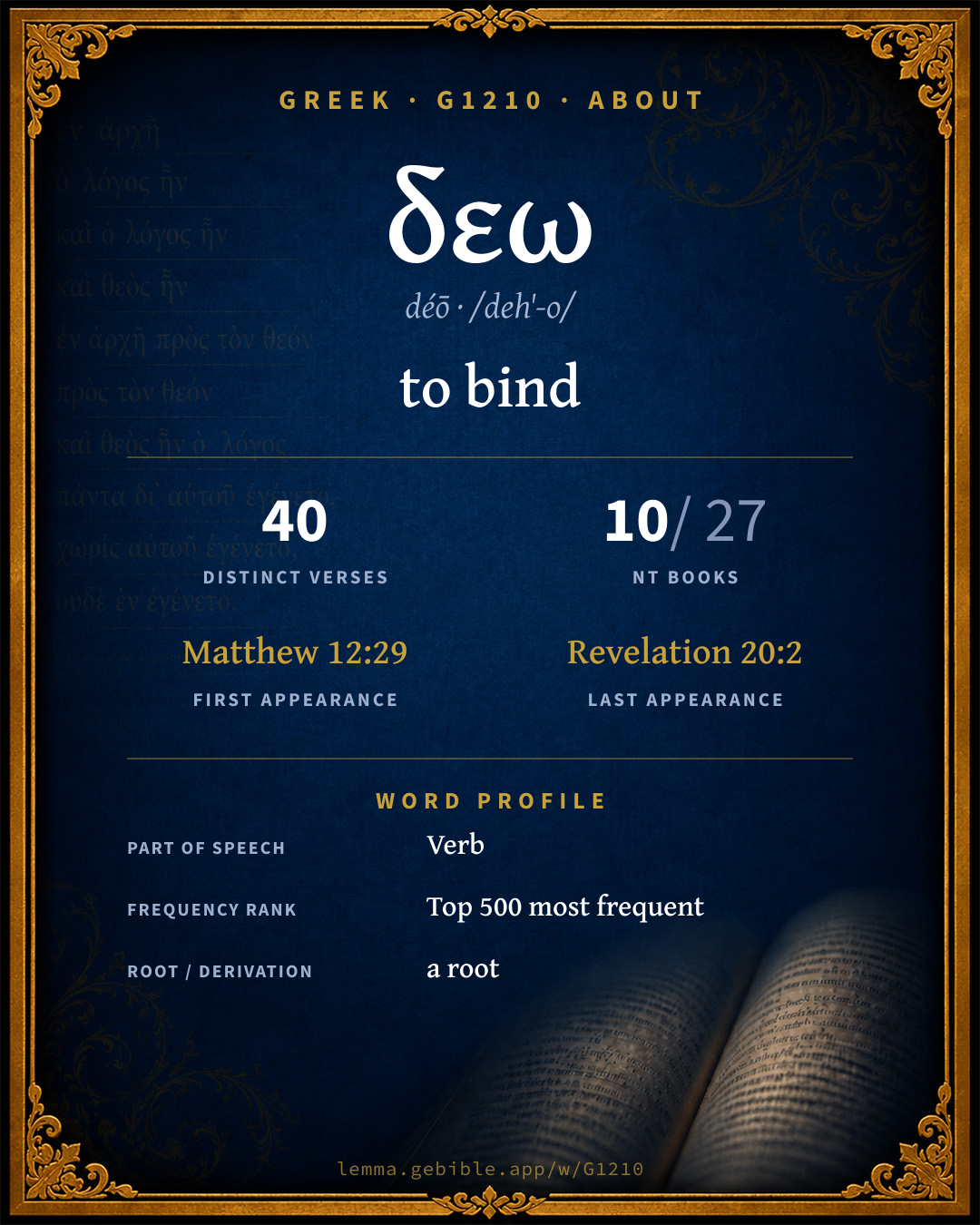
δέω
to bind
‘to bind’ is one of 3 main senses fuller range ↓
Full lexicon entry — Thayer's Greek Lexicon
From Thayer's Greek Lexicon
Where this word appears
See every Perfect-tense verb in the Greek New Testament →
Grammar key — what these labels mean
Part of speech
- Verb
- An action or state-of-being word.
Tense
- Perfect
- A completed past action with continuing present results.
- Aorist
- Action viewed as a simple whole, without regard to duration — often past (perfective aspect).
- Future
- Action expected in future time.
Voice
- Passive
- The subject receives the action.
- Active
- The subject performs the action.
Mood
- Participle
- A verbal adjective (“writing,” “having written”).
- Indicative
- States a fact or asks a factual question (the mood of reality).
- Infinitive
- A verbal noun (“to write”), unmarked for person or number.
- Subjunctive
- Expresses probability, purpose, or possibility (the mood of contingency).
- Imperative
- Expresses a command or request.
Case
- Accusative
- The case of the direct object and of extent.
- Nominative
- The case of the subject (and the predicate nominative).
Person
- 3rd person
- The one spoken about (“he / she / it / they”).
- 2nd person
- The one addressed (“you”).
- 1st person
- The speaker (“I / we”).
Gender
- Masculine
- Grammatically masculine.
- Feminine
- Grammatically feminine.
- Neuter
- Grammatically neuter.
Number
- Singular
- One.
- Plural
- More than one.
Grammatical forms 22 distinct
- Verb, Perfect, Passive, Participle, Accusative, Singular, Masculine 5 times (12%)
- Verb, Aorist, Active, Indicative, 3rd person, Singular 4 times (9%)
- Verb, Perfect, Passive, Participle, Accusative, Plural, Masculine 4 times (9%)
- Verb, Perfect, Passive, Participle, Nominative, Singular, Masculine 4 times (9%)
- Verb, Aorist, Active, Participle, Nominative, Plural, Masculine 3 times (7%)
- Verb, Perfect, Passive, Indicative, 3rd person, Singular 3 times (7%)
- Verb, Aorist, Active, Indicative, 3rd person, Plural 2 times (5%)
- Verb, Aorist, Active, Infinitive 2 times (5%)
+14 more forms (16 occurrences)
Parsed forms decoded from the imported morphology (Robinson–Tischendorf, public domain), counted across 43 parsed occurrences — not distinct verses.
Every verse where G1210 appears — 40 distinct verses across 10 books. Click any verse to open its interlinear word-by-word view. Verse text shown in the World English Bible for context — . Each verse’s Greek form is shown with its reference; the English is not keyword-highlighted, since the data carries no word-level English alignment. Use “Compare translations” on any verse to read it across multiple English versions. This concordance covers the Greek New Testament; Septuagint (Greek Old Testament) occurrences of this word are not indexed here.
Matthew 8 verses
- Matthew 12:29 δήσῃ aor act subj 3sg Or how can one enter into the house of the strong man, and plunder his goods, unless he first bind the strong man? Then he will plunder his house.
- Matthew 13:30 δήσατε aor act impv 2pl Let both grow together until the harvest, and in the harvest time I will tell the reapers, "First, gather up the darnel, and bind them in bundles to burn them; but gather the wheat into my barn."'"
- Matthew 14:3 ἔδησεν aor act ind 3sg For Herod had laid hold of John, and bound him, and put him in prison for the sake of Herodias, his brother Philip's wife.
- Matthew 16:19 δήσῃς δεδεμένον aor act subj 2sg perf pass ptcp nom sg neut I will give to you the keys of the Kingdom of Heaven, and whatever you bind on earth will be bound in heaven; and whatever you release on earth will be released in heaven."
- Matthew 18:18 δήσητε δεδεμένα aor act subj 2pl perf pass ptcp nom pl neut Most assuredly I tell you, whatever things you will bind on earth will be bound in heaven, and whatever things you will release on earth will be released in heaven.
- Matthew 21:2 δεδεμένην perf pass ptcp acc sg fem saying to them, "Go into the village that is opposite you, and immediately you will find a donkey tied, and a colt with her. Untie them, and bring them to me.
- Matthew 22:13 δήσαντες aor act ptcp nom pl masc Then the king said to the servants, 'Bind him hand and foot, take him away, and throw him into the outer darkness; there is where the weeping and grinding of teeth will be.'
- Matthew 27:2 δήσαντες aor act ptcp nom pl masc and they bound him, and led him away, and delivered him up to Pontius Pilate, the governor.
Mark 8 verses
- Mark 3:27 δήσῃ aor act subj 3sg But no one can enter into the house of the strong man to plunder, unless he first binds the strong man; and then he will plunder his house.
- Mark 5:3 δῆσαι aor act inf who had his dwelling in the tombs. Nobody could bind him any more, not even with chains,
- Mark 5:4 δεδέσθαι perf pass inf because he had been often bound with fetters and chains, and the chains had been torn apart by him, and the fetters broken in pieces. Nobody had the strength to tame him.
- Mark 6:17 ἔδησεν aor act ind 3sg For Herod himself had sent out and arrested John, and bound him in prison for the sake of Herodias, his brother Philip's wife, for he had married her.
- Mark 11:2 δεδεμένον perf pass ptcp acc sg masc and said to them, "Go your way into the village that is opposite you. Immediately as you enter into it, you will find a young donkey tied, on which no one has sat. Untie him, and bring him.
- Mark 11:4 δεδεμένον perf pass ptcp acc sg masc They went away, and found a young donkey tied at the door outside in the open street, and they untied him.
- Mark 15:1 δήσαντες aor act ptcp nom pl masc Immediately in the morning the chief priests, with the elders and scribes, and the whole council, held a consultation, and bound Jesus, and carried him away, and delivered him up to Pilate.
- Mark 15:7 δεδεμένος perf pass ptcp nom sg masc There was one called Barabbas, bound with those who had made insurrection, men who in the insurrection had committed murder.
Luke 2 verses
- Luke 13:16 ἔδησεν aor act ind 3sg Ought not this woman, being a daughter of Abraham, whom Satan had bound eighteen long years, be freed from this bondage on the Sabbath day?"
- Luke 19:30 δεδεμένον perf pass ptcp acc sg masc saying, "Go your way into the village on the other side, in which, as you enter, you will find a colt tied, whereon no man ever yet sat. Untie it, and bring it.
John 4 verses
- John 11:44 δεδεμένος perf pass ptcp nom sg masc He who was dead came out, bound hand and foot with wrappings, and his face was wrapped around with a cloth. Jesus said to them, "Free him, and let him go."
- John 18:12 ἔδησαν aor act ind 3pl So the detachment, the commanding officer, and the officers of the Jews, seized Jesus and bound him,
- John 18:24 δεδεμένον perf pass ptcp acc sg masc Annas sent him bound to Caiaphas, the high priest.
- John 19:40 ἔδησαν aor act ind 3pl So they took Jesus' body, and bound it in linen cloths with the spices, as the custom of the Jews is to bury.
Acts 11 verses
- Acts 9:2 δεδεμένους perf pass ptcp acc pl masc and asked for letters from him to the synagogues of Damascus, that if he found any who were of the Way, whether men or women, he might bring them bound to Jerusalem.
- Acts 9:14 δῆσαι aor act inf Here he has authority from the chief priests to bind all who call on your name."
- Acts 9:21 δεδεμένους perf pass ptcp acc pl masc All who heard him were amazed, and said, "Isn't this he who in Jerusalem made havoc of those who called on this name? And he had come here intending to bring them bound before the chief priests!"
- Acts 12:6 δεδεμένος perf pass ptcp nom sg masc The same night when Herod was about to bring him out, Peter was sleeping between two soldiers, bound with two chains. Guards in front of the door kept the prison.
- Acts 20:22 δεδεμένος perf pass ptcp nom sg masc Now, behold, I go bound by the Spirit to Jerusalem, not knowing what will happen to me there;
- Acts 21:11 δήσας δήσουσιν aor act ptcp nom sg masc fut act ind 3pl Coming to us, and taking Paul's belt, he bound his own feet and hands, and said, "Thus says the Holy Spirit: 'So will the Jews at Jerusalem bind the man who owns this belt, and will deliver him into the hands of the Gentiles.'"
- Acts 21:13 δεθῆναι aor pass inf Then Paul answered, "What are you doing, weeping and breaking my heart? For I am ready not only to be bound, but also to die at Jerusalem for the name of the Lord Jesus."
- Acts 21:33 δεθῆναι aor pass inf Then the commanding officer came near, arrested him, commanded him to be bound with two chains, and inquired who he was and what he had done.
- Acts 22:5 δεδεμένους perf pass ptcp acc pl masc As also the high priest and all the council of the elders testify, from whom also I received letters to the brothers, and traveled to Damascus to bring them also who were there to Jerusalem in bonds to be punished.
- Acts 22:29 δεδεκώς perf act ptcp nom sg masc Immediately those who were about to examine him departed from him, and the commanding officer also was afraid when he realized that he was a Roman, because he had bound him.
- Acts 24:27 δεδεμένον perf pass ptcp acc sg masc But when two years were fulfilled, Felix was succeeded by Porcius Festus, and desiring to gain favor with the Jews, Felix left Paul in bonds.
Romans 1 verse
1 Corinthians 2 verses
- 1 Corinthians 7:27 δέδεσαι perf pass ind 2sg Are you bound to a wife? Don't seek to be freed. Are you free from a wife? Don't seek a wife.
- 1 Corinthians 7:39 δέδεται perf pass ind 3sg A wife is bound by law for as long as her husband lives; but if the husband is dead, she is free to be married to whoever she desires, only in the Lord.
Colossians 1 verse
2 Timothy 1 verse
Revelation 2 verses
- Revelation 9:14 δεδεμένους perf pass ptcp acc pl masc saying to the sixth angel who had one trumpet, "Free the four angels who are bound at the great river Euphrates!"
- Revelation 20:2 ἔδησεν aor act ind 3sg He seized the dragon, the old serpent, which is the devil and Satan, who deceives the whole inhabited earth, and bound him for a thousand years,
About this entry
At a glance — auto-summarized from this page’s data, not written by a person. Every figure links to its source below. This summary describes the numbers; it doesn’t interpret them.
The Greek verb δεω centers on the idea of “to bind.” The King James Version usually renders it “bound,” while modern versions prefer “is necessary” (unfoldingWord Literal Text) — see the renderings breakdown. Spanning 40 verses in 10 books, it ranks among the moderately common words of the Greek New Testament. Acts dominates its distribution — 11 of 40 verses. Thayer's distinguishes 3 senses for it. Dig into 40-verse concordance and the renderings breakdown below.
Gloss history
Strong's 1890 vs modern scholarship
About this word
Strong's G1210 catalogs a Greek word from the Greek New Testament.
These counts are not copied from any lexicon or concordance. They are computed here, from the morphology-tagged Greek New Testament. What Lemma adds →
- 40
- distinct verses
- The word appears in 40 distinct verses.
- 10 / 27
- NT books
- The word appears in 10 of 27 New Testament books.
- #347
- by frequency
- Top 500 most frequent Greek words (rank 347 of 5,347 Greek words by occurrence).
View all 40 occurrences in the concordance →
By section of the New Testament
By traditional corpus
Conventional, traditional groupings — biblical authorship is debated, so this is a traditional corpus grouping, not an authorship claim. Some books belong to more than one corpus (Luke is in both the Gospels and the Lukan corpus, and so on), so these shares overlap and need not total 100%. Each figure is a share of the word’s 40 distinct verses.
- Gospels 22 verses · 55%
- Lukan (Luke–Acts) 13 verses · 33%
- Johannine 6 verses · 15%
- Pauline corpus 5 verses · 13%
- Revelation 2 verses · 5%
How translations render this word
Counts come from each version’s own published word-to-Strong’s tagging or interlinear alignment — an approximate guide to how each version renders this word, not a word-level alignment the data otherwise carries. Because each total is that version’s own tagged count, the per-version totals vary from one another and need not match the appearance or distinct-verse counts above. These counts may also differ from a printed concordance because Lemma counts each distinctly tagged rendering and does not collapse phrase taggings into a single head-word total. This is a fixed set of word-tagged versions (KJV, ASV, BSB, ULT) and does not change with the reading translation you choose elsewhere. Each version’s license is shown beside its name below (and on Sources).
- King James Version: Bound 19×, Bind 7×, Tied 4×
- American Standard Version: Bound 18×, Bind 6×, Bonds 3×
- Berean Standard Bible: Bound 11×, Tied 4×, Is bound 2×
- unfoldingWord Literal Text: Is necessary 37×, Is necessary for 20×, Bound 13×
King James Version Public Domain
Renders G1210 across 48 tagged occurrences — most commonly:
Plus 16 renderings that appear only once — usually multi-word phrases or single function words the recovered tagging swept in, not distinct renderings.
American Standard Version Public Domain
Renders G1210 across 50 tagged occurrences — most commonly:
Plus 14 renderings that appear only once — usually multi-word phrases or single function words the recovered tagging swept in, not distinct renderings.
Berean Standard Bible Public Domain
Renders G1210 across 43 tagged occurrences — most commonly:
Plus 20 renderings that appear only once — usually multi-word phrases or single function words the recovered tagging swept in, not distinct renderings.
unfoldingWord Literal Text CC BY-SA 4.0
Renders G1210 across 166 tagged occurrences — most commonly:
Plus other, less common renderings. Plus 35 renderings that appear only once — usually multi-word phrases or single function words the recovered tagging swept in, not distinct renderings.
Senses in Thayer's
The 3 senses Thayer's distinguishes for this word, in lexicon order (not ranked by frequency or importance). The full entry — with sub-senses — is in the Lexicon Entry tab.
- to bind, fasten with chains, to throw into chains
- metaph.
- to be bound to one, a wife, a husband
Word origin
Origin: a root
Forms in the corpus
The 21 distinct written forms G1210 takes in the Greek New Testament, most frequent first — each parse links to that tense’s occurrences in the concordance.
Same root — word family
Other Thayer's entries built from the same root as G1210, grouped by Strong’s listed origin. These share a root / origin per the lexicon — not necessarily a shared meaning. Each links to that word’s own entry.
Derived from this word
- δει deî G1163 it is necessary
- δεομαι déomai G1189 to ask
- δεσμον desmón G1199 bond
- δεσποτης despótēs G1203 master
- δημος dēmos G1218 people
- δουλος doûlos G1401 slave
Compare all same-root words → Showing 4 of 7 — not the complete family. They share a root, not necessarily a meaning.
Septuagint usage
The same Greek word δεω appears 107 times in the Greek Old Testament (Septuagint), across 104 verses in 24 books.
- 107
- LXX occurrences
- Tagged occurrences of this Greek word in the Septuagint.
- 104
- verses
- Distinct Septuagint verses containing this word.
- 24 / 39
- OT books
- The word appears in 24 of the 39 Old Testament books.
Sample Septuagint occurrences
- Genesis 25:21 δέω
- Exodus 16:22 δέω
- Leviticus 4:2 δέω
- Joshua 18:4 δέω
- Judges 15:4 δέω
- Ruth 4:5 δέω
- 1 Samuel 13:12 δέω
- 2 Samuel 3:34 δέω
- 1 Kings 5:2 δέω
- 2 Kings 1:13 δέω
- 2 Chronicles 6:24 δέω
- Esther 1:15 δέω
Septuagint occurrences (same lexeme)
Every verse where the same Strong’s number (G1210) appears in the Greek Septuagint — showing the first 50 of 104. Verse text shown in the World English Bible for context; the Greek form is the matched word — the English is not keyword-highlighted.
- Genesis 25:21 δέω Isaac entreated Yahweh for his wife, because she was barren. Yahweh was entreated by him, and Rebekah his wife conceived.
- Genesis 38:28 δέω It happened, when she travailed, that one put out a hand: and the midwife took and tied a scarlet thread on his hand, saying, "This came out first."
- Genesis 42:24 δέω He turned himself about from them, and wept, and he returned to them, and spoke to them, and took Simeon from among them, and bound him before their eyes.
- Exodus 16:22 δέω It happened that on the sixth day they gathered twice as much bread, two omers for each one, and all the rulers of the congregation came and told Moses.
- Exodus 21:10 δέω If he takes another wife to himself, he shall not diminish her food, her clothing, and her marital rights.
- Exodus 32:11 δέω Moses begged Yahweh his God, and said, "Yahweh, why does your wrath burn hot against your people, that you have brought forth out of the land of Egypt with great power and with a mighty hand?
- Leviticus 4:2 δέω "Speak to the children of Israel, saying, 'If anyone sins unintentionally, in any of the things which Yahweh has commanded not to be done, and does any one of them:
- Leviticus 5:17 δέω "If anyone sins, and does any of the things which Yahweh has commanded not to be done; though he didn't know it, yet he is guilty, and shall bear his iniquity.
- Joshua 18:4 δέω Appoint for you three men of each tribe: and I will send them, and they shall arise, and walk through the land, and describe it according to their inheritance; and they shall come to me.
- Judges 15:4 δέω Samson went and caught three hundred foxes, and took firebrands, and turned tail to tail, and put a firebrand in the midst between every two tails.
- Judges 15:10 δέω The men of Judah said, Why are you come up against us? They said, To bind Samson are we come up, to do to him as he has done to us.
- Judges 15:12 δέω They said to him, We have come down to bind you, that we may deliver you into the hand of the Philistines. Samson said to them, Swear to me that you will not fall on me yourselves.
- Judges 15:13 δέω They spoke to him, saying, No; but we will bind you fast, and deliver you into their hand: but surely we will not kill you. They bound him with two new ropes, and brought him up from the rock.
- Judges 16:5 δέω The lords of the Philistines came up to her, and said to her, Entice him, and see in which his great strength lies, and by what means we may prevail against him, that we may bind him to afflict him: and we will each give you of us eleven hundred [pieces] of silver.
- Judges 16:6 δέω Delilah said to Samson, Tell me, Please, in which your great strength lies, and with which you might be bound to afflict you.
- Judges 16:7 δέω Samson said to her, If they bind me with seven green cords that were never dried, then shall I become weak, and be as another man.
- Judges 16:8 δέω Then the lords of the Philistines brought up to her seven green cords which had not been dried, and she bound him with them.
- Judges 16:10 δέω Delilah said to Samson, Behold, you have mocked me, and told me lies: now tell me, Please, with which you might be bound.
- Judges 16:11 δέω He said to her, If they only bind me with new ropes with which no work has been done, then shall I become weak, and be as another man.
- Judges 16:12 δέω So Delilah took new ropes, and bound him therewith, and said to him, The Philistines are on you, Samson. The liers-in-wait were abiding in the inner chamber. He broke them off his arms like a thread.
- Judges 16:13 δέω Delilah said to Samson, Hitherto you have mocked me, and told me lies: tell me with which you might be bound. He said to her, If you weave the seven locks of my head with the web.
- Ruth 4:5 δέω Then said Boaz, What day you buy the field of the hand of Naomi, you must buy it also of Ruth the Moabitess, the wife of the dead, to raise up the name of the dead on his inheritance.
- 1 Samuel 13:12 δέω therefore said I, Now will the Philistines come down on me to Gilgal, and I haven't entreated the favor of Yahweh: I forced myself therefore, and offered the burnt offering.
- 2 Samuel 3:34 δέω Your hands were not bound, nor your feet put into fetters: As a man falls before the children of iniquity, so did you fall. All the people wept again over him.
- 2 Samuel 4:10 δέω when one told me, saying, Behold, Saul is dead, thinking to have brought good news, I took hold of him, and killed him in Ziklag, which was the reward I gave him for his news.
- 1 Kings 5:2 δέω Solomon sent to Hiram, saying,
- 1 Kings 8:33 δέω When your people Israel are struck down before the enemy, because they have sinned against you; if they turn again to you, and confess your name, and pray and make supplication to you in this house:
- 1 Kings 8:47 δέω yet if they shall repent themselves in the land where they are carried captive, and turn again, and make supplication to you in the land of those who carried them captive, saying, We have sinned, and have done perversely, we have dealt wickedly;
- 1 Kings 8:59 δέω Let these my words, with which I have made supplication before Yahweh, be near to Yahweh our God day and night, that he maintain the cause of his servant, and the cause of his people Israel, as every day shall require;
- 1 Kings 9:3 δέω Yahweh said to him, I have heard your prayer and your supplication, that you have made before me: I have made this house holy, which you have built, to put my name there forever; and my eyes and my heart shall be there perpetually.
- 1 Kings 13:6 δέω The king answered the man of God, Entreat now the favor of Yahweh your God, and pray for me, that my hand may be restored me again. The man of God entreated Yahweh, and the king's hand was restored him again, and became as it was before.
- 2 Kings 1:13 δέω Again he sent the captain of a third fifty with his fifty. The third captain of fifty went up, and came and fell on his knees before Elijah, and begged him, and said to him, man of God, please let my life, and the life of these fifty your servants, be precious in your sight.
- 2 Kings 4:13 δέω He said to him, Say now to her, Behold, you have been careful for us with all this care; what is to be done for you? would you be spoken for to the king, or to the captain of the host? She answered, I dwell among my own people.
- 2 Kings 4:14 δέω He said, What then is to be done for her? Gehazi answered, Most assuredly she has no son, and her husband is old.
- 2 Kings 7:10 δέω So they came and called to the porter of the city; and they told them, saying, We came to the camp of the Syrians, and, behold, there was no man there, neither voice of man, but the horses tied, and the donkeys tied, and the tents as they were.
- 2 Kings 12:21 δέω For Jozacar the son of Shimeath, and Jehozabad the son of Shomer, his servants, struck him, and he died; and they buried him with his fathers in the city of David: and Amaziah his son reigned in his place.
- 2 Kings 13:4 δέω Jehoahaz begged Yahweh, and Yahweh listened to him; for he saw the oppression of Israel, how that the king of Syria oppressed them.
- 2 Kings 17:4 δέω The king of Assyria found conspiracy in Hoshea; for he had sent messengers to So king of Egypt, and offered no tribute to the king of Assyria, as he had done year by year: therefore the king of Assyria shut him up, and bound him in prison.
- 2 Kings 25:7 δέω They killed the sons of Zedekiah before his eyes, and put out the eyes of Zedekiah, and bound him in fetters, and carried him to Babylon.
- 2 Chronicles 6:24 δέω If your people Israel be struck down before the enemy, because they have sinned against you, and shall turn again and confess your name, and pray and make supplication before you in this house;
- 2 Chronicles 6:37 δέω yet if they shall repent themselves in the land where they are carried captive, and turn again, and make supplication to you in the land of their captivity, saying, We have sinned, we have done perversely, and have dealt wickedly;
- 2 Chronicles 33:11 δέω Therefore Yahweh brought on them the captains of the host of the king of Assyria, who took Manasseh in chains, and bound him with fetters, and carried him to Babylon.
- 2 Chronicles 36:2 δέω Joahaz was twenty-three years old when he began to reign; and he reigned three months in Jerusalem.
- 2 Chronicles 36:6 δέω Against him came up Nebuchadnezzar king of Babylon, and bound him in fetters, to carry him to Babylon.
- Esther 1:15 δέω What shall we do to the queen Vashti according to law, because she has not done the bidding of the king Ahasuerus by the chamberlains?
- Job 5:8 δέω "But as for me, I would seek God, To God would I commit my cause;
- Job 8:5 δέω If you want to seek God diligently, Make your supplication to the Almighty.
- Job 9:15 δέω Whom, though I were righteous, yet would I not answer. I would make supplication to my judge.
- Job 11:19 δέω Also you shall lie down, and none shall make you afraid; Yes, many shall court your favor.
- Job 15:3 δέω Should he reason with unprofitable talk, Or with speeches with which he can do no good?
These are occurrences of the same Greek lexeme (G1210) in the Septuagint — not a translation of any one Hebrew word. The store carries no word-level Hebrew↔Greek alignment, so no Hebrew original is asserted here. Counts come from the recovered LXX Strong's tagging — high-frequency vocabulary is well covered, while rare or late forms may be untagged — so they reflect tagged occurrences and may slightly undercount.