Genesis 25:21

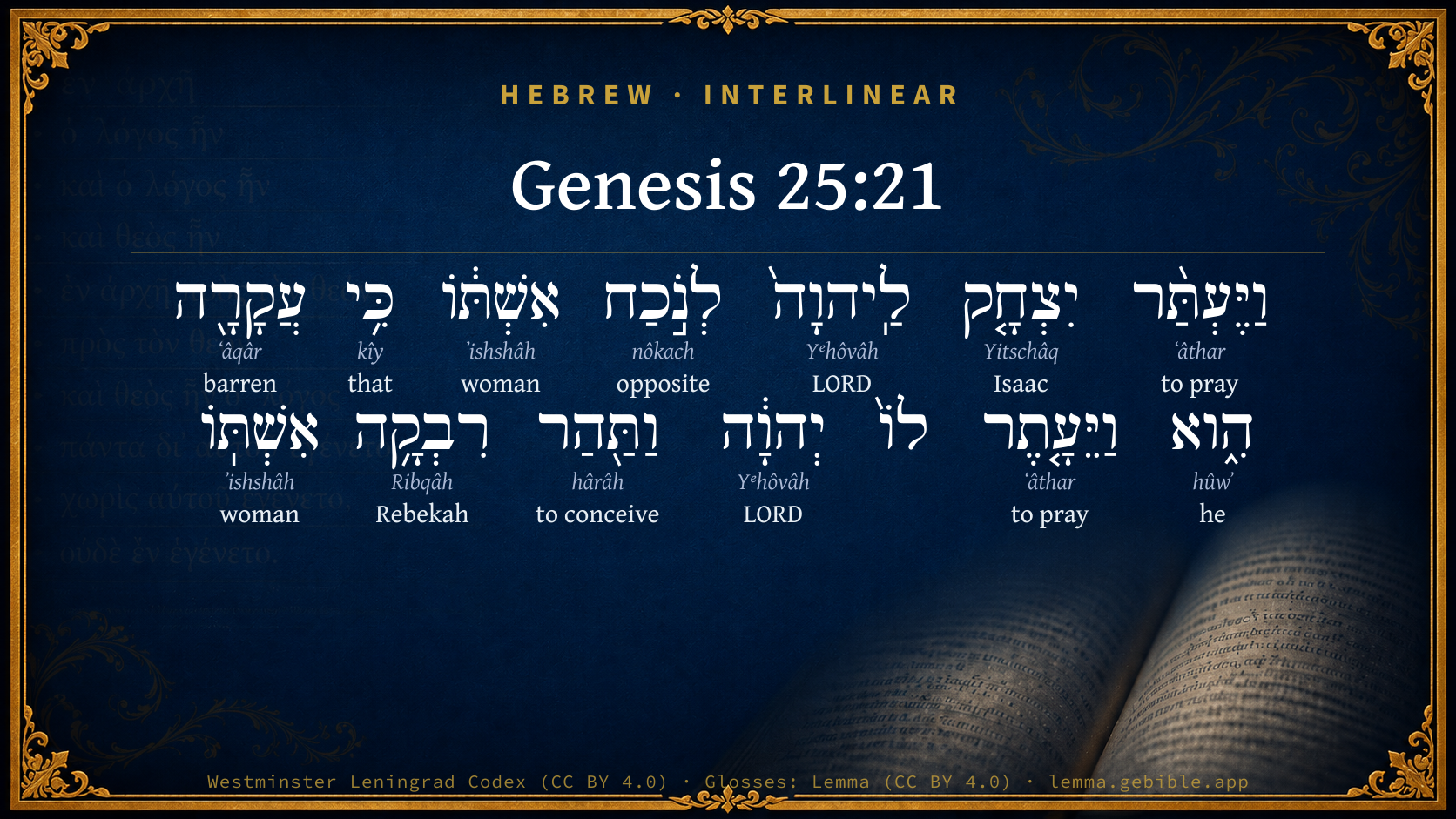
Hebrew (Westminster Leningrad Codex) Genesis 25:21 appears in the Hebrew Old Testament. The text above is from the Westminster Leningrad Codex. Each word links to its Strong’s number, a concise gloss, and parsing drawn from the Open Scriptures Hebrew Bible morphology. Click any word for its full Brown-Driver-Briggs (BDB) entry.
Download image
Cite this verse

Genesis 25:21 (World English Bible). Public Domain. Lemma interlinear Bible study tool, https://lemma.gebible.app/v/genesis/25/21.

Show BibTeX & RIS
BibTeX
RIS
English Translation
Isaac entreated Yahweh for his wife, because she was barren. Yahweh was entreated by him, and Rebekah his wife conceived.
World English Bible · Public Domain
Highlights
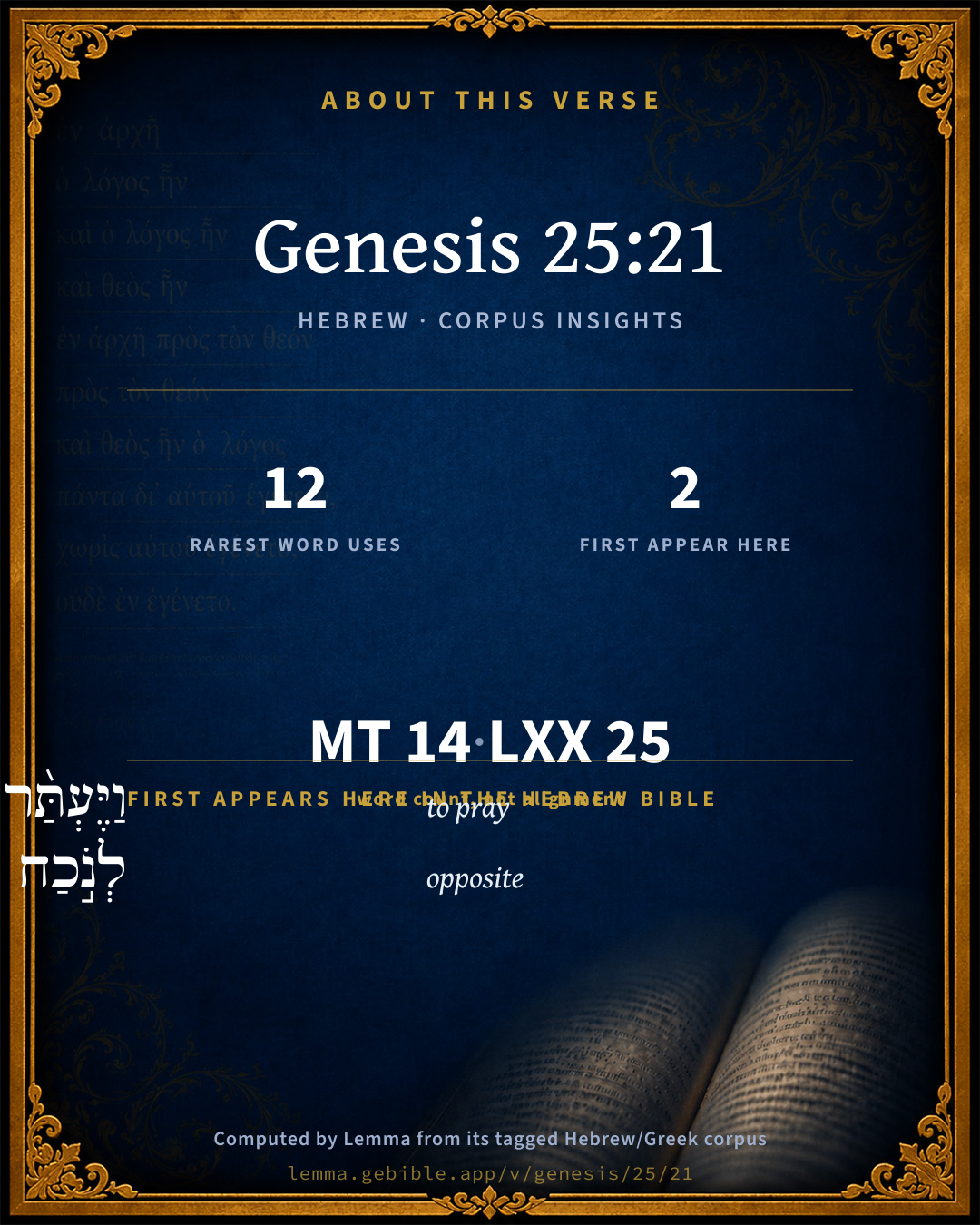
  • 2 first appearances in the Hebrew Bible
Full analysis ↓
Download a study sheet

One document with this verse’s original text, its word-by-word gloss line, the meaning frame, cross-references with their text, attributed commentary, and full source and license credits — printable, and it pastes into notes with its structure intact.

This verse Autodidact and up

Study sheet (.html) Plain text (.txt)

A passage Seminary Student

Up to 50 verses in one chapter. A passage sheet keeps up to 6 commentary sources and 12 cross-references per verse, in the order this page ranks them, and says so on the sheet whenever that leaves anything out. Ask for a single verse and you get the Autodidact verse sheet above.

Everything on this page stays free to read, with no account — the sheet is a download of what is already on screen, not access to it.

Want to remove ads? Support Godless Engineer
Compare translations 3

The same verse in 3 English versions, stacked beneath the original-language interlinear above. Click any original word for its lexicon entry.

Each is an independent rendering of the whole verse — the interlinear is not word-aligned to these translations.

Highlighted words mark where these versions differ — a whole-verse word diff, not a word-by-word alignment.

  • World English Bible Public Domain
    Isaac entreated Yahweh for his wife, because she was barren. Yahweh was entreated by him, and Rebekah his wife conceived.
  • King James Version Public Domain
    And Isaac entreated the LORD for his wife, because she was barren: and the LORD was entreated of him, and Rebekah his wife conceived.
  • unfoldingWord Literal Text CC BY-SA 4.0
    And Isaac entreated Yahweh on behalf of his wife because she barren. So Yahweh was entreated by him, and Rebekah his wife conceived.

unfoldingWord Literal Text — © unfoldingWord, licensed CC BY-SA 4.0. Word-aligned USFM3 via Door43 (git.door43.org/unfoldingWord/en_ult).

Versions to compare (up to 4)

3 of 4 selected

Show all 18 translations

Every available English version of this verse, each an independent rendering of the whole verse.

  • World English Bible Public Domain
    Isaac entreated Yahweh for his wife, because she was barren. Yahweh was entreated by him, and Rebekah his wife conceived.
  • Berean Standard Bible Public Domain
    Later, Isaac prayed to the LORD on behalf of his wife, because she was barren. And the LORD heard his prayer, and his wife Rebekah conceived.
  • Majority Standard Bible Public Domain
    Later, Isaac prayed to the LORD on behalf of his wife, because she was barren. And the LORD heard his prayer, and his wife Rebekah conceived.
  • King James Version Public Domain
    And Isaac entreated the LORD for his wife, because she was barren: and the LORD was entreated of him, and Rebekah his wife conceived.
  • American Standard Version (1901) Public Domain
    And Isaac entreated Jehovah for his wife, because she was barren. And Jehovah was entreated of him, and Rebekah his wife conceived.
  • Revised Version (1885) Public Domain
    And Isaac entreated the LORD for his wife, because she was barren: and the LORD was entreated of him, and Rebekah his wife conceived.
  • Geneva Bible (1599) Public Domain
    And Izhak prayed vuto the Lord for his wife, because she was barren: and the Lord was intreated of him, and Rebekah his wife conceiued,
  • Douay-Rheims (1899) Public Domain
    And Isaac besought the Lord for his wife, because she was barren; and he heard him, and made Rebecca to conceive.
  • Young's Literal Translation Public Domain
    And Isaac maketh entreaty to Jehovah before his wife, for she `is' barren: and Jehovah is entreated of him, and Rebekah his wife conceiveth,
  • Literal Standard Version CC BY-SA 4.0
    And Isaac makes plea to YHWH before his wife, for she [is] barren: and YHWH accepts his plea, and his wife Rebekah conceives,
  • Unlocked Literal Bible CC BY-SA 4.0
    Isaac prayed to Yahweh for his wife because she was childless, and Yahweh answered his prayer, and Rebekah his wife conceived.
  • unfoldingWord Literal Text CC BY-SA 4.0
    And Isaac entreated Yahweh on behalf of his wife because she barren. So Yahweh was entreated by him, and Rebekah his wife conceived.
  • Darby Bible Public Domain
    And Isaac entreated Jehovah for his wife, because she was barren; and Jehovah was entreated of him, and Rebecca his wife conceived.
  • World Messianic Bible Public Domain
    Isaac entreated the LORD for his wife, because she was barren. The LORD was entreated by him, and Rebekah his wife conceived.
  • Webster's Bible Public Domain
    And Isaac entreated the LORD for his wife, because she was barren: and the LORD was entreated of him, and Rebekah his wife conceived.
  • Free Bible Version CC BY-SA 4.0
    Isaac prayed to the Lord for help on behalf of his wife because she couldn't have children. The Lord answered his prayer and she became pregnant.
  • Bible in Basic English Public Domain
    Isaac made prayer to the Lord for his wife because she had no children; and the Lord gave ear to his prayer, and Rebekah became with child.
  • JPS Tanakh (1917) Public Domain
    And Isaac entreated the LORD for his wife, because she was barren; and the LORD let Himself be entreated of him, and Rebekah his wife conceived.

Literal Standard Version (2020), Covenant Press — licensed CC BY-SA 4.0. Text via the HelloAO Bible API (eBible.org). Unlocked Literal Bible (unfoldingWord) — licensed CC BY-SA 4.0. Text via the HelloAO Bible API (eBible.org). unfoldingWord Literal Text — © unfoldingWord, licensed CC BY-SA 4.0. Word-aligned USFM3 via Door43 (git.door43.org/unfoldingWord/en_ult). Free Bible Version, Dr. Jonathan Gallagher — licensed CC BY-SA 4.0. Text via the HelloAO Bible API (eBible.org).

Word by word

More ways to search: Search by grammar → Find every occurrence → Compare this word →

Practice this passage: Drill this verse → Learn its vocabulary →

עֲקָרָ֖ה
ʻâqâr
H6135
“barren”
Adjective, Adjective, Feminine, Singular, Absolute
Part of Speech
Adjective
Type
Adjective
Gender
Feminine
Number
Singular
State
Absolute
Full BDB Definition

Origin: from H6131

TWOT: 1682a

barren, sterile
  1. וַיֶּעְתַּ֨ר ʻâthar H6279 “and · to pray” Conjunction + Verb, Qal, Sequential Imperfect, 3rd Person, Masculine, Singular
  2. יִצְחָ֤ק Yitschâq H3327 “Isaac” Noun, Proper
  3. לַֽיהוָה֙ Yᵉhôvâh H3068 “to/for · LORD” Preposition + Noun, Proper
  4. לְנֹ֣כַח nôkach H5227 “to/for · opposite” Preposition + Preposition
  5. אִשְׁתּ֔וֹ ʼishshâh H802 “woman · his” Noun, Common, Feminine, Singular, Construct + Suffix, Personal, 3rd Person, Masculine, Singular
  6. כִּ֥י kîy H3588 “that” Conjunction
  7. הִ֑וא hûwʼ H1931 “he” Pronoun, Personal, 3rd Person, Feminine, Singular
  8. וַיֵּעָ֤תֶר ʻâthar H6279 “and · to pray” Conjunction + Verb, Niphal, Sequential Imperfect, 3rd Person, Masculine, Singular
  9. יְהוָ֔ה Yᵉhôvâh H3068 “LORD” Noun, Proper
  10. וַתַּ֖הַר hârâh H2029 “and · to conceive” Conjunction + Verb, Qal, Sequential Imperfect, 3rd Person, Feminine, Singular
  11. רִבְקָ֥ה Ribqâh H7259 “Rebekah” Noun, Proper
  12. אִשְׁתּֽוֹ ʼishshâh H802 “woman · his” Noun, Common, Feminine, Singular, Construct + Suffix, Personal, 3rd Person, Masculine, Singular

About this verse

These counts appear in no published source. They are computed here, from the morphology-tagged text and Lemma’s own curated glosses. What Lemma adds →

14
words
10
distinct lemmas
Pentateuch
section

Notable vocabulary

The rarest word here is עֲקָרָ֖ה barren H6135 — appearing just 12 times in the whole Hebrew Bible.

First appearance in Scripture

These words make their first canonical appearance in the Hebrew Bible here:

  • וַיֶּעְתַּ֨ר to pray H6279
  • לְנֹ֣כַח opposite H5227

Shared distinctive vocabulary

עֲקָרָ֖ה barren H6135 occurs in 11 verses of the Hebrew Bible. Also found in:

Grammatical profile

  • 3 verbs
  • 6 nouns
  • 1 adjective
  • 1 pronoun
  • 2 prepositions
  • 1 conjunction

Verb forms

  • וַיֶּעְתַּ֨ר Qal · Sequential Imperfect
  • וַיֵּעָ֤תֶר Niphal · Sequential Imperfect
  • וַתַּ֖הַר Qal · Sequential Imperfect

Repetition

Words recur within this verse — often emphatic in Hebrew:

  • וַיֶּעְתַּ֨ר to pray H6279 ×2
  • לַֽיהוָה֙ LORD H3068 ×2
  • אִשְׁתּ֔וֹ woman H802 ×2

Hebrew & Septuagint length

In English translation the verse runs 20 words from the Hebrew and 26 from the Septuagint (LXX English) — closely comparable.

A rough comparison of the two English renderings, which tokenize alike — not a word-level alignment.

Word counts can differ between the Hebrew and the Greek without any difference in meaning — e.g. the Hebrew direct-object marker אֵת has no separate Greek word, and Greek often adds the article ὁ.

In the original languages it is 14 Hebrew tokens and 25 Greek tokens — but the two are counted differently (Hebrew bundles its prefixes and suffixes into one token; the Greek is in lemma form), so that isn’t a like-for-like length.

Cross-references

22

Topical passages linked to Genesis 25:21 in the Treasury of Scripture Knowledge — connected by theme and wording, ordered by reader-vote popularity; previews shown in the World English Bible.

  • 2 Chronicles 33:13 He prayed to him; and he was entreated of him, and heard his supplication, and brought him again to Jerusalem into his kingdom. Then Manasseh knew that Yahweh he was God.
  • Ezra 8:23 So we fasted and begged our God for this: and he was entreated of us.
  • Isaiah 58:9 Then shall you call, and Yahweh will answer; you shall cry, and he will say, Here I am. If you take away from the midst of you the yoke, the putting forth of the finger, and speaking wickedly;
  • Luke 1:13 But the angel said to him, "Don't be afraid, Zacharias, because your request has been heard, and your wife, Elizabeth, will bear you a son, and you shall call his name John.
  • 1 Chronicles 5:20 They were helped against them, and the Hagrites were delivered into their hand, and all who were with them; for they cried to God in the battle, and he was entreated of them, because they put their trust in him.
  • Romans 9:10–12 Not only so, but Rebecca also conceived by one, by our father Isaac.
  • Genesis 15:2–3 Abram said, "Lord Yahweh, what will you give me, seeing I go childless, and he who will inherit my estate is Eliezer of Damascus?"
  • 1 Samuel 1:27 For this child I prayed; and Yahweh has given me my petition which I asked of him:
  • Luke 1:7 But they had no child, because Elizabeth was barren, and they both were well advanced in years.
  • Psalms 91:15 He will call on me, and I will answer him. I will be with him in trouble. I will deliver him, and honor him.
  • Proverbs 10:24 What the wicked fear, will overtake them, But the desire of the righteous will be granted.
  • Genesis 11:30 Sarai was barren. She had no child.
  • 1 Samuel 1:11 She vowed a vow, and said, Yahweh of hosts, if you will indeed look on the affliction of your handmaid, and remember me, and not forget your handmaid, but will give to your handmaid a man-child, then I will give him to Yahweh all the days of his life, and there shall no razor come on his head.
  • Psalms 65:2 You who hear prayer, To you all men will come.
  • Psalms 127:3 Behold, children are a heritage of Yahweh. The fruit of the womb is his reward.
  • Psalms 145:19 He will fulfill the desire of those who fear him. He also will hear their cry, and will save them.
  • Genesis 16:2 Sarai said to Abram," See now, Yahweh has restrained me from bearing. Please go in to my handmaid. It may be that I will obtain children by her." Abram listened to the voice of Sarai.
  • Genesis 17:16–19 I will bless her, and moreover I will give you a son by her. Yes, I will bless her, and she will be a mother of nations. Kings of peoples will come from her."
  • 1 Samuel 1:2 and he had two wives; the name of the one was Hannah, and the name of other Peninnah: and Peninnah had children, but Hannah had no children.
  • Psalms 50:15 Call on me in the day of trouble. I will deliver you, and you will honor me."
  • Isaiah 45:11 Thus says Yahweh, the Holy One of Israel, and his Maker: Ask me of the things that are to come; concerning my sons, and concerning the work of my hands, command you me.
  • Isaiah 65:24 It shall happen that, before they call, I will answer; and while they are yet speaking, I will hear.

Cross-references courtesy of OpenBible.info (CC BY 4.0).

Hebrew and Greek witnesses Masoretic Hebrew ↔ Greek Septuagint

The same verse in the two great witnesses to the Old Testament, shown verse-for-verse.

These are two independent witnesses, not word-aligned to each other, and the Septuagint is shown in lemma (dictionary) form.

Hebrew Genesis 25:21 Masoretic · Westminster Leningrad Codex

וַיֶּעְתַּ֨ר יִצְחָ֤ק לַֽיהוָה֙ לְנֹ֣כַח אִשְׁתּ֔וֹ כִּ֥י עֲקָרָ֖ה הִ֑וא וַיֵּעָ֤תֶר לוֹ֙ יְהוָ֔ה וַתַּ֖הַר רִבְקָ֥ה אִשְׁתּֽוֹ

Isaac entreated Yahweh for his wife, because she was barren. Yahweh was entreated by him, and Rebekah his wife conceived.

World English Bible · Public Domain

Greek LXX Genesis 25:21 Septuagint · lemma form

δέω δέ ισαακ κύριος περί ρεβεκκα ὁ γυνή αὐτός ὅτι στεῖρα εἰμί ἐπιἀκούω δέ αὐτός ὁ θεός καί λαμβάνω ἐν γαστήρ ρεβεκκα ὁ γυνή αὐτός

And Isaac prayed the Lord concerning Rebecca his wife, because she was barren; and the Lord heard him, and his wife Rebecca conceived in her womb.

LXX2012 (modern English Septuagint) · Public Domain

On this verse, The Pulpit Commentary discusses the Septuagint’s reading. Read the note in Commentary ↓

Hebrew: Westminster Leningrad Codex (CC BY 4.0). Greek: Septuagint (public domain); English from LXX2012 (modern English Septuagint) (Public Domain). How the Septuagint differs from the Hebrew →

Targum (Aramaic paraphrase)

2

The Targum is the ancient Jewish Aramaic paraphrase of the Hebrew Scriptures — an interpretive translation, not the Hebrew text itself. Onkelos (literal) and Pseudo-Jonathan (expansive) render the Torah, and Jonathan the Prophets. Coverage is partial: where no permissively-licensed English translation exists for a verse, only the Aramaic is shown. This is verse-level text, not a word-by-word alignment to the Hebrew.

  1. Targum Onkelos Torah (Genesis–Deuteronomy)
    וְצַלִּי יִצְחָק קֳדָם יְיָ לָקֳבֵל אִתְּתֵהּ אֲרֵי עֲקָרָה הִיא וְקַבֵּל צְלוֹתֵהּ יְיָ וְעַדִּיאַת רִבְקָה אִתְּתֵהּ

    (no public-domain English translation for this verse)

    Targum Onkelos — Aramaic: “Onkelos Genesis” (public domain); “Onkelos Exodus” (public domain); “Onkelos Leviticus” (public domain); “Onkelos Numbers” (public domain); “Onkelos Deuteronomy” (public domain). English: “Sefaria Community Translation” (CC0 1.0 (public-domain dedication)); “J.W. Etheridge. The Targums of Onkelos and Jonathan Ben Uzziel on the Pentateuch. London: Longmans, Green, 1862” (public domain). Text via Sefaria.

  2. Targum Pseudo-Jonathan Torah (Genesis–Deuteronomy)
    וַאֲזַל יִצְחָק לְטַוָור פּוּלְחָנָא אֲתַר דְכַפְתֵיהּ אֲבוֹי וְהָפַךְ יִצְחָק בִּצְלוּתֵיהּ דַעֲתֵּיה דְקֻבָּ"ה מִמַה דִגְזַר עַל אִנְתְּתֵיהּ אֲרוּם עַקְרָא הֲוַת גַבֵּיהּ עֶשְרִין וְתַרְתֵּין שְׁנִין וְאִתְהֲפִּיךְ בְּגִינֵיהּ דַעֲתֵּיה דְקֻבָּ"ה מִמַה דִגְזַר עֲלֵיהּ דְאַף הוּא הֲוָה עָקָר וְאִתְרָוַח וְאִתְעַבָּרַת רִבְקָה אִנְתְּתֵיהּ

    And Izhak went to the mountain of worship, the place where his father had bound him. And Izhak in his prayer turned the attention of the Holy One, blessed be He! from that which He had decreed concerning him who had been childless. And he was enlarged, and Rivekah his wife was with child.

    Targum Pseudo-Jonathan — Aramaic: “Targum Jonathan on Genesis” (public domain); “Targum Jonathan on Exodus” (public domain); “Targum Jonathan on Leviticus” (public domain); “Targum Jonathan on Numbers” (public domain); “Targum Jonathan on Deuteronomy” (public domain). English: “The Targum of Jonathan ben Uzziel, trans. J. W. Etheridge, London, 1862” (public domain). Text via Sefaria.

Commentary

Notes on Genesis 25:21 from classic Christian and Jewish commentators (each source and its license shown beneath its notes). The classic Christian expositions comment on the surrounding passage and are grouped to its opening verse, so a note may address several verses; the Jewish commentaries on the Tanakh (Rashi and others) are per-verse, so they appear only where the commentator wrote on this verse.

Lemma curates 59 commentaries, every one of them public domain or Creative Commons licensed, each selected and text-cleaned for this edition rather than reprinted as found. About our sources →

Trapp's Complete Commentary

John Trapp

Gen 25:21 And Isaac intreated the LORD for his wife, because she [was] barren: and the LORD was intreated of him, and Rebekah his wife conceived.

Ver. 21. And Isaac entreated the Lord for his wife.] He did it constantly and instantly, as the word עתר signifies; he multiplied prayer, which (as those arrows of deliverance, 2Ki 13:19) must be often iterated, ere the mercy can be obtained.

And the Lord was entreated of him.] Though it were long first, even full twenty years. God knows how to commend his mercies to us, and therefore holds us long in suspense. Cito data, vilescunt. Manna, lightly come by, was as lightly set by.

John Trapp, A Commentary or Exposition upon All the Books of the Old and New Testament (1647–1656) — public domain. Text from a community e-Sword module.

Joseph Benson's Commentary

Gen 25:21. And Isaac entreated the Lord for his wife — Though God had promised to multiply his family, he prayed for it; for God’s promises must not supersede, but encourage our prayers, and be improved as the ground of our faith. Though he had prayed for this mercy many years, and it was not granted, yet he did not leave off praying for it.

Joseph Benson's Commentary on the Old and New Testaments (1811–1818) — public domain. Text from a community e-Sword module.

Keil & Delitzsch

C. F. Keil & F. Delitzsch

Isaac's marriage, like Abraham's, was for a long time unfruitful; not to extreme old age, however, but only for 20 years. The seed of the promise was to be prayed for from the Lord, that it might not be regarded merely as a fruit of nature, but be received and recognised as a gift of grace. At the same time Isaac was to be exercised in the patience of faith in the promise of God. After this lengthened test, Jehovah heard his prayer in relation to his wife. לנוכח, Gen 25:21 and Gen 30:38, lit., opposite to, so that the object is before the eyes, has been well explained by Luther thus: quod toto pectore et intentus in calamitatem uxoris oraverit. Sicut quando oro pro aliquo, propono illum mihi in conspectum cordis mei, et nihil aliud video aut cogito; in eum solum animo intueor.

Gen 25:22-23

When Rebekah conceived, the children struggled together in her womb. In this she saw an evil omen, that the pregnancy so long desired and entreated of Jehovah would bring misfortune, and that the fruit of her womb might not after all secure the blessing of the divine promise; so that in intense excitement she cried out, "If it be so, wherefore am I?" i.e., why am I alive? cf. Gen 27:46. But she sought counsel from God: she went to inquire of Jehovah. Where and how she looked for a divine revelation in the matter, is not recorded, and therefore cannot be determined with certainty. Some suppose that it was by prayer and sacrifice at a place dedicated to Jehovah. Others imagine that she applied to a prophet - to Abraham, Melchizedek, or Shem (Luther); a frequent custom in Israel afterwards (Sa1 9:9), but not probable in the patriarchal age. The divine answer, couched in the form of a prophetic oracle, assured her that she carried two nations in her womb, one stronger than the other; and that the greater (elder or first-born) should serve the less (younger). הפּרד ממּעיך: "proceeding from thy womb, are separated."

Gen 25:24-26

When she was delivered, there were twins; the first-born was reddish, i.e., of a reddish-brown colour (Sa1 16:12; Sa1 17:42), and "all over like a hairy cloak," i.e., his whole body as if covered with a fur, with an unusual quantity of hair (hypertrichosis), which is sometimes the case with new-born infants, but was a sign in this instance of excessive sensual vigour and wildness. The second had laid hold of the heel of the first, i.e., he came into the world with his hand projected and holding the heel of the first-born, a sign of his future attitude towards his brother. From these accidental circumstances the children received their names. The elder they called Esau, the hairy one; the younger Jacob, heel-holder: יעקב from עקב (denom. of עקב heel, Hos 12:3), to hold the heel, then to outwit (Gen 27:36), just as in wrestling an attempt may be made to throw the opponent by grasping the heel.

Keil & Delitzsch — Biblical Commentary on the Old Testament (1861–1891) — public domain (CC PDM 1.0). Text via the HelloAO Bible API. (Old Testament only.)

Tyndale Open Study Notes

Tyndale Open Resources

25:21 For twenty years, Rebekah was barren (cp. 25:20, 26), like Sarah (see 16:1). This condition tested their faith (see study note on 16:1-3). How could they be childless when God promised that nations would issue from them? • Isaac pleaded with the Lord and the Lord answered Isaac’s prayer. Isaac apparently learned from his father’s mistake and responded in faith.

Tyndale Open Study Notes — © Tyndale Open Resources, licensed CC BY-SA 4.0. Text via the HelloAO Bible API.

Jamieson, Fausset & Brown

Robert Jamieson, A. R. Fausset & David Brown

Isaac entreated the Lord for his wife--Though tried in a similar way to his father, he did not follow the same crooked policy. Twenty years he continued unblessed with offspring, whose seed was to be "as the stars" [Gen 26:4]. But in answer to their mutual prayers (Pe1 3:7), Rebekah was divinely informed that she was to be the mother of twins, who should be the progenitors of two independent nations; that the descendants of the younger should be the more powerful and subdue those of the other (Rom 9:12; Ch2 21:8).

Jamieson, Fausset & Brown — Commentary Critical and Explanatory on the Whole Bible (1871) — public domain (CC PDM 1.0). Text via the HelloAO Bible API.

Adam Clarke's Commentary

Verse 21. Isaac entreated the Lord for his wife] Isaac and Rebekah had now lived nineteen years together without having a child; for he was forty years old when he married Rebekah, Ge 25:20, and he was threescore years of age when Jacob and Esau were born, Ge 25:26. Hence it is evident they had lived nineteen years together without having a child.

The form of the original in this place is worthy of notice: Isaac entreated Jehovah, לנכח אשתו lenochach ishto, directly, purposely, especially, for his wife. Ainsworth thinks the words imply their praying together for this thing; and the rabbins say that "Isaac and Rebekah went on purpose to Mount Moriah, where he had been bound, and prayed together there that they might have a son." God was pleased to exercise the faith of Isaac previous to the birth of Jacob, as he had exercised that of Abraham previous to his own birth.

Adam Clarke's Commentary on the Bible (1810–1826) — public domain. Text from a community e-Sword/MySword module.

John Calvin's Commentaries

21. And Isaac entreated the Lord for his wife. Some translate the passage, Isaac entreated the Lord in the presence of his wife; and understand this to have been done, that she also might add her prayers, and they might jointly supplicate God. But the version here given is more simple. Moreover, this resort to prayer testifies that Isaac knew that he was deprived of children, because God had not blessed him. He also knew that fruitfulness was a special gift of God. For although the favor of obtaining offspring was widely diffused over the whole human race, when God uttered the words “increase and multiply;” yet to show that men are not born fortuitously, he distributes this power of production in various degrees. Isaac, therefore, acknowledges, that the blessing, which was not at man’s disposal, must be sought for by prayer from God. It now truly appears, that he was endued with no ordinary constancy of faith. Forasmuch as the covenant of God was known to him, he earnestly (if ever any did) desired seed. It, therefore, had not now, for the first time, entered into his mind to pray, seeing that for more than twenty years he had been disappointed of his hope. Hence, although Moses, only in a single word, says that he had obtained offspring by his prayers to God; yet reason dictates that these prayers had continued through many years. The patience of the holy man is herein conspicuous, that while he seems in vain to pour forth his wishes into the air, he still does not remit the ardor of his devotion. And as Isaac teaches us, by his example, to persevere in prayer; so God also shows that he never turns a deaf ear to the wishes of his faithful people, although he may long defer the answer.

John Calvin's Commentaries (1540-1563) — public domain. Text from the Calvin Translation Society English edition (1840s-50s) via the Christian Classics Ethereal Library (ccel.org). Calvin's coverage is partial (roughly two-thirds of the Bible); uncommented books and verses are honest gaps, never fabricated. The 19th-century editor's footnotes and remarks are omitted so the notes are faithfully Calvin's own voice.

The Cambridge Bible for Schools and Colleges

gen. ed. J. J. S. Perowne

21. barren] As in the case of Sarah (Gen_11:30) and of Rachel (Gen_29:31). Rebekah has at first no children. The Chosen People are the children of God’s gift. In each generation patience is made the test of faith. Cf. the birth of Samson (Jdg_13:2) and Samuel (1 Samuel 1).

was intreated] Allowed Himself to be interceded with, i.e. listened to the prayer, as in 2Sa_21:14; 2Sa_24:25.

The Cambridge Bible for Schools and Colleges (gen. ed. J. J. S. Perowne; Cambridge University Press, 1878–1918) — public domain. Text from a community e-Sword module.

John Gill's Exposition

And Isaac entreated the Lord for his wife,.... Was very earnest and constant in his supplications for her, as the word signifies, as is observed by Jarchi; or, "before his wife" (a), she being present, and joining with him in his prayers: the reason was:

because she was barren; which appeared by the length of time they had been married, which was near twenty years, see Gen 25:26. The Jewish writers (b) say, that, after twenty years, Isaac took her and went with her to Mount Moriah, to the place where he was bound, and prayed that she might conceive; putting the Lord in mind of the promise he there made of the multiplication of Abraham's seed, Gen 22:17,

and the Lord was entreated of him; he granted him his request; for, though God has purposed and promised to do many things for his people, yet he will be sought unto by them to do them for them:

and Rebekah his wife conceived; two sons at once, as it follows.

(a) "praesente uxore sua", Munster, Fagins. (b) Pirke Eliezer, c. 32. Targum. Jon. in loc. Shalshalet Hakabala, fol. 3. 1.

John Gill's Exposition of the Whole Bible (1746–1763) — public domain (CC PDM 1.0). Text via the HelloAO Bible API.

Haydock's Catholic Bible Commentary

Barren. They had been married 20 years, (ver. 26.) during which time, St. Chrysostom says, Isaac had earnestly besought the Lord, (Menochius) and obtained by prayer what God long before decreed. See St. Gregory, Dial. i. 8. (Worthington)

George Leo Haydock (1774–1849), Haydock's Catholic Family Bible and Commentary, 1859 edition — public domain. Excludes Psalms (Douay-Rheims chapter numbering differs from Protestant) and Deuterocanonical books (Catholic canon only).

Matthew Poole's English Annotations

1838

He prayed, as the Hebrew word signifies, instantly or fervently, frequently and continually, for near twenty years together; for so long, it was between their marriage and the first child. He was so much concerned, because not only his comfort, but the truth of God’s promise, depended upon this mercy; and he knew very well that God’s purpose and promise did not exclude, but require the use of all convenient means for their accomplishment.

For his wife; or, in the presence of his wife; signifying that, besides their more secret devotions, they did oftentimes in a more solemn manner, and with united force, pray for this mercy wherein they were both equally concerned. Or, over against his wife, noting that each of them did severally and apart entreat God for this mercy, so that there was a concurrence, if not in place, yet in design and action.

She was barren, as divers of those holy women that were progenitors of Christ have long been, that it might appear that that sacred stock was propagated more by the virtue of God’s grace and promise than by the power of nature.

Matthew Poole's English Annotations on the Holy Bible (1683–1685) — public domain. Text from a community e-Sword/MySword module.

Whedon's Commentary on the Bible

Daniel D. Whedon

21. Entreated the Lord — The word for entreated (עתר) implies earnest and repeated prayer, and perhaps the accompaniment of incense offering, or some kind of sacrifice. See the Hebrews lexicons on the word. We note that Isaac directs his prayer to Jehovah, the God of the covenant and the promises.

Was entreated — Was prevailed upon by his importunity. Compare Luk_18:7. “The heir of promise was to be a child of prayer.”

Daniel D. Whedon (gen. ed.), Commentary on the Old and New Testaments (1874–1909) — public domain. Text from a community e-Sword module.

The Pulpit Commentary

And Isaac entreated from a root signifying to burn incense, hence to pray, implying, as some think (Wordsworth, "Speaker s Commentary"), the use of incense in patriarchal worship; but perhaps only pointing to the fact that the prayers of the godly ascend like incense (Gesenius): cf. RAPC Tob 12:12; Act_10:4. The word is commonly regarded as noting precum multiplicationem, et vehementiam et perseverantiam (Poole) cf. Eze_35:13the LordJehovah; not because vers. 21-23 are the composition of the Jehovist (Tuch, Bleek, Davidson, et alii), but because the desired son was to be the heir of promise (Hengstenberg). The less frequent occurrence of the Divine name in the Thol-doth of Isaac than in those of Terah has been explained by the fact that the historical matter of the later portion furnishes less occasion for its introduction than that of the earlier; and the predominance of the name Elohim over that of Jehovah in the second stage of the patriarchal history has been partly ascribed to the employment after Abraham"s time of such like equivalent expressions as "God of Abraham" and "God of my father" (Keil)for his wife, literally, opposite to his wife, i.e. beside his wife, placing himself opposite her, and conjoining his supplications with hers (Ainsworth, Bush); or, better, in behalf of his wife (LXX., Vulgate, Calvin, Keil, Kalisch), i.e. setting her over against him as the sole object to which he had regard in his intercessions (Luther)because she was barren: as Sarah had been before her; (vide Gen_11:30) the long-continued sterility of both having been designed to show partly that "children are the heritage of the Lord", (Psa_127:3) but chiefly that the children of the promise were to be not simply the fruit of nature, but the gift of grace and the Lord was entreated of him, and Rebekah his wife conceived (cf. Rom_9:10)

The Pulpit Commentary (1880–1919), ed. H.D.M. Spence-Jones & Joseph S. Exell — public domain. Text from a community e-Sword module.

John Wesley's Explanatory Notes

And Isaac intreated the Lord for his wife - Though God had promised to multiply his family, he prayed for it; for God's promises must not supersede but encourage our prayers, and be improved as the ground of our faith. Though he had prayed for this mercy many years, and it was not granted, yet he did not leave off praying for it.

John Wesley, Explanatory Notes Upon the Whole Bible (1754–1765) — public domain. Text via the GEBible commentary corpus.

Kretzmann's Popular Commentary

Paul E. Kretzmann

Jacob at Edar and Hebron

v. 21. And Israel journeyed, and spread his tent beyond the tower of Edar. He struck his tent, and he pitched his tent: the usual way of describing a nomadic form of life. This was south of Bethlehem, and the tower of the flocks was built for their protection, in a region eminently suited for pasturage.

v. 22. And it came to pass, when Israel dwelt in that land, that Reuben went and lay with Bilhah, his father’s concubine; and Israel heard it. Bilhah was Rachel’s hand-maid, but nevertheless Jacob’s concubine; hence Reuben’s sin was that of incest, not to speak of an utter lack of filial reverence. The matter was brought to the attention of the father, and although Jacob did not act at once, the punishment was eventually forthcoming, for the sin cost Reuben his birthright, Gen 49:4. Now the sons of Israel were twelve:

v. 23. the sons of Leah: Reuben, Jacob’s first-born, and Simeon, and Levi, and Judah, and Issachar, and Zebulun;

v. 24. the sons of Rachel: Joseph, and Benjamin;

v. 25. and the sons of Bilhah, Rachel’s handmaid: Dan, and Naphtali;

v. 26. and the sons of Zilpah, Leah’s handmaid: Gad and Asher; these are the sons of Jacob, which were born to him in Padanaram. Cf Gen 29:30-32. Benjamin is enumerated with the other sons of Jacob for the sake of completeness, although he was not born in Padanaram, yet before Jacob’s actual return to the home of his father. Jacob was now formally to enter upon his inheritance, and therefore his sons are mentioned by name, as the fathers of the people of Israel.

v. 27. And Jacob came unto Isaac, his father, unto Mamre, unto the city of Arbah, which is Hebron, where Abraham and Isaac sojourned. As Abraham had made the grove of terebinths which belonged to the Amorite Mamre his headquarters, so Isaac spent a large share of his life there, near Hebron or Kirjatharba.

v. 28. And the days of Isaac were an hundred and fourscore years.

v. 29. And Isaac gave up the ghost and died, and was gathered unto his people, being old and full of days; and his sons Esau and Jacob buried him. Isaac was thus also added to his people, his soul entered the realm of the perfected saints in heaven, to be joined with his body in the resurrection of the dead. The notice of Isaac’s death is here inserted in order to conclude his history, although, as a matter of fact, he lived about thirteen years longer. "Jacob was born in the sixtieth year of Isaac’s life, and was thus one hundred and twenty years old when Isaac died. But when he was presented to Pharaoh in Egypt, he was one hundred and thirty years old. of this time there were seven fruitful and two unfruitful years since Joseph’s exaltation in Egypt, and thirteen years between the selling of Joseph and his exaltation, for he was sold when seventeen, and was thirty when he was raised to honor and power. Hence we must take twenty-three years from the one hundred and thirty years of Jacob to determine his age at the time Joseph was sold; which is thus one hundred and seven. Isaac, therefore, shared the grief of Jacob over the loss of his son for thirteen years. " (Lange. )

Paul E. Kretzmann, Popular Commentary of the Bible (1921–1924) — public domain. Text from a community e-Sword module.

unfoldingWord translationNotes

Door43 World Missions Community

she was childless

"she was unable to become pregnant"

Rebekah his wife conceived

It can be made explicit that Rebekah was pregnant with two babies at the same time: "Rebekah, his wife, became pregnant with twins" (See: Assumed Knowledge and Implicit Information)

The children struggled together within her

"the babies inside her kept bumping against each other" or "The babies pushed against each other within her"

The children ... within her

Rebekah was pregnant with twins. (See: Assumed Knowledge and Implicit Information)

She went to ask Yahweh about this

"She went and asked Yahweh about this." It is not clear where she went. She may have gone somewhere private to pray, or she may have gone somewhere to offer a sacrifice.

translationWords

Isaac

pray

Yahweh

Rebekah

unfoldingWord translationNotes — © Distant Shores Media and the Door43 World Missions Community, licensed CC BY-SA 4.0. Source: git.door43.org/Door43/en_tn.

Rashi

Rabbi Shlomo Yitzchaki (Rashi)

וַיֶּעְתַּר AND ISAAC ENTREATED —He prayed much and urgently.

וַיֵּעָתֶר לו WAS ENTREATED OF HIM — He let himself be urged, conciliated and influenced by him. I say that wherever this root עתר occurs it has the meaning of heaping up and increasing. E. g., (Ezekiel 8:11) “And a thick (עתר) cloud of incense” which means an abundance of ascending smoke; (Ezekiel 35:13) “You have multiplied (העתרתם) your words against me”; (Proverbs 27:6) “The kisses of an enemy are importunate (נעתרות)”—they appear to be too many and therefore they are burdensome. old French encresser; English to increase.

לנכח אשתו FACING HIS WIFE — He stood in one corner and prayed whilst she stood in the other corner and prayed (Genesis Rabbah 63:5).

ויעתר לו [AND THE LORD] WAS ENTREATED OF HIM — of him and not of her, because there is no comparison between the prayer of a righteous person who is the son of a righteous person and the prayer of a righteous person the child of a wicked-person — therefore God allowed himself to be entreated of him and not of her (Yevamot 64a).

Rashi on the Tanakh — English translations: “The Judaica Press complete Tanach with Rashi, translated by A. J. Rosenberg” (CC BY 4.0); “Pentateuch with Rashi's commentary by M. Rosenbaum and A.M. Silbermann, 1929-1934” (public domain); “The Metsudah Tanach series, Lakewood, N.J” (CC BY 4.0); and “The Book of Joshua, Metsudah Publications, 1997” (CC BY 4.0). Text via Sefaria.

Radak

Rabbi David Kimhi (Radak)

ויעתר, he prayed long and hard asking that his wife should bear a child, seeing that he loved her very dearly [and would not consider marrying anyone in addition to her. Ed.] He would not even consider taking any of Rivkah’s handmaids as a partner, as had his father Avraham who had married Hagar. As a result of all this prayer, Rivkah did finally become pregnant.

לנכח אשתו, on behalf of his wife, explaining that the reason for his intense prayer was that he did not want to marry anyone else. His prayer did not so much concern his becoming a father as his becoming a father of a child born by his wife Rivkah. He prayed in the presence of his wife so that he would be better able to concentrate on her problem. [whereas the Torah had written that both Avraham and Sarah had been barren, nothing about Yitzchok being sterile had been written anywhere. Ed.]

Radak on the Tanakh — English translations: “Sefaria Community Translation” (CC0 1.0 (public-domain dedication)); “Eliyahu Munk, HaChut Hameshulash” (CC BY 4.0); “Rabbi Mike Feuer, Jerusalem Anthology” (CC BY 4.0); and “R. David Kimhi on the first book of Psalms, Translated by R.G. Finch, London, 1919” (public domain). Text via Sefaria.

Lesson kit

Teaching starters — assembled from the data on this page, not authored interpretation. Every prompt links to the verse data it draws on. Edit before teaching.

Genesis, in the Pentateuch, opens this verse with 14 words (10 distinct Hebrew lemmas). Its most distinctive word is ʻâqâr (“barren”). A historical commentator’s framing appears above. Read the whole chapter for the surrounding context.

Discussion questions

  1. The word ʻâqâr carries the sense “barren.” How does it shape the verse?
  2. 2 words here appear for the first time in Scripture. What is being introduced at this debut?
  3. Genesis 11:30 shares the word «barren» with this verse. How do the two illuminate each other?
  4. “to pray” occurs 2× in this one verse. What is the effect of the repetition?
  5. These translations render this verse differently. What is at stake in choosing one wording over another?
  6. The verb «וַיֶּעְתַּ֨ר» is Qal Sequential Imperfect. How does its form color the action?
  7. Reading how Trapp's Complete Commentary and Joseph Benson's Commentary read this verse, where do the two commentators agree and where do they part?

Things to notice

Reading settings

Reading text

Shown beneath each verse's original-language words.

Old Testament
Old Testament edition

Read the OT as the Masoretic Hebrew (MT) or the Greek Septuagint (LXX).

English shown for the Greek Septuagint (in the Hebrew ↔ Greek comparison).

Comparing translations? Open the Compare panel on any verse page to stack up to four side by side.