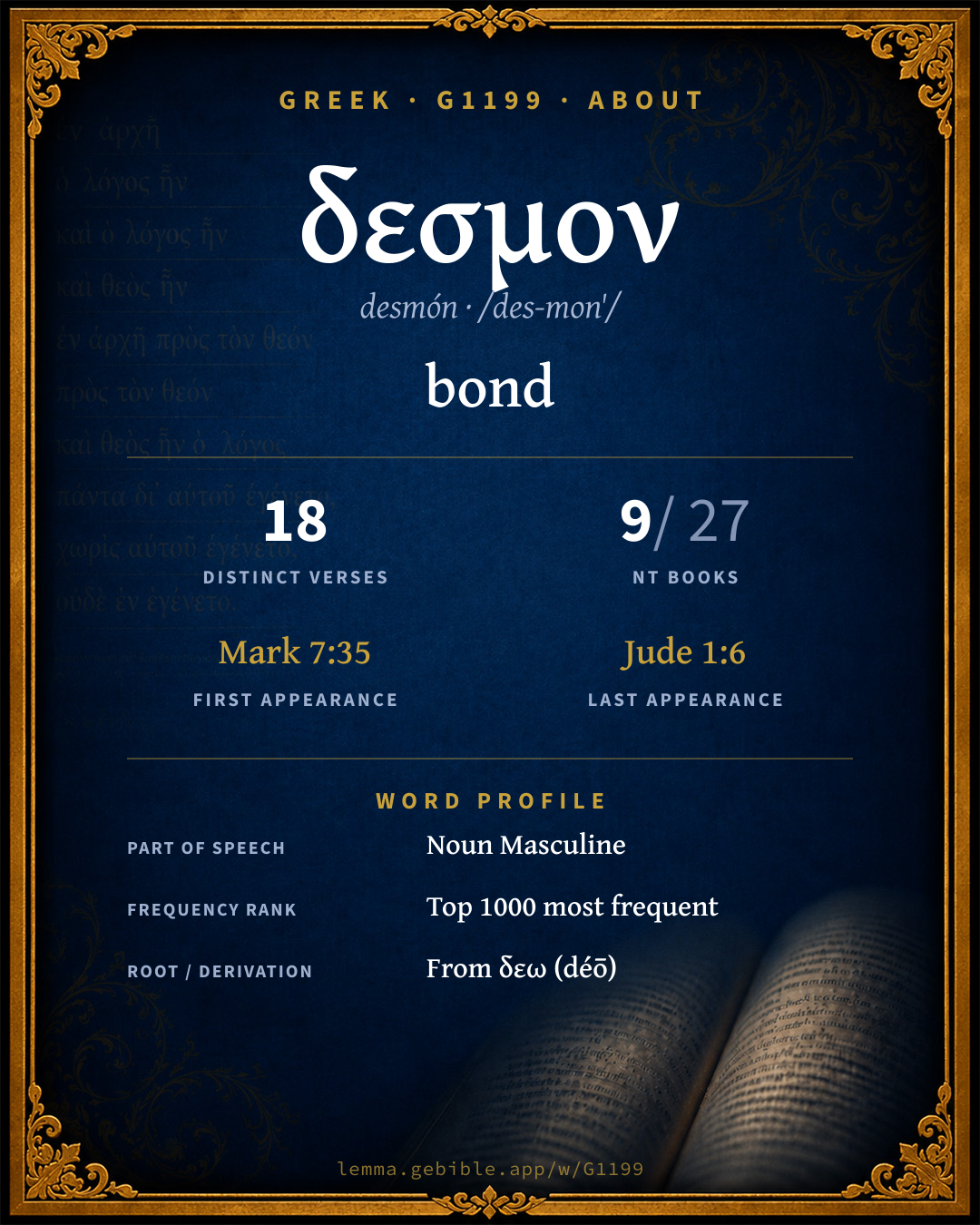
δεσμον
bond
Full lexicon entry — Thayer's Greek Lexicon
From Thayer's Greek Lexicon
Where this word appears
See every Genitive-case word in the Greek New Testament →
Grammar key — what these labels mean
Part of speech
- Noun
- A naming word — a person, place, thing, or idea.
Case
- Dative
- The case of the indirect object, means, or location — “to / for / with / in.”
- Genitive
- The case of source, possession, or “of” — answers “whose / from what.”
- Nominative
- The case of the subject (and the predicate nominative).
- Accusative
- The case of the direct object and of extent.
Gender
- Masculine
- Grammatically masculine.
- Neuter
- Grammatically neuter.
Number
- Plural
- More than one.
- Singular
- One.
Grammatical forms
- Noun, Dative, Plural, Masculine 6 times (33%)
- Noun, Genitive, Plural, Masculine 4 times (22%)
- Noun, Genitive, Plural, Neuter 2 times (11%)
- Noun, Nominative, Plural, Neuter 2 times (11%)
- Noun, Accusative, Plural, Masculine 1 time (6%)
- Noun, Accusative, Plural, Neuter 1 time (6%)
- Noun, Genitive, Singular, Masculine 1 time (6%)
- Noun, Nominative, Singular, Masculine 1 time (6%)
Parsed forms decoded from the imported morphology (Robinson–Tischendorf, public domain), counted across 18 parsed occurrences — not distinct verses.
Every verse where G1199 appears — 18 distinct verses across 9 books. Click any verse to open its interlinear word-by-word view. Verse text shown in the World English Bible for context — . Each verse’s Greek form is shown with its reference; the English is not keyword-highlighted, since the data carries no word-level English alignment. Use “Compare translations” on any verse to read it across multiple English versions. This concordance covers the Greek New Testament; Septuagint (Greek Old Testament) occurrences of this word are not indexed here.
Mark 1 verse
Luke 2 verses
- Luke 8:29 δεσμὰ n acc pl neut For Jesus was commanding the unclean spirit to come out of the man. For the unclean spirit had often seized the man. He was kept under guard, and bound with chains and fetters. Breaking the bands apart, he was driven by the demon into the desert.
- Luke 13:16 δεσμοῦ n gen sg masc Ought not this woman, being a daughter of Abraham, whom Satan had bound eighteen long years, be freed from this bondage on the Sabbath day?"
Acts 5 verses
- Acts 16:26 δεσμὰ n nom pl neut Suddenly there was a great earthquake, so that the foundations of the prison were shaken; and immediately all the doors were opened, and everyone's bonds were loosened.
- Acts 20:23 δεσμὰ n nom pl neut except that the Holy Spirit testifies in every city, saying that bonds and afflictions wait for me.
- Acts 23:29 δεσμῶν n gen pl neut I found him to be accused about questions of their law, but to have nothing laid to his charge worthy of death or of bonds.
- Acts 26:29 δεσμῶν n gen pl neut Paul said, "I pray to God, that whether with little or with much, not only you, but also all that hear me this day, might become such as I am, except for these bonds."
- Acts 26:31 δεσμῶν n gen pl masc When they had withdrawn, they spoke one to another, saying, "This man does nothing worthy of death or of bonds."
Philippians 4 verses
- Philippians 1:7 δεσμοῖς n dat pl masc It is even right for me to think this way on behalf of all of you, because I have you in my heart, because, both in my bonds and in the defense and confirmation of the Gospel, you all are partakers with me of grace.
- Philippians 1:13 δεσμούς n acc pl masc so that it became evident to the whole praetorian guard, and to all the rest, that my bonds are in Christ;
- Philippians 1:14 δεσμοῖς n dat pl masc and that most of the brothers in the Lord, being confident through my bonds, are more abundantly bold to speak the word of God without fear.
- Philippians 1:17 δεσμοῖς n dat pl masc but the latter out of love, knowing that I am appointed for the defense of the Gospel.
Colossians 1 verse
2 Timothy 1 verse
Philemon 2 verses
Hebrews 1 verse
Jude 1 verse
About this entry
At a glance — auto-summarized from this page’s data, not written by a person. Every figure links to its source below. This summary describes the numbers; it doesn’t interpret them.
At its core, δεσμον (desmón) means “bond.” Translators differ — “bonds” in the King James Version, then “chains” (Berean Standard Bible), as the renderings breakdown shows. With 18 verses in 9 books, it is an uncommon word in the Greek New Testament. Its uses concentrate in Acts (28% of all occurrences). First canonically at Mark 7:35, it enters the text early. Each statement above links to its evidence; the full detail follows below.
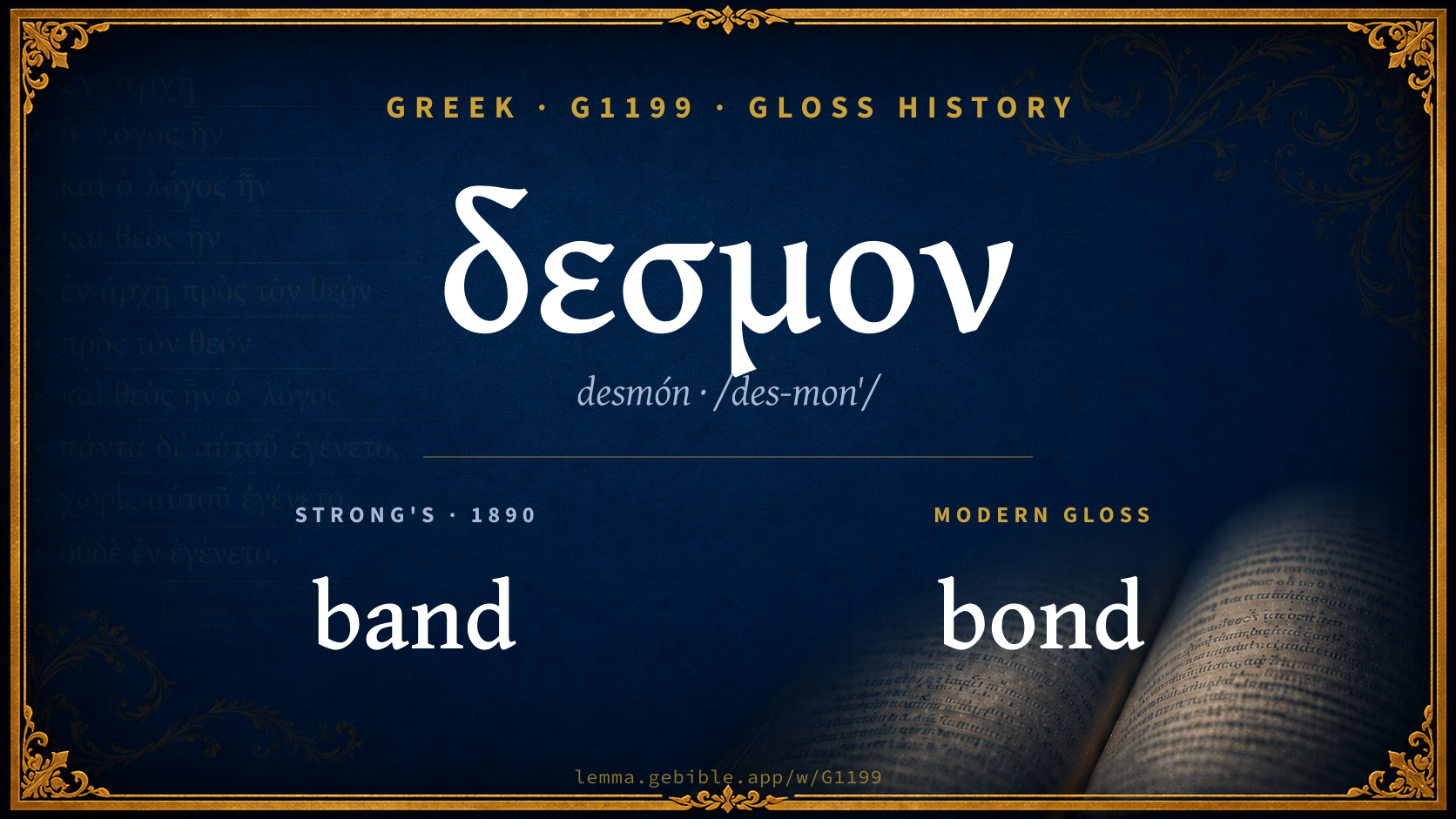
Gloss history
Strong's 1890 vs modern scholarship
About this word
Strong's G1199 catalogs a Greek word from the Greek New Testament.
These counts are not copied from any lexicon or concordance. They are computed here, from the morphology-tagged Greek New Testament. What Lemma adds →
- 18
- distinct verses
- The word appears in 18 distinct verses.
- 9 / 27
- NT books
- The word appears in 9 of 27 New Testament books.
- #664
- by frequency
- Top 1000 most frequent Greek words (rank 664 of 5,347 Greek words by occurrence).
View all 18 occurrences in the concordance →
Most concentrated in
- Acts 5 verses 28%
- Philippians 4 verses 22%
- Luke 2 verses 11%
By section of the New Testament
By traditional corpus
Conventional, traditional groupings — biblical authorship is debated, so this is a traditional corpus grouping, not an authorship claim. Some books belong to more than one corpus (Luke is in both the Gospels and the Lukan corpus, and so on), so these shares overlap and need not total 100%. Each figure is a share of the word’s 18 distinct verses.
- Pauline corpus 8 verses · 44%
- Lukan (Luke–Acts) 7 verses · 39%
- Gospels 3 verses · 17%
- Hebrews 1 verse · 6%
- General (Catholic) Epistles 1 verse · 6%
How translations render this word
Counts come from each version’s own published word-to-Strong’s tagging or interlinear alignment — an approximate guide to how each version renders this word, not a word-level alignment the data otherwise carries. Because each total is that version’s own tagged count, the per-version totals vary from one another and need not match the appearance or distinct-verse counts above. These counts may also differ from a printed concordance because Lemma counts each distinctly tagged rendering and does not collapse phrase taggings into a single head-word total. This is a fixed set of word-tagged versions (KJV, ASV, BSB, ULT) and does not change with the reading translation you choose elsewhere. Each version’s license is shown beside its name below (and on Sources).
- King James Version: Bonds 14×, Bands 3×
- American Standard Version: Bonds 14×, In 3×, Bond 2×
- Berean Standard Bible: Chains 13×, Imprisonment 2×
- unfoldingWord Literal Text: Chains 15×, Bond 2×, In 2×
King James Version Public Domain
Renders G1199 across 20 tagged occurrences — most commonly:
Plus 3 renderings that appear only once — usually multi-word phrases or single function words the recovered tagging swept in, not distinct renderings.
American Standard Version Public Domain
Renders G1199 across 23 tagged occurrences — most commonly:
Plus 4 renderings that appear only once — usually multi-word phrases or single function words the recovered tagging swept in, not distinct renderings.
Berean Standard Bible Public Domain
Renders G1199 across 17 tagged occurrences — most commonly:
Plus 2 renderings that appear only once — usually multi-word phrases or single function words the recovered tagging swept in, not distinct renderings.
unfoldingWord Literal Text CC BY-SA 4.0
Renders G1199 across 21 tagged occurrences — most commonly:
Plus 2 renderings that appear only once — usually multi-word phrases or single function words the recovered tagging swept in, not distinct renderings.
Senses in Thayer's
The 1 sense Thayer's distinguishes for this word, in lexicon order (not ranked by frequency or importance). The full entry — with sub-senses — is in the Lexicon Entry tab.
- a band or bond
Word origin
Derived from δεω (déō) (G1210) — to bind.
Neuter and masculine respectively from G1210 ; a band that is ligament (of the body) or shackle (of a prisoner); figuratively an impediment or disability : - band bond chain string.
— Strong’s Exhaustive Concordance (1890), public domain.
Forms in the corpus
The 6 distinct written forms G1199 takes in the Greek New Testament, most frequent first — each parse links to that case’s occurrences in the concordance.
| Form | Parsing | Example | Uses |
|---|---|---|---|
| δεσμῶν desmō̂n | Noun, Genitive, Plural, Masculine | Acts 26:31 | 6 |
| δεσμοῖς desmoîs | Noun, Dative, Plural, Masculine | Philippians 1:7 | 6 |
| δεσμὰ desmà | Noun, Nominative, Plural, Neuter | Acts 16:26 | 3 |
| δεσμούς desmoús | Noun, Accusative, Plural, Masculine | Philippians 1:13 | 1 |
| δεσμοῦ desmoû | Noun, Genitive, Singular, Masculine | Luke 13:16 | 1 |
| δεσμὸς desmòs | Noun, Nominative, Singular, Masculine | Mark 7:35 | 1 |
Same root — word family
Other Thayer's entries built from the same root as G1199, grouped by Strong’s listed origin. These share a root / origin per the lexicon — not necessarily a shared meaning. Each links to that word’s own entry.
Derives from
Shares the same root
- δει deî G1163 it is necessary
- δεομαι déomai G1189 to ask
- δεσποτης despótēs G1203 master
- δημος dēmos G1218 people
- δουλος doûlos G1401 slave
Derived from this word
- δεσμεω desméō G1196 to bind
- δεσμιος désmios G1198 bound
- δεσμοφυλαξ desmophýlax G1200 jailer
- δεσμωτηριον desmōtḗrion G1201 prison
Compare all same-root words → Showing 4 of 11 — not the complete family. They share a root, not necessarily a meaning.