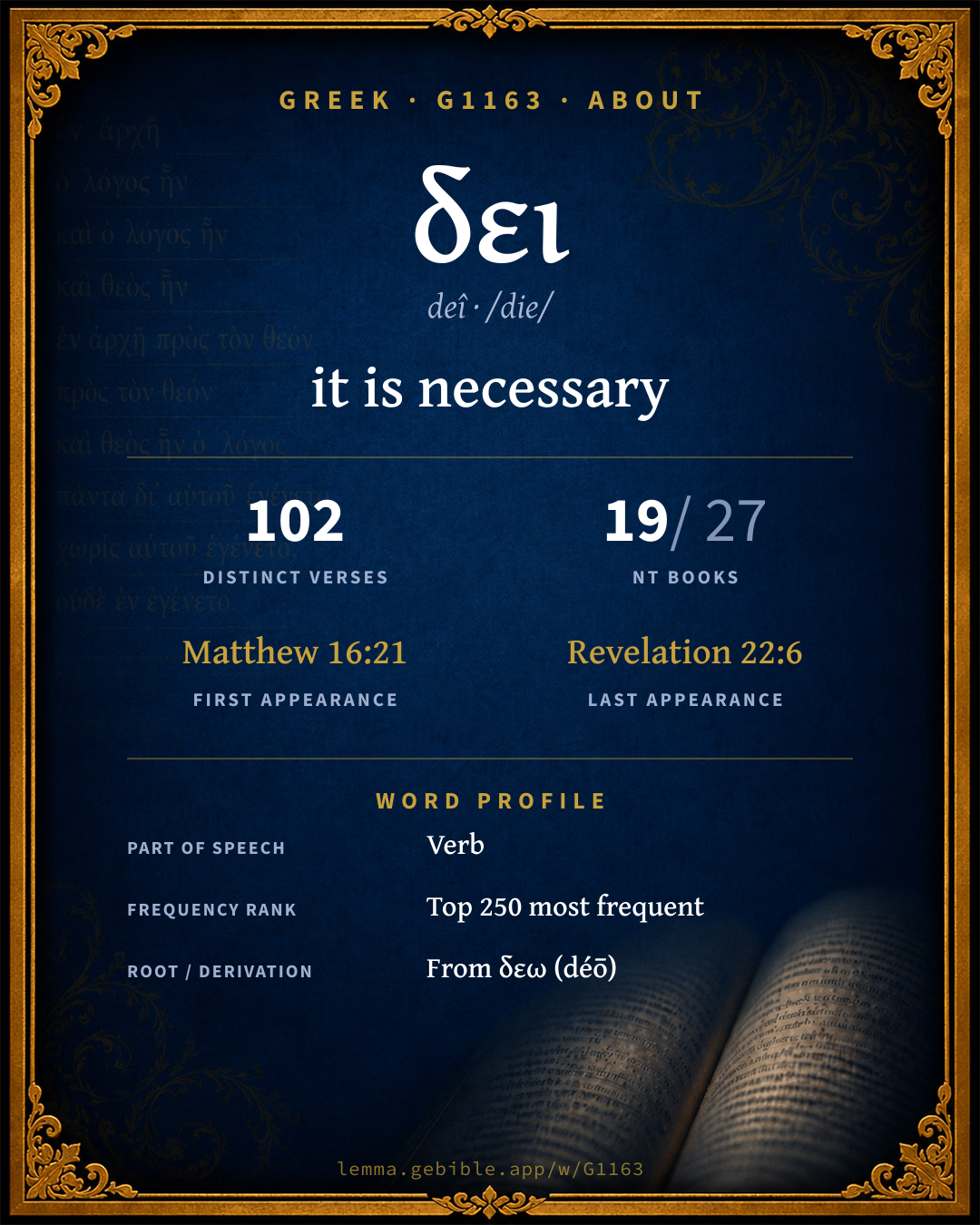
δεῖ
it is necessary
Full lexicon entry — Thayer's Greek Lexicon
From Thayer's Greek Lexicon
Where this word appears
See every Present-tense verb in the Greek New Testament →
Grammar key — what these labels mean
Part of speech
- Verb
- An action or state-of-being word.
Tense
- Present
- Ongoing or general action in present time (imperfective aspect).
- Imperfect
- Continuous or repeated action in past time (“was writing”).
Voice
- Active
- The subject performs the action.
Mood
- Indicative
- States a fact or asks a factual question (the mood of reality).
- Infinitive
- A verbal noun (“to write”), unmarked for person or number.
- Participle
- A verbal adjective (“writing,” “having written”).
- Subjunctive
- Expresses probability, purpose, or possibility (the mood of contingency).
Case
- Nominative
- The case of the subject (and the predicate nominative).
- Accusative
- The case of the direct object and of extent.
Person
- 3rd person
- The one spoken about (“he / she / it / they”).
Gender
- Neuter
- Grammatically neuter.
Number
- Singular
- One.
- Plural
- More than one.
Grammatical forms
- Verb, Present, Active, Indicative, 3rd person, Singular 79 times (77%)
- Verb, Imperfect, Active, Indicative, 3rd person, Singular 16 times (16%)
- Verb, Present, Active, Infinitive 3 times (3%)
- Verb, Present, Active, Participle, Nominative, Singular, Neuter 2 times (2%)
- Verb, Present, Active, Subjunctive, 3rd person, Singular 2 times (2%)
- Verb, Present, Active, Participle, Accusative, Plural, Neuter 1 time (1%)
Parsed forms decoded from the imported morphology (Robinson–Tischendorf, public domain), counted across 103 parsed occurrences — not distinct verses.
Every verse where G1163 appears — 102 distinct verses across 19 books. Click any verse to open its interlinear word-by-word view. Verse text shown in the World English Bible for context — . Each verse’s Greek form is shown with its reference; the English is not keyword-highlighted, since the data carries no word-level English alignment. Use “Compare translations” on any verse to read it across multiple English versions. This concordance covers the Greek New Testament; Septuagint (Greek Old Testament) occurrences of this word are not indexed here.
Matthew 8 verses
- Matthew 16:21 δεῖ pres act ind 3sg From that time, Jesus began to show his disciples that he must go to Jerusalem and suffer many things from the elders, chief priests, and scribes, and be killed, and the third day be raised up.
- Matthew 17:10 δεῖ pres act ind 3sg His disciples asked him, saying, "Then why do the scribes say that Elijah must come first?"
- Matthew 18:33 ἔδει impf act ind 3sg Shouldn't you also have had mercy on your fellow servant, even as I had mercy on you?'
- Matthew 23:23 ἔδει impf act ind 3sg "Woe to you, scribes and Pharisees, hypocrites! For you tithe mint, dill, and cumin, and have left undone the weightier matters of the law: justice, mercy, and faith. But you ought to have done these, and not to have left the other undone.
- Matthew 24:6 δεῖ pres act ind 3sg You will hear of wars and rumors of wars. See that you aren't troubled, for all this must happen, but the end is not yet.
- Matthew 25:27 ἔδει impf act ind 3sg You ought therefore to have deposited my money with the bankers, and at my coming I should have received back my own with interest.
- Matthew 26:35 δέῃ pres act subj 3sg Peter said to him, "Even if I must die with you, I will not deny you." All of the disciples also said likewise.
- Matthew 26:54 δεῖ pres act ind 3sg How then would the Scriptures be fulfilled that it must be so?"
Mark 6 verses
- Mark 8:31 δεῖ pres act ind 3sg He began to teach them that the Son of Man must suffer many things, and be rejected by the elders, the chief priests, and the scribes, and be killed, and after three days rise again.
- Mark 9:11 δεῖ pres act ind 3sg They asked him, saying, "Why do the scribes say that Elijah must come first?"
- Mark 13:7 δεῖ pres act ind 3sg "When you hear of wars and rumors of wars, don't be troubled. For those must happen, but the end is not yet.
- Mark 13:10 δεῖ pres act ind 3sg The Gospel must first be preached to all the nations.
- Mark 13:14 δεῖ pres act ind 3sg But when you see the abomination of desolation, spoken of by Daniel the prophet, standing where it ought not (let the reader understand), then let those who are in Judea flee to the mountains,
- Mark 14:31 δέῃ pres act subj 3sg But he spoke all the more, "If I must die with you, I will not deny you." They all said the same thing.
Luke 18 verses
- Luke 2:49 δεῖ pres act ind 3sg He said to them, "Why were you looking for me? Didn't you know that I must be in my Father's house?"
- Luke 4:43 δεῖ pres act ind 3sg But he said to them, "I must preach the good news of the Kingdom of God to the other cities also. For this reason I have been sent."
- Luke 9:22 δεῖ pres act ind 3sg saying, "The Son of Man must suffer many things, and be rejected by the elders, chief priests, and scribes, and be killed, and the third day be raised up."
- Luke 11:42 ἔδει impf act ind 3sg But woe to you Pharisees! For you tithe mint and rue and every herb, but you bypass justice and the love of God. You ought to have done these, and not to have left the other undone.
- Luke 12:12 δεῖ pres act ind 3sg for the Holy Spirit will teach you in that same hour what you must say."
- Luke 13:14 δεῖ pres act ind 3sg The ruler of the synagogue, being indignant because Jesus had healed on the Sabbath, said to the multitude, "There are six days in which men ought to work. Therefore come on those days and be healed, and not on the Sabbath day!"
- Luke 13:16 ἔδει impf act ind 3sg Ought not this woman, being a daughter of Abraham, whom Satan had bound eighteen long years, be freed from this bondage on the Sabbath day?"
- Luke 13:33 δεῖ pres act ind 3sg Nevertheless I must go on my way today and tomorrow and the next day, for it can't be that a prophet perish outside of Jerusalem.'
- Luke 15:32 ἔδει impf act ind 3sg But it was appropriate to celebrate and be glad, for this, your brother, was dead, and is alive again. He was lost, and is found.'"
- Luke 17:25 δεῖ pres act ind 3sg But first, he must suffer many things and be rejected by this generation.
- Luke 18:1 δεῖν pres act inf He also spoke a parable to them that they must always pray, and not give up,
- Luke 19:5 δεῖ pres act ind 3sg When Jesus came to the place, he looked up and saw him, and said to him, "Zacchaeus, hurry and come down, for today I must stay at your house."
- Luke 21:9 δεῖ pres act ind 3sg When you hear of wars and disturbances, don't be terrified, for these things must happen first, but the end won't come immediately."
- Luke 22:7 ἔδει impf act ind 3sg The day of unleavened bread came, on which the Passover must be sacrificed.
- Luke 22:37 δεῖ pres act ind 3sg For I tell you that this which is written must still be fulfilled in me: 'He was counted with the lawless.' For that which concerns me has an end."
- Luke 24:7 δεῖ pres act ind 3sg saying that the Son of Man must be delivered up into the hands of sinful men, and be crucified, and the third day rise again?"
- Luke 24:26 ἔδει impf act ind 3sg Didn't the Christ have to suffer these things and to enter into his glory?"
- Luke 24:44 δεῖ pres act ind 3sg He said to them, "This is what I told you, while I was still with you, that all things which are written in the law of Moses, the prophets, and the psalms, concerning me must be fulfilled."
John 10 verses
- John 3:7 δεῖ pres act ind 3sg Don't marvel that I said to you, 'You must be born anew.'
- John 3:14 δεῖ pres act ind 3sg As Moses lifted up the serpent in the wilderness, even so must the Son of Man be lifted up,
- John 3:30 δεῖ pres act ind 3sg He must increase, but I must decrease.
- John 4:4 ἔδει impf act ind 3sg He needed to pass through Samaria.
- John 4:20 δεῖ pres act ind 3sg Our fathers worshiped in this mountain, and you Jews say that in Jerusalem is the place where people ought to worship."
- John 4:24 δεῖ pres act ind 3sg God is spirit, and those who worship him must worship in spirit and truth."
- John 9:4 δεῖ pres act ind 3sg I must work the works of him who sent me, while it is day. The night is coming, when no one can work.
- John 10:16 δεῖ pres act ind 3sg I have other sheep, which are not of this fold. I must bring them also, and they will hear my voice. They will become one flock with one shepherd.
- John 12:34 δεῖ pres act ind 3sg The multitude answered him, "We have heard out of the law that the Christ remains forever. How do you say, 'The Son of Man must be lifted up?' Who is this Son of Man?"
- John 20:9 δεῖ pres act ind 3sg For as yet they didn't know the Scripture, that he must rise from the dead.
Acts 23 verses
- Acts 1:16 ἔδει impf act ind 3sg "Brothers, it was necessary that this Scripture should be fulfilled, which the Holy Spirit spoke before by the mouth of David concerning Judas, who was guide to those who took Jesus.
- Acts 1:21 δεῖ pres act ind 3sg Of the men therefore who have accompanied us all the time that the Lord Jesus went in and out among us,
- Acts 3:21 δεῖ pres act ind 3sg whom heaven must receive until the times of restoration of all things, which God spoke long ago by the mouth of his holy prophets.
- Acts 4:12 δεῖ pres act ind 3sg There is salvation in none other, for neither is there any other name under heaven, that is given among men, by which we must be saved!"
- Acts 5:29 δεῖ pres act ind 3sg But Peter and the apostles answered, "We must obey God rather than men.
- Acts 9:6 δεῖ pres act ind 3sg But rise up, and enter into the city, and you will be told what you must do."
- Acts 9:16 δεῖ pres act ind 3sg For I will show him how many things he must suffer for my name's sake."
- Acts 14:22 δεῖ pres act ind 3sg confirming the souls of the disciples, exhorting them to continue in the faith, and that through many afflictions we must enter into the Kingdom of God.
- Acts 15:5 δεῖ pres act ind 3sg But some of the sect of the Pharisees who believed rose up, saying, "It is necessary to circumcise them, and to charge them to keep the law of Moses."
- Acts 16:30 δεῖ pres act ind 3sg and brought them out and said, "Sirs, what must I do to be saved?"
- Acts 17:3 ἔδει impf act ind 3sg explaining and demonstrating that the Christ had to suffer and rise again from the dead, and saying, "This Jesus, whom I proclaim to you, is the Christ."
- Acts 19:21 δεῖ pres act ind 3sg Now after these things had ended, Paul determined in the spirit, when he had passed through Macedonia and Achaia, to go to Jerusalem, saying, "After I have been there, I must also see Rome."
- Acts 19:36 δέον pres act ptcp nom sg neut Seeing then that these things can't be denied, you ought to be quiet, and to do nothing rash.
- Acts 20:35 δεῖ pres act ind 3sg In all things I gave you an example, that so laboring you ought to help the weak, and to remember the words of the Lord Jesus, that he himself said, 'It is more blessed to give than to receive.'"
- Acts 21:22 δεῖ pres act ind 3sg What then? The assembly must certainly meet, for they will hear that you have come.
- Acts 23:11 δεῖ pres act ind 3sg The following night, the Lord stood by him, and said, "Cheer up, Paul, for as you have testified about me at Jerusalem, so you must testify also at Rome."
- Acts 24:19 ἔδει impf act ind 3sg They ought to have been here before you, and to make accusation, if they had anything against me.
- Acts 25:10 δεῖ pres act ind 3sg But Paul said, "I am standing before Caesar's judgment seat, where I ought to be tried. I have done no wrong to the Jews, as you also know very well.
- Acts 25:24 δεῖν pres act inf Festus said, "King Agrippa, and all men who are here present with us, you see this man, about whom all the multitude of the Jews petitioned me, both at Jerusalem and here, crying that he ought not to live any longer.
- Acts 26:9 δεῖν pres act inf "I myself most assuredly thought that I ought to do many things contrary to the name of Jesus of Nazareth.
- Acts 27:21 ἔδει impf act ind 3sg When they had been long without food, Paul stood up in the middle of them, and said, "Sirs, you should have listened to me, and not have set sail from Crete, and have gotten this injury and loss.
- Acts 27:24 δεῖ pres act ind 3sg saying, 'Don't be afraid, Paul. You must stand before Caesar. Behold, God has granted you all those who sail with you.'
- Acts 27:26 δεῖ pres act ind 3sg But we must run aground on a certain island."
Romans 3 verses
- Romans 1:27 ἔδει impf act ind 3sg Likewise also the men, leaving the natural function of the woman, burned in their lust toward one another, men doing what is inappropriate with men, and receiving in themselves the due penalty of their error.
- Romans 8:26 δεῖ pres act ind 3sg In the same way, the Spirit also helps our weaknesses, for we don't know how to pray as we ought. But the Spirit himself makes intercession for us with groanings which can't be uttered.
- Romans 12:3 δεῖ pres act ind 3sg For I say, through the grace that was given me, to every man who is among you, not to think of himself more highly than he ought to think; but to think reasonably, as God has apportioned to each person a measure of faith.
1 Corinthians 4 verses
- 1 Corinthians 8:2 δεῖ pres act ind 3sg But if anyone thinks that he knows anything, he doesn't yet know as he ought to know.
- 1 Corinthians 11:19 δεῖ pres act ind 3sg For there also must be factions among you, that those who are approved may be revealed among you.
- 1 Corinthians 15:25 δεῖ pres act ind 3sg For he must reign until he has put all his enemies under his feet.
- 1 Corinthians 15:53 δεῖ pres act ind 3sg For this corruptible must put on incorruption, and this mortal must put on immortality.
2 Corinthians 4 verses
- 2 Corinthians 2:3 ἔδει impf act ind 3sg And I wrote this very thing to you, so that, when I came, I wouldn't have sorrow from them of whom I ought to rejoice; having confidence in you all, that my joy would be shared by all of you.
- 2 Corinthians 5:10 δεῖ pres act ind 3sg For we must all be revealed before the judgment seat of Christ; that each one may receive the things in the body, according to what he has done, whether good or bad.
- 2 Corinthians 11:30 δεῖ pres act ind 3sg If I must boast, I will boast of the things that concern my weakness.
- 2 Corinthians 12:1 δεῖ pres act ind 3sg It is doubtless not profitable for me to boast. For I will come to visions and revelations of the Lord.
Ephesians 1 verse
Colossians 2 verses
1 Thessalonians 1 verse
2 Thessalonians 1 verse
1 Timothy 4 verses
- 1 Timothy 3:2 δεῖ pres act ind 3sg The overseer therefore must be without reproach, the husband of one wife, temperate, sensible, modest, hospitable, good at teaching;
- 1 Timothy 3:7 δεῖ pres act ind 3sg Moreover he must have good testimony from those who are outside, to avoid falling into reproach and the snare of the devil.
- 1 Timothy 3:15 δεῖ pres act ind 3sg but if I wait long, that you may know how men ought to behave themselves in the house of God, which is the assembly of the living God, the pillar and ground of the truth.
- 1 Timothy 5:13 δέοντα pres act ptcp acc pl neut Besides, they also learn to be idle, going about from house to house. Not only idle, but also gossips and busybodies, saying things which they ought not.
2 Timothy 2 verses
Titus 2 verses
- Titus 1:7 δεῖ pres act ind 3sg For the overseer must be blameless, as God's steward; not self-pleasing, not easily angered, not given to wine, not violent, not greedy for dishonest gain;
- Titus 1:11 δεῖ δεῖ pres act ind 3sg pres act ind 3sg whose mouths must be stopped; men who overthrow whole houses, teaching things which they ought not, for dishonest gain's sake.
Hebrews 3 verses
- Hebrews 2:1 δεῖ pres act ind 3sg Therefore we ought to pay greater attention to the things that were heard, lest perhaps we drift away.
- Hebrews 9:26 ἔδει impf act ind 3sg or else he must have suffered often since the foundation of the world. But now once at the end of the ages, he has been revealed to put away sin by the sacrifice of himself.
- Hebrews 11:6 δεῖ pres act ind 3sg Without faith it is impossible to be well pleasing to him, for he who comes to God must believe that he exists, and that he is a rewarder of those who seek him.
1 Peter 1 verse
2 Peter 1 verse
Revelation 8 verses
- Revelation 1:1 δεῖ pres act ind 3sg This is the Revelation of Jesus Christ, which God gave him to show to his servants the things which must happen soon, which he sent and made known by his angel to his servant, John,
- Revelation 4:1 δεῖ pres act ind 3sg After these things I looked and saw a door opened in heaven, and the first voice that I heard, like a trumpet speaking with me, was one saying, "Come up here, and I will show you the things which must happen after this."
- Revelation 10:11 δεῖ pres act ind 3sg They told me, "You must prophesy again over many peoples, nations, languages, and kings."
- Revelation 11:5 δεῖ pres act ind 3sg If anyone desires to harm them, fire proceeds out of their mouth and devours their enemies. If anyone desires to harm them, he must be killed in this way.
- Revelation 13:10 δεῖ pres act ind 3sg If anyone has captivity, he will go. If anyone is with the sword, he must be killed. Here is the endurance and the faith of the saints.
- Revelation 17:10 δεῖ pres act ind 3sg They are seven kings. Five have fallen, the one is, the other has not yet come. When he comes, he must continue a little while.
- Revelation 20:3 δεῖ pres act ind 3sg and cast him into the abyss, and shut it, and sealed it over him, that he should deceive the nations no more, until the thousand years were finished. After this, he must be freed for a short time.
- Revelation 22:6 δεῖ pres act ind 3sg He said to me, "These words are faithful and true. The Lord God of the spirits of the prophets sent his angel to show to his bondservants the things which must happen soon."
About this entry
At a glance — auto-summarized from this page’s data, not written by a person. Every figure links to its source below. This summary describes the numbers; it doesn’t interpret them.
At its core, δει (deî) means “it is necessary.” Translators differ — “must” in the King James Version, then “was necessary for” (unfoldingWord Literal Text), as the renderings breakdown shows. It turns up in 102 verses across 19 books, a common footprint. It first appears in Matthew 16:21. It clusters with δεω, δεομαι and δεσμον under a shared root. Dig into 102-verse concordance and the renderings breakdown below.
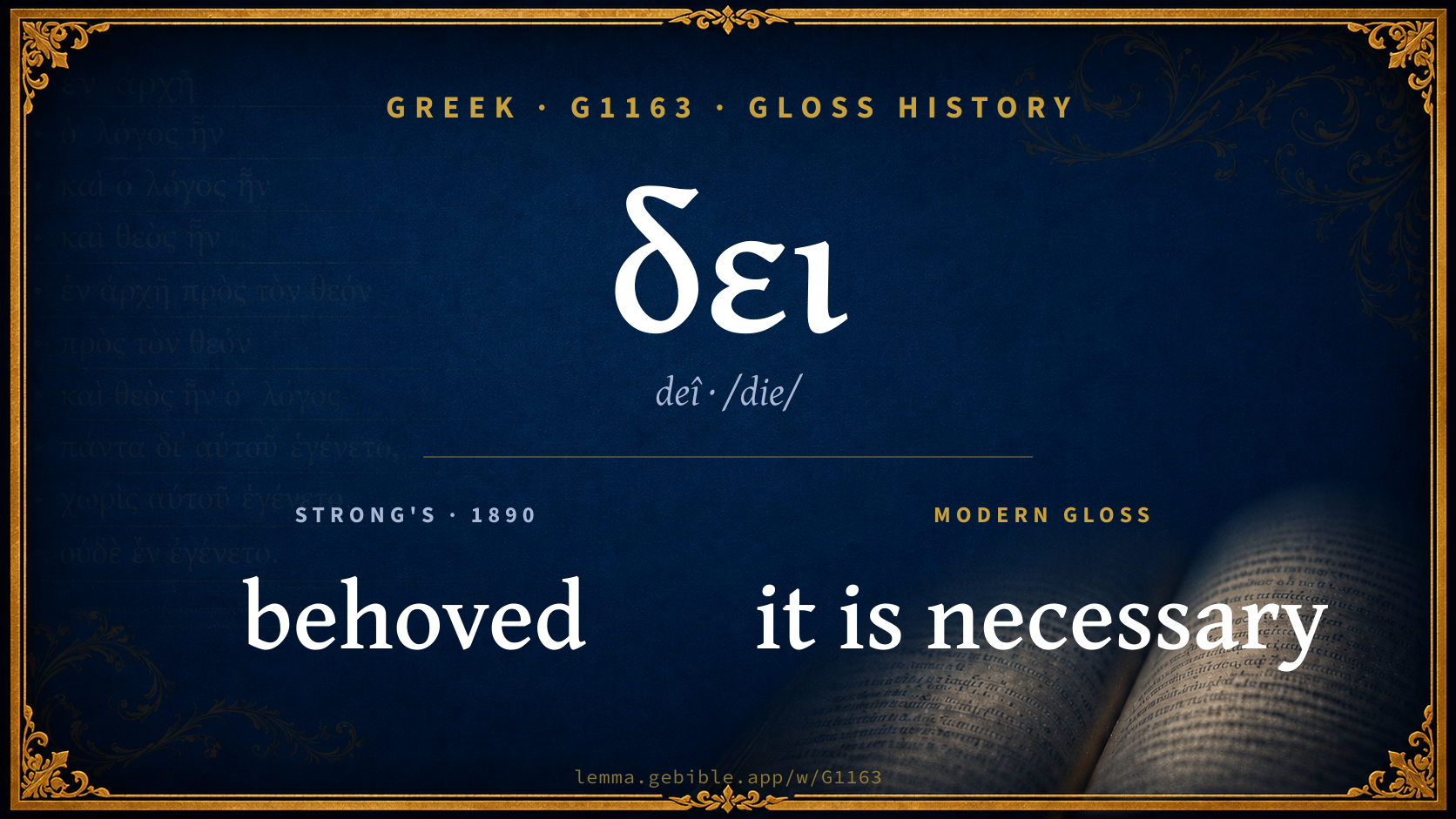
Gloss history
Strong's 1890 vs modern scholarship
About this word
Strong's G1163 catalogs a Greek word from the Greek New Testament.
These counts are not copied from any lexicon or concordance. They are computed here, from the morphology-tagged Greek New Testament. What Lemma adds →
- 102
- distinct verses
- The word appears in 102 distinct verses.
- 19 / 27
- NT books
- The word appears in 19 of 27 New Testament books.
- #159
- by frequency
- Top 250 most frequent Greek words (rank 159 of 5,347 Greek words by occurrence).
View all 102 occurrences in the concordance →
By section of the New Testament
By traditional corpus
Conventional, traditional groupings — biblical authorship is debated, so this is a traditional corpus grouping, not an authorship claim. Some books belong to more than one corpus (Luke is in both the Gospels and the Lukan corpus, and so on), so these shares overlap and need not total 100%. Each figure is a share of the word’s 102 distinct verses.
- Gospels 42 verses · 41%
- Lukan (Luke–Acts) 41 verses · 40%
- Pauline corpus 24 verses · 24%
- Johannine 18 verses · 18%
- Revelation 8 verses · 8%
- Hebrews 3 verses · 3%
- General (Catholic) Epistles 2 verses · 2%
How translations render this word
Counts come from each version’s own published word-to-Strong’s tagging or interlinear alignment — an approximate guide to how each version renders this word, not a word-level alignment the data otherwise carries. Because each total is that version’s own tagged count, the per-version totals vary from one another and need not match the appearance or distinct-verse counts above. These counts may also differ from a printed concordance because Lemma counts each distinctly tagged rendering and does not collapse phrase taggings into a single head-word total. This is a fixed set of word-tagged versions (KJV, ASV, BSB, ULT) and does not change with the reading translation you choose elsewhere. Each version’s license is shown beside its name below (and on Sources).
- King James Version: Must 57×, Ought 12×, He ought 3×
- American Standard Version: Must 51×, Ought 11×, He ought 3×
- Berean Standard Bible: Must 53×, Ought 4×, Should 4×
- unfoldingWord Literal Text: Was necessary for 5×, Was necessary 4×, Necessary 2×
King James Version Public Domain
Renders G1163 across 105 tagged occurrences — most commonly:
Plus 16 renderings that appear only once — usually multi-word phrases or single function words the recovered tagging swept in, not distinct renderings. Not rendered by a distinct English word in 1 further occurrence.
American Standard Version Public Domain
Renders G1163 across 98 tagged occurrences — most commonly:
Plus 24 renderings that appear only once — usually multi-word phrases or single function words the recovered tagging swept in, not distinct renderings.
Berean Standard Bible Public Domain
Renders G1163 across 98 tagged occurrences — most commonly:
Plus 19 renderings that appear only once — usually multi-word phrases or single function words the recovered tagging swept in, not distinct renderings. Not rendered by a distinct English word in 2 further occurrences.
unfoldingWord Literal Text CC BY-SA 4.0
Renders G1163 across 19 tagged occurrences — most commonly:
Plus 6 renderings that appear only once — usually multi-word phrases or single function words the recovered tagging swept in, not distinct renderings.
Senses in Thayer's
The 1 sense Thayer's distinguishes for this word, in lexicon order (not ranked by frequency or importance). The full entry — with sub-senses — is in the Lexicon Entry tab.
- it is necessary, there is need of, it behooves, is right and proper
Word origin
Derived from δεω (déō) (G1210) — to bind.
Third person singular active present of G1210 ; also δεόν deon which is neuter active participle of the same; both used impersonally; it is ( was etc.) necessary (as binding ): - behoved be meet must (needs) (be) need (-ful) ought should.
— Strong’s Exhaustive Concordance (1890), public domain.
Forms in the corpus
The 6 distinct written forms G1163 takes in the Greek New Testament, most frequent first — each parse links to that tense’s occurrences in the concordance.
| Form | Parsing | Example | Uses |
|---|---|---|---|
| δεῖ deî | Verb, Present, Active, Indicative, 3rd person, Singular | Matthew 16:21 | 79 |
| ἔδει édei | Verb, Imperfect, Active, Indicative, 3rd person, Singular | Matthew 18:33 | 16 |
| δεῖν deîn | Verb, Present, Active, Infinitive | Luke 18:1 | 3 |
| δέον déon | Verb, Present, Active, Participle, Nominative, Singular, Neuter | Acts 19:36 | 2 |
| δέῃ déē | Verb, Present, Active, Subjunctive, 3rd person, Singular | Matthew 26:35 | 2 |
| δέοντα déonta | Verb, Present, Active, Participle, Accusative, Plural, Neuter | 1 Timothy 5:13 | 1 |
Same root — word family
Other Thayer's entries built from the same root as G1163, grouped by Strong’s listed origin. These share a root / origin per the lexicon — not necessarily a shared meaning. Each links to that word’s own entry.
Derives from
Shares the same root
- δεομαι déomai G1189 to ask
- δεσμον desmón G1199 bond
- δεσποτης despótēs G1203 master
- δημος dēmos G1218 people
- δουλος doûlos G1401 slave
Compare all same-root words → Showing 4 of 7 — not the complete family. They share a root, not necessarily a meaning.