2 Kings 13:4

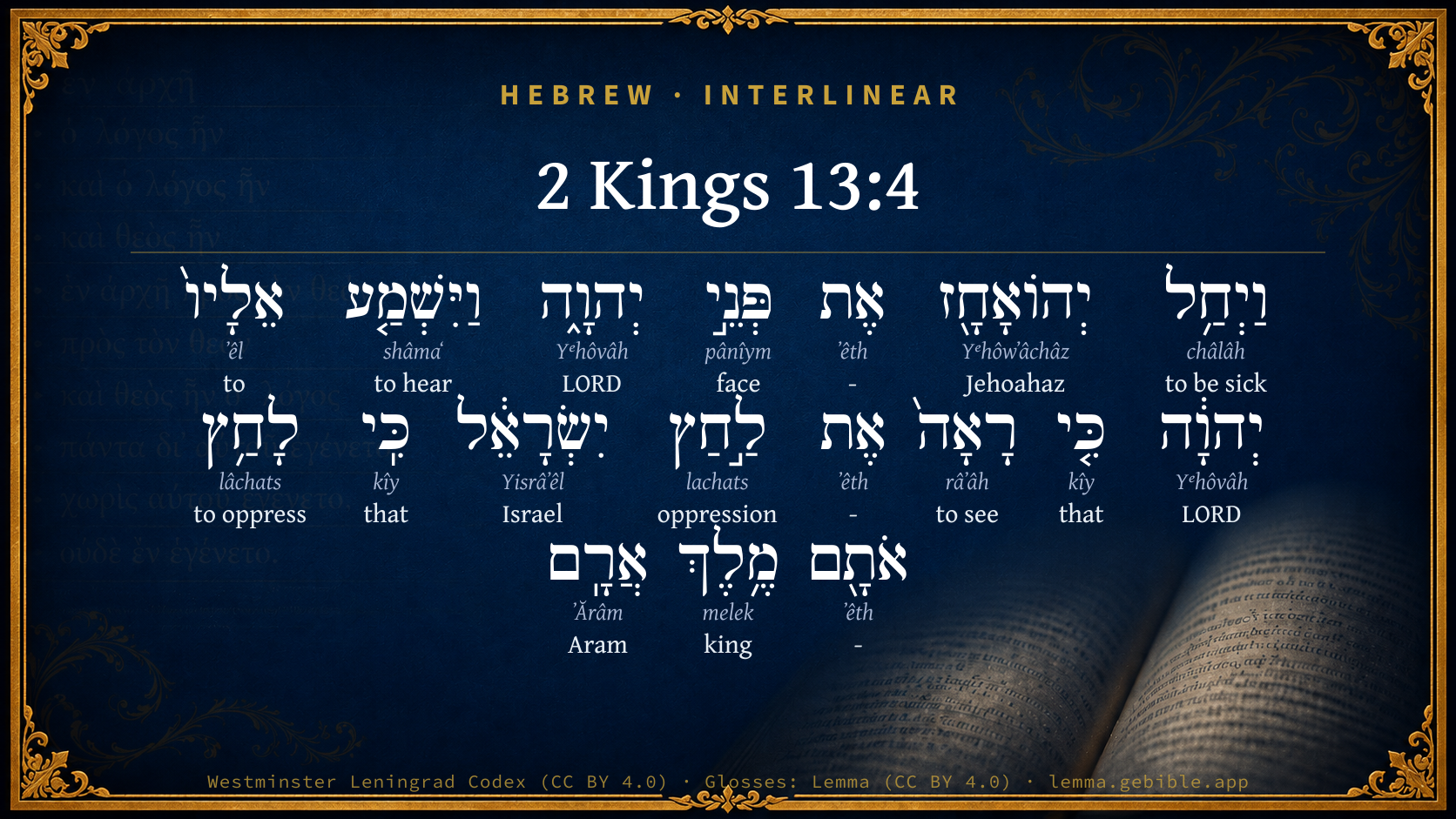
Hebrew (Westminster Leningrad Codex) 2 Kings 13:4 appears in the Hebrew Old Testament. The text above is from the Westminster Leningrad Codex. Each word links to its Strong’s number, a concise gloss, and parsing drawn from the Open Scriptures Hebrew Bible morphology. Click any word for its full Brown-Driver-Briggs (BDB) entry.
Download image
Cite this verse

2 Kings 13:4 (World English Bible). Public Domain. Lemma interlinear Bible study tool, https://lemma.gebible.app/v/2-kings/13/4.

Show BibTeX & RIS
BibTeX
RIS
English Translation
Jehoahaz begged Yahweh, and Yahweh listened to him; for he saw the oppression of Israel, how that the king of Syria oppressed them.
World English Bible · Public Domain
Download a study sheet

One document with this verse’s original text, its word-by-word gloss line, the meaning frame, cross-references with their text, attributed commentary, and full source and license credits — printable, and it pastes into notes with its structure intact.

This verse Autodidact and up

Study sheet (.html) Plain text (.txt)

A passage Seminary Student

Up to 50 verses in one chapter. A passage sheet keeps up to 6 commentary sources and 12 cross-references per verse, in the order this page ranks them, and says so on the sheet whenever that leaves anything out. Ask for a single verse and you get the Autodidact verse sheet above.

Everything on this page stays free to read, with no account — the sheet is a download of what is already on screen, not access to it.

Want to remove ads? Support Godless Engineer
Compare translations 3

The same verse in 3 English versions, stacked beneath the original-language interlinear above. Click any original word for its lexicon entry.

Each is an independent rendering of the whole verse — the interlinear is not word-aligned to these translations.

Highlighted words mark where these versions differ — a whole-verse word diff, not a word-by-word alignment.

  • World English Bible Public Domain
    Jehoahaz begged Yahweh, and Yahweh listened to him; for he saw the oppression of Israel, how that the king of Syria oppressed them.
  • King James Version Public Domain
    And Jehoahaz besought the LORD, and the LORD hearkened unto him: for he saw the oppression of Israel, because the king of Syria oppressed them.
  • unfoldingWord Literal Text CC BY-SA 4.0
    Then Jehoahaz entreated the face of Yahweh, and Yahweh listened to him because he saw the oppression of Israel, for the king of Aram oppressed them.

unfoldingWord Literal Text — © unfoldingWord, licensed CC BY-SA 4.0. Word-aligned USFM3 via Door43 (git.door43.org/unfoldingWord/en_ult).

Versions to compare (up to 4)

3 of 4 selected

Show all 18 translations

Every available English version of this verse, each an independent rendering of the whole verse.

  • World English Bible Public Domain
    Jehoahaz begged Yahweh, and Yahweh listened to him; for he saw the oppression of Israel, how that the king of Syria oppressed them.
  • Berean Standard Bible Public Domain
    Then Jehoahaz sought the favor of the LORD, and the LORD listened to him because He saw the oppression that the king of Aram had inflicted on Israel.
  • Majority Standard Bible Public Domain
    Then Jehoahaz sought the favor of the LORD, and the LORD listened to him because He saw the oppression that the king of Aram had inflicted on Israel.
  • King James Version Public Domain
    And Jehoahaz besought the LORD, and the LORD hearkened unto him: for he saw the oppression of Israel, because the king of Syria oppressed them.
  • American Standard Version (1901) Public Domain
    And Jehoahaz besought Jehovah, and Jehovah hearkened unto him; for he saw the oppression of Israel, how that the king of Syria oppressed them.
  • Revised Version (1885) Public Domain
    And Jehoahaz besought the LORD, and the LORD hearkened unto him: for he saw the oppression of Israel, how that the king of Syria oppressed them.
  • Geneva Bible (1599) Public Domain
    And Iehoahaz besought the Lord, and the Lord heard him: for he saw the trouble of Israel, wherewith the King of Aram troubled them.
  • Douay-Rheims (1899) Public Domain
    But Joachaz besought the face of the Lord, and the Lord heard him: for he saw the distress of Israel, because the king of Syria had oppressed them:
  • Young's Literal Translation Public Domain
    And Jehoahaz appeaseth the face of Jehovah, and Jehovah hearkeneth unto him, for He hath seen the oppression of Israel, for oppressed them hath the king of Aram, --
  • Literal Standard Version CC BY-SA 4.0
    And Jehoahaz appeases the face of YHWH, and YHWH listens to him, for He has seen the oppression of Israel, for the king of Aram has oppressed them—
  • Unlocked Literal Bible CC BY-SA 4.0
    So Jehoahaz implored Yahweh, and Yahweh listened to him because he saw the oppression of Israel, how the king of Aram was oppressing them.
  • unfoldingWord Literal Text CC BY-SA 4.0
    Then Jehoahaz entreated the face of Yahweh, and Yahweh listened to him because he saw the oppression of Israel, for the king of Aram oppressed them.
  • Darby Bible Public Domain
    (And Jehoahaz besought Jehovah, and Jehovah hearkened to him; for he saw the oppression of Israel, because the king of Syria oppressed them.
  • World Messianic Bible Public Domain
    Jehoahaz begged the LORD, and the LORD listened to him; for he saw the oppression of Israel, how the king of Syria oppressed them.
  • Webster's Bible Public Domain
    And Jehoahaz besought the LORD, and the LORD hearkened to him: for he saw the oppression of Israel, because the king of Syria oppressed them.
  • Free Bible Version CC BY-SA 4.0
    Jehoahaz asked the Lord for help, and the Lord responded to his request because he saw how badly the king of Aram was treating Israel.
  • Bible in Basic English Public Domain
    Then Jehoahaz made prayer to the Lord, and the Lord gave ear to him, for he saw how cruelly Israel was crushed by the king of Aram.
  • JPS Tanakh (1917) Public Domain
    And Jehoahaz besought the LORD, and the LORD hearkened unto him; for He saw the oppression of Israel, how that the king of Aram oppressed them. —

Literal Standard Version (2020), Covenant Press — licensed CC BY-SA 4.0. Text via the HelloAO Bible API (eBible.org). Unlocked Literal Bible (unfoldingWord) — licensed CC BY-SA 4.0. Text via the HelloAO Bible API (eBible.org). unfoldingWord Literal Text — © unfoldingWord, licensed CC BY-SA 4.0. Word-aligned USFM3 via Door43 (git.door43.org/unfoldingWord/en_ult). Free Bible Version, Dr. Jonathan Gallagher — licensed CC BY-SA 4.0. Text via the HelloAO Bible API (eBible.org).

Word by word

More ways to search: Search by grammar → Find every occurrence → Compare this word →

Practice this passage: Drill this verse → Learn its vocabulary →

לַ֣חַץ
lachats
H3906
“oppression of”
Noun, Common, Masculine, Singular, Construct
Part of Speech
Noun
Type
Common
Gender
Masculine
Number
Singular
State
Construct
Full BDB Definition

Origin: from H3905

TWOT: 1106a

oppression, distress, pressure
  1. וַיְחַ֥ל châlâh H2470 “and · to be sick” Conjunction + Verb, Piel, Sequential Imperfect, 3rd Person, Masculine, Singular
  2. יְהוֹאָחָ֖ז Yᵉhôwʼâchâz H3059 “Jehoahaz” Noun, Proper
  3. אֶת ʼêth H853 “-” Particle, Direct Object
  4. פְּנֵ֣י pânîym H6440 “face(s) of” Noun, Common, Both, Plural, Construct
  5. יְהוָ֑ה Yᵉhôvâh H3068 “LORD” Noun, Proper
  6. וַיִּשְׁמַ֤ע shâmaʻ H8085 “and · to hear” Conjunction + Verb, Qal, Sequential Imperfect, 3rd Person, Masculine, Singular
  7. אֵלָיו֙ ʼêl H413 “to · him” Preposition + Suffix, Personal, 3rd Person, Masculine, Singular
  8. יְהוָ֔ה Yᵉhôvâh H3068 “LORD” Noun, Proper
  9. כִּ֤י kîy H3588 “that” Conjunction
  10. רָאָה֙ râʼâh H7200 “to see” Verb, Qal, Perfect, 3rd Person, Masculine, Singular
  11. אֶת ʼêth H853 “-” Particle, Direct Object
  12. יִשְׂרָאֵ֔ל Yisrâʼêl H3478 “Israel” Noun, Proper
  13. כִּֽי kîy H3588 “that” Conjunction
  14. לָחַ֥ץ lâchats H3905 “to oppress” Verb, Qal, Perfect, 3rd Person, Masculine, Singular
  15. אֹתָ֖ם ʼêth H853 “- · them” Particle, Direct Object + Suffix, Personal, 3rd Person, Masculine, Plural
  16. מֶ֥לֶךְ melek H4428 “king of” Noun, Common, Masculine, Singular, Construct
  17. אֲרָֽם ʼĂrâm H758 “Aram” Noun, Proper

About this verse

These counts appear in no published source. They are computed here, from the morphology-tagged text and Lemma’s own curated glosses. What Lemma adds →

18
words
14
distinct lemmas
Historical
section

Notable vocabulary

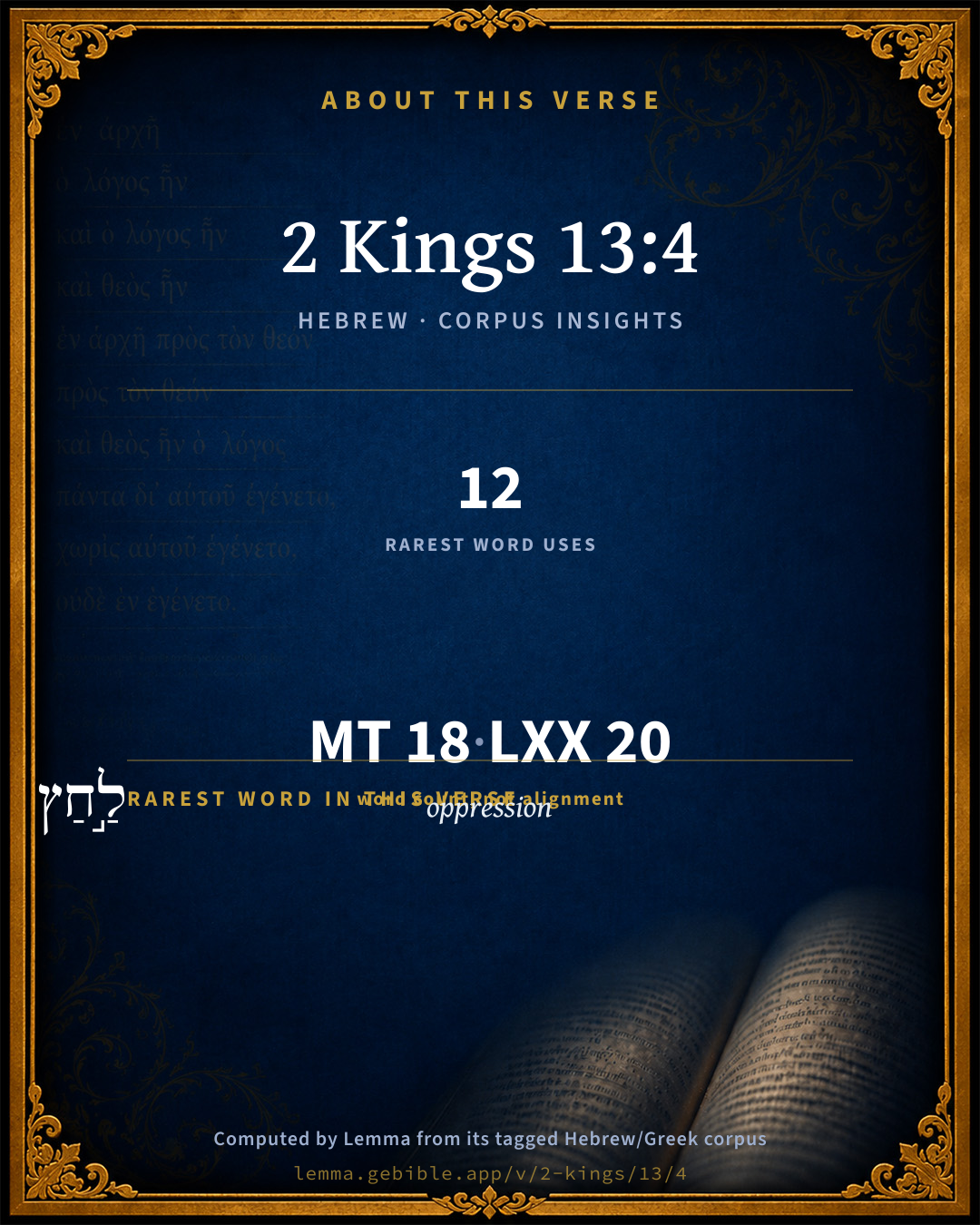
The rarest word here is לַ֣חַץ oppression H3906 — appearing just 12 times in the whole Hebrew Bible.

Shared distinctive vocabulary

לַ֣חַץ oppression H3906 occurs in 10 verses of the Hebrew Bible. Also found in:

Grammatical profile

  • 4 verbs
  • 8 nouns
  • 1 preposition
  • 2 conjunctions
  • 3 particles

Verb forms

  • וַיְחַ֥ל Piel · Sequential Imperfect
  • וַיִּשְׁמַ֤ע Qal · Sequential Imperfect
  • רָאָה֙ Qal · Perfect
  • לָחַ֥ץ Qal · Perfect

Repetition

Words recur within this verse — often emphatic in Hebrew:

  • יְהוָ֑ה LORD H3068 ×2
  • כִּ֤י that H3588 ×2

Hebrew & Septuagint length

In English translation the verse runs 23 words from the Hebrew and 25 from the Septuagint (LXX English) — closely comparable.

A rough comparison of the two English renderings, which tokenize alike — not a word-level alignment.

Word counts can differ between the Hebrew and the Greek without any difference in meaning — e.g. the Hebrew direct-object marker אֵת has no separate Greek word, and Greek often adds the article ὁ.

In the original languages it is 18 Hebrew tokens and 20 Greek tokens — but the two are counted differently (Hebrew bundles its prefixes and suffixes into one token; the Greek is in lemma form), so that isn’t a like-for-like length.

Cross-references

19

Topical passages linked to 2 Kings 13:4 in the Treasury of Scripture Knowledge — connected by theme and wording, ordered by reader-vote popularity; previews shown in the World English Bible.

  • 2 Kings 14:26 For Yahweh saw the affliction of Israel, that it was very bitter; for there was none shut up nor left at large, neither was there any helper for Israel.
  • Exodus 3:7 Yahweh said, "I have surely seen the affliction of my people who are in Egypt, and have heard their cry because of their taskmasters, for I know their sorrows.
  • Psalms 78:34 When he killed them, then they inquired after him. They returned and sought God earnestly.
  • Jeremiah 33:3 Call to me, and I will answer you, and will show you great things, and difficult, which you don't know.
  • Genesis 21:17 God heard the voice of the boy. The angel of God called to Hagar out of the sky, and said to her, "What ails you, Hagar? Don't be afraid. For God has heard the voice of the boy where he is.
  • Exodus 3:9 Now, behold, the cry of the children of Israel has come to me. Moreover I have seen the oppression with which the Egyptians oppress them.
  • Numbers 21:7 The people came to Moses, and said, We have sinned, because we have spoken against Yahweh, and against you; pray to Yahweh, that he take away the serpents from us. Moses prayed for the people.
  • Judges 10:15–16 The children of Israel said to Yahweh, We have sinned: do you to us whatever seems good to you; only deliver us, we pray you, this day.
  • Psalms 50:15 Call on me in the day of trouble. I will deliver you, and you will honor me."
  • Isaiah 63:9 In all their affliction he was afflicted, and the angel of his presence saved them: in his love and in his pity he redeemed them; and he bore them, and carried them all the days of old.
  • Genesis 31:42 Unless the God of my father, the God of Abraham, and the fear of Isaac, had been with me, surely now you would have sent me away empty. God has seen my affliction and the labor of my hands, and rebuked you last night."
  • Judges 6:6–7 Israel was brought very low because of Midian; and the children of Israel cried to Yahweh.
  • Judges 10:10 The children of Israel cried to Yahweh, saying, We have sinned against you, even because we have forsaken our God, and have served the Baals.
  • 2 Kings 13:22 Hazael king of Syria oppressed Israel all the days of Jehoahaz.
  • 2 Chronicles 33:12–13 When he was in distress, he begged Yahweh his God, and humbled himself greatly before the God of his fathers.
  • 2 Chronicles 33:19 His prayer also, and how [God] was entreated of him, and all his sin and his trespass, and the places in which he built high places, and set up the Asherim and the engraved images, before he humbled himself: behold, they are written in the history of Hozai.
  • Psalms 106:43–44 Many times he delivered them, But they were rebellious in their counsel, And were brought low in their iniquity.
  • Jeremiah 2:27 who tell a stock, You are my father; and to a stone, You have brought me forth: for they have turned their back to me, and not their face; but in the time of their trouble they will say, Arise, and save us.
  • Isaiah 26:16 Yahweh, in trouble have they visited you; they poured out a prayer [when] your chastening was on them.

Cross-references courtesy of OpenBible.info (CC BY 4.0).

Hebrew and Greek witnesses Masoretic Hebrew ↔ Greek Septuagint

The same verse in the two great witnesses to the Old Testament, shown verse-for-verse.

These are two independent witnesses, not word-aligned to each other, and the Septuagint is shown in lemma (dictionary) form.

Hebrew 2 Kings 13:4 Masoretic · Westminster Leningrad Codex

וַיְחַ֥ל יְהוֹאָחָ֖ז אֶת פְּנֵ֣י יְהוָ֑ה וַיִּשְׁמַ֤ע אֵלָיו֙ יְהוָ֔ה כִּ֤י רָאָה֙ אֶת לַ֣חַץ יִשְׂרָאֵ֔ל כִּֽי לָחַ֥ץ אֹתָ֖ם מֶ֥לֶךְ אֲרָֽם

Jehoahaz begged Yahweh, and Yahweh listened to him; for he saw the oppression of Israel, how that the king of Syria oppressed them.

World English Bible · Public Domain

Greek LXX 2 Kings 13:4 Septuagint · lemma form

καί δέω ιωαχας ὁ πρόσωπον κύριος καί ἐπιἀκούω αὐτός κύριος ὅτι ὁράω ὁ θλῖψις ἰσραήλ ὅτι θλίβω αὐτός βασιλεύς συρία

And Joachaz implored the Lord, and the Lord listened to him, for he saw the affliction of Israel, because the king of Syria afflicted them.

LXX2012 (modern English Septuagint) · Public Domain

Hebrew: Westminster Leningrad Codex (CC BY 4.0). Greek: Septuagint (public domain); English from LXX2012 (modern English Septuagint) (Public Domain). How the Septuagint differs from the Hebrew →

Targum (Aramaic paraphrase)

1

The Targum is the ancient Jewish Aramaic paraphrase of the Hebrew Scriptures — an interpretive translation, not the Hebrew text itself. Onkelos (literal) and Pseudo-Jonathan (expansive) render the Torah, and Jonathan the Prophets. Coverage is partial: where no permissively-licensed English translation exists for a verse, only the Aramaic is shown. This is verse-level text, not a word-by-word alignment to the Hebrew.

  1. Targum Jonathan Prophets (Joshua–Malachi)
    וְצַלִי יְהוֹאָחָז קֳדָם יְיָ וְקַבֵּיל צְלוֹתֵיהּ יְיָ אֲרֵי גְלֵי קָדָמוֹהִי דוֹחֲקָא דְיִשְׂרָאֵל אֲרֵי דְחַק יַתְהוֹן מַלְכָּא דַאֲרָם:

    (no public-domain English translation for this verse)

    Targum Jonathan — Aramaic: “Mikraot Gedolot” (public domain). English: “Sefaria Community Translation” (CC0 1.0 (public-domain dedication)); “London "Chaldee Paraphrase," 1871” (public domain). Text via Sefaria.

Commentary

Notes on 2 Kings 13:4 from classic Christian and Jewish commentators (each source and its license shown beneath its notes). The classic Christian expositions comment on the surrounding passage and are grouped to its opening verse, so a note may address several verses; the Jewish commentaries on the Tanakh (Rashi and others) are per-verse, so they appear only where the commentator wrote on this verse.

Lemma curates 59 commentaries, every one of them public domain or Creative Commons licensed, each selected and text-cleaned for this edition rather than reprinted as found. About our sources →

Trapp's Complete Commentary

John Trapp

2Ki 13:4 And Jehoahaz besought the LORD, and the LORD hearkened unto him: for he saw the oppression of Israel, because the king of Syria oppressed them.

Ver. 4. And Jehoahaz besought the Lord.] Affliction exciteth devotion, as blowing doth the fire; whereas rarae fumant felicibus arae. Jehoahaz was now brought very low by the Syrians, {2Ki 13:7} else God had not been thought on or sought unto.

John Trapp, A Commentary or Exposition upon All the Books of the Old and New Testament (1647–1656) — public domain. Text from a community e-Sword module.

Joseph Benson's Commentary

2Ki 13:4. The Lord hearkened unto him — Not for his sake, for God regards not the prayers of the wicked and impenitent, but for other reasons, expressed 2Ki 13:23. For he saw the oppression of Israel — His chosen and once beloved people. He now helps them because of his former and ancient kindness to them. Because the king of Syria oppressed them — To wit, very grievously, as it is expressed 2Ki 13:7. So that God helped them, not because they were worthy of his help, but because of the rage of their enemies, and the blasphemies which doubtless accompanied it. See Deu 32:27.

Joseph Benson's Commentary on the Old and New Testaments (1811–1818) — public domain. Text from a community e-Sword module.

Tyndale Open Study Notes

Tyndale Open Resources

13:4-5 Jehoahaz prayed . . . the Lord heard: Despite Jehoahaz’s poor spiritual condition, God graciously answered his prayer. The Lord graciously answers the earnest prayers of his people (see also 4:32-35; 6:17-20; 19:14-28; 20:2-6; 1 Kgs 3:8-14; 13:4-6; 17:21-23; 18:36-39; Ps 34:4-7; Jas 5:16). • provided someone to rescue the Israelites (cp. Judg 3:9, 15): Scholars have suggested many possibilities for Israel’s rescuer, the most likely being King Adad-nirari III of Assyria, whose westward thrusts brought about the capture of Damascus in 802 BC.

Tyndale Open Study Notes — © Tyndale Open Resources, licensed CC BY-SA 4.0. Text via the HelloAO Bible API.

Jamieson, Fausset & Brown

Robert Jamieson, A. R. Fausset & David Brown

he saw the oppression of Israel--that is, commiserated the fallen condition of His chosen people. The divine honor and the interests of true religion required that deliverance should be granted them to check the triumph of the idolatrous enemy and put an end to their blasphemous taunts that God had forsaken Israel (Deu 32:27; Psa 12:4).

Jamieson, Fausset & Brown — Commentary Critical and Explanatory on the Whole Bible (1871) — public domain (CC PDM 1.0). Text via the HelloAO Bible API.

Ellicott's Commentary for English Readers

(4) Besought.—Literally, stroked the face of; a metaphor which occurs in Exo_32:11; 1Ki_13:6).

And the Lord hearkened unto him.—Not, however, immediately. (See 2Ki_13:7.) The Syrian invasions, which began under Jehu, were renewed again and again throughout the reign of Jehoahaz (2Ki_13:22), until the tide of conquest began to turn in the time of Joash (2Ki_13:15), whose incomplete victories (2Ki_13:17; 2Ki_13:19; 2Ki_13:25) were followed up by the permanent successes of his son Jeroboam II. (2Ki_14:25-28).

The parenthesis marked in 2Ki_13:5 really begins, therefore, with the words, “And the Lord hearkened.” The historian added it by way of pointing out that although the prayer of Jehoahaz did not meet with immediate response, it was not ultimately ineffectual.

For he saw the oppression.—Comp. Exo_3:7; Deu_26:7.

The king of Syria.—Intentionally general, so as to include both Hazael and Ben-hadad III., his son (2Ki_13:24).

A Bible Commentary for English Readers, edited by Charles John Ellicott (1878–1897) — public domain. Text from a community e-Sword module.

The Cambridge Bible for Schools and Colleges

gen. ed. J. J. S. Perowne

4. Jehoahaz besought the Lord, and the Lord hearkened unto him] Just as in the case of punishment God does not always visit at once, even though an Ahab have sold himself to work wickedness, so in the case of mercy, the intervention of Jehovah is postponed to another generation. The Syrians are allowed to oppress Israel all the days of Jehoahaz, though we are told that his prayer had been heard. In the days of Jehoash, the next successor, some alleviation was afforded by the victories of that king over Benhadad (2Ki_13:25), but it was not, as it seems, till the following generation that the full answer to the prayer came.

The Cambridge Bible for Schools and Colleges (gen. ed. J. J. S. Perowne; Cambridge University Press, 1878–1918) — public domain. Text from a community e-Sword module.

John Gill's Exposition

And Jehoahaz besought the Lord, and the Lord hearkened unto him,.... He did not apply in his distress to the calves he worshipped, but to the Lord; who had a regard to his prayer, not for his sake, or any righteousness of his, or even his repentance and humiliation, which were only external; but for the sake of Israel, and because they were oppressed, who were his people, and he their God, though they had sadly departed from him:

for he saw the oppression of Israel; not only with his eye of omniscience, but with an eye of mercy and compassion:

because the king of Syria oppressed them; by his incursions upon them, and wars with them.

John Gill's Exposition of the Whole Bible (1746–1763) — public domain (CC PDM 1.0). Text via the HelloAO Bible API.

Matthew Poole's English Annotations

The Lord hearkened unto him; not for his sake, for God regards not the prayers of the wicked and impenitent, Psa 66:18; Pro 1:28; 15:8; but for other reasons, expressed below, 2Ki 13:23.

He saw, i.e. he observed it with care and compassion.

The oppression of Israel; his chosen and once beloved people. He now helps them, because of his former and ancient kindness to them.

The king of Syria oppressed them, to wit, very grievously, as it is expressed, 2Ki 13:7. So that he helped them not for their own sakes, but because of the rage of their enemies, and their blasphemies, which doubtless accompanied it. See Deu 32:27; Psa 12:4.

Matthew Poole's English Annotations on the Holy Bible (1683–1685) — public domain. Text from a community e-Sword/MySword module.

Whedon's Commentary on the Bible

Daniel D. Whedon

4. Jehoahaz besought the Lord — The oppression of the Syrian kings humbled his spirit, and led Jehovah to give temporary deliverance; but there was no reformation deep enough to lead to any permanent or great results.

Daniel D. Whedon (gen. ed.), Commentary on the Old and New Testaments (1874–1909) — public domain. Text from a community e-Sword module.

The Pulpit Commentary

And Jehoahaz besought the Lord; literally, besought the face of the Lord. (comp. 1Ki_13:6, and the comment ad loc.) Jehoahaz, as Josephus says, "betook him-serf to prayer and supplication of God, entreating that he would deliver him out of the hands of Hazael, and not suffer him to continue subject" ("Ant. Jud:," 9:8. He did not turn from his sin of idolatry, perhaps did not suspect that it was this sin which had provoked God"s anger; but in a general way he repented, humbled himself, and besought God"s mercy and assistance. And the Lord hearkened unto him. God accepted his repentance, all imperfect as it was, so far as to save the people from the entire destruction with which it was threatened by the severe measures of Hazael (ver. 7), to continue the national existence (ver. 23), and ultimately to restore the national prosperity. (ver. 25 and 2Ki_14:25-27) But he did not remove the oppression, as Josephus imagines, in Jehoahaz"s time. Ver. 22 makes this fact absolutely certain.

For he saw the oppression of Israel, because the King of Syria oppressed them. Oppression is always hateful to God, even when he is using it as his instrument for chastising or punishing a guilty people. He "sees" it, notes it, lays it up in his remembrance for future retribution (Exo_3:7; Isa_10:5-12, etc.) (On the nature and extent of the oppression of this period, see ver. 7, and the comment ad loc.)

The Pulpit Commentary (1880–1919), ed. H.D.M. Spence-Jones & Joseph S. Exell — public domain. Text from a community e-Sword module.

Lesson kit

Teaching starters — assembled from the data on this page, not authored interpretation. Every prompt links to the verse data it draws on. Edit before teaching.

2 Kings, in the Historical, opens this verse with 18 words (14 distinct Hebrew lemmas). Its most distinctive word is lachats (“oppression”). A historical commentator’s framing appears above. Read the whole chapter for the surrounding context.

Discussion questions

  1. How does “oppression” (lachats) shape what this verse is saying?
  2. Exodus 3:9 shares the word «oppression» with this verse. How do the two illuminate each other?
  3. “LORD” occurs 2× in this one verse. What is the effect of the repetition?
  4. These translations render this verse differently. What is at stake in choosing one wording over another?
  5. The verb «וַיְחַ֥ל» is Piel Sequential Imperfect. How does its form color the action?
  6. Reading how Trapp's Complete Commentary and Joseph Benson's Commentary read this verse, where do the two commentators agree and where do they part?

Things to notice

Reading settings

Reading text

Shown beneath each verse's original-language words.

Old Testament
Old Testament edition

Read the OT as the Masoretic Hebrew (MT) or the Greek Septuagint (LXX).

English shown for the Greek Septuagint (in the Hebrew ↔ Greek comparison).

Comparing translations? Open the Compare panel on any verse page to stack up to four side by side.