
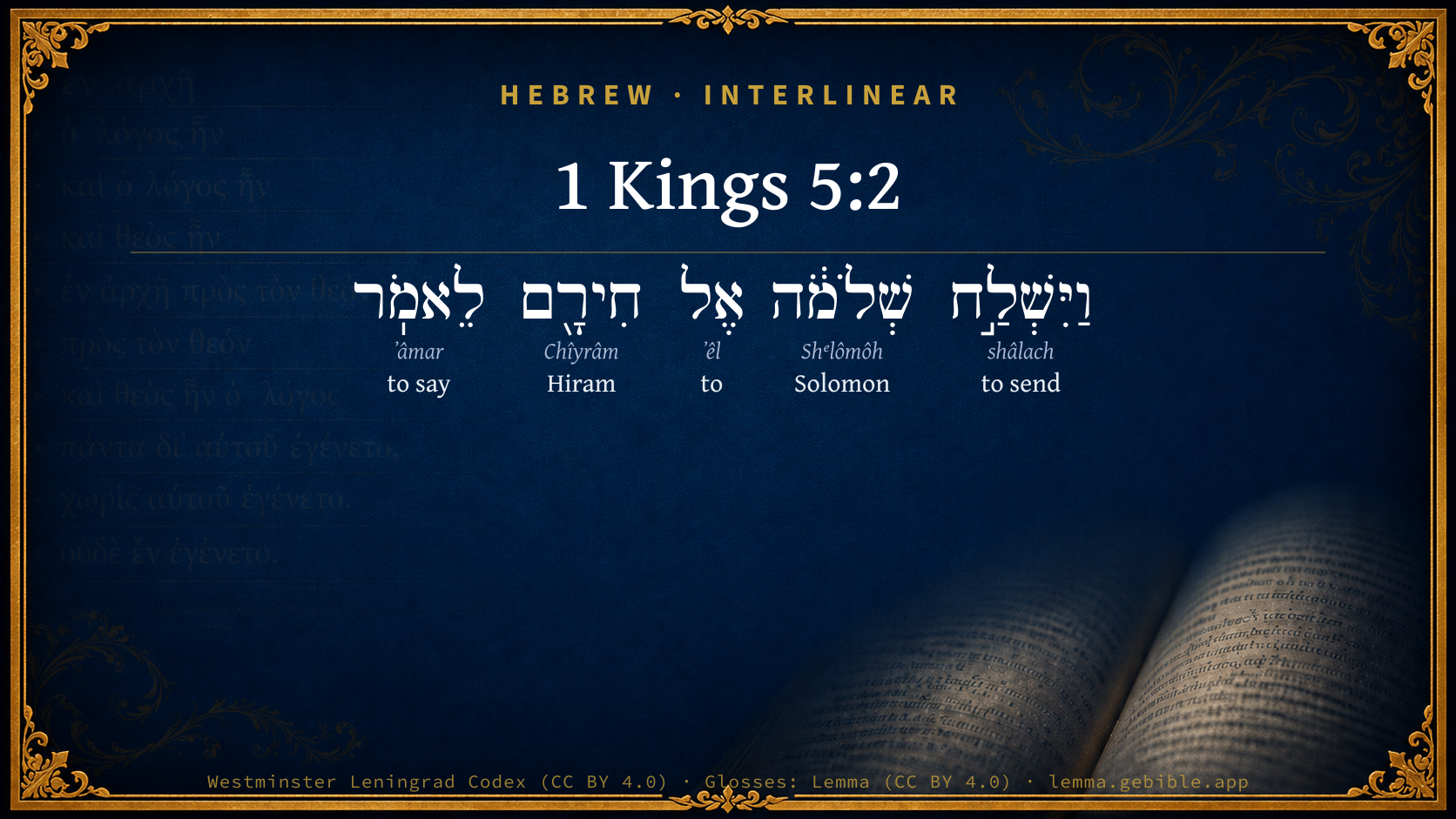
1 Kings 5:2

Hebrew (Westminster Leningrad Codex) 1 Kings 5:2 appears in the Hebrew Old Testament. The text above is from the Westminster Leningrad Codex. Each word links to its Strong’s number, a concise gloss, and parsing drawn from the Open Scriptures Hebrew Bible morphology. Click any word for its full Brown-Driver-Briggs (BDB) entry.
Download image
Cite this verse

1 Kings 5:2 (World English Bible). Public Domain. Lemma interlinear Bible study tool, https://lemma.gebible.app/v/1-kings/5/2.

Show BibTeX & RIS
BibTeX
RIS
English Translation
Solomon sent to Hiram, saying,
World English Bible · Public Domain
Download a study sheet

One document with this verse’s original text, its word-by-word gloss line, the meaning frame, cross-references with their text, attributed commentary, and full source and license credits — printable, and it pastes into notes with its structure intact.

This verse Autodidact and up

Study sheet (.html) Plain text (.txt)

A passage Seminary Student

Up to 50 verses in one chapter. A passage sheet keeps up to 6 commentary sources and 12 cross-references per verse, in the order this page ranks them, and says so on the sheet whenever that leaves anything out. Ask for a single verse and you get the Autodidact verse sheet above.

Everything on this page stays free to read, with no account — the sheet is a download of what is already on screen, not access to it.

Want to remove ads? Support Godless Engineer
Compare translations 3

The same verse in 3 English versions, stacked beneath the original-language interlinear above. Click any original word for its lexicon entry.

Each is an independent rendering of the whole verse — the interlinear is not word-aligned to these translations.

Highlighted words mark where these versions differ — a whole-verse word diff, not a word-by-word alignment.

  • World English Bible Public Domain
    Solomon sent to Hiram, saying,
  • King James Version Public Domain
    And Solomon sent to Hiram, saying,
  • unfoldingWord Literal Text CC BY-SA 4.0
    And Solomon sent to Hiram, saying,

unfoldingWord Literal Text — © unfoldingWord, licensed CC BY-SA 4.0. Word-aligned USFM3 via Door43 (git.door43.org/unfoldingWord/en_ult).

Versions to compare (up to 4)

3 of 4 selected

Show all 18 translations

Every available English version of this verse, each an independent rendering of the whole verse.

  • World English Bible Public Domain
    Solomon sent to Hiram, saying,
  • Berean Standard Bible Public Domain
    And Solomon relayed this message to Hiram:
  • Majority Standard Bible Public Domain
    And Solomon relayed this message to Hiram:
  • King James Version Public Domain
    And Solomon sent to Hiram, saying,
  • American Standard Version (1901) Public Domain
    And Solomon sent to Hiram, saying,
  • Revised Version (1885) Public Domain
    And Solomon sent to Hiram, saying,
  • Geneva Bible (1599) Public Domain
    Also Salomon sent to Hiram, saying,
  • Douay-Rheims (1899) Public Domain
    And Solomon sent to Hiram, saying:
  • Young's Literal Translation Public Domain
    and Solomon sendeth unto Hiram, saying,
  • Literal Standard Version CC BY-SA 4.0
    and Solomon sends to Hiram, saying,
  • Unlocked Literal Bible CC BY-SA 4.0
    Solomon sent word to Hiram, saying,
  • unfoldingWord Literal Text CC BY-SA 4.0
    And Solomon sent to Hiram, saying,
  • Darby Bible Public Domain
    And Solomon sent to Hiram, saying,
  • World Messianic Bible Public Domain
    Solomon sent to Hiram, saying,
  • Webster's Bible Public Domain
    And Solomon sent to Hiram, saying,
  • Free Bible Version CC BY-SA 4.0
    So Solomon sent this message back to Hiram,
  • Bible in Basic English Public Domain
    And Solomon sent back word to Hiram, saying,
  • JPS Tanakh (1917) Public Domain
    (5-16) And Solomon sent to Hiram, saying:

Literal Standard Version (2020), Covenant Press — licensed CC BY-SA 4.0. Text via the HelloAO Bible API (eBible.org). Unlocked Literal Bible (unfoldingWord) — licensed CC BY-SA 4.0. Text via the HelloAO Bible API (eBible.org). unfoldingWord Literal Text — © unfoldingWord, licensed CC BY-SA 4.0. Word-aligned USFM3 via Door43 (git.door43.org/unfoldingWord/en_ult). Free Bible Version, Dr. Jonathan Gallagher — licensed CC BY-SA 4.0. Text via the HelloAO Bible API (eBible.org).

Word by word

More ways to search: Search by grammar → Find every occurrence → Compare this word →

Practice this passage: Drill this verse → Learn its vocabulary →

About this verse

These counts appear in no published source. They are computed here, from the morphology-tagged text and Lemma’s own curated glosses. What Lemma adds →

5
words
5
distinct lemmas
Historical
section

Shared distinctive vocabulary

חִירָ֖ם Hiram H2438 occurs in 21 verses of the Hebrew Bible. Also found in:

Grammatical profile

  • 2 verbs
  • 2 nouns
  • 1 preposition

Verb forms

  • וַיִּשְׁלַ֣ח Qal · Sequential Imperfect
  • לֵאמֹֽר Qal · Infinitive Construct

Hebrew & Septuagint length

In English translation the verse runs 5 words from the Hebrew and 6 from the Septuagint (LXX English) — closely comparable.

A rough comparison of the two English renderings, which tokenize alike — not a word-level alignment.

Word counts can differ between the Hebrew and the Greek without any difference in meaning — e.g. the Hebrew direct-object marker אֵת has no separate Greek word, and Greek often adds the article ὁ.

Cross-references

1

Topical passages linked to 1 Kings 5:2 in the Treasury of Scripture Knowledge — connected by theme and wording, ordered by reader-vote popularity; previews shown in the World English Bible.

  • 2 Chronicles 2:3 Solomon sent to Huram the king of Tyre, saying, As you dealt with David my father, and sent him cedars to build him a house in which to dwell, [even so deal with me].

Cross-references courtesy of OpenBible.info (CC BY 4.0).

Hebrew and Greek witnesses Masoretic Hebrew ↔ Greek Septuagint

The same verse in the two great witnesses to the Old Testament, shown verse-for-verse.

These are two independent witnesses, not word-aligned to each other, and the Septuagint is shown in lemma (dictionary) form.

Hebrew 1 Kings 5:2 Masoretic · Westminster Leningrad Codex

וַיִּשְׁלַ֣ח שְׁלֹמֹ֔ה אֶל חִירָ֖ם לֵאמֹֽר

Solomon sent to Hiram, saying,

World English Bible · Public Domain

Greek LXX 1 Kings 5:2 Septuagint · lemma form

καί οὗτος ὁ δέω ὁ σαλωμών ἐν ἡμέρα εἷς τριάκοντα κόρος σεμίδαλις καί ἑξήκοντα κόρος ἄλευρον κοπανίζω

And Solomon sent to Chiram, saying,

LXX2012 (modern English Septuagint) · Public Domain

Hebrew: Westminster Leningrad Codex (CC BY 4.0). Greek: Septuagint (public domain); English from LXX2012 (modern English Septuagint) (Public Domain). How the Septuagint differs from the Hebrew →

Targum (Aramaic paraphrase)

1

The Targum is the ancient Jewish Aramaic paraphrase of the Hebrew Scriptures — an interpretive translation, not the Hebrew text itself. Onkelos (literal) and Pseudo-Jonathan (expansive) render the Torah, and Jonathan the Prophets. Coverage is partial: where no permissively-licensed English translation exists for a verse, only the Aramaic is shown. This is verse-level text, not a word-by-word alignment to the Hebrew.

  1. Targum Jonathan Prophets (Joshua–Malachi)
    וַהֲוָה לַחֲמָא דִשְׁלֹמֹה לְיוֹמָא חָד תְּלָתִין כֹּרִין סֻלְתָּא וְשִׁתִּין כֹּרִין קִמְחָא:

    (no public-domain English translation for this verse)

    Targum Jonathan — Aramaic: “Mikraot Gedolot” (public domain). English: “Sefaria Community Translation” (CC0 1.0 (public-domain dedication)); “London "Chaldee Paraphrase," 1871” (public domain). Text via Sefaria.

Commentary

Notes on 1 Kings 5:2 from classic Christian and Jewish commentators (each source and its license shown beneath its notes). The classic Christian expositions comment on the surrounding passage and are grouped to its opening verse, so a note may address several verses; the Jewish commentaries on the Tanakh (Rashi and others) are per-verse, so they appear only where the commentator wrote on this verse.

Lemma curates 59 commentaries, every one of them public domain or Creative Commons licensed, each selected and text-cleaned for this edition rather than reprinted as found. About our sources →

Trapp's Complete Commentary

John Trapp

1Ki 5:2 And Solomon sent to Hiram, saying,

Ver. 2. And Solomon sent to Hiram.] By the same messengers, say some. Rather by ambassadors of his own.

John Trapp, A Commentary or Exposition upon All the Books of the Old and New Testament (1647–1656) — public domain. Text from a community e-Sword module.

Tyndale Open Study Notes

Tyndale Open Resources

5:2-6 Solomon responded to Hiram by sending word through Hiram’s ambassadors that he intended to build a Temple to honor the name of the Lord, following his father David’s desire and provisions for its construction (2 Sam 7:1-3; 1 Chr 17:1-15; 22:14-19; 28:9-12).

Tyndale Open Study Notes — © Tyndale Open Resources, licensed CC BY-SA 4.0. Text via the HelloAO Bible API.

Adam Clarke's Commentary

Verse 2. Solomon sent to Hiram] Made an interchange of ambassadors and friendly greetings. Josephus tells us that the correspondence between Hiram and Solomon was preserved in the archives of the Tyrians even in his time. But this, like many other assertions of the same author, is worthy of little credit.

Adam Clarke's Commentary on the Bible (1810–1826) — public domain. Text from a community e-Sword/MySword module.

The Cambridge Bible for Schools and Colleges

gen. ed. J. J. S. Perowne

2. Solomon sent to Hiram] Josephus (l. c.) says that the message was by letter, as was also Hiram’s answer. That Hiram wrote his reply is mentioned 2Ch_2:11. Josephus also states that copies of these two letters still remained not only preserved in the Jewish records, but also among the Tyrians so that anybody wishing to test his statements might, if he wished, refer to them.

The Cambridge Bible for Schools and Colleges (gen. ed. J. J. S. Perowne; Cambridge University Press, 1878–1918) — public domain. Text from a community e-Sword module.

John Gill's Exposition

And Solomon sent to Hiram,.... A letter, either by the hand of his ambassadors when they returned, as Kimchi thinks, or by ambassadors Solomon sent on purpose. Josephus (w) appeals to the Tyrian archives for the genuineness of these letters that passed between Hiram and Solomon; and Eupolemus, an Heathen writer (x) has both this which Solomon sent to Hiram, and that which Hiram sent in answer to it, which agree with those in the sacred records:

saying: as follows.

(w) Antiqu. l. 8. c. 2. sect. 8. (x) Ut Supra. (Apud Euseb. Praepar. Evangel. l. 9. c. 32, 34.)

John Gill's Exposition of the Whole Bible (1746–1763) — public domain (CC PDM 1.0). Text via the HelloAO Bible API.

The Pulpit Commentary

And Solomon sent to Hiram. According to Josephus (Ant. 8:2. 6), he wrote a letter, which together with Hiram"s reply (ver. 8) was preserved among the public archives of Tyro. The account of 2Ch 2., which as a rule is more detailed than that of the Kings, begins here. It does not notice, that is to say, the prior embassy of the Phoenician king, as the object of the chronicler is merely to narrate the measures taken for the erection of the temple, saying The return embassy gave Solomon the opportunity to ask for the timber, etc., that he desired.

HOMILIES BY J. WAITE. Vers. 2-6.

The Temple.

Read also 2Ch_2:1-10, where additional light is thrown on this transaction. It marks a period of extreme interest and importance in Hebrew history. It introduces us, by anticipation, to that which was the crowning glory of the reign of Solomon, for his name must ever stand connected with the magnificence of the first Temple, though it be but as a gorgeous dream of the far distant past, which imagination strives in vain to reproduce with distinctness and certainty. Whether the Hiram who entered into this treaty with Solomon is the same as the Hiram who was the friend of David is a matter of doubt. Menander of Ephesus (quoted by Josephus) describes him as a man of great enterprize, a lover of architecture, noted for his skill in building and adorning the temples of the gods. And in this we have a valuable indirect confirmation of the Biblical history. Look at this purpose of Solomon to build a splendid temple to the Lord in two or three different lights.

I IT EXPRESSES HIS DESIRE TO CARRY OUT THE GOOD DESIGNS OF HIS FATHER DAVID. Filial feeling prompted it. It drew the inspiration of its enthusiasm from the warmth of a filial heart. "Thou knowest how that David my father could not," etc. We are told why he "could not". (1Ch_22:7, 8 28:5) He had been "a man of war," and had "shed much blood." Noble purposes may be conceived in a time of discord and confusion; they can be actualized only in a time of rest. The hands must be free from the blood of men that would build a worthy dwelling-place for a righteous God. Nothing was more natural than that Solomon, under happier auspices, should resolve to do what his father had the "heart to do," but "could not." To how large an extent is human life a record of thwarted purposes! A tale cut short before it is half told; a laying of plans that are never worked out; a reaching forth towards fair ideals that men have not the power or the time to turn into realities. What can the high mission of each succeeding generation be but just to take up the good purposes that a previous generation failed to accomplish and develop them to their ripe issues? This is the real law of human progress. All honour to the son who, knowing what was truest and deepest in his father"s heart, endeavours worthily to fulfil it.

II IT IS THE SPONTANEOUS OUTCOME OF HIS OWN DEVOUT FEELING. Solomon never had the pure and lofty spirit of devotion that inspired the soul of David; but as yet, at least, his religious sentiment is deep and true. A "house great and wonderful," dedicated to the Lord, in the royal city, will give it fitting public expression. All religious feeling instinctively seeks to body itself forth in appropriate forms. Forbidden as the Jews were to "make any likeness or image" of the great Object of worship, (Exo_20:4) it was quite in harmony with the Divine dispensation of the time that the spirit of worship should robe itself in a grand symbolic garb. Solomon only sought to develop the service of the tabernacle into a system more imposing and enduring. (2Ch_2:4, 2Ch_2:5) In every age symbolism has its place as the spontaneous and natural expression of religious thought and feeling. Let it be relied on as the means of awakening such thought and feeling, as the prescribed form in which it shall move an artificial substitute for it and it becomes a mockery and a snare. The magnificence of Solomon"s design for the Temple indicated not only the fervour of his devotion, but the breadth of his view as regards the essential sacredness of all natural things. "The earth is the Lord"s and the fulness thereof." All things beautiful and precious are turned to their true use when dedicated to Him. We cannot be too careful to give Him our richest and best. The true heart says," I will not offer burnt offering to the Lord of that which doth cost me nothing." Let us not be more concerned for our own houses than we are for the Lord"s. The history of the Temple, however, and of all ecclesiology, shows how easily the wealth of outward adornment in worship may become the grave of the spiritual and the veil of the Divine. In proportion as care for the symbolic form the mere shrine of worship has increased, the living reality the worship of the Father "in spirit and in truth has passed away.

III IT EXPRESSES HIS SENSE OF THE FACT THAT THE ACKNOWLEDGMENT OF GOD IS THE HEAL STRENGTH AND GLORY OF A NATION. The Temple was to be dedicated "to the name of Jehovah the visible sign and symbol of the sovereignty of that name over the whole life of the people. There was worth in the sign just so far as that sovereignty was real. The Jewish commonwealth was a theocracy the Temple the palace and throne of the great invisible King. Judaism was not the union of Church and State as two separate or separable powers, but their identification. No distinction between the political and ecclesiastical, the secular and spiritual spheres. The two were one. The ideal Christian nation is a theocracy in which Christ is king. Not made so by its institutions, but by the spiritual life that pervades it. True to its name only so far as the law of Christ is honoured in the homes of the people, moulds the form and habit of their social life, controls commerce, rules in Parliament, strengthens, ennobles, glorifies the Throne. Its Christian Churches are thus the very flower of a country"s highest life.

Those temples of His grace, How beautiful they stand! The honour of our native place And bulwark of our land.

As the graveyard where "the rude forefathers of the hamlet sleep tells of the vanity of all earthly things, how the pride and glory of man must one day moulder down to dust, so the church is the memorial of the unfading inheritance of truth and purity and love the blessed fellowship of the redeemed the "House of God, not made with hands, eternal in the heavens.

IV IT EXPRESSES HIS DESIRE THAT ISRAEL SHOULD HAVE A CENTRE OF RELIGIOUS ATTRACTION AND BOND OF RELIGIOUS UNITY. The tabernacle had been the movable sanctuary, of a wandering people, the Temple should be the resting place of the Divine presence. (Psa_132:14) Hitherto there had been a divided worship, connected both with the tabernacle at Gideon and the ark in the city of. (1Ch_16:37-39) But in future all sacred associations are to be gathered up in the central glory of the Temple. One nation, one faith, one God, one sanctuary. But this localization of the highest forms of worship had its dangers. Men came to think of" the Holy Presence as belonging to the building, instead of the building as being hallowed and glorified by the Presence." Christ proclaims the infinite Presence, the impartial Love. "The hour cometh when ye shall neither in this mountain,". (Joh_4:21) "One greater than the Temple is here in whom all its sacred symbols are fulfilled the attractive centre and bond of union for redeemed souls of every age and nation. Our thoughts are led on to the glorious vision of the holy city of which it is written, "I saw no temple therein, for the Lord God Almighty and the Lamb are the temple of it". W. (Rev_21:22)

The Pulpit Commentary (1880–1919), ed. H.D.M. Spence-Jones & Joseph S. Exell — public domain. Text from a community e-Sword module.

Lesson kit

Teaching starters — assembled from the data on this page, not authored interpretation. Every prompt links to the verse data it draws on. Edit before teaching.

1 Kings, in the Historical, opens this verse with 5 words (5 distinct Hebrew lemmas). Its most distinctive word is Chîyrâm (“Hiram”). A historical commentator’s framing appears above. Read the whole chapter for the surrounding context.

Discussion questions

  1. How does “Hiram” (Chîyrâm) shape what this verse is saying?
  2. 2 Samuel 5:11 shares the word «Hiram» with this verse. How do the two illuminate each other?
  3. The verb «וַיִּשְׁלַ֣ח» is Qal Sequential Imperfect. How does its form color the action?
  4. Reading how Trapp's Complete Commentary and Tyndale Open Study Notes read this verse, where do the two commentators agree and where do they part?

Reading settings

Reading text

Shown beneath each verse's original-language words.

Old Testament
Old Testament edition

Read the OT as the Masoretic Hebrew (MT) or the Greek Septuagint (LXX).

English shown for the Greek Septuagint (in the Hebrew ↔ Greek comparison).

Comparing translations? Open the Compare panel on any verse page to stack up to four side by side.