2 Chronicles 36:6

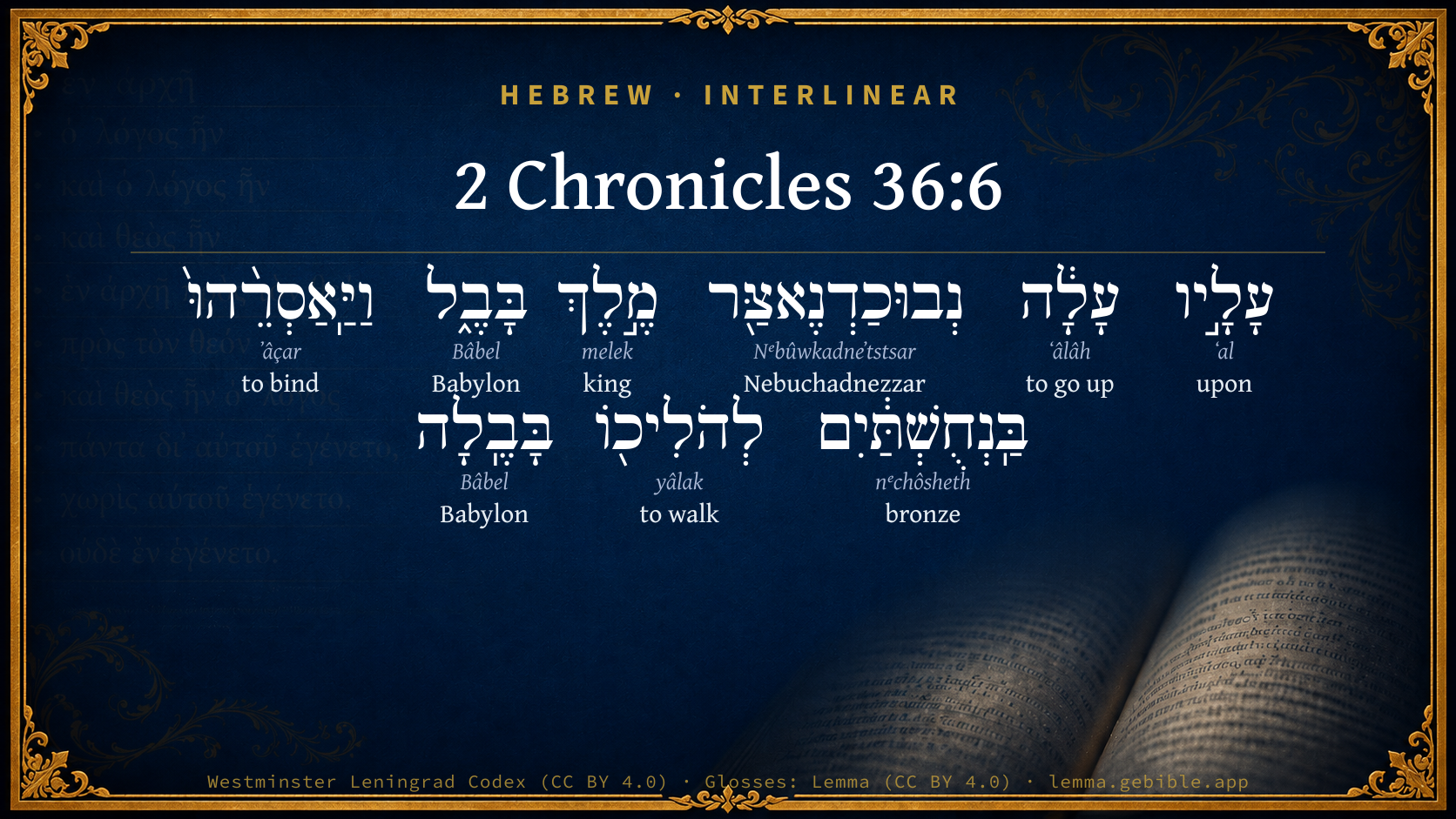
Hebrew (Westminster Leningrad Codex) 2 Chronicles 36:6 appears in the Hebrew Old Testament. The text above is from the Westminster Leningrad Codex. Each word links to its Strong’s number, a concise gloss, and parsing drawn from the Open Scriptures Hebrew Bible morphology. Click any word for its full Brown-Driver-Briggs (BDB) entry.
Download image
Cite this verse

2 Chronicles 36:6 (World English Bible). Public Domain. Lemma interlinear Bible study tool, https://lemma.gebible.app/v/2-chronicles/36/6.

Show BibTeX & RIS
BibTeX
RIS
English Translation
Against him came up Nebuchadnezzar king of Babylon, and bound him in fetters, to carry him to Babylon.
World English Bible · Public Domain
Download a study sheet

One document with this verse’s original text, its word-by-word gloss line, the meaning frame, cross-references with their text, attributed commentary, and full source and license credits — printable, and it pastes into notes with its structure intact.

This verse Autodidact and up

Study sheet (.html) Plain text (.txt)

A passage Seminary Student

Up to 50 verses in one chapter. A passage sheet keeps up to 6 commentary sources and 12 cross-references per verse, in the order this page ranks them, and says so on the sheet whenever that leaves anything out. Ask for a single verse and you get the Autodidact verse sheet above.

Everything on this page stays free to read, with no account — the sheet is a download of what is already on screen, not access to it.

Want to remove ads? Support Godless Engineer
Compare translations 3

The same verse in 3 English versions, stacked beneath the original-language interlinear above. Click any original word for its lexicon entry.

Each is an independent rendering of the whole verse — the interlinear is not word-aligned to these translations.

Highlighted words mark where these versions differ — a whole-verse word diff, not a word-by-word alignment.

  • World English Bible Public Domain
    Against him came up Nebuchadnezzar king of Babylon, and bound him in fetters, to carry him to Babylon.
  • King James Version Public Domain
    Against him came up Nebuchadnezzar king of Babylon, and bound him in fetters, to carry him to Babylon.
  • unfoldingWord Literal Text CC BY-SA 4.0
    Against him Nebuchadnezzar, the king of Babylon, came up, and he bound him with bronze to bring him to Babylon.

unfoldingWord Literal Text — © unfoldingWord, licensed CC BY-SA 4.0. Word-aligned USFM3 via Door43 (git.door43.org/unfoldingWord/en_ult).

Versions to compare (up to 4)

3 of 4 selected

Show all 18 translations

Every available English version of this verse, each an independent rendering of the whole verse.

  • World English Bible Public Domain
    Against him came up Nebuchadnezzar king of Babylon, and bound him in fetters, to carry him to Babylon.
  • Berean Standard Bible Public Domain
    Then Nebuchadnezzar king of Babylon came up against Jehoiakim and bound him with bronze shackles to take him to Babylon.
  • Majority Standard Bible Public Domain
    Then Nebuchadnezzar king of Babylon came up against Jehoiakim and bound him with bronze shackles to take him to Babylon.
  • King James Version Public Domain
    Against him came up Nebuchadnezzar king of Babylon, and bound him in fetters, to carry him to Babylon.
  • American Standard Version (1901) Public Domain
    Against him came up Nebuchadnezzar king of Babylon, and bound him in fetters, to carry him to Babylon.
  • Revised Version (1885) Public Domain
    Against him came up Nebuchadnezzar king of Babylon, and bound him in fetters, to carry him to Babylon.
  • Geneva Bible (1599) Public Domain
    Against him came vp Nebuchadnezzar King of Babel, and bounde him with chaines to cary him to Babel.
  • Douay-Rheims (1899) Public Domain
    Against him came up Nabuchodonosor king of the Chaldeans, and led him bound in chains into Babylon.
  • Young's Literal Translation Public Domain
    against him hath Nebuchadnezzar king of Babylon come up, and bindeth him in brazen fetters to take him away to Babylon.
  • Literal Standard Version CC BY-SA 4.0
    Nebuchadnezzar king of Babylon has come up against him, and binds him in bronze chains to take him away to Babylon.
  • Unlocked Literal Bible CC BY-SA 4.0
    Then Nebuchadnezzar, king of Babylon, attacked him and bound him in chains to lead him away to Babylon.
  • unfoldingWord Literal Text CC BY-SA 4.0
    Against him Nebuchadnezzar, the king of Babylon, came up, and he bound him with bronze to bring him to Babylon.
  • Darby Bible Public Domain
    Against him came up Nebuchadnezzar king of Babylon, and bound him with chains of brass to carry him to Babylon.
  • World Messianic Bible Public Domain
    Nebuchadnezzar king of Babylon came up against him, and bound him in fetters to carry him to Babylon.
  • Webster's Bible Public Domain
    Against him came up Nebuchadnezzar king of Babylon, and bound him in fetters, to carry him to Babylon.
  • Free Bible Version CC BY-SA 4.0
    Then Nebuchadnezzar, king of Babylon, attacked Jehoiakim. He captured him and put bronze shackles on him, and brought him to Babylon.
  • Bible in Basic English Public Domain
    Nebuchadnezzar, king of Babylon, came up against him, and took him away in chains to Babylon.
  • JPS Tanakh (1917) Public Domain
    Against him came up Nebuchadnezzar king of Babylon, and bound him in fetters, to carry him to Babylon.

Literal Standard Version (2020), Covenant Press — licensed CC BY-SA 4.0. Text via the HelloAO Bible API (eBible.org). Unlocked Literal Bible (unfoldingWord) — licensed CC BY-SA 4.0. Text via the HelloAO Bible API (eBible.org). unfoldingWord Literal Text — © unfoldingWord, licensed CC BY-SA 4.0. Word-aligned USFM3 via Door43 (git.door43.org/unfoldingWord/en_ult). Free Bible Version, Dr. Jonathan Gallagher — licensed CC BY-SA 4.0. Text via the HelloAO Bible API (eBible.org).

Word by word

More ways to search: Search by grammar → Find every occurrence → Compare this word →

Practice this passage: Drill this verse → Learn its vocabulary →

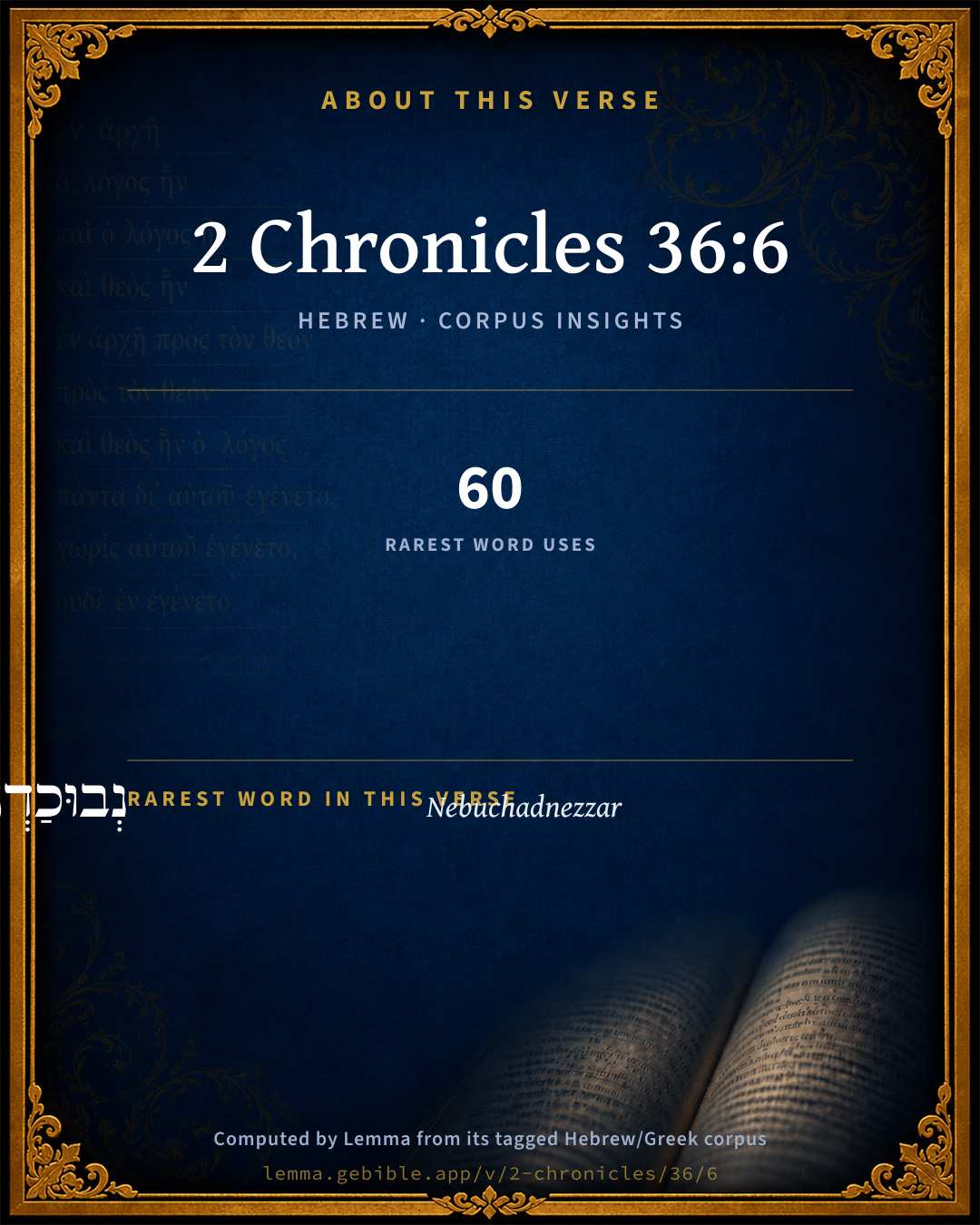
נְבוּכַדְנֶאצַּ֖ר
Nᵉbûwkadneʼtstsar
H5019
“Nebuchadnezzar”
Noun, Proper
Part of Speech
Noun
Type
Proper
Full BDB Definition

Origin: of foreign derivation

TWOT: None

Nebuchadnezzar or Nebuchadrezzar = "may Nebo protect the crown" - the great king of Babylon who captured Jerusalem and carried Judah captive
  1. עָלָ֣יו ʻal H5921 “upon · him” Preposition + Suffix, Personal, 3rd Person, Masculine, Singular
  2. עָלָ֔ה ʻâlâh H5927 “to go up” Verb, Qal, Perfect, 3rd Person, Masculine, Singular
  3. מֶ֣לֶךְ melek H4428 “king of” Noun, Common, Masculine, Singular, Construct
  4. בָּבֶ֑ל Bâbel H894 “Babylon” Noun, Proper
  5. וַיַּֽאַסְרֵ֨הוּ֙ ʼâçar H631 “and · to bind · him” Conjunction + Verb, Qal, Sequential Imperfect, 3rd Person, Masculine, Singular + Suffix, Personal, 3rd Person, Masculine, Singular
  6. בַּֽנְחֻשְׁתַּ֔יִם nᵉchôsheth H5178 “in/at the · bronze fetters” Preposition, Determined + Noun, Common, Feminine, Dual, Absolute
  7. לְהֹלִיכ֖וֹ yâlak H3212 “to walk · him” Preposition + Verb, Hiphil, Infinitive Construct + Suffix, Personal, 3rd Person, Masculine, Singular
  8. בָּבֶֽלָה Bâbel H894 “Babylon · toward” Noun, Proper + Suffix, Demonstrative

About this verse

These counts appear in no published source. They are computed here, from the morphology-tagged text and Lemma’s own curated glosses. What Lemma adds →

9
words
8
distinct lemmas
Historical
section

Shared distinctive vocabulary

נְבוּכַדְנֶאצַּ֖ר Nebuchadnezzar H5019 occurs in 58 verses of the Hebrew Bible. Also found in:

Grammatical profile

  • 3 verbs
  • 5 nouns
  • 1 preposition

Verb forms

  • עָלָ֔ה Qal · Perfect
  • וַיַּֽאַסְרֵ֨הוּ֙ Qal · Sequential Imperfect
  • לְהֹלִיכ֖וֹ Hiphil · Infinitive Construct

Repetition

A word recurs within this verse — often emphatic in Hebrew:

  • בָּבֶ֑ל Babylon H894 ×2

Hebrew & Septuagint length

In English translation the verse runs 18 words from the Hebrew and 21 from the Septuagint (LXX English) — closely comparable.

A rough comparison of the two English renderings, which tokenize alike — not a word-level alignment.

Word counts can differ between the Hebrew and the Greek without any difference in meaning — e.g. the Hebrew direct-object marker אֵת has no separate Greek word, and Greek often adds the article ὁ.

Cross-references

8

Topical passages linked to 2 Chronicles 36:6 in the Treasury of Scripture Knowledge — connected by theme and wording, ordered by reader-vote popularity; previews shown in the World English Bible.

  • 2 Chronicles 33:11 Therefore Yahweh brought on them the captains of the host of the king of Assyria, who took Manasseh in chains, and bound him with fetters, and carried him to Babylon.
  • 2 Kings 24:1–2 In his days Nebuchadnezzar king of Babylon came up, and Jehoiakim became his servant three years: then he turned and rebelled against him.
  • 2 Kings 24:5–6 Now the rest of the acts of Jehoiakim, and all that he did, aren't they written in the book of the chronicles of the kings of Judah?
  • 2 Kings 24:13–20 He carried out there all the treasures of the house of Yahweh, and the treasures of the king's house, and cut in pieces all the vessels of gold, which Solomon king of Israel had made in the temple of Yahweh, as Yahweh had said.
  • Jeremiah 25:9 behold, I will send and take all the families of the north, says Yahweh, and [I will send] to Nebuchadrezzar the king of Babylon, my servant, and will bring them against this land, and against the inhabitants of it, and against all these nations round about; and I will utterly destroy them, and make them an astonishment, and a hissing, and perpetual desolations.
  • Ezekiel 19:5–9 Now when she saw that she had waited, and her hope was lost, then she took another of her cubs, and made him a young lion.
  • Daniel 1:1–2 In the third year of the reign of Jehoiakim king of Judah came Nebuchadnezzar king of Babylon to Jerusalem, and besieged it.
  • Habakkuk 1:5–10 "Look among the nations, watch, and wonder marvelously; for I am working a work in your days, which you will not believe though it is told you.

Cross-references courtesy of OpenBible.info (CC BY 4.0).

Hebrew and Greek witnesses Masoretic Hebrew ↔ Greek Septuagint

The same verse in the two great witnesses to the Old Testament, shown verse-for-verse.

These are two independent witnesses, not word-aligned to each other, and the Septuagint is shown in lemma (dictionary) form.

Hebrew 2 Chronicles 36:6 Masoretic · Westminster Leningrad Codex

עָלָ֣יו עָלָ֔ה נְבוּכַדְנֶאצַּ֖ר מֶ֣לֶךְ בָּבֶ֑ל וַיַּֽאַסְרֵ֨הוּ֙ בַּֽנְחֻשְׁתַּ֔יִם לְהֹלִיכ֖וֹ בָּבֶֽלָה

Against him came up Nebuchadnezzar king of Babylon, and bound him in fetters, to carry him to Babylon.

World English Bible · Public Domain

Greek LXX 2 Chronicles 36:6 Septuagint · lemma form

καί ἀναβαίνω ἐπί αὐτός ναβουχοδονοσορ βασιλεύς βαβυλών καί δέω αὐτός ἐν χαλκοῦς πέδη καί ἀποἄγω αὐτός εἰς βαβυλών

And Nabuchodonosor king of Babylon came up against him, and bound him with brazen fetters, and carried him away to Babylon.

LXX2012 (modern English Septuagint) · Public Domain

Hebrew: Westminster Leningrad Codex (CC BY 4.0). Greek: Septuagint (public domain); English from LXX2012 (modern English Septuagint) (Public Domain). How the Septuagint differs from the Hebrew →

Commentary

Notes on 2 Chronicles 36:6 from classic Christian and Jewish commentators (each source and its license shown beneath its notes). The classic Christian expositions comment on the surrounding passage and are grouped to its opening verse, so a note may address several verses; the Jewish commentaries on the Tanakh (Rashi and others) are per-verse, so they appear only where the commentator wrote on this verse.

Lemma curates 59 commentaries, every one of them public domain or Creative Commons licensed, each selected and text-cleaned for this edition rather than reprinted as found. About our sources →

Trapp's Complete Commentary

John Trapp

2Ch 36:6 Against him came up Nebuchadnezzar king of Babylon, and bound him in fetters, to carry him to Babylon.

Ver. 6. Against him came up Nebuchadnezzar.] See 2Ki 24:1.

John Trapp, A Commentary or Exposition upon All the Books of the Old and New Testament (1647–1656) — public domain. Text from a community e-Sword module.

Joseph Benson's Commentary

2Ch 36:6. And bound him in fetters to carry him to Babylon — But he did not carry him thither, for Nebuchadnezzar altered his mind, and permitted him to reign at Jerusalem as his tributary, though he carried away, as it follows, some of the vessels of the temple, and also certain principal persons, as we read in the first of Daniel.

Joseph Benson's Commentary on the Old and New Testaments (1811–1818) — public domain. Text from a community e-Sword module.

Jamieson, Fausset & Brown

Robert Jamieson, A. R. Fausset & David Brown

Against him came up Nebuchadnezzar king of Babylon--This refers to the first expedition of Nebuchadnezzar against Palestine, in the lifetime of his father Nabopolassar, who, being old and infirm, adopted his son as joint sovereign and despatched him, with the command of his army, against the Egyptian invaders of his empire. Nebuchadnezzar defeated them at Carchemish, drove them out of Asia, and reduced all the provinces west of the Euphrates to obedience--among the rest the kingdom of Jehoiakim, who became a vassal of the Assyrian empire (Kg2 24:1). Jehoiakim at the end of three years threw off the yoke, being probably instigated to revolt by the solicitations of the king of Egypt, who planned a new expedition against Carchemish. But he was completely vanquished by the Babylonian king, who stripped him of all his possessions between the Euphrates and the Nile (Kg2 24:7). Then marching against the Egyptian's ally in Judah, he took Jerusalem, carried away a portion of the sacred vessels of the temple, perhaps in lieu of the unpaid tribute, and deposited them in the temple of his god, Belus, at Babylon (Dan 1:2; Dan 5:2). Though Jehoiakim had been taken prisoner (and it was designed at first to transport him in chains to Babylon), he was allowed to remain in his tributary kingdom. But having given not long after some new offense, Jerusalem was besieged by a host of Assyrian dependents. In a sally against them Jehoiakim was killed (see on Kg2 24:2-7; also Jer 22:18-19; Jer 36:30).

Jamieson, Fausset & Brown — Commentary Critical and Explanatory on the Whole Bible (1871) — public domain (CC PDM 1.0). Text via the HelloAO Bible API.

Adam Clarke's Commentary

Verse 6. Came up Nebuchadnezzar] 2Kg 24:1. Archbishop Usher believes that Jehoiakim remained three years after this tributary to the Chaldeans, and that it is from this period that the seventy years' captivity, predicted by Jeremiah, is to be reckoned.

Adam Clarke's Commentary on the Bible (1810–1826) — public domain. Text from a community e-Sword/MySword module.

The Cambridge Bible for Schools and Colleges

gen. ed. J. J. S. Perowne

6. Nebuchadnezzar] A more accurate form of his name is “Nebuchadrezzar” (so generally in Jeremiah and Ezekiel); in the Inscriptions “Na-bi-um-ku-du-ur-ri-u-ṣu-ur,” also “Nabû-ku-dur-ri-u-ṣu-ur,” the meaning being, “O Nebo (one of the gods of Babylon; cp. Isa_46:1), protect the crown (or the boundary)!” He reigned from 604–561 b.c., and was succeeded by Evil-Merodach (Amil-Marduk). The only purely historical inscription relating to his reign deals with a campaign in Egypt in 568 b.c.; cp. Jer_43:11.

Nebuchadnezzar] It seems probable that Nebuchadnezzar did not in person come up against Jerusalem at the end of Jehoiakim’s reign, nor in person carry off any of the sacred vessels; it is likely moreover that Jehoiakim was not carried to Babylon. The result of Jehoiakim’s rebellion against Nebuchadnezzar was according to 2 Kin. simply that “bands” of Chaldeans and their allies invaded Judah. Probably Jehoiakim’s life and reign came to an end (how we do not know; cp. Jer_22:18-19) during this petty warfare, and then three months later, the main Chaldean army under Nebuchadnezzar having arrived, Jerusalem was taken, and Jehoiakim’s son and successor Jehoiachin was carried off with the golden vessels of the house of the Lord to Babylon. The Chronicler seems to foreshorten the history at this point.

The Cambridge Bible for Schools and Colleges (gen. ed. J. J. S. Perowne; Cambridge University Press, 1878–1918) — public domain. Text from a community e-Sword module.

Haydock's Catholic Bible Commentary

Babylon, but sent him back soon after; (T.) unless he altered his first design, (D.) and slew him disgracefully at Jerusalem. Lyranus. E. C. 4 K. xxiii. 5. --- He allowed him to reign as a vassal other three years, but took Daniel, &c. captives. The seventy years of Jeremias, (xxv. 11.) are to be dated from this event. The year of the world 3402. Usher.

George Leo Haydock (1774–1849), Haydock's Catholic Family Bible and Commentary, 1859 edition — public domain. Excludes Psalms (Douay-Rheims chapter numbering differs from Protestant) and Deuterocanonical books (Catholic canon only).

The Pulpit Commentary

Against him came up Nebuchadnezzar King of Babylon. Our mere allusions in this and the following verse to Nebuchadnezzar"s relations to Jehoiakim and Judah are strange in comparison with the graphic account furnished by the parallel. (2Ki_24:1-6) The name is the same with Nabokodrosoros, is written in the Assyrian monuments Nebu-kuduri-utzur, and meaning, "Nebo, (Isa_46:1) protector from ill," or "protects the crown." In Jeremiah (Jer_49:28) we have the name written Nebuchadrezzar, as also in Ezekiel. Nebuchadnezzar, second King of Babylon, was the son of Nabopolassar, who took Nineveh B.C. 625, and reigned above forty years. Though we are here told he bound Jehoiakim in chains, to take him to Babylon, for some reason or other he did not carry out this intention, and Jehoiakim was put to death at Jerusalem (Jer_36:30; Eze_19:8, Eze_19:9) The expedition of Nebuchadnezzar was B.C. 605-4 (Dan_1:1; Jer_25:1) and during it, his father dying, he succeeded to the throne.

The Pulpit Commentary (1880–1919), ed. H.D.M. Spence-Jones & Joseph S. Exell — public domain. Text from a community e-Sword module.

Scofield Reference Notes

C. I. Scofield

came up

See 2Ki 24:1-6; Jer 25:1-9; Dan 1:1; Hab 1:6. This was the first deportation of Judah. See 2Ch 36:15-21, the final deportation:

The Scofield Reference Bible (1917 edition), notes by C. I. Scofield — public domain. Text from a community e-Sword module.

Rashi

Rabbi Shlomo Yitzchaki (Rashi)

Nebuchadnezzar the king of Babylon advanced upon him because Pharaoh could not go forth from his land, as it is written (II Kings 24:7): “And the king of Egypt no longer went out of his land, for the king of Babylonia had taken from the river of Egypt until the Euphrates River, all that belonged to the king of Egypt,” for he defeated him in the fourth year in Carchemish on the Euphrates River, as is delineated in Jeremiah (46:2).

to bring him to Babylon He did not actually bring him, however, but he died on the way, and they cast away his corpse, and so did Jeremiah prophesy (22:19): “A donkey’s burial shall he be buried, dragged and tossed past the gates of Jerusalem.” Now where is a donkey’s burial? In a dog’s stomach, and so it is apparent in II Kings (24:6): “And Jehoiakim slept with his forefathers,” but it is not written: “and they buried him.”

Rashi on the Tanakh — English translations: “The Judaica Press complete Tanach with Rashi, translated by A. J. Rosenberg” (CC BY 4.0); “Pentateuch with Rashi's commentary by M. Rosenbaum and A.M. Silbermann, 1929-1934” (public domain); “The Metsudah Tanach series, Lakewood, N.J” (CC BY 4.0); and “The Book of Joshua, Metsudah Publications, 1997” (CC BY 4.0). Text via Sefaria.

Lesson kit

Teaching starters — assembled from the data on this page, not authored interpretation. Every prompt links to the verse data it draws on. Edit before teaching.

2 Chronicles, in the Historical, opens this verse with 9 words (8 distinct Hebrew lemmas). Its most distinctive word is Nᵉbûwkadneʼtstsar (“Nebuchadnezzar”). A historical commentator’s framing appears above. Read the whole chapter for the surrounding context.

Discussion questions

  1. How does “Nebuchadnezzar” (Nᵉbûwkadneʼtstsar) shape what this verse is saying?
  2. How does 2 Kings 24:1, which shares the word «Nebuchadnezzar», read alongside this verse?
  3. What does the repetition of “Babylon” (2× in this one verse) do in this verse?
  4. These translations render this verse differently. What is at stake in choosing one wording over another?
  5. «עָלָ֔ה» is a Qal Perfect verb. How does that grammatical form shape the action described?
  6. Compare how Trapp's Complete Commentary and Joseph Benson's Commentary read this verse. Where do they agree or differ?

Things to notice

  • These translations choose different wording for 4 words in this verse.
  • “Babylon” occurs 2× in this single verse.
  • 8 distinct Hebrew lemmas span 9 words in this verse.

Reading settings

Reading text

Shown beneath each verse's original-language words.

Old Testament
Old Testament edition

Read the OT as the Masoretic Hebrew (MT) or the Greek Septuagint (LXX).

English shown for the Greek Septuagint (in the Hebrew ↔ Greek comparison).

Comparing translations? Open the Compare panel on any verse page to stack up to four side by side.