
Judges 15:12

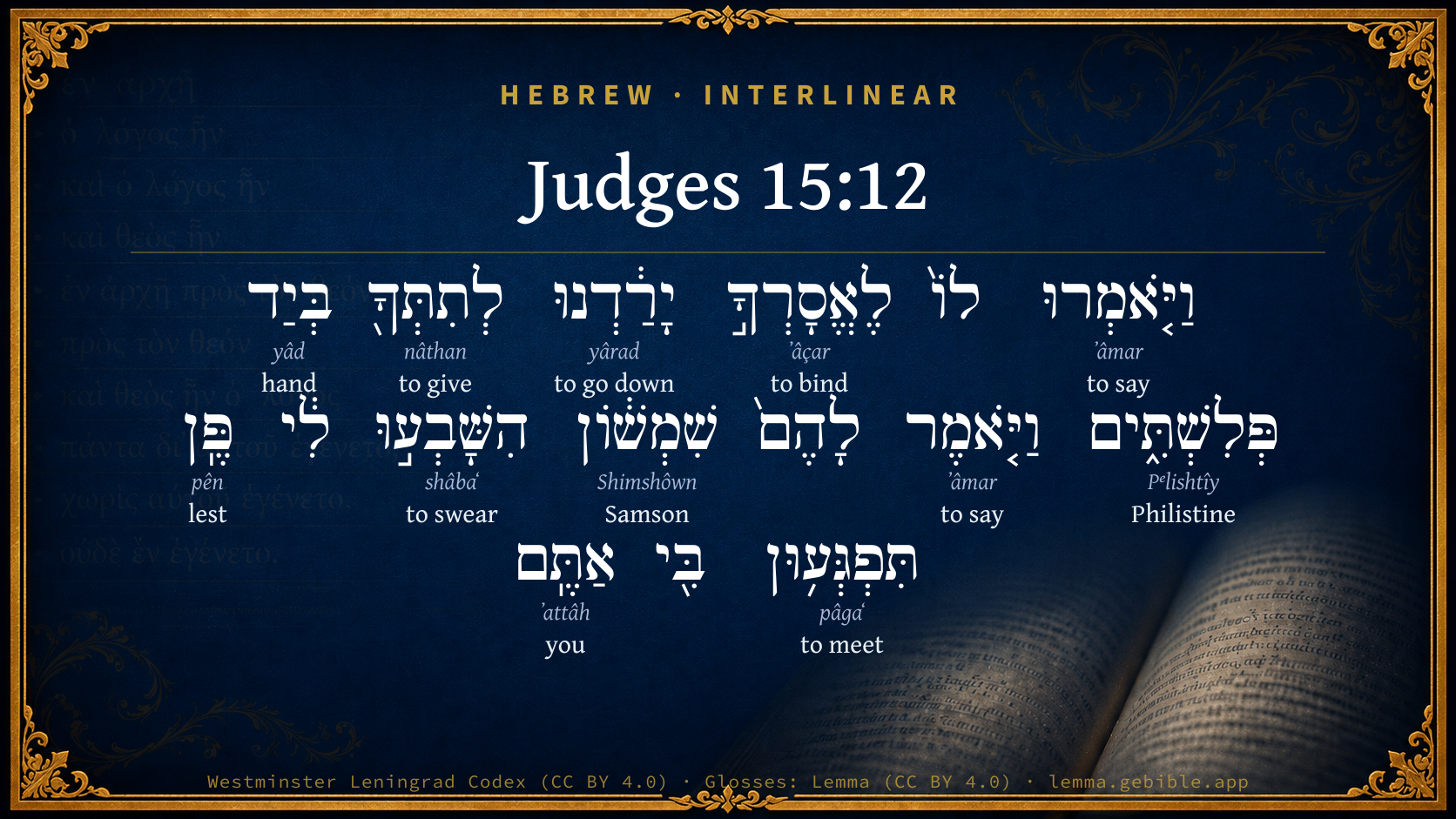
Hebrew (Westminster Leningrad Codex) Judges 15:12 appears in the Hebrew Old Testament. The text above is from the Westminster Leningrad Codex. Each word links to its Strong’s number, a concise gloss, and parsing drawn from the Open Scriptures Hebrew Bible morphology. Click any word for its full Brown-Driver-Briggs (BDB) entry.
Download image
Cite this verse

Judges 15:12 (World English Bible). Public Domain. Lemma interlinear Bible study tool, https://lemma.gebible.app/v/judges/15/12.

Show BibTeX & RIS
BibTeX
RIS
English Translation
They said to him, We have come down to bind you, that we may deliver you into the hand of the Philistines. Samson said to them, Swear to me that you will not fall on me yourselves.
World English Bible · Public Domain
Download a study sheet

One document with this verse’s original text, its word-by-word gloss line, the meaning frame, cross-references with their text, attributed commentary, and full source and license credits — printable, and it pastes into notes with its structure intact.

This verse Autodidact and up

Study sheet (.html) Plain text (.txt)

A passage Seminary Student

Up to 50 verses in one chapter. A passage sheet keeps up to 6 commentary sources and 12 cross-references per verse, in the order this page ranks them, and says so on the sheet whenever that leaves anything out. Ask for a single verse and you get the Autodidact verse sheet above.

Everything on this page stays free to read, with no account — the sheet is a download of what is already on screen, not access to it.

Want to remove ads? Support Godless Engineer
Compare translations 3

The same verse in 3 English versions, stacked beneath the original-language interlinear above. Click any original word for its lexicon entry.

Each is an independent rendering of the whole verse — the interlinear is not word-aligned to these translations.

Highlighted words mark where these versions differ — a whole-verse word diff, not a word-by-word alignment.

  • World English Bible Public Domain
    They said to him, We have come down to bind you, that we may deliver you into the hand of the Philistines. Samson said to them, Swear to me that you will not fall on me yourselves.
  • King James Version Public Domain
    And they said unto him, We are come down to bind thee, that we may deliver thee into the hand of the Philistines. And Samson said unto them, Swear unto me, that ye will not fall upon me yourselves.
  • unfoldingWord Literal Text CC BY-SA 4.0
    And they said to him, “We have come down to bind you, to give you into the hand of the Philistines.” And Samson said to them, “Swear to me that you will not strike me yourselves.”

unfoldingWord Literal Text — © unfoldingWord, licensed CC BY-SA 4.0. Word-aligned USFM3 via Door43 (git.door43.org/unfoldingWord/en_ult).

Versions to compare (up to 4)

3 of 4 selected

Show all 18 translations

Every available English version of this verse, each an independent rendering of the whole verse.

  • World English Bible Public Domain
    They said to him, We have come down to bind you, that we may deliver you into the hand of the Philistines. Samson said to them, Swear to me that you will not fall on me yourselves.
  • Berean Standard Bible Public Domain
    But they said to him, “We have come down to arrest you and hand you over to the Philistines.” Samson replied, “Swear to me that you will not kill me yourselves.”
  • Majority Standard Bible Public Domain
    But they said to him, “We have come down to arrest you and hand you over to the Philistines.” Samson replied, “Swear to me that you will not kill me yourselves.”
  • King James Version Public Domain
    And they said unto him, We are come down to bind thee, that we may deliver thee into the hand of the Philistines. And Samson said unto them, Swear unto me, that ye will not fall upon me yourselves.
  • American Standard Version (1901) Public Domain
    And they said unto him, We are come down to bind thee, that we may deliver thee into the hand of the Philistines. And Samson said unto them, Swear unto me, that ye will not fall upon me yourselves.
  • Revised Version (1885) Public Domain
    And they said unto him, We are come down to bind thee, that we may deliver thee into the hand of the Philistines. And Samson said unto them, Swear unto me, that ye will not fall upon me yourselves.
  • Geneva Bible (1599) Public Domain
    Againe they sayd vnto him, Wee are come to binde thee, and to deliuer thee into the hande of the Philistims. And Samson sayde vnto them, Sweare vnto me, that yee will not fall vpon me your selues.
  • Douay-Rheims (1899) Public Domain
    And they said to him, We are come to bind thee and to deliver thee into the hands of the Philistines. And Samson said to them: Swear to me, and promise me, that you will not kill me.
  • Young's Literal Translation Public Domain
    And they say to him, `To bind thee we have come down -- to give thee into the hand of the Philistines.' And Samson saith to them, `Swear to me, lest ye fall upon me yourselves.'
  • Literal Standard Version CC BY-SA 4.0
    And they say to him, “We have come down to bind you—to give you into the hand of the Philistines.” And Samson says to them, “Swear to me, lest you fall on me yourselves.”
  • Unlocked Literal Bible CC BY-SA 4.0
    They said to Samson, “We have come down to tie you up and give you into the hands of the Philistines.” Samson said to them, “Swear to me that you will not kill me yourselves.”
  • unfoldingWord Literal Text CC BY-SA 4.0
    And they said to him, “We have come down to bind you, to give you into the hand of the Philistines.” And Samson said to them, “Swear to me that you will not strike me yourselves.”
  • Darby Bible Public Domain
    And they said to him, "We have come down to bind you, that we may give you into the hands of the Philistines." And Samson said to them, "Swear to me that you will not fall upon me yourselves."
  • World Messianic Bible Public Domain
    They said to him, “We have come down to bind you, that we may deliver you into the hand of the Philistines.” Samson said to them, “Swear to me that you will not attack me yourselves.”
  • Webster's Bible Public Domain
    And they said to him, We have come down to bind thee, that we may deliver thee into the hand of the Philistines. And Samson said to them, Swear to me, that ye will not fall upon me yourselves.
  • Free Bible Version CC BY-SA 4.0
    “Well, we've come to take you prisoner and hand you over to the Philistines,” they told him. “Just swear to me that you're not going to kill me yourselves,” Samson answered.
  • Bible in Basic English Public Domain
    Then they said to him, We have come down to take you and give you up into the hands of the Philistines. And Samson said to them, Give me your oath that you will not make an attack on me yourselves.
  • JPS Tanakh (1917) Public Domain
    And they said unto him: 'We are come down to bind thee, that we may deliver thee into the hand of the Philistines.' And Samson said unto them: 'Swear unto me, that ye will not fall upon me yourselves.'

Literal Standard Version (2020), Covenant Press — licensed CC BY-SA 4.0. Text via the HelloAO Bible API (eBible.org). Unlocked Literal Bible (unfoldingWord) — licensed CC BY-SA 4.0. Text via the HelloAO Bible API (eBible.org). unfoldingWord Literal Text — © unfoldingWord, licensed CC BY-SA 4.0. Word-aligned USFM3 via Door43 (git.door43.org/unfoldingWord/en_ult). Free Bible Version, Dr. Jonathan Gallagher — licensed CC BY-SA 4.0. Text via the HelloAO Bible API (eBible.org).

Word by word

More ways to search: Search by grammar → Find every occurrence → Compare this word →

Practice this passage: Drill this verse → Learn its vocabulary →

שִׁמְשׁ֔וֹן
Shimshôwn
H8123
“Samson”
Noun, Proper
Part of Speech
Noun
Type
Proper
Full BDB Definition

Origin: from H8121

TWOT: None

Samson = "like the sun" - a Danite, son of Manoah, a Nazarite for life, and a judge of Israel for 20 years
  1. וַיֹּ֤אמְרוּ ʼâmar H559 “and · to say” Conjunction + Verb, Qal, Sequential Imperfect, 3rd Person, Masculine, Plural
  2. לֶאֱסָרְךָ֣ ʼâçar H631 “to bind · you” Preposition + Verb, Qal, Infinitive Construct + Suffix, Personal, 2nd Person, Masculine, Singular
  3. יָרַ֔דְנוּ yârad H3381 “to go down” Verb, Qal, Perfect, 1st Person, Common, Plural
  4. לְתִתְּךָ֖ nâthan H5414 “to give · you” Preposition + Verb, Qal, Infinitive Construct + Suffix, Personal, 2nd Person, Masculine, Singular
  5. בְּיַד yâd H3027 “in/at · hand of” Preposition + Noun, Common, Both, Singular, Construct
  6. פְּלִשְׁתִּ֑ים Pᵉlishtîy H6430 “Philistines” Noun, Gentilic, Masculine, Plural, Absolute
  7. וַיֹּ֤אמֶר ʼâmar H559 “and · to say” Conjunction + Verb, Qal, Sequential Imperfect, 3rd Person, Masculine, Singular
  8. הִשָּׁבְע֣וּ shâbaʻ H7650 “swear” Verb, Niphal, Imperative, 2nd Person, Masculine, Plural
  9. פֶּֽן pên H6435 “lest” Conjunction
  10. תִּפְגְּע֥וּן pâgaʻ H6293 “to meet” Verb, Qal, Imperfect, 2nd Person, Masculine, Plural + Suffix, n
  11. אַתֶּֽם ʼattâh H859 “you” Pronoun, Personal, 2nd Person, Masculine, Plural

About this verse

These counts appear in no published source. They are computed here, from the morphology-tagged text and Lemma’s own curated glosses. What Lemma adds →

16
words
11
distinct lemmas
Historical
section

Shared distinctive vocabulary

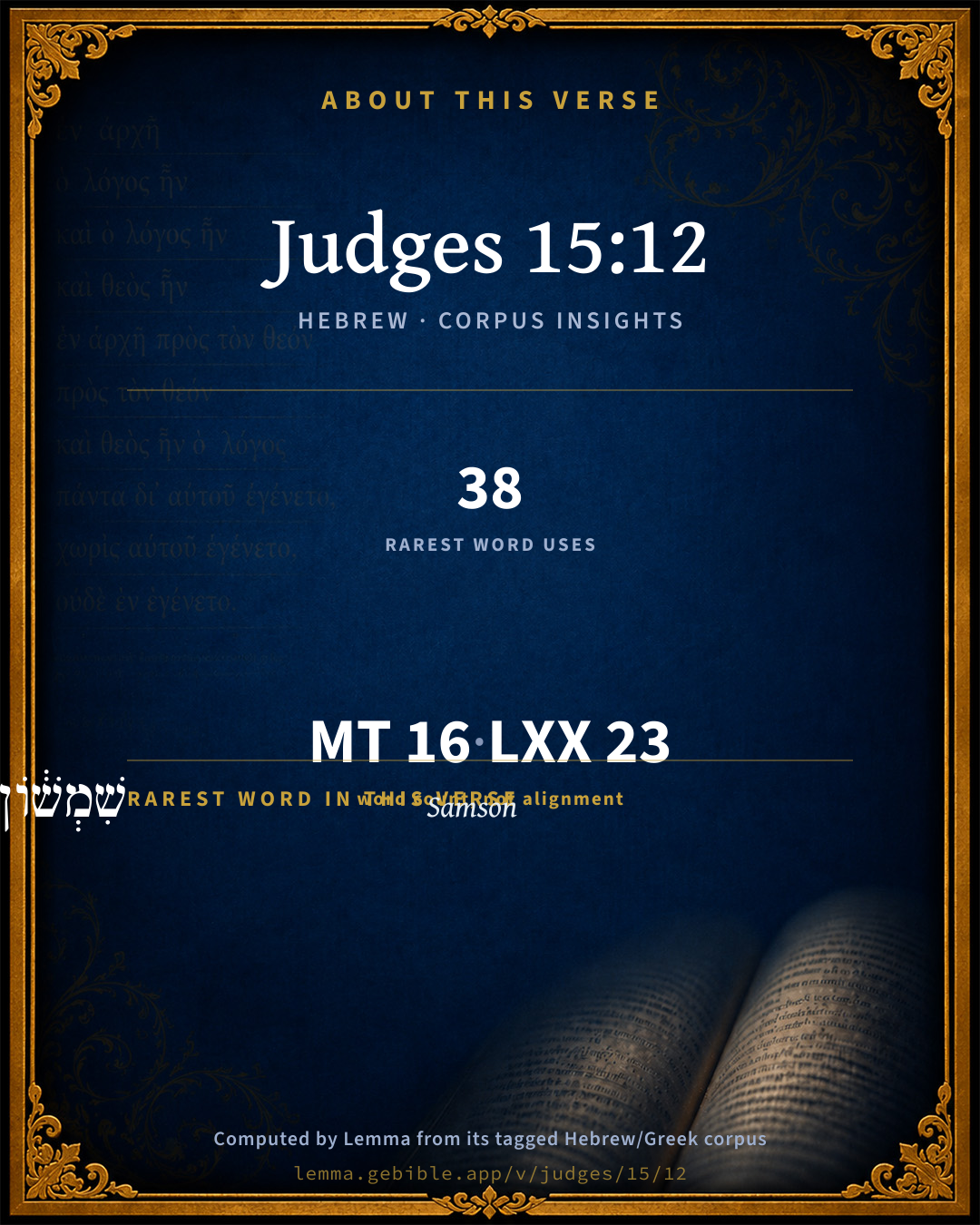
שִׁמְשׁ֔וֹן Samson H8123 occurs in 37 verses of the Hebrew Bible. Also found in:

Grammatical profile

  • 7 verbs
  • 3 nouns
  • 1 pronoun
  • 4 prepositions
  • 1 conjunction

Verb forms

  • וַיֹּ֤אמְרוּ Qal · Sequential Imperfect
  • לֶאֱסָרְךָ֣ Qal · Infinitive Construct
  • יָרַ֔דְנוּ Qal · Perfect
  • לְתִתְּךָ֖ Qal · Infinitive Construct
  • וַיֹּ֤אמֶר Qal · Sequential Imperfect
  • הִשָּׁבְע֣וּ Niphal · Imperative
  • תִּפְגְּע֥וּן Qal · Imperfect

Repetition

A word recurs within this verse — often emphatic in Hebrew:

  • וַיֹּ֤אמְרוּ to say H559 ×2

Hebrew & Septuagint length

In English translation the verse runs 37 words from the Hebrew and 37 from the Septuagint (LXX English) — the same length.

A rough comparison of the two English renderings, which tokenize alike — not a word-level alignment.

Word counts can differ between the Hebrew and the Greek without any difference in meaning — e.g. the Hebrew direct-object marker אֵת has no separate Greek word, and Greek often adds the article ὁ.

In the original languages it is 16 Hebrew tokens and 23 Greek tokens — but the two are counted differently (Hebrew bundles its prefixes and suffixes into one token; the Greek is in lemma form), so that isn’t a like-for-like length.

Cross-references

5

Topical passages linked to Judges 15:12 in the Treasury of Scripture Knowledge — connected by theme and wording, ordered by reader-vote popularity; previews shown in the World English Bible.

  • Matthew 27:2 and they bound him, and led him away, and delivered him up to Pontius Pilate, the governor.
  • Judges 8:21 Then Zebah and Zalmunna said, Rise you, and fall on us; for as the man is, so is his strength. Gideon arose, and killed Zebah and Zalmunna, and took the crescents that were on their camels' necks.
  • 1 Kings 2:25 King Solomon sent by Benaiah the son of Jehoiada; and he fell on him, so that he died.
  • 1 Kings 2:34 Then Benaiah the son of Jehoiada went up, and fell on him, and killed him; and he was buried in his own house in the wilderness.
  • Acts 7:25 He supposed that his brothers understood that God, by his hand, was giving them deliverance; but they didn't understand.

Cross-references courtesy of OpenBible.info (CC BY 4.0).

Hebrew and Greek witnesses Masoretic Hebrew ↔ Greek Septuagint

The same verse in the two great witnesses to the Old Testament, shown verse-for-verse.

These are two independent witnesses, not word-aligned to each other, and the Septuagint is shown in lemma (dictionary) form.

Hebrew Judges 15:12 Masoretic · Westminster Leningrad Codex

וַיֹּ֤אמְרוּ לוֹ֙ לֶאֱסָרְךָ֣ יָרַ֔דְנוּ לְתִתְּךָ֖ בְּיַד פְּלִשְׁתִּ֑ים וַיֹּ֤אמֶר לָהֶם֙ שִׁמְשׁ֔וֹן הִשָּׁבְע֣וּ לִ֔י פֶּֽן תִּפְגְּע֥וּן בִּ֖י אַתֶּֽם

They said to him, We have come down to bind you, that we may deliver you into the hand of the Philistines. Samson said to them, Swear to me that you will not fall on me yourselves.

World English Bible · Public Domain

Greek LXX Judges 15:12 Septuagint · lemma form

καί εἶπον αὐτός δέω σύ καταβαίνω ὁ δίδωμι σύ ἐν χείρ ἀλλόφυλος καί εἶπον αὐτός σαμψων ὄμνυμι ἐγώ μήποτε συνἀντάω ἐν ἐγώ σύ

And they said to him, We are come down to bind you to deliver you into the hand of the Philistines: and Sampson said to them, Swear to me that you⌃ will not fall upon me yourselves.

LXX2012 (modern English Septuagint) · Public Domain

Hebrew: Westminster Leningrad Codex (CC BY 4.0). Greek: Septuagint (public domain); English from LXX2012 (modern English Septuagint) (Public Domain). How the Septuagint differs from the Hebrew →

Targum (Aramaic paraphrase)

1

The Targum is the ancient Jewish Aramaic paraphrase of the Hebrew Scriptures — an interpretive translation, not the Hebrew text itself. Onkelos (literal) and Pseudo-Jonathan (expansive) render the Torah, and Jonathan the Prophets. Coverage is partial: where no permissively-licensed English translation exists for a verse, only the Aramaic is shown. This is verse-level text, not a word-by-word alignment to the Hebrew.

  1. Targum Jonathan Prophets (Joshua–Malachi)
    וַאֲמַרוּ לֵיהּ לְמֵיסְרָךְ נְחַתְנָא לְמִמְסְרָךְ בִּידָא דִפְלִשְׁתָּאֵי וַאֲמַר לְהוֹן שִׁמְשׁוֹן קַיִימוּ לִי דִלְמָא תִשְׁלְטוּן בִּי אַתּוּן:

    (no public-domain English translation for this verse)

    Targum Jonathan — Aramaic: “Mikraot Gedolot” (public domain). English: “Sefaria Community Translation” (CC0 1.0 (public-domain dedication)); “London "Chaldee Paraphrase," 1871” (public domain). Text via Sefaria.

Commentary

Notes on Judges 15:12 from classic Christian and Jewish commentators (each source and its license shown beneath its notes). The classic Christian expositions comment on the surrounding passage and are grouped to its opening verse, so a note may address several verses; the Jewish commentaries on the Tanakh (Rashi and others) are per-verse, so they appear only where the commentator wrote on this verse.

Lemma curates 59 commentaries, every one of them public domain or Creative Commons licensed, each selected and text-cleaned for this edition rather than reprinted as found. About our sources →

Trapp's Complete Commentary

John Trapp

Jdg 15:12 And they said unto him, We are come down to bind thee, that we may deliver thee into the hand of the Philistines. And Samson said unto them, Swear unto me, that ye will not fall upon me yourselves.

Ver. 12. We are come down to bind thee.] In these Israelites we have an example of ingratitude: as in Samson, of meekness, and care of his unworthy countrymen. How fitly might he have said to them, as once Themistocles in like case did to his Athenians, "Are ye weary of receiving so many benefits by one man?"

That we may deliver thee into the hand of the Philistines.] With shame enough they might speak it, like a company of cowards as they were. But he upbraideth them not with their pusillanimity {lack of courage or fortitude} or perfidy; but, as solicitous of their safety, yieldeth to be bound. So did our dear Saviour, &c. Facinus vincere civem Romanum, saith the orator. Let me imitate his gradation, It was much for the Son of God to he bound, more to be beaten, most of all to be slain. Quid dicam, in crucem tolli?

That ye will not fall upon me yourselves.] And so occasion me, in mine own defence, to fall foul again upon you. He made no question of making his party good with the Philistines, though they were an army of them: this showeth the strength of his faith.

John Trapp, A Commentary or Exposition upon All the Books of the Old and New Testament (1647–1656) — public domain. Text from a community e-Sword module.

Adam Clarke's Commentary

Verse 12. That ye will not fall upon me yourselves.] He could not bear the thought of contending with and slaying his own countrymen; for there is no doubt that he could have as easily rescued himself from their hands as from those of the Philistines.

Adam Clarke's Commentary on the Bible (1810–1826) — public domain. Text from a community e-Sword/MySword module.

Ellicott's Commentary for English Readers

(12) Swear unto me, that ye will not fall upon me yourselves.—It seems as if Samson were parleying with them from some point of vantage which he could easily have defended for a time.

A Bible Commentary for English Readers, edited by Charles John Ellicott (1878–1897) — public domain. Text from a community e-Sword module.

John Gill's Exposition

And they said unto him, we are come down to bind thee,.... That is, they were come down into the cave where he was; otherwise more properly they were come up to the top of the rock:

that we may deliver thee into the hands of the Philistines; they own what was their intention in binding him, and what put them upon it was not ill will to him, but fear of the Philistines:

and Samson said unto them, swear unto me that ye will not fall upon me yourselves; which shows he did not fear them, though they were 3000; and that if they attempted to take away his life, he should defend himself, but he chose not to shed the blood of any of them; and rather than they should come into any distress through the Philistines, consented to be bound by them, and delivered into their hands; which he was a type of Christ, who was betrayed by the Jews, and delivered by them into the hands of the Romans; and though he could have delivered himself by his great strength, would not, but suffered himself to be taken and bound, and given into the hands of his enemies, that his own people might go free; see Joh 18:4.

John Gill's Exposition of the Whole Bible (1746–1763) — public domain (CC PDM 1.0). Text via the HelloAO Bible API.

Haydock's Catholic Bible Commentary

Kill me, in a treacherous manner. He was not afraid of them. (Calmet)

George Leo Haydock (1774–1849), Haydock's Catholic Family Bible and Commentary, 1859 edition — public domain. Excludes Psalms (Douay-Rheims chapter numbering differs from Protestant) and Deuterocanonical books (Catholic canon only).

Matthew Poole's English Annotations

Not that he feared them, or could not as easily have conquered them, as he did the whole host of the Philistines; but because he would be free from all obligation or temptation of doing them any harm, though it were in his own just and necessary defence.

Matthew Poole's English Annotations on the Holy Bible (1683–1685) — public domain. Text from a community e-Sword/MySword module.

Whedon's Commentary on the Bible

Daniel D. Whedon

12. Swear unto me — He is willing to risk a combat singlehanded with the Philistines, but would not fight or injure his own countrymen. His work was to smite Philistines, not Israelites.

Daniel D. Whedon (gen. ed.), Commentary on the Old and New Testaments (1874–1909) — public domain. Text from a community e-Sword module.

The Pulpit Commentary

Vers. 12, 13. We are come down to bind thee. There is something very base in this deliberate agreement with their Philistine masters to deliver up Samson bound into their hands. But it is not very unlike the spirit in which the Hebrews looked upon Moses when he first began to work to rescue them from their Egyptian bondage. (Exo_2:14 Act_7:25-28) Samson"s forbearance towards his own countrymen is commendable. Brought him up from the deep ravine or cleft in which he was hid. His place of concealment was probably unknown to the Philistines, or may be they had quite a superstitious fear of Samson from their experience of his prowess.

The Pulpit Commentary (1880–1919), ed. H.D.M. Spence-Jones & Joseph S. Exell — public domain. Text from a community e-Sword module.

John Wesley's Explanatory Notes

Bind thee - Why not rather, to fight under thy banner? Because sin dispirits men, nay, it infatuates them, and hides from their eyes the things that belong to their peace. Swear - Not that he feared them, or could not as easily have conquered them, as he did the host of the Philistines; but because he would be free from all temptation of doing them harm, though it were in his own defense.

John Wesley, Explanatory Notes Upon the Whole Bible (1754–1765) — public domain. Text via the GEBible commentary corpus.

unfoldingWord translationNotes

Door43 World Missions Community

the hands of the Philistines

Here "hands" refers to power. AT: "the Philistine's control" (See: Metonymy)

hand you over to them

This means to cause someone to be under someone else's control. AT: "give you to the Philistines" (See: Idiom)

up from the rock

This refers to the cave in the cliff of Etam where Samson had gone in Judges 15:8. Here the words "up from" mean that they had brought him away from the cave. AT: "away from the cave in the large rock" (See: Assumed Knowledge and Implicit Information and Idiom)

translationWords

Samson

power

Philistines

oath

hand

promise

unfoldingWord translationNotes — © Distant Shores Media and the Door43 World Missions Community, licensed CC BY-SA 4.0. Source: git.door43.org/Door43/en_tn.

Lesson kit

Teaching starters — assembled from the data on this page, not authored interpretation. Every prompt links to the verse data it draws on. Edit before teaching.

Judges, in the Historical, opens this verse with 16 words (11 distinct Hebrew lemmas). Its most distinctive word is Shimshôwn (“Samson”). A historical commentator’s framing appears above. Read the whole chapter for the surrounding context.

Discussion questions

  1. What does “Samson” (Shimshôwn) contribute to the verse as a whole?
  2. How does Judges 13:24, which shares the word «Samson», read alongside this verse?
  3. What does the repetition of “to say” (2× in this one verse) do in this verse?
  4. These translations render this verse differently. What is at stake in choosing one wording over another?
  5. «וַיֹּ֤אמְרוּ» is a Qal Sequential Imperfect verb. How does that grammatical form shape the action described?
  6. Compare how Trapp's Complete Commentary and Adam Clarke's Commentary read this verse. Where do they agree or differ?

Things to notice

Reading settings

Reading text

Shown beneath each verse's original-language words.

Old Testament
Old Testament edition

Read the OT as the Masoretic Hebrew (MT) or the Greek Septuagint (LXX).

English shown for the Greek Septuagint (in the Hebrew ↔ Greek comparison).

Comparing translations? Open the Compare panel on any verse page to stack up to four side by side.