
1 Kings 8:59

Hebrew (Westminster Leningrad Codex) 1 Kings 8:59 appears in the Hebrew Old Testament. The text above is from the Westminster Leningrad Codex. Each word links to its Strong’s number, a concise gloss, and parsing drawn from the Open Scriptures Hebrew Bible morphology. Click any word for its full Brown-Driver-Briggs (BDB) entry.
Download image
Cite this verse

1 Kings 8:59 (World English Bible). Public Domain. Lemma interlinear Bible study tool, https://lemma.gebible.app/v/1-kings/8/59.

Show BibTeX & RIS
BibTeX
RIS
English Translation
Let these my words, with which I have made supplication before Yahweh, be near to Yahweh our God day and night, that he maintain the cause of his servant, and the cause of his people Israel, as every day shall require;
World English Bible · Public Domain
Download a study sheet

One document with this verse’s original text, its word-by-word gloss line, the meaning frame, cross-references with their text, attributed commentary, and full source and license credits — printable, and it pastes into notes with its structure intact.

This verse Autodidact and up

Study sheet (.html) Plain text (.txt)

A passage Seminary Student

Up to 50 verses in one chapter. A passage sheet keeps up to 6 commentary sources and 12 cross-references per verse, in the order this page ranks them, and says so on the sheet whenever that leaves anything out. Ask for a single verse and you get the Autodidact verse sheet above.

Everything on this page stays free to read, with no account — the sheet is a download of what is already on screen, not access to it.

Want to remove ads? Support Godless Engineer
Compare translations 3

The same verse in 3 English versions, stacked beneath the original-language interlinear above. Click any original word for its lexicon entry.

Each is an independent rendering of the whole verse — the interlinear is not word-aligned to these translations.

Highlighted words mark where these versions differ — a whole-verse word diff, not a word-by-word alignment.

  • World English Bible Public Domain
    Let these my words, with which I have made supplication before Yahweh, be near to Yahweh our God day and night, that he maintain the cause of his servant, and the cause of his people Israel, as every day shall require;
  • King James Version Public Domain
    And let these my words, wherewith I have made supplication before the LORD, be nigh unto the LORD our God day and night, that he maintain the cause of his servant, and the cause of his people Israel at all times, as the matter shall require:
  • unfoldingWord Literal Text CC BY-SA 4.0
    And may these my words, which I have supplicated to the face of Yahweh, be near to Yahweh our God by day and night, to do the justice of his servant and the justice of his people Israel, the matter of a day in its day,

unfoldingWord Literal Text — © unfoldingWord, licensed CC BY-SA 4.0. Word-aligned USFM3 via Door43 (git.door43.org/unfoldingWord/en_ult).

Versions to compare (up to 4)

3 of 4 selected

Show all 18 translations

Every available English version of this verse, each an independent rendering of the whole verse.

  • World English Bible Public Domain
    Let these my words, with which I have made supplication before Yahweh, be near to Yahweh our God day and night, that he maintain the cause of his servant, and the cause of his people Israel, as every day shall require;
  • Berean Standard Bible Public Domain
    And may these words with which I have made my petition before the LORD be near to the LORD our God day and night, so that He may uphold the cause of His servant and of His people Israel as each day requires,
  • Majority Standard Bible Public Domain
    And may these words with which I have made my petition before the LORD be near to the LORD our God day and night, so that He may uphold the cause of His servant and of His people Israel as each day requires,
  • King James Version Public Domain
    And let these my words, wherewith I have made supplication before the LORD, be nigh unto the LORD our God day and night, that he maintain the cause of his servant, and the cause of his people Israel at all times, as the matter shall require:
  • American Standard Version (1901) Public Domain
    And let these my words, wherewith I have made supplication before Jehovah, be nigh unto Jehovah our God day and night, that he maintain the cause of his servant, and the cause of his people Israel, as every day shall require;
  • Revised Version (1885) Public Domain
    And let these my words, wherewith I have made supplication before the LORD, be nigh unto the LORD our God day and night, that he maintain the cause of his servant, and the cause of his people Israel, as every day shall require:
  • Geneva Bible (1599) Public Domain
    And these my wordes, which I haue prayed before the Lord, be neere vnto the Lord our God day and night, that he defende the cause of his seruant, and the cause of his people Israel alway as the matter requireth,
  • Douay-Rheims (1899) Public Domain
    And let these my words, wherewith I have prayed before the Lord, he nigh unto the Lord our God day and night, that he may do judgment for his servant, and for his people Israel day by day:
  • Young's Literal Translation Public Domain
    and these my words with which I have made supplication before Jehovah, are near unto Jehovah our God by day and by night, to maintain the cause of His servant, and the cause of His people Israel, the matter of a day in its day;
  • Literal Standard Version CC BY-SA 4.0
    and these, my words, with which I have made supplication before YHWH, are near to our God YHWH by day and by night, to maintain the cause of His servant, and the cause of His people Israel, the matter of a day in its day,
  • Unlocked Literal Bible CC BY-SA 4.0
    Let these words I have spoken, by which I have made request before Yahweh, be near Yahweh our God day and night, so that he may help the cause of his servant and the cause of his people Israel, as every day will require;
  • unfoldingWord Literal Text CC BY-SA 4.0
    And may these my words, which I have supplicated to the face of Yahweh, be near to Yahweh our God by day and night, to do the justice of his servant and the justice of his people Israel, the matter of a day in its day,
  • Darby Bible Public Domain
    And let these my words, with which I have made supplication before Jehovah, be nigh to Jehovah our God day and night, that he maintain the right of his servant, and the right of his people Israel, as the matter of each day shall require;
  • World Messianic Bible Public Domain
    Let these my words, with which I have made supplication before the LORD, be near to the LORD our God day and night, that he may maintain the cause of his servant and the cause of his people Israel, as every day requires;
  • Webster's Bible Public Domain
    And let these my words with which I have made supplication before the LORD, be nigh to the LORD our God day and night, that he may maintain the cause of his servant, and the cause of his people Israel at all times, as the matter shall require:
  • Free Bible Version CC BY-SA 4.0
    May these words of mine I have used to make my request in the Lord's presence be before the Lord our God day and night. In that way he may support the cause of his servant and of his people Israel as is needed every day,
  • Bible in Basic English Public Domain
    And may these my words, the words of my prayer to the Lord, be before the Lord our God day and night, so that he may see right done to his servant and to his people Israel, day by day as we have need.
  • JPS Tanakh (1917) Public Domain
    And let these my words, wherewith I have made supplication before the LORD, be nigh unto the LORD our God day and night, that He maintain the cause of His servant, and the cause of His people Israel, as every day shall require;

Literal Standard Version (2020), Covenant Press — licensed CC BY-SA 4.0. Text via the HelloAO Bible API (eBible.org). Unlocked Literal Bible (unfoldingWord) — licensed CC BY-SA 4.0. Text via the HelloAO Bible API (eBible.org). unfoldingWord Literal Text — © unfoldingWord, licensed CC BY-SA 4.0. Word-aligned USFM3 via Door43 (git.door43.org/unfoldingWord/en_ult). Free Bible Version, Dr. Jonathan Gallagher — licensed CC BY-SA 4.0. Text via the HelloAO Bible API (eBible.org).

Word by word

More ways to search: Search by grammar → Find every occurrence → Compare this word →

Practice this passage: Drill this verse → Learn its vocabulary →

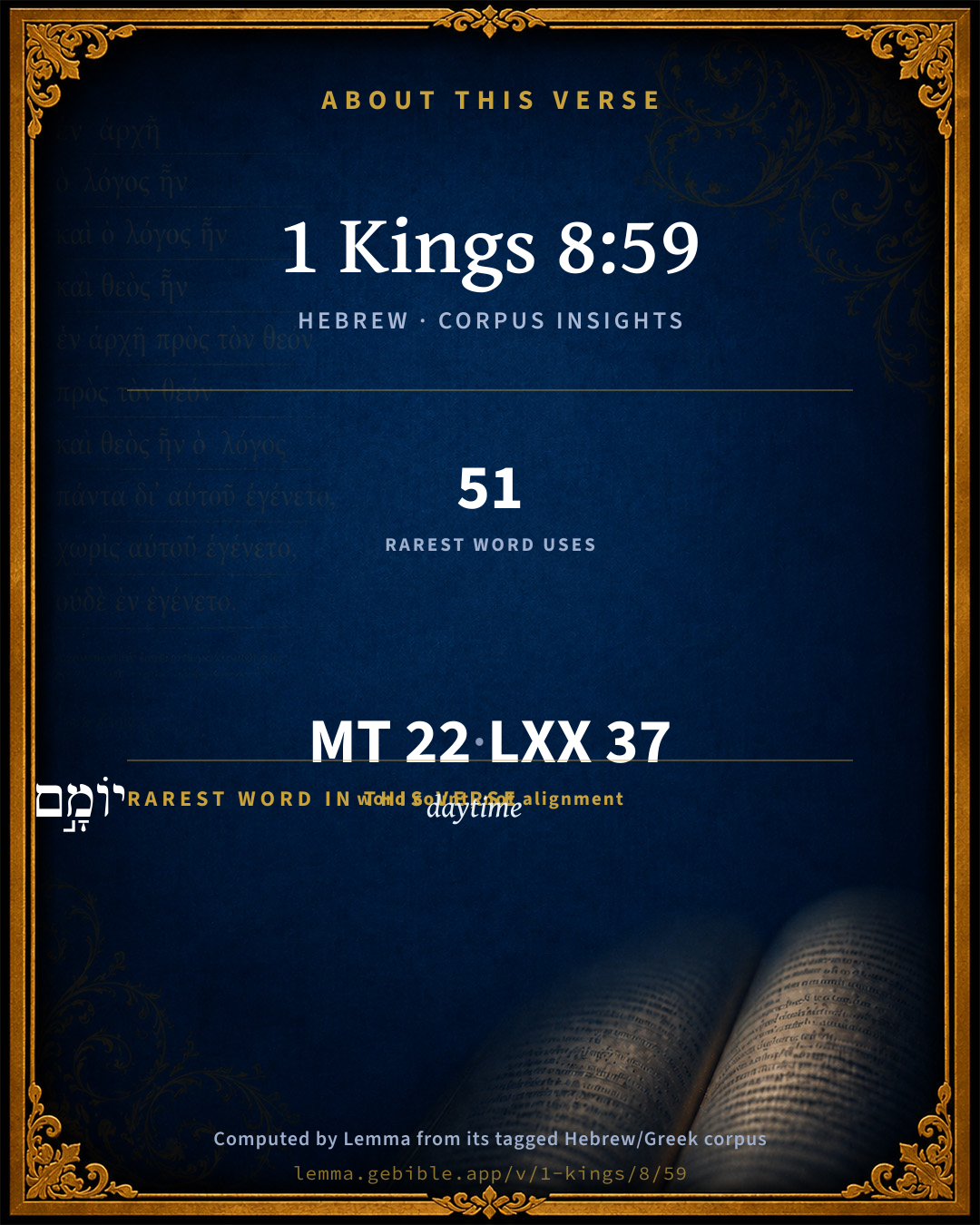
יוֹמָ֣ם
yôwmâm
H3119
“daytime”
Adverb
Part of Speech
Adverb
Full BDB Definition

Origin: from H3117

TWOT: 852a

by day, in the daytime (adverb) - daytime (substantive)
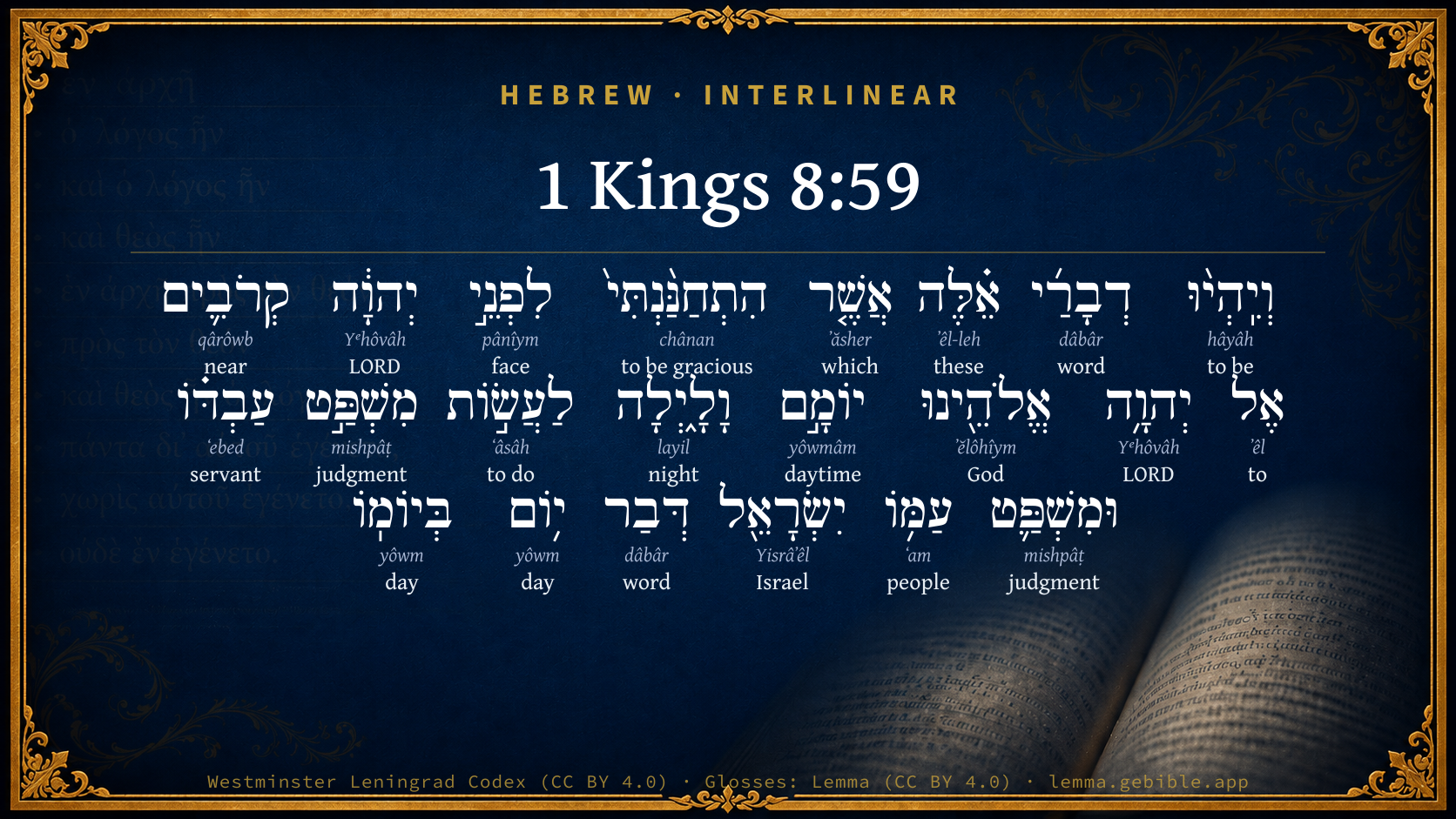
  1. וְיִֽהְי֨וּ hâyâh H1961 “and · to be” Conjunction + Verb, Qal, Jussive, 3rd Person, Masculine, Plural
  2. דְבָרַ֜י dâbâr H1697 “words · my” Noun, Common, Masculine, Plural, Construct + Suffix, Personal, 1st Person, Common, Singular
  3. אֵ֗לֶּה ʼêl-leh H428 “these” Pronoun, Demonstrative, Common, Plural
  4. אֲשֶׁ֤ר ʼăsher H834 “which” Particle, Relative
  5. הִתְחַנַּ֨נְתִּי֙ chânan H2603 “to be gracious” Verb, Hithpael, Perfect, 1st Person, Common, Singular
  6. לִפְנֵ֣י pânîym H6440 “to/for · face(s) of” Preposition + Noun, Common, Both, Plural, Construct
  7. יְהוָ֔ה Yᵉhôvâh H3068 “LORD” Noun, Proper
  8. קְרֹבִ֛ים qârôwb H7138 “near” Adjective, Adjective, Masculine, Plural, Absolute
  9. אֶל ʼêl H413 “to” Preposition
  10. יְהוָ֥ה Yᵉhôvâh H3068 “LORD” Noun, Proper
  11. אֱלֹהֵ֖ינוּ ʼĕlôhîym H430 “God(s) · our” Noun, Common, Masculine, Plural, Construct + Suffix, Personal, 1st Person, Common, Plural
  12. וָלָ֑יְלָה layil H3915 “and · night” Conjunction + Noun, Common, Masculine, Singular, Absolute
  13. לַעֲשׂ֣וֹת ʻâsâh H6213 “to do” Preposition + Verb, Qal, Infinitive Construct
  14. מִשְׁפַּ֣ט mishpâṭ H4941 “judgment of” Noun, Common, Masculine, Singular, Construct
  15. עַבְדּ֗וֹ ʻebed H5650 “servant · his” Noun, Common, Masculine, Singular, Construct + Suffix, Personal, 3rd Person, Masculine, Singular
  16. וּמִשְׁפַּ֛ט mishpâṭ H4941 “and · judgment of” Conjunction + Noun, Common, Masculine, Singular, Construct
  17. עַמּ֥וֹ ʻam H5971 “people · his” Noun, Common, Masculine, Singular, Construct + Suffix, Personal, 3rd Person, Masculine, Singular
  18. יִשְׂרָאֵ֖ל Yisrâʼêl H3478 “Israel” Noun, Proper
  19. דְּבַר dâbâr H1697 “word of” Noun, Common, Masculine, Singular, Construct
  20. י֥וֹם yôwm H3117 “day” Noun, Common, Masculine, Singular, Absolute
  21. בְּיוֹמֽוֹ yôwm H3117 “in/at · day · his” Preposition + Noun, Common, Masculine, Singular, Construct + Suffix, Personal, 3rd Person, Masculine, Singular

About this verse

These counts appear in no published source. They are computed here, from the morphology-tagged text and Lemma’s own curated glosses. What Lemma adds →

22
words
18
distinct lemmas
Historical
section

Shared distinctive vocabulary

יוֹמָ֣ם daytime H3119 occurs in 50 verses of the Hebrew Bible. Also found in:

Grammatical profile

  • 3 verbs
  • 14 nouns
  • 1 adjective
  • 1 pronoun
  • 1 preposition
  • 1 adverb
  • 1 particle

Verb forms

  • וְיִֽהְי֨וּ Qal · Jussive
  • הִתְחַנַּ֨נְתִּי֙ Hithpael · Perfect
  • לַעֲשׂ֣וֹת Qal · Infinitive Construct

Repetition

Words recur within this verse — often emphatic in Hebrew:

  • דְבָרַ֜י word H1697 ×2
  • יְהוָ֔ה LORD H3068 ×2
  • מִשְׁפַּ֣ט judgment H4941 ×2
  • י֥וֹם day H3117 ×2

Hebrew & Septuagint length

In English translation the verse runs 41 words from the Hebrew and 39 from the Septuagint (LXX English) — closely comparable.

A rough comparison of the two English renderings, which tokenize alike — not a word-level alignment.

Word counts can differ between the Hebrew and the Greek without any difference in meaning — e.g. the Hebrew direct-object marker אֵת has no separate Greek word, and Greek often adds the article ὁ.

In the original languages it is 22 Hebrew tokens and 37 Greek tokens — but the two are counted differently (Hebrew bundles its prefixes and suffixes into one token; the Greek is in lemma form), so that isn’t a like-for-like length.

Cross-references

7

Topical passages linked to 1 Kings 8:59 in the Treasury of Scripture Knowledge — connected by theme and wording, ordered by reader-vote popularity; previews shown in the World English Bible.

  • Psalms 141:2 Let my prayer be set before you like incense; The lifting up of my hands like the evening sacrifice.
  • John 17:9 I pray for them. I don't pray for the world, but for those whom you have given me, for they are yours.
  • Deuteronomy 33:25 Your bars shall be iron and brass; As your days, so shall your strength be.
  • Psalms 102:1–2 Hear my prayer, Yahweh! Let my cry come to you.
  • Luke 11:3 Give us day by day our daily bread.
  • John 17:20–24 Not for these only do I pray, but for those also who believe in me through their word,
  • 1 John 2:2 And he is the atoning sacrifice for our sins, and not for ours only, but also for the whole world.

Cross-references courtesy of OpenBible.info (CC BY 4.0).

Hebrew and Greek witnesses Masoretic Hebrew ↔ Greek Septuagint

The same verse in the two great witnesses to the Old Testament, shown verse-for-verse.

These are two independent witnesses, not word-aligned to each other, and the Septuagint is shown in lemma (dictionary) form.

Hebrew 1 Kings 8:59 Masoretic · Westminster Leningrad Codex

וְיִֽהְי֨וּ דְבָרַ֜י אֵ֗לֶּה אֲשֶׁ֤ר הִתְחַנַּ֨נְתִּי֙ לִפְנֵ֣י יְהוָ֔ה קְרֹבִ֛ים אֶל יְהוָ֥ה אֱלֹהֵ֖ינוּ יוֹמָ֣ם וָלָ֑יְלָה לַעֲשׂ֣וֹת מִשְׁפַּ֣ט עַבְדּ֗וֹ וּמִשְׁפַּ֛ט עַמּ֥וֹ יִשְׂרָאֵ֖ל דְּבַר י֥וֹם בְּיוֹמֽוֹ

Let these my words, with which I have made supplication before Yahweh, be near to Yahweh our God day and night, that he maintain the cause of his servant, and the cause of his people Israel, as every day shall require;

World English Bible · Public Domain

Greek LXX 1 Kings 8:59 Septuagint · lemma form

καί εἰμέ ὁ λόγος οὗτος ὅς δέω ἐνώπιον κύριος θεός ἐγώ ἐγγίζω πρός κύριος θεός ἐγώ ἡμέρα καί νύξ ὁ ποιέω ὁ δικαίωμα ὁ δοῦλος σύ καί ὁ δικαίωμα λαός σύ ἰσραήλ ῥῆμα ἡμέρα ἐν ἡμέρα αὐτός

And let these words, which I have prayed before the Lord our God, be near to the Lord our God day and night, to maintain the cause of your servant, and the cause of your people Israel for ever.

LXX2012 (modern English Septuagint) · Public Domain

Hebrew: Westminster Leningrad Codex (CC BY 4.0). Greek: Septuagint (public domain); English from LXX2012 (modern English Septuagint) (Public Domain). How the Septuagint differs from the Hebrew →

Targum (Aramaic paraphrase)

1

The Targum is the ancient Jewish Aramaic paraphrase of the Hebrew Scriptures — an interpretive translation, not the Hebrew text itself. Onkelos (literal) and Pseudo-Jonathan (expansive) render the Torah, and Jonathan the Prophets. Coverage is partial: where no permissively-licensed English translation exists for a verse, only the Aramaic is shown. This is verse-level text, not a word-by-word alignment to the Hebrew.

  1. Targum Jonathan Prophets (Joshua–Malachi)
    וִיהוֹן פִּתְגָמֵי אִלֵין דִי בְעֵיתִי מִן קֳדָם יְיָ מִתְקַבְּלִין קֳדָם יְיָ אֱלָהָנָא יֵימָם וְלֵילֵי לְמֶעְבַּד דִין עַבְדֵיהּ וְעוּלְבַּן עַמֵיהּ יִשְׂרָאֵל פִּתְגָם יוֹם בְּיוֹמֵיהּ:

    (no public-domain English translation for this verse)

    Targum Jonathan — Aramaic: “Mikraot Gedolot” (public domain). English: “Sefaria Community Translation” (CC0 1.0 (public-domain dedication)); “London "Chaldee Paraphrase," 1871” (public domain). Text via Sefaria.

Commentary

Notes on 1 Kings 8:59 from classic Christian and Jewish commentators (each source and its license shown beneath its notes). The classic Christian expositions comment on the surrounding passage and are grouped to its opening verse, so a note may address several verses; the Jewish commentaries on the Tanakh (Rashi and others) are per-verse, so they appear only where the commentator wrote on this verse.

Lemma curates 59 commentaries, every one of them public domain or Creative Commons licensed, each selected and text-cleaned for this edition rather than reprinted as found. About our sources →

Trapp's Complete Commentary

John Trapp

1Ki 8:59 And let these my words, wherewith I have made supplication before the LORD, be nigh unto the LORD our God day and night, that he maintain the cause of his servant, and the cause of his people Israel at all times, as the matter shall require:

Ver. 59. Be nigh unto the Lord our God.] Hang ever upon the file, as it were, before him.

At all times.] Heb., The thing of a day in his day; i.e., Ut singula fiant suo tempore, that we may have mercies seasonable and suitable to our necessities.

John Trapp, A Commentary or Exposition upon All the Books of the Old and New Testament (1647–1656) — public domain. Text from a community e-Sword module.

The Biblical Illustrator

Joseph S. Exell

1Ki_8:59

At all times, as the matter shall require.

A good practice for the New Year

But the marginal and more literal rendering of the last clause is, as the thing of a day in its day shall require.

I. Living by the day, as the thing of a day in each day shall require, will wholesomely remind us of our dependence upon God. We are dependent upon God, whether we think of it or not. It is a good thing to think of it. When we think of things in bulk, we are not so apt to recognise the giver as when we think of things piecemeal. Just take the days thoughtlessly, in bulk, and you will not be apt much to recognise God as the Giver of them. But take each day, as it really is, as a special gift from Gods gracious hand, and such separating, piecemeal thought of the days will necessarily breed in you a feeling of dependence upon the God who gives the days. And this feeling of dependence as you take each day as a separate gift from God will prompt you to much nobleness.

1. To prayer concerning each day.

2. To attempt at loftier living in each day.

3. To flushing the service that each day brings with the religious colour of the motive--for the sake of God.

II. Living by the day, as the thing of a day in each day shall require, will deliver us from foreboding.

III. Living by the day, as the thing of a day in each day shall require, will best help us to vanquish the duties of each day and so all the duties of the new year which will be made up of days. Im no hero; Im just a regular, said an officer of the army. What he meant was that it was not in his profession to be a man spectacular and of spasms; that he must steadily do whatever his country called for, whether the great, resounding thing or the small: This is what we all need to be--not searchers after the heroic, but just regulars, ready for service lofty or lowly, as it may come. And the way to do it is to do each day as the thing of the day in each day shall require. There is nothing so discouraging, perplexing, preventing, as a herd of undone duties rushing pellmell into to-day, which duties ought to have been finished in the days gone.

IV. The best way to overcome a bad habit is to overcome it by the day.

V. We shall best keep our loyalty to our Lord and to His Church as we keep it by the day. I cannot be loyal to my Lord and His Church in a lump and all at once in this New Year. I can only be thus loyal as each day brings its tests of loyalty, and I answer to them, day by day, triumphantly. (W. Hoyt, D. D.)

The matter of a day in its day

Now, I think in the words the matter of a day in its day we may see both a principle in reference to Gods gifts, and a precept in reference to our actions. Just let us look at these two things.

I. A principle in reference to Gods gifts. Life comes to us pulsation by pulsation, breath by breath, by reason of the continual operation, in the material world, of the present Gods present giving. He does not start us, at the beginning of our days, with a fund of physical vitality upon which we thereafter draw, but moment by moment He opens His hand, and lets life and breath and all things flow out to us moment by moment so that no creature would live for an instant except for the present working of a present God. If we only realised how the slow pulsation of the minutes is due to the touch of His finger on the pendulum, and how everything that we have, and the existence of us who have it, are results of the continuous welling out from the fountain of life, of ripple after ripple of the waters, everything would be sacreder, and solemner, and fuller of God than, alas! it is. But the true region in which we may best find illustrations of this principle in reference to Gods gifts is in the region of the spiritual and moral bestowments that He in His love pours upon us. He does not flood us with them; He filters them drop by drop, for great and good reasons. Let me lust quote three various forms of this one great thought.

1. God gives us gifts adapted to the moment. The matter of a day, the thing fitted for the instant, comes. In deepest reality, it is all one gift, for in truth what God gives to us is Himself; or, if you like to put it so, His grace.

2. He never gives us the wrong medicine. Whatever variety of circumstances we stand in, there, in that one infinitely simple and yet infinitely complex gift, is what we specially want at the moment.

3. God gives punctually. Peter is lying in prison. Herod intends, after the Passover, to bring him out to the people. The scaffolding is ready. The first watch of the night passes, and the second. If once it is fairly light, escape is impossible. But in the grey dawn the angel touches the sleeper. He gets safe behind Marys door before it is light enough for the jailers to discover his absence and the pursuers to be started in their search. The Lord shall help her, and that right early--the matter of a day in its day.

4. Again, God gives gifts enough, and not more than enough. He serves out our rations, for spirit as for body, as they do on ship-board, where the sailors have to take their pots and plates to the galley every day, and every meal, and get enough to help them over the moments hunger.

So all the variety of our changeful conditions, besides its purpose of disciplining ourselves, and of making character, has also the purpose of affording a theatre for the display, if I may use such cold language--or rather, let me say, affording an opportunity for the bestowment--of the infinitely varied, exquisitely adapted, punctual, and sufficient grace of God.

1. Of course, we have to look ahead, and in reference to many things to take prudent forecasts, but how many of us there are who weaken ourselves, and spoil to-day by being over-exquisite to cast the fashion of uncertain evils. It is a great piece of practical philosophy, and I am sure it has a great deal to do with our getting the best out of the present moment, that we should either take very short or very long views of the future.

2. Again I say, let us fill each day with discharged duties. If you and I do not do the matter of the day in its day, the chances are that no to-morrow will afford an opportunity of doing it. So there will come upon us all, if we are unfaithful to this portioning out of tasks to times, that burden of an irrevocable past, and of the omitted duties that will stand reproving and condemning before us, whensoever we turn our eyes to them.

3. I would say, keep open a continual communion with God, that day by day you may get what day by day you need. (A. Maclaren, D. D.)

Content to see only the inch

I want to give my readers a little counsel which I think is not sufficiently emphasised. We frequently hear advice as to the wisdom of looking far enough ahead, and of taking the broad view of things. Everybody counsels the telescopic vision, but not everybody advises the vigilant use of the microscope. Now I want to urge the long vision for the sake of the short one. All true looking into distance should aid us to a better discernment of what is immediate. There is an old belief in the North of England that our eyes are strengthened by gazing into deep wells. Robert Louis Stevenson once wrote home to his father from Paris: I am lonely and sick and out of heart, but I still believe. I still see the good in the inch and cling to it! That is the kind of sight I want to encourage. Cultivate the eyes which see the good in the inch, and this kind of sight is obtained by peering into the infinite. I was once talking to an old resident on the shores of Westmoreland, and was somewhat lamenting the blackness of the beach at that particular spot. It seemed as though it were thickly coated with coal-dust. The old man replied: Have you ever stooped down, sir, and looked closely at the spot? You will find it crowded with exquisite shells. I found it was as the old man said. To gaze upon the whole shore was to be oppressed with the sense of blackness and dirt. To gaze at the inch was to find most exquisite treasure. Let us first of all contemplate our God, and then with our strengthened eyes gaze at the inch that is nearest to us, and I think we shall find many of the treasures of grace. This inch of disappointment, this little patch of sorrow, this space of adversity--let them be looked at with microscopic intensity, and we shall find that in the darkness the Lord has hidden jewels of rare price. (Hartley Aspen.)

The Biblical Illustrator, edited by Joseph S. Exell (c. 1880s–1900s) — public domain. Text from a community e-Sword module.

Joseph Benson's Commentary

1Ki 8:59. Let these my words be nigh unto the Lord our God, day and night — Let a gracious return be made to every prayer that shall be made there, and that will be a constant answer to this prayer. That he maintain the cause if his servant and of his people — Of me their king, and consequently of all my successors, and of the whole kingdom. As the matters shall require — According to mine or their various necessities and exigences. What Solomon asks here, with regard to his prayer, is still granted in the intercession of Christ, of which his supplication was a type; that powerful, prevailing intercession, is before the Lord our God day and night. For our great Advocate attends continually to this very thing, and we may depend on him to maintain our cause, against the adversary that accuseth us day and night, (Rev 12:10,) and the common cause of his people Israel at all times, upon all occasions, as the matter shall require, so as to speak for us the word of the day in its day, as the original here reads it, from which we shall receive grace sufficient, suitable and seasonable in every time of need.

Joseph Benson's Commentary on the Old and New Testaments (1811–1818) — public domain. Text from a community e-Sword module.

MacLaren's Expositions of Holy Scripture

Alexander MacLaren

1 Kings

THE KING ‘BLESSING’ HIS PEOPLE

‘THE MATTER OF A DAY IN ITS DAY’

1Ki 8:59.

I have ventured to diverge from my usual custom, and take this fragment of a text because, in the forcible language of the original, it carries some very important lessons. The margin of our Bible gives the literal reading of the Hebrew; the sense, but not the vigorous idiom, of which is conveyed in the paraphrase in our version. ‘At all times, as the matter shall require,’ is, literally, ‘the thing of a day in its day’; and that is the only limitation which this prayer of Solomon places upon the petition that God would maintain the cause of His servants and of His people Israel. The kingly suppliant got a glimpse of very great, though very familiar, truths, and at that hour of spiritual illumination, the very high-water mark of his relations to God-for I suppose he was never half as good a man afterwards-he gave utterance to the great thought that God’s mercies come to us day by day, according to the exigencies of the moment.

Now, I think that in the words ‘the matter of a day in its day’ we may see both a principle in reference to God’s gifts and a precept in reference to our actions. Let us look at these two things.

I. A principle in reference to God’s gifts.

Of course, obviously-and I need not say more than a word about that- we find it so in regard to the outward blessings that are poured into our lives. We are taught, if the translation of the New Testament is correct, to ask, ‘Give us this day our daily bread,’ and to let to-morrow alone. Life comes to us pulsation by pulsation, breath by breath, by reason of the continual operation, in the material world, of the present God’s present giving. He does not start us, at the beginning of our days, with a fund of physical vitality upon which we thereafter draw, but moment by moment He opens His hand, and lets life and breath and all things flow out to us moment by moment, for no creature would live for an instant except for the present working of a present God. If we only realised how the slow pulsation of the minutes is due to the touch of His finger on the pendulum, and how everything that we have, and the existence of us who have it, are results of the continuous welling out from the fountain of life, of ripple after ripple of the waters, everything would be more sacred, and more solemn, and fuller of God than, alas! it is.

But the true region in which we may best find illustrations of this principle in reference to God’s gifts is the region of the spiritual and moral bestowments which He in His love pours upon us. He does not flood us with them: He filters them drop by drop, for great and good reasons. I only mention three various forms of this one great thought.

God gives us gifts adapted to the moment. ‘The matter of a day,’ the thing fitted for the instant, comes. In deepest reality, all is one gift, for in truth what God gives to us is Himself; or, if you like to put it so, His grace. That little word ‘grace’ is like a small window that opens out on to a great landscape, for it gathers up into one encyclopaediacal expression the whole infinite variety of beneficences and bestowments which come showering down upon us. That one gift is, as the Apostle puts it in one of his eloquent epithets, ‘the manifold grace of God,’ which word in the original is even more rich and picturesque, because it means the ‘many-variegated’ grace-like some rich piece of embroidery glowing with all manner of dyes and gold. So the one gift comes to us manifold, rich in its adaptation to, and its exquisite fitness for, the needs of the moment. The Rabbis had a tradition that the manna in the wilderness tasted to every man just what each man needed or wished most. It Is as though in some imperial city on a day of rejoicing, one found a fountain in the market-place pouring out, according to the wish of the people, various costly wines and refreshing drinks, God’s gift comes to us with like variety-the ‘matter of a day in its day.’

God never gives us the wrong medicine. In whatever variety of circumstances we stand, that one infinitely simple and yet infinitely complex gift contains what we specially want at the moment. Am I struggling? He extends a hand to steady me. Am I fighting? He is my ‘sword and shield, my buckler, and the horn of my salvation, and my high tower.’ Am I anxious? He comes into my heart, and brings with Him a great peace, and all waves cease to toss and smooth themselves into a level plain. Am I glad? He comes to heighten the gladness by some touch of holier joy. Am I perplexed in mind? If I look to Him, ‘His coming shall be as the morning,’ and illumination will be granted. Am I treading a lonely path? There is One by my side who will neither change, nor fail, nor die. Whatever any man needs, at the moment that he needs it, that one great Gift will supply ‘the matter of a day in its day.’

God gives punctually. Many of us may have sometimes sent Christmas presents to India or Australia some weeks before. Some will arrive in time and some will be too late. God’s gifts never reach us before the day, and they never come after the day. ‘The Lord shall help her, and that right early,’ said the grand psalm. What the Psalmist was thinking about was, I suppose, that miraculous intervention when the army of Sennacherib was smitten in a night. Timid and faithless souls in Jerusalem, as they looked over the walls and saw the encircling lines of the fierce foes drawing closer and closer round the doomed city, must have said, ‘Our Lord delayeth His coming,’ and could not stand the test of their faith and patience, involved in God’s apparent indifference to the need of His people. To-morrow the assault is to be delivered. To-night

‘The Angel of Death spread his wings on the blast,

And breathed in the face of the foe as he passed’;

and the would-be assailants, when that to-morrow dawned, were lying stiff and stark in their tents. God’s help comes, not too soon, lest we should not know the blessedness of trusting in the dark; and not too late, lest we should know the misery of trusting in vain.

Peter is lying in prison. Herod intends, after the Passover, to bring him out to the people. The scaffolding is ready. The first watch of the night passes, and the second. If once it is fairly light, escape is impossible. But in the grey dawn the angel touches the sleeper. He wakes while his guards sleep. There is no need for hurry. He who has God for his Deliverer has no occasion to ‘go out with haste.’ So, with strange and majestic leisureliness, the escaping prisoner is bid to put on his shoes and gird himself. No doubt, he cast many a scrutinising glance at the four sleeping legionaries whom a heedless movement might have wakened. When all is ready, he is led forth through all the wards, each being a separate peril, and all made safe to him. The first gate opens, and the second gate opens, and the iron gate that leads into the city opens, and quietly he and the angel go down the street. It is light enough for him to see his way to the house where the brethren are assembled. He gets safe behind Mary’s door before it is light enough for the gaolers to discover his absence, and for the pursuers to be started in their search. The Lord did help him, and that right early-’ the matter of a day in its day.’

We shall find, if we leave our times in His hand, that the old simple faith has still a talismanic power to quiet us. His time is best, so be patient, and be trustful in your patience.

Again, God gives gifts enough, and not more than enough. He serves out our rations for spirit as for body, as they do on shipboard, where the sailors have to take their pots and plates to the galley every day and for each meal, and get enough to help them over the moment’s hunger. The manna fell morning by morning. ‘He that gathered much had nothing over, he that gathered little had no lack.’ So all the variety of our changeful conditions, besides its purpose of disciplining ourselves and of making character, has also the purpose of affording a theatre for the display, if I may use such cold language-or rather let me say affording an opportunity for the bestowment-of the infinitely varied, exquisitely adapted, punctual, and sufficient grace of God.

II. But now, secondly, a word about the text as containing a precept for our action.

Let me put what I have to say in three plain sentences.

First, take short views of the future. Of course, we have to look ahead, and in reference to many things to take prudent forecasts, but how many of us there are who weaken ourselves and spoil to-day by being ‘over-exquisite to cast the fashion of uncertain evils’! It is a great piece of practical philosophy, and I am sure that it has much to do with our getting the best out of the present moment, that we should either take very short or very long views of the future. Either

‘Let the unknown to-morrow

Bring with it what it may,’

or look beyond the last of the days into the unseen light of an unsetting sun. If I must anticipate, let me anticipate the ultimate, the changeless, the certain; and let me not condemn my faculty of picturing that which is to come, to look along the low ranges of earthly life, and torture myself by imagining all the possibilities of evil of which my condition admits, as being turned into certainties to-morrow. Take ‘the matter of a day in its day.’ ‘Sufficient unto the day is the evil thereof.’ Let us make the minute what it ought to be, then God will make the whole what it ought to be.

Again I say, let us fill each day with discharged duties. If you and I do not do the matter of the day in its day, the chances are that no to-morrow will afford an opportunity of doing it. So there will come upon us all, if we are unfaithful to this portioning out of tasks to times, that burden of an irrevocable past, and of the omitted duties that will stand reproving and condemning before us, whensoever we turn our eyes to them. ‘It might have been, and it is not’; does a sadder speech than that fall from human lips? Brethren, the day, though it is short, is elastic; and no one knows how much of discharged service and accomplished work and fulfilled responsibilities can be crammed into its hours, until he has earnestly tried to fill each moment with the task which belongs to the moment. ‘The sluggard will not plough by reason of the cold; therefore shall he beg in harvest and have nothing.’ If our day is not filled full of work, some to-morrow will be filled full, in retrospect, of thorns and stings. Life is short; ‘the night cometh when no man can work.’ ‘I must work the works of Him that sent me while it is day.’

Lastly, I would say, keep open a continual communion with God, that day by day you may get what day by day you need. There are hosts of people who call themselves, and, in some kind of surface way, are, Christian people, who seem to think that they get all that they need of the grace of God in a lump, at the beginning of their Christian career, and who are living upon past communications and the memory of these, and are forgetting that they can no more live and be nourished upon past gifts of God’s grace than upon the dinner that they ate this day last year. We must hang continually upon Him, if we are continually to receive from His hand. No past blessing will avail for present use.

Dear friends, the purpose of this principle, which I have been trying to illustrate in God’s way of dealing with us, is that we shall be content to be continually dependent, and consciously as well as continually dependent, upon Him. In the measure in which we keep our hearts open for the perpetual influx of His grace, in that measure shall we be ready for each day as it comes; for its trials and its joys, for its possibilities and its duties.

This, too, must be remembered-that the days bolted together make months; and the months, years; and the years, life; and that life as a whole is ‘a day’; and that there is a ‘matter’ of that day which can only be done in its day. Oh that none of us may be the subjects of that sad wail from a Saviour’s heart and a Saviour’s lips, which lamented, ‘If thou hadst known, at least, in this thy day, the things that belong to thy peace; but now’-the night has come, and the darkness of the night, and-’they are hid from thine eyes!’

Alexander MacLaren, Expositions of Holy Scripture (1904–1910) — public domain. Text from a community e-Sword module.

Geneva Bible (1599)

Geneva Bible translators

Hebrew, the thing of a day in his day.

Geneva Bible (1599) marginal notes — public domain. Text via Bolls.life.

Adam Clarke's Commentary

Verse 59. And let these my words] This and the following verse is a sort of supplement to the prayer which ended 1Kg 8:53; but there is an important addition to this prayer in the parallel place, 2Ch 6:41-42: "Now therefore arise, O LORD God, into thy resting place, thou and the ark of thy strength: let thy priests, O LORD God, be clothed with salvation, and let thy saints rejoice in goodness. O LORD God, turn not away the face of thine anointed: remember the mercies of David thy servant."

Adam Clarke's Commentary on the Bible (1810–1826) — public domain. Text from a community e-Sword/MySword module.

Ellicott's Commentary for English Readers

(59) And Solomon offered.—The idea that the king on this occasion, and on others, performed the priest’s ministerial office is manifestly improbable. At all times he who brought the sacrifice was said to “offer” it. (See, for example, Lev_2:1; Lev_3:2; Lev_3:7, &c.) The priest accepted it in the name of the Lord, and poured the blood at the foot of the altar of sacrifice, or sprinkled it on the altar of incense. But still the absence of all mention of the priests, even as to the “hallowing” of the court for sacrifice, is characteristic of the tone of the whole narrative, in which the king alone is prominent.

A Bible Commentary for English Readers, edited by Charles John Ellicott (1878–1897) — public domain. Text from a community e-Sword module.

The Cambridge Bible for Schools and Colleges

gen. ed. J. J. S. Perowne

59. be nigh unto the Lord our God day and night] That He may have them always in remembrance.

as the matter shall require] The Hebrew is ‘the thing of a day in its day’ and the R.V. gives ‘as every day shall require,’ which brings it a little closer to the original, but with no different sense from A. V.

The Cambridge Bible for Schools and Colleges (gen. ed. J. J. S. Perowne; Cambridge University Press, 1878–1918) — public domain. Text from a community e-Sword module.

John Gill's Exposition

That all the people of the earth may know that the Lord is God,.... By chastising the people of Israel when they sinned; by bearing and answering their prayers when they prayed unto him; by forgiving their sins, and delivering them out of their troubles; by maintaining their cause, and protecting them in the enjoyment of their blessings: and that there is "none else"; no God besides him; all being else fictitious deities, or nominal ones; he only is the one living and true God.

That all the people of the earth may know that the Lord is God,.... By chastising the people of Israel when they sinned; by bearing and answering their prayers when they prayed unto him; by forgiving their sins, and delivering them out of their troubles; by maintaining their cause, and protecting them in the enjoyment of their blessings: and that there is "none else"; no God besides him; all being else fictitious deities, or nominal ones; he only is the one living and true God.

1 Kings 8:61

kg1 8:61

kg1 8:61

kg1 8:61Let your heart therefore be perfect with the Lord your God,.... Sincere in their love to him, united in their worship of him, and constant in their obedience to him:

to walk in his statutes, and to keep his commandments, as at this day: as they did that day, neither king nor people having as yet fallen into idolatry, but showing by their then present appearance a zeal for God, his house, and worship.

John Gill's Exposition of the Whole Bible (1746–1763) — public domain (CC PDM 1.0). Text via the HelloAO Bible API.

Haydock's Catholic Bible Commentary

Judgment, granting his just request, and defending him against all his enemies. (Calmet)

George Leo Haydock (1774–1849), Haydock's Catholic Family Bible and Commentary, 1859 edition — public domain. Excludes Psalms (Douay-Rheims chapter numbering differs from Protestant) and Deuterocanonical books (Catholic canon only).

Matthew Poole's English Annotations

Of his servant, i.e. of me, as 1Ki 8:28-30, their king, and consequently of all my successors.

And the cause of his people Israel, according to mine or their various necessities and exigencies.

Matthew Poole's English Annotations on the Holy Bible (1683–1685) — public domain. Text from a community e-Sword/MySword module.

The Pulpit Commentary

And let these my words, wherewith I have made supplication before the Lord, be nigh unto the Lord our God day and night, that he maintain the cause of Heb. to do the judgment of his servant, and the cause of his people Israel at all times, as the matter shall require Heb. the thing of a day in his day. Same phrase Exo_5:18 Exo_16:4:

The Pulpit Commentary (1880–1919), ed. H.D.M. Spence-Jones & Joseph S. Exell — public domain. Text from a community e-Sword module.

Keil & Delitzsch

C. F. Keil & F. Delitzsch

May these my words, which I have prayed (vv. 25-43), be near to Jehovah our God day and night, that He may secure the right of His servant (the king) and of His people, as every day demands. בּיומו יום דּבר, as in Exo 5:13; Exo 16:4. - For Kg1 8:60 compare Kg1 8:43.

Keil & Delitzsch — Biblical Commentary on the Old Testament (1861–1891) — public domain (CC PDM 1.0). Text via the HelloAO Bible API. (Old Testament only.)

unfoldingWord translationNotes

Door43 World Missions Community

day and night

This merism refers to "all the time" or "continually." (See: Merism)

let your heart be true

"be wholly devoted"

walk in his statutes

The way a person lives is spoken of as if that person were walking on a path. AT: "always obey his statutes" (See: Metaphor)

translationWords

people group

true

unfoldingWord translationNotes — © Distant Shores Media and the Door43 World Missions Community, licensed CC BY-SA 4.0. Source: git.door43.org/Door43/en_tn.

Rashi

Rabbi Shlomo Yitzchaki (Rashi)

To do justice to His servant and the justice of His people. To avenge their humiliation from their enemy.

Rashi on the Tanakh — English translations: “The Judaica Press complete Tanach with Rashi, translated by A. J. Rosenberg” (CC BY 4.0); “Pentateuch with Rashi's commentary by M. Rosenbaum and A.M. Silbermann, 1929-1934” (public domain); “The Metsudah Tanach series, Lakewood, N.J” (CC BY 4.0); and “The Book of Joshua, Metsudah Publications, 1997” (CC BY 4.0). Text via Sefaria.

Lesson kit

Teaching starters — assembled from the data on this page, not authored interpretation. Every prompt links to the verse data it draws on. Edit before teaching.

1 Kings, in the Historical, opens this verse with 22 words (18 distinct Hebrew lemmas). Its most distinctive word is yôwmâm (“daytime”). A historical commentator’s framing appears above. Read the whole chapter for the surrounding context.

Discussion questions

  1. What does “daytime” (yôwmâm) contribute to the verse as a whole?
  2. How does Exodus 13:21, which shares the word «daytime», read alongside this verse?
  3. What does the repetition of “word” (2× in this one verse) do in this verse?
  4. The translations on this page render this verse differently — a whole-verse word diff, not a word-by-word alignment. What might account for the different wordings?
  5. «וְיִֽהְי֨וּ» is a Qal Jussive verb. How does that grammatical form shape the action described?
  6. Compare how Trapp's Complete Commentary and The Biblical Illustrator read this verse. Where do they agree or differ?

Things to notice

Reading settings

Reading text

Shown beneath each verse's original-language words.

Old Testament
Old Testament edition

Read the OT as the Masoretic Hebrew (MT) or the Greek Septuagint (LXX).

English shown for the Greek Septuagint (in the Hebrew ↔ Greek comparison).

Comparing translations? Open the Compare panel on any verse page to stack up to four side by side.