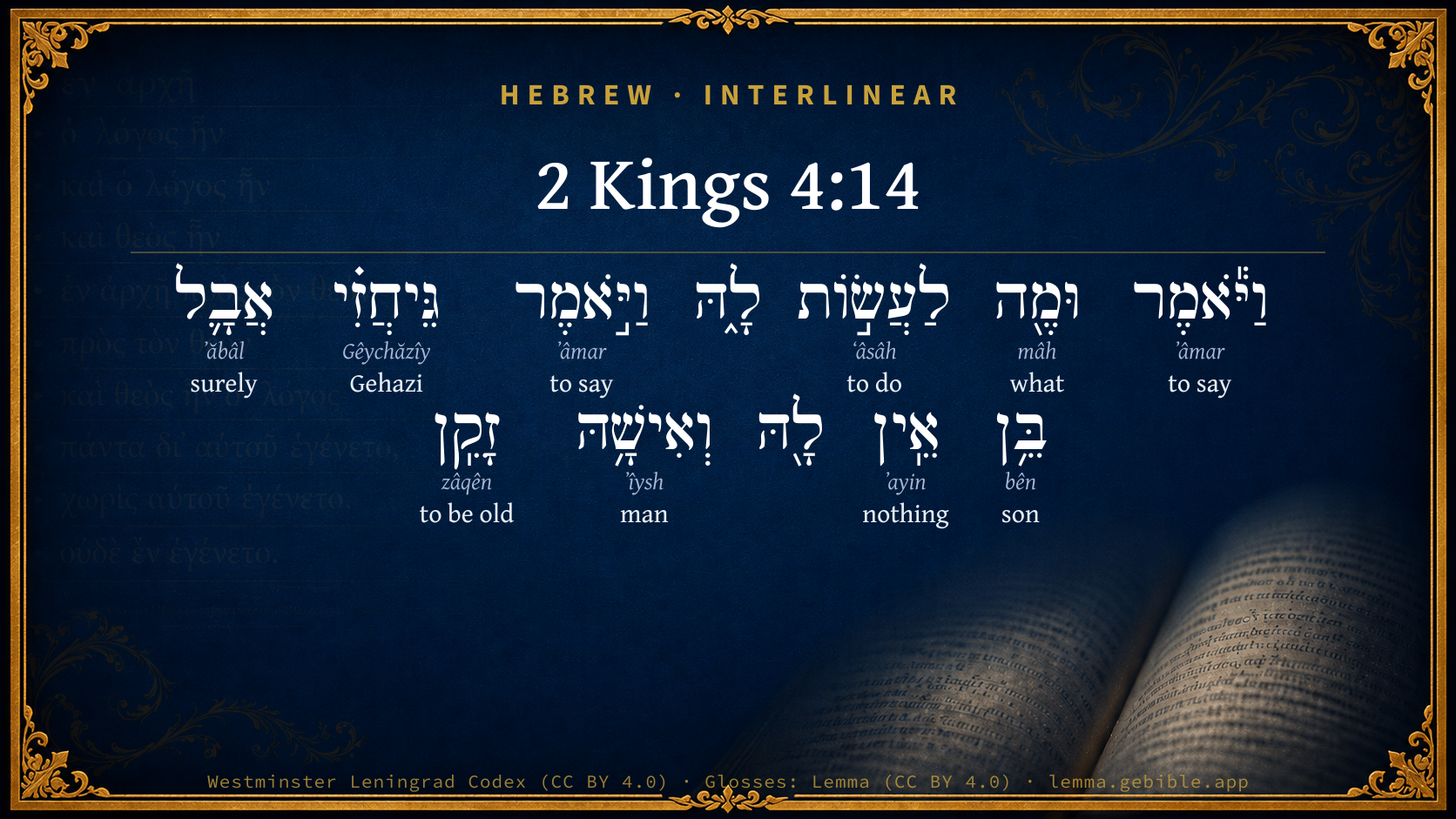
2 Kings 4:14

Hebrew (Westminster Leningrad Codex) 2 Kings 4:14 appears in the Hebrew Old Testament. The text above is from the Westminster Leningrad Codex. Each word links to its Strong’s number, a concise gloss, and parsing drawn from the Open Scriptures Hebrew Bible morphology. Click any word for its full Brown-Driver-Briggs (BDB) entry.
Download image
Cite this verse

2 Kings 4:14 (World English Bible). Public Domain. Lemma interlinear Bible study tool, https://lemma.gebible.app/v/2-kings/4/14.

Show BibTeX & RIS
BibTeX
RIS
English Translation
He said, What then is to be done for her? Gehazi answered, Most assuredly she has no son, and her husband is old.
World English Bible · Public Domain
Download a study sheet

One document with this verse’s original text, its word-by-word gloss line, the meaning frame, cross-references with their text, attributed commentary, and full source and license credits — printable, and it pastes into notes with its structure intact.

This verse Autodidact and up

Study sheet (.html) Plain text (.txt)

A passage Seminary Student

Up to 50 verses in one chapter. A passage sheet keeps up to 6 commentary sources and 12 cross-references per verse, in the order this page ranks them, and says so on the sheet whenever that leaves anything out. Ask for a single verse and you get the Autodidact verse sheet above.

Everything on this page stays free to read, with no account — the sheet is a download of what is already on screen, not access to it.

Want to remove ads? Support Godless Engineer
Compare translations 3

The same verse in 3 English versions, stacked beneath the original-language interlinear above. Click any original word for its lexicon entry.

Each is an independent rendering of the whole verse — the interlinear is not word-aligned to these translations.

Highlighted words mark where these versions differ — a whole-verse word diff, not a word-by-word alignment.

  • World English Bible Public Domain
    He said, What then is to be done for her? Gehazi answered, Most assuredly she has no son, and her husband is old.
  • King James Version Public Domain
    And he said, What then is to be done for her? And Gehazi answered, Verily she hath no child, and her husband is old.
  • unfoldingWord Literal Text CC BY-SA 4.0
    And he said, “But what to do for her?” And Gehazi said, “Indeed, there is not a son to her, and her husband old.”

unfoldingWord Literal Text — © unfoldingWord, licensed CC BY-SA 4.0. Word-aligned USFM3 via Door43 (git.door43.org/unfoldingWord/en_ult).

Versions to compare (up to 4)

3 of 4 selected

Show all 18 translations

Every available English version of this verse, each an independent rendering of the whole verse.

  • World English Bible Public Domain
    He said, What then is to be done for her? Gehazi answered, Most assuredly she has no son, and her husband is old.
  • Berean Standard Bible Public Domain
    So he asked, “Then what should be done for her?” “Well, she has no son,” Gehazi replied, “and her husband is old.”
  • Majority Standard Bible Public Domain
    So he asked, “Then what should be done for her?” “Well, she has no son,” Gehazi replied, “and her husband is old.”
  • King James Version Public Domain
    And he said, What then is to be done for her? And Gehazi answered, Verily she hath no child, and her husband is old.
  • American Standard Version (1901) Public Domain
    And he said, What then is to be done for her? And Gehazi answered, Verily she hath no son, and her husband is old.
  • Revised Version (1885) Public Domain
    And he said, What then is to be done for her? And Gehazi answered, Verily she hath no son, and her husband is old.
  • Geneva Bible (1599) Public Domain
    Againe he sayde, What is then to be done for her? Then Gehazi answered, In deede she hath no sonne, and her husband is olde.
  • Douay-Rheims (1899) Public Domain
    And he said: What will she then that I do for her? And Giezi said: Do not ask, for she hath no son, and her husband is old.
  • Young's Literal Translation Public Domain
    And he saith, `And what -- to do for her?' and Gehazi saith, `Verily she hath no son, and her husband `is' aged.'
  • Literal Standard Version CC BY-SA 4.0
    And he says, “And what can [I] do for her?” And Gehazi says, “Truly she has no son, and her husband [is] aged.”
  • Unlocked Literal Bible CC BY-SA 4.0
    So Elisha said, “What can we do for her, then?” Gehazi answered, “Indeed, she has no son, and her husband is old.”
  • unfoldingWord Literal Text CC BY-SA 4.0
    And he said, “But what to do for her?” And Gehazi said, “Indeed, there is not a son to her, and her husband old.”
  • Darby Bible Public Domain
    And he said, What then is to be done for her? And Gehazi said, Verily, she has no son, and her husband is old.
  • World Messianic Bible Public Domain
    He said, “What then is to be done for her?” Gehazi answered, “Most certainly she has no son, and her husband is old.”
  • Webster's Bible Public Domain
    And he said, What then is to be done for her? And Gehazi answered, Verily she hath no child, and her husband is old.
  • Free Bible Version CC BY-SA 4.0
    After she had left, Elisha asked, “What can we do for her?” “She doesn't have a son, and her husband is old,” Gehazi replied.
  • Bible in Basic English Public Domain
    So he said, What then is to be done for her? And Gehazi made answer, Still there is this, she has no son and her husband is old.
  • JPS Tanakh (1917) Public Domain
    And he said: 'What then is to be done for her?' And Gehazi answered: 'Verily she hath no son, and her husband is old.'

Literal Standard Version (2020), Covenant Press — licensed CC BY-SA 4.0. Text via the HelloAO Bible API (eBible.org). Unlocked Literal Bible (unfoldingWord) — licensed CC BY-SA 4.0. Text via the HelloAO Bible API (eBible.org). unfoldingWord Literal Text — © unfoldingWord, licensed CC BY-SA 4.0. Word-aligned USFM3 via Door43 (git.door43.org/unfoldingWord/en_ult). Free Bible Version, Dr. Jonathan Gallagher — licensed CC BY-SA 4.0. Text via the HelloAO Bible API (eBible.org).

Word by word

More ways to search: Search by grammar → Find every occurrence → Compare this word →

Practice this passage: Drill this verse → Learn its vocabulary →

אֲבָ֛ל
ʼăbâl
H61
“surely”
Adverb
Part of Speech
Adverb
Full BDB Definition

Origin: apparently from H56 through the idea of negation

TWOT: 8

truly, verily, surely - but, however, howbeit - contrariwise, nay rather (negative)
  1. וַיֹּ֕אמֶר ʼâmar H559 “and · to say” Conjunction + Verb, Qal, Sequential Imperfect, 3rd Person, Masculine, Singular
  2. וּמֶ֖ה mâh H4100 “and · what” Conjunction + Particle, Interrogative
  3. לַעֲשׂ֣וֹת ʻâsâh H6213 “to do” Preposition + Verb, Qal, Infinitive Construct
  4. וַיֹּ֣אמֶר ʼâmar H559 “and · to say” Conjunction + Verb, Qal, Sequential Imperfect, 3rd Person, Masculine, Singular
  5. גֵּיחֲזִ֗י Gêychăzîy H1522 “Gehazi” Noun, Proper
  6. בֵּ֥ן bên H1121 “son” Noun, Common, Masculine, Singular, Absolute
  7. אֵֽין ʼayin H369 “nothing” Particle, Negative
  8. וְאִישָׁ֥הּ ʼîysh H376 “and · man · her” Conjunction + Noun, Common, Masculine, Singular, Construct + Suffix, Personal, 3rd Person, Feminine, Singular
  9. זָקֵֽן zâqên H2204 “to be old” Verb, Qal, Perfect, 3rd Person, Masculine, Singular

About this verse

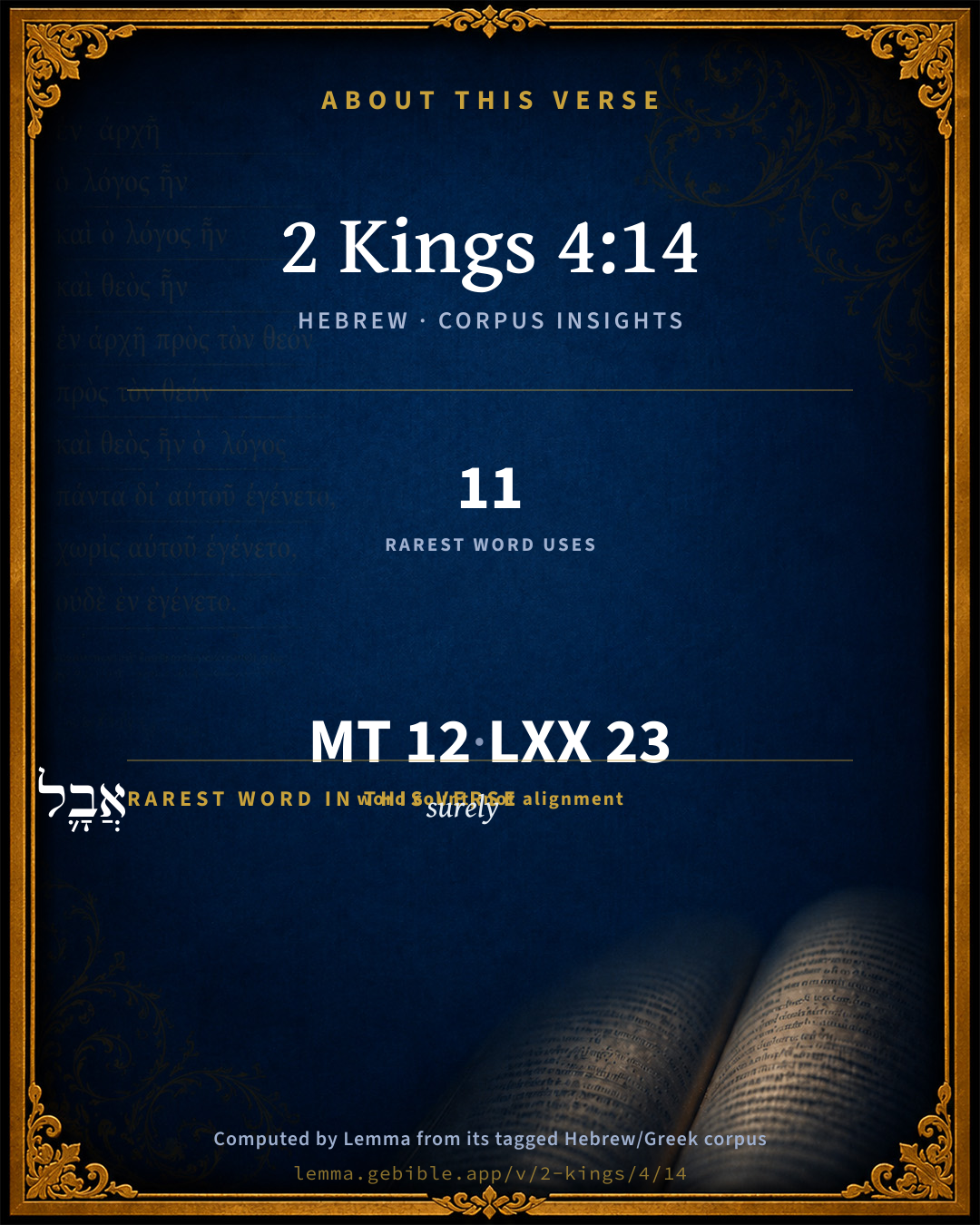
These counts appear in no published source. They are computed here, from the morphology-tagged text and Lemma’s own curated glosses. What Lemma adds →

12
words
9
distinct lemmas
Historical
section

Notable vocabulary

The rarest word here is אֲבָ֛ל surely H61 — appearing just 11 times in the whole Hebrew Bible.

Shared distinctive vocabulary

אֲבָ֛ל surely H61 occurs in 11 verses of the Hebrew Bible. Also found in:

Grammatical profile

  • 4 verbs
  • 3 nouns
  • 2 prepositions
  • 1 adverb
  • 2 particles

Verb forms

  • וַיֹּ֕אמֶר Qal · Sequential Imperfect
  • לַעֲשׂ֣וֹת Qal · Infinitive Construct
  • וַיֹּ֣אמֶר Qal · Sequential Imperfect
  • זָקֵֽן Qal · Perfect

Repetition

A word recurs within this verse — often emphatic in Hebrew:

  • וַיֹּ֕אמֶר to say H559 ×2

Hebrew & Septuagint length

In English translation the verse runs 23 words from the Hebrew and 26 from the Septuagint (LXX English) — closely comparable.

A rough comparison of the two English renderings, which tokenize alike — not a word-level alignment.

Word counts can differ between the Hebrew and the Greek without any difference in meaning — e.g. the Hebrew direct-object marker אֵת has no separate Greek word, and Greek often adds the article ὁ.

In the original languages it is 12 Hebrew tokens and 23 Greek tokens — but the two are counted differently (Hebrew bundles its prefixes and suffixes into one token; the Greek is in lemma form), so that isn’t a like-for-like length.

Cross-references

9

Topical passages linked to 2 Kings 4:14 in the Treasury of Scripture Knowledge — connected by theme and wording, ordered by reader-vote popularity; previews shown in the World English Bible.

  • Genesis 15:2–3 Abram said, "Lord Yahweh, what will you give me, seeing I go childless, and he who will inherit my estate is Eliezer of Damascus?"
  • 1 Samuel 1:8 Elkanah her husband said to her, Hannah, why weep you? and why don't you eat? and why is your heart grieved? am I not better to you than ten sons?
  • Luke 1:7 But they had no child, because Elizabeth was barren, and they both were well advanced in years.
  • Genesis 18:10–14 He said, "I will certainly return to you when the season comes round. Behold, Sarah your wife will have a son." Sarah heard in the tent door, which was behind him.
  • Genesis 25:21 Isaac entreated Yahweh for his wife, because she was barren. Yahweh was entreated by him, and Rebekah his wife conceived.
  • Judges 13:2 There was a certain man of Zorah, of the family of the Danites, whose name was Manoah; and his wife was barren, and didn't bear.
  • Genesis 17:17 Then Abraham fell on his face, and laughed, and said in his heart, "Will a child be born to him who is one hundred years old? Will Sarah, who is ninety years old, give birth?"
  • Genesis 30:1 When Rachel saw that she bore Jacob no children, Rachel envied her sister. She said to Jacob, "Give me children, or else I will die."
  • 1 Samuel 1:2 and he had two wives; the name of the one was Hannah, and the name of other Peninnah: and Peninnah had children, but Hannah had no children.

Cross-references courtesy of OpenBible.info (CC BY 4.0).

Hebrew and Greek witnesses Masoretic Hebrew ↔ Greek Septuagint

The same verse in the two great witnesses to the Old Testament, shown verse-for-verse.

These are two independent witnesses, not word-aligned to each other, and the Septuagint is shown in lemma (dictionary) form.

Hebrew 2 Kings 4:14 Masoretic · Westminster Leningrad Codex

וַיֹּ֕אמֶר וּמֶ֖ה לַעֲשׂ֣וֹת לָ֑הּ וַיֹּ֣אמֶר גֵּיחֲזִ֗י אֲבָ֛ל בֵּ֥ן אֵֽין לָ֖הּ וְאִישָׁ֥הּ זָקֵֽן

He said, What then is to be done for her? Gehazi answered, Most assuredly she has no son, and her husband is old.

World English Bible · Public Domain

Greek LXX 2 Kings 4:14 Septuagint · lemma form

καί εἶπον τίς δέω ποιέω αὐτός καί εἶπον γιεζι ὁ παιδάριον αὐτός καί μάλα υἱός οὐ εἰμί αὐτός καί ὁ ἀνήρ αὐτός πρεσβύτης

And he said to Giezi, What must we do for her? and Giezi his servant said, Indeed she has no son, and her husband is old.

LXX2012 (modern English Septuagint) · Public Domain

On this verse, The Cambridge Bible for Schools and Colleges discusses the Septuagint’s reading. Read the note in Commentary ↓

Hebrew: Westminster Leningrad Codex (CC BY 4.0). Greek: Septuagint (public domain); English from LXX2012 (modern English Septuagint) (Public Domain). How the Septuagint differs from the Hebrew →

Targum (Aramaic paraphrase)

1

The Targum is the ancient Jewish Aramaic paraphrase of the Hebrew Scriptures — an interpretive translation, not the Hebrew text itself. Onkelos (literal) and Pseudo-Jonathan (expansive) render the Torah, and Jonathan the Prophets. Coverage is partial: where no permissively-licensed English translation exists for a verse, only the Aramaic is shown. This is verse-level text, not a word-by-word alignment to the Hebrew.

  1. Targum Jonathan Prophets (Joshua–Malachi)
    וַאֲמַר וּמָה לְמֶעְבַּד לָהּ וַאֲמַר גֵיחֲזִי בְּקוּשְׁטָא בַּר לֵית לָהּ וּבַעֲלָהּ סִיב:

    (no public-domain English translation for this verse)

    Targum Jonathan — Aramaic: “Mikraot Gedolot” (public domain). English: “Sefaria Community Translation” (CC0 1.0 (public-domain dedication)); “London "Chaldee Paraphrase," 1871” (public domain). Text via Sefaria.

Commentary

Notes on 2 Kings 4:14 from classic Christian and Jewish commentators (each source and its license shown beneath its notes). The classic Christian expositions comment on the surrounding passage and are grouped to its opening verse, so a note may address several verses; the Jewish commentaries on the Tanakh (Rashi and others) are per-verse, so they appear only where the commentator wrote on this verse.

Lemma curates 59 commentaries, every one of them public domain or Creative Commons licensed, each selected and text-cleaned for this edition rather than reprinted as found. About our sources →

Trapp's Complete Commentary

John Trapp

2Ki 4:14 And he said, What then [is] to be done for her? And Gehazi answered, Verily she hath no child, and her husband is old.

Ver. 14. What then is to be done for her?] So great a prophet disdaineth not to consult and advise with his servant; and all his care is how to express his thankfulness to his hostess.

John Trapp, A Commentary or Exposition upon All the Books of the Old and New Testament (1647–1656) — public domain. Text from a community e-Sword module.

Joseph Benson's Commentary

2Ki 4:14-15. And he said, What then is to be done for her? — The above answer being returned to his master by Gehazi, Elisha asked him what he thought might be most welcome to her, as if he had said, Hast thou observed any thing which she wants or desires? For the prophet kept himself much in his chamber, while Gehazi went more freely about the house, as occasion led him. Gehazi answered, Verily, she hath no child —

She has a great estate, but no son to leave it to, and is past hopes of having any, her husband being old: if Elisha can obtain this favour from God for her, it will be the removal of that which, at present, was her only grievance. Those kindnesses are the most welcome which are most suited to our necessities. When he had called her, she stood at the door — Either out of modesty, or reverence, or an unwillingness to disturb him.

Joseph Benson's Commentary on the Old and New Testaments (1811–1818) — public domain. Text from a community e-Sword module.

Geneva Bible (1599)

Geneva Bible translators

Which then was a reproach, and therefore he would that his master should pray to God for her that she might be fruitful.

Geneva Bible (1599) marginal notes — public domain. Text via Bolls.life.

Adam Clarke's Commentary

Verse 14. What then is to be done for her?] It seems that the woman retired as soon as she had delivered the answer mentioned in the preceding verse.

Adam Clarke's Commentary on the Bible (1810–1826) — public domain. Text from a community e-Sword/MySword module.

Ellicott's Commentary for English Readers

(14) And he said—i.e., when Gehazi had reported the woman’s reply.

She hath no child.—Which was at once a misfortune and a reproach. (Comp. Gen_30:23; 1Sa_1:6-7; Luk_1:25; Deu_7:13-14; Psa_128:3-4.)

A Bible Commentary for English Readers, edited by Charles John Ellicott (1878–1897) — public domain. Text from a community e-Sword module.

The Cambridge Bible for Schools and Colleges

gen. ed. J. J. S. Perowne

14. And he said] Clearly, to Gehazi. This the LXX. adds.

Verily she hath no child] R.V. son. The R.V. is correct, though it seems from the whole narrative that the woman was childless. Of the great grief felt from want of children we learn in the history of Hannah (1Sa_1:10-11). Gehazi had probably learnt that this was a sorrow in the family at Shunem.

The Cambridge Bible for Schools and Colleges (gen. ed. J. J. S. Perowne; Cambridge University Press, 1878–1918) — public domain. Text from a community e-Sword module.

John Gill's Exposition

And he said,.... That is, Elisha to Gehazi, when he returned to him, and told him what the Shunammite said:

what then is to be done for her? something he thought should be done in gratitude, the favours they had received, and advises with his servant what could be thought of, he being one about the house:

and Gehazi answered, verily she hath no child, and her husband is old; and so not likely to have any by him; as children were always very desirable by women, and especially in those days, the servant suggests, that no doubt to have one would be very acceptable to her.

John Gill's Exposition of the Whole Bible (1746–1763) — public domain (CC PDM 1.0). Text via the HelloAO Bible API.

Haydock's Catholic Bible Commentary

No son. The desire of one was very natural, particularly to people in good circumstances (Menochius) and of the Hebrew nation. (Haydock)

George Leo Haydock (1774–1849), Haydock's Catholic Family Bible and Commentary, 1859 edition — public domain. Excludes Psalms (Douay-Rheims chapter numbering differs from Protestant) and Deuterocanonical books (Catholic canon only).

Matthew Poole's English Annotations

What then is to be done for her? hast thou observed any thing which she wants or desires? For the prophet kept himself much in his chamber, whilst Gehazi went more freely about the house, as his occasions led him.

Matthew Poole's English Annotations on the Holy Bible (1683–1685) — public domain. Text from a community e-Sword/MySword module.

The Pulpit Commentary

And he said he, Elisha, said to GehaziWhat then is to be done for her? If the woman will suggest nothing herself, can Gehazi suggest anything? Has he heard her express any wish? Does he know of any boon that would be welcome to her? Evidently the woman"s disinterestedness has increased the prophet"s desire to do something for her. b It does not appear that the woman had made any complaint or exhibited any special anxiety on the subject of offspring. But Gehazi knows, that to be barren is regarded by all Hebrew women as a re-preach, that it exposes them to scorn and contumely, (1Sa_1:6, 1Sa_1:7) and that offspring is universally, or all but universally, desired. He therefore assumes that the Shunammite must wish for it. And Elisha accepts his suggestion without a moment"s hesitation.

The Pulpit Commentary (1880–1919), ed. H.D.M. Spence-Jones & Joseph S. Exell — public domain. Text from a community e-Sword module.

John Wesley's Explanatory Notes

He said - Hast thou observed any thing which she wants or desires? For the prophet kept himself much in his chamber, whilst Gehazi went more freely about the house, as his occasions led him.

John Wesley, Explanatory Notes Upon the Whole Bible (1754–1765) — public domain. Text via the GEBible commentary corpus.

unfoldingWord translationNotes

Door43 World Missions Community

Call her

"Ask her to come to see me"

When he had called her

"When Gehazi had called her"

the door

This refers to the doorway. AT: "the doorway" (See: Metonymy)

a son

"your son"

my master and man of God

The woman uses both of these names to refer to Elisha.

your servant

The woman refers to herself as Elisha's servant to show him honor.

translationWords

lord

God

unfoldingWord translationNotes — © Distant Shores Media and the Door43 World Missions Community, licensed CC BY-SA 4.0. Source: git.door43.org/Door43/en_tn.

Rashi

Rabbi Shlomo Yitzchaki (Rashi)

And he said. Elisha [said] to Geichazi.

“Then what is there to do for her?” To reciprocate for this favor.

Rashi on the Tanakh — English translations: “The Judaica Press complete Tanach with Rashi, translated by A. J. Rosenberg” (CC BY 4.0); “Pentateuch with Rashi's commentary by M. Rosenbaum and A.M. Silbermann, 1929-1934” (public domain); “The Metsudah Tanach series, Lakewood, N.J” (CC BY 4.0); and “The Book of Joshua, Metsudah Publications, 1997” (CC BY 4.0). Text via Sefaria.

Lesson kit

Teaching starters — assembled from the data on this page, not authored interpretation. Every prompt links to the verse data it draws on. Edit before teaching.

2 Kings, in the Historical, opens this verse with 12 words (9 distinct Hebrew lemmas). Its most distinctive word is ʼăbâl (“surely”). A historical commentator’s framing appears above. Read the whole chapter for the surrounding context.

Discussion questions

  1. What does “surely” (ʼăbâl) contribute to the verse as a whole?
  2. How does Genesis 17:19, which shares the word «surely», read alongside this verse?
  3. What does the repetition of “to say” (2× in this one verse) do in this verse?
  4. These translations render this verse differently. What is at stake in choosing one wording over another?
  5. «וַיֹּ֕אמֶר» is a Qal Sequential Imperfect verb. How does that grammatical form shape the action described?
  6. Compare how Trapp's Complete Commentary and Joseph Benson's Commentary read this verse. Where do they agree or differ?

Things to notice

Reading settings

Reading text

Shown beneath each verse's original-language words.

Old Testament
Old Testament edition

Read the OT as the Masoretic Hebrew (MT) or the Greek Septuagint (LXX).

English shown for the Greek Septuagint (in the Hebrew ↔ Greek comparison).

Comparing translations? Open the Compare panel on any verse page to stack up to four side by side.