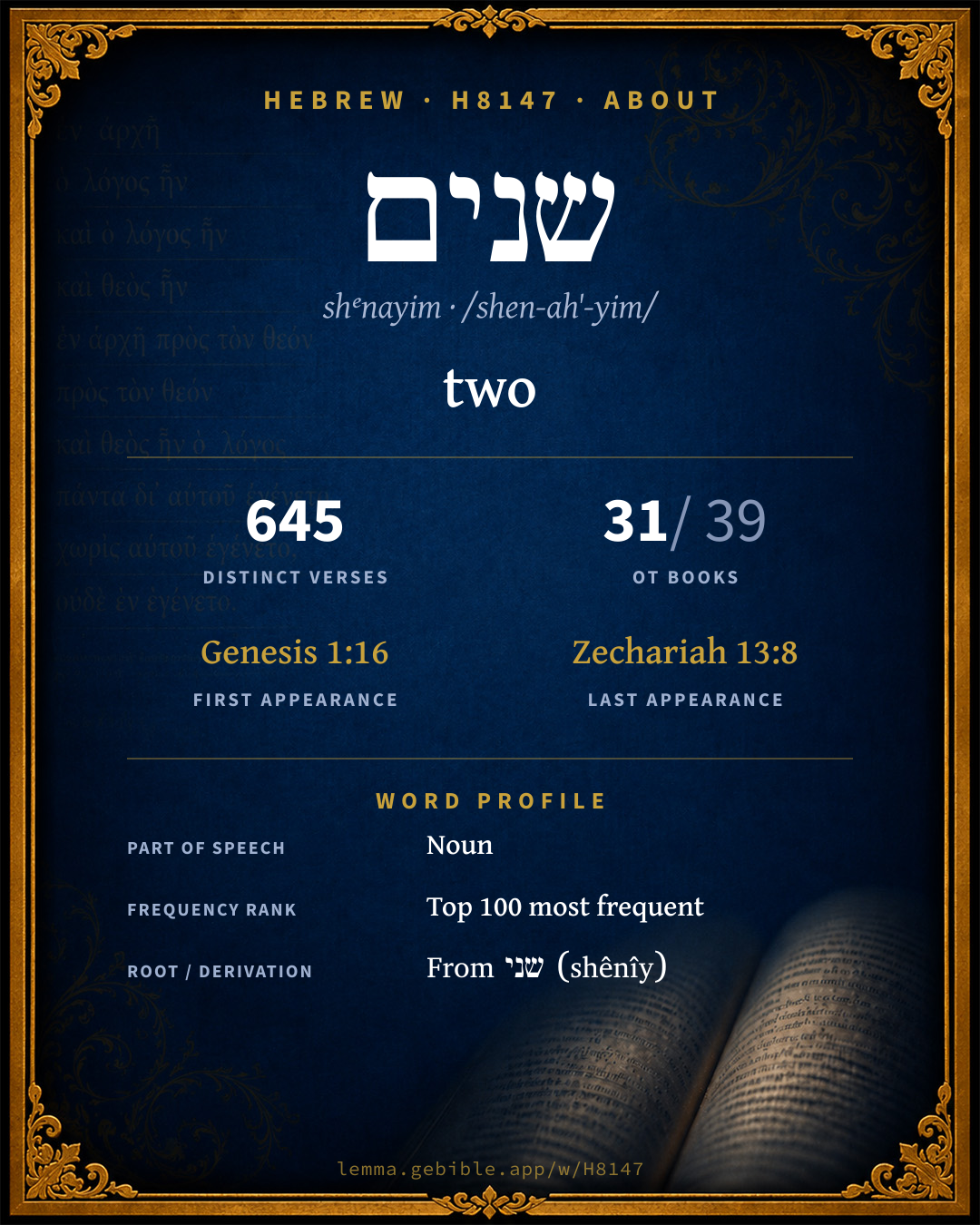
שְׁנַ֫יִם
two
‘two’ is one of 5 main senses fuller range ↓
Full lexicon entry — Brown-Driver-Briggs (BDB)
From Brown-Driver-Briggs (BDB)
Where this word appears
See every Absolute-state word in the Hebrew Bible →
Grammar key — what these labels mean
Part of speech
- Adjective
- A word that describes or qualifies a noun.
State
- Absolute
- The independent form of a noun, not bound to a following word.
- Construct
- A noun bound to a following noun in a possessive / “of” relationship (the construct chain).
Gender
- Masculine
- Grammatically masculine.
- Feminine
- Grammatically feminine.
Number
- Dual
- Exactly two — for natural pairs and some measures of time.
23 verses where H8147 appears in the Construct state in the Book of 1 Kings. Filtered view — show all forms. Click any verse to open its interlinear word-by-word view. Verse text shown in the World English Bible for context — . Each verse’s Hebrew form is shown with its reference; the English is not keyword-highlighted, since the data carries no word-level English alignment. Use “Compare translations” on any verse to read it across multiple English versions. This concordance covers the Hebrew Bible; Septuagint (Greek Old Testament) occurrences are not indexed here.
1 Kings
- 1 Kings 2:5 לִ/שְׁנֵֽי prep + Adjective Cardinal number md cs Moreover you know also what Joab the son of Zeruiah did to me, even what he did to the two captains of the hosts of Israel, to Abner the son of Ner, and to Amasa the son of Jether, whom he killed, and shed the blood of war in peace, and put the blood of war on his sash that was about his loins, and in his shoes that were on his feet.
- 1 Kings 2:32 בִּ/שְׁנֵֽי prep + Adjective Cardinal number md cs Yahweh will return his blood on his own head, because he fell on two men more righteous and better than he, and killed them with the sword, and my father David didn't know it, [to wit], Abner the son of Ner, captain of the host of Israel, and Amasa the son of Jether, captain of the host of Judah.
- 1 Kings 2:39 שְׁנֵֽי adj Cardinal number md cs It happened at the end of three years, that two of the servants of Shimei ran away to Achish, son of Maacah, king of Gath. They told Shimei, saying, Behold, your servants are in Gath.
- 1 Kings 5:12 שְׁנֵי/הֶֽם adj Cardinal number md cs + sfx pers 3mp Yahweh gave Solomon wisdom, as he promised him; and there was peace between Hiram and Solomon; and they two made a league together.
- 1 Kings 6:23 שְׁנֵ֥י adj Cardinal number md cs In the oracle he made two cherubim of olive-wood, each ten cubits high.
- 1 Kings 6:25 לִ/שְׁנֵ֥י prep + Adjective Cardinal number md cs The other cherub was ten cubits: both the cherubim were of one measure and one form.
- 1 Kings 6:32 וּ/שְׁתֵּי֮ conj + Adjective Cardinal number fd cs So [he made] two doors of olive-wood; and he carved on them carvings of cherubim and palm trees and open flowers, and overlaid them with gold; and he spread the gold on the cherubim, and on the palm trees.
- 1 Kings 6:34 וּ/שְׁתֵּ֥י שְׁנֵ֨י וּ/שְׁנֵ֧י conj + Adjective Cardinal number fd cs adj Cardinal number md cs conj + Adjective Cardinal number md cs and two doors of fir-wood: the two leaves of the one door were folding, and the two leaves of the other door were folding.
- 1 Kings 7:15 שְׁנֵ֥י שְׁתֵּים adj Cardinal number md cs adj Cardinal number fd For he fashioned the two pillars of brass, eighteen cubits high apiece: and a line of twelve cubits compassed either of them about.
- 1 Kings 7:16 וּ/שְׁתֵּ֨י conj + Adjective Cardinal number fd cs He made two capitals of molten brass, to set on the tops of the pillars: the height of the one capital was five cubits, and the height of the other capital was five cubits.
- 1 Kings 7:18 וּ/שְׁנֵי֩ conj + Adjective Cardinal number md cs So he made the pillars; and there were two rows round about on the one network, to cover the capitals that were on the top of the pillars: and so did he for the other capital.
- 1 Kings 7:20 שְׁנֵי֙ adj Cardinal number md cs There were capitals above also on the two pillars, close by the belly which was beside the network: and the pomegranates were two hundred, in rows round about on the other capital.
- 1 Kings 7:24 שְׁנֵ֤י adj Cardinal number md cs Under the brim of it round about there were buds which did compass it, for ten cubits, compassing the sea round about: the buds were in two rows, cast when it was cast.
- 1 Kings 7:25 שְׁנֵ֧י adj Cardinal number md cs It stood on twelve oxen, three looking toward the north, and three looking toward the west, and three looking toward the south, and three looking toward the east; and the sea was set on them above, and all their hinder parts were inward.
- 1 Kings 7:41 שְׁנַ֔יִם שְׁתָּ֑יִם שְׁתַּ֔יִם שְׁתֵּי֙ adj Cardinal number md adj Cardinal number fd adj Cardinal number fd adj Cardinal number fd cs the two pillars, and the two bowls of the capitals that were on the top of the pillars; and the two networks to cover the two bowls of the capitals that were on the top of the pillars;
- 1 Kings 7:42 לִ/שְׁתֵּ֣י שְׁנֵֽי שְׁתֵּי֙ prep + Adjective Cardinal number fd cs adj Cardinal number md cs adj Cardinal number fd cs and the four hundred pomegranates for the two networks; two rows of pomegranates for each network, to cover the two bowls of the capitals that were on the pillars;
- 1 Kings 8:9 שְׁנֵי֙ adj Cardinal number md cs There was nothing in the ark save the two tables of stone which Moses put there at Horeb, when Yahweh made a covenant with the children of Israel, when they came out of the land of Egypt.
- 1 Kings 9:10 שְׁנֵ֣י adj Cardinal number md cs It happened at the end of twenty years, in which Solomon had built the two houses, the house of Yahweh and the king's house
- 1 Kings 11:29 וּ/שְׁנֵי/הֶ֥ם conj + Adjective Cardinal number md cs + sfx pers 3mp It happened at that time, when Jeroboam went out of Jerusalem, that the prophet Ahijah the Shilonite found him in the way; now [Ahijah] had clad himself with a new garment; and they two were alone in the field.
- 1 Kings 12:28 שְׁנֵ֖י adj Cardinal number md cs Whereupon the king took counsel, and made two calves of gold; and he said to them, It is too much for you to go up to Jerusalem: see your gods, Israel, which brought you up out of the land of Egypt.
- 1 Kings 18:21 שְׁתֵּ֣י adj Cardinal number fd cs Elijah came near to all the people, and said, "How long will you waver between the two sides? If Yahweh is God, follow him; but if Baal, then follow him." The people answered him not a word.
- 1 Kings 20:27 כִּ/שְׁנֵי֙ prep + Adjective Cardinal number md cs The children of Israel were mustered, and were provisioned, and went against them: and the children of Israel encamped before them like two little flocks of kids; but the Syrians filled the country.
- 1 Kings 21:13 שְׁנֵ֨י adj Cardinal number md cs The two men, the base fellows, came in and sat before him: and the base fellows bore witness against him, even against Naboth, in the presence of the people, saying, Naboth did curse God and the king. Then they carried him forth out of the city, and stoned him to death with stones.
About this entry
At a glance — auto-summarized from this page’s data, not written by a person. Every figure links to its source below. This summary describes the numbers; it doesn’t interpret them.
At its core, שנים (shᵉnayim) means “two.” Not a single-sense word: explore its full sense range. Spanning 645 verses in 31 books, it ranks among the most common words of the Hebrew Bible. It first appears in Genesis 1:16. Sharing its root, it stands alongside שני, תנין and תרין. Each statement above links to its evidence; the full detail follows below.
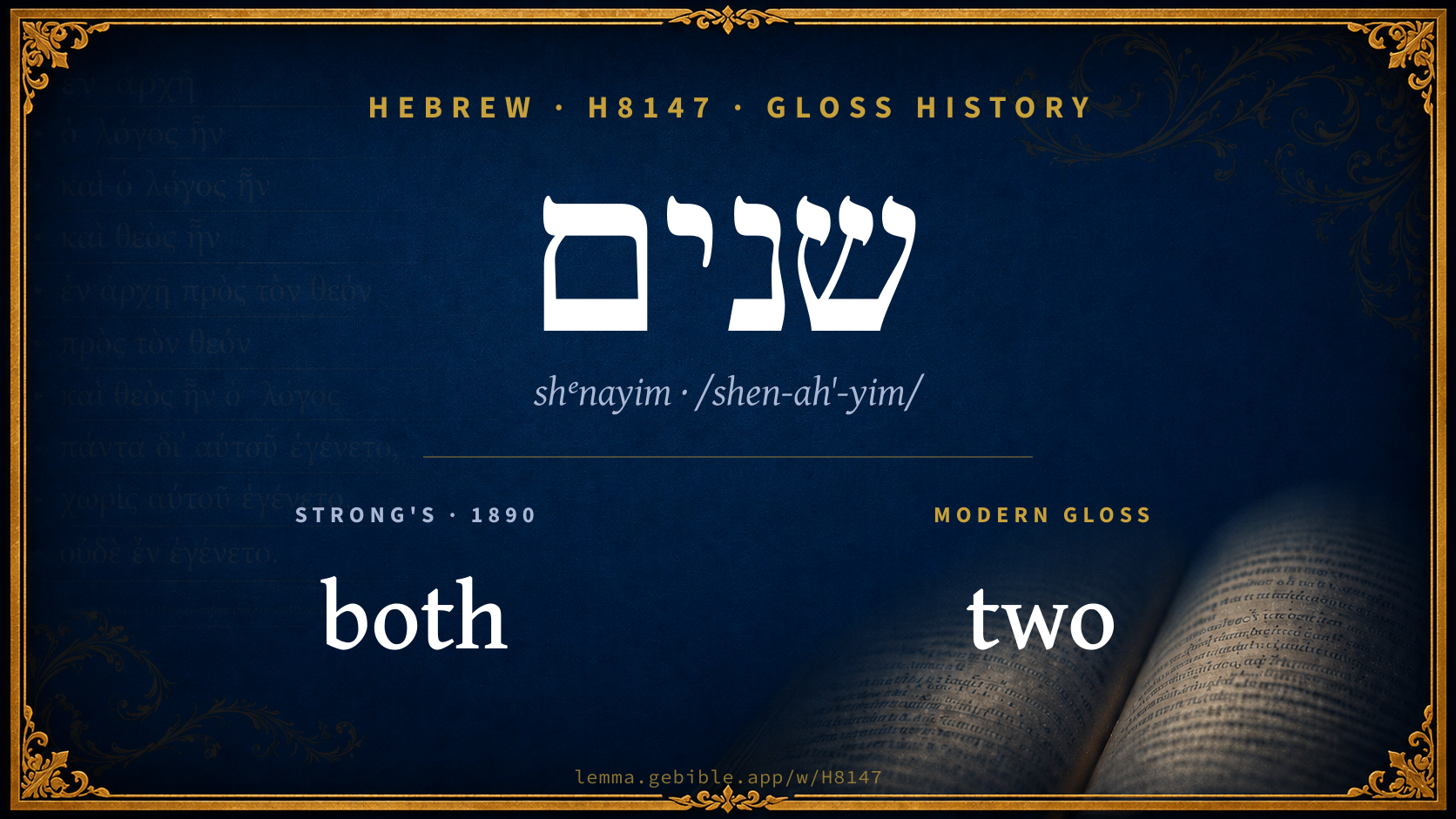
Gloss history
Strong's 1890 vs modern scholarship
About this word
Strong's H8147 catalogs a Hebrew word from the Hebrew Old Testament.
These counts are not copied from any lexicon or concordance. They are computed here, from the morphology-tagged Hebrew Old Testament. What Lemma adds →
- 645
- distinct verses
- The word appears in 645 distinct verses.
- 31 / 39
- OT books
- The word appears in 31 of 39 Old Testament books.
- #63
- by frequency
- Top 100 most frequent Hebrew words (rank 63 of 8,640 Hebrew words by occurrence).
View all 645 occurrences in the concordance →
By section of the Old Testament
By traditional corpus
Conventional, traditional groupings — biblical authorship is debated, so this is a traditional corpus grouping, not an authorship claim. Each share is this word’s portion of its verses in that division of the Hebrew canon. Each figure is a share of the word’s 645 distinct verses.
- Torah (Pentateuch) 256 verses · 40%
- Prophets (Nevi'im) 240 verses · 37%
- Writings (Ketuvim) 149 verses · 23%
How translations render this word
Counts come from each version’s own published word-to-Strong’s tagging or interlinear alignment — an approximate guide to how each version renders this word, not a word-level alignment the data otherwise carries. Because each total is that version’s own tagged count, the per-version totals vary from one another and need not match the appearance or distinct-verse counts above. These counts may also differ from a printed concordance because Lemma counts each distinctly tagged rendering and does not collapse phrase taggings into a single head-word total. This is a fixed set of word-tagged versions (KJV, ASV, BSB, ULT) and does not change with the reading translation you choose elsewhere. Each version’s license is shown beside its name below (and on Sources).
- King James Version: Two 430×, Both 54×, Twelve 51×
- American Standard Version: Two 396×, Twelve 70×, Both 47×
- Berean Standard Bible: Two 342×, Twelve 57×, Both 48×
- unfoldingWord Literal Text: Two 393×, Two of them 51×, Two of 39×
King James Version Public Domain
Renders H8147 across 754 tagged occurrences — most commonly:
Plus other, less common renderings. Plus 86 renderings that appear only once — usually multi-word phrases or single function words the recovered tagging swept in, not distinct renderings. Not rendered by a distinct English word in 15 further occurrences.
American Standard Version Public Domain
Renders H8147 across 749 tagged occurrences — most commonly:
Plus other, less common renderings. Plus 112 renderings that appear only once — usually multi-word phrases or single function words the recovered tagging swept in, not distinct renderings.
Berean Standard Bible Public Domain
Renders H8147 across 603 tagged occurrences — most commonly:
Plus other, less common renderings. Plus 53 renderings that appear only once — usually multi-word phrases or single function words the recovered tagging swept in, not distinct renderings. Not rendered by a distinct English word in 159 further occurrences.
unfoldingWord Literal Text CC BY-SA 4.0
Renders H8147 across 706 tagged occurrences — most commonly:
Plus other, less common renderings. Plus 36 renderings that appear only once — usually multi-word phrases or single function words the recovered tagging swept in, not distinct renderings. Not rendered by a distinct English word in 120 further occurrences.
Senses in the full BDB
What do BDB’s symbols mean?
BDB uses these scholarly abbreviations:
| Symbol | Meaning |
|---|---|
| 𝔊 | the Septuagint (the ancient Greek translation, LXX) |
| 𝔙 | the Vulgate (the Latin translation) |
| 𝔖 | the Syriac version (the Peshitta) |
| 𝔗 | the Targum (the Aramaic translation) |
| ψ | the Psalms |
| √ | root (the underlying root or stem) |
| ‖ | parallel passage (a synonymous or contrasted parallel) |
| † | the dagger: every passage where the word occurs is cited |
The 5 senses and sub-senses the full Brown-Driver-Briggs lexicon distinguishes for this word, in lexicon order (not ranked by frequency), with BDB’s own verbatim wording and sub-sense lettering. Shown in Hebrew script with BDB’s own scholarly abbreviations. The condensed entry is in the Lexicon Entry tab. See also the Forms in the corpus table below.
- 1. no other num.:
- a. usually cstr. before n.pl. (צְמִידִים) שְׁנֵי Gn 24:22 + 194 times + 2 S 23:20 ‖ 1 Ch 11:22 (ins. בְּנֵי 𝔊 Th mod., otherwise RSSem. i. 469, 2nd ed., 488); (נָשִׁים) שְׁתֵּי Gn 4:19 + 132 times, 1 S 10:4 ins. כִּכְּרוֹת Klo HPS Bu Now; Lv 16:21 read du. יָדָיו Qr, + Ju 16:28 (v. supr.) + שְׁתֵּי־אֵלֶּה Is 47:9 both these thing; before n.sg., שְׁנֵי Ex 16:22 (Ges§ 134e); sf. שְׁנֵיהֶם the two of them Gn 2:25 + 62 times, + Pr 24:22 (> their years 𝔖 𝔗 De al.; prob. crpt., v. Toy), שְׁנֵינוּ Gn 31:37 + 2 times, שְׁנֵיכֶם †Gn 27:45; שְׁתֵּיהֶם (msf.! Ges§ 135 o) †Ru 1:19; 4:11, יהֶן—ֵ †1 S 25:43; Ez 23:13. e.g. Genesis 24:22
- b. abs. (1) שְׁנַ֫יִם (90 times), before n.pl. Ju 11:37 + 26 times; after n.pl. 2 S 1:1; Ex 29:1 + 21 times (usually P Chr), n.sg. (coll.) Gn 46:27 Nu 7:17 + 11 times Nu 17; n. om. Gn 7:2; 44:27 + 26 times; שׁ׳ שׁ׳ distrib. Gn 7:9 +; לִשׁ׳ cut in two †2 K 3:25; Je 34:18; = double amount †Ex 22:3, 6, 8 (E); פִּי שׁ׳ †Dt 21:17 two-thirds, + בְּרוּחֲךָ †2 K 2:9 in (of) thy spirit, + בָּהּ †Zc 13:8; (2) שְׁתַּ֫יִם (55 times), bef. n.pl.; 1 K 3:16 + 16 times; after n.pl. (usually P and late) 2 Ch 24:3 + 9 times; n. om., = two things †Is 51:19 Jb 13:20 Pr 30:7; שְׁתַּיִם = twice †2 K 6:10 Jb 40:5 ψ 62:12 (or as Pr 30:7), בִּשׁ׳ Jb 33:14 either so, or in two ways RVm (v. De); as ordin. בִּשְׁנַת שְׁתַּיִם לְ 1 K 15:25 + 9 times, etc.; (3) as round number, שְׁנַיִם עֵצִים 1 K 17:12 a few sticks (Germ. ‘ein paar’), cf. 2 K 9:32 Is 17:6; שְׁתַּיִם שָׁלשׁ Am 4:8, פַּעַם וּשְׁתָּ֑יִם Ne 13:20, cf. Je 3:14 אֶחָד מֵעִיר וּשְׁנַיִם מִמִּשְׁפָחָה = a small no.; Ezr 10:13 not for one or two days (but for many), 2 K 6:10. e.g. Judges 11:37
- 2. twelve: c. n.m. שְׁנֵים עָשָׂר Gn 42:13 + 87 times, לִשְׁנֵי עָשָׂר Ex 28:21 + 4 times; c. n.f. שְׁתֵּים עֶשְׂרֵה Ex 24:4 + 34 times, שְׁתֵּי עֶשְׂרֵה †Ez 32:1, 17; 33:21; before n.pl. Gn 17:20; Ex 15:27 +; after n.pl. Nu 7:84(×2) +; before n.sg. Ex 28:21 +, Gn 14:4 (12 year) +, etc.; as ord., בְּיוֹם שְׁנֵים עָשָׂר יוֹם Nu 7:78, בִּשְׁתֵּי עֶשְׂרֵה שָׁנָה Ez 32:1 +, etc. e.g. Genesis 42:13
- 3. with large num.: 10 (etc.) + 2, 2 S 8:5; Ju 10:3 + 56 times; 2 + 10 (etc.) Nu 1:35 (P), 2 Ch 22:2 + 18 times (Köii. 1, 215 ff. Ges§ 97 f.); 200 + 2 + 30, 1 K 20:15; 50 + 2 as ord. 2 K 15:27 + 2 times; cf. 2 + 20, 1 Ch 24:17. e.g. 2 Samuel 8:5
Senses from the full Brown-Driver-Briggs lexicon (Brown, Driver, Briggs; Oxford 1906 — public domain), digitized via Sefaria, supplemented by the OpenScriptures HebrewLexicon (CC BY 4.0). Full attribution on Sources.
Word origin
(PhilipiZMG xlix (1895), 202 Ges§ 97b note)768 n.m. et f.du. two (NH id.; Ph. אשנם (and שני second), Pun. שנם Lzb380; Arabic اِثنَانِ; Sab. תֿני HomChr 47, Aramaic תְּרֵין, ܬܪܶܝܢ (תִּנְיָנָא, ܬܶܢܝܳܢܳܐ second); Nab. תרין, Palm. f. תרתן, תרתיא, Lzb388; Assyrian šinâ; on etym v. √, and especially PhilippiZMG xxxii (1878), 21–98);—m. (c. n.m.) שְׁנַיִם Am 3:3 +; cstr. שְׁנֵי Is 7:16 +, sf. שְׁנֵיהֶם Gn 2:25 +, etc.; f. (c. n.f.) שְׁתַּיִם Am 4:8 +; cstr. שְׁתֵּי Gn 4:19, וּשְׁתֵּי Is 7:21 +, etc., מִשְּׁתֵֿי Ju 16:28 (v. GFM); sfs. v. infr. (2 + 10 = 12, v. infr.); Hex chiefly P:—two:
— Brown-Driver-Briggs (Oxford 1906, public domain), digitized via Sefaria, supplemented by the OpenScriptures HebrewLexicon (CC BY 4.0). See Sources.
Derived from שני (shênîy) (H8145) — second.
Jastrow Dictionary
A second Hebrew/Aramaic lexicon for comparison, covering Aramaic and post-biblical (Talmudic, Targumic, Midrashic) usage that the biblical-Hebrew BDB does not. Matched by lemma rather than by Strong’s number, so a lemma may carry more than one Jastrow headword (shown separately below), and the entries cover usage well beyond the Bible.
שָׁנִי
- (b. h.) scarlet; תולעת ש׳, v. תֹּולֵעָה.—Pl. שָׁנִים. Sabb. 89ᵇ (ref. to Is. I, 18) כשנים כשני מיבעי ליה וכ׳ kasshanim? it ought to read kasshani (as scarlet) &c.; Yalk. Is. 256; a. e., v. שָׁנָה II. e.g. Isaiah 1:18
שְׁנַיִם
- (b. h.) two. Ber. 8ᵃ ש׳ מקרא ואחד תרגום reading the Scriptural portion of the week twice, and the Targum once. Ib. שיעור ש׳ פתחים a distance of two gates. Zeb. V, 4, v. מַתָּנָה. Sabb. I, 1 ש׳ שהן ארבע two ways of transfer from place to place, which become four (by rabbinical addition). Ib. שְׁנֵיהֶם פטורין both of them are free. Snh. V, 3 בש׳ בחדש on the second day of the month. Ib. בש׳ שעות in the second hour of the day. Men. III, 3. Ib. 6; a. v. fr.—שְׁנֵים עָשָׂר, שְׁתֵּים עֶשְׂרֵה twelve. Nidd. 69ᵇ. Ab. Zar. 3ᵇ; a. fr.
A Dictionary of the Targumim, the Talmud Babli and Yerushalmi, and the Midrashic Literature (Marcus Jastrow; London, Luzac, 1903) — Public Domain. Digitized via Sefaria. Digitized via Sefaria. Full attribution on Sources.
Forms in the corpus
The 182 distinct written forms H8147 takes in the Hebrew Bible, most frequent first — each parse links to that state’s occurrences in the concordance. Hebrew forms include their vowel points and cantillation, so a single lemma takes many written forms.
The 60 most common forms are shown; 122 rarer forms follow in the full concordance.
Same root — word family
Other BDB entries built from the same root as H8147, grouped by Strong’s listed origin. These share a root / origin per the lexicon — not necessarily a shared meaning. Each links to that word’s own entry.
Derives from
Derived from this word
Compare all same-root words → They share a root, not necessarily a meaning.
Septuagint verse parallels
This word appears in 611 verses that also exist in the Greek Old Testament (Septuagint), out of the 645 Hebrew verses it occurs in. You can read those verses in Greek by switching the Old Testament edition to the Septuagint.
Read these verses in the Septuagint
- Genesis 1:16
- Exodus 2:13
- Leviticus 3:4
- Numbers 1:35
- Deuteronomy 1:23
- Joshua 2:1
- Judges 3:16
- Ruth 1:1
- 1 Samuel 1:2
- 2 Samuel 1:1
- 1 Kings 2:5
- 2 Kings 1:14
This is a verse-level parallel only — the same verses exist in both the Hebrew and Greek Old Testaments. No word-level Hebrew↔Greek correspondence is claimed: the data carries no such alignment, so no Greek word is shown as this Hebrew word’s translation. Coverage is not total — the Septuagint omits the deuterocanon and renumbers the Psalms, so some Hebrew verses have no direct Greek parallel.