
1 Kings 7:16

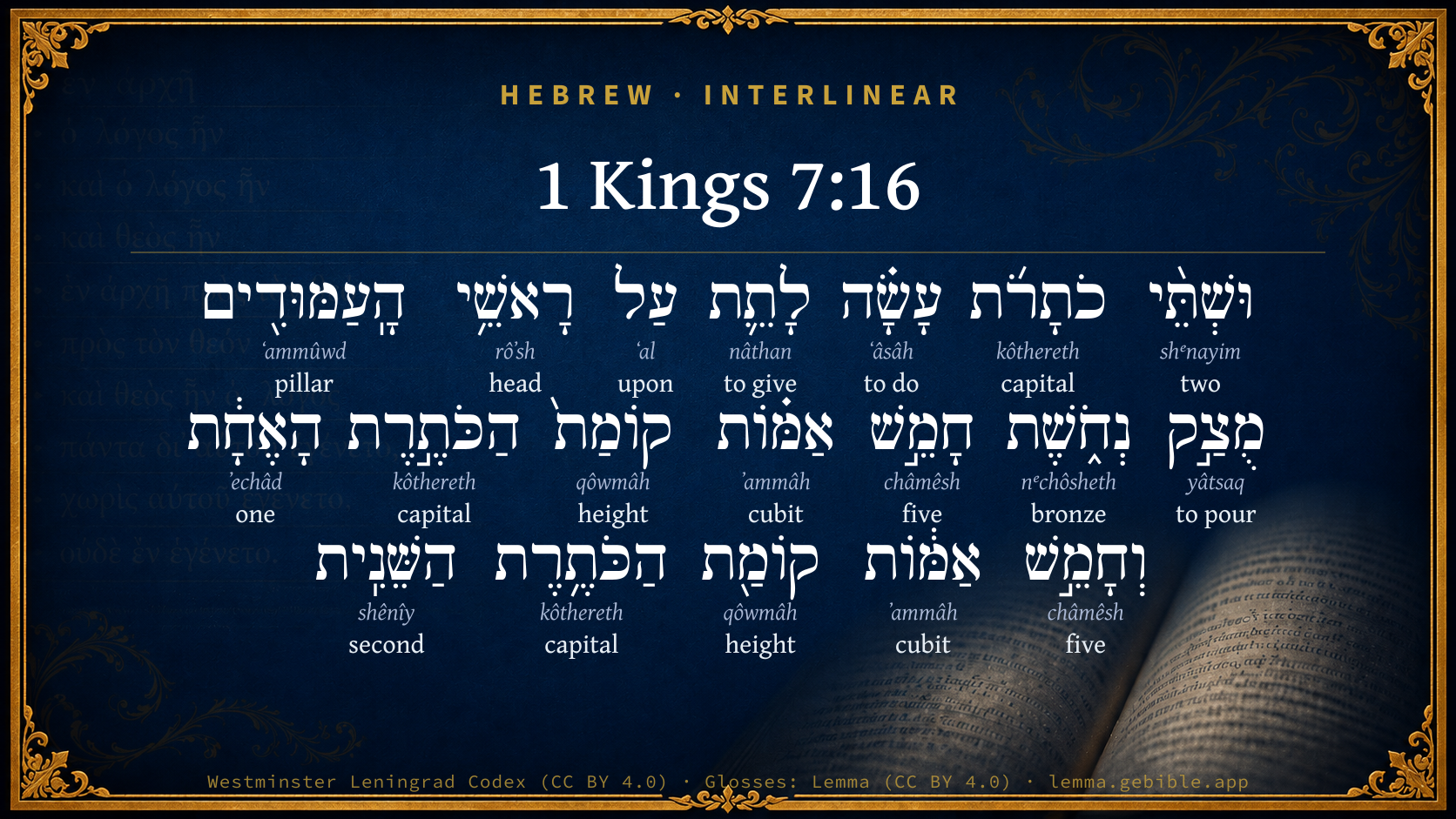
Hebrew (Westminster Leningrad Codex) 1 Kings 7:16 appears in the Hebrew Old Testament. The text above is from the Westminster Leningrad Codex. Each word links to its Strong’s number, a concise gloss, and parsing drawn from the Open Scriptures Hebrew Bible morphology. Click any word for its full Brown-Driver-Briggs (BDB) entry.
Download image
Cite this verse

1 Kings 7:16 (World English Bible). Public Domain. Lemma interlinear Bible study tool, https://lemma.gebible.app/v/1-kings/7/16.

Show BibTeX & RIS
BibTeX
RIS
English Translation
He made two capitals of molten brass, to set on the tops of the pillars: the height of the one capital was five cubits, and the height of the other capital was five cubits.
World English Bible · Public Domain
Highlights
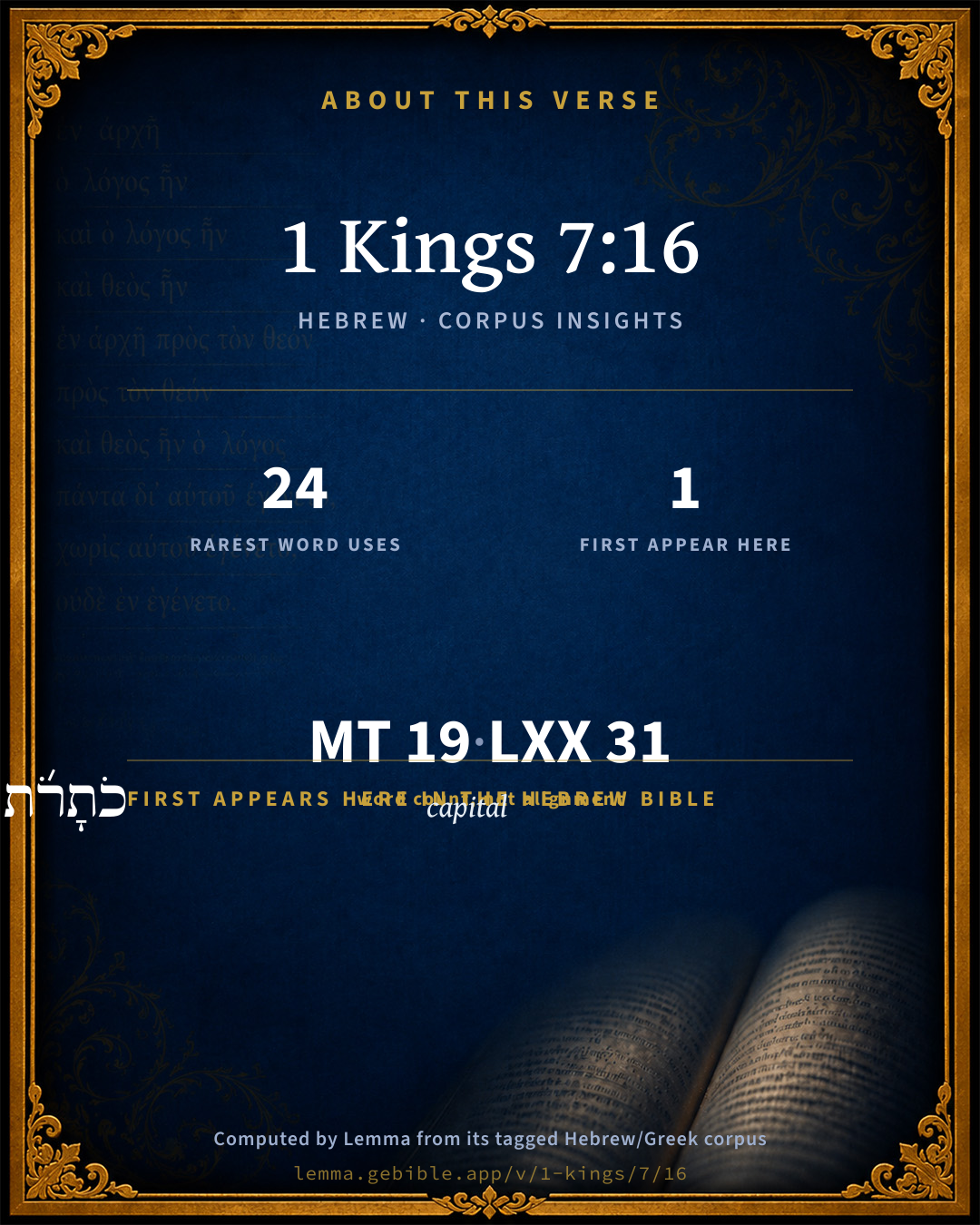
  • 1 first appearance in the Hebrew Bible
Full analysis ↓
Download a study sheet

One document with this verse’s original text, its word-by-word gloss line, the meaning frame, cross-references with their text, attributed commentary, and full source and license credits — printable, and it pastes into notes with its structure intact.

This verse Autodidact and up

Study sheet (.html) Plain text (.txt)

A passage Seminary Student

Up to 50 verses in one chapter. A passage sheet keeps up to 6 commentary sources and 12 cross-references per verse, in the order this page ranks them, and says so on the sheet whenever that leaves anything out. Ask for a single verse and you get the Autodidact verse sheet above.

Everything on this page stays free to read, with no account — the sheet is a download of what is already on screen, not access to it.

Want to remove ads? Support Godless Engineer
Compare translations 3

The same verse in 3 English versions, stacked beneath the original-language interlinear above. Click any original word for its lexicon entry.

Each is an independent rendering of the whole verse — the interlinear is not word-aligned to these translations.

Highlighted words mark where these versions differ — a whole-verse word diff, not a word-by-word alignment.

  • World English Bible Public Domain
    He made two capitals of molten brass, to set on the tops of the pillars: the height of the one capital was five cubits, and the height of the other capital was five cubits.
  • King James Version Public Domain
    And he made two chapiters of molten brass, to set upon the tops of the pillars: the height of the one chapiter was five cubits, and the height of the other chapiter was five cubits:
  • unfoldingWord Literal Text CC BY-SA 4.0
    And he made two capitals to put on the heads of the pillars, casting of bronze. Five cubits the height of one capital, and five cubits the height of the second capital.

unfoldingWord Literal Text — © unfoldingWord, licensed CC BY-SA 4.0. Word-aligned USFM3 via Door43 (git.door43.org/unfoldingWord/en_ult).

Versions to compare (up to 4)

3 of 4 selected

Show all 18 translations

Every available English version of this verse, each an independent rendering of the whole verse.

  • World English Bible Public Domain
    He made two capitals of molten brass, to set on the tops of the pillars: the height of the one capital was five cubits, and the height of the other capital was five cubits.
  • Berean Standard Bible Public Domain
    He also made two capitals of cast bronze to set on top of the pillars, each capital five cubits high.
  • Majority Standard Bible Public Domain
    He also made two capitals of cast bronze to set on top of the pillars, each capital five cubits high.
  • King James Version Public Domain
    And he made two chapiters of molten brass, to set upon the tops of the pillars: the height of the one chapiter was five cubits, and the height of the other chapiter was five cubits:
  • American Standard Version (1901) Public Domain
    And he made two capitals of molten brass, to set upon the tops of the pillars: the height of the one capital was five cubits, and the height of the other capital was five cubits.
  • Revised Version (1885) Public Domain
    And he made two chapiters of molten brass, to set upon the tops of the pillars: the height of the one chapiter was five cubits, and the height of the other chapiter was five cubits.
  • Geneva Bible (1599) Public Domain
    And he made two chapiters of molten brasse to set on the tops of the pillars: the height of one of the chapiters was fiue cubites, and the height of the other chapiter was fiue cubites.
  • Douay-Rheims (1899) Public Domain
    He made also two chapiters of molten brass, to be set upon the tops of the pillars: the height of one chapiter was five cubits, and the height of the other chapiter was five cubits:
  • Young's Literal Translation Public Domain
    And two chapiters he hath made to put on the tops of the pillars, cast in brass; five cubits the height of the one chapiter, and five cubits the height of the second chapiter.
  • Literal Standard Version CC BY-SA 4.0
    And he has made two chapiters to put on the tops of the pillars, cast in bronze; five cubits the height of the first capital, and five cubits the height of the second capital.
  • Unlocked Literal Bible CC BY-SA 4.0
    He made two capitals of polished bronze to set on the tops of the pillars. The height of each capital was five cubits.
  • unfoldingWord Literal Text CC BY-SA 4.0
    And he made two capitals to put on the heads of the pillars, casting of bronze. Five cubits the height of one capital, and five cubits the height of the second capital.
  • Darby Bible Public Domain
    And he made two capitals of molten brass, to set upon the tops of the pillars; the height of the one capital was five cubits, and the height of the other capital was five cubits;
  • World Messianic Bible Public Domain
    He made two capitals of molten bronze to set on the tops of the pillars. The height of the one capital was five cubits, and the height of the other capital was five cubits.
  • Webster's Bible Public Domain
    And he made two capitals of molten brass, to set upon the tops of the pillars: the hight of the one capital was five cubits, and the hight of the other capital was five cubits:
  • Free Bible Version CC BY-SA 4.0
    He also cast two capitals in bronze to place on top of the columns. Each capital was five cubits high.
  • Bible in Basic English Public Domain
    And he made the two crowns to be put on the tops of the pillars, of brass made soft in the fire; the crowns were five cubits high.
  • JPS Tanakh (1917) Public Domain
    And he made two capitals of molten brass, to set upon the tops of the pillars; the height of the one capital was five cubits, and the height of the other capital was five cubits.

Literal Standard Version (2020), Covenant Press — licensed CC BY-SA 4.0. Text via the HelloAO Bible API (eBible.org). Unlocked Literal Bible (unfoldingWord) — licensed CC BY-SA 4.0. Text via the HelloAO Bible API (eBible.org). unfoldingWord Literal Text — © unfoldingWord, licensed CC BY-SA 4.0. Word-aligned USFM3 via Door43 (git.door43.org/unfoldingWord/en_ult). Free Bible Version, Dr. Jonathan Gallagher — licensed CC BY-SA 4.0. Text via the HelloAO Bible API (eBible.org).

Word by word

More ways to search: Search by grammar → Find every occurrence → Compare this word →

Practice this passage: Drill this verse → Learn its vocabulary →

כֹתָרֹ֜ת
kôthereth
H3805
“capitals”
Noun, Common, Feminine, Plural, Absolute
Part of Speech
Noun
Type
Common
Gender
Feminine
Number
Plural
State
Absolute
Full BDB Definition

Origin: act. participle of H3803

TWOT: 1060c

capital crown, capital of a pillar
  1. וּשְׁתֵּ֨י shᵉnayim H8147 “and · two” Conjunction + Adjective, Cardinal number, Feminine, Dual, Construct
  2. עָשָׂ֗ה ʻâsâh H6213 “to do” Verb, Qal, Perfect, 3rd Person, Masculine, Singular
  3. לָתֵ֛ת nâthan H5414 “to give” Preposition + Verb, Qal, Infinitive Construct
  4. עַל ʻal H5921 “upon” Preposition
  5. רָאשֵׁ֥י rôʼsh H7218 “heads of” Noun, Common, Masculine, Plural, Construct
  6. הָֽעַמּוּדִ֖ים ʻammûwd H5982 “the · pillars” Particle, Definite Article + Noun, Common, Masculine, Plural, Absolute
  7. מֻצַ֣ק yâtsaq H3332 “poured” Verb, Hophal, Participle Passive, Masculine, Singular, Construct
  8. נְחֹ֑שֶׁת nᵉchôsheth H5178 “bronze” Noun, Common, Feminine, Singular, Absolute
  9. חָמֵ֣שׁ châmêsh H2568 “five” Adjective, Cardinal number, Feminine, Singular, Absolute
  10. אַמּ֗וֹת ʼammâh H520 “cubits” Noun, Common, Feminine, Plural, Absolute
  11. קוֹמַת֙ qôwmâh H6967 “height of” Noun, Common, Feminine, Singular, Construct
  12. הַכֹּתֶ֣רֶת kôthereth H3805 “the · capital” Particle, Definite Article + Noun, Common, Feminine, Singular, Absolute
  13. הָאֶחָ֔ת ʼechâd H259 “the · one” Particle, Definite Article + Adjective, Cardinal number, Feminine, Singular, Absolute
  14. וְחָמֵ֣שׁ châmêsh H2568 “and · five” Conjunction + Adjective, Cardinal number, Feminine, Singular, Absolute
  15. אַמּ֔וֹת ʼammâh H520 “cubits” Noun, Common, Feminine, Plural, Absolute
  16. קוֹמַ֖ת qôwmâh H6967 “height of” Noun, Common, Feminine, Singular, Construct
  17. הַכֹּתֶ֥רֶת kôthereth H3805 “the · capital” Particle, Definite Article + Noun, Common, Feminine, Singular, Absolute
  18. הַשֵּׁנִֽית shênîy H8145 “the · second” Particle, Definite Article + Adjective, Ordinal number, Feminine, Singular, Absolute

About this verse

These counts appear in no published source. They are computed here, from the morphology-tagged text and Lemma’s own curated glosses. What Lemma adds →

19
words
14
distinct lemmas
Historical
section

Notable vocabulary

The rarest word here is כֹתָרֹ֜ת capital H3805 — appearing just 24 times in the whole Hebrew Bible.

First appearance in Scripture

This word makes its first canonical appearance in the Hebrew Bible here:

  • כֹתָרֹ֜ת capital H3805

Shared distinctive vocabulary

כֹתָרֹ֜ת capital H3805 occurs in 12 verses of the Hebrew Bible. Also found in:

Grammatical profile

  • 3 verbs
  • 10 nouns
  • 5 adjectives
  • 1 preposition

Verb forms

  • עָשָׂ֗ה Qal · Perfect
  • לָתֵ֛ת Qal · Infinitive Construct
  • מֻצַ֣ק Hophal · Participle Passive

Repetition

Words recur within this verse — often emphatic in Hebrew:

  • כֹתָרֹ֜ת capital H3805 ×3
  • חָמֵ֣שׁ five H2568 ×2
  • אַמּ֗וֹת cubit H520 ×2
  • קוֹמַת֙ height H6967 ×2

Hebrew & Septuagint length

In English translation the verse runs 34 words from the Hebrew and 32 from the Septuagint (LXX English) — closely comparable.

A rough comparison of the two English renderings, which tokenize alike — not a word-level alignment.

Word counts can differ between the Hebrew and the Greek without any difference in meaning — e.g. the Hebrew direct-object marker אֵת has no separate Greek word, and Greek often adds the article ὁ.

In the original languages it is 19 Hebrew tokens and 31 Greek tokens — but the two are counted differently (Hebrew bundles its prefixes and suffixes into one token; the Greek is in lemma form), so that isn’t a like-for-like length.

Cross-references

5

Topical passages linked to 1 Kings 7:16 in the Treasury of Scripture Knowledge — connected by theme and wording, ordered by reader-vote popularity; previews shown in the World English Bible.

  • Exodus 36:38 and the five pillars of it with their hooks. He overlaid their capitals and their fillets with gold, and their five sockets were of brass.
  • Exodus 38:17 The sockets for the pillars were of brass. The hooks of the pillars and their fillets were of silver; and the overlaying of their capitals, of silver; and all the pillars of the court were filleted with silver.
  • Exodus 38:19 Their pillars were four, and their sockets four, of brass; their hooks of silver, and the overlaying of their capitals, and their fillets, of silver.
  • Exodus 38:28 Of the one thousand seven hundred seventy-five shekels he made hooks for the pillars, overlaid their capitals, and made fillets for them.
  • 2 Chronicles 4:12–13 the two pillars, and the bowls, and the two capitals which were on the top of the pillars, and the two networks to cover the two bowls of the capitals that were on the top of the pillars,

Cross-references courtesy of OpenBible.info (CC BY 4.0).

Hebrew and Greek witnesses Masoretic Hebrew ↔ Greek Septuagint

The same verse in the two great witnesses to the Old Testament, shown verse-for-verse.

These are two independent witnesses, not word-aligned to each other, and the Septuagint is shown in lemma (dictionary) form.

Hebrew 1 Kings 7:16 Masoretic · Westminster Leningrad Codex

וּשְׁתֵּ֨י כֹתָרֹ֜ת עָשָׂ֗ה לָתֵ֛ת עַל רָאשֵׁ֥י הָֽעַמּוּדִ֖ים מֻצַ֣ק נְחֹ֑שֶׁת חָמֵ֣שׁ אַמּ֗וֹת קוֹמַת֙ הַכֹּתֶ֣רֶת הָאֶחָ֔ת וְחָמֵ֣שׁ אַמּ֔וֹת קוֹמַ֖ת הַכֹּתֶ֥רֶת הַשֵּׁנִֽית

He made two capitals of molten brass, to set on the tops of the pillars: the height of the one capital was five cubits, and the height of the other capital was five cubits.

World English Bible · Public Domain

Greek LXX 1 Kings 7:16 Septuagint · lemma form

καί ἐπί ὁ σύγκλεισμα αὐτός ἀνά μέσος ὁ ἐκἔχω λέων καί βοῦς καί χερουβιν καί ἐπί ὁ ἐκἔχω οὕτως καί ἐπάνωθεν καί ὑποκάτωθεν ὁ λέων καί ὁ βοῦς χώρα ἔργον καταβάσις

And he made two molten capitals to put on the heads of the pillars: five cubits was the height of one chapiter, and five cubits was the height of the other chapiter.

LXX2012 (modern English Septuagint) · Public Domain

Hebrew: Westminster Leningrad Codex (CC BY 4.0). Greek: Septuagint (public domain); English from LXX2012 (modern English Septuagint) (Public Domain). How the Septuagint differs from the Hebrew →

Targum (Aramaic paraphrase)

1

The Targum is the ancient Jewish Aramaic paraphrase of the Hebrew Scriptures — an interpretive translation, not the Hebrew text itself. Onkelos (literal) and Pseudo-Jonathan (expansive) render the Torah, and Jonathan the Prophets. Coverage is partial: where no permissively-licensed English translation exists for a verse, only the Aramaic is shown. This is verse-level text, not a word-by-word alignment to the Hebrew.

  1. Targum Jonathan Prophets (Joshua–Malachi)
    וְתַרְתֵּין קְרוֹנְתְּוָן עֲבַד לְמִתַן עַל רֵישׁ עַמוּדַיָא מַתַּךְ נְחָשָׁא חֲמֵשׁ אַמִין רוּמָהּ דִקְרוֹנְתָּא חֲדָא וַחֲמֵשׁ אַמִין רוּמָהּ דִקְרוֹנְתָּא תִנְיֵתָא:

    (no public-domain English translation for this verse)

    Targum Jonathan — Aramaic: “Mikraot Gedolot” (public domain). English: “Sefaria Community Translation” (CC0 1.0 (public-domain dedication)); “London "Chaldee Paraphrase," 1871” (public domain). Text via Sefaria.

Commentary

Notes on 1 Kings 7:16 from classic Christian and Jewish commentators (each source and its license shown beneath its notes). The classic Christian expositions comment on the surrounding passage and are grouped to its opening verse, so a note may address several verses; the Jewish commentaries on the Tanakh (Rashi and others) are per-verse, so they appear only where the commentator wrote on this verse.

Lemma curates 59 commentaries, every one of them public domain or Creative Commons licensed, each selected and text-cleaned for this edition rather than reprinted as found. About our sources →

Trapp's Complete Commentary

John Trapp

1Ki 7:16 And he made two chapiters [of] molten brass, to set upon the tops of the pillars: the height of the one chapiter [was] five cubits, and the height of the other chapiter [was] five cubits:

Ver. 16. To set upon the tops of the pillars.] Hence they were called chapiters, or heads, coronamenta, epistylia; crowns they are called. {Jer 52:22}

John Trapp, A Commentary or Exposition upon All the Books of the Old and New Testament (1647–1656) — public domain. Text from a community e-Sword module.

Geneva Bible (1599)

Geneva Bible translators

Or, pommels.

Geneva Bible (1599) marginal notes — public domain. Text via Bolls.life.

John Gill's Exposition

And nets of checker work, and wreaths of chain work, for the chapiters which were upon the top of the pillars,.... These were the ornaments of the chapiters; the former being like thick branches of trees, with their boughs and leaves curiously wrought, as the word signifies, and the latter like fringes, such as the Jews wore at the skirt of their garments:

seven for the one chapiter, and seven for the other chapiter; perhaps with four rows of checker work, and three of chain work.

John Gill's Exposition of the Whole Bible (1746–1763) — public domain (CC PDM 1.0). Text via the HelloAO Bible API.

Albert Barnes' Notes on the Bible

The general character of the “chapiters” or capitals, their great size in proportion to the shaft, which is as one to two, and their construction of two quite different members, remind us of the pillars used by the Persians in their palaces, which were certainly more like Jachin and Boaz than any pillars that have reached us from antiquity. The ornamentation, however, seems to have been far more elaborate than that of the Persian capitals.

Albert Barnes' Notes on the Bible (1834–1885) — public domain. Text from a community e-Sword/MySword module.

Haydock's Catholic Bible Commentary

Five. Comprising all the ornaments. The body was only three cubits, 4 Kings xxv. 17. If we include the circles, which joined it to the pillar, it would be four; ver. 19, and with the rose, and ornaments at the top, five cubits high. Atheneus distinguishes three parts in the Egyptian chapiters; (1) next to the pillar, was seen a circle or wreath of flowers; (2) the stalk, out of which proceeded (3) a rose beginning to open. (Calmet) --- In the passages, which seem to contradict this text, the omission of the cornice or architrave, may cause the difference. (Menochius)

George Leo Haydock (1774–1849), Haydock's Catholic Family Bible and Commentary, 1859 edition — public domain. Excludes Psalms (Douay-Rheims chapter numbering differs from Protestant) and Deuterocanonical books (Catholic canon only).

Matthew Poole's English Annotations

The height of the one chapiter was five cubits.

Object. It is but three cubits in 2Ki 25:17.

Answ. The word chapiter is taken diversely, as hundreds of other words are; either more largely for the whole, so it is five cubits; or more strictly, either for the pommels, as they are called, 2Ch 4:12, or for the cornice or crown; and so it was but three cubits, to which the pomegranates being added make it four cubits, as it is below, 1Ki 7:19; and the other work upon it took up one cubit more, which in all made five cubits.

Matthew Poole's English Annotations on the Holy Bible (1683–1685) — public domain. Text from a community e-Sword/MySword module.

Whedon's Commentary on the Bible

Daniel D. Whedon

16. Two chapiters — Or capitals.

Molten brass — Brass melted, so as to be cast into the forms desired. The brass, of which these pillars, the brazen sea, and other vessels were made, had been captured by David from the cities of Hadarezer. 1Ch_18:8.

Daniel D. Whedon (gen. ed.), Commentary on the Old and New Testaments (1874–1909) — public domain. Text from a community e-Sword module.

The Pulpit Commentary

And he made two chapiters or capitals of molten Heb. poured brass, to put upon the tops Heb. heads of the pillars: the height of the one chapiter was five cubits, and the height of the other chapiter was five cubits In 2Ki_25:17 the height is given as three cubits; but this is obviously a clerical error. See 2Ch_3:15; Jer_52:22. A much more important question is whether the chapiter (trtKo) same word, akin to rtK crown of four cubits mentioned in ver. 19 is to be understood as a part of this chapiter, or something additional and superposed, the entablature, e.g. The former appears the more probable. See note on ver. 19. But it is not a fatal objection to the latter view that it would make the entire chapiter, or both members, nine cubits high; no less, that is, than one-half the length of the shaft. No doubt to modern ideas this appears wholly disproportionate; but a double chapiter, bearing the same proportion to the shaft, is found in some of the buildings of Persepolis (Fergusson,. Dict. Bib. 3. p. 1457). From the expression of vers. 41, 42, "the bowls of the chapiters" (cf. 2Ch_4:12, 2Ch_4:13; Jer_52:23) and the word "belly" (fB) in ver. 20, we gather that the chapiters were bowl shaped, or bellied out something like the so called "cushion capital" in Norman architecture.

The Pulpit Commentary (1880–1919), ed. H.D.M. Spence-Jones & Joseph S. Exell — public domain. Text from a community e-Sword module.

John Wesley's Explanatory Notes

Five cubits - The word chapiter is taken either more largely for the whole, so it is five cubits; Or, more strictly, either for the pommels, as they are called, 2 Chron. iv, 12, or for the cornice or crown, and so it was but three cubits, to which the pomegranates being added make it four cubits, as it is below, ver. 19, and the other work upon it took up one cubit more, which in all made five cubits.

John Wesley, Explanatory Notes Upon the Whole Bible (1754–1765) — public domain. Text via the GEBible commentary corpus.

Rashi

Rabbi Shlomo Yitzchaki (Rashi)

Two crown shapes. Pomels, in O. F.

Cast. Tresjited, in O.F.

One crown was five amohs high. And at the end of the book it states, “three amohs.” We learned in the Mishnah of “Forty-nine Measurements,” that the two lower amohs of the crowns were similar to the column because there were no designs in them, and the three upper [amohs] that extended beyond, were surrounded with designs, as it is stated, “branches designed like net [mesh] work,” by the likes of the branches of a palm tree they were surrounded But I say, that the two lower amohs were not counted at the end of the book [of Melachim] because they were similar to the column and the column were inserted into the crown two amohs.

Rashi on the Tanakh — English translations: “The Judaica Press complete Tanach with Rashi, translated by A. J. Rosenberg” (CC BY 4.0); “Pentateuch with Rashi's commentary by M. Rosenbaum and A.M. Silbermann, 1929-1934” (public domain); “The Metsudah Tanach series, Lakewood, N.J” (CC BY 4.0); and “The Book of Joshua, Metsudah Publications, 1997” (CC BY 4.0). Text via Sefaria.

Lesson kit

Teaching starters — assembled from the data on this page, not authored interpretation. Every prompt links to the verse data it draws on. Edit before teaching.

1 Kings, in the Historical, opens this verse with 19 words (14 distinct Hebrew lemmas). Its most distinctive word is kôthereth (“capital”). A historical commentator’s framing appears above. Read the whole chapter for the surrounding context.

Discussion questions

  1. How does “capital” (kôthereth) shape what this verse is saying?
  2. This is the first place “capital” appears in Scripture (first appears here). What does its debut here establish?
  3. How does 1 Kings 7:17, which shares the word «capital», read alongside this verse?
  4. What does the repetition of “capital” (3× in this one verse) do in this verse?
  5. The translations on this page render this verse differently — a whole-verse word diff, not a word-by-word alignment. What might account for the different wordings?
  6. «עָשָׂ֗ה» is a Qal Perfect verb. How does that grammatical form shape the action described?
  7. Compare how Trapp's Complete Commentary and Geneva Bible (1599) read this verse. Where do they agree or differ?

Things to notice

Reading settings

Reading text

Shown beneath each verse's original-language words.

Old Testament
Old Testament edition

Read the OT as the Masoretic Hebrew (MT) or the Greek Septuagint (LXX).

English shown for the Greek Septuagint (in the Hebrew ↔ Greek comparison).

Comparing translations? Open the Compare panel on any verse page to stack up to four side by side.