

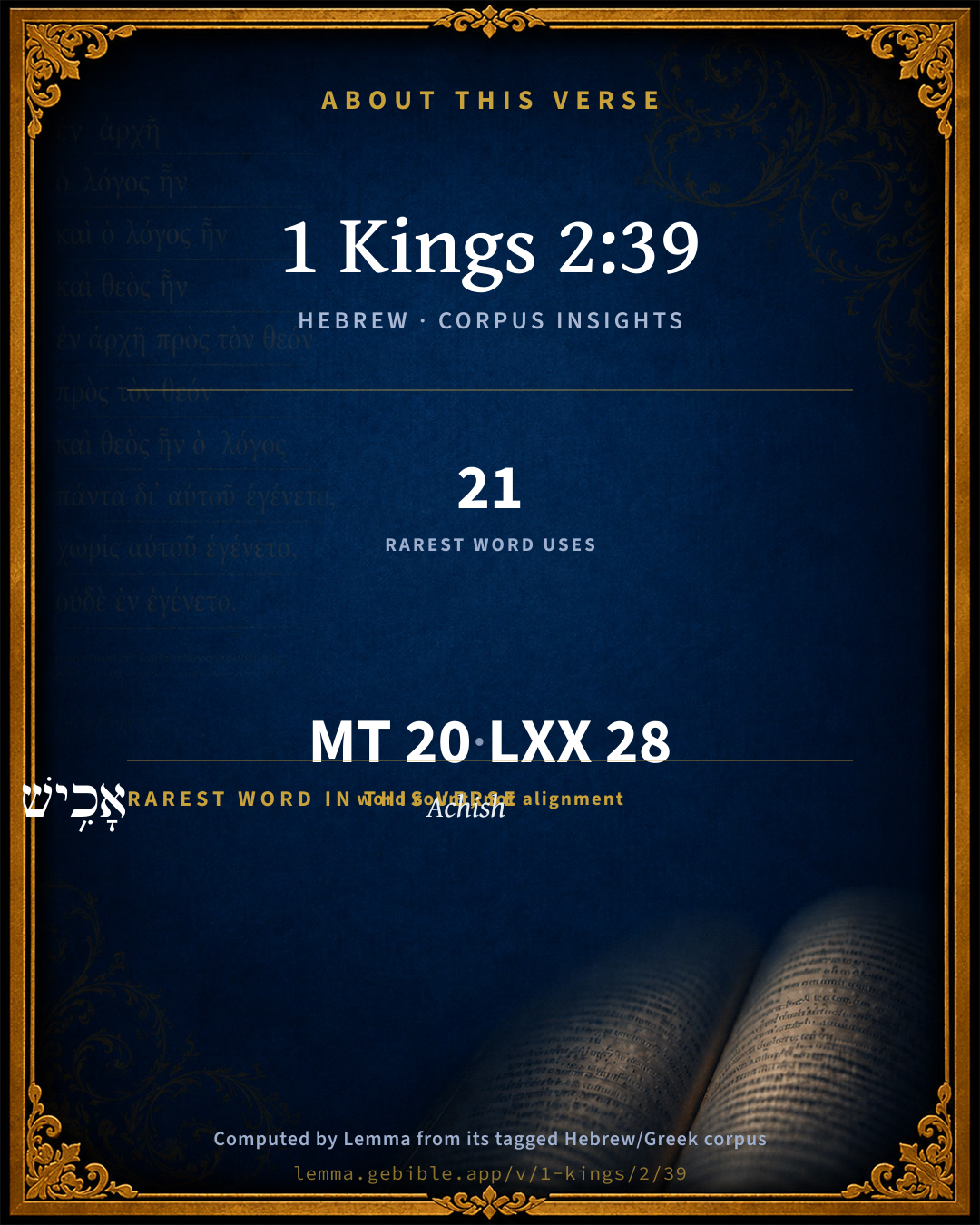
1 Kings 2:39

Hebrew (Westminster Leningrad Codex) 1 Kings 2:39 appears in the Hebrew Old Testament. The text above is from the Westminster Leningrad Codex. Each word links to its Strong’s number, a concise gloss, and parsing drawn from the Open Scriptures Hebrew Bible morphology. Click any word for its full Brown-Driver-Briggs (BDB) entry.
Download image
Cite this verse

1 Kings 2:39 (World English Bible). Public Domain. Lemma interlinear Bible study tool, https://lemma.gebible.app/v/1-kings/2/39.

Show BibTeX & RIS
BibTeX
RIS
English Translation
It happened at the end of three years, that two of the servants of Shimei ran away to Achish, son of Maacah, king of Gath. They told Shimei, saying, Behold, your servants are in Gath.
World English Bible · Public Domain
Download a study sheet

One document with this verse’s original text, its word-by-word gloss line, the meaning frame, cross-references with their text, attributed commentary, and full source and license credits — printable, and it pastes into notes with its structure intact.

This verse Autodidact and up

Study sheet (.html) Plain text (.txt)

A passage Seminary Student

Up to 50 verses in one chapter. A passage sheet keeps up to 6 commentary sources and 12 cross-references per verse, in the order this page ranks them, and says so on the sheet whenever that leaves anything out. Ask for a single verse and you get the Autodidact verse sheet above.

Everything on this page stays free to read, with no account — the sheet is a download of what is already on screen, not access to it.

Want to remove ads? Support Godless Engineer
Compare translations 3

The same verse in 3 English versions, stacked beneath the original-language interlinear above. Click any original word for its lexicon entry.

Each is an independent rendering of the whole verse — the interlinear is not word-aligned to these translations.

Highlighted words mark where these versions differ — a whole-verse word diff, not a word-by-word alignment.

  • World English Bible Public Domain
    It happened at the end of three years, that two of the servants of Shimei ran away to Achish, son of Maacah, king of Gath. They told Shimei, saying, Behold, your servants are in Gath.
  • King James Version Public Domain
    And it came to pass at the end of three years, that two of the servants of Shimei ran away unto Achish son of Maachah king of Gath. And they told Shimei, saying, Behold, thy servants be in Gath.
  • unfoldingWord Literal Text CC BY-SA 4.0
    And it happened at the end of three years that two of the slaves of Shimei fled to Achish, the son of Maacah, the king of Gath. And they declared to Shimei, saying, “Behold, your slaves in Gath.”

unfoldingWord Literal Text — © unfoldingWord, licensed CC BY-SA 4.0. Word-aligned USFM3 via Door43 (git.door43.org/unfoldingWord/en_ult).

Versions to compare (up to 4)

3 of 4 selected

Show all 18 translations

Every available English version of this verse, each an independent rendering of the whole verse.

  • World English Bible Public Domain
    It happened at the end of three years, that two of the servants of Shimei ran away to Achish, son of Maacah, king of Gath. They told Shimei, saying, Behold, your servants are in Gath.
  • Berean Standard Bible Public Domain
    After three years, however, two of Shimei’s slaves ran away to Achish son of Maacah, king of Gath. And Shimei was told, “Look, your slaves are in Gath.”
  • Majority Standard Bible Public Domain
    After three years, however, two of Shimei’s slaves ran away to Achish son of Maacah, king of Gath. And Shimei was told, “Look, your slaves are in Gath.”
  • King James Version Public Domain
    And it came to pass at the end of three years, that two of the servants of Shimei ran away unto Achish son of Maachah king of Gath. And they told Shimei, saying, Behold, thy servants be in Gath.
  • American Standard Version (1901) Public Domain
    And it came to pass at the end of three years, that two of the servants of Shimei ran away unto Achish, son of Maacah, king of Gath. And they told Shimei, saying, Behold, thy servants are in Gath.
  • Revised Version (1885) Public Domain
    And it came to pass at the end of three years, that two of the servants of Shimei ran away unto Achish, son of Maacah, king of Gath. And they told Shimei, saying; Behold, thy servants be in Gath.
  • Geneva Bible (1599) Public Domain
    And after three yeres two of the seruants of Shimei fled away vnto Achish sonne of Maachah King of Gath: and they tolde Shimei, saying, Behold, thy seruants be in Gath.
  • Douay-Rheims (1899) Public Domain
    And it came to pass after three years, that the servants of Semei ran away to Achis the son of Maacha the king of Geth: and it was told Semei that his servants were gone to Geth.
  • Young's Literal Translation Public Domain
    And it cometh to pass, at the end of three years, that flee do two of the servants of Shimei unto Achish son of Maachah, king of Gath, and they declare to Shimei, saying, `Lo, thy servants `are' in Gath;'
  • Literal Standard Version CC BY-SA 4.0
    And it comes to pass, at the end of three years, that two of the servants of Shimei flee to Achish son of Maachah, king of Gath, and they declare to Shimei, saying, “Behold, your servants [are] in Gath”;
  • Unlocked Literal Bible CC BY-SA 4.0
    But at the end of three years, two of the servants of Shimei ran away to Achish son of Maacah, the king of Gath. So they told Shimei, saying, “See, your servants are in Gath.”
  • unfoldingWord Literal Text CC BY-SA 4.0
    And it happened at the end of three years that two of the slaves of Shimei fled to Achish, the son of Maacah, the king of Gath. And they declared to Shimei, saying, “Behold, your slaves in Gath.”
  • Darby Bible Public Domain
    And it came to pass at the end of three years, that two servants of Shimei's ran away to Achish son of Maachah, king of Gath. And they told Shimei saying, Behold, thy servants are in Gath.
  • World Messianic Bible Public Domain
    At the end of three years, two of Shimei’s slaves ran away to Achish, son of Maacah, king of Gath. They told Shimei, saying, “Behold, your slaves are in Gath.”
  • Webster's Bible Public Domain
    And it came to pass at the end of three years, that two of the servants of Shimei ran away to Achish son of Maachah king of Gath: and they told Shimei, saying, behold, thy servants are in Gath.
  • Free Bible Version CC BY-SA 4.0
    But three years later, two of Shimei's slaves escaped to Achish, son of Maacah, king of Gath. Shimei was told, “Look, your slaves are in Gath.”
  • Bible in Basic English Public Domain
    But after three years, two of the servants of Shimei went in flight to Achish, son of Maacah, king of Gath. And word was given to Shimei that his servants had gone to Gath.
  • JPS Tanakh (1917) Public Domain
    And it came to pass at the end of three years, that two of the servants of Shimei ran away unto Achish, son of Maacah, king of Gath. And they told Shimei, saying: 'Behold, thy servants are in Gath.'

Literal Standard Version (2020), Covenant Press — licensed CC BY-SA 4.0. Text via the HelloAO Bible API (eBible.org). Unlocked Literal Bible (unfoldingWord) — licensed CC BY-SA 4.0. Text via the HelloAO Bible API (eBible.org). unfoldingWord Literal Text — © unfoldingWord, licensed CC BY-SA 4.0. Word-aligned USFM3 via Door43 (git.door43.org/unfoldingWord/en_ult). Free Bible Version, Dr. Jonathan Gallagher — licensed CC BY-SA 4.0. Text via the HelloAO Bible API (eBible.org).

Word by word

More ways to search: Search by grammar → Find every occurrence → Compare this word →

Practice this passage: Drill this verse → Learn its vocabulary →

אָכִ֥ישׁ
ʼĂkîysh
H397
“Achish”
Noun, Proper
Part of Speech
Noun
Type
Proper
Full BDB Definition

Origin: of uncertain derivation

TWOT: None

Achish = "I will blacken (or terrify)" or " only a man" - Philistine king of Gath
  1. וַיְהִ֗י hâyâh H1961 “and · to be” Conjunction + Verb, Qal, Sequential Imperfect, 3rd Person, Masculine, Singular
  2. מִקֵּץ֙ qêts H7093 “from · end of” Preposition + Noun, Common, Masculine, Singular, Construct
  3. שָׁלֹ֣שׁ shâlôwsh H7969 “three” Adjective, Cardinal number, Feminine, Singular, Absolute
  4. שָׁנִ֔ים shâneh H8141 “years” Noun, Common, Feminine, Plural, Absolute
  5. וַיִּבְרְח֤וּ bârach H1272 “and · to flee” Conjunction + Verb, Qal, Sequential Imperfect, 3rd Person, Masculine, Plural
  6. שְׁנֵֽי shᵉnayim H8147 “two” Adjective, Cardinal number, Masculine, Dual, Construct
  7. עֲבָדִים֙ ʻebed H5650 “servants” Noun, Common, Masculine, Plural, Absolute
  8. לְשִׁמְעִ֔י Shimʻîy H8096 “to/for · Shimei” Preposition + Noun, Proper
  9. אֶל ʼêl H413 “to” Preposition
  10. בֶּֽן bên H1121 “son of” Noun, Common, Masculine, Singular, Construct
  11. מַעֲכָ֖ה Maʻăkâh H4601 “Maachathites” Noun, Proper
  12. מֶ֣לֶךְ melek H4428 “king of” Noun, Common, Masculine, Singular, Construct
  13. גַּ֑ת Gath H1661 “Gath” Noun, Proper
  14. וַיַּגִּ֤ידוּ nâgad H5046 “and · to make known” Conjunction + Verb, Hiphil, Sequential Imperfect, 3rd Person, Masculine, Plural
  15. לְשִׁמְעִי֙ Shimʻîy H8096 “to/for · Shimei” Preposition + Noun, Proper
  16. לֵאמֹ֔ר ʼâmar H559 “to say” Preposition + Verb, Qal, Infinitive Construct
  17. הִנֵּ֥ה hinnêh H2009 “behold” Particle, Demonstrative
  18. עֲבָדֶ֖יךָ ʻebed H5650 “servants · your” Noun, Common, Masculine, Plural, Construct + Suffix, Personal, 2nd Person, Masculine, Singular
  19. בְּגַֽת Gath H1661 “in/at · Gath” Preposition + Noun, Proper

About this verse

These counts appear in no published source. They are computed here, from the morphology-tagged text and Lemma’s own curated glosses. What Lemma adds →

20
words
17
distinct lemmas
Historical
section

Notable vocabulary

The rarest word here is אָכִ֥ישׁ Achish H397 — appearing just 21 times in the whole Hebrew Bible.

Shared distinctive vocabulary

אָכִ֥ישׁ Achish H397 occurs in 20 verses of the Hebrew Bible. Also found in:

Grammatical profile

  • 4 verbs
  • 12 nouns
  • 2 adjectives
  • 1 preposition
  • 1 particle

Verb forms

  • וַיְהִ֗י Qal · Sequential Imperfect
  • וַיִּבְרְח֤וּ Qal · Sequential Imperfect
  • וַיַּגִּ֤ידוּ Hiphil · Sequential Imperfect
  • לֵאמֹ֔ר Qal · Infinitive Construct

Repetition

Words recur within this verse — often emphatic in Hebrew:

  • עֲבָדִים֙ servant H5650 ×2
  • לְשִׁמְעִ֔י Shimei H8096 ×2
  • גַּ֑ת Gath H1661 ×2

Hebrew & Septuagint length

In the original languages it is 20 Hebrew tokens and 28 Greek tokens — but the two are counted differently (Hebrew bundles its prefixes and suffixes into one token; the Greek is in lemma form), so that isn’t a like-for-like length.

Cross-references

2

Topical passages linked to 1 Kings 2:39 in the Treasury of Scripture Knowledge — connected by theme and wording, ordered by reader-vote popularity; previews shown in the World English Bible.

  • 1 Samuel 21:10 David arose, and fled that day for fear of Saul, and went to Achish the king of Gath.
  • 1 Samuel 27:2–3 David arose, and passed over, he and the six hundred men who were with him, to Achish the son of Maoch, king of Gath.

Cross-references courtesy of OpenBible.info (CC BY 4.0).

Hebrew and Greek witnesses Masoretic Hebrew ↔ Greek Septuagint

The same verse in the two great witnesses to the Old Testament, shown verse-for-verse.

These are two independent witnesses, not word-aligned to each other, and the Septuagint is shown in lemma (dictionary) form.

Hebrew 1 Kings 2:39 Masoretic · Westminster Leningrad Codex

וַיְהִ֗י מִקֵּץ֙ שָׁלֹ֣שׁ שָׁנִ֔ים וַיִּבְרְח֤וּ שְׁנֵֽי עֲבָדִים֙ לְשִׁמְעִ֔י אֶל אָכִ֥ישׁ בֶּֽן מַעֲכָ֖ה מֶ֣לֶךְ גַּ֑ת וַיַּגִּ֤ידוּ לְשִׁמְעִי֙ לֵאמֹ֔ר הִנֵּ֥ה עֲבָדֶ֖יךָ בְּגַֽת

It happened at the end of three years, that two of the servants of Shimei ran away to Achish, son of Maacah, king of Gath. They told Shimei, saying, Behold, your servants are in Gath.

World English Bible · Public Domain

Greek LXX 1 Kings 2:39 Septuagint · lemma form

καί γίγνομαι μετά τρεῖς ἔτος καί ἀποδιδράσκω δύο δοῦλος ὁ σεμεϊ πρός αγχους υἱός μααχα βασιλεύς γεθ καί ἀποἀγγέλλω ὁ σεμεϊ λέγω ἰδού ὁ δοῦλος σύ ἐν γεθ

No English rendering of this Greek verse — the small residue in the structurally divergent books.

On this verse, Haydock's Catholic Bible Commentary discusses the Septuagint’s reading. Read the note in Commentary ↓

Hebrew: Westminster Leningrad Codex (CC BY 4.0). Greek: Septuagint (public domain); English from a public-domain English Septuagint. How the Septuagint differs from the Hebrew →

Targum (Aramaic paraphrase)

1

The Targum is the ancient Jewish Aramaic paraphrase of the Hebrew Scriptures — an interpretive translation, not the Hebrew text itself. Onkelos (literal) and Pseudo-Jonathan (expansive) render the Torah, and Jonathan the Prophets. Coverage is partial: where no permissively-licensed English translation exists for a verse, only the Aramaic is shown. This is verse-level text, not a word-by-word alignment to the Hebrew.

  1. Targum Jonathan Prophets (Joshua–Malachi)
    וַהֲוָה מִסּוֹף תְּלַת שְׁנִין וְעָרָקוּ תְּרֵין עַבְדִין לְשִׁמְעִי לְוַת אָכִישׁ בַּר מַעֲכָה מַלְכָּא דְגַת וְחַוִיאוּ לְשִׁמְעִי לְמֵימָר הָא עַבְדָךְ בְּגַת:

    (no public-domain English translation for this verse)

    Targum Jonathan — Aramaic: “Mikraot Gedolot” (public domain). English: “Sefaria Community Translation” (CC0 1.0 (public-domain dedication)); “London "Chaldee Paraphrase," 1871” (public domain). Text via Sefaria.

Commentary

Notes on 1 Kings 2:39 from classic Christian and Jewish commentators (each source and its license shown beneath its notes). The classic Christian expositions comment on the surrounding passage and are grouped to its opening verse, so a note may address several verses; the Jewish commentaries on the Tanakh (Rashi and others) are per-verse, so they appear only where the commentator wrote on this verse.

Lemma curates 59 commentaries, every one of them public domain or Creative Commons licensed, each selected and text-cleaned for this edition rather than reprinted as found. About our sources →

Trapp's Complete Commentary

John Trapp

1Ki 2:39 And it came to pass at the end of three years, that two of the servants of Shimei ran away unto Achish son of Maachah king of Gath. And they told Shimei, saying, Behold, thy servants [be] in Gath.

Ver. 39. At the end of three years.] When he might haply hope that Solomon had forgotten him, or did not at least so strictly look to him. God had an overruling hand in it, to bring Shimei to condign punishment.

And they told Shimei.] Either for good or evil will; so shall a man sooner or later hear of his faults either by his friends or his foes: and malice though an ill judge, may be a good informer.

John Trapp, A Commentary or Exposition upon All the Books of the Old and New Testament (1647–1656) — public domain. Text from a community e-Sword module.

Joseph Benson's Commentary

1Ki 2:39-40. Achish king of Gath — A king, but subject and tributary, first to David, and then to Solomon: permitted to enjoy the title and honour of a king, but not the full power: whence it was, that Achish could not keep these servants, though they had fled to him for protection; but suffered Shimei to take them away from his royal city. Shimei arose and went to Gath to seek his servants — In three years’ time he thought Solomon might have forgotten his injunction, or he presumed he would not hold him strictly to it, especially since he did not go from Jerusalem for his pleasure, but to recover what he had lost, which he thought was pardonable, these servants being probably worth a great deal of money. “By seeking his servants,” says Bishop Hall, “he lost himself. These earthly things either are, or should be, our servants. How commonly do we see men run out of the bounds set by God’s laws, to hunt after them, till their souls incur a fearful judgment!”

Joseph Benson's Commentary on the Old and New Testaments (1811–1818) — public domain. Text from a community e-Sword module.

Tyndale Open Study Notes

Tyndale Open Resources

2:39-46 Shimei’s journey to Gath, ostensibly to recover his runaway slaves, violated his agreement. Technically, he did not cross the Kidron Valley in going to Gath, but the penalty was understood by both parties to apply to Shimei’s going anywhere else. Because Shimei violated his oath to the Lord (2:43) and because of his past hostilities toward David (2 Sam 16:5-13; 19:16-23), Solomon instructed Benaiah to execute him.

Tyndale Open Study Notes — © Tyndale Open Resources, licensed CC BY-SA 4.0. Text via the HelloAO Bible API.

Geneva Bible (1599)

Geneva Bible translators

Thus God appointeth the ways and means to bring his just judgments upon the wicked.

Geneva Bible (1599) marginal notes — public domain. Text via Bolls.life.

Ellicott's Commentary for English Readers

(39) Achish son of Maachah.—In 1Sa_27:2 we read of Achish son of Maoch, king of Gath; but chronology makes it most unlikely that the same person should here be referred to. The name may have been hereditary.

A Bible Commentary for English Readers, edited by Charles John Ellicott (1878–1897) — public domain. Text from a community e-Sword module.

The Cambridge Bible for Schools and Colleges

gen. ed. J. J. S. Perowne

39. two of the servants of Shimei] Shimei appears to have been a man of wealth, both from this circumstance, and from his ability to establish himself in Jerusalem as soon as Solomon commanded him. The servants may have been Philistines.

Achish son of Maachah king of Gath] The Achish to whom David fled on two occasions (1Sa_21:10; 1Sa_27:2) is called the son of Maoch, which may be only another form of Maachah. But the time which elapsed between David’s flight and the death of Shimei makes it doubtful whether the same man was king still. The same royal names were so frequently carried on in alternate generations that the similarity need not surprise us. So Hannibal was the son of Hamilcar, and Hamilcar the son of a former Hannibal.

they told Shimei] i.e. Some persons who had come to know of the whereabouts of the servants.

The Cambridge Bible for Schools and Colleges (gen. ed. J. J. S. Perowne; Cambridge University Press, 1878–1918) — public domain. Text from a community e-Sword module.

John Gill's Exposition

And Shimei arose, and saddled his ass, and went to Gath to Achish to seek his servants,.... And demand them; through the passion he was in with his servants, and his hurry to get them home, and the covetous disposition which prevailed on him, he might forget, or be tempted to neglect, the prohibition he was under not to go out of Jerusalem; or he might think Solomon had forgot it; or that he could come and go secretly without his knowledge; or if he should know of it, he might hope he would never punish him with death for so small a fault; however, so it was ordered by the providence of God leaving him to his own lust, and the temptations of Satan, that he might suffer just punishment for cursing David:

and Shimei went and brought his servants from Gath; for the king being at peace with Israel, and a tributary to them also, did not choose to detain them, but delivered them up lest it should be resented, and bring him into trouble.

John Gill's Exposition of the Whole Bible (1746–1763) — public domain (CC PDM 1.0). Text via the HelloAO Bible API.

Albert Barnes' Notes on the Bible

Achish - Possibly the Achish of the marginal reference, but more probably the grandson of the former Achish.

Albert Barnes' Notes on the Bible (1834–1885) — public domain. Text from a community e-Sword/MySword module.

Haydock's Catholic Bible Commentary

Servants. Two in number; (Hebrew; Septuagint) perhaps originally from Geth; (Menochius) to the king of which place David had fled, 44 years before. (Abulensis, q. 44.)

George Leo Haydock (1774–1849), Haydock's Catholic Family Bible and Commentary, 1859 edition — public domain. Excludes Psalms (Douay-Rheims chapter numbering differs from Protestant) and Deuterocanonical books (Catholic canon only).

Matthew Poole's English Annotations

Achish son of Maachah king of Gath; a king, but subject and tributary, first to David, and then to Solomon. This might be either that Achish who showed so much kindness to David, 1Sa 27, 1Sa 28, or his son; who, in requital of this kindness, was still permitted to enjoy the title and honour of a king, but not the full power; whence it was that Achish could not, or durst not, keep these servants, though they had fled to him for protection, but suffered Shimei to take them away from his royal city.

Matthew Poole's English Annotations on the Holy Bible (1683–1685) — public domain. Text from a community e-Sword/MySword module.

The Pulpit Commentary

And it came to pass at the of three years that two of the servants of Shimei ran away it has been thought by some that their flight was preconcerted with their master. But the narrative does not favour this supposition to Achish, son of Maachah, king of Gath. (This may well have been the "Achish, son of Maoch", (1Sa_21:11 1Sa_27:2) to whom David fled fifty years before. Longer reigns than this are not unknown to history. Or it may have been his grandson. And they told Shimei, saying, Behold, thy servants be in Gath.

The Pulpit Commentary (1880–1919), ed. H.D.M. Spence-Jones & Joseph S. Exell — public domain. Text from a community e-Sword module.

John Wesley's Explanatory Notes

Achish - A king, but subject and tributary, to Solomon. Permitted to enjoy the title and honour of a king, but not the full power; whence it was, that Achish could not keep these servants though they had fled to him for protection; but suffered Shimei to take them away from his royal city.

John Wesley, Explanatory Notes Upon the Whole Bible (1754–1765) — public domain. Text via the GEBible commentary corpus.

unfoldingWord translationNotes

Door43 World Missions Community

General Information:

Shimei leaves Jerusalem.

Achish ... Maacah ... Gath

men's names (See: How to Translate Names)

Gath

a Philistine city (See: How to Translate Names)

Shimei arose

This is an idiom. "Shimei quickly" (See: Idiom)

translationWords

Gath

donkey

unfoldingWord translationNotes — © Distant Shores Media and the Door43 World Missions Community, licensed CC BY-SA 4.0. Source: git.door43.org/Door43/en_tn.

Lesson kit

Teaching starters — assembled from the data on this page, not authored interpretation. Every prompt links to the verse data it draws on. Edit before teaching.

1 Kings, in the Historical, opens this verse with 20 words (17 distinct Hebrew lemmas). Its most distinctive word is ʼĂkîysh (“Achish”). A historical commentator’s framing appears above. Read the whole chapter for the surrounding context.

Discussion questions

  1. How does “Achish” (ʼĂkîysh) shape what this verse is saying?
  2. How does 1 Samuel 21:10, which shares the word «Achish», read alongside this verse?
  3. What does the repetition of “servant” (2× in this one verse) do in this verse?
  4. The translations on this page render this verse differently — a whole-verse word diff, not a word-by-word alignment. What might account for the different wordings?
  5. «וַיְהִ֗י» is a Qal Sequential Imperfect verb. How does that grammatical form shape the action described?
  6. Compare how Trapp's Complete Commentary and Joseph Benson's Commentary read this verse. Where do they agree or differ?

Things to notice

Reading settings

Reading text

Shown beneath each verse's original-language words.

Old Testament
Old Testament edition

Read the OT as the Masoretic Hebrew (MT) or the Greek Septuagint (LXX).

English shown for the Greek Septuagint (in the Hebrew ↔ Greek comparison).

Comparing translations? Open the Compare panel on any verse page to stack up to four side by side.