
1 Kings 7:18

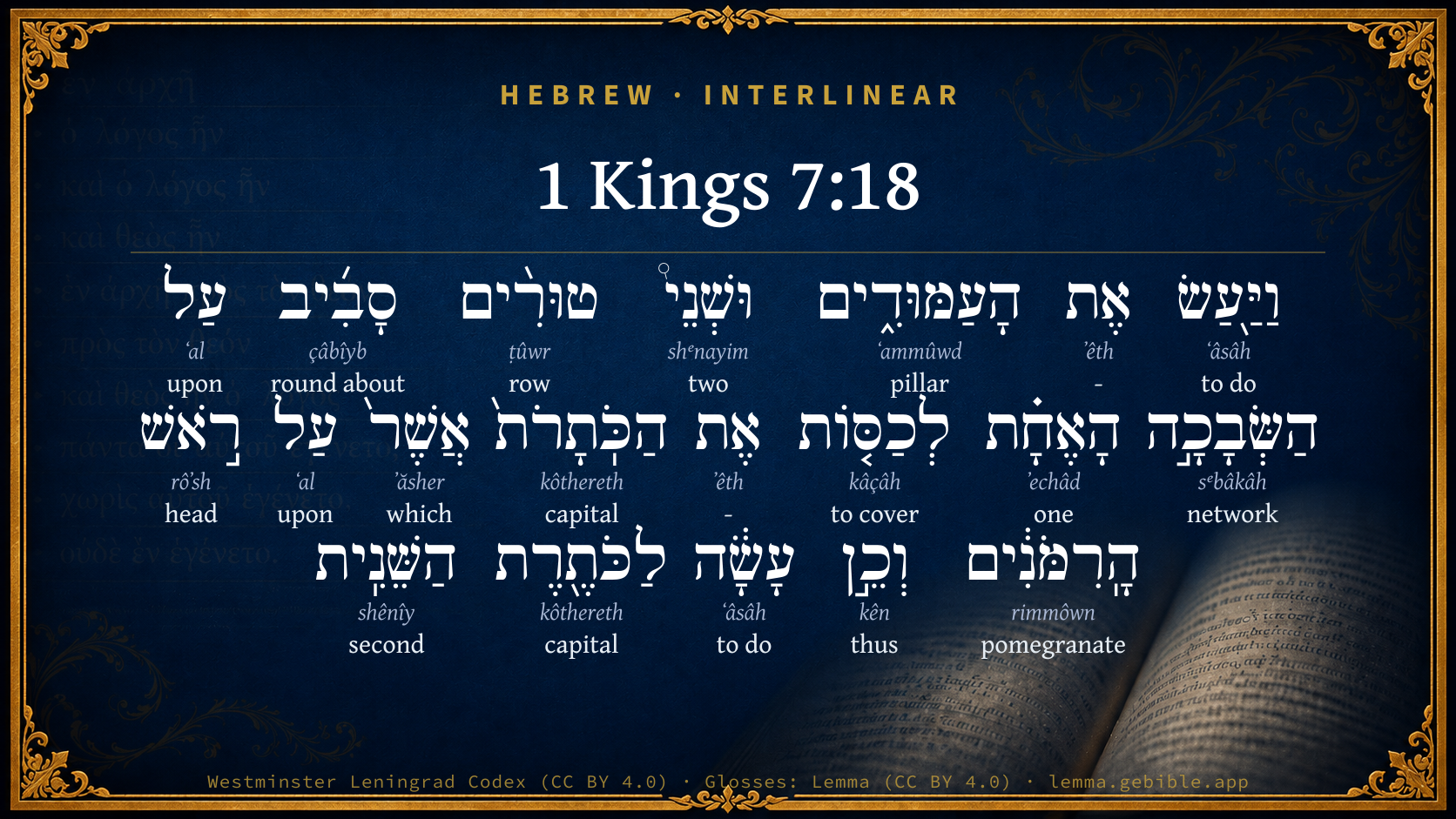
Hebrew (Westminster Leningrad Codex) 1 Kings 7:18 appears in the Hebrew Old Testament. The text above is from the Westminster Leningrad Codex. Each word links to its Strong’s number, a concise gloss, and parsing drawn from the Open Scriptures Hebrew Bible morphology. Click any word for its full Brown-Driver-Briggs (BDB) entry.
Download image
Cite this verse

1 Kings 7:18 (World English Bible). Public Domain. Lemma interlinear Bible study tool, https://lemma.gebible.app/v/1-kings/7/18.

Show BibTeX & RIS
BibTeX
RIS
English Translation
So he made the pillars; and there were two rows round about on the one network, to cover the capitals that were on the top of the pillars: and so did he for the other capital.
World English Bible · Public Domain
Download a study sheet

One document with this verse’s original text, its word-by-word gloss line, the meaning frame, cross-references with their text, attributed commentary, and full source and license credits — printable, and it pastes into notes with its structure intact.

This verse Autodidact and up

Study sheet (.html) Plain text (.txt)

A passage Seminary Student

Up to 50 verses in one chapter. A passage sheet keeps up to 6 commentary sources and 12 cross-references per verse, in the order this page ranks them, and says so on the sheet whenever that leaves anything out. Ask for a single verse and you get the Autodidact verse sheet above.

Everything on this page stays free to read, with no account — the sheet is a download of what is already on screen, not access to it.

Want to remove ads? Support Godless Engineer
Compare translations 3

The same verse in 3 English versions, stacked beneath the original-language interlinear above. Click any original word for its lexicon entry.

Each is an independent rendering of the whole verse — the interlinear is not word-aligned to these translations.

Highlighted words mark where these versions differ — a whole-verse word diff, not a word-by-word alignment.

  • World English Bible Public Domain
    So he made the pillars; and there were two rows round about on the one network, to cover the capitals that were on the top of the pillars: and so did he for the other capital.
  • King James Version Public Domain
    And he made the pillars, and two rows round about upon the one network, to cover the chapiters that were upon the top, with pomegranates: and so did he for the other chapiter.
  • unfoldingWord Literal Text CC BY-SA 4.0
    And he made pillars, and two rows all around on one network, to cover the capitals that were on the head of the pomegranates, and thus he did for the second capital.

unfoldingWord Literal Text — © unfoldingWord, licensed CC BY-SA 4.0. Word-aligned USFM3 via Door43 (git.door43.org/unfoldingWord/en_ult).

Versions to compare (up to 4)

3 of 4 selected

Show all 18 translations

Every available English version of this verse, each an independent rendering of the whole verse.

  • World English Bible Public Domain
    So he made the pillars; and there were two rows round about on the one network, to cover the capitals that were on the top of the pillars: and so did he for the other capital.
  • Berean Standard Bible Public Domain
    Likewise, he made the pillars with two rows of pomegranates around each grating to cover each capital atop the pillars.
  • Majority Standard Bible Public Domain
    Likewise, he made the pillars with two rows of pomegranates around each grating to cover each capital atop the pillars.
  • King James Version Public Domain
    And he made the pillars, and two rows round about upon the one network, to cover the chapiters that were upon the top, with pomegranates: and so did he for the other chapiter.
  • American Standard Version (1901) Public Domain
    So he made the pillars; and there were two rows round about upon the one network, to cover the capitals that were upon the top of the pillars: and so did he for the other capital.
  • Revised Version (1885) Public Domain
    So he made the pillars; and there were two rows round about upon the one network, to cover the chapiters that were upon the top of the pillars: and so did he for the other chapiter.
  • Geneva Bible (1599) Public Domain
    So he made the pillars and two rowes of pomegranates round about in the one grate to couer the chapiters that were vpon the top. And thus did he for the other chapiter.
  • Douay-Rheims (1899) Public Domain
    And he made the pillars, and two rows round about each network to cover the chapiters, that were upon the top, with pomegranates: and in like manner did he to the other chapiter.
  • Young's Literal Translation Public Domain
    And he maketh the pillars, and two rows round about on the one net-work, to cover the chapiters that `are' on the top, with the pomegranates, and so he hath made for the second chapiter.
  • Literal Standard Version CC BY-SA 4.0
    And he makes the pillars, and two rows around on the one network, to cover the chapiters that [are] on the top, with the pomegranates, and so he has made for the second capital.
  • Unlocked Literal Bible CC BY-SA 4.0
    So Huram made two rows of pomegranates around the top of each pillar to decorate their capitals.
  • unfoldingWord Literal Text CC BY-SA 4.0
    And he made pillars, and two rows all around on one network, to cover the capitals that were on the head of the pomegranates, and thus he did for the second capital.
  • Darby Bible Public Domain
    And he made pomegranates, namely two rows round about upon the one network, to cover the capitals that were upon the top of the pillars; and so he did for the other capital.
  • World Messianic Bible Public Domain
    So he made the pillars; and there were two rows of pomegranates around the one network, to cover the capitals that were on the top of the pillars; and he did so for the other capital.
  • Webster's Bible Public Domain
    And he made the pillars, and two rows around upon the one net-work, to cover the capitals that were upon the top, with pomegranates: and so he did for the other capital.
  • Free Bible Version CC BY-SA 4.0
    Around the lattice network he made two rows of ornamental pomegranates to cover the capitals on the top of both the columns.
  • Bible in Basic English Public Domain
    And he made ornaments of apples; and two lines of apples all round over the network, covering the crowns of the pillars, the two crowns in the same way.
  • JPS Tanakh (1917) Public Domain
    And he made the pillars; and there were two rows round about upon the one network, to cover the capitals that were upon the top of the pomegranates; and so did he for the other capital.

Literal Standard Version (2020), Covenant Press — licensed CC BY-SA 4.0. Text via the HelloAO Bible API (eBible.org). Unlocked Literal Bible (unfoldingWord) — licensed CC BY-SA 4.0. Text via the HelloAO Bible API (eBible.org). unfoldingWord Literal Text — © unfoldingWord, licensed CC BY-SA 4.0. Word-aligned USFM3 via Door43 (git.door43.org/unfoldingWord/en_ult). Free Bible Version, Dr. Jonathan Gallagher — licensed CC BY-SA 4.0. Text via the HelloAO Bible API (eBible.org).

Word by word

More ways to search: Search by grammar → Find every occurrence → Compare this word →

Practice this passage: Drill this verse → Learn its vocabulary →

הַשְּׂבָכָ֣ה
sᵉbâkâh
H7639
“the · network”
Particle, Definite Article + Noun, Common, Feminine, Singular, Absolute
Part of Speech
Particle + Noun
Type
Common
Gender
Feminine
Number
Singular
State
Absolute
Full BDB Definition

Origin: from H7638

TWOT: 2230b

network, lattice-work, net, netting - lattice - net-ornament (on pillars) - network, toils (for catching animals)
  1. וַיַּ֖עַשׂ ʻâsâh H6213 “and · to do” Conjunction + Verb, Qal, Sequential Imperfect, 3rd Person, Masculine, Singular
  2. אֶת ʼêth H853 “-” Particle, Direct Object
  3. הָעַמּוּדִ֑ים ʻammûwd H5982 “the · pillars” Particle, Definite Article + Noun, Common, Masculine, Plural, Absolute
  4. וּשְׁנֵי֩ shᵉnayim H8147 “and · two” Conjunction + Adjective, Cardinal number, Masculine, Dual, Construct
  5. טוּרִ֨ים ṭûwr H2905 “rows” Noun, Common, Masculine, Plural, Absolute
  6. סָבִ֜יב çâbîyb H5439 “round about” Noun, Common, Both, Singular, Absolute
  7. עַל ʻal H5921 “upon” Preposition
  8. הָאֶחָ֗ת ʼechâd H259 “the · one” Particle, Definite Article + Adjective, Cardinal number, Feminine, Singular, Absolute
  9. לְכַסּ֤וֹת kâçâh H3680 “to cover” Preposition + Verb, Piel, Infinitive Construct
  10. אֶת ʼêth H853 “-” Particle, Direct Object
  11. הַכֹּֽתָרֹת֙ kôthereth H3805 “the · capitals” Particle, Definite Article + Noun, Common, Feminine, Plural, Absolute
  12. אֲשֶׁר֙ ʼăsher H834 “which” Particle, Relative
  13. עַל ʻal H5921 “upon” Preposition
  14. רֹ֣אשׁ rôʼsh H7218 “head of” Noun, Common, Masculine, Singular, Construct
  15. הָֽרִמֹּנִ֔ים rimmôwn H7416 “the · pomegranates” Particle, Definite Article + Noun, Common, Masculine, Plural, Absolute
  16. וְכֵ֣ן kên H3651 “and · thus” Conjunction + Particle, Demonstrative
  17. עָשָׂ֔ה ʻâsâh H6213 “to do” Verb, Qal, Perfect, 3rd Person, Masculine, Singular
  18. לַכֹּתֶ֖רֶת kôthereth H3805 “to/for the · capital” Preposition, Determined + Noun, Common, Feminine, Singular, Absolute
  19. הַשֵּׁנִֽית shênîy H8145 “the · second” Particle, Definite Article + Adjective, Ordinal number, Feminine, Singular, Absolute

About this verse

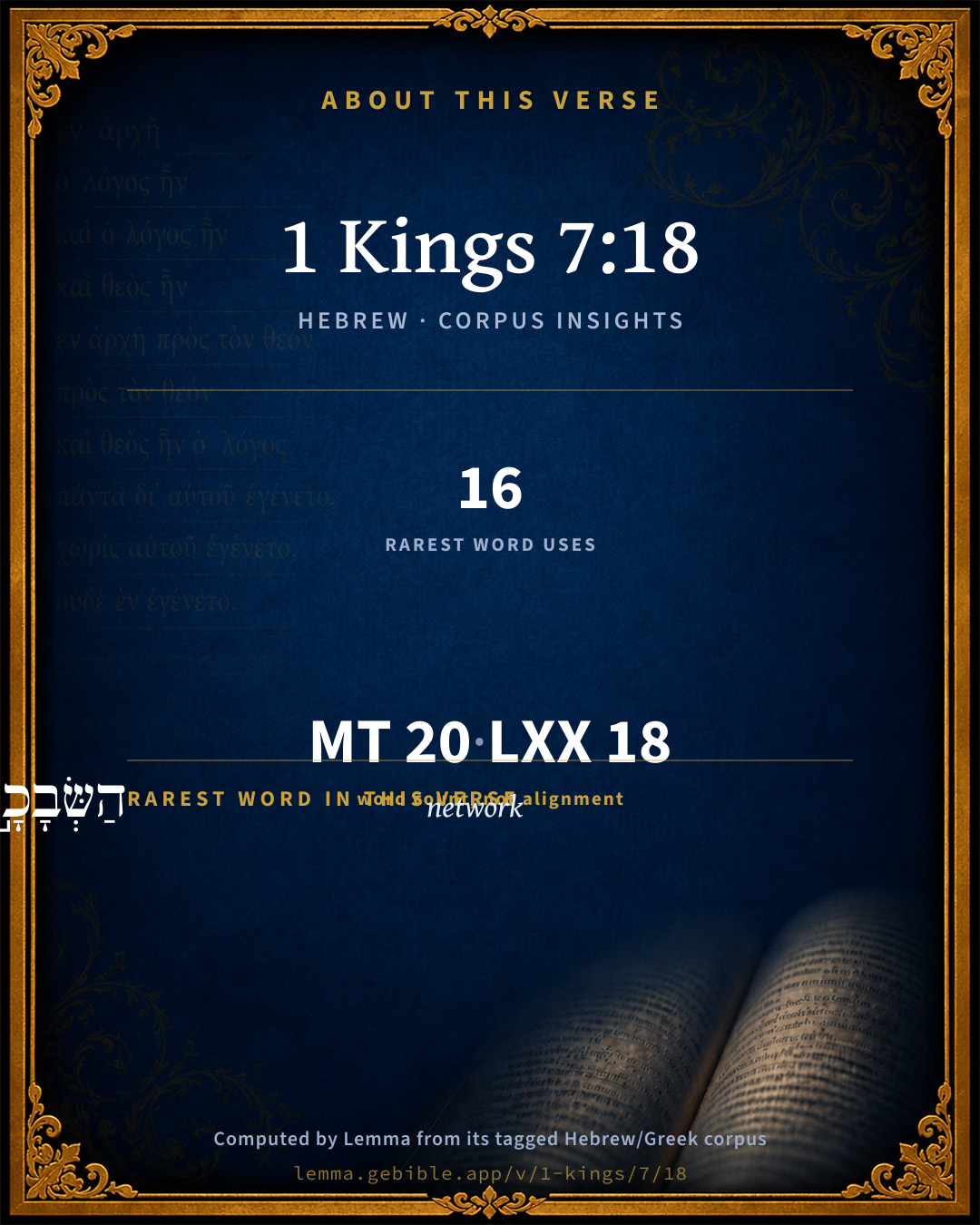
These counts appear in no published source. They are computed here, from the morphology-tagged text and Lemma’s own curated glosses. What Lemma adds →

20
words
16
distinct lemmas
Historical
section

Notable vocabulary

The rarest word here is הַשְּׂבָכָ֣ה network H7639 — appearing just 16 times in the whole Hebrew Bible.

Shared distinctive vocabulary

הַשְּׂבָכָ֣ה network H7639 occurs in 12 verses of the Hebrew Bible. Also found in:

Grammatical profile

  • 3 verbs
  • 8 nouns
  • 3 adjectives
  • 2 prepositions
  • 4 particles

Verb forms

  • וַיַּ֖עַשׂ Qal · Sequential Imperfect
  • לְכַסּ֤וֹת Piel · Infinitive Construct
  • עָשָׂ֔ה Qal · Perfect

Repetition

Words recur within this verse — often emphatic in Hebrew:

  • וַיַּ֖עַשׂ to do H6213 ×2
  • עַל upon H5921 ×2
  • הַכֹּֽתָרֹת֙ capital H3805 ×2

Hebrew & Septuagint length

In English translation the verse runs 36 words from the Hebrew and 63 from the Septuagint (LXX English) — the Septuagint runs noticeably longer here. See the side-by-side →

A rough comparison of the two English renderings, which tokenize alike — not a word-level alignment.

Word counts can differ between the Hebrew and the Greek without any difference in meaning — e.g. the Hebrew direct-object marker אֵת has no separate Greek word, and Greek often adds the article ὁ.

In the original languages it is 20 Hebrew tokens and 18 Greek tokens — but the two are counted differently (Hebrew bundles its prefixes and suffixes into one token; the Greek is in lemma form), so that isn’t a like-for-like length.

Cross-references

5

Topical passages linked to 1 Kings 7:18 in the Treasury of Scripture Knowledge — connected by theme and wording, ordered by reader-vote popularity; previews shown in the World English Bible.

  • Exodus 28:14 and two chains of pure gold; you make them like cords shall, of braided work: and you shall put the braided chains on the settings.
  • Exodus 28:22 You shall make on the breastplate chains like cords, of braided work of pure gold.
  • Exodus 28:24–25 You shall put the two braided chains of gold in the two rings at the ends of the breastplate.
  • Exodus 39:15–18 They made on the breastplate chains like cords, of braided work of pure gold.
  • 2 Kings 25:17 The height of the one pillar was eighteen cubits, and a capital of brass was on it; and the height of the capital was three cubits, with network and pomegranates on the capital round about, all of brass: and like to these had the second pillar with network.

Cross-references courtesy of OpenBible.info (CC BY 4.0).

Hebrew and Greek witnesses Masoretic Hebrew ↔ Greek Septuagint

The same verse in the two great witnesses to the Old Testament, shown verse-for-verse.

Here the Septuagint runs noticeably longer than the Hebrew — LXX2012 (modern English Septuagint) 63 words vs World English Bible 36. A rough length comparison of the two English translations, not a word-level alignment — read both below.

These are two independent witnesses, not word-aligned to each other, and the Septuagint is shown in lemma (dictionary) form.

Hebrew 1 Kings 7:18 Masoretic · Westminster Leningrad Codex

וַיַּ֖עַשׂ אֶת הָעַמּוּדִ֑ים וּשְׁנֵי֩ טוּרִ֨ים סָבִ֜יב עַל הַשְּׂבָכָ֣ה הָאֶחָ֗ת לְכַסּ֤וֹת אֶת הַכֹּֽתָרֹת֙ אֲשֶׁר֙ עַל רֹ֣אשׁ הָֽרִמֹּנִ֔ים וְכֵ֣ן עָשָׂ֔ה לַכֹּתֶ֖רֶת הַשֵּׁנִֽית

So he made the pillars; and there were two rows round about on the one network, to cover the capitals that were on the top of the pillars: and so did he for the other capital.

World English Bible · Public Domain

Greek LXX 1 Kings 7:18 Septuagint · lemma form

καί χείρ ἐν ὁ τροχός ἐν ὁ μεχωνωθ καί ὁ ὕψος ὁ τροχός ὁ εἷς πῆχυς καί ἥμισυς

And hanging work, two rows of brazen pomegranates, formed with network, hanging work, row upon row: and thus he framed the ornaments for the second chapiter. 21 And he set up the pillars of the porch of the temple: and he set up the one pillar, and called its name Jachum: and he set up the second pillar, and called its name Boloz.

LXX2012 (modern English Septuagint) · Public Domain

On this verse, The Cambridge Bible for Schools and Colleges discusses the Septuagint’s reading. Read the note in Commentary ↓

Hebrew: Westminster Leningrad Codex (CC BY 4.0). Greek: Septuagint (public domain); English from LXX2012 (modern English Septuagint) (Public Domain). How the Septuagint differs from the Hebrew →

Targum (Aramaic paraphrase)

1

The Targum is the ancient Jewish Aramaic paraphrase of the Hebrew Scriptures — an interpretive translation, not the Hebrew text itself. Onkelos (literal) and Pseudo-Jonathan (expansive) render the Torah, and Jonathan the Prophets. Coverage is partial: where no permissively-licensed English translation exists for a verse, only the Aramaic is shown. This is verse-level text, not a word-by-word alignment to the Hebrew.

  1. Targum Jonathan Prophets (Joshua–Malachi)
    וַעֲבַד יַת עַמוּדַיָא וּתְרֵין סִדְרִין סְחוֹר סְחוֹר עַל סְרִגְתָּא חֲדָא לְכַסָאָה יַת קְרוֹנְתְּוָן דְעַל רֵישׁ רִמוֹנַיָא וְכֵן עֲבַד לִקְרוֹנְתָּא תִנְיֵתָא:

    (no public-domain English translation for this verse)

    Targum Jonathan — Aramaic: “Mikraot Gedolot” (public domain). English: “Sefaria Community Translation” (CC0 1.0 (public-domain dedication)); “London "Chaldee Paraphrase," 1871” (public domain). Text via Sefaria.

Commentary

Notes on 1 Kings 7:18 from classic Christian and Jewish commentators (each source and its license shown beneath its notes). The classic Christian expositions comment on the surrounding passage and are grouped to its opening verse, so a note may address several verses; the Jewish commentaries on the Tanakh (Rashi and others) are per-verse, so they appear only where the commentator wrote on this verse.

Lemma curates 59 commentaries, every one of them public domain or Creative Commons licensed, each selected and text-cleaned for this edition rather than reprinted as found. About our sources →

Trapp's Complete Commentary

John Trapp

1Ki 7:18 And he made the pillars, and two rows round about upon the one network, to cover the chapiters that [were] upon the top, with pomegranates: and so did he for the other chapiter.

Ver. 18. And he made the pillars.] That is, He thus decked them. Peter Martyr saith that these pillars resembled a man, the nether part setting forth his feet, the second the trunk of his body, the third his head, and the fourth his hat: and that they signified God’s protection over this house, as of old the pillar of fire, and pillar of smoke, showed his protection over them in the wilderness.

John Trapp, A Commentary or Exposition upon All the Books of the Old and New Testament (1647–1656) — public domain. Text from a community e-Sword module.

The Cambridge Bible for Schools and Colleges

gen. ed. J. J. S. Perowne

18. upon the top, with pomegranates] The Hebrew text means ‘upon the top of the pomegranates.’ But some authorities give ‘upon the top of the pillars,’ which has been adopted by the R.V. The first words of the verse must however surely be wrong. ‘And he made the pillars’ is utterly out of place here. It had been noticed before; and the present verse is a description of the capitals. What appears to have happened is this. The words for ‘pillars’ and ‘pomegranates’ have changed places. The LXX. gives no help. But assuming this interchange of words we may render (nearly with R.V.) ‘So he made the pomegranates, and there were two rows about upon the one network, to cover the chapiters that were upon the top of the pillars; and so made he for the other chapiter.’ The words ‘to cover … pillars’ explaining the purpose of the work, come in a little awkwardly, but a sense is made out of what before was incomprehensible.

The Cambridge Bible for Schools and Colleges (gen. ed. J. J. S. Perowne; Cambridge University Press, 1878–1918) — public domain. Text from a community e-Sword module.

John Gill's Exposition

And the chapiters that were upon the top of the pillars were of lily work in the porch,.... Or such as was in the porch of the temple; the work was like that wrought in the form of the flower of lilies open:

four cubits; of the five cubits of which the chapiters consisted, four of them were of lily work, the two rows of pomegranates taking up the other; though Dr. Lightfoot (o) thinks, that at the head of the pillar was a border or circle of lily work, that stood out four cubits under the chapiter, into and along the porch; a four cubit circle, after the manner of a spread lily.

(o) Prospect of the Temple, c. 13. sect. 2. p. 1075.

John Gill's Exposition of the Whole Bible (1746–1763) — public domain (CC PDM 1.0). Text via the HelloAO Bible API.

Albert Barnes' Notes on the Bible

The pomegranate was one of the most common ornaments in Assyria. It was used on quivers, on spear-shafts, and maceheads, in patterns on doorways and pavements, etc. It is doubtful whether a symbolic meaning was attached to it, or whether it was merely selected as a beautiful natural form.

Albert Barnes' Notes on the Bible (1834–1885) — public domain. Text from a community e-Sword/MySword module.

Haydock's Catholic Bible Commentary

The pillars. This word may have changed places with pomegranates.

George Leo Haydock (1774–1849), Haydock's Catholic Family Bible and Commentary, 1859 edition — public domain. Excludes Psalms (Douay-Rheims chapter numbering differs from Protestant) and Deuterocanonical books (Catholic canon only).

Matthew Poole's English Annotations

And he made; or, so he made, or framed, or perfected.

Two rows; either of pomegranates, by comparing this with 1Ki 7:20, or of some other curious work.

Matthew Poole's English Annotations on the Holy Bible (1683–1685) — public domain. Text from a community e-Sword/MySword module.

Whedon's Commentary on the Bible

Daniel D. Whedon

18. He made the pillars — Rather, he made pomegranates, for in the Masoretic text the words pillars and pomegranates have evidently become transposed. So below, where our version has upon the top, with pomegranates, we should read, upon the top of the pillars. “The pomegranate was one of the commonest ornaments in Assyria. It was used on quivers, on spear-shafts and mace-heads, in patterns on doorways and pavements. It is doubtful whether a symbolical meaning attached to it, or whether it was merely selected as a beautiful natural form.” — Rawlinson.

Two rows — These rows of pomegranates were probably set upon the upper and lower edges of the network, so that there were two rows for each pillar, and one hundred pomegranates in each row. See on 1Ki_7:20.

To cover the chapiters — More fully in 1Ki_7:42, “to cover the two bowls of the chapiters;” that is, as we take it, to cover the upper and lower edges of the bowls or pommels of each capital.

Daniel D. Whedon (gen. ed.), Commentary on the Old and New Testaments (1874–1909) — public domain. Text from a community e-Sword module.

The Pulpit Commentary

And he made the pillars There is evidently a confusion of the text here. Probably we should read, with some MSS. the pomegranates (so LXX), instead of or rather, we should transpose the two words, reading pomegranates where the Masoretic text has pillars, and vice versa. "The pomegranate was one of the commonest ornaments of Assyria. It is doubtful whether a symbolical meaning was attached to it, or whether it was merely selected as a beautiful natural form" (Rawlinson). Wordsworth characteristically sees in its many ripe seeds, "an expressive emblem of fruitfulness in good works. According to Bahr, it is an image of the law or covenant of Jehovah, and the seeds represent the separate commands (Symbolik, 2:122, 123). In the tabernacle it was pourtrayed in works of divers colours on the hem of the robe of the. (Exo_28:33, 34 39:24) All the Scripture notices of this fruit prove its great abundance in Palestine (Num_13:23; Jos_15:32 Jos_21:25; in the two last passages it appears as the name of a town Son_4:3, 13 8:2; Joe_1:12; Hag_2:9, etc.) It was also well known to the Egyptians, Num_20:5 and or even two rows round about upon the one network "The relation between the two rows of pomegranates and the plaited work is not clearly defined, but it is generally and correctly assumed that one row ran round the pillars below the plaited work and the other above" (Keil). The pomegranates, one hundred in number in each row, (2Ch_3:16) four hundred in all (2Ch_4:13; Jer_52:23) would thus form a double border to the chain work, to cover the chapiters that were upon the top, with pomegranates rather, on the top of the pillars, as the transposition mentioned above and the sense require); and so did he for the other chapiter.

The Pulpit Commentary (1880–1919), ed. H.D.M. Spence-Jones & Joseph S. Exell — public domain. Text from a community e-Sword module.

John Wesley's Explanatory Notes

Two rows - Either of pomegranates, by comparing this with ver. 20, or of some other curious work.

John Wesley, Explanatory Notes Upon the Whole Bible (1754–1765) — public domain. Text via the GEBible commentary corpus.

unfoldingWord translationNotes

Door43 World Missions Community

Huram made

Huram would have commanded his workers to do this work. AT: "Huram commanded his workers to make" (See: Metonymy)

two rows of pomegranates

A pomegranate is a fruit with a hard, red rind and many juicy seeds inside. Huram did not use real pomegranates to decorate the pillars. He made them out of bronze.

The capitals ... were decorated with lilies, four cubits high

Lilies are plants whose flowers are wide at one end and very narrow at the other end. These words can be stated in active form. AT: "Huram decorated the capitals ... with bronze lilies, four cubits high" (See: Active or Passive and Assumed Knowledge and Implicit Information)

the tops of the portico

Translate "portico" as in 1 Kings 7:6.

four cubits

A cubit is 46 centimeters. AT: "about 1.8 meters" (See: Biblical Distance)

translationWords

column

unfoldingWord translationNotes — © Distant Shores Media and the Door43 World Missions Community, licensed CC BY-SA 4.0. Source: git.door43.org/Door43/en_tn.

Rashi

Rabbi Shlomo Yitzchaki (Rashi)

And two rows. Of pomegranates and of copper; the pomegranates were inserted into the chain [work] which encircled the crowns, thus is this explained in Divrei Hayomim and in the Mishnah of “Forty-Nine Measurements.”

To cover the crowns that were on top of the pomegranates. [The text of] this verse is in a disarranged order. [It means,] “the pomegranates should cover the crowns which were on the top.” And thus were the crowns made according to the order of the apparent meaning of the verses; each one was in the form of two bowls. The receptacle of the lower bowl was facing upward and it is called גולה [=a bowl], as it is stated about this subject, “וגולת הכותרות,” and [Targum] Yonoson rendered this, “and the bowls of the crowns.” The upper [bowl] was inverted on the lower one, its receptacle was [facing] downward, and it was called שבכה [=net or mesh] work, as it is stated regarding this subject, “[also] two net [mesh] works to cover the two bowls of the crowns.” The result being that it is wide in the place where it is connected, and it narrows going upward and it narrows going downward, and this is called “a stomach,” and thus [Targum] Yonoson rendered מעלות הבטן, “against the place of attachment.” And the height of these two bowls was four amohs, and this is what he stated, “in the entrance hall were made like lilies, four amohs.” These were decorated inside with flowers of lilies, in the same design of the decorations which were on the wall of the entrance halls; four amohs high, and the fifth amoh was a small crown above the big one. This is what was stated, “And there were also crowns above on the two columns.”

Rashi on the Tanakh — English translations: “The Judaica Press complete Tanach with Rashi, translated by A. J. Rosenberg” (CC BY 4.0); “Pentateuch with Rashi's commentary by M. Rosenbaum and A.M. Silbermann, 1929-1934” (public domain); “The Metsudah Tanach series, Lakewood, N.J” (CC BY 4.0); and “The Book of Joshua, Metsudah Publications, 1997” (CC BY 4.0). Text via Sefaria.

Lesson kit

Teaching starters — assembled from the data on this page, not authored interpretation. Every prompt links to the verse data it draws on. Edit before teaching.

1 Kings, in the Historical, opens this verse with 20 words (16 distinct Hebrew lemmas). Its most distinctive word is sᵉbâkâh (“network”). The Greek Septuagint runs longer here. A historical commentator’s framing appears above. Read the whole chapter for the surrounding context.

Discussion questions

  1. What does “network” (sᵉbâkâh) contribute to the verse as a whole?
  2. How does 1 Kings 7:17, which shares the word «network», read alongside this verse?
  3. What does the repetition of “to do” (2× in this one verse) do in this verse?
  4. The Septuagint runs longer here than the Hebrew. What might account for the difference?
  5. These translations render this verse differently; the difference is in the English rendering, not the original. What questions does that raise?
  6. «וַיַּ֖עַשׂ» is a Qal Sequential Imperfect verb. How does that grammatical form shape the action described?
  7. Compare how Trapp's Complete Commentary and The Cambridge Bible for Schools and Colleges read this verse. Where do they agree or differ?

Things to notice

Reading settings

Reading text

Shown beneath each verse's original-language words.

Old Testament
Old Testament edition

Read the OT as the Masoretic Hebrew (MT) or the Greek Septuagint (LXX).

English shown for the Greek Septuagint (in the Hebrew ↔ Greek comparison).

Comparing translations? Open the Compare panel on any verse page to stack up to four side by side.