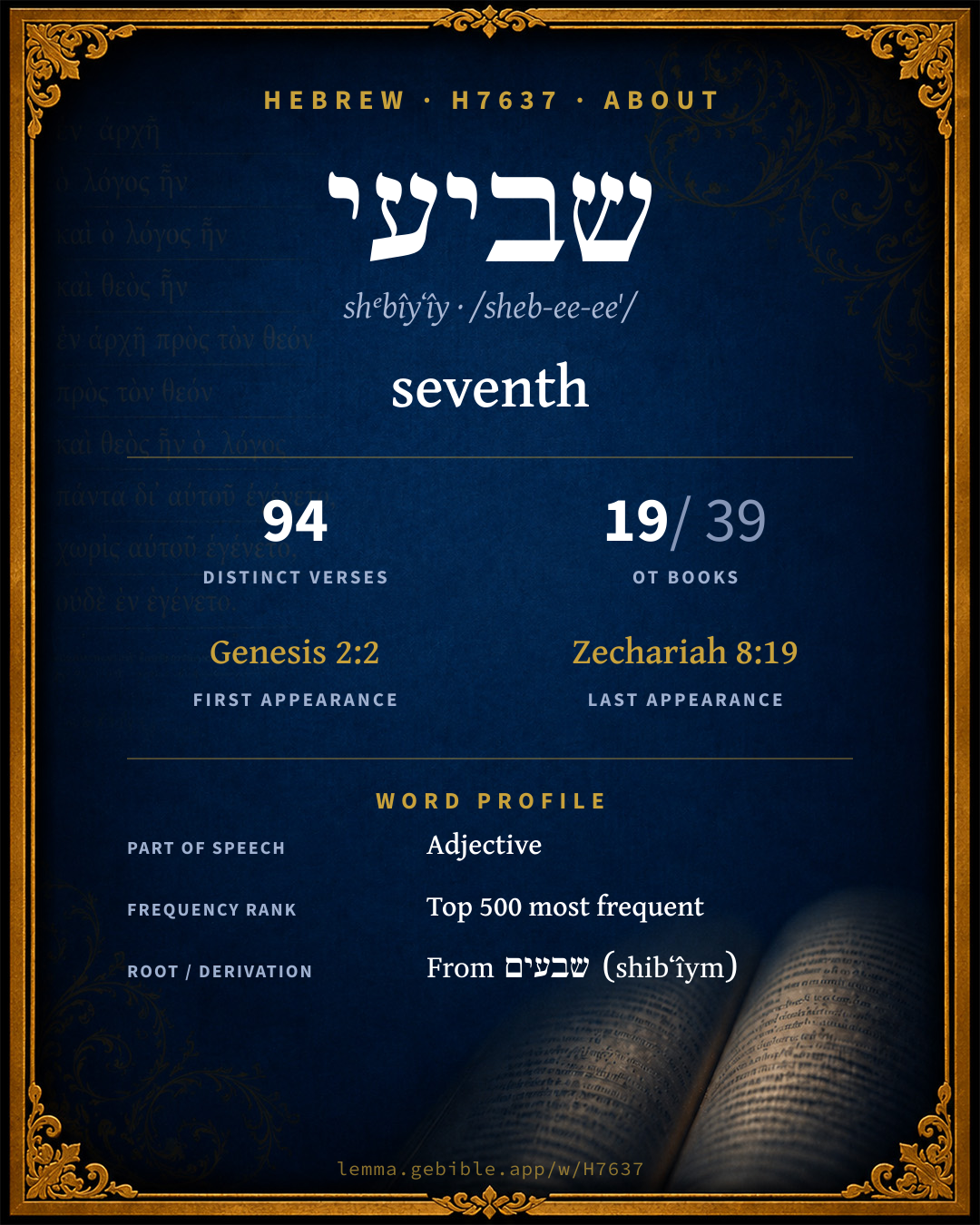
שְׁבִיעִי
seventh
‘seventh’ is one of 2 main senses fuller range ↓
Full lexicon entry — Brown-Driver-Briggs (BDB)
From Brown-Driver-Briggs (BDB)
Where this word appears
Grammar key — what these labels mean
State
- Absolute
- The independent form of a noun, not bound to a following word.
Gender
- Masculine
- Grammatically masculine.
- Feminine
- Grammatically feminine.
Number
- Singular
- One.
Grammatical forms
- Adjective, Ordinal number, Masculine, Singular, Absolute 84 times (86%)
- Adjective, Ordinal number, Feminine, Singular, Absolute 14 times (14%)
Parsed forms decoded from the imported morphology (morphhb / Westminster Leningrad Codex — WLC text public domain, morphhb tagging CC BY 4.0), counted across 98 parsed occurrences — not distinct verses.
Every verse where H7637 appears — 94 distinct verses across 19 books. Click any verse to open its interlinear word-by-word view. Verse text shown in the World English Bible for context — . Each verse’s Hebrew form is shown with its reference; the English is not keyword-highlighted, since the data carries no word-level English alignment. Use “Compare translations” on any verse to read it across multiple English versions. This concordance covers the Hebrew Bible; Septuagint (Greek Old Testament) occurrences are not indexed here.
Genesis 3 verses
- Genesis 2:2 הַ/שְּׁבִיעִ֔י הַ/שְּׁבִיעִ֔י ptcl def.art + Adjective Ordinal number ms ptcl def.art + Adjective Ordinal number ms On the seventh day God finished his work which he had made; and he rested on the seventh day from all his work which he had made.
- Genesis 2:3 הַ/שְּׁבִיעִ֔י ptcl def.art + Adjective Ordinal number ms God blessed the seventh day, and made it holy, because he rested in it from all his work which he had created and made.
- Genesis 8:4 הַ/שְּׁבִיעִ֔י ptcl def.art + Adjective Ordinal number ms The ark rested in the seventh month, on the seventeenth day of the month, on Ararat's mountains.
Exodus 17 verses
- Exodus 12:15 הַ/שְּׁבִעִֽי ptcl def.art + Adjective Ordinal number ms Seven days shall you eat unleavened bread; even the first day you shall put away yeast out of your houses, for whoever eats leavened bread from the first day until the seventh day, that soul shall be cut off from Israel.
- Exodus 12:16 הַ/שְּׁבִיעִ֔י ptcl def.art + Adjective Ordinal number ms In the first day there shall be to you a holy convocation, and in the seventh day a holy convocation; no manner of work shall be done in them, except that which every man must eat, that only may be done by you.
- Exodus 13:6 הַ/שְּׁבִיעִ֔י ptcl def.art + Adjective Ordinal number ms Seven days you shall eat unleavened bread, and in the seventh day shall be a feast to Yahweh.
- Exodus 16:26 הַ/שְּׁבִיעִ֛י ptcl def.art + Adjective Ordinal number ms Six days you shall gather it, but on the seventh day is the Sabbath. In it there shall be none."
- Exodus 16:27 הַ/שְּׁבִיעִ֔י ptcl def.art + Adjective Ordinal number ms It happened on the seventh day, that some of the people went out to gather, and they found none.
- Exodus 16:29 הַ/שְּׁבִיעִֽי ptcl def.art + Adjective Ordinal number ms Behold, because Yahweh has given you the Sabbath, therefore he gives you on the sixth day the bread of two days. Everyone stay in his place. Let no one go out of his place on the seventh day."
- Exodus 16:30 הַ/שְּׁבִעִֽי ptcl def.art + Adjective Ordinal number ms So the people rested on the seventh day.
- Exodus 20:10 הַ/שְּׁבִיעִ֔י ptcl def.art + Adjective Ordinal number ms but the seventh day is a Sabbath to Yahweh your God. You shall not do any work in it, you, nor your son, nor your daughter, your man-servant, nor your maid-servant, nor your cattle, nor your stranger who is within your gates;
- Exodus 20:11 הַ/שְּׁבִיעִ֑י ptcl def.art + Adjective Ordinal number ms for in six days Yahweh made heaven and earth, the sea, and all that is in them, and rested the seventh day; therefore Yahweh blessed the Sabbath day, and made it holy.
- Exodus 21:2 וּ/בַ֨/שְּׁבִעִ֔ת conj + prep det + Adjective Ordinal number fs If you buy a Hebrew servant, he shall serve six years and in the seventh he shall go out free without paying anything.
- Exodus 23:11 וְ/הַ/שְּׁבִיעִ֞ת conj + ptcl def.art + Adjective Ordinal number fs but the seventh year you shall let it rest and lie fallow, that the poor of your people may eat; and what they leave the animal of the field shall eat. In like manner you shall deal with your vineyard and with your olive grove.
- Exodus 23:12 הַ/שְּׁבִיעִ֖י ptcl def.art + Adjective Ordinal number ms "Six days you shall do your work, and on the seventh day you shall rest, that your ox and your donkey may have rest, and the son of your handmaid, and the alien may be refreshed.
- Exodus 24:16 הַ/שְּׁבִיעִ֖י ptcl def.art + Adjective Ordinal number ms The glory of Yahweh settled on Mount Sinai, and the cloud covered it six days. The seventh day he called to Moses out of the midst of the cloud.
- Exodus 31:15 הַ/שְּׁבִיעִ֗י ptcl def.art + Adjective Ordinal number ms Six days shall work be done, but on the seventh day is a Sabbath of solemn rest, holy to Yahweh. Whoever does any work on the Sabbath day shall surely be put to death.
- Exodus 31:17 הַ/שְּׁבִיעִ֔י ptcl def.art + Adjective Ordinal number ms It is a sign between me and the children of Israel forever; for in six days Yahweh made heaven and earth, and on the seventh day he rested, and was refreshed.'"
- Exodus 34:21 הַ/שְּׁבִיעִ֖י ptcl def.art + Adjective Ordinal number ms Six days you shall work, but on the seventh day you shall rest: in plowing time and in harvest you shall rest.
- Exodus 35:2 הַ/שְּׁבִיעִ֗י ptcl def.art + Adjective Ordinal number ms 'Six days shall work be done, but on the seventh day there shall be a holy day for you, a Sabbath of solemn rest to Yahweh: whoever does any work in it shall be put to death.
Leviticus 20 verses
- Leviticus 13:5 הַ/שְּׁבִיעִי֒ ptcl def.art + Adjective Ordinal number ms The priest shall examine him on the seventh day, and, behold, if in his eyes the plague is arrested, and the plague hasn't spread in the skin, then the priest shall isolate him for seven more days.
- Leviticus 13:6 הַ/שְּׁבִיעִי֮ ptcl def.art + Adjective Ordinal number ms The priest shall examine him again on the seventh day; and, behold, if the plague has faded, and the plague hasn't spread in the skin, then the priest shall pronounce him clean. It is a scab. He shall wash his clothes, and be clean.
- Leviticus 13:27 הַ/שְּׁבִיעִ֑י ptcl def.art + Adjective Ordinal number ms The priest shall examine him on the seventh day. If it has spread in the skin, then the priest shall pronounce him unclean. It is the plague of leprosy.
- Leviticus 13:32 הַ/שְּׁבִיעִי֒ ptcl def.art + Adjective Ordinal number ms On the seventh day the priest shall examine the plague; and, behold, if the itch hasn't spread, and there is no yellow hair in it, and the appearance of the itch isn't deeper than the skin,
- Leviticus 13:34 הַ/שְּׁבִיעִ֗י ptcl def.art + Adjective Ordinal number ms On the seventh day, the priest shall examine the itch; and, behold, if the itch hasn't spread in the skin, and its appearance isn't deeper than the skin, then the priest shall pronounce him clean. He shall wash his clothes, and be clean.
- Leviticus 13:51 הַ/שְּׁבִיעִ֗י ptcl def.art + Adjective Ordinal number ms He shall examine the plague on the seventh day. If the plague has spread in the garment, either in the warp, or in the woof, or in the skin, whatever use the skin is used for, the plague is a destructive mildew. It is unclean.
- Leviticus 14:9 הַ/שְּׁבִיעִ֜י ptcl def.art + Adjective Ordinal number ms It shall be on the seventh day, that he shall shave all his hair off his head and his beard and his eyebrows, even all his hair he shall shave off. He shall wash his clothes, and he shall bathe his body in water, then he shall be clean.
- Leviticus 14:39 הַ/שְּׁבִיעִ֑י ptcl def.art + Adjective Ordinal number ms The priest shall come again on the seventh day, and look. If the plague has spread in the walls of the house,
- Leviticus 16:29 הַ֠/שְּׁבִיעִי ptcl def.art + Adjective Ordinal number ms "It shall be a statute to you forever: in the seventh month, on the tenth day of the month, you shall afflict your souls, and shall do no manner of work, the native-born, or the stranger who lives as a foreigner among you:
- Leviticus 23:3 הַ/שְּׁבִיעִ֗י ptcl def.art + Adjective Ordinal number ms "'Six days shall work be done: but on the seventh day is a Sabbath of solemn rest, a holy convocation; you shall do no manner of work. It is a Sabbath to Yahweh in all your dwellings.
- Leviticus 23:8 הַ/שְּׁבִיעִי֙ ptcl def.art + Adjective Ordinal number ms But you shall offer an offering made by fire to Yahweh seven days. In the seventh day is a holy convocation: you shall do no regular work.'"
- Leviticus 23:16 הַ/שְּׁבִיעִ֔ת ptcl def.art + Adjective Ordinal number fs even to the next day after the seventh Sabbath you shall number fifty days; and you shall offer a new meal offering to Yahweh.
- Leviticus 23:24 הַ/שְּׁבִיעִ֜י ptcl def.art + Adjective Ordinal number ms "Speak to the children of Israel, saying, 'In the seventh month, on the first day of the month, shall be a solemn rest to you, a memorial of blowing of trumpets, a holy convocation.
- Leviticus 23:27 הַ/שְּׁבִיעִ֨י ptcl def.art + Adjective Ordinal number ms "However on the tenth day of this seventh month is the day of atonement: it shall be a holy convocation to you, and you shall afflict yourselves; and you shall offer an offering made by fire to Yahweh.
- Leviticus 23:34 הַ/שְּׁבִיעִי֙ ptcl def.art + Adjective Ordinal number ms "Speak to the children of Israel, and say, 'On the fifteenth day of this seventh month is the feast of tents for seven days to Yahweh.
- Leviticus 23:39 הַ/שְּׁבִיעִ֗י ptcl def.art + Adjective Ordinal number ms "'So on the fifteenth day of the seventh month, when you have gathered in the fruits of the land, you shall keep the feast of Yahweh seven days: on the first day shall be a solemn rest, and on the eighth day shall be a solemn rest.
- Leviticus 23:41 הַ/שְּׁבִיעִ֖י ptcl def.art + Adjective Ordinal number ms You shall keep it a feast to Yahweh seven days in the year: it is a statute forever throughout your generations; you shall keep it in the seventh month.
- Leviticus 25:4 הַ/שְּׁבִיעִ֗ת ptcl def.art + Adjective Ordinal number fs but in the seventh year there shall be a Sabbath of solemn rest for the land, a Sabbath to Yahweh. You shall not sow your field or prune your vineyard.
- Leviticus 25:9 הַ/שְּׁבִעִ֔י ptcl def.art + Adjective Ordinal number ms Then you shall sound the loud trumpet on the tenth day of the seventh month. On the Day of Atonement you shall sound the trumpet throughout all your land.
- Leviticus 25:20 הַ/שְּׁבִיעִ֑ת ptcl def.art + Adjective Ordinal number fs If you said, "What shall we eat the seventh year? Behold, we shall not sow, nor gather in our increase;"
Numbers 11 verses
- Numbers 6:9 הַ/שְּׁבִיעִ֖י ptcl def.art + Adjective Ordinal number ms "If any man dies very suddenly beside him, and he defiles the head of his separation; then he shall shave his head in the day of his cleansing. On the seventh day he shall shave it.
- Numbers 7:48 הַ/שְּׁבִיעִ֔י ptcl def.art + Adjective Ordinal number ms On the seventh day Elishama the son of Ammihud, prince of the children of Ephraim
- Numbers 19:12 הַ/שְּׁבִיעִ֖י הַ/שְּׁבִיעִ֖י ptcl def.art + Adjective Ordinal number ms ptcl def.art + Adjective Ordinal number ms the same shall purify himself therewith on the third day, and on the seventh day he shall be clean: but if he doesn't purify himself the third day, then the seventh day he shall not be clean.
- Numbers 19:19 הַ/שְּׁבִיעִ֑י הַ/שְּׁבִיעִ֔י ptcl def.art + Adjective Ordinal number ms ptcl def.art + Adjective Ordinal number ms and the clean person shall sprinkle on the unclean on the third day, and on the seventh day: and on the seventh day he shall purify him; and he shall wash his clothes, and bathe himself in water, and shall be clean at even.
- Numbers 28:25 הַ/שְּׁבִיעִ֔י ptcl def.art + Adjective Ordinal number ms On the seventh day you shall have a holy convocation: you shall do no servile work.
- Numbers 29:1 הַ/שְּׁבִיעִ֜י ptcl def.art + Adjective Ordinal number ms In the seventh month, on the first day of the month, you shall have a holy convocation; you shall do no servile work: it is a day of blowing of trumpets to you.
- Numbers 29:7 הַ/שְּׁבִיעִ֜י ptcl def.art + Adjective Ordinal number ms On the tenth day of this seventh month you shall have a holy convocation; and you shall afflict your souls: you shall do no manner of work;
- Numbers 29:12 הַ/שְּׁבִיעִ֗י ptcl def.art + Adjective Ordinal number ms On the fifteenth day of the seventh month you shall have a holy convocation; you shall do no servile work, and you shall keep a feast to Yahweh seven days:
- Numbers 29:32 הַ/שְּׁבִיעִ֛י ptcl def.art + Adjective Ordinal number ms On the seventh day seven bulls, two rams, fourteen he-lambs a year old without blemish;
- Numbers 31:19 הַ/שְּׁבִיעִ֔י ptcl def.art + Adjective Ordinal number ms Encamp you outside of the camp seven days: whoever has killed any person, and whoever has touched any slain, purify yourselves on the third day and on the seventh day, you and your captives.
- Numbers 31:24 הַ/שְּׁבִיעִ֖י ptcl def.art + Adjective Ordinal number ms You shall wash your clothes on the seventh day, and you shall be clean; and afterward you shall come into the camp.
Deuteronomy 3 verses
- Deuteronomy 5:14 הַ/שְּׁבִיעִ֔י ptcl def.art + Adjective Ordinal number ms but the seventh day is a Sabbath to Yahweh your God: [in it] you shall not do any work, you, nor your son, nor your daughter, nor your man-servant, nor your maid-servant, nor your ox, nor your donkey, nor any of your cattle, nor your stranger who is within your gates; that your man-servant and your maid-servant may rest as well as you.
- Deuteronomy 15:12 הַ/שְּׁבִיעִ֔ת ptcl def.art + Adjective Ordinal number fs If your brother, a Hebrew man, or a Hebrew woman, be sold to you, and serve you six years; then in the seventh year you shall let him go free from you.
- Deuteronomy 16:8 הַ/שְּׁבִיעִ֗י ptcl def.art + Adjective Ordinal number ms Six days you shall eat unleavened bread; and on the seventh day shall be a solemn assembly to Yahweh your God; you shall do no work [therein].
Joshua 4 verses
- Joshua 6:4 הַ/שְּׁבִיעִ֔י ptcl def.art + Adjective Ordinal number ms Seven priests shall bear seven trumpets of rams' horns before the ark: and the seventh day you shall compass the city seven times, and the priests shall blow the trumpets.
- Joshua 6:15 הַ/שְּׁבִיעִ֗י ptcl def.art + Adjective Ordinal number ms It happened on the seventh day, that they rose early at the dawning of the day, and compassed the city after the same manner seven times: only on the day they compassed the city seven times.
- Joshua 6:16 הַ/שְּׁבִיעִ֔ית ptcl def.art + Adjective Ordinal number fs It happened at the seventh time, when the priests blew the trumpets, Joshua said to the people, Shout; for Yahweh has given you the city.
- Joshua 19:40 הַ/שְּׁבִיעִֽי ptcl def.art + Adjective Ordinal number ms The seventh lot came out for the tribe of the children of Dan according to their families.
Judges 3 verses
- Judges 14:15 הַ/שְּׁבִיעִ֗י ptcl def.art + Adjective Ordinal number ms It happened on the seventh day, that they said to Samson's wife, Entice your husband, that he may declare to us the riddle, lest we burn you and your father's house with fire: have you called us to impoverish us? is it not [so]?
- Judges 14:17 הַ/שְּׁבִיעִ֗י ptcl def.art + Adjective Ordinal number ms She wept before him the seven days, while their feast lasted: and it happened on the seventh day, that he told her, because she pressed him sore; and she told the riddle to the children of her people.
- Judges 14:18 הַ/שְּׁבִיעִ֗י ptcl def.art + Adjective Ordinal number ms The men of the city said to him on the seventh day before the sun went down, What is sweeter than honey? and what is stronger than a lion? He said to them, If you hadn't plowed with my heifer, You wouldn't have found out my riddle.
2 Samuel 1 verse
1 Kings 3 verses
- 1 Kings 8:2 הַ/שְּׁבִיעִֽי ptcl def.art + Adjective Ordinal number ms All the men of Israel assembled themselves to king Solomon at the feast, in the month Ethanim, which is the seventh month.
- 1 Kings 18:44 בַּ/שְּׁבִעִ֔ית prep det + Adjective Ordinal number fs It happened at the seventh time, that he said, "Behold, a small cloud, like a man's hand, is rising out of the sea." He said, Go up, tell Ahab, Make ready [your chariot], and get you down, that the rain not stop you.
- 1 Kings 20:29 הַ/שְּׁבִיעִ֗י ptcl def.art + Adjective Ordinal number ms They encamped one over against the other seven days. So it was, that in the seventh day the battle was joined; and the children of Israel killed of the Syrians one hundred thousand footmen in one day.
2 Kings 3 verses
- 2 Kings 11:4 הַ֠/שְּׁבִיעִית ptcl def.art + Adjective Ordinal number fs In the seventh year Jehoiada sent and fetched the captains over hundreds of the Carites and of the guard, and brought them to him into the house of Yahweh; and he made a covenant with them, and took an oath of them in the house of Yahweh, and shown them the king's son.
- 2 Kings 18:9 הַ/שְּׁבִיעִ֔ית ptcl def.art + Adjective Ordinal number fs It happened in the fourth year of king Hezekiah, which was the seventh year of Hoshea son of Elah king of Israel, that Shalmaneser king of Assyria came up against Samaria, and besieged it.
- 2 Kings 25:25 הַ/שְּׁבִיעִ֗י ptcl def.art + Adjective Ordinal number ms But it happened in the seventh month, that Ishmael the son of Nethaniah, the son of Elishama, of the royal seed came, and ten men with him, and struck Gedaliah, so that he died, and the Jews and the Chaldeans that were with him at Mizpah.
1 Chronicles 7 verses
- 1 Chronicles 2:15 הַ/שְּׁבִעִֽי ptcl def.art + Adjective Ordinal number ms Ozem the sixth, David the seventh;
- 1 Chronicles 12:11 הַ/שְּׁבִעִֽי ptcl def.art + Adjective Ordinal number ms Attai the sixth, Eliel the seventh,
- 1 Chronicles 24:10 הַ/שְּׁבִעִ֔י ptcl def.art + Adjective Ordinal number ms the seventh to Hakkoz, the eighth to Abijah,
- 1 Chronicles 25:14 הַ/שְּׁבִעִ֣י ptcl def.art + Adjective Ordinal number ms the seventh to Jesharelah, his sons and his brothers, twelve:
- 1 Chronicles 26:3 הַ/שְּׁבִיעִֽי ptcl def.art + Adjective Ordinal number ms Elam the fifth, Jehohanan the sixth, Eliehoenai the seventh.
- 1 Chronicles 26:5 הַ/שְּׁבִיעִ֔י ptcl def.art + Adjective Ordinal number ms Ammiel the sixth, Issachar the seventh, Peullethai the eighth; for God blessed him.
- 1 Chronicles 27:10 הַ/שְּׁבִיעִי֙ הַ/שְּׁבִיעִ֔י ptcl def.art + Adjective Ordinal number ms ptcl def.art + Adjective Ordinal number ms The seventh [captain] for the seventh month was Helez the Pelonite, of the children of Ephraim: and in his division were twenty-four thousand.
2 Chronicles 4 verses
- 2 Chronicles 5:3 הַ/שְּׁבִעִֽי ptcl def.art + Adjective Ordinal number ms And all the men of Israel assembled themselves to the king at the feast, which was [in] the seventh month.
- 2 Chronicles 7:10 הַ/שְּׁבִיעִ֔י ptcl def.art + Adjective Ordinal number ms On the three and twentieth day of the seventh month he sent the people away to their tents, joyful and glad of heart for the goodness that Yahweh had shown to David, and to Solomon, and to Israel his people.
- 2 Chronicles 23:1 הַ/שְּׁבִעִ֜ית ptcl def.art + Adjective Ordinal number fs In the seventh year Jehoiada strengthened himself, and took the captains of hundreds, Azariah the son of Jeroham, and Ishmael the son of Jehohanan, and Azariah the son of Obed, and Maaseiah the son of Adaiah, and Elishaphat the son of Zichri, into covenant with him.
- 2 Chronicles 31:7 הַ/שְּׁבִיעִ֖י ptcl def.art + Adjective Ordinal number ms In the third month they began to lay the foundation of the heaps, and finished them in the seventh month.
Ezra 3 verses
- Ezra 3:1 הַ/שְּׁבִיעִ֔י ptcl def.art + Adjective Ordinal number ms When the seventh month was come, and the children of Israel were in the cities, the people gathered themselves together as one man to Jerusalem.
- Ezra 3:6 הַ/שְּׁבִיעִ֔י ptcl def.art + Adjective Ordinal number ms From the first day of the seventh month began they to offer burnt offerings to Yahweh: but the foundation of the temple of Yahweh was not yet laid.
- Ezra 7:8 הַ/שְּׁבִיעִ֖ית ptcl def.art + Adjective Ordinal number fs He came to Jerusalem in the fifth month, which was in the seventh year of the king.
Nehemiah 4 verses
- Nehemiah 7:73 הַ/שְּׁבִיעִ֔י ptcl def.art + Adjective Ordinal number ms So the priests, and the Levites, and the porters, and the singers, and some of the people, and the Nethinim, and all Israel, lived in their cities. When the seventh month was come, the children of Israel were in their cities.
- Nehemiah 8:2 הַ/שְּׁבִיעִֽי ptcl def.art + Adjective Ordinal number ms Ezra the priest brought the law before the assembly, both men and women, and all who could hear with understanding, on the first day of the seventh month.
- Nehemiah 8:14 הַ/שְּׁבִיעִֽי ptcl def.art + Adjective Ordinal number ms They found written in the law, how that Yahweh had commanded by Moses, that the children of Israel should dwell in booths in the feast of the seventh month;
- Nehemiah 10:31 הַ/שְּׁבִיעִ֖ית ptcl def.art + Adjective Ordinal number fs and if the peoples of the land bring wares or any grain on the Sabbath day to sell, that we would not buy of them on the Sabbath, or on a holy day; and that we would forego the seventh year, and the exaction of every debt.
Esther 1 verse
Jeremiah 2 verses
- Jeremiah 28:17 הַ/שְּׁבִיעִֽי ptcl def.art + Adjective Ordinal number ms So Hananiah the prophet died the same year in the seventh month.
- Jeremiah 41:1 הַ/שְּׁבִיעִ֗י ptcl def.art + Adjective Ordinal number ms Now it happened in the seventh month, that Ishmael the son of Nethaniah, the son of Elishama, of the seed royal and [one of] the chief officers of the king, and ten men with him, came to Gedaliah the son of Ahikam to Mizpah; and there they ate bread together in Mizpah.
Ezekiel 2 verses
- Ezekiel 20:1 הַ/שְּׁבִיעִ֗ית ptcl def.art + Adjective Ordinal number fs It happened in the seventh year, in the fifth [month], the tenth [day] of the month, that certain of the elders of Israel came to inquire of Yahweh, and sat before me.
- Ezekiel 45:25 בַּ/שְּׁבִיעִ֡י prep det + Adjective Ordinal number ms In the seventh [month], in the fifteenth day of the month, in the feast, shall he do the like the seven days; according to the sin-offering, according to the burnt offering, and according to the meal-offering, and according to the oil.
Haggai 1 verse
Zechariah 2 verses
- Zechariah 7:5 וּ/בַ/שְּׁבִיעִ֗י conj + prep det + Adjective Ordinal number ms "Speak to all the people of the land, and to the priests, saying, 'When you fasted and mourned in the fifth and in the seventh month for these seventy years, did you at all fast to me, really to me?
- Zechariah 8:19 הַ/שְּׁבִיעִ֜י ptcl def.art + Adjective Ordinal number ms Thus says Yahweh of Hosts: "The fasts of the fourth fifth, seventh, and tenth months shall be for the house of Judah joy and gladness, and cheerful feasts. Therefore love truth and peace."
About this entry
At a glance — auto-summarized from this page’s data, not written by a person. Every figure links to its source below. This summary describes the numbers; it doesn’t interpret them.
שביעי — transliterated shᵉbîyʻîy — is a Hebrew adjective carrying the sense “seventh.” It first appears in Genesis 2:2. With 94 verses in 19 books, it is a moderately common word in the Hebrew Bible. It is not a single-sense word — see its full sense range. Each statement above links to its evidence; the full detail follows below.
Gloss history
Strong's 1890 vs modern scholarship
About this word
Strong's H7637 catalogs a Hebrew word from the Hebrew Old Testament.
These counts are not copied from any lexicon or concordance. They are computed here, from the morphology-tagged Hebrew Old Testament. What Lemma adds →
- 94
- distinct verses
- The word appears in 94 distinct verses.
- 19 / 39
- OT books
- The word appears in 19 of 39 Old Testament books.
- #429
- by frequency
- Top 500 most frequent Hebrew words (rank 429 of 8,640 Hebrew words by occurrence).
View all 94 occurrences in the concordance →
By section of the Old Testament
By traditional corpus
Conventional, traditional groupings — biblical authorship is debated, so this is a traditional corpus grouping, not an authorship claim. Each share is this word’s portion of its verses in that division of the Hebrew canon. Each figure is a share of the word’s 94 distinct verses.
- Torah (Pentateuch) 54 verses · 57%
- Prophets (Nevi'im) 21 verses · 22%
- Writings (Ketuvim) 19 verses · 20%
How translations render this word
Counts come from each version’s own published word-to-Strong’s tagging or interlinear alignment — an approximate guide to how each version renders this word, not a word-level alignment the data otherwise carries. Because each total is that version’s own tagged count, the per-version totals vary from one another and need not match the appearance or distinct-verse counts above. These counts may also differ from a printed concordance because Lemma counts each distinctly tagged rendering and does not collapse phrase taggings into a single head-word total. This is a fixed set of word-tagged versions (KJV, ASV, BSB, ULT) and does not change with the reading translation you choose elsewhere. Each version’s license is shown beside its name below (and on Sources).
- King James Version: Seventh 75×, Came to pass on the seventh 4×, Came to pass in the seventh 2×
- American Standard Version: Seventh 72×, Came to pass on the seventh 5×, Came to pass in the seventh 2×
- Berean Standard Bible: Seventh 90×
- unfoldingWord Literal Text: Seventh 88×, Seventh day 4×, Seventh month 3×
King James Version Public Domain
Renders H7637 across 98 tagged occurrences — most commonly:
Plus 13 renderings that appear only once — usually multi-word phrases or single function words the recovered tagging swept in, not distinct renderings.
American Standard Version Public Domain
Renders H7637 across 98 tagged occurrences — most commonly:
Plus 15 renderings that appear only once — usually multi-word phrases or single function words the recovered tagging swept in, not distinct renderings.
Berean Standard Bible Public Domain
Renders H7637 across 98 tagged occurrences — most commonly:
Plus 8 renderings that appear only once — usually multi-word phrases or single function words the recovered tagging swept in, not distinct renderings.
unfoldingWord Literal Text CC BY-SA 4.0
Renders H7637 across 98 tagged occurrences — most commonly:
Plus 3 renderings that appear only once — usually multi-word phrases or single function words the recovered tagging swept in, not distinct renderings.
Senses in the full BDB
What do BDB’s symbols mean?
BDB uses these scholarly abbreviations:
| Symbol | Meaning |
|---|---|
| 𝔊 | the Septuagint (the ancient Greek translation, LXX) |
| 𝔙 | the Vulgate (the Latin translation) |
| 𝔖 | the Syriac version (the Peshitta) |
| 𝔗 | the Targum (the Aramaic translation) |
| ψ | the Psalms |
| √ | root (the underlying root or stem) |
| ‖ | parallel passage (a synonymous or contrasted parallel) |
| † | the dagger: every passage where the word occurs is cited |
The 2 senses and sub-senses the full Brown-Driver-Briggs lexicon distinguishes for this word, in lexicon order (not ranked by frequency), with BDB’s own verbatim wording and sub-sense lettering. Shown in Hebrew script with BDB’s own scholarly abbreviations. The condensed entry is in the Lexicon Entry tab. See also the Forms in the corpus table below.
- 1. m. 7th day Gn 2:3 + 47 times; month (חֹדֶשׁ) 8:4 + 23 times + (n. om.) Ez 45:25 + 3 times; lot (הַגּוֹרָל) Jos 19:40 + (n. om.) 1 Ch 24:10; 25:14; n. om. also 1 Ch 2:15; 26:3, 5 (son), 12:11 (man), 27:10 (captain). e.g. Genesis 2:3
- 2. f. 7th year, 2 K 11:4 + 7 times + (n. om.) Ex 21:2; 23:11, also שְׁנַת הַשְּׁבִיעִית (Ges§ 134 p) Ezr 7:8; sabbath Lv 23:16; time (פַּעַם) Jos 6:16 + (n. om.) 1 K 18:44. e.g. 2 Kings 11:4
Senses from the full Brown-Driver-Briggs lexicon (Brown, Driver, Briggs; Oxford 1906 — public domain), digitized via Sefaria, supplemented by the OpenScriptures HebrewLexicon (CC BY 4.0). Full attribution on Sources.
Word origin
m. שְׁבִיעִית f.97 adj. num. ord. seventh;—m. שְׁבִיעִי Gn 2:2 +, שְׁבִעִי Ex 12:15 +; f. שְׁבִיעִית Jos 6:16 +, -עִת Ex 23:11 +, שְׁבִעִת 21:2, -עִית 1 K 18:44; 2 Ch 23:1;—seventh, especially P; always c. art.:
— Brown-Driver-Briggs (Oxford 1906, public domain), digitized via Sefaria, supplemented by the OpenScriptures HebrewLexicon (CC BY 4.0). See Sources.
Derived from שבעים (shibʻîym) (H7657) — seventy.
Jastrow Dictionary
A second Hebrew/Aramaic lexicon for comparison, covering Aramaic and post-biblical (Talmudic, Targumic, Midrashic) usage that the biblical-Hebrew BDB does not. Matched by lemma rather than by Strong’s number, so a lemma may carry more than one Jastrow headword (shown separately below), and the entries cover usage well beyond the Bible.
שְׁבִיעִי
- seventh. Succ. V, 6 בש׳ on the seventh day of Succoth. Lev. R. s. 29 ש׳ חביב the seventh thing is most precious; a. fr.—Pl. שְׁבִיעִין. Ib. כל הש׳ וכ׳ all seventh things are precious.—Fem. שְׁבִיעִית Ib.; a. fr.—Esp. the seventh year, Sabbatical year. Shebi. I, 1 ערב ש׳ the year preceding the Sabbatical year; ib. 4 מוצאי ש׳, v. מוֹצָא III. Snh. III, 3 סוחרי ש׳ traders in fruits of the Sabbatical year; a. v. fr.—Pl. שְׁבִיעִיּוֹת. Y. ib. 21ᵃ bot. שתי ש׳ we must wait for two Sabbatical years before reinstating the trader in Sabbatical fruits in his civic rights; Y. Shebu. VII, 37ᵈ bot. (not שני).—Sh’biʿith, name of a treatise, of the Order of Z’raʿim, of Mishnah, Tosefta, and Talmud Y’rushalmi.
A Dictionary of the Targumim, the Talmud Babli and Yerushalmi, and the Midrashic Literature (Marcus Jastrow; London, Luzac, 1903) — Public Domain. Digitized via Sefaria. Digitized via Sefaria. Full attribution on Sources.
Forms in the corpus
The 29 distinct written forms H7637 takes in the Hebrew Bible, most frequent first — each parse links to that state’s occurrences in the concordance. Hebrew forms include their vowel points and cantillation, so a single lemma takes many written forms.
| Form | Parsing | Example | Uses |
|---|---|---|---|
| הַ/שְּׁבִיעִ֔י | Adjective, Ordinal number, Masculine, Singular, Absolute | Deuteronomy 5:14 | 22 |
| הַ/שְּׁבִיעִ֗י | Adjective, Ordinal number, Masculine, Singular, Absolute | Deuteronomy 16:8 | 15 |
| הַ/שְּׁבִיעִ֖י | Adjective, Ordinal number, Masculine, Singular, Absolute | Exodus 23:12 | 10 |
| הַ/שְּׁבִיעִֽי | Adjective, Ordinal number, Masculine, Singular, Absolute | Exodus 16:29 | 7 |
| הַ/שְּׁבִיעִ֜י | Adjective, Ordinal number, Masculine, Singular, Absolute | Leviticus 14:9 | 5 |
| הַ/שְּׁבִעִֽי | Adjective, Ordinal number, Masculine, Singular, Absolute | Exodus 12:15 | 5 |
| הַ/שְּׁבִיעִ֑י | Adjective, Ordinal number, Masculine, Singular, Absolute | Exodus 20:11 | 4 |
| הַ/שְּׁבִיעִי֙ | Adjective, Ordinal number, Masculine, Singular, Absolute | 1 Chronicles 27:10 | 3 |
| הַ/שְּׁבִיעִ֔ית | Adjective, Ordinal number, Feminine, Singular, Absolute | 2 Kings 18:9 | 2 |
| הַ/שְּׁבִיעִ֔ת | Adjective, Ordinal number, Feminine, Singular, Absolute | Deuteronomy 15:12 | 2 |
| הַ/שְּׁבִיעִ֖ית | Adjective, Ordinal number, Feminine, Singular, Absolute | Ezra 7:8 | 2 |
| הַ/שְּׁבִיעִ֛י | Adjective, Ordinal number, Masculine, Singular, Absolute | Exodus 16:26 | 2 |
| הַ/שְּׁבִיעִי֒ | Adjective, Ordinal number, Masculine, Singular, Absolute | Leviticus 13:5 | 2 |
| הַ/שְּׁבִעִ֔י | Adjective, Ordinal number, Masculine, Singular, Absolute | 1 Chronicles 24:10 | 2 |
| בַּ/שְּׁבִיעִ֕י | Adjective, Ordinal number, Masculine, Singular, Absolute | Haggai 2:1 | 1 |
| בַּ/שְּׁבִיעִ֡י | Adjective, Ordinal number, Masculine, Singular, Absolute | Ezekiel 45:25 | 1 |
| בַּ/שְּׁבִעִ֔ית | Adjective, Ordinal number, Feminine, Singular, Absolute | 1 Kings 18:44 | 1 |
| הַ/שְּׁבִיעִ֑ת | Adjective, Ordinal number, Feminine, Singular, Absolute | Leviticus 25:20 | 1 |
| הַ/שְּׁבִיעִ֗ית | Adjective, Ordinal number, Feminine, Singular, Absolute | Ezekiel 20:1 | 1 |
| הַ/שְּׁבִיעִ֗ת | Adjective, Ordinal number, Feminine, Singular, Absolute | Leviticus 25:4 | 1 |
| הַ/שְּׁבִיעִ֨י | Adjective, Ordinal number, Masculine, Singular, Absolute | Leviticus 23:27 | 1 |
| הַ/שְּׁבִיעִי֮ | Adjective, Ordinal number, Masculine, Singular, Absolute | Leviticus 13:6 | 1 |
| הַ/שְּׁבִעִ֜ית | Adjective, Ordinal number, Feminine, Singular, Absolute | 2 Chronicles 23:1 | 1 |
| הַ/שְּׁבִעִ֣י | Adjective, Ordinal number, Masculine, Singular, Absolute | 1 Chronicles 25:14 | 1 |
| הַ֠/שְּׁבִיעִי | Adjective, Ordinal number, Masculine, Singular, Absolute | Leviticus 16:29 | 1 |
| הַ֠/שְּׁבִיעִית | Adjective, Ordinal number, Feminine, Singular, Absolute | 2 Kings 11:4 | 1 |
| וְ/הַ/שְּׁבִיעִ֞ת | Adjective, Ordinal number, Feminine, Singular, Absolute | Exodus 23:11 | 1 |
| וּ/בַ/שְּׁבִיעִ֗י | Adjective, Ordinal number, Masculine, Singular, Absolute | Zechariah 7:5 | 1 |
| וּ/בַ֨/שְּׁבִעִ֔ת | Adjective, Ordinal number, Feminine, Singular, Absolute | Exodus 21:2 | 1 |
Septuagint verse parallels
This word appears in 89 verses that also exist in the Greek Old Testament (Septuagint), out of the 94 Hebrew verses it occurs in. You can read those verses in Greek by switching the Old Testament edition to the Septuagint.
Read these verses in the Septuagint
- Genesis 2:2
- Exodus 12:15
- Leviticus 13:5
- Numbers 6:9
- Deuteronomy 5:14
- Joshua 6:15
- Judges 14:15
- 2 Samuel 12:18
- 1 Kings 8:2
- 2 Kings 11:4
- 1 Chronicles 2:15
- 2 Chronicles 5:3
This is a verse-level parallel only — the same verses exist in both the Hebrew and Greek Old Testaments. No word-level Hebrew↔Greek correspondence is claimed: the data carries no such alignment, so no Greek word is shown as this Hebrew word’s translation. Coverage is not total — the Septuagint omits the deuterocanon and renumbers the Psalms, so some Hebrew verses have no direct Greek parallel.