Leviticus 13:27

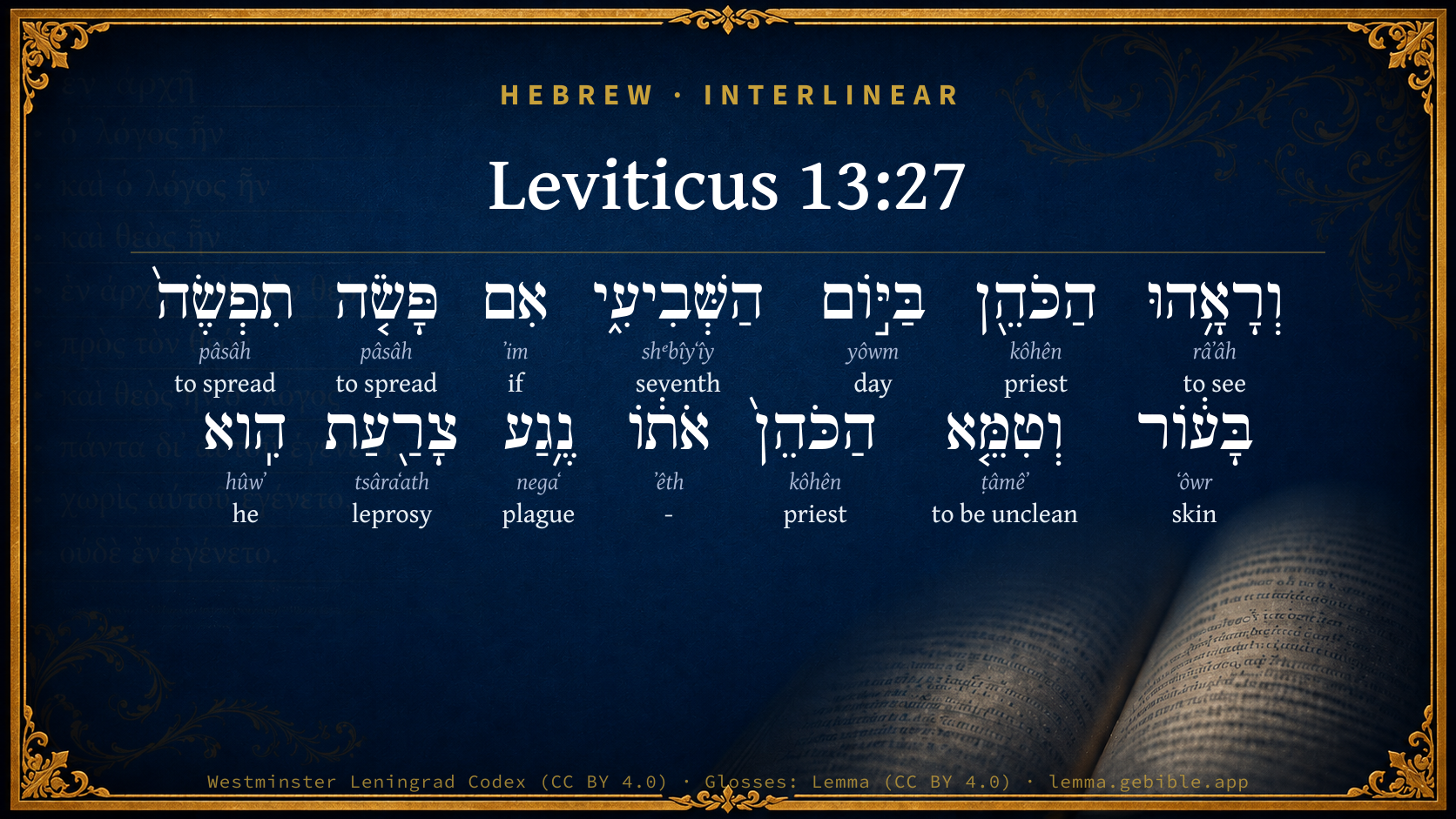
Hebrew (Westminster Leningrad Codex) Leviticus 13:27 appears in the Hebrew Old Testament. The text above is from the Westminster Leningrad Codex. Each word links to its Strong’s number, a concise gloss, and parsing drawn from the Open Scriptures Hebrew Bible morphology. Click any word for its full Brown-Driver-Briggs (BDB) entry.
Download image
Cite this verse

Leviticus 13:27 (World English Bible). Public Domain. Lemma interlinear Bible study tool, https://lemma.gebible.app/v/leviticus/13/27.

Show BibTeX & RIS
BibTeX
RIS
English Translation
The priest shall examine him on the seventh day. If it has spread in the skin, then the priest shall pronounce him unclean. It is the plague of leprosy.
World English Bible · Public Domain
Download a study sheet

One document with this verse’s original text, its word-by-word gloss line, the meaning frame, cross-references with their text, attributed commentary, and full source and license credits — printable, and it pastes into notes with its structure intact.

This verse Autodidact and up

Study sheet (.html) Plain text (.txt)

A passage Seminary Student

Up to 50 verses in one chapter. A passage sheet keeps up to 6 commentary sources and 12 cross-references per verse, in the order this page ranks them, and says so on the sheet whenever that leaves anything out. Ask for a single verse and you get the Autodidact verse sheet above.

Everything on this page stays free to read, with no account — the sheet is a download of what is already on screen, not access to it.

Want to remove ads? Support Godless Engineer
Compare translations 3

The same verse in 3 English versions, stacked beneath the original-language interlinear above. Click any original word for its lexicon entry.

Each is an independent rendering of the whole verse — the interlinear is not word-aligned to these translations.

Highlighted words mark where these versions differ — a whole-verse word diff, not a word-by-word alignment.

  • World English Bible Public Domain
    The priest shall examine him on the seventh day. If it has spread in the skin, then the priest shall pronounce him unclean. It is the plague of leprosy.
  • King James Version Public Domain
    And the priest shall look upon him the seventh day: and if it be spread much abroad in the skin, then the priest shall pronounce him unclean: it is the plague of leprosy.
  • unfoldingWord Literal Text CC BY-SA 4.0
    And the priest shall see him on the seventh day. If, spreading, it has spread on the skin, then the priest shall pronounce him unclean. It an infection of skin disease.

unfoldingWord Literal Text — © unfoldingWord, licensed CC BY-SA 4.0. Word-aligned USFM3 via Door43 (git.door43.org/unfoldingWord/en_ult).

Versions to compare (up to 4)

3 of 4 selected

Show all 18 translations

Every available English version of this verse, each an independent rendering of the whole verse.

  • World English Bible Public Domain
    The priest shall examine him on the seventh day. If it has spread in the skin, then the priest shall pronounce him unclean. It is the plague of leprosy.
  • Berean Standard Bible Public Domain
    On the seventh day the priest is to reexamine him, and if it has spread further on the skin, the priest must pronounce him unclean; it is a diseased infection.
  • Majority Standard Bible Public Domain
    On the seventh day the priest is to reexamine him, and if it has spread further on the skin, the priest must pronounce him unclean; it is a diseased infection.
  • King James Version Public Domain
    And the priest shall look upon him the seventh day: and if it be spread much abroad in the skin, then the priest shall pronounce him unclean: it is the plague of leprosy.
  • American Standard Version (1901) Public Domain
    and the priest shall look upon him the seventh day: if it spread abroad in the skin, then the priest shall pronounce him unclean: it is the plague of leprosy.
  • Revised Version (1885) Public Domain
    and the priest shall look upon him the seventh day: if it spread abroad in the skin, then the priest shall pronounce him unclean: it is the plague of leprosy.
  • Geneva Bible (1599) Public Domain
    After, the Priest shall looke on him the seuenth day: if it be growen abroad in the skinne, then the Priest shall pronounce him vncleane: for it is the plague of leprosie.
  • Douay-Rheims (1899) Public Domain
    And on the seventh day he shall view him: if the leprosy be grown farther in the skin, he shall declare him unclean.
  • Young's Literal Translation Public Domain
    and the priest hath seen him on the seventh day, if it spread greatly in the skin, then the priest hath pronounced him unclean; a plague of leprosy it `is'.
  • Literal Standard Version CC BY-SA 4.0
    and the priest has seen him on the seventh day, [and] if it spreads greatly in the skin, then the priest has pronounced him unclean; it [is] a plague of leprosy.
  • Unlocked Literal Bible CC BY-SA 4.0
    Then the priest must examine him on the seventh day. If it has spread widely in the skin, then the priest must pronounce him unclean. It is an infectious disease.
  • unfoldingWord Literal Text CC BY-SA 4.0
    And the priest shall see him on the seventh day. If, spreading, it has spread on the skin, then the priest shall pronounce him unclean. It an infection of skin disease.
  • Darby Bible Public Domain
    And the priest shall look on him the seventh day, and if it have spread much in the skin, the priest shall pronounce him unclean: it is the sore of leprosy.
  • World Messianic Bible Public Domain
    The priest shall examine him on the seventh day. If it has spread in the skin, then the priest shall pronounce him unclean. It is the plague of leprosy.
  • Webster's Bible Public Domain
    And the priest shall look upon him the seventh day: and if it is spread much in the skin, then the priest shall pronounce him unclean: it is the plague of leprosy,
  • Free Bible Version CC BY-SA 4.0
    On the seventh day the priest will inspect the person again. If then the spot has spread further on the skin, the priest will declare them unclean; it is a serious skin disease.
  • Bible in Basic English Public Domain
    And the priest is to see him again on the seventh day; if it is increased in the skin, then the priest will say that he is unclean: it is the leper's disease.
  • JPS Tanakh (1917) Public Domain
    And the priest shall look upon him the seventh day; if it spread abroad in the skin, then the priest shall pronounce him unclean: it is the plague of leprosy.

Literal Standard Version (2020), Covenant Press — licensed CC BY-SA 4.0. Text via the HelloAO Bible API (eBible.org). Unlocked Literal Bible (unfoldingWord) — licensed CC BY-SA 4.0. Text via the HelloAO Bible API (eBible.org). unfoldingWord Literal Text — © unfoldingWord, licensed CC BY-SA 4.0. Word-aligned USFM3 via Door43 (git.door43.org/unfoldingWord/en_ult). Free Bible Version, Dr. Jonathan Gallagher — licensed CC BY-SA 4.0. Text via the HelloAO Bible API (eBible.org).

Word by word

More ways to search: Search by grammar → Find every occurrence → Compare this word →

Practice this passage: Drill this verse → Learn its vocabulary →

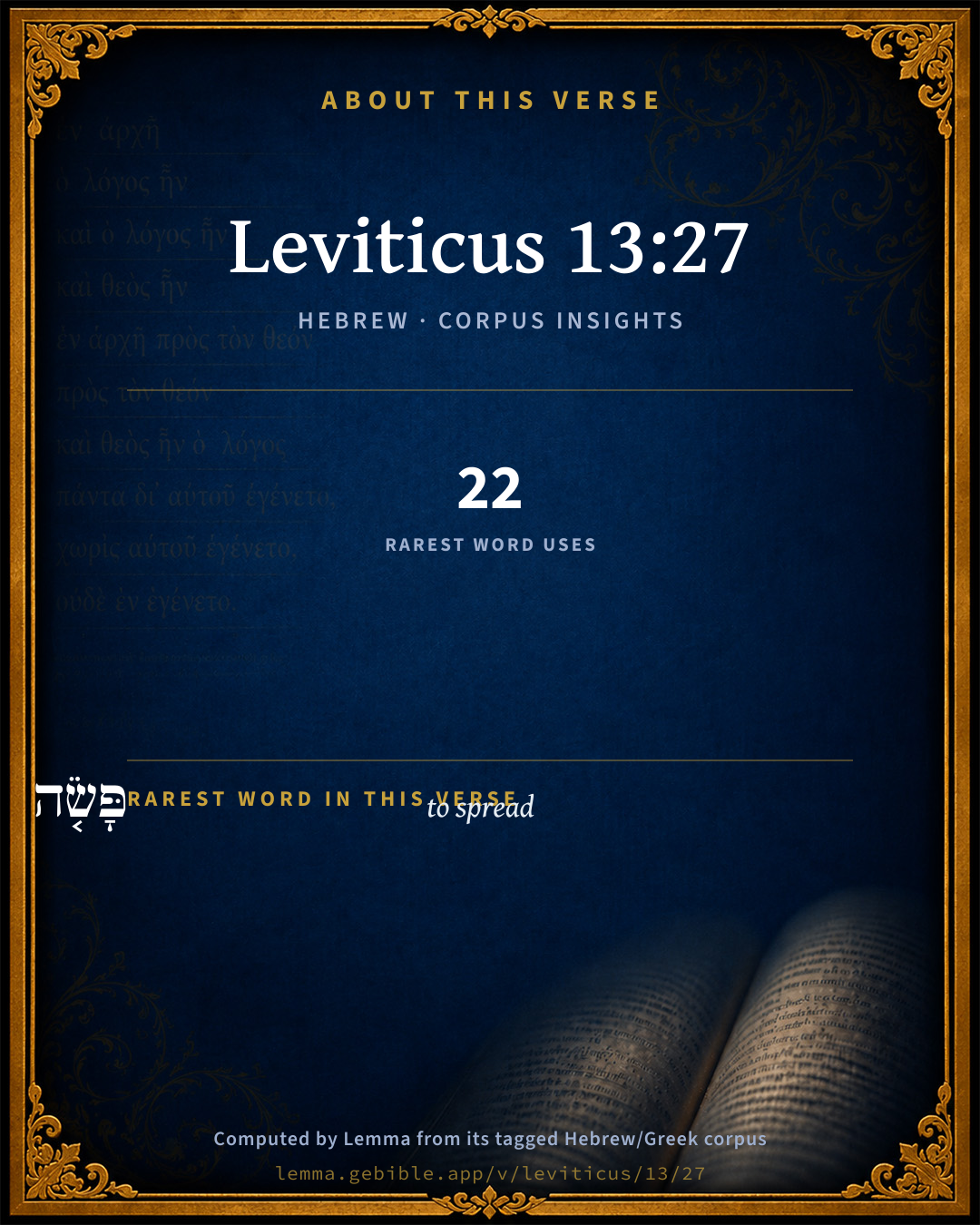
פָּשֹׂ֤ה
pâsâh
H6581
“to spread”
Verb, Qal, Infinitive Absolute
Part of Speech
Verb
Stem
Qal
Form
Infinitive Absolute
Full BDB Definition

Origin: a primitive root

TWOT: 1840

(Qal) to spread
  1. וְרָאָ֥הוּ râʼâh H7200 “and · to see · him” Conjunction + Verb, Qal, Sequential Perfect, 3rd Person, Masculine, Singular + Suffix, Personal, 3rd Person, Masculine, Singular
  2. הַכֹּהֵ֖ן kôhên H3548 “the · priest” Particle, Definite Article + Noun, Common, Masculine, Singular, Absolute
  3. בַּיּ֣וֹם yôwm H3117 “in/at the · day” Preposition, Determined + Noun, Common, Masculine, Singular, Absolute
  4. הַשְּׁבִיעִ֑י shᵉbîyʻîy H7637 “the · seventh” Particle, Definite Article + Adjective, Ordinal number, Masculine, Singular, Absolute
  5. אִם ʼim H518 “if” Conjunction
  6. תִפְשֶׂה֙ pâsâh H6581 “to spread” Verb, Qal, Imperfect, 3rd Person, Feminine, Singular
  7. בָּע֔וֹר ʻôwr H5785 “in/at the · skin” Preposition, Determined + Noun, Common, Masculine, Singular, Absolute
  8. וְטִמֵּ֤א ṭâmêʼ H2930 “and · to be unclean” Conjunction + Verb, Piel, Sequential Perfect, 3rd Person, Masculine, Singular
  9. הַכֹּהֵן֙ kôhên H3548 “the · priest” Particle, Definite Article + Noun, Common, Masculine, Singular, Absolute
  10. אֹת֔וֹ ʼêth H853 “- · him” Particle, Direct Object + Suffix, Personal, 3rd Person, Masculine, Singular
  11. נֶ֥גַע negaʻ H5061 “plague of” Noun, Common, Masculine, Singular, Construct
  12. צָרַ֖עַת tsâraʻath H6883 “leprosy” Noun, Common, Feminine, Singular, Absolute
  13. הִֽוא hûwʼ H1931 “he” Pronoun, Personal, 3rd Person, Feminine, Singular

About this verse

These counts appear in no published source. They are computed here, from the morphology-tagged text and Lemma’s own curated glosses. What Lemma adds →

14
words
12
distinct lemmas
Pentateuch
section

Notable vocabulary

The rarest word here is פָּשֹׂ֤ה to spread H6581 — appearing just 22 times in the whole Hebrew Bible.

Shared distinctive vocabulary

פָּשֹׂ֤ה to spread H6581 occurs in 18 verses of the Hebrew Bible. Also found in:

Grammatical profile

  • 4 verbs
  • 6 nouns
  • 1 adjective
  • 1 pronoun
  • 1 conjunction
  • 1 particle

Verb forms

  • וְרָאָ֥הוּ Qal · Sequential Perfect
  • פָּשֹׂ֤ה Qal · Infinitive Absolute
  • תִפְשֶׂה֙ Qal · Imperfect
  • וְטִמֵּ֤א Piel · Sequential Perfect

Repetition

Words recur within this verse — often emphatic in Hebrew:

  • הַכֹּהֵ֖ן priest H3548 ×2
  • פָּשֹׂ֤ה to spread H6581 ×2

Hebrew & Septuagint length

In English translation the verse runs 29 words from the Hebrew and 41 from the Septuagint (LXX English) — the Septuagint runs noticeably longer here. See the side-by-side →

A rough comparison of the two English renderings, which tokenize alike — not a word-level alignment.

Word counts can differ between the Hebrew and the Greek without any difference in meaning — e.g. the Hebrew direct-object marker אֵת has no separate Greek word, and Greek often adds the article ὁ.

Hebrew and Greek witnesses Masoretic Hebrew ↔ Greek Septuagint

The same verse in the two great witnesses to the Old Testament, shown verse-for-verse.

Here the Septuagint runs noticeably longer than the Hebrew — LXX2012 (modern English Septuagint) 41 words vs World English Bible 29. A rough length comparison of the two English translations, not a word-level alignment — read both below.

These are two independent witnesses, not word-aligned to each other, and the Septuagint is shown in lemma (dictionary) form.

Hebrew Leviticus 13:27 Masoretic · Westminster Leningrad Codex

וְרָאָ֥הוּ הַכֹּהֵ֖ן בַּיּ֣וֹם הַשְּׁבִיעִ֑י אִם פָּשֹׂ֤ה תִפְשֶׂה֙ בָּע֔וֹר וְטִמֵּ֤א הַכֹּהֵן֙ אֹת֔וֹ נֶ֥גַע צָרַ֖עַת הִֽוא

The priest shall examine him on the seventh day. If it has spread in the skin, then the priest shall pronounce him unclean. It is the plague of leprosy.

World English Bible · Public Domain

Greek LXX Leviticus 13:27 Septuagint · lemma form

καί ὁράω αὐτός ὁ ἱερεύς ὁ ἡμέρα ὁ ἕβδομος ἐάν δέ διάχυσις διαχέω ἐν ὁ δέρμα καί μιαίνω αὐτός ὁ ἱερεύς ἁφή λέπρα εἰμί ἐν ὁ ἕλκος ἐκἀνθέω

And the priest shall look upon him on the seventh day; and if the spot be much spread in the skin, then the priest shall pronounce him unclean: it is a plague of leprosy, it has broken out in the ulcer.

LXX2012 (modern English Septuagint) · Public Domain

On this verse, Haydock's Catholic Bible Commentary discusses the Septuagint’s reading. Read the note in Commentary ↓

Hebrew: Westminster Leningrad Codex (CC BY 4.0). Greek: Septuagint (public domain); English from LXX2012 (modern English Septuagint) (Public Domain). How the Septuagint differs from the Hebrew →

Targum (Aramaic paraphrase)

2

The Targum is the ancient Jewish Aramaic paraphrase of the Hebrew Scriptures — an interpretive translation, not the Hebrew text itself. Onkelos (literal) and Pseudo-Jonathan (expansive) render the Torah, and Jonathan the Prophets. Coverage is partial: where no permissively-licensed English translation exists for a verse, only the Aramaic is shown. This is verse-level text, not a word-by-word alignment to the Hebrew.

  1. Targum Onkelos Torah (Genesis–Deuteronomy)
    וְיֶחֱזִנֵהּ כַּהֲנָא בְּיוֹמָא שְׁבִיעָאָה אִם אוֹסָפָא תוֹסֵף בְּמַשְׁכָּא וִיסָאֵב כַּהֲנָא יָתֵהּ מַכְתַּשׁ סְגִירוּתָא הִיא

    (no public-domain English translation for this verse)

    Targum Onkelos — Aramaic: “Onkelos Genesis” (public domain); “Onkelos Exodus” (public domain); “Onkelos Leviticus” (public domain); “Onkelos Numbers” (public domain); “Onkelos Deuteronomy” (public domain). English: “Sefaria Community Translation” (CC0 1.0 (public-domain dedication)); “J.W. Etheridge. The Targums of Onkelos and Jonathan Ben Uzziel on the Pentateuch. London: Longmans, Green, 1862” (public domain). Text via Sefaria.

  2. Targum Pseudo-Jonathan Torah (Genesis–Deuteronomy)
    וְיַחְמִינֵיהּ כַּהֲנָא בְּיוֹמָא שְׁבִיעָאָה אִין הַלְכָא תַּהֲלִיךְ פִּסְיוֹנָא בְּמוֹשְׁכָא וְיַסְאִיב כַּהֲנָא יָתֵיהּ מְטוּל דְמַכְתַּשׁ סְגִירוּתָא הוּא

    And the priest shall see him on the seventh day; and if it hath gone on widening in the skin, the priest shall make him unclean; it is the plague of leprosy.

    Targum Pseudo-Jonathan — Aramaic: “Targum Jonathan on Genesis” (public domain); “Targum Jonathan on Exodus” (public domain); “Targum Jonathan on Leviticus” (public domain); “Targum Jonathan on Numbers” (public domain); “Targum Jonathan on Deuteronomy” (public domain). English: “The Targum of Jonathan ben Uzziel, trans. J. W. Etheridge, London, 1862” (public domain). Text via Sefaria.

Commentary

Notes on Leviticus 13:27 from classic Christian and Jewish commentators (each source and its license shown beneath its notes). The classic Christian expositions comment on the surrounding passage and are grouped to its opening verse, so a note may address several verses; the Jewish commentaries on the Tanakh (Rashi and others) are per-verse, so they appear only where the commentator wrote on this verse.

Lemma curates 59 commentaries, every one of them public domain or Creative Commons licensed, each selected and text-cleaned for this edition rather than reprinted as found. About our sources →

Ellicott's Commentary for English Readers

(27, 28) And the priest shall look.—The directions here given as to what the priest is to do at the end of the week’s quarantine are the same as those given in Lev_13:23-24. It will be seen that there is a difference in the treatment of the suspicious symptoms in case No. 1, and in the case before us, No. 3. In the former instance, where there is no apparent cause for the symptoms, the suspected invalid has to undergo two remands of seven days each before his case can be decided; whilst in the instance before us, where the boil, the inflammation, or the burn visibly supplies the reason for this suspicion, he is only remanded for one week, at the end of which his case is finally decided.

A Bible Commentary for English Readers, edited by Charles John Ellicott (1878–1897) — public domain. Text from a community e-Sword module.

John Gill's Exposition

And the priest shall look upon him the seventh day,.... When that is come, any time on that day; not needing to wait until the end of it, or till, the seven days are precisely up; the same is to be understood in all places in this chapter where the like is used:

and if it be spread much abroad in the skin; in the space of seven days:

then the priest shall pronounce him unclean; it is the plague of leprosy: according to the law; so that it was necessary, in such a case for him to conform to it in order to his cleansing.

John Gill's Exposition of the Whole Bible (1746–1763) — public domain (CC PDM 1.0). Text via the HelloAO Bible API.

Haydock's Catholic Bible Commentary

Unclean. Hebrew adds, "it is the stroke of leprosy," and the Septuagint, "it has spread in the ulcer."

George Leo Haydock (1774–1849), Haydock's Catholic Family Bible and Commentary, 1859 edition — public domain. Excludes Psalms (Douay-Rheims chapter numbering differs from Protestant) and Deuterocanonical books (Catholic canon only).

Lesson kit

Teaching starters — assembled from the data on this page, not authored interpretation. Every prompt links to the verse data it draws on. Edit before teaching.

Leviticus, in the Pentateuch, opens this verse with 14 words (12 distinct Hebrew lemmas). Its most distinctive word is pâsâh (“to spread”). The Greek Septuagint runs longer here. A historical commentator’s framing appears above. Read the whole chapter for the surrounding context.

Discussion questions

  1. What does “to spread” (pâsâh) contribute to the verse as a whole?
  2. How does Leviticus 13:5, which shares the word «to spread», read alongside this verse?
  3. What does the repetition of “priest” (2× in this one verse) do in this verse?
  4. The Septuagint runs longer here than the Hebrew. What might account for the difference?
  5. These translations render this verse differently. What is at stake in choosing one wording over another?
  6. «וְרָאָ֥הוּ» is a Qal Sequential Perfect verb. How does that grammatical form shape the action described?
  7. Compare how Ellicott's Commentary for English Readers and John Gill's Exposition read this verse. Where do they agree or differ?

Things to notice

Reading settings

Reading text

Shown beneath each verse's original-language words.

Old Testament
Old Testament edition

Read the OT as the Masoretic Hebrew (MT) or the Greek Septuagint (LXX).

English shown for the Greek Septuagint (in the Hebrew ↔ Greek comparison).

Comparing translations? Open the Compare panel on any verse page to stack up to four side by side.