Exodus 34:21

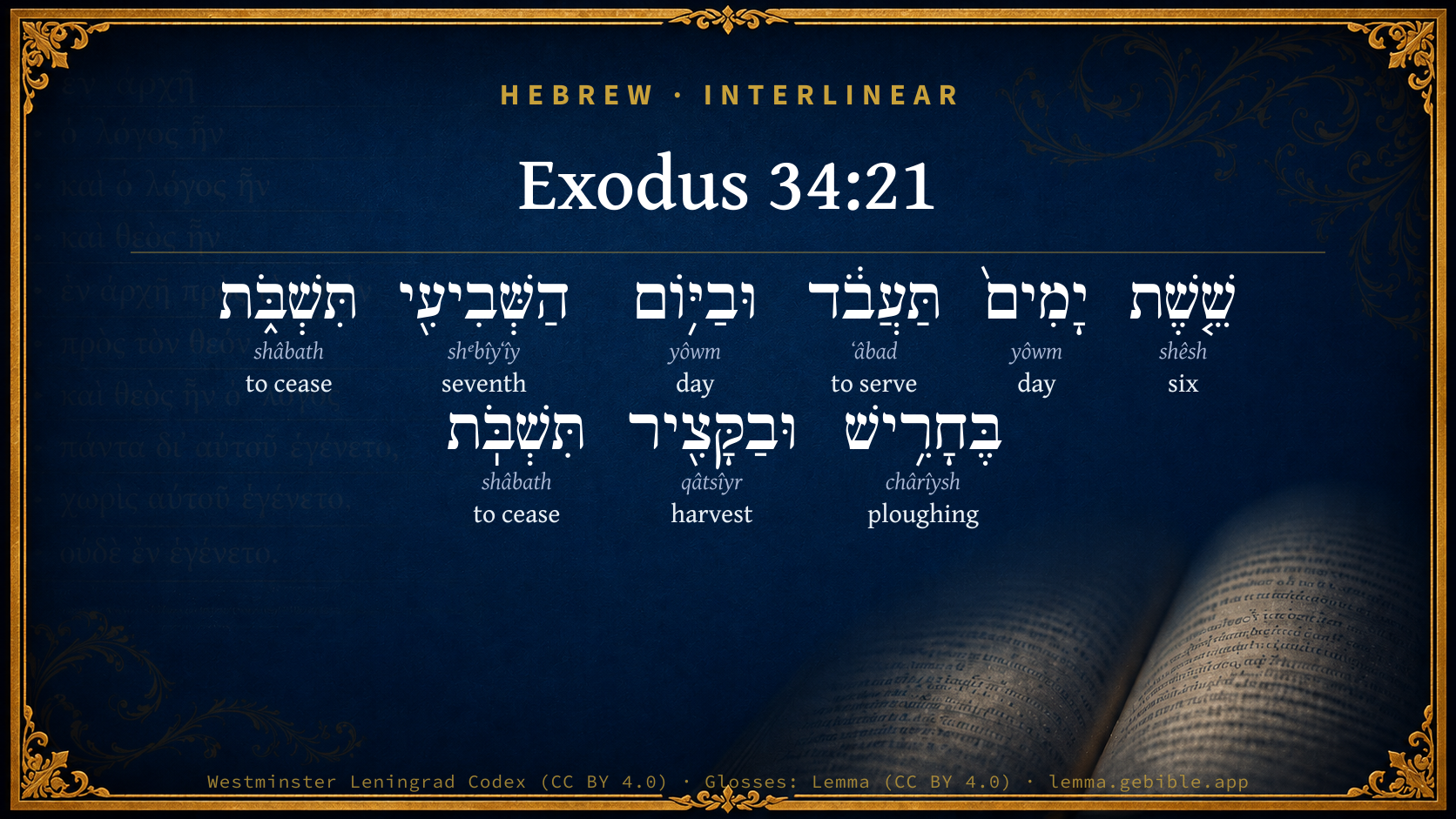
Hebrew (Westminster Leningrad Codex) Exodus 34:21 appears in the Hebrew Old Testament. The text above is from the Westminster Leningrad Codex. Each word links to its Strong’s number, a concise gloss, and parsing drawn from the Open Scriptures Hebrew Bible morphology. Click any word for its full Brown-Driver-Briggs (BDB) entry.
Download image
Cite this verse

Exodus 34:21 (World English Bible). Public Domain. Lemma interlinear Bible study tool, https://lemma.gebible.app/v/exodus/34/21.

Show BibTeX & RIS
BibTeX
RIS
English Translation
Six days you shall work, but on the seventh day you shall rest: in plowing time and in harvest you shall rest.
World English Bible · Public Domain
Download a study sheet

One document with this verse’s original text, its word-by-word gloss line, the meaning frame, cross-references with their text, attributed commentary, and full source and license credits — printable, and it pastes into notes with its structure intact.

This verse Autodidact and up

Study sheet (.html) Plain text (.txt)

A passage Seminary Student

Up to 50 verses in one chapter. A passage sheet keeps up to 6 commentary sources and 12 cross-references per verse, in the order this page ranks them, and says so on the sheet whenever that leaves anything out. Ask for a single verse and you get the Autodidact verse sheet above.

Everything on this page stays free to read, with no account — the sheet is a download of what is already on screen, not access to it.

Want to remove ads? Support Godless Engineer
Compare translations 3

The same verse in 3 English versions, stacked beneath the original-language interlinear above. Click any original word for its lexicon entry.

Each is an independent rendering of the whole verse — the interlinear is not word-aligned to these translations.

Highlighted words mark where these versions differ — a whole-verse word diff, not a word-by-word alignment.

  • World English Bible Public Domain
    Six days you shall work, but on the seventh day you shall rest: in plowing time and in harvest you shall rest.
  • King James Version Public Domain
    Six days thou shalt work, but on the seventh day thou shalt rest: in earing time and in harvest thou shalt rest.
  • unfoldingWord Literal Text CC BY-SA 4.0
    Six days you shall labor, but on the seventh day you shall rest. In plowing time and in harvest time, you shall rest.

unfoldingWord Literal Text — © unfoldingWord, licensed CC BY-SA 4.0. Word-aligned USFM3 via Door43 (git.door43.org/unfoldingWord/en_ult).

Versions to compare (up to 4)

3 of 4 selected

Show all 18 translations

Every available English version of this verse, each an independent rendering of the whole verse.

  • World English Bible Public Domain
    Six days you shall work, but on the seventh day you shall rest: in plowing time and in harvest you shall rest.
  • Berean Standard Bible Public Domain
    Six days you shall labor, but on the seventh day you shall rest; even in the seasons of plowing and harvesting, you must rest.
  • Majority Standard Bible Public Domain
    Six days you shall labor, but on the seventh day you shall rest; even in the seasons of plowing and harvesting, you must rest.
  • King James Version Public Domain
    Six days thou shalt work, but on the seventh day thou shalt rest: in earing time and in harvest thou shalt rest.
  • American Standard Version (1901) Public Domain
    Six days thou shalt work, but on the seventh day thou shalt rest: in plowing time and in harvest thou shalt rest.
  • Revised Version (1885) Public Domain
    Six days thou shalt work, but on the seventh day thou shalt rest: in plowing time and in harvest thou shalt rest.
  • Geneva Bible (1599) Public Domain
    Six dayes shalt thou worke, and in the seuenth day thou shalt rest: both in earing time, and in the haruest thou shalt rest.
  • Douay-Rheims (1899) Public Domain
    Six days shalt thou work, the seventh day thou shalt cease to plough, and to reap.
  • Young's Literal Translation Public Domain
    `Six days thou dost work, and on the seventh day thou dost rest; in ploughing-time and in harvest thou dost rest.
  • Literal Standard Version CC BY-SA 4.0
    [For] six days you work, and on the seventh day you rest; in plowing-time and in harvest you rest.
  • Unlocked Literal Bible CC BY-SA 4.0
    You may work for six days, but on the seventh day you must rest. Even at plowing time and in harvest, you must rest.
  • unfoldingWord Literal Text CC BY-SA 4.0
    Six days you shall labor, but on the seventh day you shall rest. In plowing time and in harvest time, you shall rest.
  • Darby Bible Public Domain
    -- Six days shalt thou work, but on the seventh day thou shalt rest; in ploughing time and in harvest thou shalt rest.
  • World Messianic Bible Public Domain
    “Six days you shall work, but on the seventh day you shall rest: in plowing time and in harvest you shall rest.
  • Webster's Bible Public Domain
    Six days thou shalt work, but on the seventh day thou shalt rest: in time of plowing and in harvest thou shalt rest.
  • Free Bible Version CC BY-SA 4.0
    You shall work for six days, but you shall rest on the seventh day. Even during the times of sowing and harvest you shall rest.
  • Bible in Basic English Public Domain
    Six days let work be done, but on the seventh day take your rest: at ploughing time and at the grain-cutting you are to have a day for rest.
  • JPS Tanakh (1917) Public Domain
    Six days thou shalt work, but on the seventh day thou shalt rest; in plowing time and in harvest thou shalt rest.

Literal Standard Version (2020), Covenant Press — licensed CC BY-SA 4.0. Text via the HelloAO Bible API (eBible.org). Unlocked Literal Bible (unfoldingWord) — licensed CC BY-SA 4.0. Text via the HelloAO Bible API (eBible.org). unfoldingWord Literal Text — © unfoldingWord, licensed CC BY-SA 4.0. Word-aligned USFM3 via Door43 (git.door43.org/unfoldingWord/en_ult). Free Bible Version, Dr. Jonathan Gallagher — licensed CC BY-SA 4.0. Text via the HelloAO Bible API (eBible.org).

Word by word

More ways to search: Search by grammar → Find every occurrence → Compare this word →

Practice this passage: Drill this verse → Learn its vocabulary →

בֶּחָרִ֥ישׁ
chârîysh
H2758
“in/at the · ploughing”
Preposition, Determined + Noun, Common, Masculine, Singular, Absolute
Part of Speech
Preposition + Noun
Type
Common
Gender
Masculine
Number
Singular
State
Absolute
Full BDB Definition

Origin: from H2790

TWOT: 760c

ploughing, ploughing time
  1. שֵׁ֤שֶׁת shêsh H8337 “six” Adjective, Cardinal number, Masculine, Singular, Construct
  2. יָמִים֙ yôwm H3117 “days” Noun, Common, Masculine, Plural, Absolute
  3. תַּעֲבֹ֔ד ʻâbad H5647 “to serve” Verb, Qal, Imperfect, 2nd Person, Masculine, Singular
  4. וּבַיּ֥וֹם yôwm H3117 “and · in/at the · day” Conjunction + Preposition, Determined + Noun, Common, Masculine, Singular, Absolute
  5. הַשְּׁבִיעִ֖י shᵉbîyʻîy H7637 “the · seventh” Particle, Definite Article + Adjective, Ordinal number, Masculine, Singular, Absolute
  6. תִּשְׁבֹּ֑ת shâbath H7673 “to cease” Verb, Qal, Imperfect, 2nd Person, Masculine, Singular
  7. וּבַקָּצִ֖יר qâtsîyr H7105 “and · in/at the · harvest” Conjunction + Preposition, Determined + Noun, Common, Masculine, Singular, Absolute
  8. תִּשְׁבֹּֽת shâbath H7673 “to cease” Verb, Qal, Imperfect, 2nd Person, Masculine, Singular

About this verse

These counts appear in no published source. They are computed here, from the morphology-tagged text and Lemma’s own curated glosses. What Lemma adds →

9
words
7
distinct lemmas
Pentateuch
section

Notable vocabulary

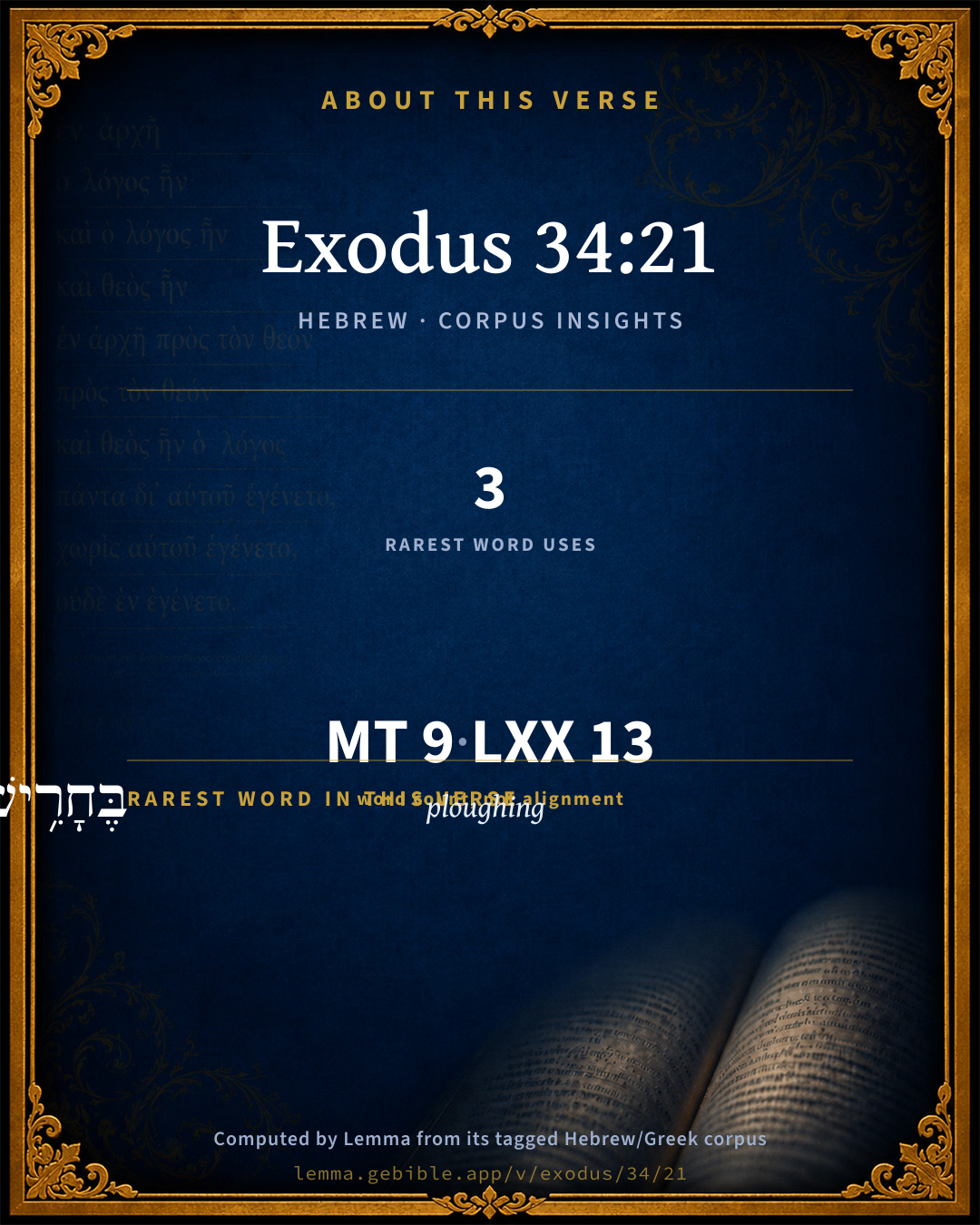
The rarest word here is בֶּחָרִ֥ישׁ ploughing H2758 — appearing just 3 times in the whole Hebrew Bible.

Shared distinctive vocabulary

בֶּחָרִ֥ישׁ ploughing H2758 occurs in 3 verses of the Hebrew Bible. Also found in:

Grammatical profile

  • 3 verbs
  • 4 nouns
  • 2 adjectives

Verb forms

  • תַּעֲבֹ֔ד Qal · Imperfect
  • תִּשְׁבֹּ֑ת Qal · Imperfect
  • תִּשְׁבֹּֽת Qal · Imperfect

Repetition

Words recur within this verse — often emphatic in Hebrew:

  • יָמִים֙ day H3117 ×2
  • תִּשְׁבֹּ֑ת to cease H7673 ×2

Hebrew & Septuagint length

In English translation the verse runs 22 words from the Hebrew and 22 from the Septuagint (LXX English) — the same length.

A rough comparison of the two English renderings, which tokenize alike — not a word-level alignment.

Word counts can differ between the Hebrew and the Greek without any difference in meaning — e.g. the Hebrew direct-object marker אֵת has no separate Greek word, and Greek often adds the article ὁ.

In the original languages it is 9 Hebrew tokens and 13 Greek tokens — but the two are counted differently (Hebrew bundles its prefixes and suffixes into one token; the Greek is in lemma form), so that isn’t a like-for-like length.

Cross-references

10

Topical passages linked to Exodus 34:21 in the Treasury of Scripture Knowledge — connected by theme and wording, ordered by reader-vote popularity; previews shown in the World English Bible.

  • Exodus 23:12 "Six days you shall do your work, and on the seventh day you shall rest, that your ox and your donkey may have rest, and the son of your handmaid, and the alien may be refreshed.
  • Exodus 35:2 'Six days shall work be done, but on the seventh day there shall be a holy day for you, a Sabbath of solemn rest to Yahweh: whoever does any work in it shall be put to death.
  • Deuteronomy 21:4 and the elders of that city shall bring down the heifer to a valley with running water, which is neither plowed nor sown, and shall break the heifer's neck there in the valley.
  • 1 Samuel 8:12 and he will appoint them to him for captains of thousands, and captains of fifties; and [he will set some] to plow his ground, and to reap his harvest, and to make his instruments of war, and the instruments of his chariots.
  • Luke 13:14 The ruler of the synagogue, being indignant because Jesus had healed on the Sabbath, said to the multitude, "There are six days in which men ought to work. Therefore come on those days and be healed, and not on the Sabbath day!"
  • Deuteronomy 5:12–15 "Observe the Sabbath day, to keep it holy, as Yahweh your God commanded you.
  • Isaiah 30:24 the oxen likewise and the young donkeys that till the ground shall eat savory provender, which has been winnowed with the shovel and with the fork.
  • Luke 23:56 They returned, and prepared spices and ointments. On the Sabbath they rested according to the commandment.
  • Genesis 45:6 For these two years the famine has been in the land, and there are yet five years, in which there will be neither plowing nor harvest.
  • Exodus 20:9–11 You shall labor six days, and do all your work,

Cross-references courtesy of OpenBible.info (CC BY 4.0).

Hebrew and Greek witnesses Masoretic Hebrew ↔ Greek Septuagint

The same verse in the two great witnesses to the Old Testament, shown verse-for-verse.

These are two independent witnesses, not word-aligned to each other, and the Septuagint is shown in lemma (dictionary) form.

Hebrew Exodus 34:21 Masoretic · Westminster Leningrad Codex

שֵׁ֤שֶׁת יָמִים֙ תַּעֲבֹ֔ד וּבַיּ֥וֹם הַשְּׁבִיעִ֖י תִּשְׁבֹּ֑ת בֶּחָרִ֥ישׁ וּבַקָּצִ֖יר תִּשְׁבֹּֽת

Six days you shall work, but on the seventh day you shall rest: in plowing time and in harvest you shall rest.

World English Bible · Public Domain

Greek LXX Exodus 34:21 Septuagint · lemma form

ἕξ ἡμέρα ἐργάζομαι ὁ δέ ἕβδομος καταπαύω ὁ σπόρος καί ὁ ἀμητός καταπαύω

Six days you shall work, but on the seventh day you shall rest: there shall be rest in seed time and harvest.

LXX2012 (modern English Septuagint) · Public Domain

Hebrew: Westminster Leningrad Codex (CC BY 4.0). Greek: Septuagint (public domain); English from LXX2012 (modern English Septuagint) (Public Domain). How the Septuagint differs from the Hebrew →

Targum (Aramaic paraphrase)

2

The Targum is the ancient Jewish Aramaic paraphrase of the Hebrew Scriptures — an interpretive translation, not the Hebrew text itself. Onkelos (literal) and Pseudo-Jonathan (expansive) render the Torah, and Jonathan the Prophets. Coverage is partial: where no permissively-licensed English translation exists for a verse, only the Aramaic is shown. This is verse-level text, not a word-by-word alignment to the Hebrew.

  1. Targum Onkelos Torah (Genesis–Deuteronomy)
    שִׁתָּא יוֹמִין תִּפְלָח וּבְיוֹמָא שְׁבִיעָאָה תְּנוּחַ בִּזְרוֹעָא וּבַחֲצָדָא תְּנוּחַ:

    (no public-domain English translation for this verse)

    Targum Onkelos — Aramaic: “Onkelos Genesis” (public domain); “Onkelos Exodus” (public domain); “Onkelos Leviticus” (public domain); “Onkelos Numbers” (public domain); “Onkelos Deuteronomy” (public domain). English: “Sefaria Community Translation” (CC0 1.0 (public-domain dedication)); “J.W. Etheridge. The Targums of Onkelos and Jonathan Ben Uzziel on the Pentateuch. London: Longmans, Green, 1862” (public domain). Text via Sefaria.

  2. Targum Pseudo-Jonathan Torah (Genesis–Deuteronomy)
    שִׁיתָּא יוֹמִין תִּפְלָח וּבְיוֹמָא שְׁבִיעָאָה תָנוּחַ בְּרִידַיָא וּבְחַצְדָא תָּנוּחַ

    Six days shalt thou work, and in the seventh day have rest; in ploughing time and in harvest thou shalt rest.

    Targum Pseudo-Jonathan — Aramaic: “Targum Jonathan on Genesis” (public domain); “Targum Jonathan on Exodus” (public domain); “Targum Jonathan on Leviticus” (public domain); “Targum Jonathan on Numbers” (public domain); “Targum Jonathan on Deuteronomy” (public domain). English: “The Targum of Jonathan ben Uzziel, trans. J. W. Etheridge, London, 1862” (public domain). Text via Sefaria.

Commentary

Notes on Exodus 34:21 from classic Christian and Jewish commentators (each source and its license shown beneath its notes). The classic Christian expositions comment on the surrounding passage and are grouped to its opening verse, so a note may address several verses; the Jewish commentaries on the Tanakh (Rashi and others) are per-verse, so they appear only where the commentator wrote on this verse.

Lemma curates 59 commentaries, every one of them public domain or Creative Commons licensed, each selected and text-cleaned for this edition rather than reprinted as found. About our sources →

Trapp's Complete Commentary

John Trapp

Exo 34:21 Six days thou shalt work, but on the seventh day thou shalt rest: in earing time and in harvest thou shalt rest.

Ver. 21. In earing time and in harvest.] Though most busy times, you may not make bold with God.

John Trapp, A Commentary or Exposition upon All the Books of the Old and New Testament (1647–1656) — public domain. Text from a community e-Sword module.

The Biblical Illustrator

Joseph S. Exell

Exo_34:21-26

Thou shalt rest.

Sabbath rest in harvest

Six days thou shalt work, but on the seventh day thou shalt rest: in earing time and in harvest thou shalt rest; that is, you shall not violate the Sabbath-day because it is harvest. I have heard persons say, It has been six days very wet; the corn is standing, and Sunday happens to be a bright sunny day; and they say, We ought to go and cut down the corn on the Sabbath-day. Here is a provision for this very possibility. God says, Even in harvest and earing time you shall still keep the Sabbath sacred to God. And I have noticed, although I admit my observation has been very limited, that that man who has cut down his corn on the Sunday in order to get it in well, did not succeed one whir better in the long run than he that observed the Sabbath as holy, and waited for sunny week-days in order to do his week-day work. I admit that there are works of necessity and mercy that are proper to be done on the Sabbath-day; and I can conceive the possibility that a time may come--an autumn may come when, even upon the Sabbath-day, you should be obliged to cut down the corn in consequence of unfavourable weather on the week-days; but you should first be well satisfied that there is no prospect of sunshine during the six days that are to follow. Do not forget that God said--not as ceremony but morality--that in earing time, and in harvest even, thou shalt rest, or sabbatize, or keep the Lords day. (J. Cumming, D. D.)

Exemplary Sabbath-keeping

I remember one time, many years ago, I was standing out for Sunday, but the owners could not bear the thought of the smacks laying to for the Sabbath. Well, the owner I sailed for wanted me to work on Sunday. I felt I could not, so I had to leave my berth. I walked about eight weeks after that in search of employment. Several owners asked me whether I wanted a situation. I asked them whether they wished me to fish on the Lords day. They said, yes. I had to decline. Well, the money was getting short, and I used to go in the dark places on the sands to lift up my heart to God to help me to stand against this fierce temptation. I had no help at home. My wife, not loving my Saviour, could not understand my objection, and I have often seen her crying to think that she and the two little children would have no bread to eat. My faith told me that my Father in heaven would not let them be without bread and water--that would be sure. At length the time came when I had to take my watch to pledge to get bread. I started with a heavy heart, and when I got to the shop I could not gain, courage to go in for a long time. I walked up and down praying to God to keep ms strong and faithful and able to part with everything rather than to betray my trust. At last I went in, and there stood one of our Church helpers behind the counter. Hullo, says he, Wilkinson, has it come to this? He was a dear young Christian, and has been a minister of the gospel for many years now. He asked me what I wanted there. Then I told him I had come to pledge my watch to get bread for wife and children. The tears stood in both our eyes. At last he asked, How much do you want on it? I said, I dont know; give me enough to get something to eat to-day; and to-morrow, perhaps, God may see fit to give me something to do where I can still serve Him. Well, he gave me some money, and he shook hands with me, and said, Have faith and courage; keep trusting in the Lord, and He will bring you through. And so He did. The next week three smacks had to be sold, and a Christian man bought one. He asked me to go as skipper of her. He told me, before I went to sea, not to do anything on Sundays if I could help it. That is twenty-six years ago, and that is how the Lord brought me through. (Captain Wilkinson, Mission Smack Ed. Birkbeck.)

Observe the feast.

Gods provision for His peoples enjoyment

I. That seasons for rejoicing were commanded. Let those who think that the Old Dispensation was gloomy remember that there was Divine injunction for joy and feasting three times a year.

II. That these seasons for rejoicing were conveniently appointed. Not in winter, but--

1. In spring, Passover.

2. Summer, First-fruits.

3. Autumn, Ingathering.

III. That these seasons for rejoicing had a religious basis.

1. The feasts were unto God.

2. Were in remembrance of Divine services which made rejoicing possible.

IV. That these seasons for rejoicing were connected with religious acts (Exo_34:17-19).

1. Personal dedication.

2. Sacrifices.

V. That seasons of rejoicing must not engender slovenliness and uncleanness (Exo_34:18).

VI. That seasons of rejoicing must not be desecrated by unnatural or superstitious ceremonies. Thou shalt not seethe a kid in his mothers milk; an outrage on nature and connected with witchcraft. In conclusion, if Judaism was a religion of joy, much more so is Christianity. The latter--

1. Was inaugurated as glad tidings of great joy.

2. Its leading fact and doctrines are grounds of joy (1Jn_1:1-4).

3. Its great central and fundamental principle is an occasion of joy (Rom_5:11).

4. The fruit of the Spirit is joy.

5. It provides an eternity of joy.

6. But remember the joy of the Lords your strength, and it is only in the Lord that we can rejoice evermore (Php_4:4). (J. W. Burn.)

Thrice in the year.--

The three yearly feasts at Jerusalem

We will--

I. Draw your attention to the institution recorded in the text. Consider--

1. Of what nature this appointment was: partly political, and partly religious.

2. What care God took to guard against the objections to which it was liable.

II. Suggest some observations founded upon it.

1. The service of God is of paramount obligation.

2. They who serve the Lord shall be saved by Him. (C. Simeon, M. A.)

The Biblical Illustrator, edited by Joseph S. Exell (c. 1880s–1900s) — public domain. Text from a community e-Sword module.

Joseph Benson's Commentary

Exo 34:21. Here is a repetition of several appointments made before, especially relating to their solemn feasts: when they had made the calf, they proclaimed a feast in honour of it; now, that they might never do so again, they are here charged with the observance of the feasts which God had instituted. Thou shalt rest, even in earing-time and in harvest — The most busy times of the year. All worldly business must give way to that holy rest: harvest-work will prosper the better for the religious observation of the sabbath day in harvest-time. Hereby we must show that we prefer our communion with God, before either the business or the joy of harvest.

Joseph Benson's Commentary on the Old and New Testaments (1811–1818) — public domain. Text from a community e-Sword module.

Adam Clarke's Commentary

Verse 21. In earing time and in harvest thou shalt rest.] This commandment is worthy of especial note; many break the Sabbath on the pretense of absolute necessity, because, if in harvest time the weather happens to be what is called bad, and the Sabbath day be fair and fine, they judge it perfectly lawful to employ that day in endeavouring to save the fruits of the field, and think that the goodness of the day beyond the preceding, is an indication from Providence that it should be thus employed. But is not the above command pointed directly against this? I have known this law often broken on this pretence, and have never been able to discover a single instance where the persons who acted thus succeeded one whit better than their more conscientious neighbors, who availed themselves of no such favourable circumstances, being determined to keep God's law, even to the prejudice of their secular interests; but no man ever yet ultimately suffered loss by a conscientious attachment to his duty to God. He who is willing and obedient, shall eat the good of the land; but God will ever distinguish those in his providence who respect his commandments.

Adam Clarke's Commentary on the Bible (1810–1826) — public domain. Text from a community e-Sword/MySword module.

Ellicott's Commentary for English Readers

(21) The law of the Sabbath meets us at every turn in Exodus. It was so fundamental to the entire polity, that it naturally held a place in every section of the legislation. We have already found it (1) propounded at the giving of the manna (Exo_16:22-30); (2) reasserted in the fourth commandment (Exo_20:8-11); (3) introduced into the “Book of the Covenant” (Exo_23:12); and (4) appended to the directions given for the construction of the Tabernacle (Exo_31:13-17).

In earing time and in harvest thou shalt rest.—“Earing-time” is ploughing time, “to ear” being an old English verb, etymologically connected with the Greek ἄρω and the Latin aro. (Comp. Gen_45:6; Deu_21:4; 1Sa_8:12; Isa_30:24.) There was a special temptation to trench on the Sabbatical rest at the times most critical in respect to agricultural operations.

A Bible Commentary for English Readers, edited by Charles John Ellicott (1878–1897) — public domain. Text from a community e-Sword module.

The Cambridge Bible for Schools and Colleges

gen. ed. J. J. S. Perowne

21. in plowing time, &c.] i.e. even at times when the need of working continuously might seem most urgent. For clause a, see on Exo_23:12.

The Cambridge Bible for Schools and Colleges (gen. ed. J. J. S. Perowne; Cambridge University Press, 1878–1918) — public domain. Text from a community e-Sword module.

John Gill's Exposition

Thrice in the year shall all your men children appear before the Lord God,.... At the three above mentioned feasts; see Gill on Exo 23:17 here it is added:

the God of Israel; who had chosen them to be his special people, had redeemed them out of Egypt, and done great things for them since; had made a covenant with them, and had now renewed that covenant with them, and was their covenant God, and they his people, and so were under great obligations to present themselves unto him at the times appointed by him.

John Gill's Exposition of the Whole Bible (1746–1763) — public domain (CC PDM 1.0). Text via the HelloAO Bible API.

Haydock's Catholic Bible Commentary

Reap; when the most urgent necessity might seem to authorize labour. (Haydock)

George Leo Haydock (1774–1849), Haydock's Catholic Family Bible and Commentary, 1859 edition — public domain. Excludes Psalms (Douay-Rheims chapter numbering differs from Protestant) and Deuterocanonical books (Catholic canon only).

Matthew Poole's English Annotations

Which times are expressed, because the great profit and seeming necessity of working at that time was likely to be a powerful temptation to make men break the sabbath.

Matthew Poole's English Annotations on the Holy Bible (1683–1685) — public domain. Text from a community e-Sword/MySword module.

The Pulpit Commentary

Six days, etc. This is repeated from the "Book of the Covenant", (Exo_23:12) but with a remarkable additionin earing time and in harvest thou shalt rest. "Earing time" is "ploughing time to "ear" being to "plough" in Old English, a word cognate with the Greek arw and the Latin are; and the command to rest both then and at harvest time is a command not to break the Sabbath rest at the seasons when it might seem most necessary so to do The temptation to "save the harvest" is readily intelligible to Englishmen. To appreciate the other temptation, we require to know the peculiar circumstances of the East. It is necessary there to complete the ploughing before the spring rains are over. These last but a short time; and when they are once past no rain can be looked for till the autumn.

The Pulpit Commentary (1880–1919), ed. H.D.M. Spence-Jones & Joseph S. Exell — public domain. Text from a community e-Sword module.

John Wesley's Explanatory Notes

Here is a repetition of several appointments made before, especially relating to their solemn feasts: when they had made the calf they proclaimed a feast in honour of it; now, that they might never do so again, they are here charged with the observance of the feasts which God had instituted. Thou shalt rest, even in earing-time and in harvest - The most busy times of the year. All wordly business must give way to that holy rest: harvest-work will prosper the better for the religious observation of the sabbath- day in harvest-time. Hereby we must shew that we prefer our communion with God, before either the business or the joy of harvest.

John Wesley, Explanatory Notes Upon the Whole Bible (1754–1765) — public domain. Text via the GEBible commentary corpus.

unfoldingWord translationNotes

Door43 World Missions Community

General Information:

Yahweh continues telling Moses what the people must do.

Even at plowing time and in harvest

"Even when you are preparing the soil or gathering the crops"

Festival of Ingathering

This festival was also known as the Festival of Shelters or the Festival of Booths. The idea came from the practice of the farmers living in temporary booths, or huts, out in the fields to guard the crop as it ripened. The word "Ingathering" means when they harvest their crop.

translationWords

rest

harvest

Pentecost

wheat

unfoldingWord translationNotes — © Distant Shores Media and the Door43 World Missions Community, licensed CC BY-SA 4.0. Source: git.door43.org/Door43/en_tn.

Rashi

Rabbi Shlomo Yitzchaki (Rashi)

בחריש ובקציר IN PLOUGHING TIME AND IN HARVEST [THOU SHALT LEAVE OFF] — Why are ploughing and harvesting specially mentioned (since all work is forbidden on Sabbath)? There are some of our Rabbis who say that this refers to ploughing in the year preceding the Sabbatical year which ploughing passeth into (produces its first fruits in) the seventh year and to harvesting grain that has reached one-third of its maturity during the Sabbatical year which harvesting actually goeth forth into (takes place in) the eighth year, that following the Sabbatical year; and that this statement is intended to teach you that one must add part of the secular time to the holy time (i. e. that one must apply to a certain period before the beginning and after the termination of the Sabbatical year the laws applicable to that year in order to prevent its desecration). Thus, the following is what it (this verse) means: “Six days thou mayest work, but on the seventh day thou shalt rest”; but even with regard to the six days’ work which I have permitted you there are years when ploughing and harvesting are forbidden. This must be the meaning, referring to ploughing in the sixth year and harvesting in the seventh, and it cannot refer to the seventh year itself for it is unnecessary to make any mention of ploughing and harvesting in the seventh year being forbidden, for it is already said (Leviticus 25:4) “[But in the seventh year …] thou shalt neither sow thy field [nor prune thine vineyard]”! Others, however, hold that Scripture in this part of the text, is only speaking of the ordinary Sabbath day, as in the first part, and ploughing and harvesting which are specially mentioned in it as being forbidden on the Sabbath are mentioned to suggest to you the following: What is the characteristic of ploughing? It is an optional act (no such work being commanded anywhere in the Law)! So, too, is harvesting forbidden on Sabbath only when it constitutes an optional act! There is, therefore, excluded the harvesting of the barley for the “Omer” (cf. Leviticus 23:10: ye shall reap the harvest thereof) which is obligatory and which therefore supersedes the Sabbath (occasions a suspension of the Sabbath laws) (Rosh Hashanah 9a).

Rashi on the Tanakh — English translations: “The Judaica Press complete Tanach with Rashi, translated by A. J. Rosenberg” (CC BY 4.0); “Pentateuch with Rashi's commentary by M. Rosenbaum and A.M. Silbermann, 1929-1934” (public domain); “The Metsudah Tanach series, Lakewood, N.J” (CC BY 4.0); and “The Book of Joshua, Metsudah Publications, 1997” (CC BY 4.0). Text via Sefaria.

Ramban (Nachmanides)

Rabbi Moshe ben Nachman (Ramban / Nachmanides)

IN PLOWING TIME AND IN HARVEST THOU SHALT REST. In line with the plain meaning of Scripture He mentioned plowing and harvesting [as works forbidden on the Sabbath] because they are the mainstay of man’s life. He mentioned the Sabbath between the holidays, putting it next to the feast of unleavened bread and the sanctification of the firstborn, because they are all a reminder of the act of Creation, for in the exodus from Egypt itself there is a sign and wonder referring to the Creation, as I have explained in the Ten Commandments. Besides, Scripture states that in the Sabbath likewise there is a reminder of the exodus from Egypt, as it says in the second Ten Commandments, And thou shalt remember that thou wast a servant in the land of Egypt, and the Eternal thy G-d brought thee out thence [by a mighty hand and by an outstretched arm]; therefore the Eternal thy G-d commanded thee to keep the Sabbath-day. There I will explain it, with the help of G-d, blessed and exalted be He.

Ramban (Nachmanides) on the Tanakh — English translation: “Commentary on the Torah by Ramban (Nachmanides). Translated and annotated by Charles B. Chavel. New York, Shilo Pub. House, 1971-1976” (CC BY 4.0). Text via Sefaria.

Lesson kit

Teaching starters — assembled from the data on this page, not authored interpretation. Every prompt links to the verse data it draws on. Edit before teaching.

Exodus, in the Pentateuch, opens this verse with 9 words (7 distinct Hebrew lemmas). Its most distinctive word is chârîysh (“ploughing”). A historical commentator’s framing appears above. Read the whole chapter for the surrounding context.

Discussion questions

  1. How does “ploughing” (chârîysh) shape what this verse is saying?
  2. Genesis 45:6 shares the word «ploughing» with this verse. How do the two illuminate each other?
  3. “day” occurs 2× in this one verse. What is the effect of the repetition?
  4. These translations render this verse differently. What is at stake in choosing one wording over another?
  5. The verb «תַּעֲבֹ֔ד» is Qal Imperfect. How does its form color the action?
  6. Reading how Trapp's Complete Commentary and The Biblical Illustrator read this verse, where do the two commentators agree and where do they part?

Things to notice

Reading settings

Reading text

Shown beneath each verse's original-language words.

Old Testament
Old Testament edition

Read the OT as the Masoretic Hebrew (MT) or the Greek Septuagint (LXX).

English shown for the Greek Septuagint (in the Hebrew ↔ Greek comparison).

Comparing translations? Open the Compare panel on any verse page to stack up to four side by side.