
Zechariah 7:5

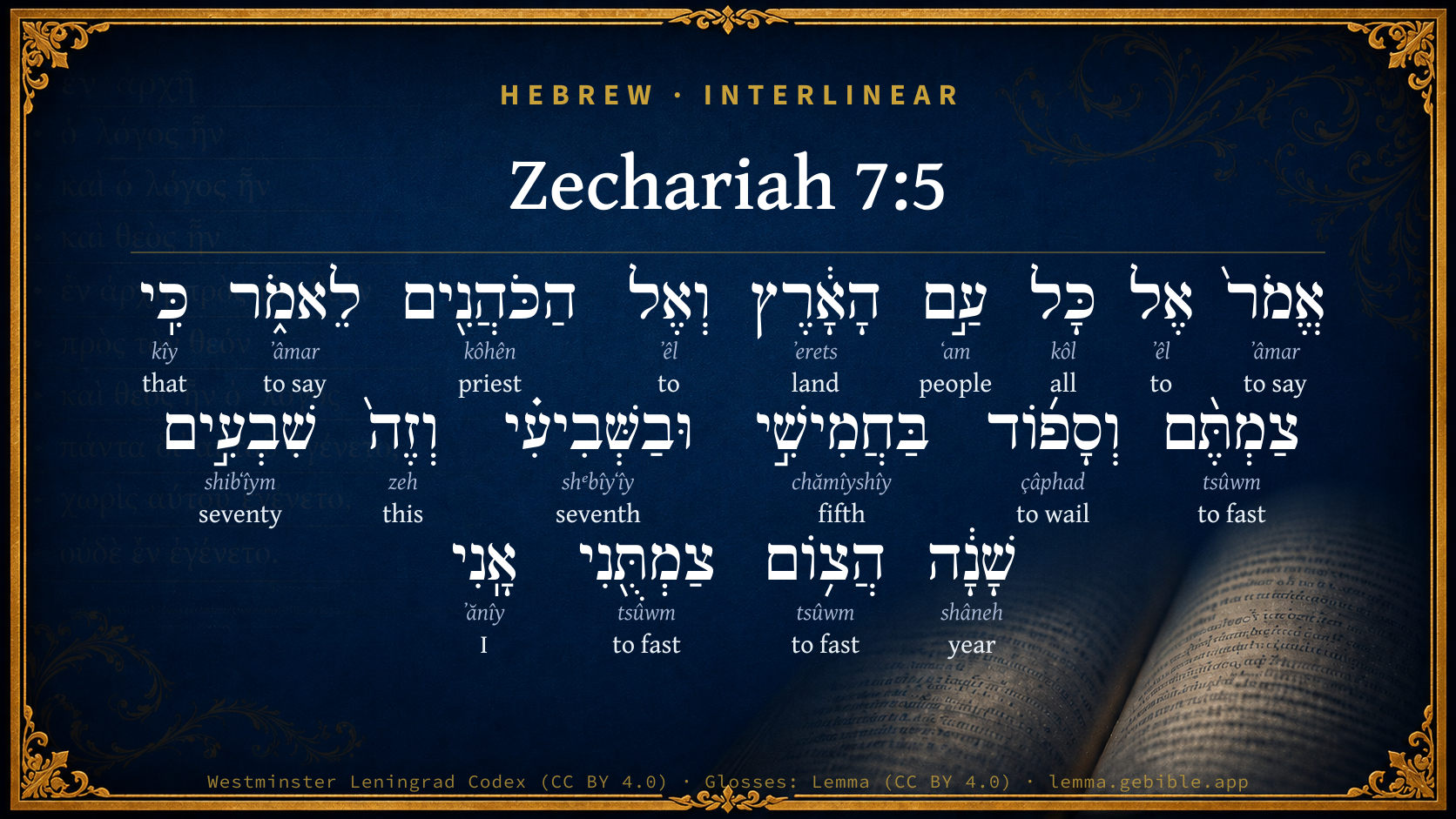
Hebrew (Westminster Leningrad Codex) Zechariah 7:5 appears in the Hebrew Old Testament. The text above is from the Westminster Leningrad Codex. Each word links to its Strong’s number, a concise gloss, and parsing drawn from the Open Scriptures Hebrew Bible morphology. Click any word for its full Brown-Driver-Briggs (BDB) entry.
Download image
Cite this verse

Zechariah 7:5 (World English Bible). Public Domain. Lemma interlinear Bible study tool, https://lemma.gebible.app/v/zechariah/7/5.

Show BibTeX & RIS
BibTeX
RIS
English Translation
"Speak to all the people of the land, and to the priests, saying, 'When you fasted and mourned in the fifth and in the seventh month for these seventy years, did you at all fast to me, really to me?
World English Bible · Public Domain
Download a study sheet

One document with this verse’s original text, its word-by-word gloss line, the meaning frame, cross-references with their text, attributed commentary, and full source and license credits — printable, and it pastes into notes with its structure intact.

This verse Autodidact and up

Study sheet (.html) Plain text (.txt)

A passage Seminary Student

Up to 50 verses in one chapter. A passage sheet keeps up to 6 commentary sources and 12 cross-references per verse, in the order this page ranks them, and says so on the sheet whenever that leaves anything out. Ask for a single verse and you get the Autodidact verse sheet above.

Everything on this page stays free to read, with no account — the sheet is a download of what is already on screen, not access to it.

Want to remove ads? Support Godless Engineer
Compare translations 3

The same verse in 3 English versions, stacked beneath the original-language interlinear above. Click any original word for its lexicon entry.

Each is an independent rendering of the whole verse — the interlinear is not word-aligned to these translations.

Highlighted words mark where these versions differ — a whole-verse word diff, not a word-by-word alignment.

  • World English Bible Public Domain
    "Speak to all the people of the land, and to the priests, saying, 'When you fasted and mourned in the fifth and in the seventh month for these seventy years, did you at all fast to me, really to me?
  • King James Version Public Domain
    Speak unto all the people of the land, and to the priests, saying, When ye fasted and mourned in the fifth and seventh month, even those seventy years, did ye at all fast unto me, even to me?
  • unfoldingWord Literal Text CC BY-SA 4.0
    “Speak to all the people of the land and to the priests, saying, ‘When you fasted and mourned in the fifth and in the seventh, and this seventy years—did you truly fast for me— me?

unfoldingWord Literal Text — © unfoldingWord, licensed CC BY-SA 4.0. Word-aligned USFM3 via Door43 (git.door43.org/unfoldingWord/en_ult).

Versions to compare (up to 4)

3 of 4 selected

Show all 18 translations

Every available English version of this verse, each an independent rendering of the whole verse.

  • World English Bible Public Domain
    "Speak to all the people of the land, and to the priests, saying, 'When you fasted and mourned in the fifth and in the seventh month for these seventy years, did you at all fast to me, really to me?
  • Berean Standard Bible Public Domain
    “Ask all the people of the land and the priests, ‘When you fasted and mourned in the fifth and seventh months for these seventy years, was it really for Me that you fasted?
  • Majority Standard Bible Public Domain
    “Ask all the people of the land and the priests, ‘When you fasted and mourned in the fifth and seventh months for these seventy years, was it really for Me that you fasted?
  • King James Version Public Domain
    Speak unto all the people of the land, and to the priests, saying, When ye fasted and mourned in the fifth and seventh month, even those seventy years, did ye at all fast unto me, even to me?
  • American Standard Version (1901) Public Domain
    Speak unto all the people of the land, and to the priests, saying, When ye fasted and mourned in the fifth and in the seventh `month', even these seventy years, did ye at all fast unto me, even to me?
  • Revised Version (1885) Public Domain
    Speak unto all the people of the land, and to the priests, saying, When ye fasted and mourned in the fifth and in the seventh month, even these seventy years, did ye at all fast unto me, even to me?
  • Geneva Bible (1599) Public Domain
    Speake vnto all the people of the land, and to the Priests, and say, When ye fasted, and mourned in the fift and seuenth moneth, euen the seuentie yeeres, did ye fast vnto me? doe I approoue it?
  • Douay-Rheims (1899) Public Domain
    Speak to all the people of the land, and to the priests, saying: When you fasted, and mourned in the fifth and the seventh month for these seventy years: did you keep a fast unto me?
  • Young's Literal Translation Public Domain
    `Speak unto all the people of the land, and unto the priests, saying:
  • Literal Standard Version CC BY-SA 4.0
    “Speak to all the people of the land, and to the priests, saying,
  • Unlocked Literal Bible CC BY-SA 4.0
    “Speak to all the people of the land and to the priests and say, 'When you fasted and mourned in the fifth and in the seventh month for these seventy years, were you truly fasting for me?
  • unfoldingWord Literal Text CC BY-SA 4.0
    “Speak to all the people of the land and to the priests, saying, ‘When you fasted and mourned in the fifth and in the seventh, and this seventy years—did you truly fast for me— me?
  • Darby Bible Public Domain
    Speak unto all the people of the land, and to the priests, saying, When ye fasted and mourned in the fifth and in the seventh [month], even those seventy years, did ye really fast unto me, [even] unto me?
  • World Messianic Bible Public Domain
    “Speak to all the people of the land and to the priests, saying, ‘When you fasted and mourned in the fifth and in the seventh month for these seventy years, did you at all fast to me, really to me?
  • Webster's Bible Public Domain
    Speak to all the people of the land, and to the priests, saying, When ye fasted and mourned in the fifth and seventh month, even those seventy years, did ye at all fast to me, even to me?
  • Free Bible Version CC BY-SA 4.0
    Tell everyone in the land and the priests, when you fasted and mourned in the fifth month and the seventh month during these seventy years, was it really me you were fasting for?
  • Bible in Basic English Public Domain
    Say to all the people of the land and to the priests, When you went without food and gave yourselves to grief in the fifth and the seventh months for these seventy years, did you ever do it because of me?
  • JPS Tanakh (1917) Public Domain
    'Speak unto all the people of the land, and to the priests, saying: When ye fasted and mourned in the fifth and in the seventh month, even these seventy years, did ye at all fast unto Me, even to Me?

Literal Standard Version (2020), Covenant Press — licensed CC BY-SA 4.0. Text via the HelloAO Bible API (eBible.org). Unlocked Literal Bible (unfoldingWord) — licensed CC BY-SA 4.0. Text via the HelloAO Bible API (eBible.org). unfoldingWord Literal Text — © unfoldingWord, licensed CC BY-SA 4.0. Word-aligned USFM3 via Door43 (git.door43.org/unfoldingWord/en_ult). Free Bible Version, Dr. Jonathan Gallagher — licensed CC BY-SA 4.0. Text via the HelloAO Bible API (eBible.org).

Word by word

More ways to search: Search by grammar → Find every occurrence → Compare this word →

Practice this passage: Drill this verse → Learn its vocabulary →

צַמְתֶּ֨ם
tsûwm
H6684
“to fast”
Verb, Qal, Perfect, 2nd Person, Masculine, Plural
Part of Speech
Verb
Stem
Qal
Form
Perfect
Person
2nd Person
Gender
Masculine
Number
Plural
Full BDB Definition

Origin: a primitive root

TWOT: 1890

(Qal) to abstain from food, fast
  1. אֱמֹר֙ ʼâmar H559 “say” Verb, Qal, Imperative, 2nd Person, Masculine, Singular
  2. אֶל ʼêl H413 “to” Preposition
  3. כָּל kôl H3605 “all of” Noun, Common, Masculine, Singular, Construct
  4. עַ֣ם ʻam H5971 “people of” Noun, Common, Masculine, Singular, Construct
  5. הָאָ֔רֶץ ʼerets H776 “the · land” Particle, Definite Article + Noun, Common, Both, Singular, Absolute
  6. וְאֶל ʼêl H413 “and · to” Conjunction + Preposition
  7. הַכֹּהֲנִ֖ים kôhên H3548 “the · priests” Particle, Definite Article + Noun, Common, Masculine, Plural, Absolute
  8. לֵאמֹ֑ר ʼâmar H559 “to say” Preposition + Verb, Qal, Infinitive Construct
  9. כִּֽי kîy H3588 “that” Conjunction
  10. וְסָפ֜וֹד çâphad H5594 “and · to wail” Conjunction + Verb, Qal, Infinitive Absolute
  11. בַּחֲמִישִׁ֣י chămîyshîy H2549 “in/at · fifth” Preposition + Adjective, Ordinal number, Masculine, Singular, Absolute
  12. וּבַשְּׁבִיעִ֗י shᵉbîyʻîy H7637 “and · in/at the · seventh” Conjunction + Preposition, Determined + Adjective, Ordinal number, Masculine, Singular, Absolute
  13. וְזֶה֙ zeh H2088 “and · this” Conjunction + Pronoun, Demonstrative, Masculine, Singular
  14. שִׁבְעִ֣ים shibʻîym H7657 “seventy” Adjective, Cardinal number, Both, Plural, Absolute
  15. שָׁנָ֔ה shâneh H8141 “year” Noun, Common, Feminine, Singular, Absolute
  16. הֲצ֥וֹם tsûwm H6684 “to fast” Particle, Interrogative + Verb, Qal, Infinitive Absolute
  17. צַמְתֻּ֖נִי tsûwm H6684 “to fast · me” Verb, Qal, Perfect, 2nd Person, Masculine, Plural + Suffix, Personal, 1st Person, Common, Singular
  18. אָֽנִי ʼănîy H589 “I” Pronoun, Personal, 1st Person, Common, Singular

About this verse

These counts appear in no published source. They are computed here, from the morphology-tagged text and Lemma’s own curated glosses. What Lemma adds →

19
words
15
distinct lemmas
Prophets
section

Notable vocabulary

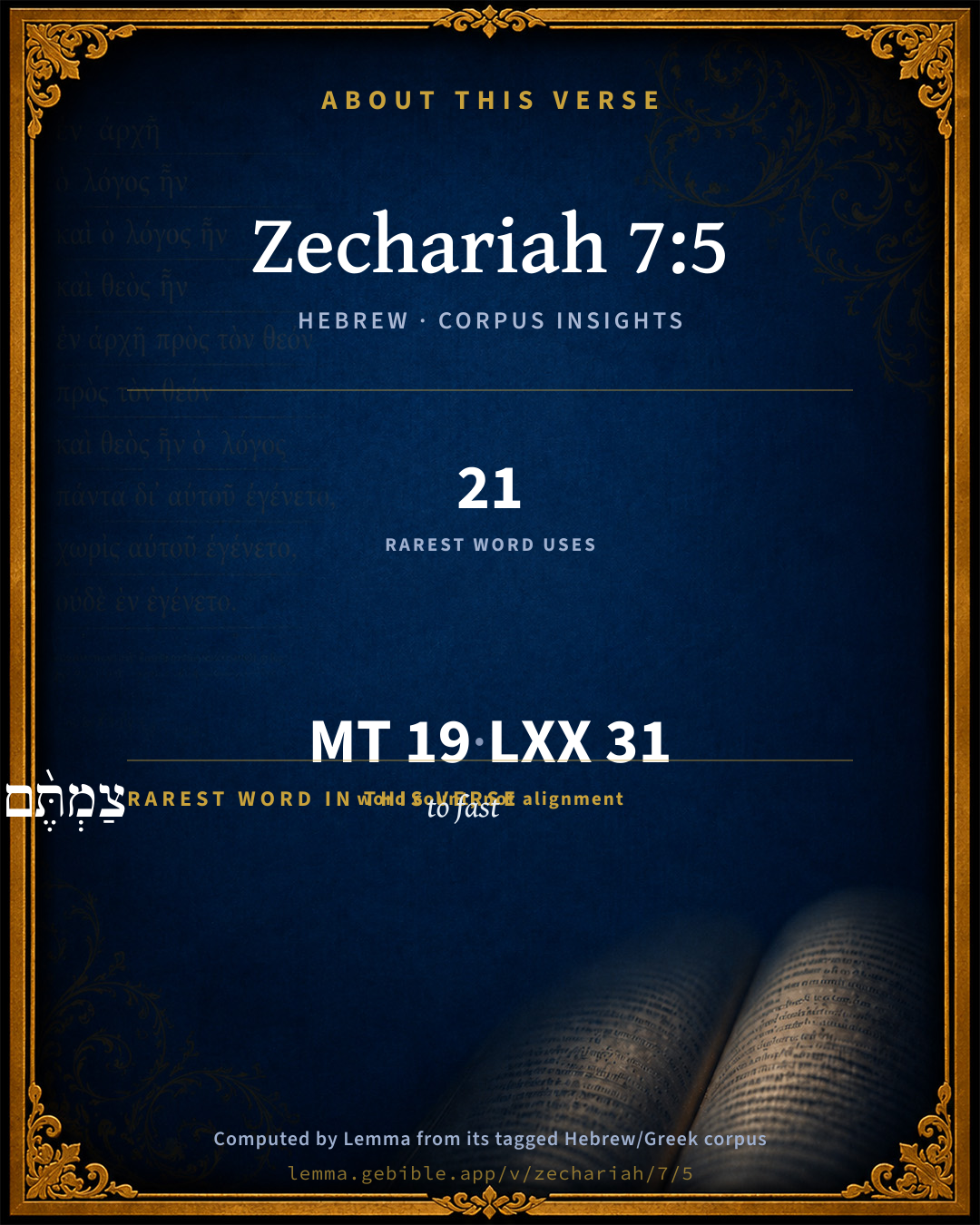
The rarest word here is צַמְתֶּ֨ם to fast H6684 — appearing just 21 times in the whole Hebrew Bible.

Shared distinctive vocabulary

צַמְתֶּ֨ם to fast H6684 occurs in 17 verses of the Hebrew Bible. Also found in:

Grammatical profile

  • 6 verbs
  • 5 nouns
  • 3 adjectives
  • 2 pronouns
  • 2 prepositions
  • 1 conjunction

Verb forms

  • אֱמֹר֙ Qal · Imperative
  • לֵאמֹ֑ר Qal · Infinitive Construct
  • צַמְתֶּ֨ם Qal · Perfect
  • וְסָפ֜וֹד Qal · Infinitive Absolute
  • הֲצ֥וֹם Qal · Infinitive Absolute
  • צַמְתֻּ֖נִי Qal · Perfect

Repetition

Words recur within this verse — often emphatic in Hebrew:

  • צַמְתֶּ֨ם to fast H6684 ×3
  • אֱמֹר֙ to say H559 ×2
  • אֶל to H413 ×2

Hebrew & Septuagint length

In English translation the verse runs 40 words from the Hebrew and 36 from the Septuagint (LXX English) — closely comparable.

A rough comparison of the two English renderings, which tokenize alike — not a word-level alignment.

Word counts can differ between the Hebrew and the Greek without any difference in meaning — e.g. the Hebrew direct-object marker אֵת has no separate Greek word, and Greek often adds the article ὁ.

In the original languages it is 19 Hebrew tokens and 31 Greek tokens — but the two are counted differently (Hebrew bundles its prefixes and suffixes into one token; the Greek is in lemma form), so that isn’t a like-for-like length.

Cross-references

19

Topical passages linked to Zechariah 7:5 in the Treasury of Scripture Knowledge — connected by theme and wording, ordered by reader-vote popularity; previews shown in the World English Bible.

  • Zechariah 1:12 Then the angel of Yahweh replied, "O Yahweh of Hosts, how long will you not have mercy on Jerusalem and on the cities of Judah, against which you have had indignation these seventy years?"
  • Isaiah 58:4–6 Behold, you fast for strife and contention, and to strike with the fist of wickedness: you don't fast this day so as to make your voice to be heard on high.
  • Matthew 5:16–18 Even so, let your light shine before men; that they may see your good works, and glorify your Father who is in heaven.
  • 1 Corinthians 10:31 Whether therefore you eat, or drink, or whatever you do, do all to the glory of God.
  • Isaiah 1:11–12 "What are the multitude of your sacrifices to me?," says Yahweh. "I have had enough of the burnt offerings of rams, And the fat of fed animals. I don't delight in the blood of bulls, Or of lambs, Or of male goats.
  • Zechariah 7:3 and to speak to the priests of the house of Yahweh of Hosts, and to the prophets, saying, "Should I weep in the fifth month, separating myself, as I have done these so many years?"
  • Zechariah 7:6 When you eat, and when you drink, don't you eat for yourselves, and drink for yourselves?
  • Matthew 6:2 Therefore when you do merciful deeds, don't sound a trumpet before yourself, as the hypocrites do in the synagogues and in the streets, that they may get glory from men. Most assuredly I tell you, they have received their reward.
  • Matthew 6:5 "When you pray, you shall not be as the hypocrites, for they love to stand and pray in the synagogues and in the corners of the streets, that they may be seen by men. Most assuredly, I tell you, they have received their reward.
  • Matthew 6:16 "Moreover when you fast, don't be like the hypocrites, with sad faces. For they disfigure their faces, that they may be seen by men to be fasting. Most assuredly I tell you, they have received their reward.
  • Romans 14:6–9 He who observes the day, observes it to the Lord; and he who does not observe the day, to the Lord he does not observe it. He who eats, eats to the Lord, for he gives God thanks. He who doesn't eat, to the Lord he doesn't eat, and gives God thanks.
  • Romans 14:17–18 for the Kingdom of God is not eating and drinking, but righteousness, peace, and joy in the Holy Spirit.
  • Colossians 3:23 And whatever you do, work heartily, as for the Lord, and not for men,
  • 2 Kings 25:23 Now when all the captains of the forces, they and their men, heard that the king of Babylon had made Gedaliah governor, they came to Gedaliah to Mizpah, even Ishmael the son of Nethaniah, and Johanan the son of Kareah, and Seraiah the son of Tanhumeth the Netophathite, and Jaazaniah the son of the Maacathite, they and their men.
  • Jeremiah 25:11 This whole land shall be a desolation, and an astonishment; and these nations shall serve the king of Babylon seventy years.
  • Jeremiah 41:1–4 Now it happened in the seventh month, that Ishmael the son of Nethaniah, the son of Elishama, of the seed royal and [one of] the chief officers of the king, and ten men with him, came to Gedaliah the son of Ahikam to Mizpah; and there they ate bread together in Mizpah.
  • Zechariah 8:19 Thus says Yahweh of Hosts: "The fasts of the fourth fifth, seventh, and tenth months shall be for the house of Judah joy and gladness, and cheerful feasts. Therefore love truth and peace."
  • Matthew 23:5 But all their works they do to be seen by men. They make their phylacteries broad, enlarge the fringes of their garments,
  • 2 Corinthians 5:15 He died for all, that those who live should no longer live to themselves, but to him who for their sakes died and rose again.

Cross-references courtesy of OpenBible.info (CC BY 4.0).

Hebrew and Greek witnesses Masoretic Hebrew ↔ Greek Septuagint

The same verse in the two great witnesses to the Old Testament, shown verse-for-verse.

These are two independent witnesses, not word-aligned to each other, and the Septuagint is shown in lemma (dictionary) form.

Hebrew Zechariah 7:5 Masoretic · Westminster Leningrad Codex

אֱמֹר֙ אֶל כָּל עַ֣ם הָאָ֔רֶץ וְאֶל הַכֹּהֲנִ֖ים לֵאמֹ֑ר כִּֽי צַמְתֶּ֨ם וְסָפ֜וֹד בַּחֲמִישִׁ֣י וּבַשְּׁבִיעִ֗י וְזֶה֙ שִׁבְעִ֣ים שָׁנָ֔ה הֲצ֥וֹם צַמְתֻּ֖נִי אָֽנִי

"Speak to all the people of the land, and to the priests, saying, 'When you fasted and mourned in the fifth and in the seventh month for these seventy years, did you at all fast to me, really to me?

World English Bible · Public Domain

Greek LXX Zechariah 7:5 Septuagint · lemma form

εἶπον πρός ἅπας ὁ λαός ὁ γῆ καί πρός ὁ ἱερεύς λέγω ἐάν νηστεύω ἤ κόπτω ἐν ὁ πέμπτος ἤ ἐν ὁ ἕβδομος καί ἰδού ἑβδομήκοντα ἔτος μή νηστεία νηστεύω ἐγώ

Speak to the whole people of the land, and to the priests, saying, Though you⌃ fasted or lamented in the fifth or seventh months (yes, behold, these seventy years) have you⌃ at all fasted to me?

LXX2012 (modern English Septuagint) · Public Domain

Hebrew: Westminster Leningrad Codex (CC BY 4.0). Greek: Septuagint (public domain); English from LXX2012 (modern English Septuagint) (Public Domain). How the Septuagint differs from the Hebrew →

Targum (Aramaic paraphrase)

1

The Targum is the ancient Jewish Aramaic paraphrase of the Hebrew Scriptures — an interpretive translation, not the Hebrew text itself. Onkelos (literal) and Pseudo-Jonathan (expansive) render the Torah, and Jonathan the Prophets. Coverage is partial: where no permissively-licensed English translation exists for a verse, only the Aramaic is shown. This is verse-level text, not a word-by-word alignment to the Hebrew.

  1. Targum Jonathan Prophets (Joshua–Malachi)
    אֱמַר לְכָל עַמָא דְאַרְעָא וּלְכַהֲנַיָא לְמֵימַר אֲרֵי צַיְמִין אַתּוּן וְסָפְדִין בְּחַמְשָׁא וּבִשְׁבִיעָאָה דְנַן שַׁבְעִין שְׁנִין הֲצוֹם תַּעֲנִי אַתּוּן מִתְעַנִין קָדָמָי:

    (no public-domain English translation for this verse)

    Targum Jonathan — Aramaic: “Mikraot Gedolot” (public domain). English: “Sefaria Community Translation” (CC0 1.0 (public-domain dedication)); “London "Chaldee Paraphrase," 1871” (public domain). Text via Sefaria.

Commentary

Notes on Zechariah 7:5 from classic Christian and Jewish commentators (each source and its license shown beneath its notes). The classic Christian expositions comment on the surrounding passage and are grouped to its opening verse, so a note may address several verses; the Jewish commentaries on the Tanakh (Rashi and others) are per-verse, so they appear only where the commentator wrote on this verse.

Lemma curates 59 commentaries, every one of them public domain or Creative Commons licensed, each selected and text-cleaned for this edition rather than reprinted as found. About our sources →

Ellicott's Commentary for English Readers

(5) All the people.—The question, though asked but by a few, was of interest to all the people; or the people of Bethel may have been the representatives of all the people; at all events the reply is given to the whole nation (Zec_7:5). Though the mission came in the ninth month, no question was asked about the fast of the tenth month, but only about that of the fifth month. The reason of this appears to be, that the fast in Ab being in connection with their mourning for the destruction of the Temple, it was natural that, now the rebuilding of it had progressed so far, they should inquire whether that particular fast should be kept. The prophet, in his first reply, mentions also the fast of the 3rd of the seventh month (Tishri), which was kept in memory of the assassination of Gedaliah, which took place soon after the destruction of the Temple. The seventy years to which he refers are those between the seventh month B.C. 587 (the date of the assassination of Gedaliah) and the ninth month B.C. 518 (the date of the Bethel mission).

A Bible Commentary for English Readers, edited by Charles John Ellicott (1878–1897) — public domain. Text from a community e-Sword module.

Trapp's Complete Commentary

John Trapp

Zec 7:5 Speak unto all the people of the land, and to the priests, saying, When ye fasted and mourned in the fifth and seventh [month], even those seventy years, did ye at all fast unto me, [even] to me?

Ver. 5. Speak unto all the people of the land], Not to the ambassadors only: as the cause is common, so let the answer be public; for they were all too well conceited of their external services, bodily exercises, and made much ado about a trifle, a practice of their own devising, neglecting the weightier matters of the law, judgment, mercy, and faith, Mat 23:23.

And to the priests] Who themselves were to seek belike; and having been the authors and observers of these customs, were backward to abolish them, as those that rested in them without true repentance, faith, and new obedience.

When ye fasted and mourned in the fifth and seventh month] sc. For the slaughter of Gedaliah and the sad consequence thereof, 2Ki 25:22 Jer 41:1.

Even those seventy years] Wherein ye have lost full seven score fasts; and were not a bit the better for them, because they fasted rather to get off their chains than their sins; they rested in their fasts, in the work done, neither regarding how nor why they should fast. Now God weighs men’s actions by their aims. And with him, though a good aim doth not make a bad action good (as we see in the case of Uzzah), yet a bad aim makes a good action bad, as in Jehu’s reformation. He had a squint eye to his own ends in all (as the eagle hath an eye upon her prey when she flies highest), and so consulted ruin to his own house.

Did ye at all fast unto me, even to me?] Did you propound me to yourselves? Or gat I anything by the hand? Did you serve me? and not yourselves rather upon me? Was it not sinful self-love and base self-seeking that put you upon these practices? looked you any higher therein than only to the satisfying of your own carnal humours? God was not in all your thoughts. This Daniel saw and acknowledged with grief and shame, Dan 9:13 "All this is come upon us: yet made we not our prayer before the Lord our God, that we might turn from our iniquities and understand thy truth: therefore hath the Lord watched upon the evil and brought it upon us," &c. The Jews no doubt had prayed much and often during that seventy years’ captivity; yet Daniel denies that they had prayed to any purpose; because they had failed both quoad fontem et quoad finem, they had acted from evil principles, and had been carried on by self-respects. They had not that true heart spoken of by the apostle, Heb 10:22, but that wicked mind mentioned by the wise man, Pro 21:27. The sacrifice of the wicked is abominable; how much more when he brings it with a wicked mind; either as thinking to deceive the God of heaven, or at least to stop his judgments, and still the noise of his own conscience by his external services. Thus Ephraim bore fruit to himself, but proved an empty vine, Hos 10:1; when as the spouse (that fruitful vine on Christ’s house side) kept her fruit for her beloved, Son 5:4; who therefore fed heartily upon it; and not upon her vine only, but her milk too; not upon her honey only, her finer and sweeter services, but upon her honeycomb too, that had much wax in it, meaning her more worse and coarser performances. If the heart be upright all is well between Christ and his people. O labour for that truth in the inward parts, that we may be, with "Apelles, approved in Christ," Rom 16:10; that he may say of us, as once he did of Nathaniel, "Behold an Israelite indeed, in whom is no guile." Great virtues not sweetened with sincerity are no ornaments unto us, and great infirmities not soured with hypocrisy are no great deformities. Those God acknowledgeth not, these he imputeth not.

John Trapp, A Commentary or Exposition upon All the Books of the Old and New Testament (1647–1656) — public domain. Text from a community e-Sword module.

Tyndale Open Study Notes

Tyndale Open Resources

7:5 According to Jeremiah, seventy years of exile in Babylon (see Jer 25:11-12; 29:10) were to make up the Sabbath years of rest for the land that had gone unobserved for nearly 500 years (2 Chr 36:21; see Exod 23:10-11; Lev 26:34-35). • While the summer fast lamented the destruction of Solomon’s Temple (Zech 7:3), the early autumn fast either commemorated the assassination of Gedaliah, governor of Judah (see 2 Kgs 25:22-25; Jer 41:1-3), or it was the Day of Atonement (Lev 23:26-32).

Tyndale Open Study Notes — © Tyndale Open Resources, licensed CC BY-SA 4.0. Text via the HelloAO Bible API.

Geneva Bible (1599)

Geneva Bible translators

For there were both of the people, and of the Priests, which doubted as touching this controversy, besides them which as yet remained in Chaldea, and reason of it, as of one of the chief points of their religion.

For they thought they had deserved toward God because of this fast, which they invented of themselves: and though fasting of itself be good, yet because they thought it a service toward God, and trusted therein, it is here reproved.

Geneva Bible (1599) marginal notes — public domain. Text via Bolls.life.

Jamieson, Fausset & Brown

Robert Jamieson, A. R. Fausset & David Brown

Speak unto all--The question had been asked in the name of the people in general by Sherezer and Regemmelech. The self-imposed fast they were tired of, not having observed it in the spirit of true religion.

seventh month--This fast was in memory of the murder of Gedaliah and those with him at Mizpah, issuing in the dispersion of the Jews (Kg2 25:25-26; Jer 41:1-3).

did ye . . . fast unto me?--No; it was to gratify yourselves in hypocritical will-worship. If it had been "unto Me," ye would have "separated yourselves" not only from food, but from your sins (Isa 58:3-7). They falsely made the fast an end intrinsically meritorious in itself, not a means towards God's glory in their sanctification. The true principle of piety, reference to God, was wanting: hence the emphatic repetition of "unto Me." Before settling questions as to the outward forms of piety (however proper, as in this case), the great question was as to piety itself; that being once settled, all their outward observances become sanctified, being "unto the Lord" (Rom 14:6).

Jamieson, Fausset & Brown — Commentary Critical and Explanatory on the Whole Bible (1871) — public domain (CC PDM 1.0). Text via the HelloAO Bible API.

Adam Clarke's Commentary

Verse 5. When ye fasted and mourned in the fifth - month] This they did in the remembrance of the burning of the temple, on the tenth day of that month; and on the seventh month, on the third of which month they observed a fast for the murder of Gedaliah, and the dispersion of the remnant of the people which were with him. See Jer 41:1, and 2Kg 25:25.

Adam Clarke's Commentary on the Bible (1810–1826) — public domain. Text from a community e-Sword/MySword module.

John Calvin's Commentaries

He therefore brings this charge against them, Have ye fasted to me? have ye eaten to me? as though he had said, “God regards not fastings, except they proceed from a sincere feeling and tend to a right and lawful end.” It was then the object of the Prophet to awaken the Jews, that they might not imagine that God was pacified by fasting or by any other frigid ceremonies, but that they might know that something more was required. And we see how prone mankind are to rely on external rites, and to think that they have rightly performed their duty to God when they have fasted. As then human nature labors under this disease, the Prophet is here sent to dissipate this delusion; which he does by declaring that fasting does not please God, or is acceptable to him, as though it were something meritorious, or as though there was in it any holiness.

He says first, that the word of Jehovah was given to him, that he might go to the people of the land and to the priests. We see the truth of what I have already said, that the answer was not directed to the captives, but to the very inhabitants of the land and to the citizens of Jerusalem, and for this reason, — because they thought that when the question respecting fasting was moved, the first and chief part of all religion was the subject of inquiry. Hence God, that he might strip them of this superstition, says, When ye fasted in the fifth month and in the seventh month, and during the seventy years, did ye fast to me — to me? for he has put an affix to the verb, צמתני, tsametni, and afterwards added אני, ani: as though he had said, “Was it to me that ye fasted? Shall I approve of such fasting?” There is an emphasis in the repetition, as though he had said, that there was no reason for the Jews to boast that they faithfully served God, and fully performed their duty, because they fasted twice in the year, for they had to do with that God who rejected such trifling things.

We hence learn that nothing is more preposterous than for men to judge of God’s worship according to their own notions, and to trust in themselves. It is indeed easy for us to deceive ourselves; for as we are earthly, so we may think that whatever glitters before our eyes is most acceptable to God. But the Prophet here reminds us, by one sentence, how frivolous are such self-pleasing thoughts; for God meets us with this question, “Have ye fasted to me? Are ye to be judges, and is it right for you at your pleasure to invent various modes of worship? But I remain always like myself, and not transform me according to what pleases you; for I repudiate everything of this kind.”

John Calvin's Commentaries (1540-1563) — public domain. Text from the Calvin Translation Society English edition (1840s-50s) via the Christian Classics Ethereal Library (ccel.org). Calvin's coverage is partial (roughly two-thirds of the Bible); uncommented books and verses are honest gaps, never fabricated. The 19th-century editor's footnotes and remarks are omitted so the notes are faithfully Calvin's own voice.

The Cambridge Bible for Schools and Colleges

gen. ed. J. J. S. Perowne

4–7. The Answer. First Section

5. seventh month] This fast appears to have been observed during the captivity, because in the seventh month “the murder of Gedaliah, whom the king of Babylon made governor of the land, completed the calamities of Jerusalem, in the voluntary but prohibited exile to Egypt, for fear lest the murder should be avenged on them.” Pusey. See 2Ki_25:25-26; Jeremiah 41-43.

even to me] For the emphatic repetition of the pronoun comp. Hag_1:4 and note.

The Cambridge Bible for Schools and Colleges (gen. ed. J. J. S. Perowne; Cambridge University Press, 1878–1918) — public domain. Text from a community e-Sword module.

John Gill's Exposition

And when ye did eat, and when ye did drink,.... Either at common meals, or at their festivals:

did not ye eat for yourselves, and drink for yourselves? merely and only for their own refreshment and pleasure, and not for the glory of God; though that ought to be the principal end in eating and drinking, Co1 10:31.

John Gill's Exposition of the Whole Bible (1746–1763) — public domain (CC PDM 1.0). Text via the HelloAO Bible API.

Albert Barnes' Notes on the Bible

Speak unto all the people of the land - They of Bethel had spoken as one man, as Edom said to Israel, “Thou shalt not pass by me” Num 20:18; and “the men of Israel said to the Hivite; Perhaps thou dwellest in the midst of me, and how shall I make a league with thee?” Jos 9:7. God gives the answer not to them only, but to all like-minded with them, “all the people of the land,” the whole population (in our language); as Jeremiah says, “ye and your fathers, your kings and your princes and all the people of the land” Jer 44:21, and, “the scribe who mustered the people of the land.” Jer 52:25.

When ye fasted and that, mourning - It was no mere abstinence from food (severe as the Jewish fasts were, one unbroken abstinence from evening to evening) but with real mourning, the word being used only of mourning for the dead (Gen 23:2; Gen 50:10; 1Sa 25:1; 1Sa 28:3; 2Sa 1:12; 2Sa 3:31; 2Sa 11:26; 1Ki 13:29-30; 1Ki 14:13, 1Ki 14:18; Ecc 12:5; Jer 16:4-6; Jer 22:18; (twice); Jer 25:33; Jer 34:5; Eze 24:16, Eze 24:23; Zec 12:10, Zec 12:12), or, in a few instances, , for a very great public calamity; probably with beating on the breast.

In the seventh month - The murder of Gedaliah, “whom the king of Babylon made governor of the land,” completed the calamities of Jerusalem, in the voluntary, but prohibited exile to Egypt, for fear lest the murder should be avenged on them Jer. 41–43.

Did ye at all fast unto Me, Me? - God emphatically rejects such fasting as their’s had been, as something, unutterably alien from Him, “to Me, Me!” Yet the fasting and mourning had been real, but irreligious, like remorse for ill-deeds, which has self only for its ground. He prepares the way for His answer by correcting the error of the question. Osorius: “Ye fasted to yourselves, not to Me. For ye mourned your sorrows, not your misdeeds; and your public fast was undertaken, not for My glory, but out of feeling for your own grief. But nothing can be pleasing to God, which is not referred to His glory. But those things alone can be referred to His glory, which are done with righteousness and devotion.”

Albert Barnes' Notes on the Bible (1834–1885) — public domain. Text from a community e-Sword/MySword module.

Haydock's Catholic Bible Commentary

Years, from the ruin of the temple till the fourth of Darius. --- Unto me? Did you grieve for the injury done to me; or was your sorrow caused by your own loss? The prophet gives not a direct answer; but sufficiently shews that exterior works of themselves are of little value. Whether the Jews entered into his sentiments or not, they still observe these fasts, though he said they should be changed into days of rejoicing, chap. viii. 19. (Calmet) --- The fast was good, but imperfect, wanting works of charity. (St. Gregory) (Worthington)

George Leo Haydock (1774–1849), Haydock's Catholic Family Bible and Commentary, 1859 edition — public domain. Excludes Psalms (Douay-Rheims chapter numbering differs from Protestant) and Deuterocanonical books (Catholic canon only).

Matthew Poole's English Annotations

Speak unto all the people, i.e. either by their messengers who came in their name, or to all the Jews that were at Jerusalem.

Of the land; by which it seems to be not the loiterers in Babylon, but the returned in Judea, that sent.

And to the priests: some of these perhaps doubted; and others might overvalue and dote on these voluntary services, and needed, as well as deserved, a reproof.

When ye fasted and mourned: who prescribed this your fast? and since you needs would, (as it was at liberty you might fast and mourn,) who was better for it? or did you do it to please me, when you displeased me by other, your sinful courses?

In the fifth month: see Zec 7:3.

And seventh; for the murder of Gedaliah, slain by Ishmael, Jer 41:1.

Even those seventy years; so many they were since Gedaliah’s death to this time of inquiry, which is made now as many years after the return as Gedaliah was slain after the beginning of the captivity.

Did ye at all fast unto me? whatever was in it, there was very little in it from me, no command, no honour; as you ordered it, you pleased yourselves in it, not me; you wept more for the inconveniences of the thing than the sinfulness of it. Had you fasted to me, you would have abstained more from sin, which I forbade, than from meats, which I did not forbid.

Even to me; as if God had said, I put it once more to you, did you indeed fast to me?

Matthew Poole's English Annotations on the Holy Bible (1683–1685) — public domain. Text from a community e-Sword/MySword module.

The Pulpit Commentary

Unto all the people of the land. The message was not for Bethel only, but for all the restored Jews, for whose satisfaction the question had been asked. And to the priests. The prophet was to make known to the priests God"s will in this matter, it not being a mere ritual question. Fifth month (see note on ver. 3). The original question referred only to this fast; the answer embraces also another fast appointed by human authority. The seventh month . This fast was instituted in consequence of the murder of Gedaliah, B.C. 587, just seventy years ago, when the greater part of the remnant of the Jews, contrary to the prophet"s warning, fled into Egypt to escape the punishment of the crime. (2Ki_25:25, 26 Jer_41:2, Jer_41:16, etc.) Did ye at all fast unto me? It was not by God"s command, or to do him honor, that they fasted; not from hearty repentance or sorrow for the sins which had brought ruin upon their city and country; but from vexation at the calamity itself, and in a self-righteous spirit, with some idea of gaining merit by this punishment of the body; and God was not constrained by this formal observance to show them favour. Even to me. (For the forcible repetition of the pronoun, comp. Gen_27:34 Pro_22:19 Hag_1:4)

The Pulpit Commentary (1880–1919), ed. H.D.M. Spence-Jones & Joseph S. Exell — public domain. Text from a community e-Sword module.

John Wesley's Explanatory Notes

Unto all the people - By their messengers. And seventh - For the murder of Gedaliah, slain by Ishmael. Even to me - You pleased yourselves in it, not me; you wept more for the inconveniences of the thing than the sinfulness of it.

John Wesley, Explanatory Notes Upon the Whole Bible (1754–1765) — public domain. Text via the GEBible commentary corpus.

Rashi

Rabbi Shlomo Yitzchaki (Rashi)

and in the seventh [month] That is the fast of Gedaliah.

did you fast for Me, even for Me The ‘he’ is vowelized with a ‘hataf pattah’ because it is used as the interrogative: Did you fast in My honor that you should be required to fast now, too?

Rashi on the Tanakh — English translations: “The Judaica Press complete Tanach with Rashi, translated by A. J. Rosenberg” (CC BY 4.0); “Pentateuch with Rashi's commentary by M. Rosenbaum and A.M. Silbermann, 1929-1934” (public domain); “The Metsudah Tanach series, Lakewood, N.J” (CC BY 4.0); and “The Book of Joshua, Metsudah Publications, 1997” (CC BY 4.0). Text via Sefaria.

Radak

Rabbi David Kimhi (Radak)

Say — They said "on the fifth and the severth" even though there are four fast days. It mentions the fifth because upon it was the destruction, and the seventh because in it Gedaliah was killed, and it was a second destruction, because already the poorest of the land remained and were not destroyed, since the poorest of the land were kept by Nebuzadaran to be vine dressers and ditch diggers (II Kings 25:12), but Gedaliah was killed on the first day of the seventh month, and since it was a holiday they declared a fast the day after.

Did you fast Me, I? — did you fast Me, meaning did you fast for Me, that is to say, if you fasted on Mu account, on account of your sins the Temple was destroyed and you were exiled. On account of this you fast. If you perform justice and righteousness, you will not need to fast, for the House will be built and you will go up from exile and dwell in the land all days. If you do good in My eyes you will not ever be exiled from it. And what is the purpose that the "I" after "did you fast Me" serves? It is meant to say "Did I command you to fast?" And the Targum Yonatan translates as "On the fast did you fast your fasting before Me?"

Radak on the Tanakh — English translations: “Sefaria Community Translation” (CC0 1.0 (public-domain dedication)); “Eliyahu Munk, HaChut Hameshulash” (CC BY 4.0); “Rabbi Mike Feuer, Jerusalem Anthology” (CC BY 4.0); and “R. David Kimhi on the first book of Psalms, Translated by R.G. Finch, London, 1919” (public domain). Text via Sefaria.

Lesson kit

Teaching starters — assembled from the data on this page, not authored interpretation. Every prompt links to the verse data it draws on. Edit before teaching.

Zechariah, in the Prophets, opens this verse with 19 words (15 distinct Hebrew lemmas). Its most distinctive word is tsûwm (“to fast”). A historical commentator’s framing appears above. Read the whole chapter for the surrounding context.

Discussion questions

  1. What does “to fast” (tsûwm) contribute to the verse as a whole?
  2. How does Judges 20:26, which shares the word «to fast», read alongside this verse?
  3. What does the repetition of “to fast” (3× in this one verse) do in this verse?
  4. These translations render this verse differently; the difference is in the English rendering, not the original. What questions does that raise?
  5. «אֱמֹר֙» is a Qal Imperative verb. How does that grammatical form shape the action described?
  6. Compare how Ellicott's Commentary for English Readers and Trapp's Complete Commentary read this verse. Where do they agree or differ?

Things to notice

Reading settings

Reading text

Shown beneath each verse's original-language words.

Old Testament
Old Testament edition

Read the OT as the Masoretic Hebrew (MT) or the Greek Septuagint (LXX).

English shown for the Greek Septuagint (in the Hebrew ↔ Greek comparison).

Comparing translations? Open the Compare panel on any verse page to stack up to four side by side.