
Nehemiah 10:31

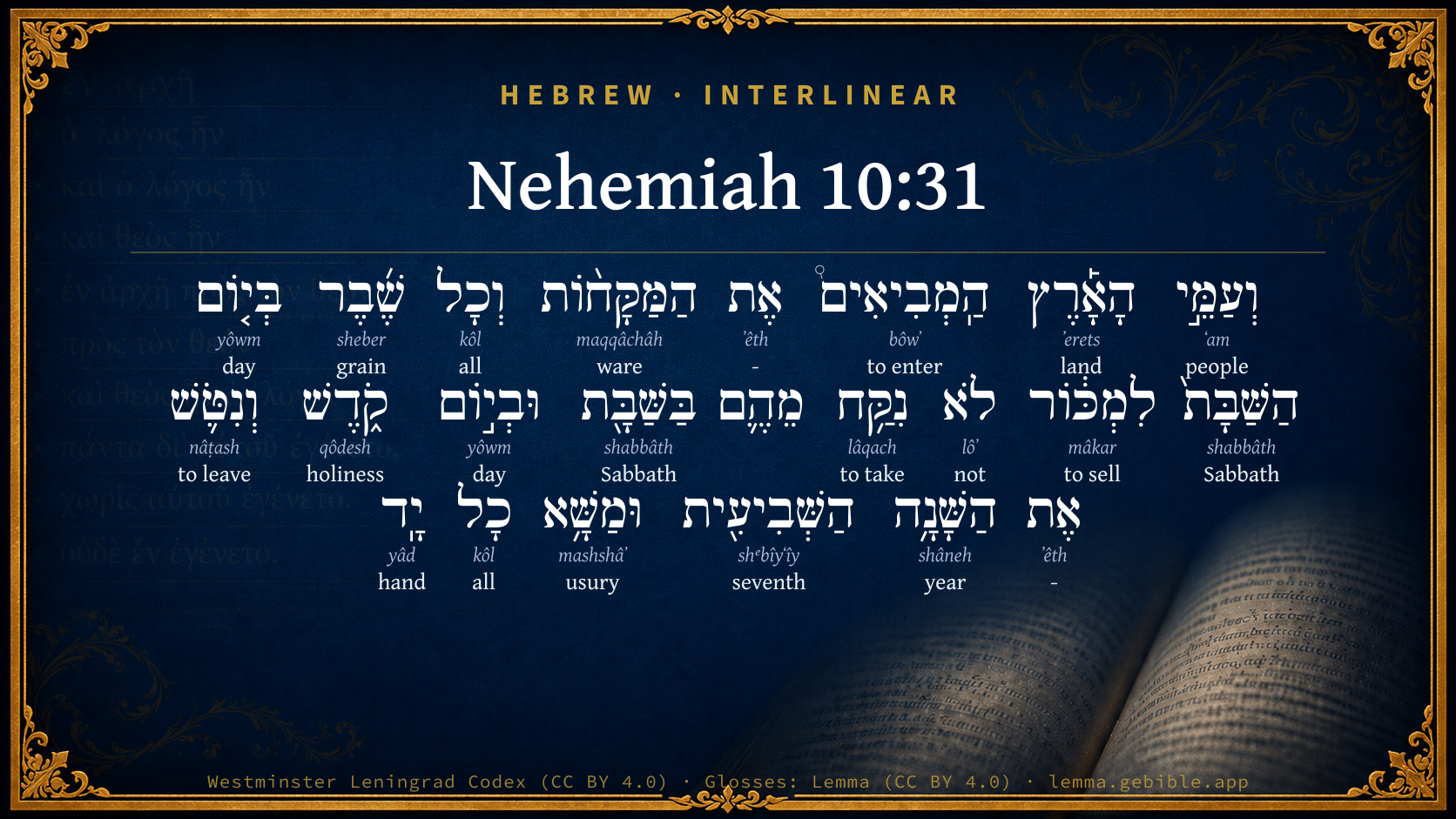
Hebrew (Westminster Leningrad Codex) Nehemiah 10:31 appears in the Hebrew Old Testament. The text above is from the Westminster Leningrad Codex. Each word links to its Strong’s number, a concise gloss, and parsing drawn from the Open Scriptures Hebrew Bible morphology. Click any word for its full Brown-Driver-Briggs (BDB) entry.
Download image
Cite this verse

Nehemiah 10:31 (World English Bible). Public Domain. Lemma interlinear Bible study tool, https://lemma.gebible.app/v/nehemiah/10/31.

Show BibTeX & RIS
BibTeX
RIS
English Translation
and if the peoples of the land bring wares or any grain on the Sabbath day to sell, that we would not buy of them on the Sabbath, or on a holy day; and that we would forego the seventh year, and the exaction of every debt.
World English Bible · Public Domain
Highlights
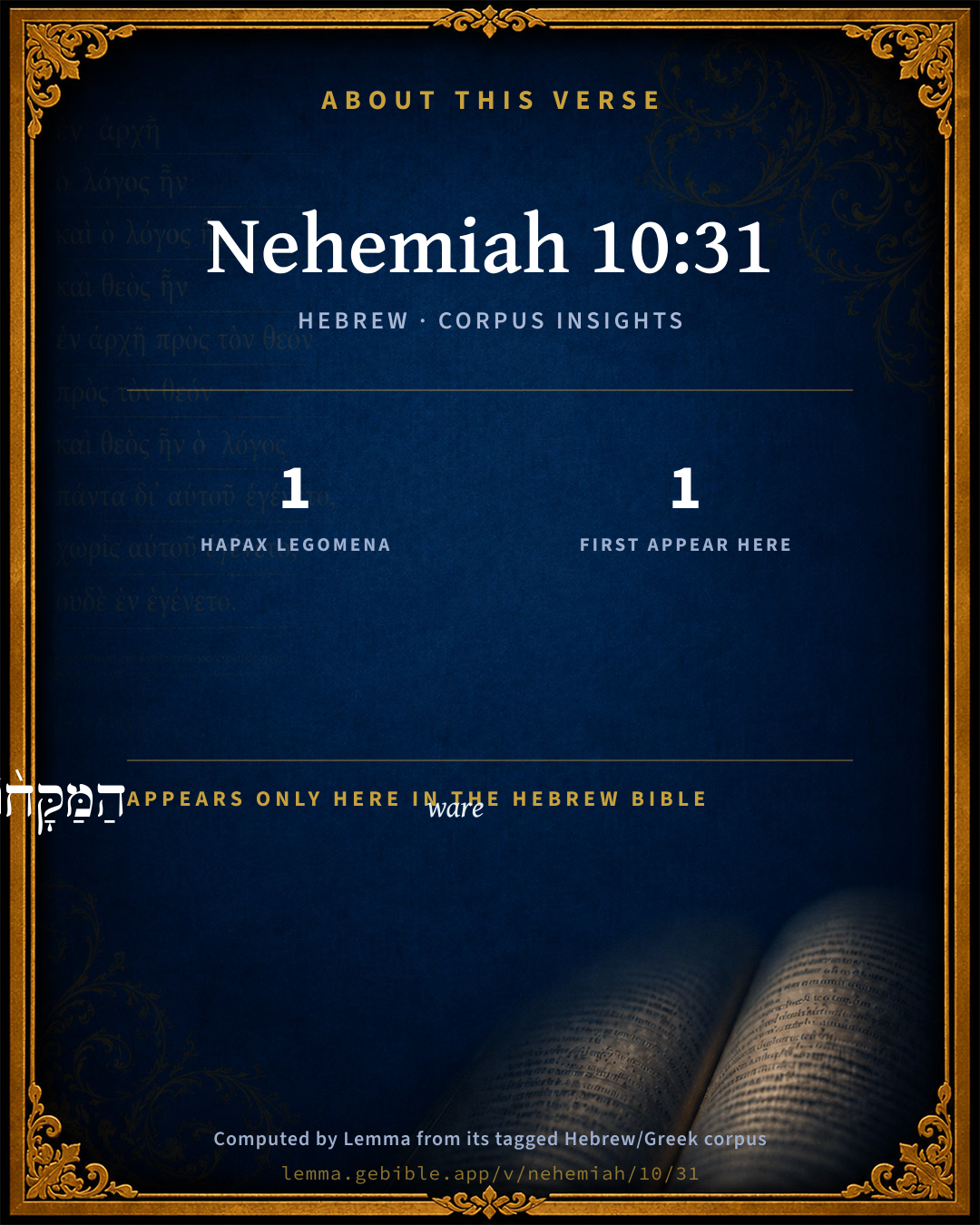
  • 1 hapax legomenon — only here in the Hebrew Bible
  • 1 first appearance in the Hebrew Bible
Full analysis ↓
Download a study sheet

One document with this verse’s original text, its word-by-word gloss line, the meaning frame, cross-references with their text, attributed commentary, and full source and license credits — printable, and it pastes into notes with its structure intact.

This verse Autodidact and up

Study sheet (.html) Plain text (.txt)

A passage Seminary Student

Up to 50 verses in one chapter. A passage sheet keeps up to 6 commentary sources and 12 cross-references per verse, in the order this page ranks them, and says so on the sheet whenever that leaves anything out. Ask for a single verse and you get the Autodidact verse sheet above.

Everything on this page stays free to read, with no account — the sheet is a download of what is already on screen, not access to it.

Want to remove ads? Support Godless Engineer
Compare translations 3

The same verse in 3 English versions, stacked beneath the original-language interlinear above. Click any original word for its lexicon entry.

Each is an independent rendering of the whole verse — the interlinear is not word-aligned to these translations.

Highlighted words mark where these versions differ — a whole-verse word diff, not a word-by-word alignment.

  • World English Bible Public Domain
    and if the peoples of the land bring wares or any grain on the Sabbath day to sell, that we would not buy of them on the Sabbath, or on a holy day; and that we would forego the seventh year, and the exaction of every debt.
  • King James Version Public Domain
    And if the people of the land bring ware or any victuals on the sabbath day to sell, that we would not buy it of them on the sabbath, or on the holy day: and that we would leave the seventh year, and the exaction of every debt.
  • unfoldingWord Literal Text CC BY-SA 4.0
    and, on the sabbath or on a holy day, we would not take from the peoples of the land, the ones bringing goods and all kinds of grain to sell on the day of the sabbath; and we would leave alone the seventh year and interest of every hand.

unfoldingWord Literal Text — © unfoldingWord, licensed CC BY-SA 4.0. Word-aligned USFM3 via Door43 (git.door43.org/unfoldingWord/en_ult).

Versions to compare (up to 4)

3 of 4 selected

Show all 18 translations

Every available English version of this verse, each an independent rendering of the whole verse.

  • World English Bible Public Domain
    and if the peoples of the land bring wares or any grain on the Sabbath day to sell, that we would not buy of them on the Sabbath, or on a holy day; and that we would forego the seventh year, and the exaction of every debt.
  • Berean Standard Bible Public Domain
    When the people of the land bring merchandise or any kind of grain to sell on the Sabbath day, we will not buy from them on a Sabbath or holy day. Every seventh year we will let the fields lie fallow, and will cancel every debt.
  • Majority Standard Bible Public Domain
    When the people of the land bring merchandise or any kind of grain to sell on the Sabbath day, we will not buy from them on a Sabbath or holy day. Every seventh year we will let the fields lie fallow and will cancel every debt.
  • King James Version Public Domain
    And if the people of the land bring ware or any victuals on the sabbath day to sell, that we would not buy it of them on the sabbath, or on the holy day: and that we would leave the seventh year, and the exaction of every debt.
  • American Standard Version (1901) Public Domain
    and if the peoples of the land bring wares or any grain on the sabbath day to sell, that we would not buy of them on the sabbath, or on a holy day; and that we would forego the seventh year, and the exaction of every debt.
  • Revised Version (1885) Public Domain
    and if the peoples of the land bring ware or any victuals on the sabbath day to sell, that we would not buy of them on the sabbath, or on a holy day: and that we would forgo the seventh year, and the exaction of every debt.
  • Geneva Bible (1599) Public Domain
    And if the people of the lande brought ware on the Sabbath, or any vitailes to sell, that we would not take it of them on the Sabbath and on the holy dayes: and that we would let the seuenth yeere be free, and the debtes of euery person.
  • Douay-Rheims (1899) Public Domain
    And if the people of the land bring in things to sell, or any things for use, to sell them on the sabbath day, that we would not buy them of them on the sabbath, or on the holy day. And that we would leave the seventh year, and the exaction of every hand.
  • Young's Literal Translation Public Domain
    and the peoples of the land who are bringing in the wares and any corn on the sabbath-day to sell, we receive not of them on the sabbath, and on a holy day, and we leave the seventh year, and usury on every hand.
  • Literal Standard Version CC BY-SA 4.0
    and the peoples of the land who are bringing in the wares and any grain on the Sabbath day to sell, we do not receive of them on the Sabbath, and on a holy day, and we leave the seventh year, and usury on every hand.
  • Unlocked Literal Bible CC BY-SA 4.0
    We also promised that if the people of the land bring goods or any grain to sell on the Sabbath day, we would not buy from them on the Sabbath or on any holy day. Every seventh year we will let our fields rest, and we will cancel all debts.
  • unfoldingWord Literal Text CC BY-SA 4.0
    and, on the sabbath or on a holy day, we would not take from the peoples of the land, the ones bringing goods and all kinds of grain to sell on the day of the sabbath; and we would leave alone the seventh year and interest of every hand.
  • Darby Bible Public Domain
    and that if the peoples of the land brought wares or any grain on the sabbath day to sell, we would not take it of them on the sabbath, or on [any] holy day; and that we would leave [the land uncultivated] the seventh year, and the exaction of every debt.
  • World Messianic Bible Public Domain
    and if the peoples of the land bring wares or any grain on the Sabbath day to sell, that we would not buy from them on the Sabbath, or on a holy day; and that we would forego the seventh year crops and the exaction of every debt.
  • Webster's Bible Public Domain
    And if the people of the land should bring wares or any provisions on the sabbath day to sell, that we would not buy it of them on the sabbath, or on the holy day: and that we would leave the seventh year, and the exaction of every debt.
  • Free Bible Version CC BY-SA 4.0
    When the people of the land bring goods and all kinds of food to sell on the holy Sabbath, we will not buy anything from them on the Sabbath or on other holy days. Every seventh year we will leave the land to rest, and we will cancel all debts.
  • Bible in Basic English Public Domain
    And if the peoples of the lands come to do trade in goods or food on the Sabbath day, that we would do no trade with them on the Sabbath or on a holy day: and that in the seventh year we would take no payment from any debtor.
  • JPS Tanakh (1917) Public Domain
    (10-32) and if the peoples of the land bring ware or any victuals on the sabbath day to sell, that we would not buy of them on the sabbath, or on a holy day; and that we would forego the seventh year, and the exaction of every debt.

Literal Standard Version (2020), Covenant Press — licensed CC BY-SA 4.0. Text via the HelloAO Bible API (eBible.org). Unlocked Literal Bible (unfoldingWord) — licensed CC BY-SA 4.0. Text via the HelloAO Bible API (eBible.org). unfoldingWord Literal Text — © unfoldingWord, licensed CC BY-SA 4.0. Word-aligned USFM3 via Door43 (git.door43.org/unfoldingWord/en_ult). Free Bible Version, Dr. Jonathan Gallagher — licensed CC BY-SA 4.0. Text via the HelloAO Bible API (eBible.org).

Word by word

More ways to search: Search by grammar → Find every occurrence → Compare this word →

Practice this passage: Drill this verse → Learn its vocabulary →

הַמַּקָּח֨וֹת
maqqâchâh
H4728
“the · wares”
Particle, Definite Article + Noun, Common, Feminine, Plural, Absolute
Part of Speech
Particle + Noun
Type
Common
Gender
Feminine
Number
Plural
State
Absolute
Full BDB Definition

Origin: from H3947

TWOT: 1124f

ware
  1. וְעַמֵּ֣י ʻam H5971 “and · peoples of” Conjunction + Noun, Common, Masculine, Plural, Construct
  2. הָאָ֡רֶץ ʼerets H776 “the · land” Particle, Definite Article + Noun, Common, Both, Singular, Absolute
  3. הַֽמְבִיאִים֩ bôwʼ H935 “the · entering” Particle, Definite Article + Verb, Hiphil, Participle Active, Masculine, Plural, Absolute
  4. אֶת ʼêth H853 “-” Particle, Direct Object
  5. וְכָל kôl H3605 “and · all of” Conjunction + Noun, Common, Masculine, Singular, Construct
  6. שֶׁ֜בֶר sheber H7668 “grain” Noun, Common, Masculine, Singular, Absolute
  7. בְּי֤וֹם yôwm H3117 “in/at · day of” Preposition + Noun, Common, Masculine, Singular, Construct
  8. הַשַּׁבָּת֙ shabbâth H7676 “the · Sabbath” Particle, Definite Article + Noun, Common, Both, Singular, Absolute
  9. לִמְכּ֔וֹר mâkar H4376 “to sell” Preposition + Verb, Qal, Infinitive Construct
  10. לֹא lôʼ H3808 “not” Particle, Negative
  11. נִקַּ֥ח lâqach H3947 “to take” Verb, Qal, Imperfect, 1st Person, Common, Plural
  12. בַּשַּׁבָּ֖ת shabbâth H7676 “in/at the · Sabbath” Preposition, Determined + Noun, Common, Both, Singular, Absolute
  13. וּבְי֣וֹם yôwm H3117 “and · in/at · day of” Conjunction + Preposition + Noun, Common, Masculine, Singular, Construct
  14. קֹ֑דֶשׁ qôdesh H6944 “holiness” Noun, Common, Masculine, Singular, Absolute
  15. וְנִטֹּ֛שׁ nâṭash H5203 “and · to leave” Conjunction + Verb, Qal, Imperfect, 1st Person, Common, Plural
  16. אֶת ʼêth H853 “-” Particle, Direct Object
  17. הַשָּׁנָ֥ה shâneh H8141 “the · year” Particle, Definite Article + Noun, Common, Feminine, Singular, Absolute
  18. הַשְּׁבִיעִ֖ית shᵉbîyʻîy H7637 “the · seventh” Particle, Definite Article + Adjective, Ordinal number, Feminine, Singular, Absolute
  19. וּמַשָּׁ֥א mashshâʼ H4855 “and · usury of” Conjunction + Noun, Common, Masculine, Singular, Construct
  20. כָל kôl H3605 “all of” Noun, Common, Masculine, Singular, Construct
  21. יָֽד yâd H3027 “hand” Noun, Common, Both, Singular, Absolute

About this verse

These counts appear in no published source. They are computed here, from the morphology-tagged text and Lemma’s own curated glosses. What Lemma adds →

23
words
18
distinct lemmas
Historical
section

Notable vocabulary

1 hapax legomenon — a word that appears only here in the entire Hebrew Bible:

  • הַמַּקָּח֨וֹת ware H4728

First appearance in Scripture

This word makes its first canonical appearance in the Hebrew Bible here:

  • הַמַּקָּח֨וֹת ware H4728

Shared distinctive vocabulary

וּמַשָּׁ֥א usury H4855 occurs in 3 verses of the Hebrew Bible. Also found in:

Grammatical profile

  • 4 verbs
  • 14 nouns
  • 1 adjective
  • 1 preposition
  • 3 particles

Verb forms

  • הַֽמְבִיאִים֩ Hiphil · Participle Active
  • לִמְכּ֔וֹר Qal · Infinitive Construct
  • נִקַּ֥ח Qal · Imperfect
  • וְנִטֹּ֛שׁ Qal · Imperfect

Repetition

Words recur within this verse — often emphatic in Hebrew:

  • וְכָל all H3605 ×2
  • בְּי֤וֹם day H3117 ×2
  • הַשַּׁבָּת֙ Sabbath H7676 ×2

Cross-references

20

Topical passages linked to Nehemiah 10:31 in the Treasury of Scripture Knowledge — connected by theme and wording, ordered by reader-vote popularity; previews shown in the World English Bible.

  • Leviticus 23:3 "'Six days shall work be done: but on the seventh day is a Sabbath of solemn rest, a holy convocation; you shall do no manner of work. It is a Sabbath to Yahweh in all your dwellings.
  • Nehemiah 13:15–22 In those days saw I in Judah some men treading wine-presses on the Sabbath, and bringing in sheaves, and lading donkeys [therewith]; as also wine, grapes, and figs, and all manner of burdens, which they brought into Jerusalem on the Sabbath day: and I testified [against them] in the day in which they sold food.
  • Exodus 23:10–11 "For six years you shall sow your land, and shall gather in its increase,
  • Exodus 20:10 but the seventh day is a Sabbath to Yahweh your God. You shall not do any work in it, you, nor your son, nor your daughter, your man-servant, nor your maid-servant, nor your cattle, nor your stranger who is within your gates;
  • Jeremiah 17:21–22 Thus says Yahweh, Take heed to yourselves, and bear no burden on the Sabbath day, nor bring it in by the gates of Jerusalem;
  • Exodus 12:16 In the first day there shall be to you a holy convocation, and in the seventh day a holy convocation; no manner of work shall be done in them, except that which every man must eat, that only may be done by you.
  • Leviticus 16:29 "It shall be a statute to you forever: in the seventh month, on the tenth day of the month, you shall afflict your souls, and shall do no manner of work, the native-born, or the stranger who lives as a foreigner among you:
  • Leviticus 23:21 You shall make proclamation on the same day: there shall be a holy convocation to you; you shall do no regular work. This is a statute forever in all your dwellings throughout your generations.
  • Leviticus 23:35–36 On the first day shall be a holy convocation: you shall do no regular work.
  • Leviticus 25:1–7 Yahweh said to Moses in Mount Sinai,
  • Deuteronomy 5:12–14 "Observe the Sabbath day, to keep it holy, as Yahweh your God commanded you.
  • Deuteronomy 15:1–3 At the end of every seven years you shall make a release.
  • Deuteronomy 15:7–9 If there be with you a poor man, one of your brothers, within any of your gates in your land which Yahweh your God gives you, you shall not harden your heart, nor shut your hand from your poor brother;
  • 2 Chronicles 36:21 to fulfill the word of Yahweh by the mouth of Jeremiah, until the land had enjoyed its Sabbaths: [for] as long as it lay desolate it kept Sabbath, to fulfill seventy years.
  • Nehemiah 5:1–13 Then there arose a great cry of the people and of their wives against their brothers the Jews.
  • Isaiah 58:6 Isn't this the fast that I have chosen: to loose the bonds of wickedness, to undo the bands of the yoke, and to let the oppressed go free, and that you break every yoke?
  • Isaiah 58:13–14 If you turn away your foot from the Sabbath, from doing your pleasure on my holy day; and call the Sabbath a delight, [and] the holy of Yahweh honorable; and shall honor it, not doing your own ways, nor finding your own pleasure, nor speaking [your own] words:
  • Matthew 6:12 Forgive us our debts, as we also forgive our debtors.
  • Matthew 18:27–35 The lord of that servant, being moved with compassion, released him, and forgave him the debt.
  • Colossians 2:16 Let no man therefore judge you in eating, or in drinking, or with respect to a feast day or a new moon or a Sabbath day,

Cross-references courtesy of OpenBible.info (CC BY 4.0).

Hebrew and Greek witnesses Masoretic Hebrew ↔ Greek Septuagint

The same verse in the two great witnesses to the Old Testament, shown verse-for-verse.

These are two independent witnesses, not word-aligned to each other, and the Septuagint is shown in lemma (dictionary) form.

Hebrew Nehemiah 10:31 Masoretic · Westminster Leningrad Codex

וְעַמֵּ֣י הָאָ֡רֶץ הַֽמְבִיאִים֩ אֶת הַמַּקָּח֨וֹת וְכָל שֶׁ֜בֶר בְּי֤וֹם הַשַּׁבָּת֙ לִמְכּ֔וֹר לֹא נִקַּ֥ח מֵהֶ֛ם בַּשַּׁבָּ֖ת וּבְי֣וֹם קֹ֑דֶשׁ וְנִטֹּ֛שׁ אֶת הַשָּׁנָ֥ה הַשְּׁבִיעִ֖ית וּמַשָּׁ֥א כָל יָֽד

and if the peoples of the land bring wares or any grain on the Sabbath day to sell, that we would not buy of them on the Sabbath, or on a holy day; and that we would forego the seventh year, and the exaction of every debt.

World English Bible · Public Domain

Greek LXX Structure differs

The Septuagint has no separate book of Nehemiah. Its Greek text is the second half of Esdras B (2 Esdras), chapters 11–23; Ezra is the first half (1–10).

A verse-for-verse comparison isn’t shown here because the chapters and verses don’t line up. Switch to the LXX edition with the MT / LXX toggle above to read the Greek directly.

On this verse, The Cambridge Bible for Schools and Colleges discusses the Septuagint’s reading. Read the note in Commentary ↓

Hebrew: Westminster Leningrad Codex (CC BY 4.0). Greek: Septuagint (public domain); English from a public-domain English Septuagint. How the Septuagint differs from the Hebrew →

Commentary

Notes on Nehemiah 10:31 from classic Christian and Jewish commentators (each source and its license shown beneath its notes). The classic Christian expositions comment on the surrounding passage and are grouped to its opening verse, so a note may address several verses; the Jewish commentaries on the Tanakh (Rashi and others) are per-verse, so they appear only where the commentator wrote on this verse.

Lemma curates 59 commentaries, every one of them public domain or Creative Commons licensed, each selected and text-cleaned for this edition rather than reprinted as found. About our sources →

Trapp's Complete Commentary

John Trapp

Neh 10:31 And [if] the people of the land bring ware or any victuals on the sabbath day to sell, [that] we would not buy it of them on the sabbath, or on the holy day: and [that] we would leave the seventh year, and the exaction of every debt.

Ver. 31. And if the people of the land bring any ware] As they might without the Jews’ leave; and did, Neh 13:16, and some of those Jews, forgetting their covenant, bought of them too; even the children of Judah in Jerusalem, ib., as if they had been of her religion in the tragedy, who said,

η γλωττ ομωμοχ η δε φοην ανωμοτος.

that is, I swore with my tongue, but not with my heart. But shall they thus escape by iniquity? Be not deceived, God is not mocked; a God of truth, and without iniquity; just and right is he, Deu 32:4.

That we would not buy it of them] Lest we should trouble and disquiet that holy rest; and God should sue us upon an action of waste; "For the seventh day is the sabbath of the Lord thy God," Exo 20:10 Jer 17:12.

Or on the holy day] Now abrogated, Col 2:16.

And that we would leave the seventh year] That Sabbatical year, prefiguring the year of grace, the kingdom of Christ, Qui noxas et nexus omnes solveret, who giveth his people a general release, Deu 15:2, and comes not over them again with a later reckoning, Peccata non redeunt. The land also was to rest from tillage this year, Exo 23:11.

And the exaction of every debt] For that year, at least, and the next too, if the debtor were not able to pay; the lender was to expect a recompense from God, Deu 15:6.

John Trapp, A Commentary or Exposition upon All the Books of the Old and New Testament (1647–1656) — public domain. Text from a community e-Sword module.

The Biblical Illustrator

Joseph S. Exell

Neh_10:31

And if the people of the land bring ware or any victuals on the sabbath day to all

The profit of Sabbath-keeping

John Brand was an old Cornish fisherman.

The fishing had not been good for some days, the water had been wild and stormy; but at length, on the Sunday, the weather became fine, and the other fishermen said, We would keep Sunday--but--we have had so few fish lately; and we are sorry to go out to-day--but--the weather is so good. It is a pity; we would not go if we were not so poor. What! said honest John, are you going to break Gods laws with your ifs and buts? Better be poor than be wicked. My religion is not the kind that shifts with the wind. Thou shalt remember the Sabbath day to keep it holy--that is enough for me. So he persuaded them, and they took his advice, and spent the day in worshipping God. And it was well they did so; for that night, just when the boats would have been coming back, a terrible storm suddenly burst over the deep, and lasted two days. Any boat out in that weather would certainly have been wrecked. But two days after the beautiful weather returned, and more fish were taken then than had been caught for weeks before. No; no one ever yet lost by obeying God. Be you like John Brand; be thorough, honest, and God-fearing in and out; do not have a religion like a weathercock that shifts with the wind, or one that can be broken with An if or a but. (J. Reid Howatt.)

The Sabbath beneficial

In a prize essay on the Sabbath written by a journeyman printer in Scotland, there appears the following striking passage: Yoke-fellows, think how the abstraction of the Sabbath would hopelessly enslave the working-classes with whom we are identified. Think of the labour thus going on in one monotonous, and continuous, and eternal cycle--limbs for ever on the rack, the fingers for ever plying, the eyeballs for ever straining, the brow for ever sweating, the feet for ever plodding, the brain for ever throbbing, the shoulders for ever drooping, the loins for ever aching, and the restless mind for ever scheming! Think of the beauty it would efface, of the merry-heartedness it would extinguish, of the giant strength it would tame, of the resources of nature it would exhaust, of the aspirations it would crush, of the sickness it would breed, of the projects it would wreck, of the groans it would extort, of the lives it would immolate, of the cheerless graves it would prematurely dig! See them toiling and moiling, sweating and fretting, grinding and hewing, weaving and spinning, sowing and gathering, mowing and reaping, raising mad building, digging mad planting, unloading and storing, striving and struggling--in the garden and in the field, in the granary and in the barn, in the factory and in the mill, in the warehouse and in the shop, on the mountain and in the ditch, on the roadside and in the wood, in the city and in the country, on the sea and on the shore, on the earth in days of brightness and of gloom. What a sad picture would the world present if we had no Sabbath!

The Biblical Illustrator, edited by Joseph S. Exell (c. 1880s–1900s) — public domain. Text from a community e-Sword module.

Joseph Benson's Commentary

Neh 10:31. And if the people of the land — The heathen; bring ware or victuals on the sabbath day to sell, we would not buy it — They not only would not sell goods themselves for gain on that day, but they would not encourage the heathen to sell by buying of them, no, not victuals, under pretence of necessity, but would buy in their provisions for their families the day before. They that covenant to keep all the commandments of God, must particularly covenant to keep the sabbath holy. For the profanation of this is a sure inlet to all manner of profaneness. Or on the holy day — That is, on days of rest from labour, such as the passover, the first and seventh day of unleavened bread, Exo 12:16, the feast of trumpets, Lev 23:25, and others. And that we would leave the seventh year — Let the land rest from ploughing or tilling in that year, and leave the fruit of it, which grew of itself, for the poor, as the law required. See the margin. And the exaction of every debt — Would remit, in that year, the debts owed by the poor. The Hebrew משׂא כל יד, masse cal jad, is literally, the burden of every hand. Debts may be so called, because they are commonly contracted or confirmed by a bill, declaration, or promise, given under the debtor’s hand. Or the meaning is, as in Isa 58:6, that they engage to undo the heavy burdens, to let the oppressed go free, and to break off every yoke.

Joseph Benson's Commentary on the Old and New Testaments (1811–1818) — public domain. Text from a community e-Sword module.

Tyndale Open Study Notes

Tyndale Open Resources

10:31 Ceasing trade on the Sabbath was necessary for covenant faithfulness (cp. 13:15-22; see Exod 16:29; 20:8-11; 31:15; Num 15:32-36; Amos 8:5). • Every seventh year: See Exod 23:10-11; Lev 25:2-7; Deut 15:1-3.

Tyndale Open Study Notes — © Tyndale Open Resources, licensed CC BY-SA 4.0. Text via the HelloAO Bible API.

Geneva Bible (1599)

Geneva Bible translators

Which notwithstanding they brake soon after, as Neh. 13:15.

Hebrew, hand.

Geneva Bible (1599) marginal notes — public domain. Text via Bolls.life.

Adam Clarke's Commentary

Verse 31. Bring ware] We will most solemnly keep the Sabbath. Leave the seventh year-We will let the land have its Sabbath, and rest every seventh year. See on Ex 23:10-11.

Adam Clarke's Commentary on the Bible (1810–1826) — public domain. Text from a community e-Sword/MySword module.

Ellicott's Commentary for English Readers

(31) Or on the holy day.—On the great festivals, equally with the Sabbath days of rest.

Leave the seventh year.—The Sabbatical year naturally follows; in it the ground should be left untilled.

The exaction of every debt.—The “Lord’s release” of the seventh year (Deu_15:2).

A Bible Commentary for English Readers, edited by Charles John Ellicott (1878–1897) — public domain. Text from a community e-Sword module.

The Cambridge Bible for Schools and Colleges

gen. ed. J. J. S. Perowne

31. Prohibition of Traffic on the Sabbath; and Observance of Sabbatic Year

people] R.V. peoples. ‘The peoples of the land (’ammey haârec̣) are the heathen dwellers in the land. The title ‘the people of the land’ (’am haârec̣) was used in later days of the unlearned multitude ‘which knoweth not the law’ (Joh_7:49).

ware] The Hebrew word occurs only here in the O.T. (LXX. ἀγορασμούς, Vulg. ‘venalia’).

on the sabbath day] The prohibition is not found in so many words in the Pentateuch. But it represents the natural expansion of the command to keep the Sabbath holy. Pollution would most easily be contracted by the interchange of wares with the heathen.

Complete abstention from such occupation was the only safeguard for the purity of the people, as well as for the observance of the Sabbath as a day of rest, cf. Neh_13:15. This abstention was practised in the kingly period in respect of the sabbath and the new-moon days. Amo_8:5, ‘When will the new moon be gone that we may sell corn? and the sabbath, that we may set forth wheat?’

on the holy day] R.V. on a holy day. The days set apart to be observed as ‘holy-days’ are described in Numbers 28, 31.

That these were to be observed as ‘days of rest,’ and were thus on the same footing with the Sabbath-days argues the acquaintance of the writer with the Levitical Law of the Priestly Code.

leave] R.V. forgo. The same word that is used in Exo_23:11 for ‘let lie fallow.’ LXX. ἀνήσομεν.

the seventh year] See Exo_23:10-11, ‘And six years thou shalt sow thy land, and shalt gather in the increase thereof; but the seventh year thou shalt let it rest (marg. ‘release it’) and lie fallow.’ This observance of the Sabbatic year is not referred to in the Deuteronomic Law which only speaks of it as the year of release from debt (Deuteronomy 15). But the Priestly Law in Lev_25:2-7 enters with some minuteness into the agricultural ‘rest’ of the seventh year. This regulation was not, for practical reasons, scrupulously carried out; its neglect is the subject of rebuke, Lev_26:34-35; Lev_26:43; 2Ch_36:21. It seems to have been observed in later times, cf. 1Ma_6:49; 1Ma_6:53; Jos. Ant. xi. 8. 6, xiii. 8. 1, &c. Tacitus, who is prejudiced against the Jews, attributes the custom to national laziness, Hist. Neh_10:4.

and the exaction of every debt] This is a technical expression taken from Deu_15:2, and constitutes the expansion, for the requirements of a more developed time, of the principle laid down in the agricultural Law of the Sabbatic Year (Exodus 23). By a common error it has been supposed that debts were on this year altogether remitted. The analogy of the ‘fallow’ land shows that the debts remained, but were not exacted; payment was ‘hung up’ for a whole year. Some render ‘the exaction of every man’s pledge.’ The versions are literal, LXX. ἀπαίτησιν πάσης χειρός. Vulg. ‘exactionem universae manus.’ The remission of ‘the exaction of debt’ on the seventh or Sabbatic year is found in the Deuteronomic, but not in the Levitical Laws. The covenant to which the Israelites were now subscribing did not rest on a Levitical code alone, but recognised the authority of other portions of the Pentateuch.

This is one indication among others that the Law, which Ezra administered, contained substantially all the component parts of our Pentateuch, though not necessarily every item, as we now have it, in each component part.

The Cambridge Bible for Schools and Colleges (gen. ed. J. J. S. Perowne; Cambridge University Press, 1878–1918) — public domain. Text from a community e-Sword module.

John Gill's Exposition

Also we made ordinance, for us,.... Laws among themselves, binding them to that which the laws of God did not:

to charge ourselves yearly with the third part of a shekel, for the service of the house of our God; the particulars of which follow in the next verse; for the defraying of which there used to be a treasury in the temple; but now there was none, and therefore they took this method to assess themselves; and being poor, instead of the half shekel, which in some cases was required, they only charged themselves with the third part of one; though Aben Ezra thinks this was added to the half shekel, and was paid over and above that; according to Brerewood (a), it was of the value of ten pence of our money: Waserus (b) has given us the figure of one of these coins, with this inscription, a "third" part of a shekel of Israel.

(a) De Pond. & Pret. Vet. Num. c. 1. (b) De Antiqu. Num. Heb. l. 2.

John Gill's Exposition of the Whole Bible (1746–1763) — public domain (CC PDM 1.0). Text via the HelloAO Bible API.

Albert Barnes' Notes on the Bible

Bring ware ... on the sabbath day - Compare Neh 13:16, where this desecration of the Sabbath is shown to have commonly taken place.

Leave the seventh year ... - i. e., “let the land rest in the sabbatical year” (margin reference) and give up the “pledge-taking” Neh 10:2-10.

Albert Barnes' Notes on the Bible (1834–1885) — public domain. Text from a community e-Sword/MySword module.

Haydock's Catholic Bible Commentary

Holy day. The contrary practice is therefore sinful. (Haydock) --- Year. Not cultivating the land, Leviticus xxv. 4. --- Hand. No debts were to be demanded, Deuteronomy xv. 1. (Menochius)

George Leo Haydock (1774–1849), Haydock's Catholic Family Bible and Commentary, 1859 edition — public domain. Excludes Psalms (Douay-Rheims chapter numbering differs from Protestant) and Deuterocanonical books (Catholic canon only).

Matthew Poole's English Annotations

That we would leave the seventh year, i.e. leave the land at rest from ploughing or tilling it in that year, according to God’s command, Exo 23:10,11; Le 25:4.

The exaction of every debt, Heb. hand: debts are called hands, because they are commonly contracted or confirmed by a bill under the hand of the debtor.

Matthew Poole's English Annotations on the Holy Bible (1683–1685) — public domain. Text from a community e-Sword/MySword module.

Whedon's Commentary on the Bible

Daniel D. Whedon

31. We would not buy… on the sabbath — Such breaking of the Sabbath had prevailed among them before this.

Or on the holy day — The day of any of the great religious festivals, on which the law forbade all servile work. Num_29:1-7; Num_29:12.

Seventh year — See the law in Exo_23:11; Lev_25:4.

Exaction of every debt — Literally, the debt of every hand. “So called either because the debtor promised to pay by giving his right hand, or because the hand is the instrument and emblem of deposit, trust. Some editions read here משׁא, burden, which is less well.” — Gesenius. See the law in Deu_15:1-2.

Daniel D. Whedon (gen. ed.), Commentary on the Old and New Testaments (1874–1909) — public domain. Text from a community e-Sword module.

The Pulpit Commentary

If the people of the land bring ware ... on the sabbath. If the heathen of this region will insist on bringing their wares into our cities and offering them for immediate sale on the sabbath, we Jews bind ourselves not to deal with them on that day. Subsequently, Nehemiah carried out more stringent regulations. (Neh_13:15-22) Or on the holy day. Rather, "or on a holy day." The people bind themselves to abstain from trade not only on the sabbath, but on any holy day. That we would leave the seventh year. By leaving the seventh year," leaving the lands untilled every seventh or sabbatical year is meant. This precept of the law had been frequently neglected during the times of the monarchy, and its neglect was one of the sins which the captivity was expressly intended to punish. (2Ch_36:21) It now appears that after the return the precept had been again disobeyed. The exaction of every debt. Literally, "the pledge of every hand." Compare Neh_5:2-13, and note that, notwithstanding Nehemiah"s curse and the people"s assent to it (ver. 13), the practice of lending upon pledge had recommenced.

The Pulpit Commentary (1880–1919), ed. H.D.M. Spence-Jones & Joseph S. Exell — public domain. Text from a community e-Sword module.

John Wesley's Explanatory Notes

People of the land - The Heathens. On the sabbath - They that covenant to keep all the commandments of God, must particularly covenant to keep the sabbath holy. For the profanation of this is a sure inlet to all manner of profaneness.

John Wesley, Explanatory Notes Upon the Whole Bible (1754–1765) — public domain. Text via the GEBible commentary corpus.

Lesson kit

Teaching starters — assembled from the data on this page, not authored interpretation. Every prompt links to the verse data it draws on. Edit before teaching.

Nehemiah, in the Historical, opens this verse with 23 words (18 distinct Hebrew lemmas). Its most distinctive word is maqqâchâh (“ware”). A historical commentator’s framing appears above. Read the whole chapter for the surrounding context.

Discussion questions

  1. How does “ware” (maqqâchâh) shape what this verse is saying?
  2. This verse holds 1 word here found nowhere else in the Hebrew Bible. What might the rare word draw attention to?
  3. The word “ware” first appears here in Scripture. What is being introduced at this debut?
  4. Nehemiah 5:7 shares the word «usury» with this verse. How do the two illuminate each other?
  5. “all” occurs 2× in this one verse. What is the effect of the repetition?
  6. These translations render this verse differently. What is at stake in choosing one wording over another?
  7. The verb «הַֽמְבִיאִים֩» is Hiphil Participle Active. How does its form color the action?
  8. Reading how Trapp's Complete Commentary and The Biblical Illustrator read this verse, where do the two commentators agree and where do they part?

Things to notice

  • 1 word in this verse appears nowhere else in the Hebrew Bible.
  • 1 word makes its first canonical appearance in Scripture here.
  • These translations choose different wording for 22 words in this verse.
  • “all” occurs 2× in this single verse.
  • 18 distinct Hebrew lemmas span 23 words in this verse.

Reading settings

Reading text

Shown beneath each verse's original-language words.

Old Testament
Old Testament edition

Read the OT as the Masoretic Hebrew (MT) or the Greek Septuagint (LXX).

English shown for the Greek Septuagint (in the Hebrew ↔ Greek comparison).

Comparing translations? Open the Compare panel on any verse page to stack up to four side by side.