
Judges 14:18

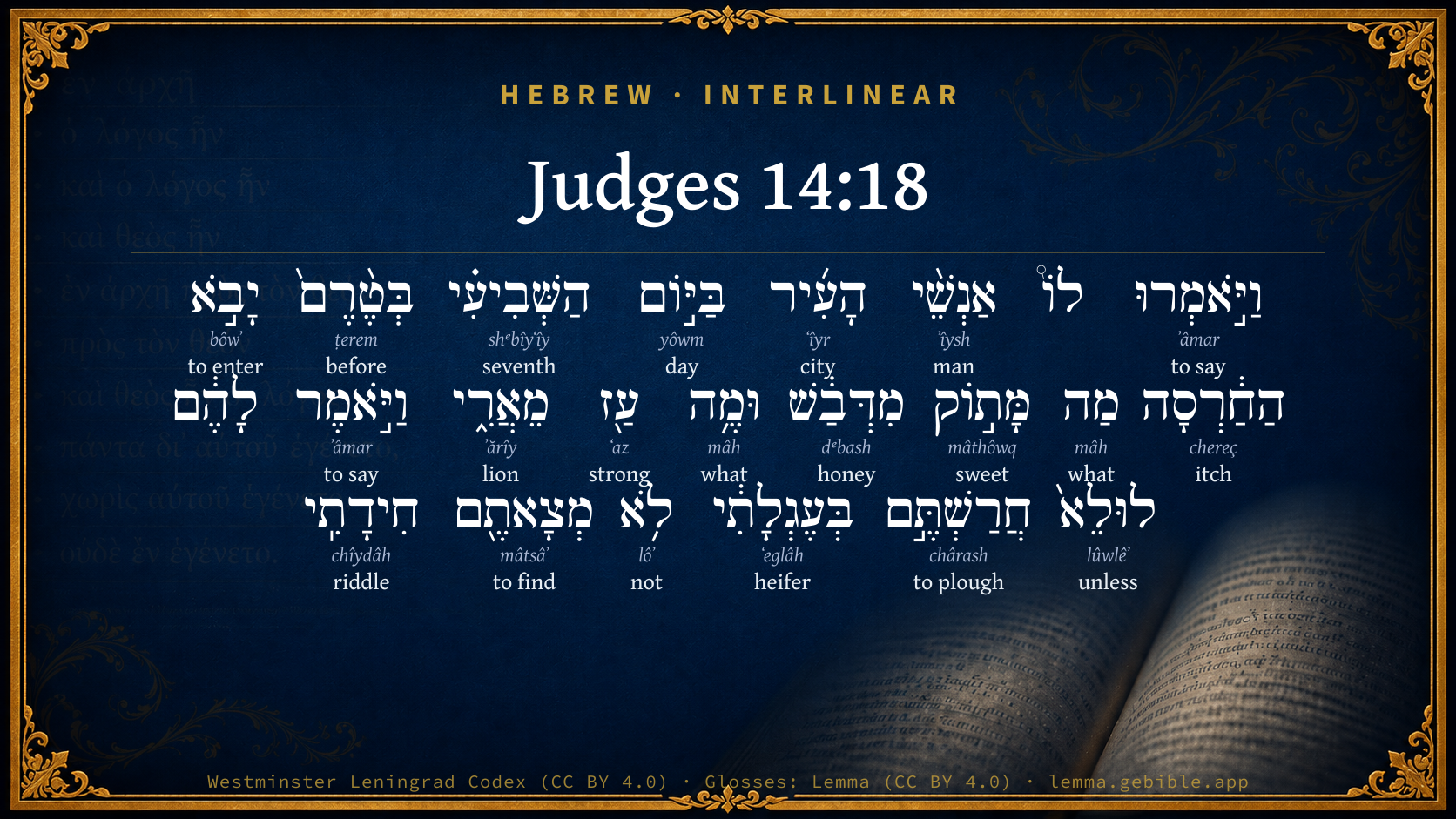
Hebrew (Westminster Leningrad Codex) Judges 14:18 appears in the Hebrew Old Testament. The text above is from the Westminster Leningrad Codex. Each word links to its Strong’s number, a concise gloss, and parsing drawn from the Open Scriptures Hebrew Bible morphology. Click any word for its full Brown-Driver-Briggs (BDB) entry.
Download image
Cite this verse

Judges 14:18 (World English Bible). Public Domain. Lemma interlinear Bible study tool, https://lemma.gebible.app/v/judges/14/18.

Show BibTeX & RIS
BibTeX
RIS
English Translation
The men of the city said to him on the seventh day before the sun went down, What is sweeter than honey? and what is stronger than a lion? He said to them, If you hadn't plowed with my heifer, You wouldn't have found out my riddle.
World English Bible · Public Domain
Download a study sheet

One document with this verse’s original text, its word-by-word gloss line, the meaning frame, cross-references with their text, attributed commentary, and full source and license credits — printable, and it pastes into notes with its structure intact.

This verse Autodidact and up

Study sheet (.html) Plain text (.txt)

A passage Seminary Student

Up to 50 verses in one chapter. A passage sheet keeps up to 6 commentary sources and 12 cross-references per verse, in the order this page ranks them, and says so on the sheet whenever that leaves anything out. Ask for a single verse and you get the Autodidact verse sheet above.

Everything on this page stays free to read, with no account — the sheet is a download of what is already on screen, not access to it.

Want to remove ads? Support Godless Engineer
Compare translations 3

The same verse in 3 English versions, stacked beneath the original-language interlinear above. Click any original word for its lexicon entry.

Each is an independent rendering of the whole verse — the interlinear is not word-aligned to these translations.

Highlighted words mark where these versions differ — a whole-verse word diff, not a word-by-word alignment.

  • World English Bible Public Domain
    The men of the city said to him on the seventh day before the sun went down, What is sweeter than honey? and what is stronger than a lion? He said to them, If you hadn't plowed with my heifer, You wouldn't have found out my riddle.
  • King James Version Public Domain
    And the men of the city said unto him on the seventh day before the sun went down, What is sweeter than honey? And what is stronger than a lion? and he said unto them, If ye had not plowed with my heifer, ye had not found out my riddle.
  • unfoldingWord Literal Text CC BY-SA 4.0
    And the men of the city said to him on the seventh day, before the sun came in, “What sweeter than honey? And what stronger than a lion?” And he said to them, “If you had not plowed with my heifer, you would not have found my riddle.”

unfoldingWord Literal Text — © unfoldingWord, licensed CC BY-SA 4.0. Word-aligned USFM3 via Door43 (git.door43.org/unfoldingWord/en_ult).

Versions to compare (up to 4)

3 of 4 selected

Show all 18 translations

Every available English version of this verse, each an independent rendering of the whole verse.

  • World English Bible Public Domain
    The men of the city said to him on the seventh day before the sun went down, What is sweeter than honey? and what is stronger than a lion? He said to them, If you hadn't plowed with my heifer, You wouldn't have found out my riddle.
  • Berean Standard Bible Public Domain
    Before sunset on the seventh day, the men of the city said to Samson: “What is sweeter than honey? And what is stronger than a lion?” So he said to them: “If you had not plowed with my heifer, you would not have solved my riddle!”
  • Majority Standard Bible Public Domain
    Before sunset on the seventh day, the men of the city said to Samson: “What is sweeter than honey? And what is stronger than a lion?” So he said to them: “If you had not plowed with my heifer, you would not have solved my riddle!”
  • King James Version Public Domain
    And the men of the city said unto him on the seventh day before the sun went down, What is sweeter than honey? And what is stronger than a lion? and he said unto them, If ye had not plowed with my heifer, ye had not found out my riddle.
  • American Standard Version (1901) Public Domain
    And the men of the city said unto him on the seventh day before the sun went down, What is sweeter than honey? and what is stronger than a lion? And he said unto them, If ye had not plowed with my heifer, Ye had not found out my riddle.
  • Revised Version (1885) Public Domain
    And the men of the city said unto him on the seventh day before the sun went down, What is sweeter than honey? and what is stronger than a lion? And he said unto them, If ye had not plowed with my heifer, ye had not found out my riddle.
  • Geneva Bible (1599) Public Domain
    And the men of ye citie sayde vnto him the seuenth day before the Sunne went downe, What is sweeter then honie? and what is stronger then a lyon? Then sayd hee vnto them, If yee had not plowed with my heiffer, yee had not found out my riddle.
  • Douay-Rheims (1899) Public Domain
    And they on the seventh day before the sun went down said to him: What is sweeter than honey? and what is stronger than a lion? And he said to them: If you had not ploughed with my heifer, you had not found out my riddle.
  • Young's Literal Translation Public Domain
    And the men of the city say to him on the seventh day, before the sun goeth in: -- `What `is' sweeter than honey? And what stronger than a lion?' And he saith to them: `Unless ye had ploughed with my heifer, Ye had not found out my riddle.'
  • Literal Standard Version CC BY-SA 4.0
    And the men of the city say to him on the seventh day, before the sun goes in: “What [is] sweeter than honey? And what [is] stronger than a lion?” And he says to them: “Unless you had plowed with my heifer, || You had not found out my riddle.”
  • Unlocked Literal Bible CC BY-SA 4.0
    Before the sun went down on the seventh day the men of the city said to him, “What is sweeter than honey? What is stronger than a lion?” Samson said to them, “If you had not plowed with my heifer, you would not have found the answer to my riddle.”
  • unfoldingWord Literal Text CC BY-SA 4.0
    And the men of the city said to him on the seventh day, before the sun came in, “What sweeter than honey? And what stronger than a lion?” And he said to them, “If you had not plowed with my heifer, you would not have found my riddle.”
  • Darby Bible Public Domain
    And the men of the city said to him on the seventh day before the sun went down, "What is sweeter than honey? What is stronger than a lion?" And he said to them, "If you had not plowed with my heifer, you would not have found out my riddle."
  • World Messianic Bible Public Domain
    The men of the city said to him on the seventh day before the sun went down, “What is sweeter than honey? What is stronger than a lion?” He said to them, “If you hadn’t plowed with my heifer, you wouldn’t have found out my riddle.”
  • Webster's Bible Public Domain
    And the men of the city said to him on the seventh day before the sun went down, What is sweeter than honey? and what is stronger than a lion? And he said to them, If ye had not plowed with my heifer, ye had not found out my riddle.
  • Free Bible Version CC BY-SA 4.0
    Before the sun set on the seventh day, the men of the town came to Samson and said, “What's sweeter than honey? What's stronger than a lion?” “If you hadn't used my cow to plow with, you wouldn't have found out the meaning of my riddle,” Samson replied.
  • Bible in Basic English Public Domain
    Then on the seventh day, before he went into the bride's room, the men of the town said to him, What is sweeter than honey? and what is stronger than a lion? And he said to them, If you had not been ploughing with my cow you would not have got the answer to my question.
  • JPS Tanakh (1917) Public Domain
    And the men of the city said unto him on the seventh day before the sun went down: What is sweeter than honey? and what is stronger than a lion? And he said unto them: If ye had not plowed with my heifer, ye had not found out my riddle.

Literal Standard Version (2020), Covenant Press — licensed CC BY-SA 4.0. Text via the HelloAO Bible API (eBible.org). Unlocked Literal Bible (unfoldingWord) — licensed CC BY-SA 4.0. Text via the HelloAO Bible API (eBible.org). unfoldingWord Literal Text — © unfoldingWord, licensed CC BY-SA 4.0. Word-aligned USFM3 via Door43 (git.door43.org/unfoldingWord/en_ult). Free Bible Version, Dr. Jonathan Gallagher — licensed CC BY-SA 4.0. Text via the HelloAO Bible API (eBible.org).

Word by word

More ways to search: Search by grammar → Find every occurrence → Compare this word →

Practice this passage: Drill this verse → Learn its vocabulary →

הַחַ֔רְסָה
chereç
H2775
“the · itch · toward”
Particle, Definite Article + Noun, Common, Masculine, Singular, Absolute + Suffix, Demonstrative
Part of Speech
Particle + Noun
Type
Common
Gender
Masculine
Number
Singular
State
Absolute
Full BDB Definition

Origin: from an unused root meaning to scrape

TWOT: 759b , 748a

itch, an eruptive disease - sun
  1. וַיֹּ֣אמְרוּ ʼâmar H559 “and · to say” Conjunction + Verb, Qal, Sequential Imperfect, 3rd Person, Masculine, Plural
  2. אַנְשֵׁ֨י ʼîysh H376 “men of” Noun, Common, Masculine, Plural, Construct
  3. הָעִ֜יר ʻîyr H5892 “the · city” Particle, Definite Article + Noun, Common, Feminine, Singular, Absolute
  4. בַּיּ֣וֹם yôwm H3117 “in/at the · day” Preposition, Determined + Noun, Common, Masculine, Singular, Absolute
  5. הַשְּׁבִיעִ֗י shᵉbîyʻîy H7637 “the · seventh” Particle, Definite Article + Adjective, Ordinal number, Masculine, Singular, Absolute
  6. בְּטֶ֨רֶם֙ ṭerem H2962 “in/at · before” Preposition + Adverb
  7. יָבֹ֣א bôwʼ H935 “to enter” Verb, Qal, Imperfect, 3rd Person, Masculine, Singular
  8. מַה mâh H4100 “what” Particle, Interrogative
  9. מָּת֣וֹק mâthôwq H4966 “sweet” Adjective, Adjective, Masculine, Singular, Absolute
  10. מִדְּבַ֔שׁ dᵉbash H1706 “from · honey” Preposition + Noun, Common, Masculine, Singular, Absolute
  11. וּמֶ֥ה mâh H4100 “and · what” Conjunction + Particle, Interrogative
  12. עַ֖ז ʻaz H5794 “strong” Adjective, Adjective, Masculine, Singular, Absolute
  13. מֵאֲרִ֑י ʼărîy H738 “from · lion” Preposition + Noun, Common, Masculine, Singular, Absolute
  14. וַיֹּ֣אמֶר ʼâmar H559 “and · to say” Conjunction + Verb, Qal, Sequential Imperfect, 3rd Person, Masculine, Singular
  15. לוּלֵא֙ lûwlêʼ H3884 “unless” Conjunction
  16. חֲרַשְׁתֶּ֣ם chârash H2790 “to plough” Verb, Qal, Perfect, 2nd Person, Masculine, Plural
  17. בְּעֶגְלָתִ֔י ʻeglâh H5697 “in/at · heifer · my” Preposition + Noun, Common, Feminine, Singular, Construct + Suffix, Personal, 1st Person, Common, Singular
  18. לֹ֥א lôʼ H3808 “not” Particle, Negative
  19. מְצָאתֶ֖ם mâtsâʼ H4672 “to find” Verb, Qal, Perfect, 2nd Person, Masculine, Plural
  20. חִידָתִֽי chîydâh H2420 “riddle · my” Noun, Common, Feminine, Singular, Construct + Suffix, Personal, 1st Person, Common, Singular

About this verse

These counts appear in no published source. They are computed here, from the morphology-tagged text and Lemma’s own curated glosses. What Lemma adds →

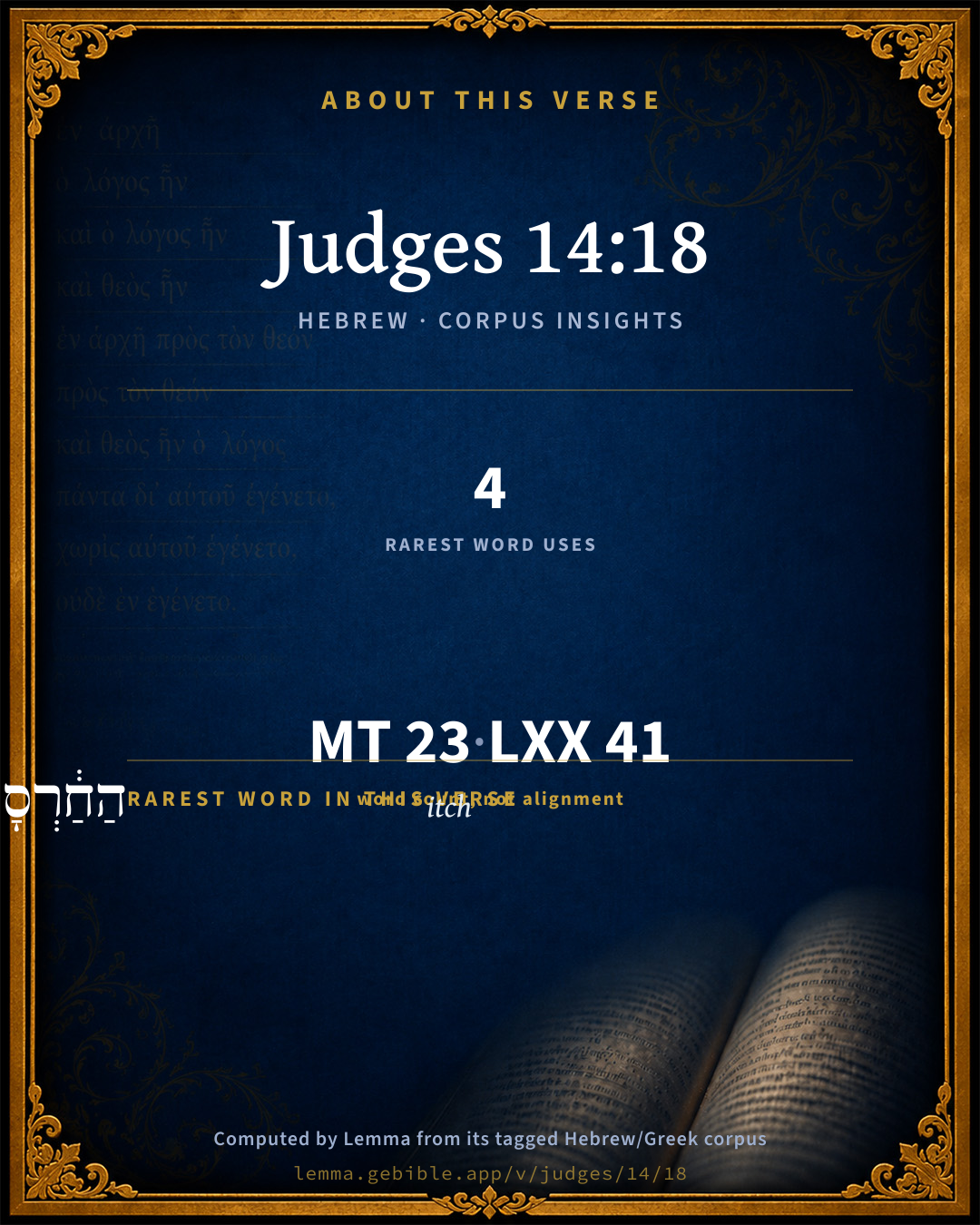
23
words
19
distinct lemmas
Historical
section

Notable vocabulary

The rarest word here is הַחַ֔רְסָה itch H2775 — appearing just 4 times in the whole Hebrew Bible.

Shared distinctive vocabulary

הַחַ֔רְסָה itch H2775 occurs in 4 verses of the Hebrew Bible. Also found in:

Grammatical profile

  • 5 verbs
  • 8 nouns
  • 3 adjectives
  • 2 prepositions
  • 1 conjunction
  • 1 adverb
  • 3 particles

Verb forms

  • וַיֹּ֣אמְרוּ Qal · Sequential Imperfect
  • יָבֹ֣א Qal · Imperfect
  • וַיֹּ֣אמֶר Qal · Sequential Imperfect
  • חֲרַשְׁתֶּ֣ם Qal · Perfect
  • מְצָאתֶ֖ם Qal · Perfect

Repetition

Words recur within this verse — often emphatic in Hebrew:

  • וַיֹּ֣אמְרוּ to say H559 ×2
  • מַה what H4100 ×2

Hebrew & Septuagint length

In English translation the verse runs 47 words from the Hebrew and 47 from the Septuagint (LXX English) — the same length.

A rough comparison of the two English renderings, which tokenize alike — not a word-level alignment.

Word counts can differ between the Hebrew and the Greek without any difference in meaning — e.g. the Hebrew direct-object marker אֵת has no separate Greek word, and Greek often adds the article ὁ.

In the original languages it is 23 Hebrew tokens and 41 Greek tokens — but the two are counted differently (Hebrew bundles its prefixes and suffixes into one token; the Greek is in lemma form), so that isn’t a like-for-like length.

Hebrew and Greek witnesses Masoretic Hebrew ↔ Greek Septuagint

The same verse in the two great witnesses to the Old Testament, shown verse-for-verse.

These are two independent witnesses, not word-aligned to each other, and the Septuagint is shown in lemma (dictionary) form.

Hebrew Judges 14:18 Masoretic · Westminster Leningrad Codex

וַיֹּ֣אמְרוּ לוֹ֩ אַנְשֵׁ֨י הָעִ֜יר בַּיּ֣וֹם הַשְּׁבִיעִ֗י בְּטֶ֨רֶם֙ יָבֹ֣א הַחַ֔רְסָה מַה מָּת֣וֹק מִדְּבַ֔שׁ וּמֶ֥ה עַ֖ז מֵאֲרִ֑י וַיֹּ֣אמֶר לָהֶ֔ם לוּלֵא֙ חֲרַשְׁתֶּ֣ם בְּעֶגְלָתִ֔י לֹ֥א מְצָאתֶ֖ם חִידָתִֽי

The men of the city said to him on the seventh day before the sun went down, What is sweeter than honey? and what is stronger than a lion? He said to them, If you hadn't plowed with my heifer, You wouldn't have found out my riddle.

World English Bible · Public Domain

Greek LXX Judges 14:18 Septuagint · lemma form

καί εἶπον αὐτός ὁ ἀνήρ ὁ πόλις ἐν ὁ ἡμέρα ὁ ἕβδομος πρό ὁ ἀνατέλλω ὁ ἥλιος τίς γλυκύς μέλι καί τίς ἰσχυρός λέων καί εἶπον αὐτός σαμψων εἰ μή ἀροτριάω ἐν ὁ δάμαλις ἐγώ οὐ ἄν γιγνώσκω ὁ πρόβλημα ἐγώ

And the men of the city said to him on the seventh day, before sunrise, What is sweeter than honey? and what is stronger than a lion? and Sampson said to them, If you⌃ had not plowed with my heifer, you⌃ would not have known my riddle.

LXX2012 (modern English Septuagint) · Public Domain

On this verse, Adam Clarke's Commentary discusses the Septuagint’s reading. Read the note in Commentary ↓

Hebrew: Westminster Leningrad Codex (CC BY 4.0). Greek: Septuagint (public domain); English from LXX2012 (modern English Septuagint) (Public Domain). How the Septuagint differs from the Hebrew →

Targum (Aramaic paraphrase)

1

The Targum is the ancient Jewish Aramaic paraphrase of the Hebrew Scriptures — an interpretive translation, not the Hebrew text itself. Onkelos (literal) and Pseudo-Jonathan (expansive) render the Torah, and Jonathan the Prophets. Coverage is partial: where no permissively-licensed English translation exists for a verse, only the Aramaic is shown. This is verse-level text, not a word-by-word alignment to the Hebrew.

  1. Targum Jonathan Prophets (Joshua–Malachi)
    וַאֲמַרוּ לֵיהּ אֱנָשֵׁי קַרְתָּא בְּיוֹמָא שְׁבִיעָאָה עַד לָא מֵעַל שִׁמְשָׁא מַה חַלֵי מִדוּבְשָׁא וּמַה תַּקִיף מֵאַרְיָא וַאֲמַר לְהוֹן אִילוּלָפוֹן בְּדַקְתּוּן בְּאִתְּתִי לָא אַשְׁכַּחְתּוּן חוּדָתִי:

    (no public-domain English translation for this verse)

    Targum Jonathan — Aramaic: “Mikraot Gedolot” (public domain). English: “Sefaria Community Translation” (CC0 1.0 (public-domain dedication)); “London "Chaldee Paraphrase," 1871” (public domain). Text via Sefaria.

Commentary

Notes on Judges 14:18 from classic Christian and Jewish commentators (each source and its license shown beneath its notes). The classic Christian expositions comment on the surrounding passage and are grouped to its opening verse, so a note may address several verses; the Jewish commentaries on the Tanakh (Rashi and others) are per-verse, so they appear only where the commentator wrote on this verse.

Lemma curates 59 commentaries, every one of them public domain or Creative Commons licensed, each selected and text-cleaned for this edition rather than reprinted as found. About our sources →

Trapp's Complete Commentary

John Trapp

Jdg 14:18 And the men of the city said unto him on the seventh day before the sun went down, What [is] sweeter than honey? and what [is] stronger than a lion? And he said unto them, If ye had not plowed with my heifer, ye had not found out my riddle.

Ver. 18. If ye had not ploughed with my heifer.] His wife he calleth his heifer, propter mulierum insolentiam, saith Lyra. Some think that these words intimate some sign of suspicion of some secret and unchaste dealing with his wife, that iuvenca petalca, which kindled a "jealousy" in him, which is, saith Solomon, "the rage of a man."

John Trapp, A Commentary or Exposition upon All the Books of the Old and New Testament (1647–1656) — public domain. Text from a community e-Sword module.

Joseph Benson's Commentary

Jdg 14:18-19. If ye had not, &c. — If you had not employed my wife to find it out, as men plough up the ground with a heifer, thereby discovering its hidden parts; he calls her heifer, because she was joined with him in the same yoke. The Spirit of the Lord came upon him — Though he had constant strength and courage, yet that was exceedingly increased upon special occasions, by the extraordinary influences of God’s Spirit. To Ashkelon — Either to the territory, or to the city itself, where he had both strength and courage enough to attempt what follows; and upon the doing hereof they were doubtless struck with such terror, that every one sought only to preserve himself, and none durst pursue him. This action of Samson could neither be commended nor justified, had he not been actuated by a divine impulse, in order to punish the Philistines, according to God’s intention. God made use of him, as the judge does of the executioner, to punish those that merit and are condemned to suffer punishment. And took their spoil — This plainly shows the thirty sheets, and thirty changes of raiment, mentioned Jdg 14:13, mean only thirty suits of apparel, such as men commonly wore. His anger was kindled — For the treachery of his wife and companions; and he went up to his father’s house — Without his wife. It would be well for us, if the unkindnesses we meet with from the world, and our disappointments therein, had this good effect upon us, to oblige us to return by faith and prayer to our heavenly Father’s house.

Joseph Benson's Commentary on the Old and New Testaments (1811–1818) — public domain. Text from a community e-Sword module.

Geneva Bible (1599)

Geneva Bible translators

If ye had not used the help of my wife.

Geneva Bible (1599) marginal notes — public domain. Text via Bolls.life.

Jamieson, Fausset & Brown

Robert Jamieson, A. R. Fausset & David Brown

If ye had not plowed with my heifer, ye had not found out my riddle--a metaphor borrowed from agricultural pursuits, in which not only oxen but cows and heifers were, and continue to be, employed in dragging the plough. Divested of metaphor, the meaning is taken by some in a criminal sense, but probably means no more than that they had resorted to the aid of his wife--an unworthy expedient, which might have been deemed by a man of less noble spirit and generosity as releasing him from the obligation to fulfil his bargain.

Jamieson, Fausset & Brown — Commentary Critical and Explanatory on the Whole Bible (1871) — public domain (CC PDM 1.0). Text via the HelloAO Bible API.

Adam Clarke's Commentary

Verse 18. If ye had not ploughed with my heifer] If my wife had not been unfaithful to my bed, she would not have been unfaithful to my secret; and, you being her paramours, your interest was more precious to her than that of her husband. She has betrayed me through her attachment to you.

Calmet has properly remarked, in quoting the Septuagint, that to plough with one's heifer, or to plough in another man's ground, are delicate turns of expression used both by the Greeks and Latins, as well as the Hebrews, to point out a wife's infidelities.

Thus Theognis, Gnom. v. 581: -

Εχθαιρω δε γυναικα περιδρομον, ανδρα τε μαργον.

Ὁς την αλλονριην βουλετ' αρουραν αρουν.

"I detest a woman who gads about, and also a libidinous man, who wishes to plough in another man's ground."

Fundum alienium arat, incultum familiarem deserit.

PLAUTUS.

"He ploughs another's farm, and leaves his own heritage uncultivated."

Milo domi non est, perepre at Milone profecto

Arva vacant, uxor non minus inde parit.

MARTIAL.

"Milo is not at home, and Milo being from home, his field lies uncultivated; his wife, nevertheless, continues to breed, and brings forth children."

There is the same metaphor in the following lines of Virgil: -

Hoc faciunt, nimo ne luxu obtusior usus,

Sit genitali arvo, sulcosque oblimet inertes.

Geor. l. iii., v. 135.

In this sense Samson's words were understood by the Septuagint, by the Syriac, and by Rabbi Levi. See BOCHART, Hierozoic. p. 1., lib. ii., cap. 41., col. 406.

The metaphor was a common one, and we need seek for no other interpretation of the words of Samson.

Adam Clarke's Commentary on the Bible (1810–1826) — public domain. Text from a community e-Sword/MySword module.

Ellicott's Commentary for English Readers

(18) What is sweeter than honey?—Their answer is given in the same rhythmical form as the riddle itself.

If ye had not plowed with my heifer.—Many commentators, following Rabbi Levi Ben Gershom, read in this proverbial phrase an implication that Samson suspected his wife of adultery; but there is no sufficient reason for this view.

A Bible Commentary for English Readers, edited by Charles John Ellicott (1878–1897) — public domain. Text from a community e-Sword module.

The Cambridge Bible for Schools and Colleges

gen. ed. J. J. S. Perowne

18. before the sun went down] lit. went in. But the word for sun (ḥeres) is rare and poetical, and it has the accus. ending which denotes motion towards. A slight correction proposed by Stade gives the right sense: before he went into the chamber, the same word as in Jdg_15:1. They wait till the last moment before the wedding was completed.

The Cambridge Bible for Schools and Colleges (gen. ed. J. J. S. Perowne; Cambridge University Press, 1878–1918) — public domain. Text from a community e-Sword module.

John Gill's Exposition

And the men of the city said unto him, on the seventh day, before the sun went down,.... And so soon, enough to free them from the obligation they otherwise would have been under, to have given him the sheets and changes of raiment agreed unto:

what is sweeter than honey? nothing, at least that was known, sugar not being invented. Julian the emperor (n), in commendation of figs, shows, from various authors, that nothing is sweeter than they, excepting honey:

and what is stronger than a lion? no creature is, it is the strongest among beasts, Pro 30:30. Homer (o) gives the epithet of strong to a lion:

and he said unto them, if ye had not ploughed with my heifer; meaning his wife, whom he compares to an heifer, young, wanton, and unaccustomed to the yoke (p); and by "ploughing" with her, he alludes to such creatures being employed therein, making use of her to get the secret out of him, and then plying her closely to obtain it from her; and this diligent application and search of theirs, by this means to inform themselves, was like ploughing up ground; they got a discovery of that which before lay hid, and without which they could never have had the knowledge of, as he adds:

ye had not found out my riddle; the explanation of it. Ben Gersome and Abarbinel interpret ploughing of committing adultery with her; in which sense the phrase is used by Greek and Latin writers (q); but the first sense is best, for it is not said, "ploughed my heifer", but with her.

(n) Opera, par. 9. epist. 24. (o) Odyss. 4. ver. 336. (p) Vid. Horat. Carmin, l. 2. ode 5. Graja. "Juvenca venit". Ovid. ep. 5. ver. 117. (q) Vid. Bochart. Hierozoic par. 1. l. 2. c. 41. col. 406.

John Gill's Exposition of the Whole Bible (1746–1763) — public domain (CC PDM 1.0). Text via the HelloAO Bible API.

Albert Barnes' Notes on the Bible

They try to give the answer in a way to make it appear that they had guessed it. Samson saw at once that she had betrayed him. He lets them know in a speech, which was of the nature of a riddle, that he had discovered the treachery.

Albert Barnes' Notes on the Bible (1834–1885) — public domain. Text from a community e-Sword/MySword module.

Haydock's Catholic Bible Commentary

Down, at which time the day ended among the Jews. --- Heifer. This proverbial expression means, that another’s property had been used against himself; (Delrio adag.162) or it may intimate, that improper liberties had been taken with Samson’s wife, (Calmet) as her so readily taking one of them for her husband, (ver. 20) might lead us to suspect. (Haydock) --- The Greek and Latin authors speak of a faithless wife in similar terms. (Theognis. lviii., &c.)

George Leo Haydock (1774–1849), Haydock's Catholic Family Bible and Commentary, 1859 edition — public domain. Excludes Psalms (Douay-Rheims chapter numbering differs from Protestant) and Deuterocanonical books (Catholic canon only).

Matthew Poole's English Annotations

If you had not employed my wife to find it out, as men plough up the ground with a heifer, thereby discovering its hidden parts: he calls her

heifer, either because he now suspected her wantonness and too much familiarity with that friend which she afterwards married; or because she was joined with him in the same yoke; or rather, because they used such in ploughing.

Matthew Poole's English Annotations on the Holy Bible (1683–1685) — public domain. Text from a community e-Sword/MySword module.

Whedon's Commentary on the Bible

Daniel D. Whedon

18. Men of the city — The thirty companions mentioned in Jdg_14:11.

Before the sun went down — Just in time to save themselves the mulct.

What is sweeter than honey? And what is stronger than a lion?

They answer thus sententiously, and by a distich similar to that in which he propounded the riddle. It was not necessary that they utter particulars, but only say so much as to assure him that they knew his riddle. Their triumph had been gained at such pains that they seem to have sought to make their answer poignant, in order to irritate Samson.

Ploughed with my heifer — A proverbial expression implying the illegal use of that which was not their own. The expression was, indeed, not a delicate or chaste one, but does not charge, as some have thought, lewd and criminal intercourse between Samson’s wife and his thirty companions.

Daniel D. Whedon (gen. ed.), Commentary on the Old and New Testaments (1874–1909) — public domain. Text from a community e-Sword module.

The Pulpit Commentary

The men of the city the same as were spoken of in ver. 11 as Samson"s companions. Before the sun went down just in time, therefore, to save the wager, as defined in ver. 12. This is the uncommon word for the sun used also in Jud_1:8:13, where see note. What is sweeter, etc. They put their answer in a form to make it seem as if they had guessed the riddle; but Samson instantly perceived his wife"s treachery, and showed that he did so by quoting the proverb of plowing with another person s heifer. They had not used their own wit to find out the riddle, but had learnt the secret at Samson"s cost, through his wife. He insinuates that had they acted fairly he would have won the wager.

Ploughing with another"s heifer.

The saying derives itself from the occasional discovery of hidden treasure by the plough, and the superstitious belief that the homebred heifer knew where the furrow ought to be drawn, because it has been shown the way before, when the treasure was hid.

I So SATAN AND HIS SERVANTS BETRAY MEN THROUGH THEIR HABITUAL TEMPERAMENT OR BIAS THE WEAKNESS PECULIAR TO THEM. The weak place in Samson was his sensuality. His enemies speedily discovered this, and were unscrupulous enough to take advantage of it.

II SAINTS SHOULD BE DISTRUSTFUL OF UNHOLY CONFIDENCES, AND SHOULD LEAVE "NO UNGUARDED PLACE" IN THEIR SPIRITUAL CHARACTER OR RELATIONS. All habitual relations or companionships with worldly persons are dangerous. Our sin will find us out, to our confusion. Safety can alone be found in perfect consecration putting on the whole armour of God. Relations in life which, when both parties are holy, are full of comfort and help, when they involve us in close fellowship with the wicked may be our destruction. M.

The Pulpit Commentary (1880–1919), ed. H.D.M. Spence-Jones & Joseph S. Exell — public domain. Text from a community e-Sword module.

John Wesley's Explanatory Notes

If ye had not &c. - If you had not employed my wife to find it out, as men plough up the ground with an heifer, thereby discovering its hidden parts; he calls her heifer, because she was joined with him in the same yoke.

John Wesley, Explanatory Notes Upon the Whole Bible (1754–1765) — public domain. Text via the GEBible commentary corpus.

unfoldingWord translationNotes

Door43 World Missions Community

the men of the city

This refers to Samson's wife's relatives. This can be stated clearly. AT: "the young men" or "her relatives" (See: Assumed Knowledge and Implicit Information)

the seventh day

"day 7" (See: Ordinal Numbers)

What is sweeter than honey? What is stronger than a lion?

This is the answer to the riddle. It may be written as a statement instead of as questions. If necessary it could be made clear how this relates to the riddle by adding more information. AT: "Honey is sweet and a lion is strong." or "Honey is sweet and it came out of a lion." (See: Rhetorical Question and Assumed Knowledge and Implicit Information)

If you had not plowed with my heifer

Samson compares their using his wife to get the answer to someone using another person's heifer to plow his field. AT: "If you had not used my wife" (See: Metaphor)

plowed

To plow is to use an animal to pull a blade through soil to prepare the soil for seeds.

translationWords

honey

lions

cow

unfoldingWord translationNotes — © Distant Shores Media and the Door43 World Missions Community, licensed CC BY-SA 4.0. Source: git.door43.org/Door43/en_tn.

Rashi

Rabbi Shlomo Yitzchaki (Rashi)

Before sunset. Before the sun descended, as they still had time until nightfall.

Plowed with my calf. This is allegorical—if you had not questioned my wife.

Rashi on the Tanakh — English translations: “The Judaica Press complete Tanach with Rashi, translated by A. J. Rosenberg” (CC BY 4.0); “Pentateuch with Rashi's commentary by M. Rosenbaum and A.M. Silbermann, 1929-1934” (public domain); “The Metsudah Tanach series, Lakewood, N.J” (CC BY 4.0); and “The Book of Joshua, Metsudah Publications, 1997” (CC BY 4.0). Text via Sefaria.

Lesson kit

Teaching starters — assembled from the data on this page, not authored interpretation. Every prompt links to the verse data it draws on. Edit before teaching.

Judges, in the Historical, opens this verse with 23 words (19 distinct Hebrew lemmas). Its most distinctive word is chereç (“itch”). A historical commentator’s framing appears above. Read the whole chapter for the surrounding context.

Discussion questions

  1. What does “itch” (chereç) contribute to the verse as a whole?
  2. Deuteronomy 28:27 shares the word «itch» with this verse. How do the two illuminate each other?
  3. “to say” occurs 2× in this one verse. What is the effect of the repetition?
  4. The translations on this page render this verse differently — a whole-verse word diff, not a word-by-word alignment. What might account for the different wordings?
  5. The verb «וַיֹּ֣אמְרוּ» is Qal Sequential Imperfect. How does its form color the action?
  6. Reading how Trapp's Complete Commentary and Joseph Benson's Commentary read this verse, where do the two commentators agree and where do they part?

Things to notice

Reading settings

Reading text

Shown beneath each verse's original-language words.

Old Testament
Old Testament edition

Read the OT as the Masoretic Hebrew (MT) or the Greek Septuagint (LXX).

English shown for the Greek Septuagint (in the Hebrew ↔ Greek comparison).

Comparing translations? Open the Compare panel on any verse page to stack up to four side by side.