
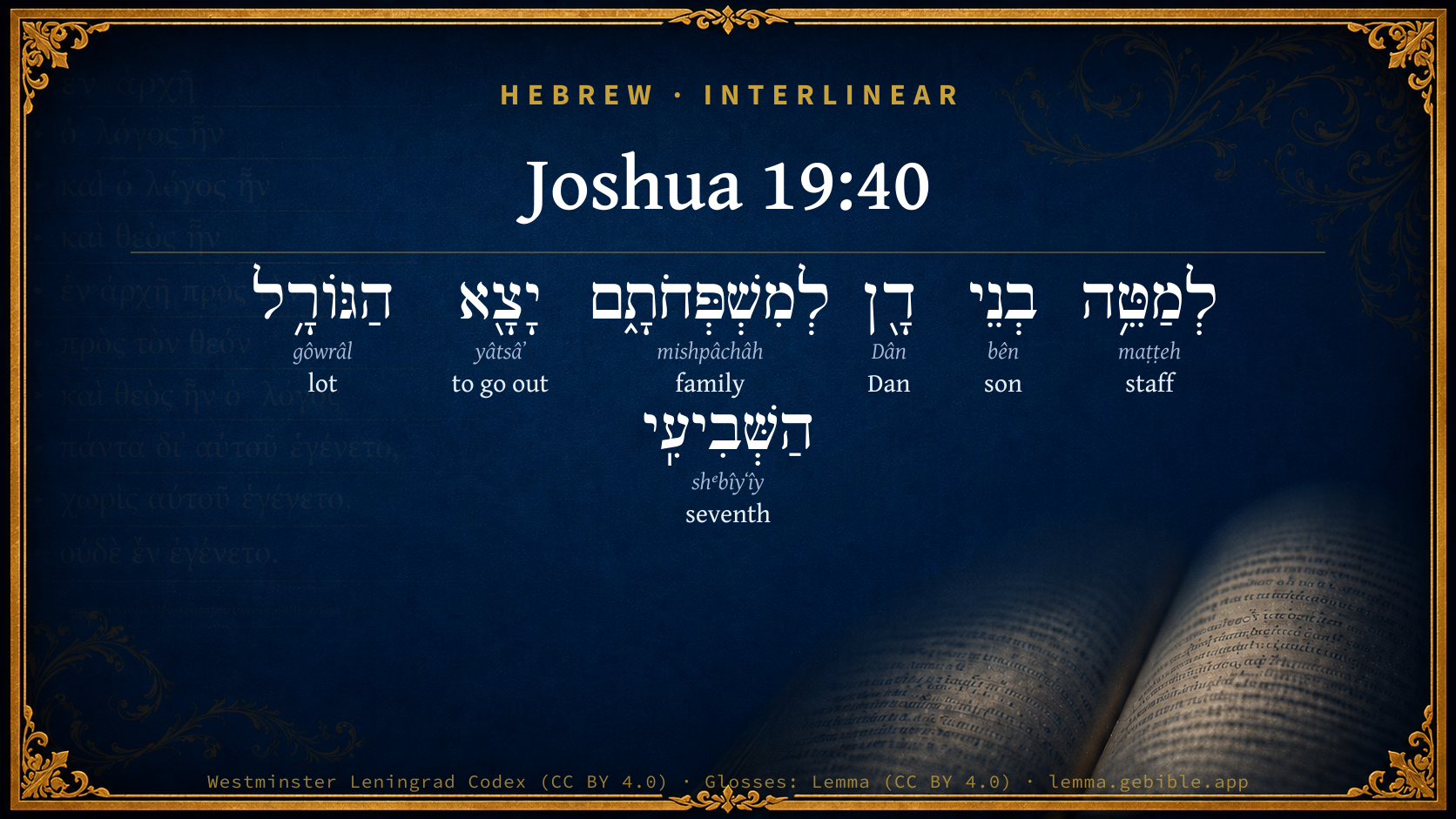
Joshua 19:40

Hebrew (Westminster Leningrad Codex) Joshua 19:40 appears in the Hebrew Old Testament. The text above is from the Westminster Leningrad Codex. Each word links to its Strong’s number, a concise gloss, and parsing drawn from the Open Scriptures Hebrew Bible morphology. Click any word for its full Brown-Driver-Briggs (BDB) entry.
Download image
Cite this verse

Joshua 19:40 (World English Bible). Public Domain. Lemma interlinear Bible study tool, https://lemma.gebible.app/v/joshua/19/40.

Show BibTeX & RIS
BibTeX
RIS
English Translation
The seventh lot came out for the tribe of the children of Dan according to their families.
World English Bible · Public Domain
Download a study sheet

One document with this verse’s original text, its word-by-word gloss line, the meaning frame, cross-references with their text, attributed commentary, and full source and license credits — printable, and it pastes into notes with its structure intact.

This verse Autodidact and up

Study sheet (.html) Plain text (.txt)

A passage Seminary Student

Up to 50 verses in one chapter. A passage sheet keeps up to 6 commentary sources and 12 cross-references per verse, in the order this page ranks them, and says so on the sheet whenever that leaves anything out. Ask for a single verse and you get the Autodidact verse sheet above.

Everything on this page stays free to read, with no account — the sheet is a download of what is already on screen, not access to it.

Want to remove ads? Support Godless Engineer
Compare translations 3

The same verse in 3 English versions, stacked beneath the original-language interlinear above. Click any original word for its lexicon entry.

Each is an independent rendering of the whole verse — the interlinear is not word-aligned to these translations.

Highlighted words mark where these versions differ — a whole-verse word diff, not a word-by-word alignment.

  • World English Bible Public Domain
    The seventh lot came out for the tribe of the children of Dan according to their families.
  • King James Version Public Domain
    And the seventh lot came out for the tribe of the children of Dan according to their families.
  • unfoldingWord Literal Text CC BY-SA 4.0
    The seventh lot came out for the tribe of the sons of Dan according to their clans.

unfoldingWord Literal Text — © unfoldingWord, licensed CC BY-SA 4.0. Word-aligned USFM3 via Door43 (git.door43.org/unfoldingWord/en_ult).

Versions to compare (up to 4)

3 of 4 selected

Show all 18 translations

Every available English version of this verse, each an independent rendering of the whole verse.

  • World English Bible Public Domain
    The seventh lot came out for the tribe of the children of Dan according to their families.
  • Berean Standard Bible Public Domain
    The seventh lot came out for the clans of the tribe of Dan:
  • Majority Standard Bible Public Domain
    The seventh lot came out for the clans of the tribe of Dan:
  • King James Version Public Domain
    And the seventh lot came out for the tribe of the children of Dan according to their families.
  • American Standard Version (1901) Public Domain
    The seventh lot came out for the tribe of the children of Dan according to their families.
  • Revised Version (1885) Public Domain
    The seventh lot came out for the tribe of the children of Dan according to their families.
  • Geneva Bible (1599) Public Domain
    The seuenth lot came out for the tribe of the children of Dan according to their families.
  • Douay-Rheims (1899) Public Domain
    The seventh lot came out to the tribe of the children of Dan by their families:
  • Young's Literal Translation Public Domain
    For the tribe of the sons of Dan, for their families, hath the seventh lot gone out;
  • Literal Standard Version CC BY-SA 4.0
    The seventh lot has gone out for the tribe of the sons of Dan, for their families;
  • Unlocked Literal Bible CC BY-SA 4.0
    The seventh casting of lots fell to the tribe of Dan, clan by clan.
  • unfoldingWord Literal Text CC BY-SA 4.0
    The seventh lot came out for the tribe of the sons of Dan according to their clans.
  • Darby Bible Public Domain
    The seventh lot came forth for the tribe of the children of Dan according to their families.
  • World Messianic Bible Public Domain
    The seventh lot came out for the tribe of the children of Dan according to their families.
  • Webster's Bible Public Domain
    And the seventh lot came out for the tribe of the children of Dan according to their families.
  • Free Bible Version CC BY-SA 4.0
    The seventh lot cast went to the tribe of Dan, by families.
  • Bible in Basic English Public Domain
    For the tribe of Dan by their families the seventh heritage came out;
  • JPS Tanakh (1917) Public Domain
    The seventh lot came out for the tribe of the children of Dan according to their families.

Literal Standard Version (2020), Covenant Press — licensed CC BY-SA 4.0. Text via the HelloAO Bible API (eBible.org). Unlocked Literal Bible (unfoldingWord) — licensed CC BY-SA 4.0. Text via the HelloAO Bible API (eBible.org). unfoldingWord Literal Text — © unfoldingWord, licensed CC BY-SA 4.0. Word-aligned USFM3 via Door43 (git.door43.org/unfoldingWord/en_ult). Free Bible Version, Dr. Jonathan Gallagher — licensed CC BY-SA 4.0. Text via the HelloAO Bible API (eBible.org).

Word by word

More ways to search: Search by grammar → Find every occurrence → Compare this word →

Practice this passage: Drill this verse → Learn its vocabulary →

About this verse

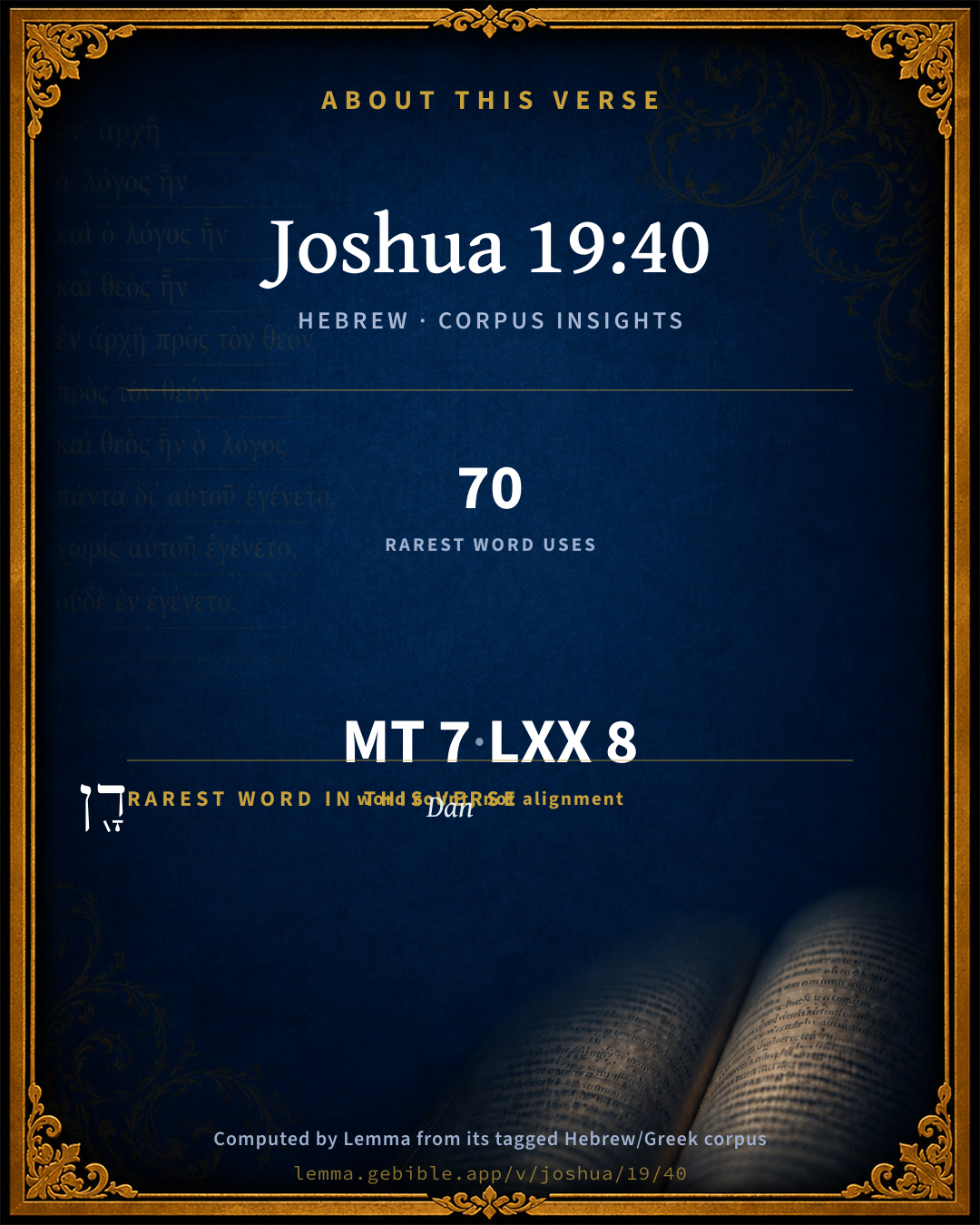
These counts appear in no published source. They are computed here, from the morphology-tagged text and Lemma’s own curated glosses. What Lemma adds →

7
words
7
distinct lemmas
Historical
section

Grammatical profile

  • 1 verb
  • 5 nouns
  • 1 adjective

Verb forms

  • יָצָ֖א Qal · Perfect

Hebrew & Septuagint length

In English translation the verse runs 17 words from the Hebrew and 8 from the Septuagint (LXX English) — the Septuagint runs noticeably shorter here. See the side-by-side →

A rough comparison of the two English renderings, which tokenize alike — not a word-level alignment.

Word counts can differ between the Hebrew and the Greek without any difference in meaning — e.g. the Hebrew direct-object marker אֵת has no separate Greek word, and Greek often adds the article ὁ.

In the original languages it is 7 Hebrew tokens and 8 Greek tokens — but the two are counted differently (Hebrew bundles its prefixes and suffixes into one token; the Greek is in lemma form), so that isn’t a like-for-like length.

Hebrew and Greek witnesses Masoretic Hebrew ↔ Greek Septuagint

The same verse in the two great witnesses to the Old Testament, shown verse-for-verse.

Here the Septuagint runs noticeably shorter than the Hebrew — LXX2012 (modern English Septuagint) 8 words vs World English Bible 17. A rough length comparison of the two English translations, not a word-level alignment — read both below.

These are two independent witnesses, not word-aligned to each other, and the Septuagint is shown in lemma (dictionary) form.

Hebrew Joshua 19:40 Masoretic · Westminster Leningrad Codex

לְמַטֵּ֥ה בְנֵי דָ֖ן לְמִשְׁפְּחֹתָ֑ם יָצָ֖א הַגּוֹרָ֥ל הַשְּׁבִיעִֽי

The seventh lot came out for the tribe of the children of Dan according to their families.

World English Bible · Public Domain

Greek LXX Joshua 19:40 Septuagint · lemma form

καί ὁ δαν ἐκἔρχομαι ὁ κλῆρος ὁ ἕβδομος

And the seventh lot came out to Dan.

LXX2012 (modern English Septuagint) · Public Domain

On this verse, John Gill's Exposition discusses the Septuagint’s reading. Read the note in Commentary ↓

Hebrew: Westminster Leningrad Codex (CC BY 4.0). Greek: Septuagint (public domain); English from LXX2012 (modern English Septuagint) (Public Domain). How the Septuagint differs from the Hebrew →

Targum (Aramaic paraphrase)

1

The Targum is the ancient Jewish Aramaic paraphrase of the Hebrew Scriptures — an interpretive translation, not the Hebrew text itself. Onkelos (literal) and Pseudo-Jonathan (expansive) render the Torah, and Jonathan the Prophets. Coverage is partial: where no permissively-licensed English translation exists for a verse, only the Aramaic is shown. This is verse-level text, not a word-by-word alignment to the Hebrew.

  1. Targum Jonathan Prophets (Joshua–Malachi)
    לְשִׁבְטָא דִבְנֵי דָן לְזַרְעֲיַתְהוֹן נַפְקָא עַדְבָא שְׁבִיעָאָה:

    (no public-domain English translation for this verse)

    Targum Jonathan — Aramaic: “Mikraot Gedolot” (public domain). English: “Sefaria Community Translation” (CC0 1.0 (public-domain dedication)); “London "Chaldee Paraphrase," 1871” (public domain). Text via Sefaria.

Commentary

Notes on Joshua 19:40 from classic Christian and Jewish commentators (each source and its license shown beneath its notes). The classic Christian expositions comment on the surrounding passage and are grouped to its opening verse, so a note may address several verses; the Jewish commentaries on the Tanakh (Rashi and others) are per-verse, so they appear only where the commentator wrote on this verse.

Lemma curates 59 commentaries, every one of them public domain or Creative Commons licensed, each selected and text-cleaned for this edition rather than reprinted as found. About our sources →

Jamieson, Fausset & Brown

Robert Jamieson, A. R. Fausset & David Brown

OF DAN. (Jos 19:40-48)

the seventh lot came out for the tribe . . . Dan--It lay on the west of Benjamin and consisted of portions surrendered by Judah and Ephraim. Its boundaries are not stated, as they were easily distinguishable from the relative position of Dan to the three adjoining tribes.

Jamieson, Fausset & Brown — Commentary Critical and Explanatory on the Whole Bible (1871) — public domain (CC PDM 1.0). Text via the HelloAO Bible API.

Trapp's Complete Commentary

John Trapp

Jos 19:40 [And] the seventh lot came out for the tribe of the children of Dan according to their families.

Ver. 40. For the tribe of the children of Dan.] Who also, as well as Simeon, had various cities taken out of the first lot of the tribe of Judah. See on Jos 19:1.

John Trapp, A Commentary or Exposition upon All the Books of the Old and New Testament (1647–1656) — public domain. Text from a community e-Sword module.

Whedon's Commentary on the Bible

Daniel D. Whedon

DAN’S LOT, Jos_19:40-48.

[The territory assigned to Dan was the smallest of all the tribe divisions. But it was not without advantages. Its border on the northeast and south joined respectively on Ephraim, Benjamin, and Judah, the three most powerful tribes of Israel. Its western border was the Mediterranean. The territory thus enclosed embraced the beautiful plain south of Joppa, the cornfield and garden of Southern Palestine. Dr. Robinson thus describes this district, as seen from the tower of Ramleh: “Towards the north and south, as far as the eye could reach, the beautiful plain was spread out like a carpet at our feet, variegated with tracts of brown, from which the crops had just been taken, and with fields still rich with the yellow of ripe corn, or green with the springing millet. Immediately below us the eye rested on the immense olive groves of Ramleh and Lydda, and the picturesque towers, and minarets, and domes, of these large villages. In the plain itself there were not many villages; but the tract of hills, and the mountain side beyond, especially in the northeast, appeared as if studded with them, and, as now seen in the setting sun, they seemed like white villas and hamlets among the dark hills, presenting an appearance of thriftiness and beauty which certainly would not stand a closer examination.”

But the children of Dan were unable to hold this beautiful plain, for “the Amorites forced them into the mountain, for they would not suffer them to come down to the valley,” (Jdg_1:34,) and they were obliged to receive help from “the hand of the house of Joseph.” Jos_19:35.

Some time after the allotment this tribe enlarged its possessions by the conquest of Laish in the north. Judges 18. In this covert but daring movement Dan fulfilled the prophecies of Jacob and of Moses. Gen_49:17; Deuteronomy 13:32. Of this tribe was the famous hero Samson, who judged Israel twenty years. By taking Micah’s images, and with them establishing a tribe sanctuary at Dan, (Jdg_18:20; Jdg_18:30,) they seem to have been the first to adopt and establish an illegal worship in Israel, and as the tribe of Dan is not mentioned in Rev_7:5-7, among those that were sealed, some of the fathers inclined to believe that from this tribe Antichrist should spring.]

Daniel D. Whedon (gen. ed.), Commentary on the Old and New Testaments (1874–1909) — public domain. Text from a community e-Sword module.

Tyndale Open Study Notes

Tyndale Open Resources

19:40-48 The original allotment given to the tribe of Dan lay west of Judah and southwest of Ephraim’s main territory, between Judah and Philistia.

Tyndale Open Study Notes — © Tyndale Open Resources, licensed CC BY-SA 4.0. Text via the HelloAO Bible API.

Matthew Henry's Commentary

Dan, though commander of one of the four squadrons of the camp of Israel, in the wilderness, that which brought up the rear, yet was last provided for in Canaan, and his lot fell in the southern part of Canaan, between Judah on the east and the land of the Philistines on the west, Ephraim on the north and Simeon on the south. Providence ordered this numerous and powerful tribe into a post of danger, as best able to deal with those vexatious neighbours the Philistines, and so it was found in Samson. Here is an account, 1. Of what fell to this tribe by lot, Zorah, and Eshtaol, and the camp of Dan thereabouts, of which we read in the story of Samson. And near there was the valley of Eshcol, whence the spies brought the famous bunch of grapes. Japho, or Joppa was in this lot. 2. Of what they got by their own industry and valour, which is mentioned here (Jos 19:47), but related at large, Jdg 18:7, etc.

Matthew Henry's Commentary on the Whole Bible (1708–1710) — public domain (CC PDM 1.0). Text via the HelloAO Bible API.

Ellicott's Commentary for English Readers

(40) The seventh lot . . . of the children of Dan.—Dan was the most numerous tribe, next to Judah, in each census taken during the exodus. (See Numbers 1, 26) This tribe had also had a post of honour in being commander of the rear-guard during the march. A similar post is here assigned to Dan in Palestine, viz., next to Judah, on the side of the Philistine territory. The Philistines were the most powerful and warlike of the unconquered nations of Palestine. The wisdom of guarding Israel on their frontier by the two strongest of the tribes is manifest. It was Samson, a Danite, who began to deliver Israel from them, and David completed the work. Though there were Philistine wars in the time of the later kings, they never had dominion over Israel after David’s time.

A Bible Commentary for English Readers, edited by Charles John Ellicott (1878–1897) — public domain. Text from a community e-Sword module.

The Cambridge Bible for Schools and Colleges

gen. ed. J. J. S. Perowne

40–48. The Inheritance of the Tribe of Dan

40. the seventh lot] came out to the smallest of all the tribes, that of Dan, descended from the fifth son of Jacob. The position of the tribe during the march through the wilderness had been on the north side of the Tabernacle, the hindmost of the long procession between Naphtali and Asher. At the census in the desert it was the most numerous of all the tribes with the exception of Judah, containing 62,700 men able to bear arms.

The Cambridge Bible for Schools and Colleges (gen. ed. J. J. S. Perowne; Cambridge University Press, 1878–1918) — public domain. Text from a community e-Sword module.

John Gill's Exposition

And the coast of their inheritance was Zorah, and Eshtaol,.... The tribe of Dan is not described by places the boundaries of it, as other tribes, but by its cities, which were chiefly, at least several of them, taken out of the tribe of Judah, as the two first of these most manifestly were; See Gill on Jos 15:33,

and Irshemesh signifies the city of the sun, as the Targum interprets it, and was so called very probably from a temple in it, dedicated to the idolatrous worship of the sun, but a different place from Bethshemesh in other tribes; though those of that name, as this, had it for the like reason; and so Heliopolis, in Egypt, which signifies the same, where was a temple of the same kind; as there was another city of this name, between the mountains of Libanus and Antilibanus, now called Balbec (p), where the ruins of the temple are yet to be seen: but this was a different place, the Septuagint version calls it Sammaus, and it was, according to Jerom (q), the same with Emmaus, afterwards called Nicopolis; which, if the same Emmaus with that in Luk 24:13; though some doubt it, was sixty furlongs from Jerusalem, or seven miles and a half.

(p) See Maundrell's Journey from Aleppo, &c. p. 120, 138. (q) Comment. in Ezek. xlviii. fol. 263. A.

John Gill's Exposition of the Whole Bible (1746–1763) — public domain (CC PDM 1.0). Text via the HelloAO Bible API.

Keil & Delitzsch

C. F. Keil & F. Delitzsch

The Inheritance of the Tribe of Dan. - This fell to the west of Benjamin, between Judah and Ephraim, and was formed by Judah giving up some of its northern towns, and Ephraim some of its southern towns, to the Danites, so as to furnish them with a territory proportionate to their number. It was situated for the most part in the lowland (shephelah), including, however, the hill country between the Mediterranean and the mountains, and extended over a portion of the plain of Sharon, so that it belonged to one of the most fruitful portions of Palestine. The boundaries are not given, because they could be traced from those of the adjoining territories.

Jos 19:41-42

From Judah the families of Dan received Zorea and Eshtaol (see at Jos 15:33), and Ir-shemesh, also called Beth-shemesh (Kg1 4:9), on the border of Judah (see Jos 15:10); but of these the Danites did not take possession, as they were given up by Judah to the Levites (Jos 21:16 : see at Jos 15:10). Saalabbin, or Saalbim, which remained in the hands of the Canaanites (Jdg 1:35), is frequently mentioned in the history of David and Solomon (Sa2 23:32; Ch1 11:33; Kg1 4:9). It may possibly be the present Selbt (Rob. iii. App.; Bibl. Res. p. 144), some distance to the north of the three places mentioned (Knobel). Ajalon, which was also not taken from the Canaanites (Jdg 1:35), was assigned to the Levites (Jos 21:24; Ch1 6:54). It is mentioned in the wars with the Philistines (Sa1 14:31; Ch1 8:13), was fortified by Rehoboam (Ch2 11:10), and was taken by the Philistines from King Ahaz (Ch2 28:18). It has been preserved in the village of Yalo (see at Jos 10:12). Jethlah is only mentioned here, and has not yet been discovered. So far as the name is concerned, it may possibly be preserved in the Wady Atallah, on the west of Yalo (Bibl. Res. pp. 143-4).

Jos 19:43

Elon, which is mentioned again in Kg1 4:9, with the addition of Beth-hanan, has not yet been traced; according to Knobel, it "may possibly be Ellin, near Timnath and Beth-shemesh, mentioned by Robinson in his Pal. vol. iii. App." Thimna (Thimnathah) and Ekron, on the boundary of Judah (see at Jos 15:10-11).

Jos 19:44

Eltekeh and Gibbethon, which were allotted to the Levites (Jos 21:23), have not yet been discovered. Under the earliest kings of Israel, Gibbethon was in the hands of the Philistines (Kg1 15:27; Kg1 16:15, Kg1 16:17). Baalath was fortified by Solomon (Kg1 9:18). According to Josephus (Ant. 8:6, 1), it was "Baleth in the neighbourhood of Geser;" probably the same place as Baalah, on the border of Judah (Jos 15:11).

Jos 19:45

Jehud has probably been preserved in the village of Jehudieh (Hudieh), two hours to the north of Ludd (Diospolis), in a splendidly cultivated plain (Berggren, R. iii. p. 162; Rob. iii. p. 45, and App.). Bene-berak, the present Ibn Abrak, an hour from Jehud (Scholz, R. p. 256). Gath-rimmon, which was given to the Levites (Jos 21:24; Ch1 6:54), is described in the Onom. (s. v.) as villa praegrandis in duodecimo milliario Diospoleos pergentibus Eleutheropolin, - a statement which points to the neighbourhood of Thimnah, though it has not yet been discovered.

Jos 19:46

Me-jarkon, i.e., aquae flavedinis, and Rakkon, are unknown; but from the clause which follows, "with the territory before Japho," it must have been in the neighbourhood of Joppa (Jaffa). "The territory before Japho" includes the places in the environs of Joppa. Consequently Joppa itself does not appear to have belonged to the territory of Dan, although, according to Jdg 5:17, the Danites must have had possession of this town. Japho, the well-known port of Palestine (Ch2 2:15; Ezr 3:7; Jon 1:3), which the Greeks called Ἰόππη (Joppa), the present Jaffa (see v. Raumer, Pal. pp. 204-5, and Ritter, Erdk. xvi. pp. 574ff.).

Jos 19:47-48

Besides this inheritance, the Danites of Zorea and Eshtaol went, after Joshua's death, and conquered the town of Leshem or Laish, on the northern boundary of Canaan, and gave it the name of Dan, as the territory which was allotted to them under Joshua was too small for them, on account of their inability to drive out the Amorites from several of their towns (Jdg 1:34-35; Jdg 18:2). For further particulars concerning this conquest, see Judg 18. Leshem or Laish (Jdg 18:7, Jdg 18:27), i.e., Dan, which the Onom. describes as viculus quarto a Paneade milliario euntibus Tyrum, was the present Tell el Kadi, or el Leddan, the central source of the Jordan, to the west of Banjas, a place with ancient ruins (see Rob. iii. p. 351; Bibl. Res. pp. 390, 393). It was there that Jeroboam set up the golden calves (Kg1 12:29-30, etc.); and it is frequently mentioned as the northernmost city of the Israelites, in contrast with Beersheba, which was in the extreme south of the land (Jdg 20:1; Sa1 3:20; Sa2 3:10 : see also Ritter, Erdk. xvi. pp. 207ff.).

Keil & Delitzsch — Biblical Commentary on the Old Testament (1861–1891) — public domain (CC PDM 1.0). Text via the HelloAO Bible API. (Old Testament only.)

unfoldingWord translationNotes

Door43 World Missions Community

The seventh casting of lots

See how you translated this phrase in Joshua 19:1.

The seventh

number seven in a list (See: Ordinal Numbers)

The territory of its inheritance

The land that the tribe of Dan received is spoken of as if it was an inheritance that they received as a permanent possession. AT: "The territory of land that the tribe of Dan received as an inheritance" (See: Metaphor)

Zorah, Eshtaol, Ir Shemesh, Shaalabbin, Aijalon, and Ithlah

These are the names of places. (See: How to Translate Names)

translationWords

tribe

Dan

inherit

unfoldingWord translationNotes — © Distant Shores Media and the Door43 World Missions Community, licensed CC BY-SA 4.0. Source: git.door43.org/Door43/en_tn.

Lesson kit

Teaching starters — assembled from the data on this page, not authored interpretation. Every prompt links to the verse data it draws on. Edit before teaching.

Joshua, in the Historical, opens this verse with 7 words (7 distinct Hebrew lemmas). Its most distinctive word is Dân (“Dan”). The Greek Septuagint runs shorter here. A historical commentator’s framing appears above. Read the whole chapter for the surrounding context.

Discussion questions

  1. The word Dân carries the sense “Dan.” How does it shape the verse?
  2. Compared with the Hebrew, the Septuagint runs shorter here. What questions does that raise?
  3. These translations render this verse differently. What is at stake in choosing one wording over another?
  4. The verb «יָצָ֖א» is Qal Perfect. How does its form color the action?
  5. Reading how Jamieson, Fausset & Brown and Trapp's Complete Commentary read this verse, where do the two commentators agree and where do they part?

Things to notice

Reading settings

Reading text

Shown beneath each verse's original-language words.

Old Testament
Old Testament edition

Read the OT as the Masoretic Hebrew (MT) or the Greek Septuagint (LXX).

English shown for the Greek Septuagint (in the Hebrew ↔ Greek comparison).

Comparing translations? Open the Compare panel on any verse page to stack up to four side by side.