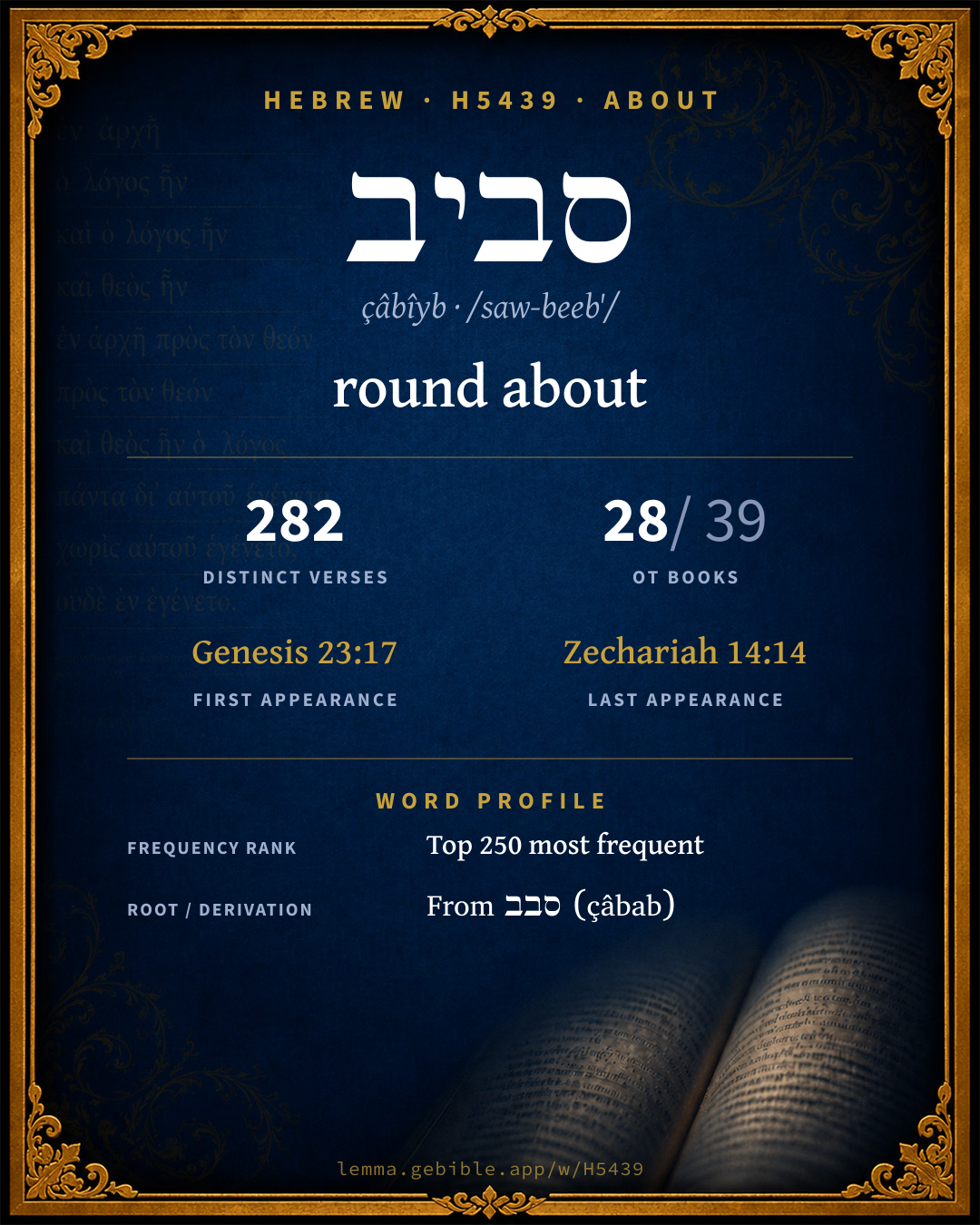
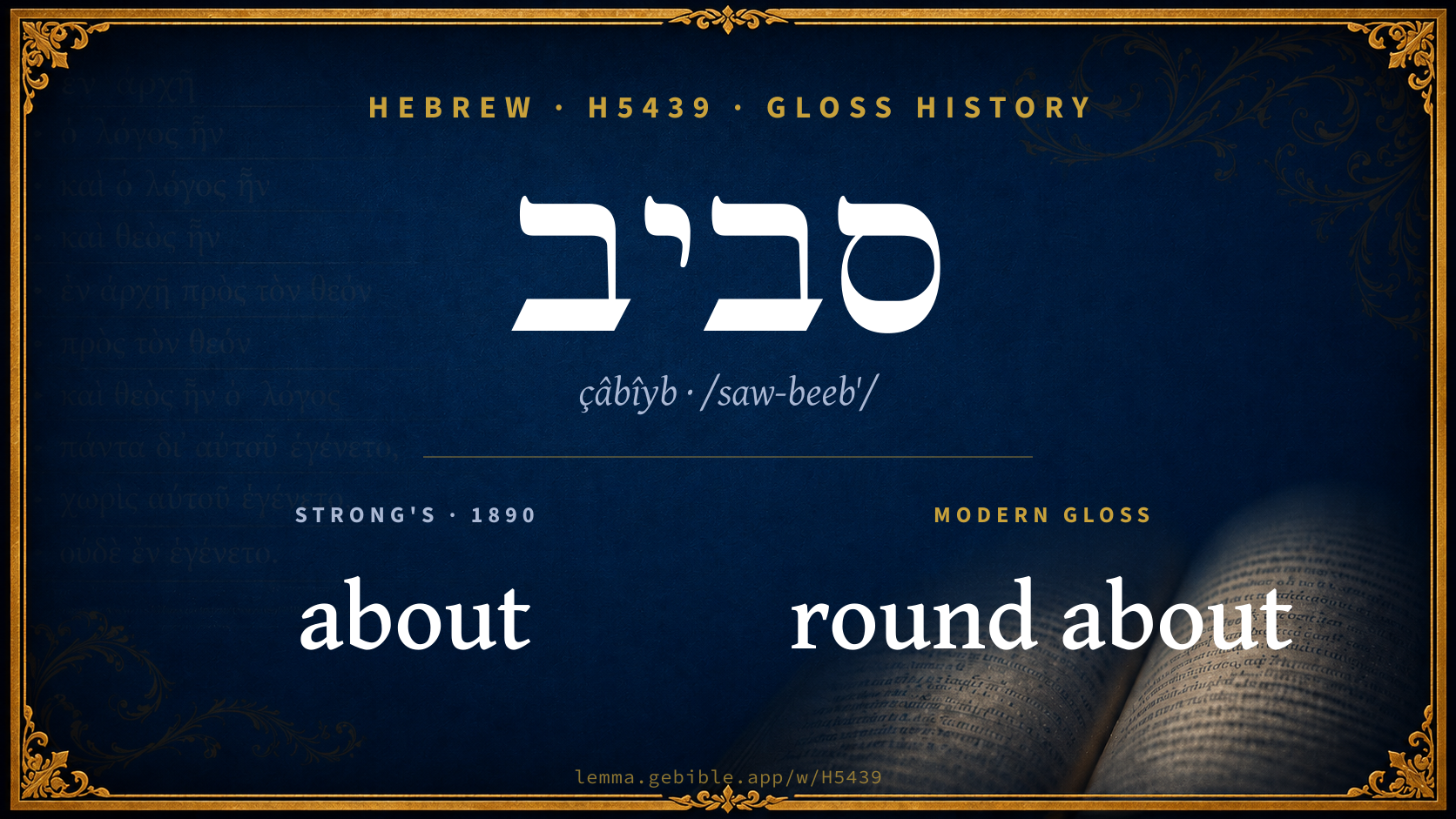
סָבִיב
round about
also: places round about, circuit fuller range ↓
Full lexicon entry — Brown-Driver-Briggs (BDB)
From Brown-Driver-Briggs (BDB)
Where this word appears
See every Absolute-state word in the Hebrew Bible →
Grammar key — what these labels mean
Part of speech
- Noun
- A naming word — a person, place, thing, or idea.
Noun type
- Common
- A common noun — a general class of person, place, or thing (“king,” “city,” “water”), not a specific name.
State
- Absolute
- The independent form of a noun, not bound to a following word.
- Construct
- A noun bound to a following noun in a possessive / “of” relationship (the construct chain).
Gender
- Both
- Attested as both masculine and feminine.
Number
- Singular
- One.
- Plural
- More than one (in Hebrew, generally three or more).
12 verses where H5439 appears in the Absolute state in the Book of Numbers. Filtered view — show all forms. Click any verse to open its interlinear word-by-word view. Verse text shown in the World English Bible for context — . Each verse’s Hebrew form is shown with its reference; the English is not keyword-highlighted, since the data carries no word-level English alignment. Use “Compare translations” on any verse to read it across multiple English versions. This concordance covers the Hebrew Bible; Septuagint (Greek Old Testament) occurrences are not indexed here.
Numbers
- Numbers 1:50 וְ/סָבִ֥יב conj + n c bs but appoint the Levites over the Tabernacle of the Testimony, and over all its furnishings, and over all that belongs to it. They shall carry the tabernacle, and all its furnishings; and they shall take care of it, and shall encamp around it.
- Numbers 1:53 סָבִיב֙ n c bs But the Levites shall encamp around the Tabernacle of the Testimony, that there may be no wrath on the congregation of the children of Israel: and the Levites shall be responsible for the Tabernacle of the Testimony."
- Numbers 2:2 סָבִ֥יב n c bs "The children of Israel shall encamp every man by his own standard, with the ensigns of their fathers' houses: at a distance from the tent of meeting shall they encamp around it."
- Numbers 3:26 סָבִ֑יב n c bs and the hangings of the court, and the screen for the door of the court, which is by the tabernacle, and around the altar, and its cords for all of its service.
- Numbers 3:37 סָבִ֖יב n c bs the pillars of the court around it, their sockets, their pins, and their cords.
- Numbers 4:26 סָבִ֔יב n c bs and the hangings of the court, and the screen for the door of the gate of the court, which is by the tabernacle and around the altar, and their cords, and all the instruments of their service, and whatever shall be done with them. Therein shall they serve.
- Numbers 4:32 סָבִ֜יב n c bs and the pillars of the court around it, and their sockets, and their pins, and their cords, with all their instruments, and with all their service: and by name you shall appoint the instruments of the charge of their burden.
- Numbers 16:24 מִ/סָּבִ֔יב prep + n c bs Speak to the congregation, saying, Get away from around the tent of Korah, Dathan, and Abiram.
- Numbers 16:27 מִ/סָּבִ֑יב prep + n c bs So they got them up from the tent of Korah, Dathan, and Abiram, on every side: and Dathan and Abiram came out, and stood at the door of their tents, and their wives, and their sons, and their little ones.
- Numbers 32:33 סָבִֽיב n c bs Moses gave to them, even to the children of Gad, and to the children of Reuben, and to the half-tribe of Manasseh the son of Joseph, the kingdom of Sihon king of the Amorites, and the kingdom of Og king of Bashan, the land, according to the cities of it with [their] borders, even the cities of the land round about.
- Numbers 34:12 סָבִֽיב n c bs and the border shall go down to the Jordan, and the goings out of it shall be at the Salt Sea. This shall be your land according to the borders of it round about.
- Numbers 35:4 סָבִֽיב n c bs The suburbs of the cities, which you shall give to the Levites, shall be from the wall of the city and outward one thousand cubits round about.
About this entry
At a glance — auto-summarized from this page’s data, not written by a person. Every figure links to its source below. This summary describes the numbers; it doesn’t interpret them.
סביב — transliterated çâbîyb — is a Hebrew word carrying the sense “round about.” Its English rendering has broadened — “round about” classically, “around” (Berean Standard Bible) and “all around” (unfoldingWord Literal Text) in modern versions; see the renderings breakdown. The Hebrew Bible uses it across 282 verses — common. More than a quarter of its appearances fall in Ezekiel. It also covers “places round about” and “circuit”, alongside “round about” — see its full sense range. See the sense tree, 282-verse concordance, and the renderings breakdown below.
Gloss history
Strong's 1890 vs modern scholarship
About this word
Strong's H5439 catalogs a Hebrew word from the Hebrew Old Testament.
These counts are not copied from any lexicon or concordance. They are computed here, from the morphology-tagged Hebrew Old Testament. What Lemma adds →
- 282
- distinct verses
- The word appears in 282 distinct verses.
- 28 / 39
- OT books
- The word appears in 28 of 39 Old Testament books.
- #146
- by frequency
- Top 250 most frequent Hebrew words (rank 146 of 8,640 Hebrew words by occurrence).
View all 282 occurrences in the concordance →
By section of the Old Testament
By traditional corpus
Conventional, traditional groupings — biblical authorship is debated, so this is a traditional corpus grouping, not an authorship claim. Each share is this word’s portion of its verses in that division of the Hebrew canon. Each figure is a share of the word’s 282 distinct verses.
- Prophets (Nevi'im) 159 verses · 56%
- Torah (Pentateuch) 67 verses · 24%
- Writings (Ketuvim) 56 verses · 20%
How translations render this word
Counts come from each version’s own published word-to-Strong’s tagging or interlinear alignment — an approximate guide to how each version renders this word, not a word-level alignment the data otherwise carries. Because each total is that version’s own tagged count, the per-version totals vary from one another and need not match the appearance or distinct-verse counts above. These counts may also differ from a printed concordance because Lemma counts each distinctly tagged rendering and does not collapse phrase taggings into a single head-word total. This is a fixed set of word-tagged versions (KJV, ASV, BSB, ULT) and does not change with the reading translation you choose elsewhere. Each version’s license is shown beside its name below (and on Sources).
BDB lists this Strong’s number as 2 distinct words (homographs). Each count above pools all of them and is not split by sense — see the Senses section below. A low-frequency rendering may belong to a different one of those words, not the primary meaning.
- King James Version†: Round about 181×, Are round about 19×, Every side 18×
- American Standard Version†: Round about 165×, Every side 14×, Are round about 13×
- Berean Standard Bible†: Around 61×, All around 30×, Every side 27×
- unfoldingWord Literal Text†: All around 113×, Around 55×, Surrounding 15×
King James Version Public Domain
Renders H5439 across 308† tagged occurrences — most commonly:
Plus other, less common renderings. Plus 33 renderings that appear only once — usually multi-word phrases or single function words the recovered tagging swept in, not distinct renderings.
American Standard Version Public Domain
Renders H5439 across 307† tagged occurrences — most commonly:
Plus other, less common renderings. Plus 56 renderings that appear only once — usually multi-word phrases or single function words the recovered tagging swept in, not distinct renderings.
Berean Standard Bible Public Domain
Renders H5439 across 295† tagged occurrences — most commonly:
Plus other, less common renderings. Plus 50 renderings that appear only once — usually multi-word phrases or single function words the recovered tagging swept in, not distinct renderings. Not rendered by a distinct English word in 38 further occurrences.
unfoldingWord Literal Text CC BY-SA 4.0
Renders H5439 across 329† tagged occurrences — most commonly:
Plus other, less common renderings. Plus 43 renderings that appear only once — usually multi-word phrases or single function words the recovered tagging swept in, not distinct renderings.
8 senses and sub-senses in the full BDB
What do BDB’s symbols mean?
BDB uses these scholarly abbreviations:
| Symbol | Meaning |
|---|---|
| 𝔊 | the Septuagint (the ancient Greek translation, LXX) |
| 𝔙 | the Vulgate (the Latin translation) |
| 𝔖 | the Syriac version (the Peshitta) |
| 𝔗 | the Targum (the Aramaic translation) |
| ψ | the Psalms |
| √ | root (the underlying root or stem) |
| ‖ | parallel passage (a synonymous or contrasted parallel) |
| † | the dagger: every passage where the word occurs is cited |
The 8 senses and sub-senses the full Brown-Driver-Briggs lexicon distinguishes for this word, in lexicon order (not ranked by frequency), with BDB’s own verbatim wording and sub-sense lettering. Shown in Hebrew script with BDB’s own scholarly abbreviations. The condensed entry is in the Lexicon Entry tab. See also the Forms in the corpus table below.
סביב I subst., used mostly as adv. and prep., circuit, round about
- 1. in sg.:—
- a. as subst. 1 Ch 11:8 מן־המלוא וְעַד־הַסָּבִיב and to the parts round about. e.g. 1 Chronicles 11:8
- b. as adv.acc. סָבִיב (in) a circuit, i.e. round about, Gn 23:17 בְּכָל־גְּבֻלוֹ סָבִיב Ex 19:12; 25:11, 24, 25, Lv 1:5, 11 עַל הַמִּזְבֵּחַ סָבִיב, Ju 20:29 1 K 3:1; 5:11 ψ 3:7 אֲשֶׁר ס׳ שָׁתוּ עָלָ֑י, 12:9 34:8 + often; sometimes doubled, for the sake of emphasis, 2 Ch 4:3, Ez 8:10 עַל הַקִּיר ס׳ ס׳, 37:2; 40:5 and often in Ez 40–43. e.g. Genesis 23:17
- c. as prep.: (a) †Am 3:11 צַר וּסְבִיב הָאָרֶץ distress, and that in the circuit of (= round about) the land (but read prob. with 𝔖 יְסֹבֵב will encircle). (b) סָבִיב לְ׳ Ex 16:13; 40:33 Nu 1:50, 53; 2:2 Ju 7:21 1 K 6:5; 18:32, 35 Ez 41:10, 16 Jb 19:12 ψ 34:8; 78:28; 125:2(×2) י׳ סָבִיב לְעַמּוֹ, 128:3 Ct 3:7 Na 3:8. (c) strangely, סָבִיב אֵת †1 K 6:5 (om.𝔊), Ez 43:17. e.g. Amos 3:11
- d. מִסָּבִיב42, from round about, from every side, Ez 16:33, 37; 23:22; 37:21, but usually (מִן 1 c) = on every side, Je 4:17 הָיוּ עָלֶיהָ מִסָּבִיב, Is 42:25 וַתְּלַהֲטֵהוּ מ׳, Jo 4:11, 12; †מָגוֹר מִסָּבִיב terror on every side! Je 6:25; 20:3, 10; 46:5; 49:29 ψ 31:14, cf. La 2:22; especially in the Deut. phrases אוֹיְבִים מ׳, or הֵנִיחַ מ׳ (sometimes in combin.), as Dt 12:10 והניח לכם מכל־אויביכם מ׳, 25:19 Jos 21:42 וַיָּנַח י׳ לָהֶם מ׳, 23:1 Ju 2:14; 8:34 1 S 12:11 +; מִסָּבִיב לְ from round about, †Nu 16:24, 27.—On 1 S 14:21 2 S 24:6 Jb 10:8 v. סָבַב. e.g. Ezekiel 16:33
- 2. In plur.:—
- a. †סְבִיבִים: (a) in masc. sense, those round about, ψ 76:12 כָּל־סְבִיבָיו יֹבִילוּשַׁי, 89:8 Je 48:17, 39. (b) in neuter sense, the parts round about, Je 49:5 מִכָּל־סְבִיבָ֑יִךְ, בִּסְבִיבֵי ירושׁלם 32:44; 33:13; 21:14 וְאָֽכְלָה כָּל־סְבִיבֶיהָ, 46:14; with the force of a prep., ψ 50:3 וסביביו נשׂערה מאד, 97:2 La 1:17. e.g. Psalms 76:12
- b. סְבִיבוֹת: (a) as subst. (α) circuits, Ec 1:6 ועל סביבותיו שָׁב הָרוּחַ; (β) the parts round about, Nu 22:4 ילחכו הקהל את־כל־סְבִיבֹתֵינוּ, Je 17:26; 50:32 (cf. 21:14 supr.); with ref. to their inhabitants, ψ 44:19 = 79:4 לעג וקלם לסב׳, Ez 16:57; 28:24 Dn 9:16. (b) with the force of a prep. Ex 7:24 סְבִיבֹת הַיְאֹר lit. (in) the circuits of the Nile = round about the Nile, Nu 11:24, 31, 32; 35:2 סְבִיבֹתֵיהֶם, Ju 7:18 1 S 26:5, 7 2 K 6:17 סביבֹת אלישׁע, ψ 18:12; 27:6 על אֹיְבַי סביבותי, etc.; often idiom. preceded by אשׁר, as Gn 35:5 הערים אשׁר סביבותיהם 41:48 Lv 25:44 Nu 16:34 Dt 6:14; 13:8; 17:14; 21:2 +. In the same sense מִסְּבִיבוֹתָם + Ez 28:26. e.g. Ecclesiastes 1:6
סביב II encompassing, surrounding(?)
Senses from the full Brown-Driver-Briggs lexicon (Brown, Driver, Briggs; Oxford 1906 — public domain), digitized via Sefaria, supplemented by the OpenScriptures HebrewLexicon (CC BY 4.0). Full attribution on Sources.
Word origin
I. subst., used mostly as adv. and prep., circuit, round about:—cstr. סְבִיב †Am 3:11; pl. cstr. סְבִיבֵי †Je 32:44; 33:13, sf. סְבִיבֶיךָ etc. (10 times), much oftener סְבִיבוֹת Ex 7:24 + 22 times, סְבִיבוֹתַי, תֶיךָ-, etc., Dt 17:14, etc. (48 times):—
I. n.m. encompassing, surrounding(?);—only cstr. מוּסַב הַבַּיִת Ez 41:7 the encompassing of the house, but meaning wholly obscure; מוּסַף enlargement Ew Berthol ToyHpt after 𝔊; Co del. clause as dittogr.
— Brown-Driver-Briggs (Oxford 1906, public domain), digitized via Sefaria, supplemented by the OpenScriptures HebrewLexicon (CC BY 4.0). See Sources.
Derived from סבב (çâbab) (H5437) — to turn around.
Jastrow Dictionary
A second Hebrew/Aramaic lexicon for comparison, covering Aramaic and post-biblical (Talmudic, Targumic, Midrashic) usage that the biblical-Hebrew BDB does not. Matched by lemma rather than by Strong’s number, so a lemma may carry more than one Jastrow headword (shown separately below), and the entries cover usage well beyond the Bible.
סָבִיב
- around. Tanḥ. B’midb. 12 ס׳ למשכן around the Tabernacle; a. e.
A Dictionary of the Targumim, the Talmud Babli and Yerushalmi, and the Midrashic Literature (Marcus Jastrow; London, Luzac, 1903) — Public Domain. Digitized via Sefaria. Digitized via Sefaria. Full attribution on Sources.
Forms in the corpus
The 84 distinct written forms H5439 takes in the Hebrew Bible, most frequent first — each parse links to that state’s occurrences in the concordance. Hebrew forms include their vowel points and cantillation, so a single lemma takes many written forms.
The 60 most common forms are shown; 24 rarer forms follow in the full concordance.
Same root — word family
Other BDB entries built from the same root as H5439, grouped by Strong’s listed origin. These share a root / origin per the lexicon — not necessarily a shared meaning. Each links to that word’s own entry.
Derives from
Shares the same root
- מוסב mûwçâb H4141 surrounding
- מסב mêçab H4524 surroundings
- נסבה nᵉçibbâh H5252 turn of affairs
- סבה çibbâh H5438 turn of events
Compare all same-root words → Showing 4 of 6 — not the complete family. They share a root, not necessarily a meaning.
Septuagint verse parallels
This word appears in 257 verses that also exist in the Greek Old Testament (Septuagint), out of the 282 Hebrew verses it occurs in. You can read those verses in Greek by switching the Old Testament edition to the Septuagint.
Read these verses in the Septuagint
- Genesis 23:17
- Exodus 7:24
- Leviticus 1:5
- Numbers 1:50
- Deuteronomy 6:14
- Joshua 15:12
- Judges 2:12
- 1 Samuel 12:11
- 2 Samuel 5:9
- 1 Kings 5:4
- 2 Kings 6:17
- 1 Chronicles 4:33
This is a verse-level parallel only — the same verses exist in both the Hebrew and Greek Old Testaments. No word-level Hebrew↔Greek correspondence is claimed: the data carries no such alignment, so no Greek word is shown as this Hebrew word’s translation. Coverage is not total — the Septuagint omits the deuterocanon and renumbers the Psalms, so some Hebrew verses have no direct Greek parallel.