
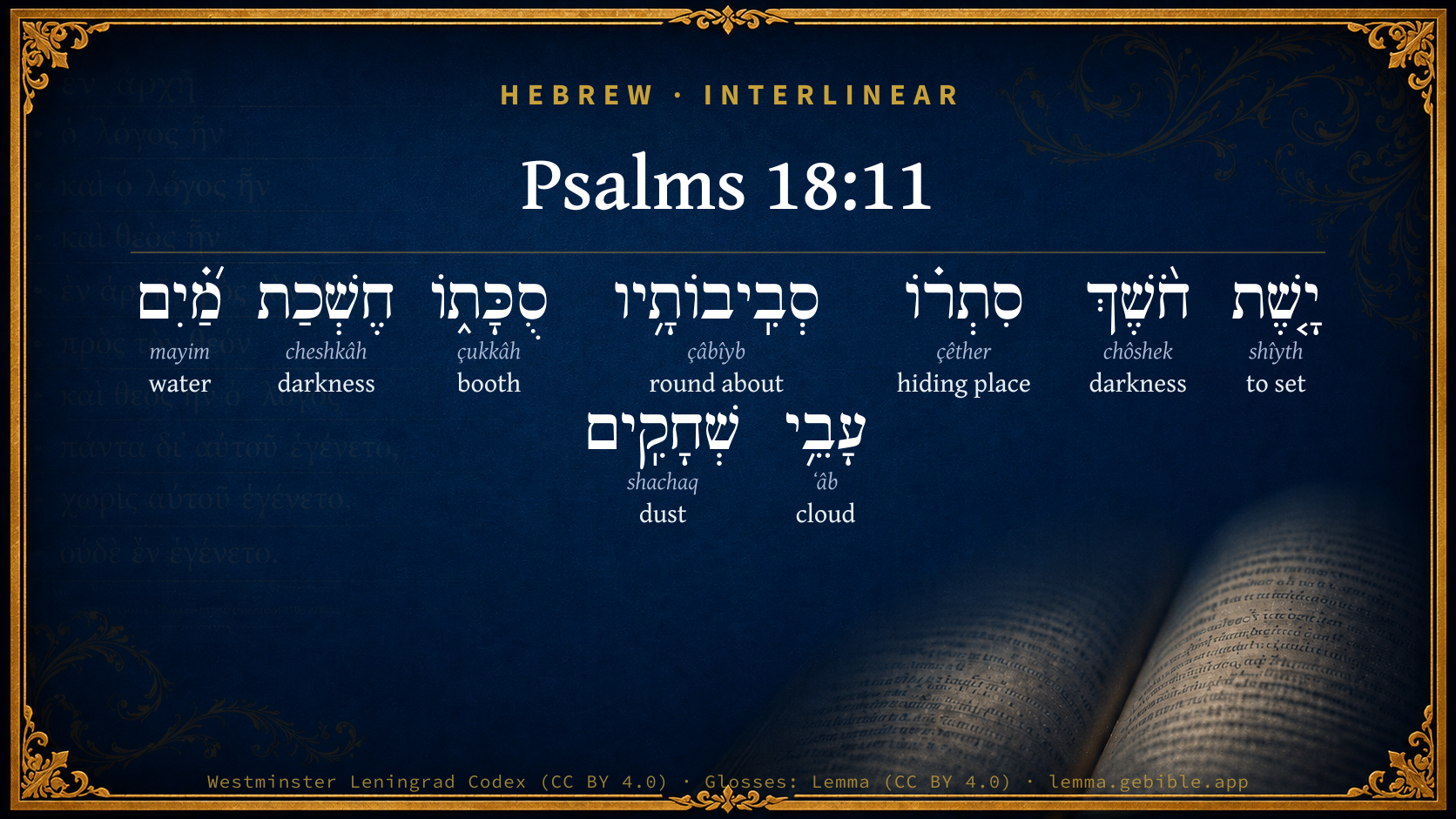
Psalms 18:11

Hebrew (Westminster Leningrad Codex) Psalms 18:11 appears in the Hebrew Old Testament. The text above is from the Westminster Leningrad Codex. Each word links to its Strong’s number, a concise gloss, and parsing drawn from the Open Scriptures Hebrew Bible morphology. Click any word for its full Brown-Driver-Briggs (BDB) entry.
Download image
Cite this verse

Psalms 18:11 (World English Bible). Public Domain. Lemma interlinear Bible study tool, https://lemma.gebible.app/v/psalms/18/11.

Show BibTeX & RIS
BibTeX
RIS
English Translation
He made darkness his hiding-place, his pavilion around him, Darkness of waters, thick clouds of the skies.
World English Bible · Public Domain
Highlights
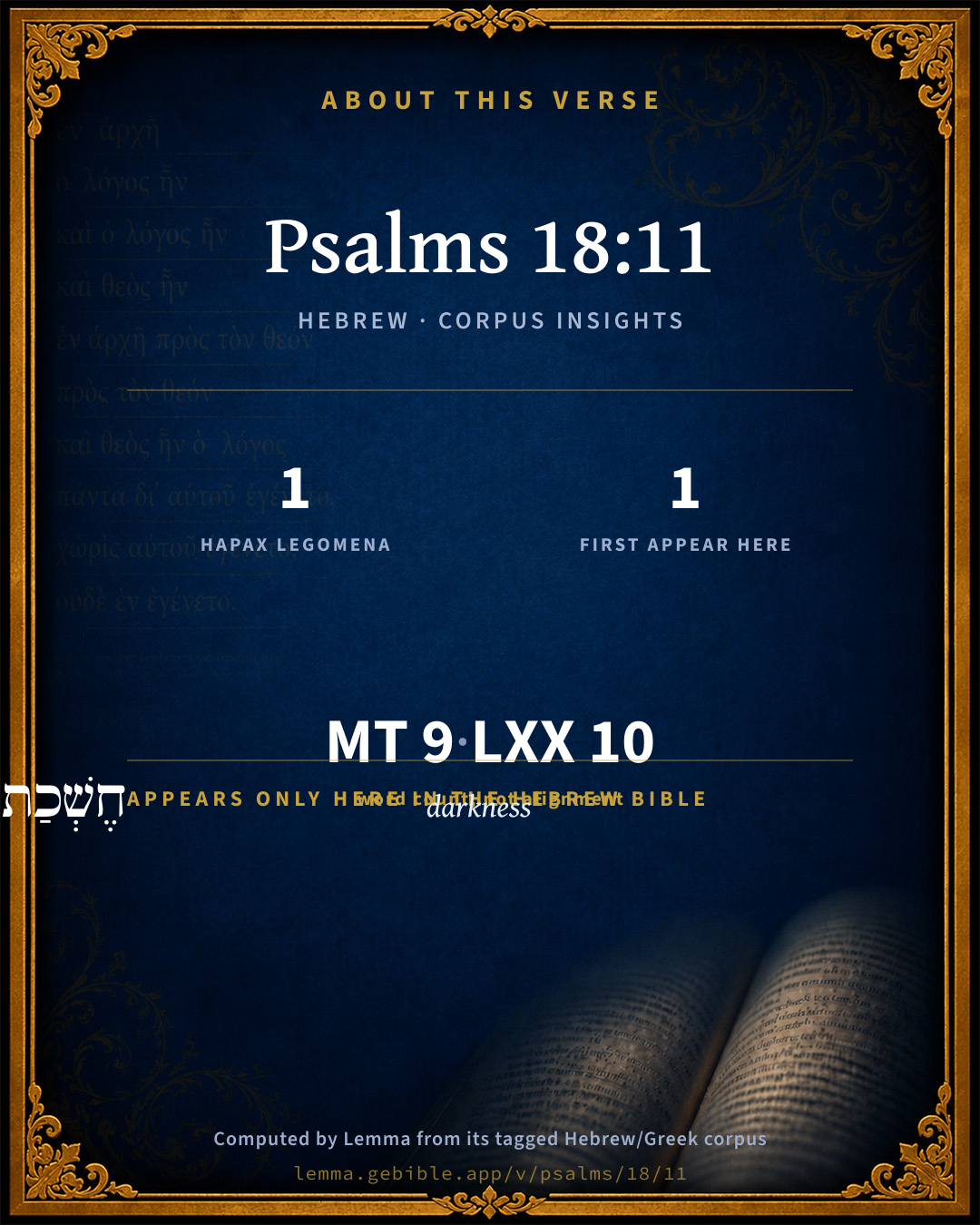
  • 1 hapax legomenon — only here in the Hebrew Bible
  • 1 first appearance in the Hebrew Bible
Full analysis ↓
Download a study sheet

One document with this verse’s original text, its word-by-word gloss line, the meaning frame, cross-references with their text, attributed commentary, and full source and license credits — printable, and it pastes into notes with its structure intact.

This verse Autodidact and up

Study sheet (.html) Plain text (.txt)

A passage Seminary Student

Up to 50 verses in one chapter. A passage sheet keeps up to 6 commentary sources and 12 cross-references per verse, in the order this page ranks them, and says so on the sheet whenever that leaves anything out. Ask for a single verse and you get the Autodidact verse sheet above.

Everything on this page stays free to read, with no account — the sheet is a download of what is already on screen, not access to it.

Want to remove ads? Support Godless Engineer
Compare translations 3

The same verse in 3 English versions, stacked beneath the original-language interlinear above. Click any original word for its lexicon entry.

Each is an independent rendering of the whole verse — the interlinear is not word-aligned to these translations.

Highlighted words mark where these versions differ — a whole-verse word diff, not a word-by-word alignment.

  • World English Bible Public Domain
    He made darkness his hiding-place, his pavilion around him, Darkness of waters, thick clouds of the skies.
  • King James Version Public Domain
    He made darkness his secret place; his pavilion round about him were dark waters and thick clouds of the skies.
  • unfoldingWord Literal Text CC BY-SA 4.0
    He set darkness his covering, the booth around him a darkness of waters, clouds of the skies.

unfoldingWord Literal Text — © unfoldingWord, licensed CC BY-SA 4.0. Word-aligned USFM3 via Door43 (git.door43.org/unfoldingWord/en_ult).

Versions to compare (up to 4)

3 of 4 selected

Show all 18 translations

Every available English version of this verse, each an independent rendering of the whole verse.

  • World English Bible Public Domain
    He made darkness his hiding-place, his pavilion around him, Darkness of waters, thick clouds of the skies.
  • Berean Standard Bible Public Domain
    He made darkness His hiding place, and storm clouds a canopy around Him.
  • Majority Standard Bible Public Domain
    He made darkness His hiding place, and storm clouds a canopy around Him.
  • King James Version Public Domain
    He made darkness his secret place; his pavilion round about him were dark waters and thick clouds of the skies.
  • American Standard Version (1901) Public Domain
    He made darkness his hiding-place, his pavilion round about him, Darkness of waters, thick clouds of the skies.
  • Revised Version (1885) Public Domain
    He made darkness his hiding place, his pavilion round about him; darkness of waters, thick clouds of the skies.
  • Geneva Bible (1599) Public Domain
    He made darkenes his secrete place, and his pauilion round about him, euen darkenesse of waters, and cloudes of the ayre.
  • Douay-Rheims (1899) Public Domain
    And he ascended upon the cherubim, and he flew; he flew upon the wings of the winds.
  • Young's Literal Translation Public Domain
    He maketh darkness His secret place, Round about Him His tabernacle, Darkness of waters, thick clouds of the skies.
  • Literal Standard Version CC BY-SA 4.0
    He makes darkness His secret place, || Around Him His dwelling place, || Darkness of waters, thick clouds of the skies.
  • Unlocked Literal Bible CC BY-SA 4.0
    He made darkness a tent around him, heavy rainclouds in the skies.
  • unfoldingWord Literal Text CC BY-SA 4.0
    He set darkness his covering, the booth around him a darkness of waters, clouds of the skies.
  • Darby Bible Public Domain
    He made darkness his secret place, his tent round about him: darkness of waters, thick clouds of the skies.
  • World Messianic Bible Public Domain
    He made darkness his hiding place, his pavilion around him, darkness of waters, thick clouds of the skies.
  • Webster's Bible Public Domain
    \\18:10\\And he rode upon a cherub, and flew; yes, he flew upon the wings of the wind.
  • Free Bible Version CC BY-SA 4.0
    He hid himself in darkness, covering himself with black thunderclouds.
  • Bible in Basic English Public Domain
    He made the dark his secret place; his tent round him was the dark waters and thick clouds of the skies.
  • JPS Tanakh (1917) Public Domain
    (18-12) He made darkness His hiding-place, His pavilion round about Him; darkness of waters, thick clouds of the skies.

Literal Standard Version (2020), Covenant Press — licensed CC BY-SA 4.0. Text via the HelloAO Bible API (eBible.org). Unlocked Literal Bible (unfoldingWord) — licensed CC BY-SA 4.0. Text via the HelloAO Bible API (eBible.org). unfoldingWord Literal Text — © unfoldingWord, licensed CC BY-SA 4.0. Word-aligned USFM3 via Door43 (git.door43.org/unfoldingWord/en_ult). Free Bible Version, Dr. Jonathan Gallagher — licensed CC BY-SA 4.0. Text via the HelloAO Bible API (eBible.org).

Word by word

More ways to search: Search by grammar → Find every occurrence → Compare this word →

Practice this passage: Drill this verse → Learn its vocabulary →

About this verse

These counts appear in no published source. They are computed here, from the morphology-tagged text and Lemma’s own curated glosses. What Lemma adds →

9
words
9
distinct lemmas
Wisdom
section

Notable vocabulary

1 hapax legomenon — a word that appears only here in the entire Hebrew Bible:

  • חֶשְׁכַת darkness H2824

First appearance in Scripture

This word makes its first canonical appearance in the Hebrew Bible here:

  • חֶשְׁכַת darkness H2824

Shared distinctive vocabulary

שְׁחָקִֽים dust H7834 occurs in 21 verses of the Hebrew Bible. Also found in:

Grammatical profile

  • 1 verb
  • 8 nouns

Verb forms

  • יָ֤שֶׁת Qal · Imperfect

Hebrew & Septuagint length

In English translation the verse runs 17 words from the Hebrew and 22 from the Septuagint (LXX English) — closely comparable.

A rough comparison of the two English renderings, which tokenize alike — not a word-level alignment.

Word counts can differ between the Hebrew and the Greek without any difference in meaning — e.g. the Hebrew direct-object marker אֵת has no separate Greek word, and Greek often adds the article ὁ.

In the original languages it is 9 Hebrew tokens and 10 Greek tokens — but the two are counted differently (Hebrew bundles its prefixes and suffixes into one token; the Greek is in lemma form), so that isn’t a like-for-like length.

Cross-references

6

Topical passages linked to Psalms 18:11 in the Treasury of Scripture Knowledge — connected by theme and wording, ordered by reader-vote popularity; previews shown in the World English Bible.

  • Deuteronomy 4:11 You came near and stood under the mountain; and the mountain burned with fire to the heart of the sky, with darkness, cloud, and thick darkness.
  • Psalms 97:2 Clouds and darkness are around him. Righteousness and justice are the foundation of his throne.
  • Psalms 81:7 You called in trouble, and I delivered you. I answered you in the secret place of thunder. I tested you at the waters of Meribah." Selah.
  • Psalms 91:1 He who dwells in the secret place of the Most High Will rest in the shadow of the Almighty.
  • Joel 2:2 A day of darkness and gloominess, A day of clouds and thick darkness. As the dawn spreading on the mountains, A great and strong people; There has never been the like, Neither will there be any more after them, Even to the years of many generations.
  • Psalms 27:5 For in the day of trouble he will keep me secretly in his pavilion. In the covert of his tent he will hide me. He will lift me up on a rock.

Cross-references courtesy of OpenBible.info (CC BY 4.0).

Hebrew and Greek witnesses Masoretic Hebrew ↔ Greek Septuagint

The same verse in the two great witnesses to the Old Testament, shown verse-for-verse.

You’re reading Greek Psalm 17 (Hebrew Psalm 18). The Septuagint counts the superscription, so verse numbers can differ from the Hebrew — chapter-level alignment, not verse-by-verse. Numbering follows Rahlfs.

These are two independent witnesses, not word-aligned to each other, and the Septuagint is shown in lemma (dictionary) form.

Hebrew Psalms 18:11 Masoretic · Westminster Leningrad Codex

יָ֤שֶׁת חֹ֨שֶׁךְ סִתְר֗וֹ סְבִֽיבוֹתָ֥יו סֻכָּת֑וֹ חֶשְׁכַת מַ֝֗יִם עָבֵ֥י שְׁחָקִֽים

He made darkness his hiding-place, his pavilion around him, Darkness of waters, thick clouds of the skies.

World English Bible · Public Domain

Greek LXX Greek Psalm 17:11 Septuagint · lemma form

καί ἐπιβαίνω ἐπί χερουβείμ καί πετάννυμι πετάννυμι ἐπί πτέρυξ ἄνεμος

And he made darkness his secret place: round about him was his tabernacle, even dark water in the clouds of the air.

LXX2012 (modern English Septuagint) · Public Domain

Hebrew: Westminster Leningrad Codex (CC BY 4.0). Greek: Septuagint (public domain); English from LXX2012 (modern English Septuagint) (Public Domain). How the Septuagint differs from the Hebrew →

Commentary

Notes on Psalms 18:11 from classic Christian and Jewish commentators (each source and its license shown beneath its notes). The classic Christian expositions comment on the surrounding passage and are grouped to its opening verse, so a note may address several verses; the Jewish commentaries on the Tanakh (Rashi and others) are per-verse, so they appear only where the commentator wrote on this verse.

Lemma curates 59 commentaries, every one of them public domain or Creative Commons licensed, each selected and text-cleaned for this edition rather than reprinted as found. About our sources →

Trapp's Complete Commentary

John Trapp

Psa 18:11 He made darkness his secret place; his pavilion round about him [were] dark waters [and] thick clouds of the skies.

Ver. 11. He made darkness his secret place] As a king, that, being angry, withdraweth himself from his subjects, and will not be seen of them. Vel quia decreta Dei veniunt invisibiliter, said R. David.

John Trapp, A Commentary or Exposition upon All the Books of the Old and New Testament (1647–1656) — public domain. Text from a community e-Sword module.

The Biblical Illustrator

Joseph S. Exell

Psa_18:11

His pavilions round about Him were . . . thick clouds of the skies.

The ministry of the cloud

His pavilions are thick clouds! Then the cloud is not a destructive libertine, some stray, haphazard, lawless force, the grim parent of shadow and chill and tempest. His pavilions are thick clouds. The clouds are the dwelling places of God. He lives in them; He moves through them; He pervades them with the gentle ministries of grace and love. The clouds drop down their dew. Then the clouds are more than shutters; they are springs. They do more than exclude the sunlight; they are the parents of the fertilising rains, and the drenching mists and dews. It is something of a triumph when we have got thus far in our religious faith. The cloud may hide the light; it does not destroy it. The cloud does not disprove the light; it is really the proof of the light. Without the warm and genial light there could be no cloud; the cloud is the creation of light. When, therefore, the cloud is forming, it means the sun is working. Raindrops can be traced to sunbeams. Love yearns to send a gentle rain, and so love prepares a cloud. So, the cloud is part of the answer to our prayer for dew. If, therefore, I have been asking my God for a softening, fertilising rain, I must not be discomfited by the appearance of a chilling and darkening cloud. If I have been asking for a drenching baptism of dew, I must not lose my heart when there comes a confusing mist. We asked the Lord to bless our nation; there came a chilling disappointment; the answer was in a cloud! Have you ever noticed how many of the dispositions of the perfected life can only be richly gained in the baptism of shadow and tears? And when I contemplate the dispositions which are the creations of the Spirit I feel that for their perfect nourishing something is needed of moistness and of shade. Here is a short list of the beautiful things: Love, joy, peace, long suffering, gentleness, goodness, faith, meekness, temperance. I am more inclined to call them ferns than flowers! I dont think they would come to any luxurious profusion and beauty if they were grown in the prolonged and cloudless glare! Here is an exquisite fern--gentleness. Where will you find it growing in richest profusion? You will find it growing in the life that has known the shadow and the tear. There is no touch so tenderly gentle as the touch of the wounded hand. There is no speech so insinuatingly sympathetic as the speech of those who have been folded about by the garment of night. Gentleness is a fern, and it requires the ministry of the cloud. Here is another rare and beautiful fern--long suffering. How can you grow that in the garish day? Long suffering is a fern, and it needs the ministry of the cloud. And is it otherwise with the ferns of goodness and love? How this love fern expands when life passes into the shadow; when husband or child is laid low, how love puts on strength and beauty, whether the lover be peasant wife or queen! Now, I do not think we have any difficulty in perceiving the influence of the cloud in the individual life. in my distress Thou hast enlarged me. Enlarged! It is a very spacious word, and includes the complementary meanings of broadening and enrichment. In my cloud experience Thou hast enriched me! A man goes into the cloud rough and boorish, and full of domineering aggression, and he emerges from its ministry strangely softened and refined! He entered the cloud hard and dry as a pavement; he emerges with disposition suggestive of the fernery. In my distress Thou hast enriched me! But the cloud experience is not only the minister of enrichment, but also of enlargement! It is in the cloud that men grow the fern of a spacious tolerance. Narrowness is transformed to breadth. In the personal life, if it were not for the cloud we should become and remain dry and infertile as Sahara; it is the providential cloud that calls forth the hidden growth, the sleeping ferns, and transforms, the dust heap into a thing of grace and beauty. It is not otherwise with the ministry of the cloud m the sphere of the home. There is many a family which never realises its unity until it is enveloped in the folds of a chilling cloud. Health and luxury are too often divisive; sickness and sorrow are wondrous cements. Luxury nourishes a thoughtless individualism; adversity discovers hidden and profounder kinships. We shall know each other better when the mists have roiled away! Ah! but we sometimes never know each other until we meet together in the mist! It is in the common cloud that the family finds its kinship. It is in our sorrow that deep calleth unto deep, and our communion is revealed. Is it otherwise in the larger life and family of the nations? Does the cloud ministry exercise its influence in the State? Surely we may say that the common life of a people is deepened and enriched by the ministry of the shade. A people is not consolidated by common material interests end aims. It is not by free trade or by reciprocity that we shall forge the links of enduring fellowships. Juxtaposition is not fellowship. It is not the prosperous glare that makes us one. We fall apart in the noontide; we draw closer to each other in the night. It is in the national clouds and shadows, and in the nations tears that you will find the forces of a true consolidation. The clouds, in their courses, have been the friends of the national life. (J. H. Jowett M. A.)

The Biblical Illustrator, edited by Joseph S. Exell (c. 1880s–1900s) — public domain. Text from a community e-Sword module.

Joseph Benson's Commentary

Psa 18:11. He made darkness his secret place — Or, his hiding place: his covert, says Dr. Waterland; his tent, says Chandler. He covered himself with dark clouds. God is frequently represented as surrounded with clouds, in the sacred writings; this representation is peculiarly proper in this place, as thick, heavy clouds, deeply charged, and with lowering aspects, are always the forerunners and attendants of a tempest, and greatly heighten the horrors of the appearance; and the representation of them, as spreading around the Almighty for his pavilion and tent, is truly poetical and grand. And, as storms and tempests in the air are often instruments of the divine displeasure, they are therefore here selected with great propriety as figures of it; and God, who has the whole artillery of the aerial regions at his command, and holds the reins of whirlwinds in his hand, and directs their impetuous course through the world when and how he pleases, is here fifty represented as employing them against his enemies in the day of battle and war.

Joseph Benson's Commentary on the Old and New Testaments (1811–1818) — public domain. Text from a community e-Sword module.

J. A. Alexander on Psalms

Joseph Addison Alexander

12. (Psa 18:11). (And) set darkness (as) his covert about him, his shelter, darkness of waters, clouds of the skies, This concealment suggests the idea of a brightness insupportable by mortal sight. Compare Deu 4:11, Job 36:29, Psa 97:2. Darkness of waters does not mean dark waters, but watery darkness, a beautiful description of clouds charged with rain. The two nouns in the last clause both mean clouds, but the second is used only in the plural, and seems properly to designate the whole body of vapours constituting the visible heavens or sky. A somewhat similar combination occurs in Exo 19:9.

Joseph Addison Alexander, The Psalms Translated and Explained (1850) — public domain. Text from a community e-Sword module.

Geneva Bible (1599)

Geneva Bible translators

As a king angry with the people, will not show himself unto them.

Geneva Bible (1599) marginal notes — public domain. Text via Bolls.life.

Jamieson, Fausset & Brown

Robert Jamieson, A. R. Fausset & David Brown

dark waters--or, clouds heavy with vapor.

Jamieson, Fausset & Brown — Commentary Critical and Explanatory on the Whole Bible (1871) — public domain (CC PDM 1.0). Text via the HelloAO Bible API.

Adam Clarke's Commentary

Verse 11. He made darkness his secret place] God is represented as dwelling in the thick darkness, De 4:11; Ps 97:2. This representation in the place before us is peculiarly proper; as thick heavy clouds deeply charged, and with lowering aspects, are always the forerunners and attendants of a tempest, and greatly heighten the horrors of the appearance: and the representation of them, spread about the Almighty as a tent, is truly grand and poetic.

Dark waters] The vapours strongly condensed into clouds; which, by the stroke of the lightning, are about to be precipitated in torrents of rain. See the next verse.

Adam Clarke's Commentary on the Bible (1810–1826) — public domain. Text from a community e-Sword/MySword module.

Ellicott's Commentary for English Readers

(11) Secret place.—Better, veil. Comp. Job_22:14; Lam_3:44. A better arrangement of the members of this verse is, He made darkness His veil round about Him; His tent He made of dark waters and black clouds. Literally, darkness of waters and blacknesses of clouds. (Comp. Psa_97:2; Job_36:29.) In Samuel, instead of “blacknesses” of clouds, the expression used is “bendings,” or “collectings,” and the parallelism is marred by the omission of “his veil.”

Always present to the Hebrew imagination, God is still invisible, veiled by thick clouds, and far withdrawn in His own ineffable brightness.

This verse gives suggestion of that momentary lull so common before the final fury of a storm bursts. In the Hebrew imagery Jehovah stays His winged car, and draws round Him, as if to take up His abode within them, thick curtains of cloud.

“We often see, against some storm,

A silence in the heavens, the rack stand still,

The bold winds speechless, and the orb below

As hush as death.”—SHAKSPEARE: Hamlet.

A Bible Commentary for English Readers, edited by Charles John Ellicott (1878–1897) — public domain. Text from a community e-Sword module.

The Cambridge Bible for Schools and Colleges

gen. ed. J. J. S. Perowne

11. R.V. He made darkness his hiding-place, his pavilion round about him;

Darkness of waters, thick clouds of the skies.

The darkness of the rain-charged storm-cloud is the tent in which Jehovah shrouds His Majesty. Cp. Job_36:29; Psa_97:2. The rhythm gains by the omission of his hiding-place, as in 2 Sam.; and the text there may be right in reading gathering of waters for darkness of waters.

The Cambridge Bible for Schools and Colleges (gen. ed. J. J. S. Perowne; Cambridge University Press, 1878–1918) — public domain. Text from a community e-Sword module.

John Gill's Exposition

At the brightness that was before him, The lightning that came out of the thick clouds; which may denote, either the coming of Christ to take vengeance on the Jewish nation, which was swift and sudden, clear and manifest; or the spreading of the Gospel in the Gentile world, in which Christ, the brightness of his Father's glory, appeared to the illumination of many; see Mat 24:27; and both may be intended, as the effects following show;

his thick clouds passed; that is, passed away; the gross darkness, which had for so many years covered the Gentile world, was removed when God sent forth his light and truth; and multitudes, who were darkness itself, were made light in the Lord;

hail stones and coals of fire; the same Gospel that was enlightening to the Gentiles, and the savour of life unto life unto them, was grievous, like hail stones, and tormenting, scorching, irritating, and provoking, like coals of fire, and the savour of death unto death, to the Jews; when God provoked them, by sending the Gospel among the Gentiles, and calling them: or these may design the heavy, awful, and consuming judgments of God upon them, which are sometimes signified by hail storms; see Rev 8:7. In Sa2 22:13, it is only, "through the brightness before him were coals of fire kindled".

John Gill's Exposition of the Whole Bible (1746–1763) — public domain (CC PDM 1.0). Text via the HelloAO Bible API.

Albert Barnes' Notes on the Bible

He made darkness his secret place - Herder has beautifully rendered this verse,

“Now he wrapped himself in darkness;

Clouds on clouds enclosed him round.”

The word rendered “secret place” - סתר sêther - means properly a hiding; then something hidden, private, secret. Hence, it means a covering, a veil. Compare Job 22:14; Job 24:15. In Psa 81:7 it is applied to thunder: “I answered thee in the secret place of thunder;” that is, in the secret place or retreat - the deep, dark cloud, from where the thunder seems to come. Here the meaning seems to be, that God was encompassed with darkness. He had, as it were, wrapped himself in night, and made his abode in the gloom of the storm.

His pavilion - His tent, for so the word means. Compare Psa 27:5; Psa 31:20. His abode was in the midst of clouds and waters, or watery clouds.

Round about him - Perhaps a more literal translation would be, “the things round about him - his tent (shelter, or cover) - were the darkness of waters, the clouds of the skies.” The idea is that he seemed to be encompassed with watery clouds.

Dark waters - Hebrew, darkness of waters. The allusion is to clouds filled with water; charged with rain.

Thick clouds of the skies - The word rendered skies in this place - שׁחקים shachaqiym - means, in the singular, dust, as being fine; then a cloud, as a cloud of dust; then, in the plural, it is used to denote clouds, Job 38:37; and hence, it is used to denote the region of the clouds; the firmament; the sky; Job 37:18. Perhaps a not-inaccurate rendering here would be, “clouds of clouds;” that is, clouds rolled in with clouds; clouds of one kind rapidly succeeding those of another kind - inrolling and piled on each other. There are four different kinds of clouds; and though we cannot suppose that the distinction was accurately marked in the time of the psalmist, yet to the slightest observation there is a distinction in the clouds, and it is possible that by the use of two terms here, both denoting clouds - one thick and dense, and the other clouds as resembling dust - the psalmist meant to intimate that clouds of all kinds rolled over the firmament, and that these constituted the “pavilion” of God.

Albert Barnes' Notes on the Bible (1834–1885) — public domain. Text from a community e-Sword/MySword module.

Matthew Poole's English Annotations

His secret place; or, his hiding-place; i.e. he covered himself with dark clouds, from hence he secretly shot at his enemies, as it follows.

Dark waters, i.e. watery vapours and thick clouds, as the next words expound these.

Matthew Poole's English Annotations on the Holy Bible (1683–1685) — public domain. Text from a community e-Sword/MySword module.

The Treasury of David

Charles H. Spurgeon

Ver. 11. The storm thickened, and the clouds pouring forth torrents of rain combined to form the secret chamber of the invisible but wonder working God. "Pavilioned in impervious shade" faith saw him, but no other eye could gaze through the

thick clouds of the skies. Blessed is the darkness which encurtains my God; if I may not see him, it is sweet to know that he is working in secret for my eternal good. Even fools can believe that God is abroad in the sunshine and the calm, but faith is wise, and discerns him in the terrible darkness and threatening storm.

Ver. 11. The darkness in which Jehovah hides, Why? When? What then? etc.

Psalms 18:12*

Charles H. Spurgeon's The Treasury of David (1869–1885) — public domain. Psalms only. Text from a community e-Sword/MySword module.

Whedon's Commentary on the Bible

Daniel D. Whedon

11. Darkness his secret place—Compare Psa_18:9 and Psa_97:2. The allusion is to Deu_4:11.

His pavilion… dark waters and thick clouds—Tempestuous storm clouds were his military tent. See Psa_104:3

Daniel D. Whedon (gen. ed.), Commentary on the Old and New Testaments (1874–1909) — public domain. Text from a community e-Sword module.

The Pulpit Commentary

He made darkness his secret place; i.e. he hid himself amid clouds and thick darkness. In executing his judgments he did not allow himself to be seen. God"s action is always secret and inscrutable. His pavilion round about him were dark waters and thick clouds of the skies. The original runs as follows: "He made darkness his secret place his pavilion round about him dark waters, thick clouds of the skies." The whole forms one sentence, "his pavilion" being in apposition with "secret place," and the last clause, "dark waters, thick clouds of the skies," being exegetical of the "darkness" in the first clause. God"s "pavilion," or "tent" (hBs), is mentioned again in Psa_27:5 and Psa_31:20.

The Pulpit Commentary (1880–1919), ed. H.D.M. Spence-Jones & Joseph S. Exell — public domain. Text from a community e-Sword module.

John Wesley's Explanatory Notes

Darkness - He covered himself with dark clouds. Waters - Watery vapors.

John Wesley, Explanatory Notes Upon the Whole Bible (1754–1765) — public domain. Text via the GEBible commentary corpus.

unfoldingWord translationNotes

Door43 World Missions Community

He made darkness ... him

Here the words "He" and "him" refer to Yahweh.

He made darkness a tent

Here darkness is spoken of as if it were a tent. AT: "He made darkness a covering" or "He made darkness a hiding place" (See: Metaphor)

heavy rainclouds

"clouds heavy with rain" or "thick, dark rainclouds"

Hailstones

stones made of ice

unfoldingWord translationNotes — © Distant Shores Media and the Door43 World Missions Community, licensed CC BY-SA 4.0. Source: git.door43.org/Door43/en_tn.

Rashi

Rabbi Shlomo Yitzchaki (Rashi)

He swooped Heb. וידא, He flew, as (in Deut. 28:49), “as the eagle swoops (ידאה).”

Rashi on the Tanakh — English translations: “The Judaica Press complete Tanach with Rashi, translated by A. J. Rosenberg” (CC BY 4.0); “Pentateuch with Rashi's commentary by M. Rosenbaum and A.M. Silbermann, 1929-1934” (public domain); “The Metsudah Tanach series, Lakewood, N.J” (CC BY 4.0); and “The Book of Joshua, Metsudah Publications, 1997” (CC BY 4.0). Text via Sefaria.

Lesson kit

Teaching starters — assembled from the data on this page, not authored interpretation. Every prompt links to the verse data it draws on. Edit before teaching.

Psalms, in the Wisdom, opens this verse with 9 words (9 distinct Hebrew lemmas). Its most distinctive word is cheshkâh (“darkness”). A historical commentator’s framing appears above. Read the whole chapter for the surrounding context.

Discussion questions

  1. The word cheshkâh carries the sense “darkness.” How does it shape the verse?
  2. 1 word here appears nowhere else in the Hebrew Bible. Why might the author reach for such rare wording?
  3. This is the first place “darkness” appears in Scripture (first appears here). What does its debut here establish?
  4. How does Deuteronomy 33:26, which shares the word «dust», read alongside this verse?
  5. These translations render this verse differently; the difference is in the English rendering, not the original. What questions does that raise?
  6. «יָ֤שֶׁת» is a Qal Imperfect verb. How does that grammatical form shape the action described?
  7. Compare how Trapp's Complete Commentary and The Biblical Illustrator read this verse. Where do they agree or differ?

Things to notice

Reading settings

Reading text

Shown beneath each verse's original-language words.

Old Testament
Old Testament edition

Read the OT as the Masoretic Hebrew (MT) or the Greek Septuagint (LXX).

English shown for the Greek Septuagint (in the Hebrew ↔ Greek comparison).

Comparing translations? Open the Compare panel on any verse page to stack up to four side by side.