Ezekiel 41:5

Hebrew (Westminster Leningrad Codex) Ezekiel 41:5 appears in the Hebrew Old Testament. The text above is from the Westminster Leningrad Codex. Each word links to its Strong’s number, a concise gloss, and parsing drawn from the Open Scriptures Hebrew Bible morphology. Click any word for its full Brown-Driver-Briggs (BDB) entry.
Download image
Cite this verse

Ezekiel 41:5 (World English Bible). Public Domain. Lemma interlinear Bible study tool, https://lemma.gebible.app/v/ezekiel/41/5.

Show BibTeX & RIS
BibTeX
RIS
English Translation
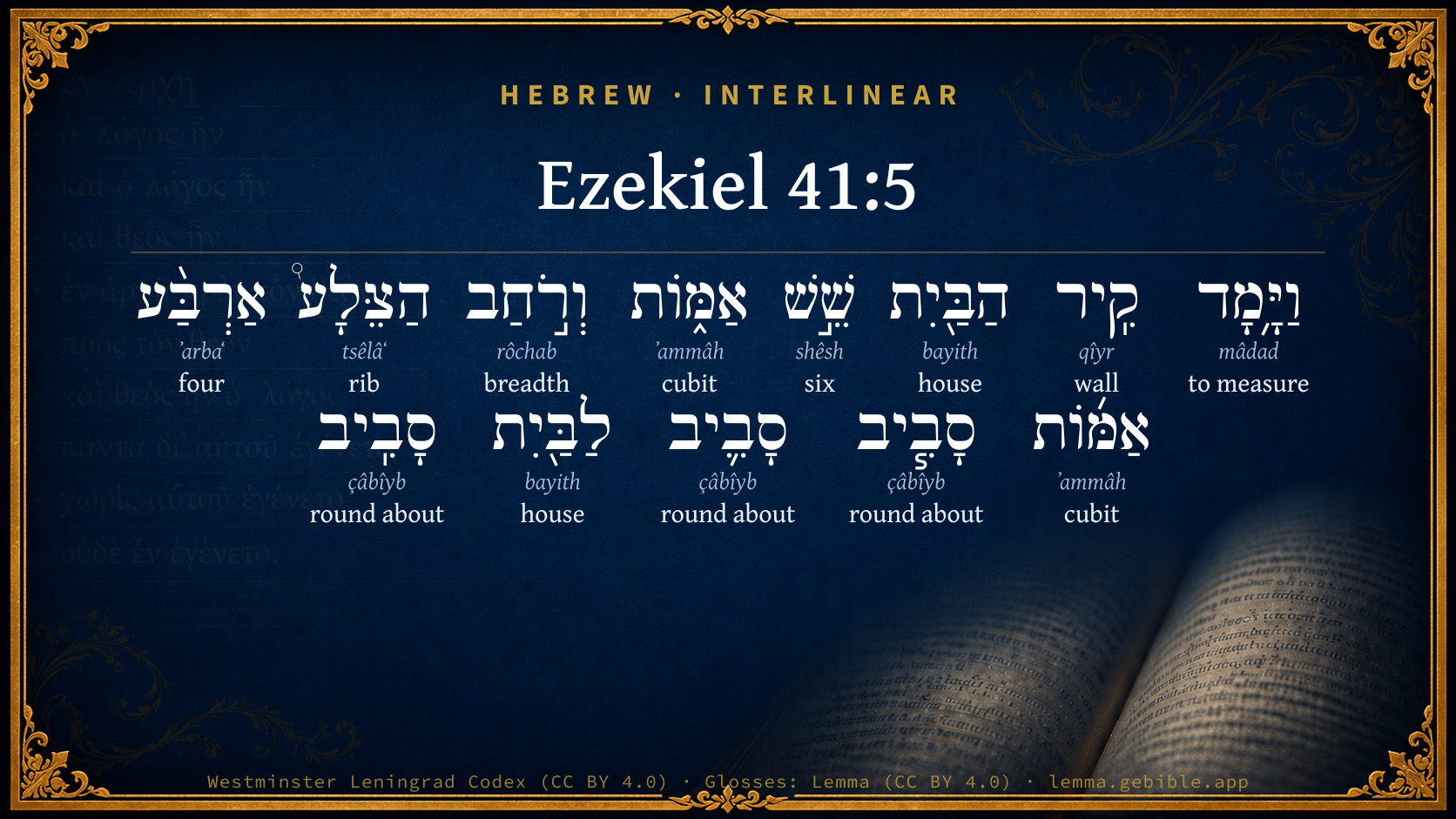
Then he measured the wall of the house, six cubits; and the breadth of every side-chamber, four cubits, round about the house on every side.
World English Bible · Public Domain
Download a study sheet

One document with this verse’s original text, its word-by-word gloss line, the meaning frame, cross-references with their text, attributed commentary, and full source and license credits — printable, and it pastes into notes with its structure intact.

This verse Autodidact and up

Study sheet (.html) Plain text (.txt)

A passage Seminary Student

Up to 50 verses in one chapter. A passage sheet keeps up to 6 commentary sources and 12 cross-references per verse, in the order this page ranks them, and says so on the sheet whenever that leaves anything out. Ask for a single verse and you get the Autodidact verse sheet above.

Everything on this page stays free to read, with no account — the sheet is a download of what is already on screen, not access to it.

Want to remove ads? Support Godless Engineer
Compare translations 3

The same verse in 3 English versions, stacked beneath the original-language interlinear above. Click any original word for its lexicon entry.

Each is an independent rendering of the whole verse — the interlinear is not word-aligned to these translations.

Highlighted words mark where these versions differ — a whole-verse word diff, not a word-by-word alignment.

  • World English Bible Public Domain
    Then he measured the wall of the house, six cubits; and the breadth of every side-chamber, four cubits, round about the house on every side.
  • King James Version Public Domain
    After he measured the wall of the house, six cubits; and the breadth of every side chamber, four cubits, round about the house on every side.
  • unfoldingWord Literal Text CC BY-SA 4.0
    Then the man measured the wall of the house—it was six cubits thick. The width of each side room around the house was four cubits in width.

unfoldingWord Literal Text — © unfoldingWord, licensed CC BY-SA 4.0. Word-aligned USFM3 via Door43 (git.door43.org/unfoldingWord/en_ult).

Versions to compare (up to 4)

3 of 4 selected

Show all 18 translations

Every available English version of this verse, each an independent rendering of the whole verse.

  • World English Bible Public Domain
    Then he measured the wall of the house, six cubits; and the breadth of every side-chamber, four cubits, round about the house on every side.
  • Berean Standard Bible Public Domain
    Next he measured the wall of the temple to be six cubits thick, and the width of each side room around the temple was four cubits.
  • Majority Standard Bible Public Domain
    Next he measured the wall of the temple to be six cubits thick, and the width of each side room around the temple was four cubits.
  • King James Version Public Domain
    After he measured the wall of the house, six cubits; and the breadth of every side chamber, four cubits, round about the house on every side.
  • American Standard Version (1901) Public Domain
    Then he measured the wall of the house, six cubits; and the breadth of every side-chamber, four cubits, round about the house on every side.
  • Revised Version (1885) Public Domain
    Then he measured the wall of the house, six cubits; and the breadth of every side-chamber, four cubits, round about the house on every side.
  • Geneva Bible (1599) Public Domain
    After, he measured the wall of the house, sixe cubites, and the breadth of euery chamber foure cubites rounde about the house, on euery side.
  • Douay-Rheims (1899) Public Domain
    And he measured the wall of the house six cubits: and the breadth of every side chamber four cubits round about the house on every side.
  • Young's Literal Translation Public Domain
    And he measureth the wall of the house six cubits, and the breadth of the side-chamber four cubits, all round the house round about.
  • Literal Standard Version CC BY-SA 4.0
    And he measures the wall of the house—six cubits, and the breadth of the side-chamber—four cubits, all around the house.
  • Unlocked Literal Bible CC BY-SA 4.0
    Then the man measured the wall of the house—it was six cubits thick. The width of each side room around the house was four cubits in width.
  • unfoldingWord Literal Text CC BY-SA 4.0
    Then the man measured the wall of the house—it was six cubits thick. The width of each side room around the house was four cubits in width.
  • Darby Bible Public Domain
    And he measured the wall of the house, six cubits; and the breadth of the side-chambers, four cubits, round about the house on every side.
  • World Messianic Bible Public Domain
    Then he measured the wall of the house, six cubits; and the width of every side room, four cubits, all around the house on every side.
  • Webster's Bible Public Domain
    Afterward he measured the wall of the house, six cubits; and the breadth of every side-chamber, four cubits, round the house on every side.
  • Free Bible Version CC BY-SA 4.0
    He measured Temple wall as six cubits thick, and each side room around the Temple was four cubits wide.
  • Bible in Basic English Public Domain
    Then he took the measure of the wall of the house, which was six cubits; and of the side-rooms round the house, which were four cubits wide.
  • JPS Tanakh (1917) Public Domain
    Then he measured the wall of the house, six cubits; and the breadth of every side-chamber, four cubits, round about the house on every side.

Literal Standard Version (2020), Covenant Press — licensed CC BY-SA 4.0. Text via the HelloAO Bible API (eBible.org). Unlocked Literal Bible (unfoldingWord) — licensed CC BY-SA 4.0. Text via the HelloAO Bible API (eBible.org). unfoldingWord Literal Text — © unfoldingWord, licensed CC BY-SA 4.0. Word-aligned USFM3 via Door43 (git.door43.org/unfoldingWord/en_ult). Free Bible Version, Dr. Jonathan Gallagher — licensed CC BY-SA 4.0. Text via the HelloAO Bible API (eBible.org).

Word by word

More ways to search: Search by grammar → Find every occurrence → Compare this word →

Practice this passage: Drill this verse → Learn its vocabulary →

הַצֵּלָע֩
tsêlâʻ
H6763
“the · rib”
Particle, Definite Article + Noun, Common, Both, Singular, Absolute
Part of Speech
Particle + Noun
Type
Common
Gender
Both
Number
Singular
State
Absolute
Full BDB Definition

Origin: from H6760

TWOT: 1924a

side, rib, beam - rib (of man) - rib (of hill, ridge, etc) - side-chambers or cells (of temple structure) - rib, plank, board (of cedar or fir) - leaves (of door) - side (of ark)
  1. וַיָּ֥מָד mâdad H4058 “and · to measure” Conjunction + Verb, Qal, Sequential Imperfect, 3rd Person, Masculine, Singular
  2. קִֽיר qîyr H7023 “wall of” Noun, Common, Masculine, Singular, Construct
  3. הַבַּ֖יִת bayith H1004 “the · house” Particle, Definite Article + Noun, Common, Masculine, Singular, Absolute
  4. שֵׁ֣שׁ shêsh H8337 “six” Adjective, Cardinal number, Feminine, Singular, Absolute
  5. אַמּ֑וֹת ʼammâh H520 “cubits” Noun, Common, Feminine, Plural, Absolute
  6. וְרֹ֣חַב rôchab H7341 “and · breadth of” Conjunction + Noun, Common, Masculine, Singular, Construct
  7. אַרְבַּ֨ע ʼarbaʻ H702 “four” Adjective, Cardinal number, Feminine, Singular, Absolute
  8. אַמּ֜וֹת ʼammâh H520 “cubits” Noun, Common, Feminine, Plural, Absolute
  9. סָבִ֧יב çâbîyb H5439 “round about” Noun, Common, Both, Singular, Absolute
  10. סָבִ֛יב çâbîyb H5439 “round about” Noun, Common, Both, Singular, Absolute
  11. לַבַּ֖יִת bayith H1004 “to/for the · house” Preposition, Determined + Noun, Common, Masculine, Singular, Absolute
  12. סָבִֽיב çâbîyb H5439 “round about” Noun, Common, Both, Singular, Absolute

About this verse

These counts appear in no published source. They are computed here, from the morphology-tagged text and Lemma’s own curated glosses. What Lemma adds →

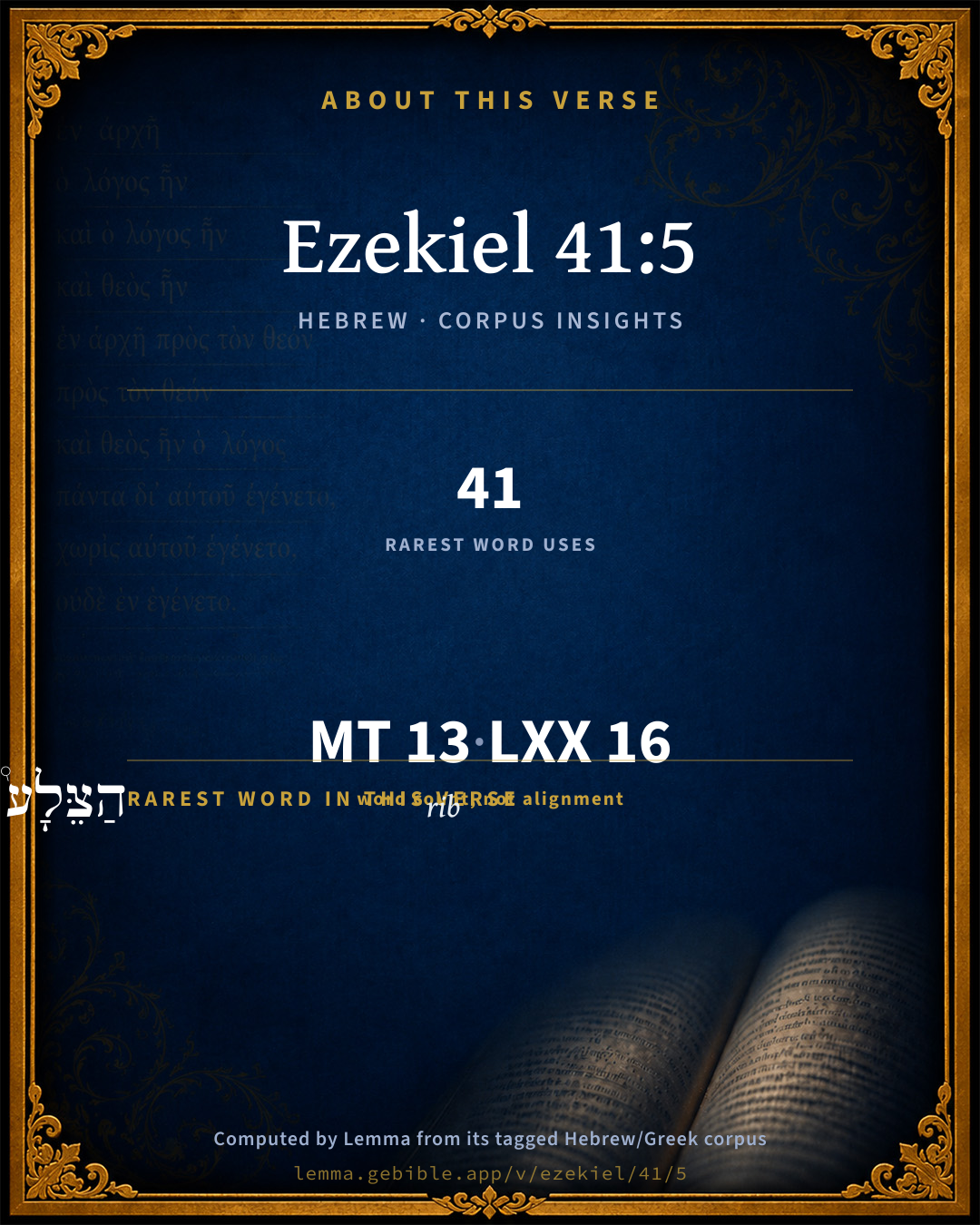
13
words
9
distinct lemmas
Prophets
section

Shared distinctive vocabulary

הַצֵּלָע֩ rib H6763 occurs in 32 verses of the Hebrew Bible. Also found in:

Grammatical profile

  • 1 verb
  • 10 nouns
  • 2 adjectives

Verb forms

  • וַיָּ֥מָד Qal · Sequential Imperfect

Repetition

Words recur within this verse — often emphatic in Hebrew:

  • סָבִ֧יב round about H5439 ×3
  • הַבַּ֖יִת house H1004 ×2
  • אַמּ֑וֹת cubit H520 ×2

Hebrew & Septuagint length

In English translation the verse runs 25 words from the Hebrew and 20 from the Septuagint (LXX English) — closely comparable.

A rough comparison of the two English renderings, which tokenize alike — not a word-level alignment.

Word counts can differ between the Hebrew and the Greek without any difference in meaning — e.g. the Hebrew direct-object marker אֵת has no separate Greek word, and Greek often adds the article ὁ.

In the original languages it is 13 Hebrew tokens and 16 Greek tokens — but the two are counted differently (Hebrew bundles its prefixes and suffixes into one token; the Greek is in lemma form), so that isn’t a like-for-like length.

Cross-references

3

Topical passages linked to Ezekiel 41:5 in the Treasury of Scripture Knowledge — connected by theme and wording, ordered by reader-vote popularity; previews shown in the World English Bible.

  • 1 Kings 6:5–6 Against the wall of the house he built stories round about, against the walls of the house round about, both of the temple and of the oracle; and he made side-chambers round about.
  • Ezekiel 41:6–9 The side-chambers were in three stories, one over another, and thirty in order; and they entered into the wall which belonged to the house for the side-chambers round about, that they might have hold [therein], and not have hold in the wall of the house.
  • Ezekiel 42:3–14 Over against the twenty [cubits] which belonged to the inner court, and over against the pavement which belonged to the outer court, was gallery against gallery in the third story.

Cross-references courtesy of OpenBible.info (CC BY 4.0).

Hebrew and Greek witnesses Masoretic Hebrew ↔ Greek Septuagint

The same verse in the two great witnesses to the Old Testament, shown verse-for-verse.

These are two independent witnesses, not word-aligned to each other, and the Septuagint is shown in lemma (dictionary) form.

Hebrew Ezekiel 41:5 Masoretic · Westminster Leningrad Codex

וַיָּ֥מָד קִֽיר הַבַּ֖יִת שֵׁ֣שׁ אַמּ֑וֹת וְרֹ֣חַב הַצֵּלָע֩ אַרְבַּ֨ע אַמּ֜וֹת סָבִ֧יב סָבִ֛יב לַבַּ֖יִת סָבִֽיב

Then he measured the wall of the house, six cubits; and the breadth of every side-chamber, four cubits, round about the house on every side.

World English Bible · Public Domain

Greek LXX Ezekiel 41:5 Septuagint · lemma form

καί διαμετρέω ὁ τοῖχος ὁ οἶκος πηχύς ἕξ καί ὁ εὖρος ὁ πλευρά πηχύς τέσσαρες κυκλόθεν

And he measured the wall of the house, six cubits: and the breadth of each side, four cubits round about.

LXX2012 (modern English Septuagint) · Public Domain

On this verse, Keil & Delitzsch discusses the Septuagint’s reading. Read the note in Commentary ↓

Hebrew: Westminster Leningrad Codex (CC BY 4.0). Greek: Septuagint (public domain); English from LXX2012 (modern English Septuagint) (Public Domain). How the Septuagint differs from the Hebrew →

Targum (Aramaic paraphrase)

1

The Targum is the ancient Jewish Aramaic paraphrase of the Hebrew Scriptures — an interpretive translation, not the Hebrew text itself. Onkelos (literal) and Pseudo-Jonathan (expansive) render the Torah, and Jonathan the Prophets. Coverage is partial: where no permissively-licensed English translation exists for a verse, only the Aramaic is shown. This is verse-level text, not a word-by-word alignment to the Hebrew.

  1. Targum Jonathan Prophets (Joshua–Malachi)
    וּמְשַׁח כּוֹתְלָא דְבֵיתָא שִׁית אַמִין וּפוּתְיָא דִמְחִיצְתָּא אַרְבַּע אַמִין סְחוֹר סְחוֹר מַקַף לְבֵיתָא סְחוֹר סְחוֹר:

    (no public-domain English translation for this verse)

    Targum Jonathan — Aramaic: “Mikraot Gedolot” (public domain). English: “Sefaria Community Translation” (CC0 1.0 (public-domain dedication)); “London "Chaldee Paraphrase," 1871” (public domain). Text via Sefaria.

Commentary

Notes on Ezekiel 41:5 from classic Christian and Jewish commentators (each source and its license shown beneath its notes). The classic Christian expositions comment on the surrounding passage and are grouped to its opening verse, so a note may address several verses; the Jewish commentaries on the Tanakh (Rashi and others) are per-verse, so they appear only where the commentator wrote on this verse.

Lemma curates 59 commentaries, every one of them public domain or Creative Commons licensed, each selected and text-cleaned for this edition rather than reprinted as found. About our sources →

The Cambridge Bible for Schools and Colleges

gen. ed. J. J. S. Perowne

5. The wall of the house at its base was 6 cubits thick, and the breadth (N. to S.) of the side-chambers on the basement was 4 cubits. If the rebatements in the wall of the house were the same here as in Solomon’s temple, the second story would be a cubit broader than the ground floor, and the third a cubit broader than the second (1Ki_6:6), i. e. 4, 5 and 6 cubits. In Solomon’s temple the side-chambers were larger, measuring 5, 6 and 7 cubits.

Ch. Eze_41:5-11. The side chambers or annexe to the house

The text in some places is confused, but the general meaning is clear. Round about the wall of the house on three sides (N., W. and S.) were built side-chambers in three stories, thirty chambers in each story, Fig. 2, D. The chamber on the ground floor was 4 cubits wide (N. to S.), but in the second story the width was greater than in the first, and in the third story greater than in the second. The reason of this greater wideness of the upper stories was that the wall of the house on which the chambers were built diminished in thickness as it ascended. This wall was 6 cubits thick at the base (Eze_41:5), but it was let in at two points as it ascended. The same arrangement had place in Solomon’s temple—“on the outside he made rebatements in the wall of the house round about” (1Ki_6:6). The effect of this decrease in the thickness of the wall (in Solomon’s temple a cubit each time) was that the chambers in the second and third stories became so much broader. In consequence of this narrowing of the wall of the house at two points two ledges ran round the wall on three sides, and on these ledges the beams that supported the second and third stories of the side-chambers rested, without being let into the wall (Eze_41:6). The wall of the side-chambers was thus on one side the wall of the house; on the other side they had a wall of their own, 5 cubits thick (Eze_41:9). The whole structure, house and side chambers, was built upon a raised platform, 6 cubits higher than the level of the inner court (Eze_41:8). The buildings, however (temple and side-chambers), did not quite cover the platform: a margin of 5 cubits (“that which was left,” Eze_41:9; Eze_41:11) remained free outside the side-chambers, on two sides (N. and S.), Fig. 2, E; and from this free space the doors into the side-chambers opened, one on the N. and another on the S., Fig. 2, g (Eze_41:11). Further, on the walls of the inner court, N. and S., were chambers for the priests, Fig. 3, GG´, and between the temple-platform and these cells ran a passage or court of 20 cubits (“the separate place,” Eze_41:12). This court ran round the house-platform on three sides (N. W. S.), Fig. 3, H. The way in which one story of the side-chambers communicated with another is described only generally (Eze_41:7); in Solomon’s temple the communication is supposed to have been by a spiral staircase, or more probably by a ladder and trap-doors. It is evident that the prophet reproduces in the main the arrangements of the temple, hence he refers to the several things, even when first mentioning them, as the so and so, assuming that they are well known.

The Cambridge Bible for Schools and Colleges (gen. ed. J. J. S. Perowne; Cambridge University Press, 1878–1918) — public domain. Text from a community e-Sword module.

Trapp's Complete Commentary

John Trapp

Eze 41:5 After he measured the wall of the house, six cubits; and the breadth of [every] side chamber, four cubits, round about the house on every side.

Ver. 5. He measured the wall.] With the counterforts added to it for strength and ornament; these are commonly called pilasters or pillars.

Six cubits,] scil., In breadth.

John Trapp, A Commentary or Exposition upon All the Books of the Old and New Testament (1647–1656) — public domain. Text from a community e-Sword module.

Joseph Benson's Commentary

Eze 41:5-6. He measured the wall of the house, six cubits — Three yards thick was this wall, from the ground to the first story of the side-chambers. And the breadth of every side-chamber, four cubits — Of the lowest floor; for there were three stories of these, and they differed in their breadth, as the wall of the temple, on which they rested, abated of its thickness; for the middle chambers were broader than the lowest by a cubit, and the highest as much broader than the middle. The side-chambers were three, one over another — They were three stories high; and thirty in order — As in Solomon’s temple, according to Josephus’s description, Antiq., lib. 8. cap. 3, sec. 2, where it appears, that round Solomon’s temple were chambers three stories high, each story consisting of thirty chambers. It is supposed that twelve were placed to the north, twelve to the south, and six to the east. And they entered into the wall — At five cubits height from the ground, the wall which supported these outward chambers, abated of its thickness one cubit, in consequence of which there was a rest, or a ledge, of one cubit’s breadth, on which the ends of each story were fastened: see 1Ki 6:10. But they had not hold in the wall of the house — They were not fastened into the main wall of the house, but rested on the outside of the wall where it became more narrow.

Joseph Benson's Commentary on the Old and New Testaments (1811–1818) — public domain. Text from a community e-Sword module.

Keil & Delitzsch

C. F. Keil & F. Delitzsch

The Wall and the Side-Building

Eze 41:5. And he measured the wall of the house six cubits, and the breadth of the side storey four cubits round the house round about. Eze 41:6. And of the side-rooms there were room upon room three, and that thirty times, and they came upon the wall, which the house had by the side-rooms round about, so that they were held, and yet they were not held in the wall of the house. Eze 41:7. And it spread out, and was surrounded upwards more and more to the side-rooms, for the enclosure of the house went upwards more and more round about the house; therefore the house received breadth upwards; and so the lower ascended to the upper after the proportion of the central one. Eze 41:8. And I saw in the house a height round about, with regard to the foundations of the side-rooms a full rod, six cubits to the joint. Eze 41:9. The breadth of the wall, which the side storey had on the outside, was five cubits, and so also what was left free was by the side-chamber building of the house. Eze 41:10. And between the cells was a breadth of twenty cubits round the house round about. Eze 41:11. And the door of the side-chamber building led toward what was left free, one door toward the north and one door toward the south, and the breadth of the space left free was five cubits round about. - From the interior of the sanctuary the measuring man turned to the outer work, and measured, first of all, the wall of the house (Eze 41:5), i.e., the wall commencing with the pillars in the front (Eze 41:1), which surrounded the holy place and the holy of holies on the north, the west, and the south (e). This was six cubits thick, He then measured the breadth of the צלע, i.e., of the building consisting of three storeys of side-rooms, which was erected against the north, west, and south sides of the sanctuary (h). For צלע signifies not only a single side-room, but collectively the whole range of these side-chambers, the entire building against the sides of the temple house, called יצוּע in Kg1 6:5-6, with which הצּלע (Eze 41:8) is also used alternately there (see the comm. on Kg1 6:5).; - The breadth of the side-building was four cubits in the clear, that is to say, the space from the temple wall to the outer wall of the side-building (f), which was five cubits thick (Eze 41:9), and that uniformly all round the temple. - The further particulars concerning the side-rooms in Eze 41:6 and Eze 41:7 are very obscure, so that they can only be made perfectly intelligible by comparing them with the description of the similar building in Solomon's temple. According to this, Eze 41:6 is to be taken thus: "and as for the side-rooms, there were room upon room (אל for על) three, and (that) thirty times," and understood as signifying that there were three side-rooms standing one above another, and that this occurred thirty times, so that the side-building had three storeys, each containing thirty rooms (chambers), so that there were thirty times three rooms standing one above another (h h h). There is no necessity, therefore, for the transposition of שׁלושׁ וּשׁלשׁים into שׁלשׁים ושׁלושׁ, which Bttcher, Hitzig, and Hvernick have adopted from the lxx, because of their having taken אל in the sense of against, room against room thirty, and that three times, which yields the same thought, no doubt, but not so clearly, inasmuch as it remains indefinite whether the three times thirty rooms were above one another or side by side. Nothing is said about the distribution of the thirty rooms in each storey; but it is very probable that the distribution was uniform, so that on each of the longer sides, i.e., against the northern and southern walls of the temple, there were twelve rooms, and six against the shorter western wall. The northern and southern walls were sixty cubits, plus six cubits the thickness of the wall, plus four cubits the breadth of the side building against the western wall (60 + 6 + 4), in all therefore seventy cubits, or, deducting five cubits for the thickness of the outer wall at the front of the building, sixty-five cubits long; and the western wall was 20 + 2 x 6 (the thickness of the side wall), i.e., thirty-two cubits long. If, therefore, we fix the length of each side-room at 4 1/2 cubits, there remain five cubits against the western wall for the seven party walls required, or five-sevenths of a cubit for each, and against the northern and southern walls eleven cubits for party walls and staircase, and reckoning the party walls at four-sevenths of a cubit in thickness, there are left four cubits and a seventh for the space of the stairs, quite a sufficient space for a winding staircase.

The clauses which follow relate to the connection between these side-rooms and the temple house. באות בּקּיר, they were coming (going) upon the wall. בּוא ב, generally intrare in locu, here, on account of what follows, to tread upon the wall; that is to say, they were built against the wall in such a manner that the beams of the floors of the three storeys rested on the temple wall on the inner side, i.e., were held or borne by it, but not so as to be inserted in the wall and held fast thereby. The only way in which this could be effected was by so constructing the temple wall that it had a ledge at every storey on which the beams of the side-storeys could rest, i.e., by making it recede half a cubit, or become so much thinner on the outer side, so that if the thickness of the wall at the bottom was six cubits, it would be five cubits and a half at the first storey, five cubits at the second, and four and a half at the third. In this way the side-rooms were supported by the temple wall, but not in such a manner that the beams laid hold of the walls of the sanctuary, or were dovetailed into them, which would have done violence to the sanctity of the temple house; and the side storeys appeared as, what they should be, an external building, which did not interfere with the integrity of the sanctuary. That this is the meaning of the words is rendered certain by a comparison with Kg1 6:6, where the ledges on the temple wall are expressly mentioned, and the design of these is said to be לבלתּי אחז בּקירות, that the beams might not be fastened in the walls of the house, to which the last words of our verse, ולא־יהיוּ אחוּזים בּקיר הבּית, refer. Kliefoth's rendering of באות בּקּיר, "they went against the wall," is grammatically untenable, as בּוא sa ,elba with ב does not mean to go against anything. אשׁר לבּית לצּלעות, which the (temple) house had toward the side-rooms. סביב סביב, round about, i.e., on all three sides of the temple. The peculiarity of the storeys, arising from this resting upon the temple, is described in Eze 41:7, of which different explanations have been given, but the general meaning of which is that it occasioned a widening of the side-rooms proceeding upwards from storey to storey, as is plainly stated in Kg1 6:6. The words ורחבה ונסבה are not to be taken together, as expressing one idea, viz., "it spread round about" (De Wette), but contain two different assertions, which are more precisely defined in what follows by the substantives מוּסב and רחב. Neither קיר nor הצלע is to be taken as the subject; but the verbs are to be regarded as impersonal: "there spread out and surrounded," i.e., a widening and a surrounding took place. The double למעלה has been correctly explained by Bochart, viz., "by continued ascending," i.e., the higher one went the more extension and compass did one find, with regard to, i.e., according to the measure of, the side-rooms or side-storeys. לצּלעות belongs to למעלה, and is added for the purpose of defining more precisely how the widening took place, not gradually, but at each storey; for "these צלעות are the three rooms standing one above another, spoken of in Eze 41:6" (Kliefoth).

This statement is explained, and the reason assigned, in the clause introduced with כּי, the meaning of which depends upon the explanation of the word מוּסב. This word may mean a way round, and a surrounding. The Rabbins, whom Hvernick follows, understand by מוּסב a winding staircase, the לוּלים mentioned in Kg1 6:8, which led from the lower storey to the upper ones. This is decidedly wrong; for apart from the question whether this meaning can be grammatically sustained, it is impossible to attach any rational meaning to the words, "a winding staircase of the house was upwards more and more round about the house," since a winding staircase could never run round about a building seventy cubits long and forty cubits broad, but could only ascend at one spot, which would really give it the character of a winding staircase. Bttcher's explanation is equally untenable: "for the winding round of the interior was upwards more and more round and round inwards." For, in the first place, הבּית does not mean the interior, and לבּית does not mean inwards; and secondly, "winding round" is not equivalent to an alteration of form in the shape of the rooms, through which those in the bottom storey were oblongs running lengthwise, those in the central storey squares, and those in the third oblongs running inwards, which Bttcher imagines to have been the case. It would be much easier to adopt the explanation of Kliefoth and others, who take מוּסב in the sense of a way round, and regard it as signifying a passage running round the house in the form of a gallery, by which one could walk all round the house, and so reach the rooms in the upper storeys. This, as Kliefoth still further remarks, was the reason why the surrounding of (circuit round) the house was greater the higher one ascended, and also the reason why it became wider up above in the upper storeys, as the words, "therefore the breadth of the house increased upwards," affirm. In these words Kliefoth finds a distinct assertion "that there is no foundation for the assumption that the widening upwards was occasioned by the receding of the temple walls; but that the widening of the building, which took place above, arose from the passages round that were attached to the second and third storeys, and that these passages ran round the building, and consequently were attached to the outside in the form of galleries." But we are unable to see how this can be distinctly asserted in the words רחב לבּית למעלה. Even if הבּית, in connection with מוּסב, signified the side-building, including the temple house, the only thought contained in the words would be, that the side-building became broader at each storey as you ascended, i.e., that the breadth of the side-building increased with each storey. But even then it would not be stated in what manner the increase in breadth arose; whether in consequence of the receding of the temple wall at each storey, or from the fact that the side-rooms were built so as to project farther out, or that the side-storeys were widened by the addition of a passage in the form of a gallery. And the decision in favour of one or other of these possibilities could only be obtained from the preceding clause, where it is stated that מוּסב הבּית went round about the side-building, and that in favour of the last.

But, in the first place, the assumption that הבּית and לבּית denote the side-building, to the exclusion of the temple house, is extremely harsh, as throughout the whole section הבּית signifies the temple house; and in Eze 41:6 לבּית is used again in this sense. If we understand, however, by מוּסב הבּית a passage or a surrounding all round the temple house, the words by no means imply that there were outer galleries running round the side-rooms. In the second place, it is extremely harsh to take מוּסב in the sense of a passage round, if the preceding נסבה is to signify surrounded. As מוּסב takes up the word נסבד again, and "precisely the same thing is signified by the two verbs רחבה ונסבה as by the substantives רחב and מוּסב afterwards," we cannot render נסבה by surrounded, and מוסב by a passage round. If, therefore, מוּסב signified a passage, a gallery running round the building, this would necessarily be expressed in the verb נסבה, which must be rendered, "there went round," i.e., there was a passage round, more and more upwards, according to the measure of the storeys. But this would imply that the passage round existed in the case of the bottom storey also, and merely increased in breadth in the central and upper storeys. Now a gallery round the bottom storey is shown to be out of the question by the measurements which follow. From this we may see that the supposition that there were galleries on the outside round the second and third storeys is not required by the text, and possibly is irreconcilable with it; and there is not even a necessity to adduce the further argument, that Kliefoth's idea, that the entire building of three storeys was simply upheld by the outer wall, without any support to the beams from the wall of the temple, is most improbable, as such a building would have been very insecure, and useless for the reception of any things of importance. We therefore take נסב and מוּסב in the sense of surrounded and surrounding. In this case, Eze 41:7 simply affirms that the surrounding of the house, i.e., the side-building round about the temple house, became broader toward the top, increasing (more and more) according to the measure of the storeys; for it increased the more in proportion to the height against the temple house, so that the house became broader as you ascended. To this there is appended by means of וכן the last statement of the verse: "and so the lower ascended to the upper after the measure of the central one." This clause is taken by the majority of the commentators to mean: thus they ascended from the lower to the upper after the central one. But many have observed the folly of an arrangement by which they ascended a staircase on the outside from the lower storey to the upper, and went from that into the central one, and have therefore followed the lxx in changing וכן into וּמן and לתּיכונה into בּתּיכונה, "and from the lower (they ascended) to the upper through the central one." But there is no apparent necessity for these alterations of the text, as the reading in the text yields a good sense, if we take התּחתּונה as the subject to יעלה: and thus the lower storey ascended to the upper after the measure of the central one, - a rendering to which no decisive objection can be urged on the ground of the difference of gender (the masc. יעלה). וכן affirms that the ascent took place according to the mode of widening already mentioned.

In the Eze 41:8 we have a further statement concerning the side-rooms, as we may see from the middle clause; but it has also been explained in various ways. Bttcher, for example, renders the first clause thus: "and I saw what the height round about was in an inwardly direction;" but this is both grammatically false and senseless, as לבּית does not mean inwardly, and "in an inwardly direction" yields no conceivable sense. Kliefoth adopts the rendering: "I fixed my eyes upon the height round about to the house;" but this is also untenable, as ראה does not mean to fix the eyes upon, in the sense of measuring with the eyes, and in this case also the article could hardly be omitted in the case of גּבהּ. The words run simply thus: "I saw in the house a height" = an elevation round about. What this means is shown in the following words: the side-rooms had foundations a full rod, i.e., the foundation of the rooms was a full rod (six cubits) high. מיסדות is not a substantive מיסדות, but a participle Pual מיסּדות; and the Keri is substantially correct, though an unnecessary correction; מלו for מלוא (compare Eze 28:16, מלוּ for מלאוּ). The side-building did not stand on level ground, therefore, but had a foundation six cubits high. This is in harmony with the statement in Eze 40:49, that they ascended by steps to the temple porch, so that the temple house with its front porch was raised above the inner court. As this elevation was a full rod or six cubits, not merely for the side-building, but also for the temple porch, we may assume that there were twelve steps, and not ten after the lxx of Eze 40:49, as half a cubit of Ezekiel's measurement was a considerable height for steps. - The expression which follows, "six cubits אצּילה," is obscure, on account of the various ways in which אצילה may be understood. So much, however, is beyond all doubt, that the words cannot contain merely an explanation of the length of the rod measure: "six cubits (measured) to the wrist," because the length of the rod has already been fixed in Eze 40:5, and therefore a fresh definition would be superfluous, and the one given here would contradict that of Eze 40:5. אצּיל signifies connection or joint, and when applied to a building can hardly mean anything else than the point at which one portion of the building joins on to the other. Hvernick and Kliefoth therefore understand by אצּיל the point at which one storey ends and another begins, the connecting line of the rooms standing one above another; and Hvernick takes the clause to be a more precise definition of מיסדות הץ', understanding by מיסדות the foundations of the rooms, i.e., the floors. Kliefoth, on the other hand, regards the clause as containing fresh information, namely, concerning the height of the storeys, so that according to the statement in this verse the side-building had a foundation of six cubits in height, and each of the storeys had also a height of six cubits, and consequently the whole building was twenty-four cubits high, reckoning from the ground. So much is clear, that מיסדות does not signify the floors of the rooms, so that Hvernick's explanation falls to the ground. And Kliefoth's view is also open to this objection, that if the words gave the height of the storeys, and therefore supplied a second measurement, the copula ו could hardly fail to stand before them. The absence of this copula evidently leads to the conclusion that the "six cubits" אצּילה are merely intended to furnish a further substantial explanation as to the foundation, which was a full rod high, the meaning of which has not yet been satisfactorily cleared up, as all the explanations given elsewhere are still further from the mark.

In Eze 41:9 there follow two further particulars with reference to the side-building. The wall of it without, i.e., on the outside (f), was five cubits thick or broad, and therefore one cubit thinner than the temple wall. The מנּח in the side-building was just the same breadth. In the clause beginning with ואשׁר the measure (five cubits) given in the first clause is to be repeated, so that we may render ו by "and also," and must take the words in the sense of "just as broad." מנּח, the Hophal participle of הנּיח, to let alone, in the case of a building, is that portion of the building space which is not built upon like the rest; and in Eze 41:11, there it is used as a substantive, it signifies the space left open by the sides of the building (Plate I i). The Chaldee rendering is אתר, locus relictus. בּית צלעות is an adverbial or locative accusative: against the house of side-chambers, or all along it; and אשׁר לבּית is an appositional explanation: "which was to the temple," i.e., belonged to it, was built round about it. - Consequently there is no necessity for any alteration of the text, not even for changing בּית into בּין in order to connect together Eze 41:9 and Eze 41:10 as one clause, as Bttcher and Hitzig propose; though all that they gain thereby is the discrepancy that in Eze 41:9 and Eze 41:10 the space left open between the side-rooms against the temple house and between the cells against the wall of the court is said to have been twenty cubits broad, whereas in Eze 41:12 the breadth of this munnâch is set down as five cubits. - There follows next in Eze 41:10 the account of the breadth between the temple-building and the cells against the wall of the inner court, and then in Eze 41:11 we have further particulars concerning the side-building and the space left open. הלשׁכות (Eze 41:10) are the cell buildings, more fully described in Eze 42:1., which stood along the wall dividing the inner court from the outer on the west of the north and south gates of the inner court, and therefore opposite to the temple house (Plate I L L). To the expression, "and between the cells there was a breadth," there has to be supplied the correlative term from the context, namely, the space between the מנּח and the לשׁכות had a breadth of twenty cubits round about the house, i.e., on the north, west, and south sides of the temple house. - The description of this space closes in Eze 41:11 with an account of the entrances to the side-building. It had a door toward the space left open, i.e., leading out into this space, one to the north and one to the south (Plate III i i), and the space left open was five cubits broad round about, i.e., on the north, west, and south sides of the temple-building. מקום , the place of that which remained open, i.e., the space left open.

If, then, in conclusion, we gather together all the measurements of the temple house and its immediate surroundings, we obtain (as is shown in Plate I) a square of a hundred cubits in breadth and a hundred cubits in length, exclusive of the porch. The temple (G) was twenty cubits broad in the inside (Eze 41:2); the wall surrounding the sanctuary was six cubits (Eze 41:5), or (for the two walls) 2 x 6 = 12 cubits. The side-buildings being four cubits broad in the clear on each side (Eze 41:5), make 2 x 4 = 8 cubits. The outside walls of these buildings, five cubits on each side (Eze 41:9), make 2 x 5 = 10 cubits. The מנּח (i), five cubits round about (Eze 41:11), makes 2 x 5 = 10 cubits. And the space between this and the cells standing by the wall of the court (e-g-h-f), twenty cubits round about (Eze 41:10), makes 2 x 20 = 40 cubits. The sum total therefore is 20 + 12 + 8 + 10 + 10 + 40 = 100 cubits, in perfect harmony with the breadth of the inner court given in Eze 40:47. The length was as follows: forty cubits the holy place, and twenty cubits the holy of holies (Eze 41:2 and Eze 41:4); the western wall, six cubits; the side-rooms on the west, four cubits; and their wall, five cubits; the מנּח, on the west, five cubits; and the space to the cells, twenty cubits; in all, 40 + 20 + 6 + 4 + 5 + 5 + 20 = 100 cubits, as stated in Eze 41:13. The porch and thickness both of the party-wall between the holy place and the most holy, and also of the front (eastern) wall of the holy place, are not taken into calculation here. The porch is not included, because the ground which it covered belonged to the space of the inner court into which it projected. The party-wall is not reckoned, because it was merely a thin wooden partition, and therefore occupied no space worth notice. But it is difficult to say why the front wall of the holy place is not included. As there was no room for it in the square of a hundred cubits, Kliefoth assumes that there was no wall whatever on the western side of the holy place, and supposes that the back wall (i.e., the western wall) of the porch supplied its place. But this is inadmissible, for the simple reason that the porch was certainly not of the same height as the holy place, and according to Eze 40:48 it had only sixteen cubits of external breadth; so that there would not only have been an open space left in the upper portion of the front, but also an open space of two cubits in breadth on either side, if the holy place had had no wall of its own. Moreover, the measurement both of the pillars on both sides of the front of the היכל (Eze 41:1), and of the shoulders on both sides of the door (Eze 41:2), presupposes a wall or partition on the eastern side of the holy place, which cannot be supposed to have been thinner than the side-walls, that is to say, not less than six cubits in thickness. We are shut up, therefore, to the conjecture that the forty cubits' length of the holy place was measured from the door-line, which was ten cubits broad, and that the thickness of the door-shoulders on the two sides is included in these forty cubits, or, what is the same thing, that they were not taken into account in the measurement. The objection raised to this, namely, that the space within the holy place would thereby have lost a considerable portion of its significant length of forty cubits, cannot have much weight, as the door-shoulders, the thickness of which is not reckoned, were only five cubits broad on each side, and for the central portion of the holy place, which was occupied by the door, and was ten cubits broad, the length of forty cubits suffered no perceptible diminution. Just as the pillars of the door of the holy of holies with the party-wall are reckoned in the 40 + 20 cubits' length of the sanctuary, and are not taken into consideration; so may this also have been the case with the thickness of wall of the door-shoulders of the holy place. The measurements of the space occupied by the holy place and holy of holies, which have a symbolical significance, cannot be measured with mathematical scrupulosity.

Keil & Delitzsch — Biblical Commentary on the Old Testament (1861–1891) — public domain (CC PDM 1.0). Text via the HelloAO Bible API. (Old Testament only.)

Tyndale Open Study Notes

Tyndale Open Resources

41:5-26 Around the Temple building were ninety side rooms on three levels. To the rear was a large building of unspecified purpose that might have protected the back of the Temple from unauthorized access. No one was permitted to approach God’s presence from behind. The side rooms might have been designed to store priestly clothing and equipment.

Tyndale Open Study Notes — © Tyndale Open Resources, licensed CC BY-SA 4.0. Text via the HelloAO Bible API.

Jamieson, Fausset & Brown

Robert Jamieson, A. R. Fausset & David Brown

side chamber--the singular used collectively for the plural. These chambers were appendages attached to the outside of the temple, on the west, north, and south; for on the east side, the principal entrance, there were no chambers. The narrowness of the chambers was in order that the beams could be supported without needing pillars.

Jamieson, Fausset & Brown — Commentary Critical and Explanatory on the Whole Bible (1871) — public domain (CC PDM 1.0). Text via the HelloAO Bible API.

Ellicott's Commentary for English Readers

(5) The wall of the house, six cubits.—The thickness of the wall is the same with that of the wall of the outer court (Eze_40:5), about ten feet. Great massiveness is characteristic of Oriental architecture, but is carried to excess in this vision, to set forth the firmness and security of the things symbolised.

Every side chamber.—Every is not in the original, and is unnecessary. He measured the range of side rooms, the word being used collectively. These (J J [Eze_40:44-49]) entirely surrounded the house, except on the front or east side where the porch stood.

A Bible Commentary for English Readers, edited by Charles John Ellicott (1878–1897) — public domain. Text from a community e-Sword module.

John Gill's Exposition

After he measured the wall of the house six cubits,.... Or a reed, three yards and a half thick: this was the wall of the holy of holies, or which divided that from the holy place, and was not in the second temple; or rather the wall of the temple, the whole house or building, both of the holy place, and of the most holy, which were contiguous: such a strong wall is the Lord to his church, and especially will be in the latter day, when salvation will be for walls and bulwarks against all enemies, and to preserve from all hurt and danger, Isa 26:1, the New Jerusalem also will have a wall great and high, and made of a precious stone, Rev 21:12,

and the breadth of every side chamber four cubits round about the house on every side; or, "of every rib" (y); as ribs are to the body, so were these side chambers or buildings to the fabric, as Ben Melech observes, who interprets them of beams: adjoining to the above wall were chambers all around the holy place and the most holy on each side, north and south; for there could be none on the east, that being the entrance into the holy, and so into the most holy place; and the floor of these chambers were four cubits, or two yards and a foot broad; that is, those of the lower storey: these were for the priests, where they lodged, and laid up and ate their most holy things, and put their garments in which they ministered; see Eze 42:13, and design, as the chambers everywhere do, particular congregated churches; where such as are made priests to God by Christ have a place, and communion with God in holy things; and appear in the righteousness of Christ, and in the beauties of holiness.

(y) "costae", Piscator, Cocceius, Starckius.

John Gill's Exposition of the Whole Bible (1746–1763) — public domain (CC PDM 1.0). Text via the HelloAO Bible API.

Albert Barnes' Notes on the Bible

The wall of the house - This was the outer wall of the temple itself. Its thickness of six cubits corresponds with the colossal proportions of the architecture of the east.

Every side chamber - the side-chambers (D). These were a marked feature in Solomon’s Temple, and were probably used as storehouses for the furniture and property of the temple. The arrangement of these side-chambers differed in some respects from that of Solomon’s Temple, the object of Ezekiel’s vision being throughout to bring all things to a more exact proportion.

Albert Barnes' Notes on the Bible (1834–1885) — public domain. Text from a community e-Sword/MySword module.

Haydock's Catholic Bible Commentary

Four. Herein it differed from Solomon’s chambers, which were in breadth five, six, and seven cubits, in the three stories, respectively. (Calmet)

George Leo Haydock (1774–1849), Haydock's Catholic Family Bible and Commentary, 1859 edition — public domain. Excludes Psalms (Douay-Rheims chapter numbering differs from Protestant) and Deuterocanonical books (Catholic canon only).

Matthew Poole's English Annotations

Having left the holy of holies measured in the 3rd verse, now he is come to take the measures of the outer wall.

The house; the temple itself,

Six cubits; three yards thick was this wall from the ground to the first story of the side chambers.

Every side chamber of the lowest floor; for there were three stories of these, and they differed in their breadth, as the wall of the temple on which they rested abated of its thickness; for the middle chambers were broader than the lowest by a cubit, and the highest as much broader than the middle.

Round about; on the north, south, and west parts.

On every side; on each side of every one of these three gates. The east gate, and buildings about that, were not faced with such facings.

Matthew Poole's English Annotations on the Holy Bible (1683–1685) — public domain. Text from a community e-Sword/MySword module.

Whedon's Commentary on the Bible

Daniel D. Whedon

5-11. Various details in this description of the side chambers (compare 1Ki_6:5-10; 1Ki_7:51) are uncertain, but Toy’s rendering makes plain the general meaning: “He measured the wall of the temple six cubits thick. And the interior width of the side structure was four cubits round about the temple. The side cells were in three stories, thirty on each story. There were rebatements all around in the wall of the temple for the joists of the cells to rest on, so that they should not be inserted in the wall of the temple. Thus the interior width of the cells increased as they went up, according to the enlargement of the rebatement upward round about the temple. There was an ascent from the lower story to the middle and from the middle to the upper. And around the temple was a raised platform, the foundation of the side cells, a long rod high — that is, six cubits and six handbreadths. The outer wall of the side structure was five cubits thick and the part of the platform left uncovered was five cubits wide. Between the cells and the chambers was a space of twenty cubits round about. The doors of the side structure opened on the uncovered part of the platform.” We append Dean Plumptre’s plan and measurements: —

I. The breadth of the court — Cubits.

Daniel D. Whedon (gen. ed.), Commentary on the Old and New Testaments (1874–1909) — public domain. Text from a community e-Sword module.

The Pulpit Commentary

Vers. 5.-11 The wall and side buildings.

The measuring commenced with the wall of the house, i.e. with the outer wall, which, beginning at the pillars (ver. 1), enclosed the temple on its south, west, and north sides. Its great thickness, six cubits, corresponded with and even surpassed the colossal proportions of architecture in the ancient East. The walls of Solomon"s temple, though not mentioned in either Kings or Chronicles, could hardly have been less

than four cubits thick, (see 1Ki_6:6) and were probably more (Schurer). Like the Solomonic, (1Ki_6:5-10) the Ezekelian temple had side chambers, which, like those of the earlier building, served as storehouses for priests" clothing, temple utensils, and temple treasures (1Ki_7:51; 2Ki_11:2; 2Ch_5:1) and measured four cubits broad in the clear.

The Pulpit Commentary (1880–1919), ed. H.D.M. Spence-Jones & Joseph S. Exell — public domain. Text from a community e-Sword module.

John Wesley's Explanatory Notes

After - Having left the holy of holies, now he is come to take the measures of the outer wall. The house - The temple. Six cubits - Three yards thick was this wall from the ground to the first story of the side-chambers. Side-chamber - Of the lowest floor; for there were three stories of these, and they differed in their breadth, as the wall of the temple, on which they rested, abated of its thickness; for the middle chambers were broader than the lowest by a cubit, and the highest as much broader than the middle. Round about - On the north, south, and west parts, on each side of every one of these three gates.

John Wesley, Explanatory Notes Upon the Whole Bible (1754–1765) — public domain. Text via the GEBible commentary corpus.

unfoldingWord translationNotes

Door43 World Missions Community

the house

the temple

six cubits

about 3.2 meters (See: Biblical Distance)

cubits

Each long cubit was about 54 centimeters. See how you translated this in Ezekiel 40:05. (See: Biblical Distance)

four cubits

about 2 meters

three levels

"three stories"

There were ledges around the wall of the house

"The house had ledges all around for the side rooms all around." This way the side rooms could rest on the ledge of the wall.

to support

"so that the ledges could support"

for there was no support put in the wall of the house

"for there were no supports in the wall of the house." The people who built the temple did not want stones or wood that would support the side rooms to be sticking out from the wall of the sanctuary.

translationWords

house

unfoldingWord translationNotes — © Distant Shores Media and the Door43 World Missions Community, licensed CC BY-SA 4.0. Source: git.door43.org/Door43/en_tn.

Rashi

Rabbi Shlomo Yitzchaki (Rashi)

And he measured the wall the western wall.

and the width of the cell [Heb. הַצֵלָע,] apendiz in Old French. The interior of the cell behind it was four amos in measurement, and in the Second Temple it was six (amos). And perforce this Temple is the one of the future, because there was no wall separating the Holy of Holies in the Second Temple.

Rashi on the Tanakh — English translations: “The Judaica Press complete Tanach with Rashi, translated by A. J. Rosenberg” (CC BY 4.0); “Pentateuch with Rashi's commentary by M. Rosenbaum and A.M. Silbermann, 1929-1934” (public domain); “The Metsudah Tanach series, Lakewood, N.J” (CC BY 4.0); and “The Book of Joshua, Metsudah Publications, 1997” (CC BY 4.0). Text via Sefaria.

Lesson kit

Teaching starters — assembled from the data on this page, not authored interpretation. Every prompt links to the verse data it draws on. Edit before teaching.

Ezekiel, in the Prophets, opens this verse with 13 words (9 distinct Hebrew lemmas). Its most distinctive word is tsêlâʻ (“rib”). A historical commentator’s framing appears above. Read the whole chapter for the surrounding context.

Discussion questions

  1. What does “rib” (tsêlâʻ) contribute to the verse as a whole?
  2. How does Genesis 2:21, which shares the word «rib», read alongside this verse?
  3. What does the repetition of “round about” (3× in this one verse) do in this verse?
  4. The translations on this page render this verse differently — a whole-verse word diff, not a word-by-word alignment. What might account for the different wordings?
  5. «וַיָּ֥מָד» is a Qal Sequential Imperfect verb. How does that grammatical form shape the action described?
  6. Compare how The Cambridge Bible for Schools and Colleges and Trapp's Complete Commentary read this verse. Where do they agree or differ?

Things to notice

Reading settings

Reading text

Shown beneath each verse's original-language words.

Old Testament
Old Testament edition

Read the OT as the Masoretic Hebrew (MT) or the Greek Septuagint (LXX).

English shown for the Greek Septuagint (in the Hebrew ↔ Greek comparison).

Comparing translations? Open the Compare panel on any verse page to stack up to four side by side.