
Jeremiah 33:13

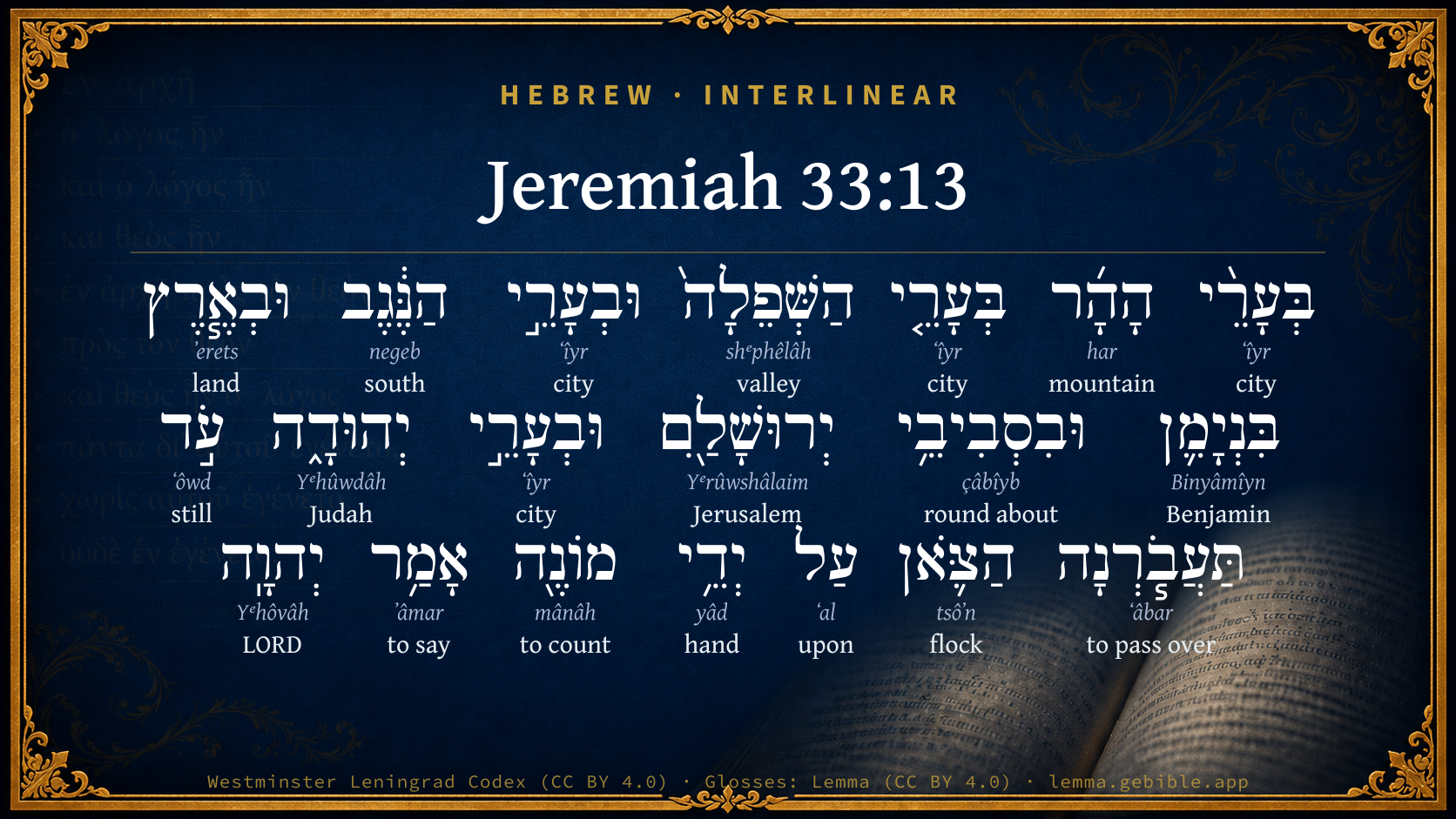
Hebrew (Westminster Leningrad Codex) Jeremiah 33:13 appears in the Hebrew Old Testament. The text above is from the Westminster Leningrad Codex. Each word links to its Strong’s number, a concise gloss, and parsing drawn from the Open Scriptures Hebrew Bible morphology. Click any word for its full Brown-Driver-Briggs (BDB) entry.
Download image
Cite this verse

Jeremiah 33:13 (World English Bible). Public Domain. Lemma interlinear Bible study tool, https://lemma.gebible.app/v/jeremiah/33/13.

Show BibTeX & RIS
BibTeX
RIS
English Translation
In the cities of the hill-country, in the cities of the lowland, and in the cities of the South, and in the land of Benjamin, and in the places about Jerusalem, and in the cities of Judah, shall the flocks again pass under the hands of him who numbers them, says Yahweh.
World English Bible · Public Domain
Download a study sheet

One document with this verse’s original text, its word-by-word gloss line, the meaning frame, cross-references with their text, attributed commentary, and full source and license credits — printable, and it pastes into notes with its structure intact.

This verse Autodidact and up

Study sheet (.html) Plain text (.txt)

A passage Seminary Student

Up to 50 verses in one chapter. A passage sheet keeps up to 6 commentary sources and 12 cross-references per verse, in the order this page ranks them, and says so on the sheet whenever that leaves anything out. Ask for a single verse and you get the Autodidact verse sheet above.

Everything on this page stays free to read, with no account — the sheet is a download of what is already on screen, not access to it.

Want to remove ads? Support Godless Engineer
Compare translations 3

The same verse in 3 English versions, stacked beneath the original-language interlinear above. Click any original word for its lexicon entry.

Each is an independent rendering of the whole verse — the interlinear is not word-aligned to these translations.

Highlighted words mark where these versions differ — a whole-verse word diff, not a word-by-word alignment.

  • World English Bible Public Domain
    In the cities of the hill-country, in the cities of the lowland, and in the cities of the South, and in the land of Benjamin, and in the places about Jerusalem, and in the cities of Judah, shall the flocks again pass under the hands of him who numbers them, says Yahweh.
  • King James Version Public Domain
    In the cities of the mountains, in the cities of the vale, and in the cities of the south, and in the land of Benjamin, and in the places about Jerusalem, and in the cities of Judah, shall the flocks pass again under the hands of him that telleth them, saith the LORD.
  • unfoldingWord Literal Text CC BY-SA 4.0
    In the cities in the hill country, the lowlands, and the Negev, in the land of Benjamin and all around Jerusalem, and in the cities of Judah, the flocks will again pass under the hands of the ones counting them,’ says Yahweh.

unfoldingWord Literal Text — © unfoldingWord, licensed CC BY-SA 4.0. Word-aligned USFM3 via Door43 (git.door43.org/unfoldingWord/en_ult).

Versions to compare (up to 4)

3 of 4 selected

Show all 18 translations

Every available English version of this verse, each an independent rendering of the whole verse.

  • World English Bible Public Domain
    In the cities of the hill-country, in the cities of the lowland, and in the cities of the South, and in the land of Benjamin, and in the places about Jerusalem, and in the cities of Judah, shall the flocks again pass under the hands of him who numbers them, says Yahweh.
  • Berean Standard Bible Public Domain
    In the cities of the hill country, the foothills, and the Negev, in the land of Benjamin and the cities surrounding Jerusalem, and in the cities of Judah, the flocks will again pass under the hands of the one who counts them, says the LORD.
  • Majority Standard Bible Public Domain
    In the cities of the hill country, the foothills, and the Negev, in the land of Benjamin and the cities surrounding Jerusalem, and in the cities of Judah, the flocks will again pass under the hands of the one who counts them, says the LORD.
  • King James Version Public Domain
    In the cities of the mountains, in the cities of the vale, and in the cities of the south, and in the land of Benjamin, and in the places about Jerusalem, and in the cities of Judah, shall the flocks pass again under the hands of him that telleth them, saith the LORD.
  • American Standard Version (1901) Public Domain
    In the cities of the hill-country, in the cities of the lowland, and in the cities of the South, and in the land of Benjamin, and in the places about Jerusalem, and in the cities of Judah, shall the flocks again pass under the hands of him that numbereth them, saith Jehovah.
  • Revised Version (1885) Public Domain
    In the cities of the hill country, in the cities of the lowland, and in the cities of the South, and in the land of Benjamin, and in the places about Jerusalem, and in the cities of Judah, shall the flocks again pass under the hands of him that telleth them, saith the LORD.
  • Geneva Bible (1599) Public Domain
    In the cities of the mountaines, in the cities in the plaine, and in the cities of the South, and in the land of Beniamin, and about Ierusalem, and in the cities of Iudah shall the sheepe passe againe, vnder the hand of him that telleth them, sayth the Lord.
  • Douay-Rheims (1899) Public Domain
    And in the cities on the mountains, and in the cities of the plains, and in the cities that are towards the south: and in the land of Benjamin, and round about Jerusalem, and in the cities of Juda shall the flocks pass again under the hand of him that numbereth them, saith the Lord.
  • Young's Literal Translation Public Domain
    In the cities of the hill-country, In the cities of the low country, And in the cities of the south, And in the land of Benjamin, And in the suburbs of Jerusalem, And in the cities of Judah, Again doth the flock pass by under the hands of the numberer, said Jehovah.
  • Literal Standard Version CC BY-SA 4.0
    In the cities of the hill-country, || In the cities of the low country, || And in the cities of the south, || And in the land of Benjamin, || And in the outskirts of Jerusalem, || And in the cities of Judah, || Again the flock passes by under the hands of the numberer,” said YHWH.
  • Unlocked Literal Bible CC BY-SA 4.0
    In the cities in the hill country, the lowlands, and the Negev,in the land of Benjamin and all around Jerusalem, and in the cities of Judah, the flocks will again pass under the hands of the ones counting them,' says Yahweh.
  • unfoldingWord Literal Text CC BY-SA 4.0
    In the cities in the hill country, the lowlands, and the Negev, in the land of Benjamin and all around Jerusalem, and in the cities of Judah, the flocks will again pass under the hands of the ones counting them,’ says Yahweh.
  • Darby Bible Public Domain
    In the cities of the hill-country, in the cities of the lowland, and in the cities of the south, and in the land of Benjamin, and in the environs of Jerusalem, and in the cities of Judah, shall the flocks pass again under the hands of him that counteth [them], saith Jehovah.
  • World Messianic Bible Public Domain
    In the cities of the hill country, in the cities of the lowland, in the cities of the South, in the land of Benjamin, in the places around Jerusalem, and in the cities of Judah, the flocks will again pass under the hands of him who counts them,” says the LORD.
  • Webster's Bible Public Domain
    In the cities of the mountains, in the cities of the vale, and in the cities of the south, and in the land of Benjamin, and in the places about Jerusalem, and in the cities of Judah, shall the flocks pass again under the hands of him that counteth them, saith the LORD.
  • Free Bible Version CC BY-SA 4.0
    In all the towns, whether in the hill country, or the foothills, or the Negev, or the land of Benjamin or the towns around Jerusalem, or throughout the cities of Judah, flocks will once again be counted by their shepherds, says the Lord.
  • Bible in Basic English Public Domain
    In the towns of the hill-country, in the towns of the lowland, and in the towns of the South and in the land of Benjamin and in the country round Jerusalem and in the towns of Judah, the flocks will again go under the hand of him who is numbering them, says the Lord.
  • JPS Tanakh (1917) Public Domain
    In the cities of the hill-country, in the cities of the Lowland, and in the cities of the South, and in the land of Benjamin, and in the places about Jerusalem, and in the cities of Judah, shall the flocks again pass under the hands of him that counteth them, saith the LORD.

Literal Standard Version (2020), Covenant Press — licensed CC BY-SA 4.0. Text via the HelloAO Bible API (eBible.org). Unlocked Literal Bible (unfoldingWord) — licensed CC BY-SA 4.0. Text via the HelloAO Bible API (eBible.org). unfoldingWord Literal Text — © unfoldingWord, licensed CC BY-SA 4.0. Word-aligned USFM3 via Door43 (git.door43.org/unfoldingWord/en_ult). Free Bible Version, Dr. Jonathan Gallagher — licensed CC BY-SA 4.0. Text via the HelloAO Bible API (eBible.org).

Word by word

More ways to search: Search by grammar → Find every occurrence → Compare this word →

Practice this passage: Drill this verse → Learn its vocabulary →

הַשְּׁפֵלָה֙
shᵉphêlâh
H8219
“the · valley”
Particle, Definite Article + Noun, Common, Feminine, Singular, Absolute
Part of Speech
Particle + Noun
Type
Common
Gender
Feminine
Number
Singular
State
Absolute
Full BDB Definition

Origin: from H8213

TWOT: 2445d

lowland, valley - lowland - strip west of Judean mountains (technical term) - the Shephelah - strip near coast north of Carmel
  1. בְּעָרֵ֨י ʻîyr H5892 “in/at · cities of” Preposition + Noun, Common, Feminine, Plural, Construct
  2. הָהָ֜ר har H2022 “the · mountain” Particle, Definite Article + Noun, Common, Masculine, Singular, Absolute
  3. בְּעָרֵ֤י ʻîyr H5892 “in/at · cities of” Preposition + Noun, Common, Feminine, Plural, Construct
  4. וּבְעָרֵ֣י ʻîyr H5892 “and · in/at · cities of” Conjunction + Preposition + Noun, Common, Feminine, Plural, Construct
  5. הַנֶּ֔גֶב negeb H5045 “the · south” Particle, Definite Article + Noun, Common, Masculine, Singular, Absolute
  6. וּבְאֶ֧רֶץ ʼerets H776 “and · in/at · land of” Conjunction + Preposition + Noun, Common, Both, Singular, Construct
  7. בִּנְיָמִ֛ן Binyâmîyn H1144 “Benjamin” Noun, Proper
  8. וּבִסְבִיבֵ֥י çâbîyb H5439 “and · in/at · surroundings of” Conjunction + Preposition + Noun, Common, Both, Plural, Construct
  9. יְרוּשָׁלִַ֖ם Yᵉrûwshâlaim H3389 “Jerusalem” Noun, Proper
  10. וּבְעָרֵ֣י ʻîyr H5892 “and · in/at · cities of” Conjunction + Preposition + Noun, Common, Feminine, Plural, Construct
  11. יְהוּדָ֑ה Yᵉhûwdâh H3063 “Judah” Noun, Proper
  12. עֹ֣ד ʻôwd H5750 “still” Adverb
  13. תַּעֲבֹ֧רְנָה ʻâbar H5674 “to pass over” Verb, Qal, Imperfect, 3rd Person, Feminine, Plural
  14. הַצֹּ֛אן tsôʼn H6629 “the · flock” Particle, Definite Article + Noun, Common, Both, Singular, Absolute
  15. עַל ʻal H5921 “upon” Preposition
  16. יְדֵ֥י yâd H3027 “hands of” Noun, Common, Both, Dual, Construct
  17. מוֹנֶ֖ה mânâh H4487 “counting” Verb, Qal, Participle Active, Masculine, Singular, Absolute
  18. אָמַ֥ר ʼâmar H559 “to say” Verb, Qal, Perfect, 3rd Person, Masculine, Singular
  19. יְהוָֽה Yᵉhôvâh H3068 “LORD” Noun, Proper

About this verse

These counts appear in no published source. They are computed here, from the morphology-tagged text and Lemma’s own curated glosses. What Lemma adds →

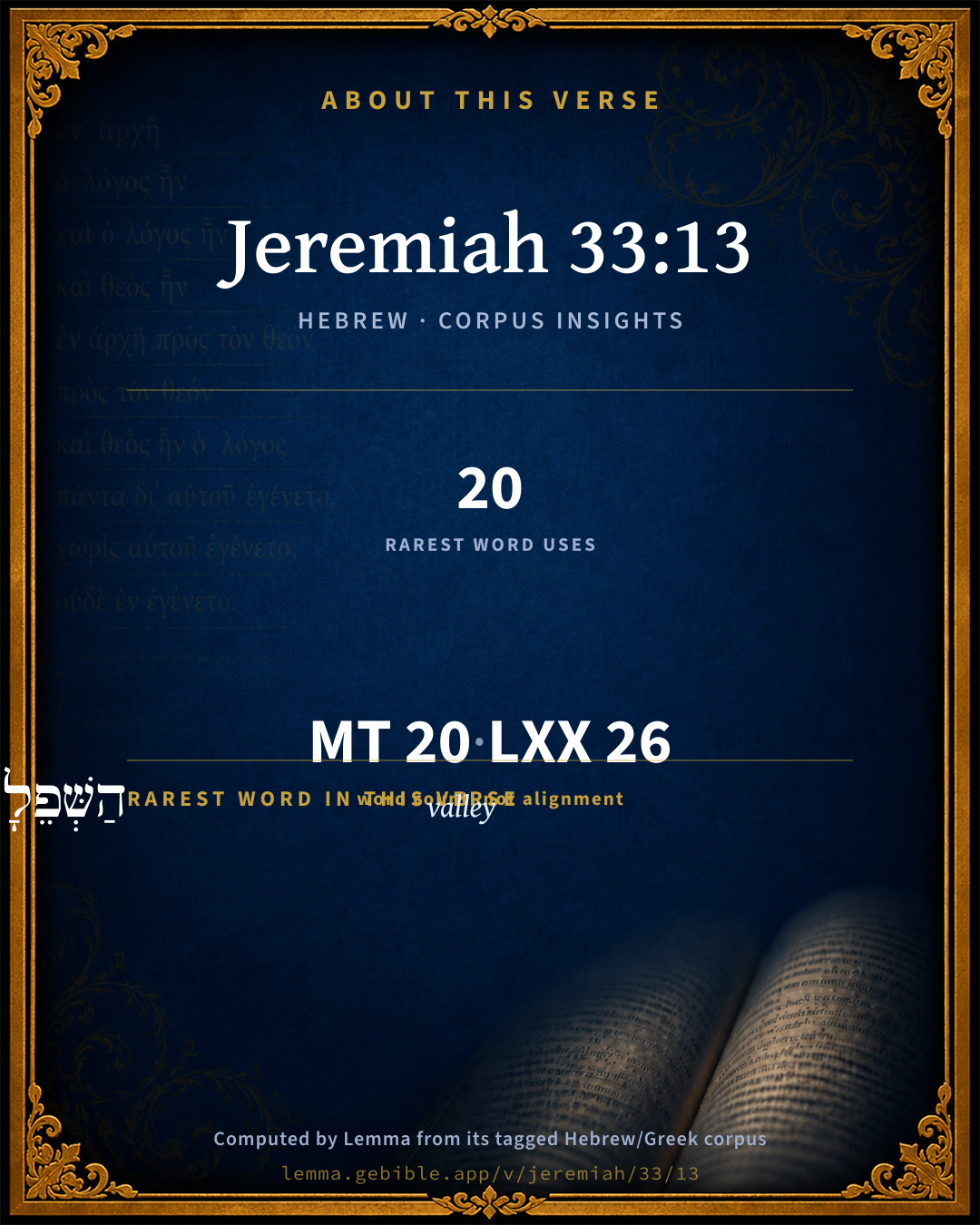
20
words
17
distinct lemmas
Prophets
section

Notable vocabulary

The rarest word here is הַשְּׁפֵלָה֙ valley H8219 — appearing just 20 times in the whole Hebrew Bible.

Shared distinctive vocabulary

הַשְּׁפֵלָה֙ valley H8219 occurs in 19 verses of the Hebrew Bible. Also found in:

Grammatical profile

  • 3 verbs
  • 15 nouns
  • 1 preposition
  • 1 adverb

Verb forms

  • תַּעֲבֹ֧רְנָה Qal · Imperfect
  • מוֹנֶ֖ה Qal · Participle Active
  • אָמַ֥ר Qal · Perfect

Repetition

A word recurs within this verse — often emphatic in Hebrew:

  • בְּעָרֵ֨י city H5892 ×4

Hebrew & Septuagint length

In the original languages it is 20 Hebrew tokens and 26 Greek tokens — but the two are counted differently (Hebrew bundles its prefixes and suffixes into one token; the Greek is in lemma form), so that isn’t a like-for-like length.

Cross-references

4

Topical passages linked to Jeremiah 33:13 in the Treasury of Scripture Knowledge — connected by theme and wording, ordered by reader-vote popularity; previews shown in the World English Bible.

  • Leviticus 27:32 All the tithe of the herds or the flocks, whatever passes under the rod, the tenth shall be holy to Yahweh.
  • Jeremiah 17:26 They shall come from the cities of Judah, and from the places round about Jerusalem, and from the land of Benjamin, and from the lowland, and from the hill-country, and from the South, bringing burnt offerings, and sacrifices, and meal-offerings, and frankincense, and bringing [sacrifices of] thanksgiving, to the house of Yahweh.
  • Luke 15:4 "Which of you men, if you had one hundred sheep, and lost one of them, wouldn't leave the ninety-nine in the wilderness, and go after the one that was lost, until he found it?
  • John 10:3–4 The gatekeeper opens the gate for him, and the sheep listen to his voice. He calls his own sheep by name, and leads them out.

Cross-references courtesy of OpenBible.info (CC BY 4.0).

Hebrew and Greek witnesses Masoretic Hebrew ↔ Greek Septuagint

The same verse in the two great witnesses to the Old Testament, shown verse-for-verse.

These are two independent witnesses, not word-aligned to each other, and the Septuagint is shown in lemma (dictionary) form.

Hebrew Jeremiah 33:13 Masoretic · Westminster Leningrad Codex

בְּעָרֵ֨י הָהָ֜ר בְּעָרֵ֤י הַשְּׁפֵלָה֙ וּבְעָרֵ֣י הַנֶּ֔גֶב וּבְאֶ֧רֶץ בִּנְיָמִ֛ן וּבִסְבִיבֵ֥י יְרוּשָׁלִַ֖ם וּבְעָרֵ֣י יְהוּדָ֑ה עֹ֣ד תַּעֲבֹ֧רְנָה הַצֹּ֛אן עַל יְדֵ֥י מוֹנֶ֖ה אָמַ֥ר יְהוָֽה

In the cities of the hill-country, in the cities of the lowland, and in the cities of the South, and in the land of Benjamin, and in the places about Jerusalem, and in the cities of Judah, shall the flocks again pass under the hands of him who numbers them, says Yahweh.

World English Bible · Public Domain

Greek LXX Structure differs

In the Septuagint, Jeremiah is about an eighth shorter than the Hebrew and arranges its material differently — the Oracles Against the Nations (Hebrew chapters 46–51) appear in the middle of the Greek book, after 25:13. Because the chapter and verse boundaries do not line up, a verse-for-verse comparison with the Hebrew is not shown.

A verse-for-verse comparison isn’t shown here because the chapters and verses don’t line up. Switch to the LXX edition with the MT / LXX toggle above to read the Greek directly.

Hebrew: Westminster Leningrad Codex (CC BY 4.0). Greek: Septuagint (public domain); English from a public-domain English Septuagint. How the Septuagint differs from the Hebrew →

Targum (Aramaic paraphrase)

1

The Targum is the ancient Jewish Aramaic paraphrase of the Hebrew Scriptures — an interpretive translation, not the Hebrew text itself. Onkelos (literal) and Pseudo-Jonathan (expansive) render the Torah, and Jonathan the Prophets. Coverage is partial: where no permissively-licensed English translation exists for a verse, only the Aramaic is shown. This is verse-level text, not a word-by-word alignment to the Hebrew.

  1. Targum Jonathan Prophets (Joshua–Malachi)
    בְּקִרְוֵי טוּרָא בְּקִרְוֵי שְׁפֶלְתָּא וּבְקִרְוֵי דָרוֹמָא וּבְאֲרַע שְׁבַט בִּנְיָמִן וּבְסַחְרָנֵי יְרוּשְׁלֵם וּבְקִרְוַיָא דְבֵית יְהוּדָה עוֹד יִתְנֵהּ עַמָא עַל יְדֵי מְשִׁיחָא אֲמַר יְיָ:

    (no public-domain English translation for this verse)

    Targum Jonathan — Aramaic: “Mikraot Gedolot” (public domain). English: “Sefaria Community Translation” (CC0 1.0 (public-domain dedication)); “London "Chaldee Paraphrase," 1871” (public domain). Text via Sefaria.

Commentary

Notes on Jeremiah 33:13 from classic Christian and Jewish commentators (each source and its license shown beneath its notes). The classic Christian expositions comment on the surrounding passage and are grouped to its opening verse, so a note may address several verses; the Jewish commentaries on the Tanakh (Rashi and others) are per-verse, so they appear only where the commentator wrote on this verse.

Lemma curates 59 commentaries, every one of them public domain or Creative Commons licensed, each selected and text-cleaned for this edition rather than reprinted as found. About our sources →

Trapp's Complete Commentary

John Trapp

Jer 33:13 In the cities of the mountains, in the cities of the vale, and in the cities of the south, and in the land of Benjamin, and in the places about Jerusalem, and in the cities of Judah, shall the flocks pass again under the hands of him that telleth [them], saith the LORD.

Ver. 13. Shall the flocks pass again under the hand of him that telleth them.] As shepherds used oft to tell their sheep. Christ the great Shepherd and Bishop of souls knoweth all his sheep, and calleth them by name; he hath them ever in numerato, for he numbereth the stars also. See Joh 10:3; Joh 10:11-12.

John Trapp, A Commentary or Exposition upon All the Books of the Old and New Testament (1647–1656) — public domain. Text from a community e-Sword module.

Geneva Bible (1599)

Geneva Bible translators

Meaning, that all the country of Judah shall be inhabited again.

Geneva Bible (1599) marginal notes — public domain. Text via Bolls.life.

Jamieson, Fausset & Brown

Robert Jamieson, A. R. Fausset & David Brown

pass . . . under . . . hands of him that telleth them--Shepherds, in sending forth and bringing back their sheep to the folds, count them by striking each as it passes with a rod, implying the shepherd's provident care that not one should be lost (Lev 27:32; Mic 7:14; compare Joh 10:28-29; Joh 17:12).

Jamieson, Fausset & Brown — Commentary Critical and Explanatory on the Whole Bible (1871) — public domain (CC PDM 1.0). Text via the HelloAO Bible API.

John Calvin's Commentaries

And in the next verse Jeremiah confirms the same thing, where he mentions, as before, the cities of the mountains, and the cities of the plains, and then the cities of the south, and adds also the land of Benjamin, which was a different part of the country, and he mentions generally the circuits of Jerusalem and the cities of Judah What then? The flocks, he says, shall pass under the hands of a numberer Here, again, is set forth a greater security, because shepherds would not, as it were, by stealth lead forth their sheep, and afterwards gather them in a hurry, as it is usually done, when there is any fear of danger. The sheep, he says, shall pass under the hands of a numberer This could not be the case but in time of perfect peace and quietness; for where there is fear, the shepherds can hardly dare send forth their flocks, and then they dare not number them, but shut them in; and they are also often compelled to drive their flocks into forests and desert places, in order to conceal them. When, therefore, Jeremiah mentions the numbering of them, he intimates that the whole country would be in a state of peace, as in other words, and without a figure, he presently will tell us. But the Prophet in this way exalted the benefits of God, and at the same time strengthened the minds of the weak, for as it has been said, this favor could have hardly been tasted by the Jews while in a state so despairing. The Prophet then made use of a homely and ordinary style when he spoke of flocks and herds. It now follows —

John Calvin's Commentaries (1540-1563) — public domain. Text from the Calvin Translation Society English edition (1840s-50s) via the Christian Classics Ethereal Library (ccel.org). Calvin's coverage is partial (roughly two-thirds of the Bible); uncommented books and verses are honest gaps, never fabricated. The 19th-century editor's footnotes and remarks are omitted so the notes are faithfully Calvin's own voice.

The Cambridge Bible for Schools and Colleges

gen. ed. J. J. S. Perowne

13. him that telleth] For “tell” in the sense (now archaic) of count cp. Gen_15:5; Psa_22:17; Psa_48:12.

“While one with moderate haste might tell a hundred.”

Hamlet, Jer_1:2.

The cognate substantive is preserved to us in the title of the “tellers” who report the result of a division in the House of Commons. For tale in the Bible in the sense of number see Exo_5:8; Exo_5:18; 1Sa_18:27; 1Ch_9:28.—Bible Word Book.

The Cambridge Bible for Schools and Colleges (gen. ed. J. J. S. Perowne; Cambridge University Press, 1878–1918) — public domain. Text from a community e-Sword module.

John Gill's Exposition

In the cities of the mountains, in the cities of the vale,

and in the cities of the south,.... Into which three parts the land of Judea was divided; See Gill on Jer 32:44;

and in the land of Benjamin, and in the places about Jerusalem, and in the cities of Judah; in the cities of the two tribes, of which Jerusalem was the metropolis; and which returned from the captivity, and settled here, and were in being when the Messiah came, here prophesied of, the great Shepherd of the sheep:

shall the flocks pass again under the hands of him that telleth them, saith the Lord; alluding to the custom of shepherds telling their flocks, when they led them out of the fold in the morning, and when they put them in at evening (s); or to the tithing of them, Lev 27:32; this is not to be understood literally, but mystically. So Jarchi, Kimchi, and Abarbinel interpret it of the Israelites going in and out under the hands of their king, that goes at the head of them; and the Targum, of the King Messiah, and who is no doubt meant. The elect of God, who are intended by the "flocks", were in eternal election considered as sheep, and by that act of grace were distinguished from others; and so when an exact account was taken of them, their names were written in heaven, and in the Lamb's book of life; and had this seal and mark put upon them, "the Lord knows them that are his", Ti2 2:19; also in the gift of them to Christ; in the covenant of grace, when they were brought into the bond of that covenant, they were likewise considered as sheep, distinct from others; and were told into the hands of Christ, where they are kept, and who has a most perfect knowledge of them; and in the effectual calling they will again pass under his hands; they are then as sheep that had gone astray, returned to the Shepherd and Bishop of their souls; and when they are separated from others, and special knowledge is taken of them, and Christ's mark, the sanctification of the Spirit, is put upon them; and at the last day, when Christ shall deliver them up to the Father, he will say, lo, I and the children, or sheep, whom thou hast given me; and they will all be numbered, and not one will be wanting.

(s) "Bisque die numerant, alter pecus, alter et haedos". Virgil.

John Gill's Exposition of the Whole Bible (1746–1763) — public domain (CC PDM 1.0). Text via the HelloAO Bible API.

Albert Barnes' Notes on the Bible

Telleth - i. e., counts the number of his sheep.

Albert Barnes' Notes on the Bible (1834–1885) — public domain. Text from a community e-Sword/MySword module.

Haydock's Catholic Bible Commentary

Mountains. Chap. xxxii. 44. --- Numbereth them, they come into the fold. (Calmet) --- Chaldean, "my people shall be instructed, and formed by the hand of the Messias." Grabe supplies what follows to the end of the chapter. (Haydock)

George Leo Haydock (1774–1849), Haydock's Catholic Family Bible and Commentary, 1859 edition — public domain. Excludes Psalms (Douay-Rheims chapter numbering differs from Protestant) and Deuterocanonical books (Catholic canon only).

Matthew Poole's English Annotations

So as to keep tale of them, as it is said they were wont to do both morning and evening in those countries.

Matthew Poole's English Annotations on the Holy Bible (1683–1685) — public domain. Text from a community e-Sword/MySword module.

Whedon's Commentary on the Bible

Daniel D. Whedon

13. Under the hands of him that telleth them — That is, who counts the sheep as they are put out to pasture, and again as they are brought back to the fold.

Daniel D. Whedon (gen. ed.), Commentary on the Old and New Testaments (1874–1909) — public domain. Text from a community e-Sword module.

The Pulpit Commentary

In the cities, etc. A parallel description to Jer_17:26 Jer_32:44. The vale; rather, the lowland (about the Mediterranean, on the south). The south. It is the Negeb, or south country, which is meant. Under the hands; rather, at the beck. Of him that telleth them. Comp. Milton, "L"AllegroAnd every shepherd tolls his tale Under the hawthorn in the dale. Virgil, "Eel.," 3:34 die numerant ambo pecus, alter et haedos."

The Pulpit Commentary (1880–1919), ed. H.D.M. Spence-Jones & Joseph S. Exell — public domain. Text from a community e-Sword module.

John Wesley's Explanatory Notes

Shall pass - So as to keep tally of them, as they were wont to do both morning and evening in those countries.

John Wesley, Explanatory Notes Upon the Whole Bible (1754–1765) — public domain. Text via the GEBible commentary corpus.

Rashi

Rabbi Shlomo Yitzchaki (Rashi)

flocks shall again pass, etc. Israel will come and go under the hands of a king who walks at their head.

Rashi on the Tanakh — English translations: “The Judaica Press complete Tanach with Rashi, translated by A. J. Rosenberg” (CC BY 4.0); “Pentateuch with Rashi's commentary by M. Rosenbaum and A.M. Silbermann, 1929-1934” (public domain); “The Metsudah Tanach series, Lakewood, N.J” (CC BY 4.0); and “The Book of Joshua, Metsudah Publications, 1997” (CC BY 4.0). Text via Sefaria.

Lesson kit

Teaching starters — assembled from the data on this page, not authored interpretation. Every prompt links to the verse data it draws on. Edit before teaching.

Jeremiah, in the Prophets, opens this verse with 20 words (17 distinct Hebrew lemmas). Its most distinctive word is shᵉphêlâh (“valley”). A historical commentator’s framing appears above. Read the whole chapter for the surrounding context.

Discussion questions

  1. How does “valley” (shᵉphêlâh) shape what this verse is saying?
  2. How does Deuteronomy 1:7, which shares the word «valley», read alongside this verse?
  3. What does the repetition of “city” (4× in this one verse) do in this verse?
  4. The translations on this page render this verse differently — a whole-verse word diff, not a word-by-word alignment. What might account for the different wordings?
  5. «תַּעֲבֹ֧רְנָה» is a Qal Imperfect verb. How does that grammatical form shape the action described?
  6. Compare how Trapp's Complete Commentary and Geneva Bible (1599) read this verse. Where do they agree or differ?

Things to notice

Reading settings

Reading text

Shown beneath each verse's original-language words.

Old Testament
Old Testament edition

Read the OT as the Masoretic Hebrew (MT) or the Greek Septuagint (LXX).

English shown for the Greek Septuagint (in the Hebrew ↔ Greek comparison).

Comparing translations? Open the Compare panel on any verse page to stack up to four side by side.