2 Samuel 24:6

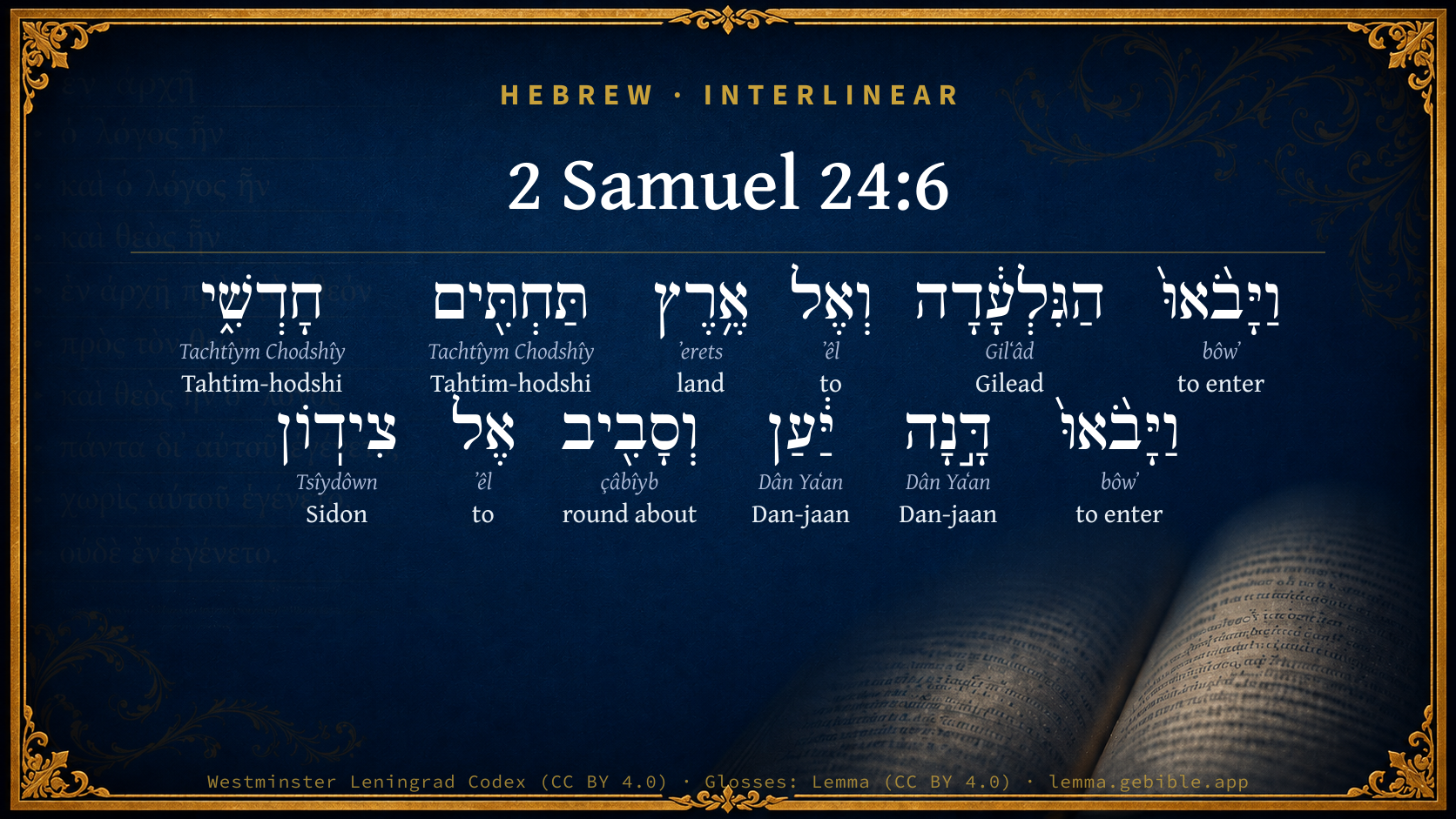
Hebrew (Westminster Leningrad Codex) 2 Samuel 24:6 appears in the Hebrew Old Testament. The text above is from the Westminster Leningrad Codex. Each word links to its Strong’s number, a concise gloss, and parsing drawn from the Open Scriptures Hebrew Bible morphology. Click any word for its full Brown-Driver-Briggs (BDB) entry.
Download image
Cite this verse

2 Samuel 24:6 (World English Bible). Public Domain. Lemma interlinear Bible study tool, https://lemma.gebible.app/v/2-samuel/24/6.

Show BibTeX & RIS
BibTeX
RIS
English Translation
then they came to Gilead, and to the land of Tahtim Hodshi; and they came to Dan Jaan, and round about to Sidon,
World English Bible · Public Domain
Highlights
  • 2 first appearances in the Hebrew Bible
Full analysis ↓
Download a study sheet

One document with this verse’s original text, its word-by-word gloss line, the meaning frame, cross-references with their text, attributed commentary, and full source and license credits — printable, and it pastes into notes with its structure intact.

This verse Autodidact and up

Study sheet (.html) Plain text (.txt)

A passage Seminary Student

Up to 50 verses in one chapter. A passage sheet keeps up to 6 commentary sources and 12 cross-references per verse, in the order this page ranks them, and says so on the sheet whenever that leaves anything out. Ask for a single verse and you get the Autodidact verse sheet above.

Everything on this page stays free to read, with no account — the sheet is a download of what is already on screen, not access to it.

Want to remove ads? Support Godless Engineer
Compare translations 3

The same verse in 3 English versions, stacked beneath the original-language interlinear above. Click any original word for its lexicon entry.

Each is an independent rendering of the whole verse — the interlinear is not word-aligned to these translations.

Highlighted words mark where these versions differ — a whole-verse word diff, not a word-by-word alignment.

  • World English Bible Public Domain
    then they came to Gilead, and to the land of Tahtim Hodshi; and they came to Dan Jaan, and round about to Sidon,
  • King James Version Public Domain
    Then they came to Gilead, and to the land of Tahtimhodshi; and they came to Danjaan, and about to Zidon,
  • unfoldingWord Literal Text CC BY-SA 4.0
    And they came to Gilead and to the land of Tahtim Hodshi. And they came to Dan Jaan, and around to Sidon.

unfoldingWord Literal Text — © unfoldingWord, licensed CC BY-SA 4.0. Word-aligned USFM3 via Door43 (git.door43.org/unfoldingWord/en_ult).

Versions to compare (up to 4)

3 of 4 selected

Show all 18 translations

Every available English version of this verse, each an independent rendering of the whole verse.

  • World English Bible Public Domain
    then they came to Gilead, and to the land of Tahtim Hodshi; and they came to Dan Jaan, and round about to Sidon,
  • Berean Standard Bible Public Domain
    Then they went to Gilead and the land of Tahtim-hodshi, and on to Dan-jaan and around to Sidon.
  • Majority Standard Bible Public Domain
    Then they went to Gilead and the land of Tahtim-hodshi, and on to Dan-jaan and around to Sidon.
  • King James Version Public Domain
    Then they came to Gilead, and to the land of Tahtimhodshi; and they came to Danjaan, and about to Zidon,
  • American Standard Version (1901) Public Domain
    then they came to Gilead, and to the land of Tahtim-hodshi; and they came to Dan-jaan, and round about to Sidon,
  • Revised Version (1885) Public Domain
    then they came to Gilead, and to the land of Tahtim-hodshi; and they came to Dan-jaan, and round about to Zidon,
  • Geneva Bible (1599) Public Domain
    Then they came to Gilead, and to Tahtim-hodshi, so they came to Dan Iaan, and so about to Zidon,
  • Douay-Rheims (1899) Public Domain
    And by Jazer they passed into Galaad, and to the lower land of Hodsi, and they came into the woodlands of Dan. And going about by Sidon,
  • Young's Literal Translation Public Domain
    and they come in to Gilead, and unto the land of Tahtim-Hodshi, and they come in to Dan-Jaan, and round about unto Zidon,
  • Literal Standard Version CC BY-SA 4.0
    and they come to Gilead, and to the land of Tahtim-Hodshi, and they come to Dan-Jaan, and around to Sidon,
  • Unlocked Literal Bible CC BY-SA 4.0
    They came to Gilead and to the land of Tahtim Hodshi, then on to Dan Jaan and around toward Sidon.
  • unfoldingWord Literal Text CC BY-SA 4.0
    And they came to Gilead and to the land of Tahtim Hodshi. And they came to Dan Jaan, and around to Sidon.
  • Darby Bible Public Domain
    And they came to Gilead, and to the land of Tahtim-hodshi; and came to Dan-jaan, and to the environs of Sidon;
  • World Messianic Bible Public Domain
    then they came to Gilead and to the land of Tahtim Hodshi; and they came to Dan Jaan and around to Sidon,
  • Webster's Bible Public Domain
    Then they came to Gilead, and to the land of Tahtim-hodshi; and they came to Dan-jaan, and about to Zidon,
  • Free Bible Version CC BY-SA 4.0
    Then they went on to Gilead, and to the land of Tahtim-hodshi; then continued towards Dan, and from Dan around to Sidon.
  • Bible in Basic English Public Domain
    Then they came to Gilead, and to the land of the Hittites under Hermon; and they came to Dan, and from Dan they came round to Zidon,
  • JPS Tanakh (1917) Public Domain
    then they came to Gilead, and to the land of Tahtim-hodshi; and they came to Dan-jaan, and round about to Zidon,

Literal Standard Version (2020), Covenant Press — licensed CC BY-SA 4.0. Text via the HelloAO Bible API (eBible.org). Unlocked Literal Bible (unfoldingWord) — licensed CC BY-SA 4.0. Text via the HelloAO Bible API (eBible.org). unfoldingWord Literal Text — © unfoldingWord, licensed CC BY-SA 4.0. Word-aligned USFM3 via Door43 (git.door43.org/unfoldingWord/en_ult). Free Bible Version, Dr. Jonathan Gallagher — licensed CC BY-SA 4.0. Text via the HelloAO Bible API (eBible.org).

Word by word

More ways to search: Search by grammar → Find every occurrence → Compare this word →

Practice this passage: Drill this verse → Learn its vocabulary →

תַּחְתִּ֖ים
Tachtîym Chodshîy
H8483
“Tahtim-hodshi”
Noun, Proper
Part of Speech
Noun
Type
Proper
Full BDB Definition

Origin: apparently from the pl. masc. of H8482 or H8478 and H2320

TWOT: None

Tahtim-hodshi = "lowest-moon" - a place near Gilead on the east of the Jordan
  1. וַיָּבֹ֨אוּ֙ bôwʼ H935 “and · to enter” Conjunction + Verb, Qal, Sequential Imperfect, 3rd Person, Masculine, Plural
  2. הַגִּלְעָ֔דָה Gilʻâd H1568 “the · Gilead · toward” Particle, Definite Article + Noun, Proper + Suffix, Demonstrative
  3. וְאֶל ʼêl H413 “and · to” Conjunction + Preposition
  4. אֶ֥רֶץ ʼerets H776 “land of” Noun, Common, Both, Singular, Construct
  5. חָדְשִׁ֑י Tachtîym Chodshîy H8483 “Tahtim-hodshi” Noun, Proper
  6. וַיָּבֹ֨אוּ֙ bôwʼ H935 “and · to enter” Conjunction + Verb, Qal, Sequential Imperfect, 3rd Person, Masculine, Plural
  7. דָּ֣נָה Dân Yaʻan H1842 “Dan-jaan · toward” Noun, Proper + Suffix, Demonstrative
  8. יַּ֔עַן Dân Yaʻan H1842 “Dan-jaan” Noun, Proper
  9. וְסָבִ֖יב çâbîyb H5439 “and · round about” Conjunction + Noun, Common, Both, Singular, Absolute
  10. אֶל ʼêl H413 “to” Preposition
  11. צִידֽוֹן Tsîydôwn H6721 “Sidon” Noun, Proper

About this verse

These counts appear in no published source. They are computed here, from the morphology-tagged text and Lemma’s own curated glosses. What Lemma adds →

12
words
8
distinct lemmas
Historical
section

Notable vocabulary

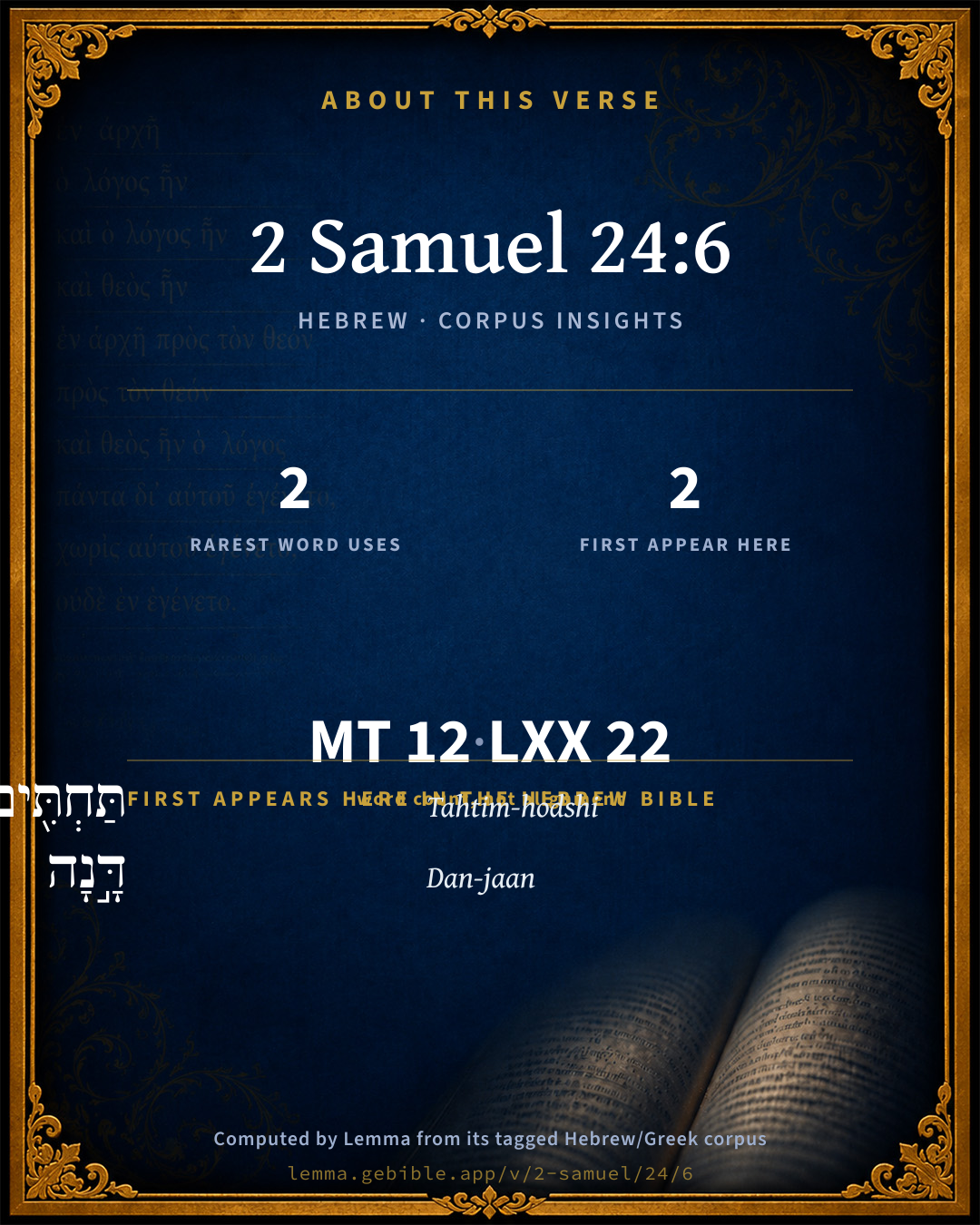
The rarest word here is תַּחְתִּ֖ים Tahtim-hodshi H8483 — appearing just 2 times in the whole Hebrew Bible.

First appearance in Scripture

These words make their first canonical appearance in the Hebrew Bible here:

  • תַּחְתִּ֖ים Tahtim-hodshi H8483
  • דָּ֣נָה Dan-jaan H1842

Grammatical profile

  • 2 verbs
  • 8 nouns
  • 2 prepositions

Verb forms

  • וַיָּבֹ֨אוּ֙ Qal · Sequential Imperfect
  • וַיָּבֹ֨אוּ֙ Qal · Sequential Imperfect

Repetition

Words recur within this verse — often emphatic in Hebrew:

  • וַיָּבֹ֨אוּ֙ to enter H935 ×2
  • תַּחְתִּ֖ים Tahtim-hodshi H8483 ×2
  • דָּ֣נָה Dan-jaan H1842 ×2
  • וְאֶל to H413 ×2

Hebrew & Septuagint length

In English translation the verse runs 23 words from the Hebrew and 24 from the Septuagint (LXX English) — closely comparable.

A rough comparison of the two English renderings, which tokenize alike — not a word-level alignment.

Word counts can differ between the Hebrew and the Greek without any difference in meaning — e.g. the Hebrew direct-object marker אֵת has no separate Greek word, and Greek often adds the article ὁ.

In the original languages it is 12 Hebrew tokens and 22 Greek tokens — but the two are counted differently (Hebrew bundles its prefixes and suffixes into one token; the Greek is in lemma form), so that isn’t a like-for-like length.

Cross-references

10

Topical passages linked to 2 Samuel 24:6 in the Treasury of Scripture Knowledge — connected by theme and wording, ordered by reader-vote popularity; previews shown in the World English Bible.

  • Joshua 19:28 and Ebron, and Rehob, and Hammon, and Kanah, even to great Sidon;
  • Genesis 10:15 Canaan became the father of Sidon (his firstborn), Heth,
  • Genesis 31:21 So he fled with all that he had. He rose up, passed over the River, and set his face toward the mountain of Gilead.
  • Genesis 31:47–48 Laban called it Jegar Sahadutha, but Jacob called it Galeed.
  • Numbers 32:1 Now the children of Reuben and the children of Gad had a very great multitude of cattle: and when they saw the land of Jazer, and the land of Gilead, that behold, the place was a place for cattle;
  • Numbers 32:39 The children of Machir the son of Manasseh went to Gilead, and took it, and dispossessed the Amorites who were therein.
  • Joshua 11:8 Yahweh delivered them into the hand of Israel, and they struck them, and chased them to great Sidon, and to Misrephoth Maim, and to the valley of Mizpeh eastward; and they struck them, until they left them none remaining.
  • Joshua 19:47 The border of the children of Dan went out beyond them; for the children of Dan went up and fought against Leshem, and took it, and struck it with the edge of the sword, and possessed it, and lived therein, and called Leshem, Dan, after the name of Dan their father.
  • Judges 1:31 Asher didn't drive out the inhabitants of Acco, nor the inhabitants of Sidon, nor of Ahlab, nor of Achzib, nor of Helbah, nor of Aphik, nor of Rehob;
  • Judges 18:28–29 There was no deliverer, because it was far from Sidon, and they had no dealings with any man; and it was in the valley that lies by Beth Rehob. They built the city, and lived therein.

Cross-references courtesy of OpenBible.info (CC BY 4.0).

Hebrew and Greek witnesses Masoretic Hebrew ↔ Greek Septuagint

The same verse in the two great witnesses to the Old Testament, shown verse-for-verse.

These are two independent witnesses, not word-aligned to each other, and the Septuagint is shown in lemma (dictionary) form.

Hebrew 2 Samuel 24:6 Masoretic · Westminster Leningrad Codex

וַיָּבֹ֨אוּ֙ הַגִּלְעָ֔דָה וְאֶל אֶ֥רֶץ תַּחְתִּ֖ים חָדְשִׁ֑י וַיָּבֹ֨אוּ֙ דָּ֣נָה יַּ֔עַן וְסָבִ֖יב אֶל צִידֽוֹן

then they came to Gilead, and to the land of Tahtim Hodshi; and they came to Dan Jaan, and round about to Sidon,

World English Bible · Public Domain

Greek LXX 2 Samuel 24:6 Septuagint · lemma form

καί ἔρχομαι εἰς ὁ γαλαάδ καί εἰς γῆ θαβασων ὅς εἰμί αδασαι καί παραγίγνομαι εἰς δανιδαν καί ουδαν καί κυκλόω εἰς σιδών

And they came to Galaad, and into the land of Thabason, which is Adasai, and they came to Danidan and Udan, and compassed Sidon.

LXX2012 (modern English Septuagint) · Public Domain

On this verse, Ellicott's Commentary for English Readers discusses the Septuagint’s reading. Read the note in Commentary ↓

Hebrew: Westminster Leningrad Codex (CC BY 4.0). Greek: Septuagint (public domain); English from LXX2012 (modern English Septuagint) (Public Domain). How the Septuagint differs from the Hebrew →

Targum (Aramaic paraphrase)

1

The Targum is the ancient Jewish Aramaic paraphrase of the Hebrew Scriptures — an interpretive translation, not the Hebrew text itself. Onkelos (literal) and Pseudo-Jonathan (expansive) render the Torah, and Jonathan the Prophets. Coverage is partial: where no permissively-licensed English translation exists for a verse, only the Aramaic is shown. This is verse-level text, not a word-by-word alignment to the Hebrew.

  1. Targum Jonathan Prophets (Joshua–Malachi)
    וַאֲתוֹ לְגִלְעָד וּלְאַרְעָא דָרוֹמָא לְחָדְשִׁי וַאֲתוֹ לְדָן יַעַן וּמִתַּמָן אִסְתְּחַר לְצִידוֹן:

    (no public-domain English translation for this verse)

    Targum Jonathan — Aramaic: “Mikraot Gedolot” (public domain). English: “Sefaria Community Translation” (CC0 1.0 (public-domain dedication)); “London "Chaldee Paraphrase," 1871” (public domain). Text via Sefaria.

Commentary

Notes on 2 Samuel 24:6 from classic Christian and Jewish commentators (each source and its license shown beneath its notes). The classic Christian expositions comment on the surrounding passage and are grouped to its opening verse, so a note may address several verses; the Jewish commentaries on the Tanakh (Rashi and others) are per-verse, so they appear only where the commentator wrote on this verse.

Lemma curates 59 commentaries, every one of them public domain or Creative Commons licensed, each selected and text-cleaned for this edition rather than reprinted as found. About our sources →

Trapp's Complete Commentary

John Trapp

2Sa 24:6 Then they came to Gilead, and to the land of Tahtimhodshi; and they came to Danjaan, and about to Zidon,

Ver. 6. To the land of Tahtimhodshi.] In terram inferiorem recens comparatam, into the lower lands recently conquered; sc., in the days of Saul, {1Ch 5:10} so Junius rendereth, and senseth it.

John Trapp, A Commentary or Exposition upon All the Books of the Old and New Testament (1647–1656) — public domain. Text from a community e-Sword module.

Geneva Bible (1599)

Geneva Bible translators

Or, to the nether land newly inhabited.

Geneva Bible (1599) marginal notes — public domain. Text via Bolls.life.

Jamieson, Fausset & Brown

Robert Jamieson, A. R. Fausset & David Brown

the land of Tahtim-hodshi--that is, the land lately acquired; namely, that of the Hagarites conquered by Saul (Ch1 5:10). The progress was northward. Thence they crossed the country, and, proceeding along the western coast to the southern extremities of the country, they at length arrived in Jerusalem, having completed the enumeration of the whole kingdom in the space of nine months and twenty days.

Jamieson, Fausset & Brown — Commentary Critical and Explanatory on the Whole Bible (1871) — public domain (CC PDM 1.0). Text via the HelloAO Bible API.

Adam Clarke's Commentary

Verse 6. Tahtim-hodshi] Where this place was is not exactly known: some think that the words refer to a newly conquered country, as our margin, the nether land newly inhabited; and if so, this was probably the country eastward of Gilead, which the Israelites, in the time of Saul, had conquered from the Hagarites, and dwelt in themselves. See 1Ch 5:10, where this transaction is recorded.

To Dan-jaan] Or, to Dan of the woods. This is the place so frequently mentioned, situated at the foot of Mount Libanus, near to the source of the Jordan, the most northern city of all the possessions of the Israelites in what was called the promised land, as Beer-sheba was the most southern: hence the common form of speech, From Dan to Beer-sheba, i.e., from north to south.

Adam Clarke's Commentary on the Bible (1810–1826) — public domain. Text from a community e-Sword/MySword module.

Ellicott's Commentary for English Readers

(6) Land of Tahtim-hodshi.—This unknown and strange name, of which the ancient versions make nothing, is generally considered as a corruption. The most probable conjecture is that for “Tahtim” we should read “Hittites” (a change of only a single letter), and that “Hodshi” is the remnant of an expression designating the month of their arrival there.

Dan-jaan.—This is the only place in which the name “Dan” occurs with this addition. It seems certain that the same Dan must be meant as in 2Sa_24:2; 2Sa_24:15; and so the reading of the LXX. (Alex.) and Vulg. may be correct: “Dan-jaar=Dan in the forest.”

Zidon.—This mother city of the Phœnicians was in the tribe of Asher nominally, but was never actually possessed by the Israelites. The same also is true of Tyre. Either the census-takers merely came to the confines of these cities, or, being on friendly terms, actually entered them to enumerate the Israelites living in them.

A Bible Commentary for English Readers, edited by Charles John Ellicott (1878–1897) — public domain. Text from a community e-Sword module.

The Cambridge Bible for Schools and Colleges

gen. ed. J. J. S. Perowne

6. Gilead] The mountainous district partly to the north and partly to the south of the River Jabbok.

the land of Tahtim-hodshi] No such district is known, and the form of the words also makes it probable that the text is corrupt. Some conjecture that we should read (with some MSS. of the Sept.) to the land of the Hittites to Kedesh, the famous Hittite capital on the Orontes, but this seems too far north; others conjecture the regions below mount Hermon; and so forth. All that can be said is that some district, apparently east of the Jordan and north of Gilead, is meant.

Dan-jaan] Perhaps the well known Dan, but if so, it is strange that it should here and nowhere else be distinguished as Dan-jaan. The meaning of jaan is uncertain, and perhaps we should follow the Sept. (A) and Vulg. in reading Dan-jaar, i.e. Dan in the forest.

and about to Zidon] Shaping their course westward to the famous city of Zidon, the extreme north-western limit of the kingdom, on the border of Asher (Jos_19:28), but never occupied by that tribe (Jdg_1:31). Zidon was anciently the most important city of Phoenicia, and hence the Phoenicians are generally called Zidonians in the O. T. (Jos_13:6; Jdg_18:7; 1Ki_5:6); but at this time it was inferior and probably subject to Tyre.

The Cambridge Bible for Schools and Colleges (gen. ed. J. J. S. Perowne; Cambridge University Press, 1878–1918) — public domain. Text from a community e-Sword module.

John Gill's Exposition

Then they came to Gilead,.... The land of Gilead, half of which was given to the tribes of Reuben and Gad, and the other half to the half tribe of Manasseh, Deu 3:12; which tribes were numbered, and the first of all:

and to the land of Tahtimhodshi; or the low lands of a new place; it seems to be a country newly possessed and inhabited; the Targum calls it the southern land of Hodshi; Bunting (w) calls it the lower country of Hodshi, near to the city Corazin, in the half tribe of Manasseh, fifty two miles from Jerusalem, and towards the northeast, and signifies a new land:

and they came to Danjaan; the same that is simply called Dan, and formerly Leshem, Jos 19:47; why Juan is added to it is not easy to say; it lay at the northern border of the land of Israel, and was four miles from Paneas as you go to Tyre (x):

and about to Zidon; from Dan they went round about to Zidon, to the parts adjacent to it; for with Zidon itself they had nothing to do, of which See Gill on Jos 11:8.

(w) Travels, &c. p. 147. (x) Hieron. de loc. Heb. fol. 90. H.

John Gill's Exposition of the Whole Bible (1746–1763) — public domain (CC PDM 1.0). Text via the HelloAO Bible API.

Albert Barnes' Notes on the Bible

To Gilead - Jazer was in the plain. They passed from there to the mountain district of Gilead.

The land of Tahtim-hodshi - The text here is corrupt, as no such land is known. Possibly the right reading is “the land of the Hittites” Jdg 1:26; “hodshi” may be a fragment of a sentence which mentioned in what month חדשׁ chôdesh they arrived there, just as 2Sa 24:8 relates that they returned to Jerusalem at the end of nine “months.”

Dan-jaan - The versions read “Dan-jaar,” i. e., Dan in the wood. Whatever is the meaning of “Jaan,” there can be little doubt that Dan (the ancient Laish) is meant (marginal references), both from its position and importance as the northern boundary of Israel, and from its connection with Zidon.

Albert Barnes' Notes on the Bible (1834–1885) — public domain. Text from a community e-Sword/MySword module.

Haydock's Catholic Bible Commentary

Hodsi. Alexandrian Septuagint, (5) "of Gad and Eliazer, (6) and they came into Galaad, and into the land of Ethaon Adasai, and they went into Dan Jaran." The other editions vary. Hebrew means, "to the land of new subjects," or "lately conquered" (Junius) from the Agarites, (1 Paralipomenon v. 10,) which agrees with this situation. (Calmet; Lyranus) --- The commissioners first took an account of the tribe of Ruben, (Menochius) and then proceeded northward, till they returned from Dan towards the south. (Haydock) --- Woodlands. St. Jerome reads jar, instead of jan. By transposing a letter, ain would signify Dan, "the spring," which feeds the Jordan.

George Leo Haydock (1774–1849), Haydock's Catholic Family Bible and Commentary, 1859 edition — public domain. Excludes Psalms (Douay-Rheims chapter numbering differs from Protestant) and Deuterocanonical books (Catholic canon only).

Matthew Poole's English Annotations

To Gilead; to Mount Gilead, which lay northward from Arnon.

Tahtim-hodshi; a place so called. Or, the lowland lately gained, i. e. not given by Joshua, but taken lately from the Hagarites by Saul; which was near Gilead, 1Ch 5:10.

Dan-jaan, i.e. probably the famous city of Dan, as it is called, Jos 19:47; Jdg 18:7; for this was in the northern border of the land, and in the way from Gilead to Zidon.

About to Zidon, i.e. to the city and territory of Zidon; but not into it, because it was not in the power and possession of the Israelites: and the like is to be thought concerning Tyre, and the cities which the Hivites and Canaanites yet possessed in the neighbourhood of Tyre and Sidon.

Matthew Poole's English Annotations on the Holy Bible (1683–1685) — public domain. Text from a community e-Sword/MySword module.

Whedon's Commentary on the Bible

Daniel D. Whedon

6. Gilead — The mountainous district north of Aroer.

Tahtim-hodshi — Some section of country east or northeast of the sea of Galilee, but now unknown.

Danjaan — The same as Dan, the northern city of Palestine. See note on Gen_14:14.

Zidon — On the seacoast, some thirty miles northwest of Dan.

Daniel D. Whedon (gen. ed.), Commentary on the Old and New Testaments (1874–1909) — public domain. Text from a community e-Sword module.

The Pulpit Commentary

Then they came to Gilead. When the enumerators had finished their labours in Reuben and the region south of Aroer, Joab moved his camp northwards, and pitched in Gilead, on the river Jabbek; and, having completed the counting in this part of the tribe of Gad, would next enter the wild regions of Manasseh. It is probable that the tribal princes and local officers actually numbered the people, and that Joab, with a powerful force, constrained them to obedience often against their will. It was possibly this danger of resistance which made David entrust the business to Joab, instead of employing the Levites. The land of Tahtim-hodshi. Gesenius dismisses this name with the remark that it can scarcely be regarded as genuine. The versions give little help; but Thenius cleverly extracts from the LXX, "unto Bashan, which is Edrei." Others, by a slight change in the Hebrew, read, "the land of the Hittites," and suppose that Hodshi is a corruption of the Hebrew word for "month," so that the whole might have been, "They came to the land of the Hittites in the (third) month." Others, again, suppose that Hodshi is a corruption of the name of the town Kadesh. But the versions would certainly have preserved anything so commonplace as this. When they make mistakes, it is almost invariably in proper names or unusual phrases. The emendation of Thenius is too ingenious to be accepted, but it gives the right sense, namely, that from Gilead and the tribe of Gad the numerators went northward through Bashan and the rest of the half tribe of Manasseh till they came to Dan, the town on the extreme northeast border, and the limit in that direction of the Israelite realm, as Beersheba was its limit on the south. Dan-jaan. Nowhere else is Dan found with this addition, and the Syriac omits it even here. The Vulgate, and Septuagint (Codex Alex.) read Dan-jaar the woodland Dan. Possibly the names of two towns have been run into one, and the original reading was "unto Dan and Ijon". (see 1Ki_15:20) Ijon was on the direct road from Dan to Sidon. Zidon. This was on the extreme northwestern boundary. It did not actually belong to David, but both it and Tyro had apparently placed themselves under his protection, and were bound to render some kind of military service.

The Pulpit Commentary (1880–1919), ed. H.D.M. Spence-Jones & Joseph S. Exell — public domain. Text from a community e-Sword module.

Rashi

Rabbi Shlomo Yitzchaki (Rashi)

And to a land of a new [settlement]. A place where there was a new settlement whose population was small; perhaps in the interim Dovid would reconsider and sent him a messenger to stop.

To Don's portion. To the people of Don.

Ya'an. The name of the place.

Rashi on the Tanakh — English translations: “The Judaica Press complete Tanach with Rashi, translated by A. J. Rosenberg” (CC BY 4.0); “Pentateuch with Rashi's commentary by M. Rosenbaum and A.M. Silbermann, 1929-1934” (public domain); “The Metsudah Tanach series, Lakewood, N.J” (CC BY 4.0); and “The Book of Joshua, Metsudah Publications, 1997” (CC BY 4.0). Text via Sefaria.

Lesson kit

Teaching starters — assembled from the data on this page, not authored interpretation. Every prompt links to the verse data it draws on. Edit before teaching.

2 Samuel, in the Historical, opens this verse with 12 words (8 distinct Hebrew lemmas). Its most distinctive word is Tachtîym Chodshîy (“Tahtim-hodshi”). A historical commentator’s framing appears above. Read the whole chapter for the surrounding context.

Discussion questions

  1. How does “Tahtim-hodshi” (Tachtîym Chodshîy) shape what this verse is saying?
  2. 2 words make their first appearance in Scripture here. What does this debut establish?
  3. How does Joshua 19:28, which shares this passage’s theme, read alongside this verse?
  4. What does the repetition of “to enter” (2× in this one verse) do in this verse?
  5. The translations on this page render this verse differently — a whole-verse word diff, not a word-by-word alignment. What might account for the different wordings?
  6. «וַיָּבֹ֨אוּ֙» is a Qal Sequential Imperfect verb. How does that grammatical form shape the action described?
  7. Compare how Trapp's Complete Commentary and Geneva Bible (1599) read this verse. Where do they agree or differ?

Things to notice

Reading settings

Reading text

Shown beneath each verse's original-language words.

Old Testament
Old Testament edition

Read the OT as the Masoretic Hebrew (MT) or the Greek Septuagint (LXX).

English shown for the Greek Septuagint (in the Hebrew ↔ Greek comparison).

Comparing translations? Open the Compare panel on any verse page to stack up to four side by side.