Joshua 21:42

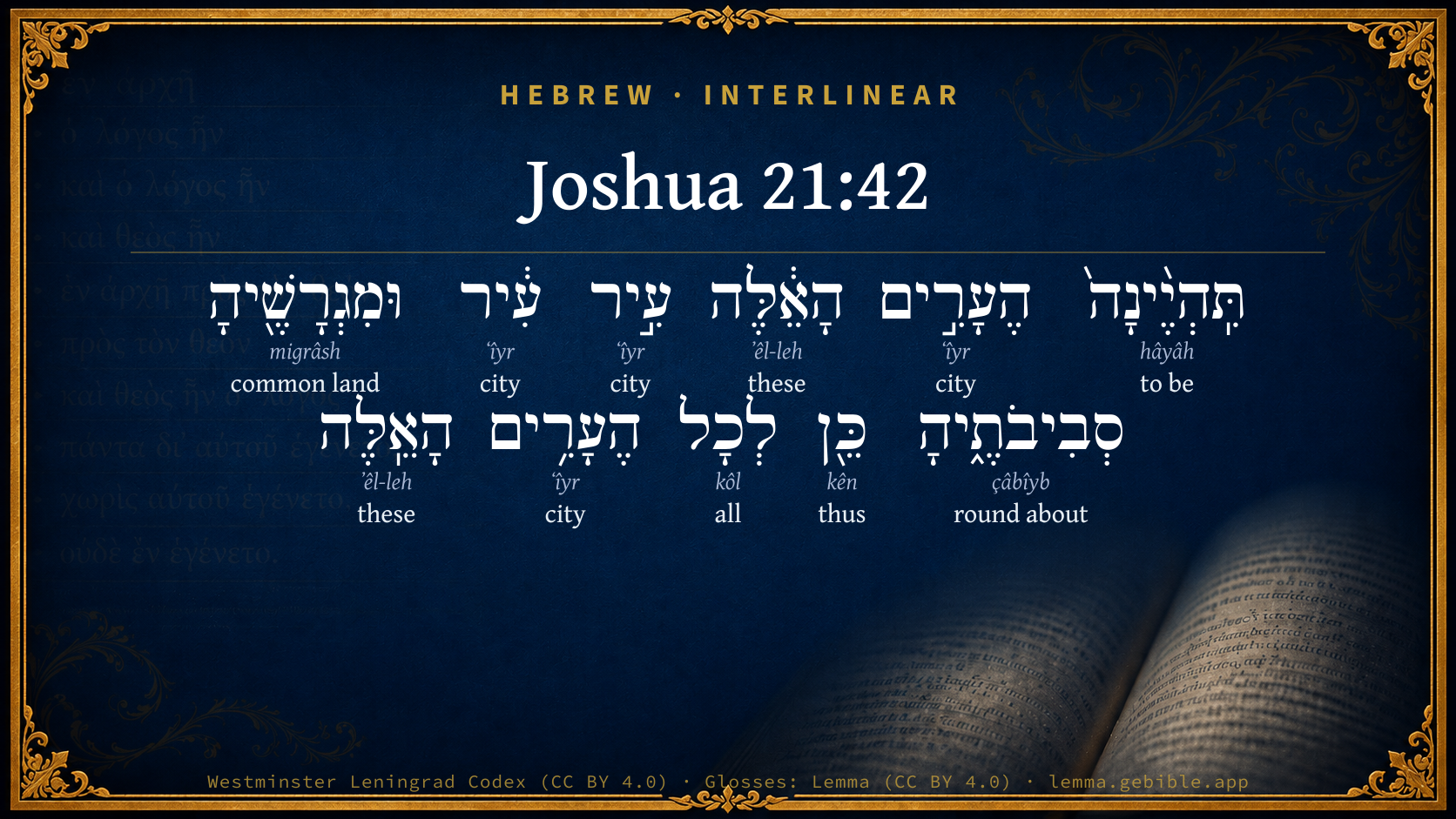
Hebrew (Westminster Leningrad Codex) Joshua 21:42 appears in the Hebrew Old Testament. The text above is from the Westminster Leningrad Codex. Each word links to its Strong’s number, a concise gloss, and parsing drawn from the Open Scriptures Hebrew Bible morphology. Click any word for its full Brown-Driver-Briggs (BDB) entry.
Download image
Cite this verse

Joshua 21:42 (World English Bible). Public Domain. Lemma interlinear Bible study tool, https://lemma.gebible.app/v/joshua/21/42.

Show BibTeX & RIS
BibTeX
RIS
English Translation
These cities were every one with their suburbs round about them: thus it was with all these cities.
World English Bible · Public Domain
Download a study sheet

One document with this verse’s original text, its word-by-word gloss line, the meaning frame, cross-references with their text, attributed commentary, and full source and license credits — printable, and it pastes into notes with its structure intact.

This verse Autodidact and up

Study sheet (.html) Plain text (.txt)

A passage Seminary Student

Up to 50 verses in one chapter. A passage sheet keeps up to 6 commentary sources and 12 cross-references per verse, in the order this page ranks them, and says so on the sheet whenever that leaves anything out. Ask for a single verse and you get the Autodidact verse sheet above.

Everything on this page stays free to read, with no account — the sheet is a download of what is already on screen, not access to it.

Want to remove ads? Support Godless Engineer
Compare translations 3

The same verse in 3 English versions, stacked beneath the original-language interlinear above. Click any original word for its lexicon entry.

Each is an independent rendering of the whole verse — the interlinear is not word-aligned to these translations.

Highlighted words mark where these versions differ — a whole-verse word diff, not a word-by-word alignment.

  • World English Bible Public Domain
    These cities were every one with their suburbs round about them: thus it was with all these cities.
  • King James Version Public Domain
    These cities were every one with their suburbs round about them: thus were all these cities.
  • unfoldingWord Literal Text CC BY-SA 4.0
    These cities were city, city, and its pasturelands around it, thus for all of these cities.

unfoldingWord Literal Text — © unfoldingWord, licensed CC BY-SA 4.0. Word-aligned USFM3 via Door43 (git.door43.org/unfoldingWord/en_ult).

Versions to compare (up to 4)

3 of 4 selected

Show all 18 translations

Every available English version of this verse, each an independent rendering of the whole verse.

  • World English Bible Public Domain
    These cities were every one with their suburbs round about them: thus it was with all these cities.
  • Berean Standard Bible Public Domain
    Each of these cities had its own surrounding pasturelands; this was true for all the cities.
  • Majority Standard Bible Public Domain
    Each of these cities had its own surrounding pasturelands; this was true for all the cities.
  • King James Version Public Domain
    These cities were every one with their suburbs round about them: thus were all these cities.
  • American Standard Version (1901) Public Domain
    These cities were every one with their suburbs round about them: thus it was with all these cities.
  • Revised Version (1885) Public Domain
    These cities were every one with their suburbs round about them: thus it was with all these cities.
  • Geneva Bible (1599) Public Domain
    These cities lay euery one seuerallie with their suburbes round about them: so were all these cities.
  • Douay-Rheims (1899) Public Domain
    And he gave them peace from all nations round about: and none of their enemies durst stand against them, but were brought under their dominion.
  • Young's Literal Translation Public Domain
    These cities are each city and its suburbs round about it; so to all these cities.
  • Literal Standard Version CC BY-SA 4.0
    These cities are each city and its outskirts around it; so to all these cities.
  • Unlocked Literal Bible CC BY-SA 4.0
    These cities each had its surrounding pasturelands. It was this way with all these cities.
  • unfoldingWord Literal Text CC BY-SA 4.0
    These cities were city, city, and its pasturelands around it, thus for all of these cities.
  • Darby Bible Public Domain
    Each one of these cities had its suburbs round about it: thus were all these cities.
  • World Messianic Bible Public Domain
    Each of these cities included their pasture lands around them. It was this way with all these cities.
  • Webster's Bible Public Domain
    These cities were every one with their suburbs around them. Thus were all these cities.
  • Free Bible Version CC BY-SA 4.0
    Each of these towns had pastures around them.
  • Bible in Basic English Public Domain
    Every one of these towns had grass-lands round it.
  • JPS Tanakh (1917) Public Domain
    even these cities, every one with the open land round about it; thus it shall be with all these cities.

Literal Standard Version (2020), Covenant Press — licensed CC BY-SA 4.0. Text via the HelloAO Bible API (eBible.org). Unlocked Literal Bible (unfoldingWord) — licensed CC BY-SA 4.0. Text via the HelloAO Bible API (eBible.org). unfoldingWord Literal Text — © unfoldingWord, licensed CC BY-SA 4.0. Word-aligned USFM3 via Door43 (git.door43.org/unfoldingWord/en_ult). Free Bible Version, Dr. Jonathan Gallagher — licensed CC BY-SA 4.0. Text via the HelloAO Bible API (eBible.org).

Word by word

More ways to search: Search by grammar → Find every occurrence → Compare this word →

Practice this passage: Drill this verse → Learn its vocabulary →

וּמִגְרָשֶׁ֖יהָ
migrâsh
H4054
“and · common lands · her”
Conjunction + Noun, Common, Masculine, Plural, Construct + Suffix, Personal, 3rd Person, Feminine, Singular
Part of Speech
Conjunction + Noun
Type
Common
Gender
Masculine
Number
Plural
State
Construct
Full BDB Definition

Origin: from H1644

TWOT: 388c

common, common land, open land, suburb
  1. תִּֽהְיֶ֨ינָה֙ hâyâh H1961 “to be” Verb, Qal, Imperfect, 3rd Person, Feminine, Plural
  2. הֶעָרִ֣ים ʻîyr H5892 “the · cities” Particle, Definite Article + Noun, Common, Feminine, Plural, Absolute
  3. הָאֵ֔לֶּה ʼêl-leh H428 “the · these” Particle, Definite Article + Pronoun, Demonstrative, Common, Plural
  4. עִ֣יר ʻîyr H5892 “city” Noun, Common, Feminine, Singular, Absolute
  5. עִ֔יר ʻîyr H5892 “city” Noun, Common, Feminine, Singular, Absolute
  6. סְבִיבֹתֶ֑יהָ çâbîyb H5439 “surroundings · her” Noun, Common, Both, Plural, Construct + Suffix, Personal, 3rd Person, Feminine, Singular
  7. כֵּ֖ן kên H3651 “thus” Particle, Demonstrative
  8. לְכָל kôl H3605 “to/for · all of” Preposition + Noun, Common, Masculine, Singular, Construct
  9. הֶעָרִ֥ים ʻîyr H5892 “the · cities” Particle, Definite Article + Noun, Common, Feminine, Plural, Absolute
  10. הָאֵֽלֶּה ʼêl-leh H428 “the · these” Particle, Definite Article + Pronoun, Demonstrative, Common, Plural

About this verse

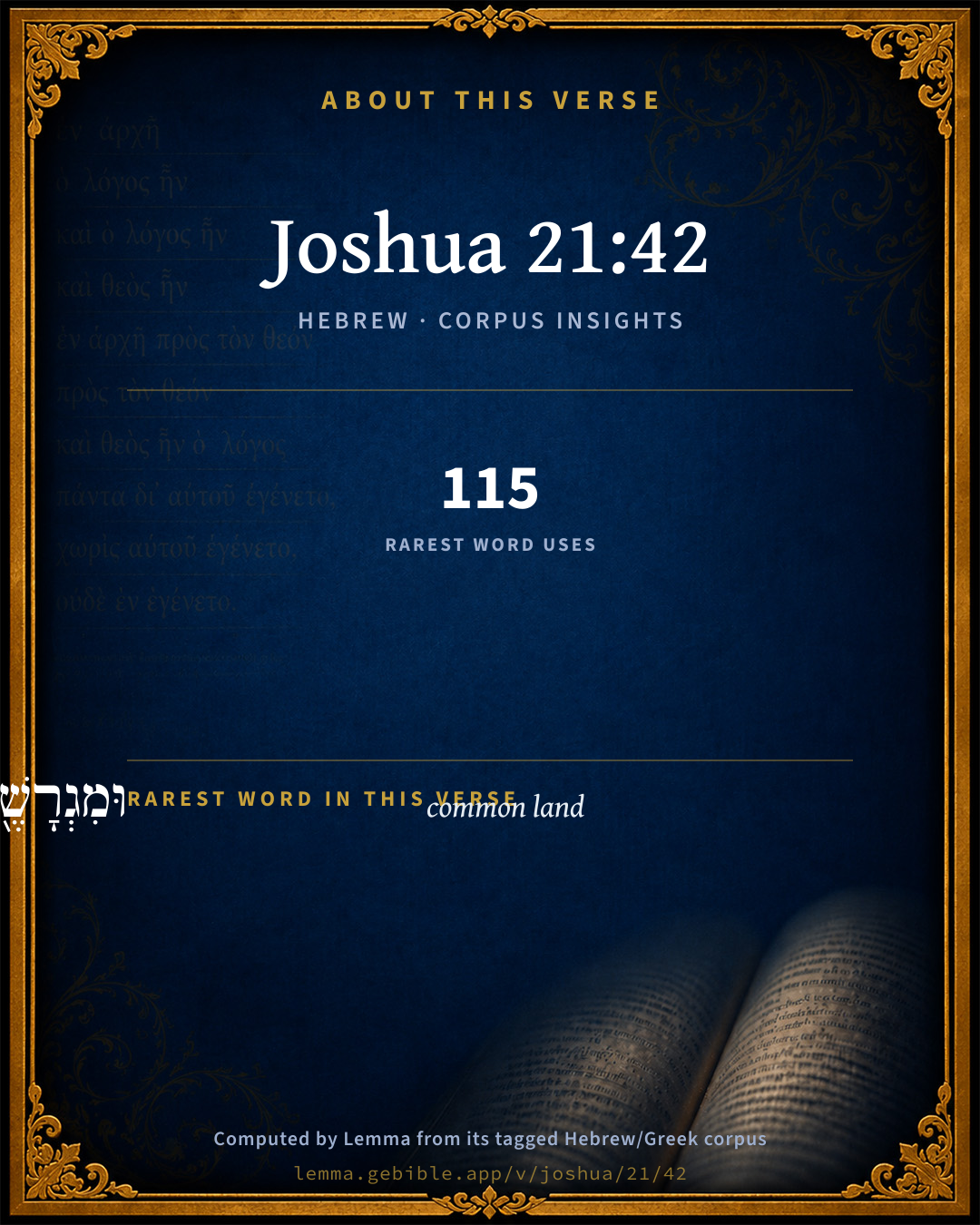
These counts appear in no published source. They are computed here, from the morphology-tagged text and Lemma’s own curated glosses. What Lemma adds →

11
words
7
distinct lemmas
Historical
section

Grammatical profile

  • 1 verb
  • 7 nouns
  • 2 pronouns
  • 1 particle

Verb forms

  • תִּֽהְיֶ֨ינָה֙ Qal · Imperfect

Repetition

Words recur within this verse — often emphatic in Hebrew:

  • הֶעָרִ֣ים city H5892 ×4
  • הָאֵ֔לֶּה these H428 ×2

Hebrew & Septuagint length

In English translation the verse runs 18 words from the Hebrew and 34 from the Septuagint (LXX English) — the Septuagint runs noticeably longer here. See the side-by-side →

A rough comparison of the two English renderings, which tokenize alike — not a word-level alignment.

Word counts can differ between the Hebrew and the Greek without any difference in meaning — e.g. the Hebrew direct-object marker אֵת has no separate Greek word, and Greek often adds the article ὁ.

Hebrew and Greek witnesses Masoretic Hebrew ↔ Greek Septuagint

The same verse in the two great witnesses to the Old Testament, shown verse-for-verse.

Here the Septuagint runs noticeably longer than the Hebrew — LXX2012 (modern English Septuagint) 34 words vs World English Bible 18. A rough length comparison of the two English translations, not a word-level alignment — read both below.

These are two independent witnesses, not word-aligned to each other, and the Septuagint is shown in lemma (dictionary) form.

Hebrew Joshua 21:42 Masoretic · Westminster Leningrad Codex

תִּֽהְיֶ֨ינָה֙ הֶעָרִ֣ים הָאֵ֔לֶּה עִ֣יר עִ֔יר וּמִגְרָשֶׁ֖יהָ סְבִיבֹתֶ֑יהָ כֵּ֖ן לְכָל הֶעָרִ֥ים הָאֵֽלֶּה

These cities were every one with their suburbs round about them: thus it was with all these cities.

World English Bible · Public Domain

Greek LXX Joshua 21:42 Septuagint · lemma form

κύκλος ὁ πόλις οὗτος πόλις καί ὁ περισπόριον κύκλος ὁ πόλις πᾶς ὁ πόλις οὗτος καί συντελέω ἰησοῦς διαμερίζω ὁ γῆ ἐν ὁ ὅριον αὐτός καί δίδωμι ὁ υἱός ἰσραήλ μερίς ὁ ἰησοῦς κατά πρόσταγμα κύριος δίδωμι αὐτός ὁ πόλις ὅς αἰτέω ὁ θαμνασαραχ δίδωμι αὐτός ἐν ὁ ὄρος ἐφράιμ καί οἰκοδομέω ἰησοῦς ὁ πόλις καί οἰκέω ἐν αὐτός καί λαμβάνω ἰησοῦς ὁ μάχαιρα ὁ πέτρινος ἐν ὅς περιτέμνω ὁ υἱός ἰσραήλ ὁ γίγνομαι ἐν ὁ ὁδός ἐν ὁ ἔρημος καί τίθημι αὐτός ἐν θαμνασαραχ

And the Lord gave them rest round about, as he swore to their fathers: not one of all their enemies maintained his ground against them; the Lord delivered all their enemies into their hands.

LXX2012 (modern English Septuagint) · Public Domain

On this verse, Albert Barnes' Notes on the Bible discusses the Septuagint’s reading. Read the note in Commentary ↓

Hebrew: Westminster Leningrad Codex (CC BY 4.0). Greek: Septuagint (public domain); English from LXX2012 (modern English Septuagint) (Public Domain). How the Septuagint differs from the Hebrew →

Targum (Aramaic paraphrase)

1

The Targum is the ancient Jewish Aramaic paraphrase of the Hebrew Scriptures — an interpretive translation, not the Hebrew text itself. Onkelos (literal) and Pseudo-Jonathan (expansive) render the Torah, and Jonathan the Prophets. Coverage is partial: where no permissively-licensed English translation exists for a verse, only the Aramaic is shown. This is verse-level text, not a word-by-word alignment to the Hebrew.

  1. Targum Jonathan Prophets (Joshua–Malachi)
    יֶהֶוְיָן קִרְוַיָא הָאִלֵין קִרְוֵי קִרְוֵי וְרַוְחָהָא סַחֲרָנָהָא כֵּן לְכָל קִרְוַיָא הָאִלֵין:

    (no public-domain English translation for this verse)

    Targum Jonathan — Aramaic: “Mikraot Gedolot” (public domain). English: “Sefaria Community Translation” (CC0 1.0 (public-domain dedication)); “London "Chaldee Paraphrase," 1871” (public domain). Text via Sefaria.

Commentary

Notes on Joshua 21:42 from classic Christian and Jewish commentators (each source and its license shown beneath its notes). The classic Christian expositions comment on the surrounding passage and are grouped to its opening verse, so a note may address several verses; the Jewish commentaries on the Tanakh (Rashi and others) are per-verse, so they appear only where the commentator wrote on this verse.

Lemma curates 59 commentaries, every one of them public domain or Creative Commons licensed, each selected and text-cleaned for this edition rather than reprinted as found. About our sources →

Joseph Benson's Commentary

Jos 21:42. These cities were every one with their suburbs — Namely, two thousand cubits on every side round each city, as was ordered, Num 35:5; and it certainly was a large proportion for this tribe. But God intended that an ample provision should be made for his ministers, to put honour on those whom he foresaw many would despise; and that, being free from outward cares and distractions, they might more entirely and fervently devote themselves to the service of God.

Joseph Benson's Commentary on the Old and New Testaments (1811–1818) — public domain. Text from a community e-Sword module.

John Gill's Exposition

These cities were everyone with their suburbs round about them,.... Which reached to the space of two thousand cubits on every side; and such a space was assigned to everyone of the above cities for their cattle, to keep them in and lay up provision for them:

thus were all their cities; six of them cities of refuge, and forty two for the priests and Levites to dwell in, and for the commodious use of their herds and flocks.

John Gill's Exposition of the Whole Bible (1746–1763) — public domain (CC PDM 1.0). Text via the HelloAO Bible API.

Albert Barnes' Notes on the Bible

After this verse, the Septuagint introduces a passage (in part a repetition from Jos 19:49-50), recording the grant of a special inheritance to Joshua, and also that he buried at Timnath-serah the flint-knives with which he had circumcised (Jos 5:2 note) the people after the passage of Jordan. The latter statement, which has the authority of the Septuagint only, is a Jewish legend of early date.

Albert Barnes' Notes on the Bible (1834–1885) — public domain. Text from a community e-Sword/MySword module.

Whedon's Commentary on the Bible

Daniel D. Whedon

42. To this verse the LXX add the following, partly taken from Jos_19:49-50, and partly legendary: “And Joshua finished dividing the land in their borders, and the children of Israel gave a portion to Joshua according to the commandment of the Lord; they gave him the city which he asked for, Timnath-serah gave they him in Mount Ephraim, and Joshua fortified the city and dwelt in it. And Joshua took the stone knives with which he circumcised the children of Israel who were born during the journey in the wilderness, and he deposited them in Timnath-serah.”

Daniel D. Whedon (gen. ed.), Commentary on the Old and New Testaments (1874–1909) — public domain. Text from a community e-Sword module.

The Pulpit Commentary

These cities. Rather, perhaps, these cities were, (i.e. , "have been enumerated," or "were given"), city by city, and their cattle drives surrounding them, thus was it with all these cities.

The Pulpit Commentary (1880–1919), ed. H.D.M. Spence-Jones & Joseph S. Exell — public domain. Text from a community e-Sword module.

Lesson kit

Teaching starters — assembled from the data on this page, not authored interpretation. Every prompt links to the verse data it draws on. Edit before teaching.

Joshua, in the Historical, opens this verse with 11 words (7 distinct Hebrew lemmas). Its most distinctive word is migrâsh (“common land”). The Greek Septuagint runs longer here. A historical commentator’s framing appears above. Read the whole chapter for the surrounding context.

Discussion questions

  1. How does “common land” (migrâsh) shape what this verse is saying?
  2. What does the repetition of “city” (4× in this one verse) do in this verse?
  3. The Septuagint runs longer here than the Hebrew. What might account for the difference?
  4. These translations render this verse differently. What is at stake in choosing one wording over another?
  5. «תִּֽהְיֶ֨ינָה֙» is a Qal Imperfect verb. How does that grammatical form shape the action described?
  6. Compare how Joseph Benson's Commentary and John Gill's Exposition read this verse. Where do they agree or differ?

Things to notice

  • These translations choose different wording for 8 words in this verse.
  • “city” occurs 4× in this single verse.
  • 7 distinct Hebrew lemmas span 11 words in this verse.

Reading settings

Reading text

Shown beneath each verse's original-language words.

Old Testament
Old Testament edition

Read the OT as the Masoretic Hebrew (MT) or the Greek Septuagint (LXX).

English shown for the Greek Septuagint (in the Hebrew ↔ Greek comparison).

Comparing translations? Open the Compare panel on any verse page to stack up to four side by side.