
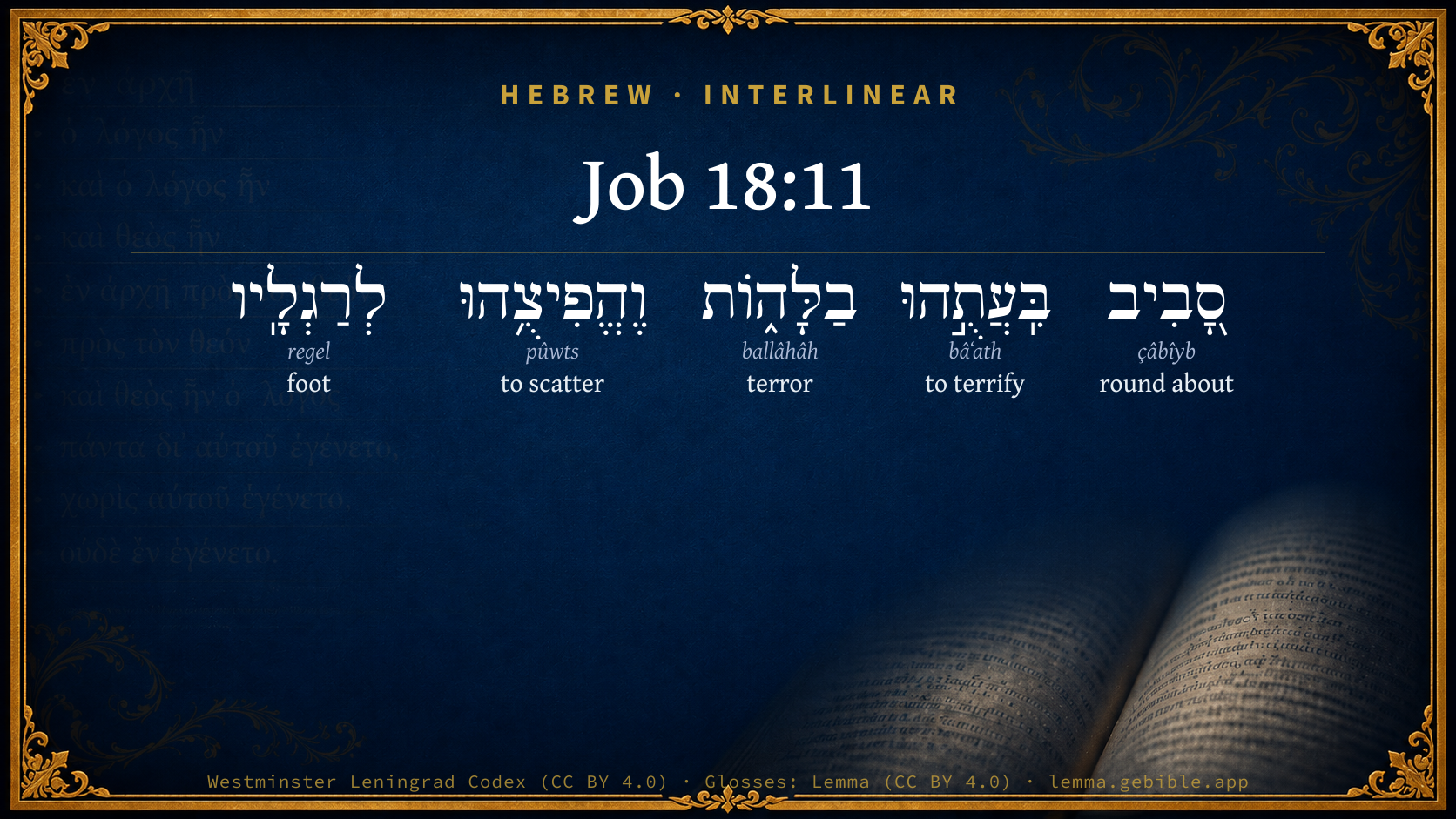
Job 18:11

Hebrew (Westminster Leningrad Codex) Job 18:11 appears in the Hebrew Old Testament. The text above is from the Westminster Leningrad Codex. Each word links to its Strong’s number, a concise gloss, and parsing drawn from the Open Scriptures Hebrew Bible morphology. Click any word for its full Brown-Driver-Briggs (BDB) entry.
Download image
Cite this verse

Job 18:11 (World English Bible). Public Domain. Lemma interlinear Bible study tool, https://lemma.gebible.app/v/job/18/11.

Show BibTeX & RIS
BibTeX
RIS
English Translation
Terrors shall make him afraid on every side, And shall chase him at his heels.
World English Bible · Public Domain
Highlights
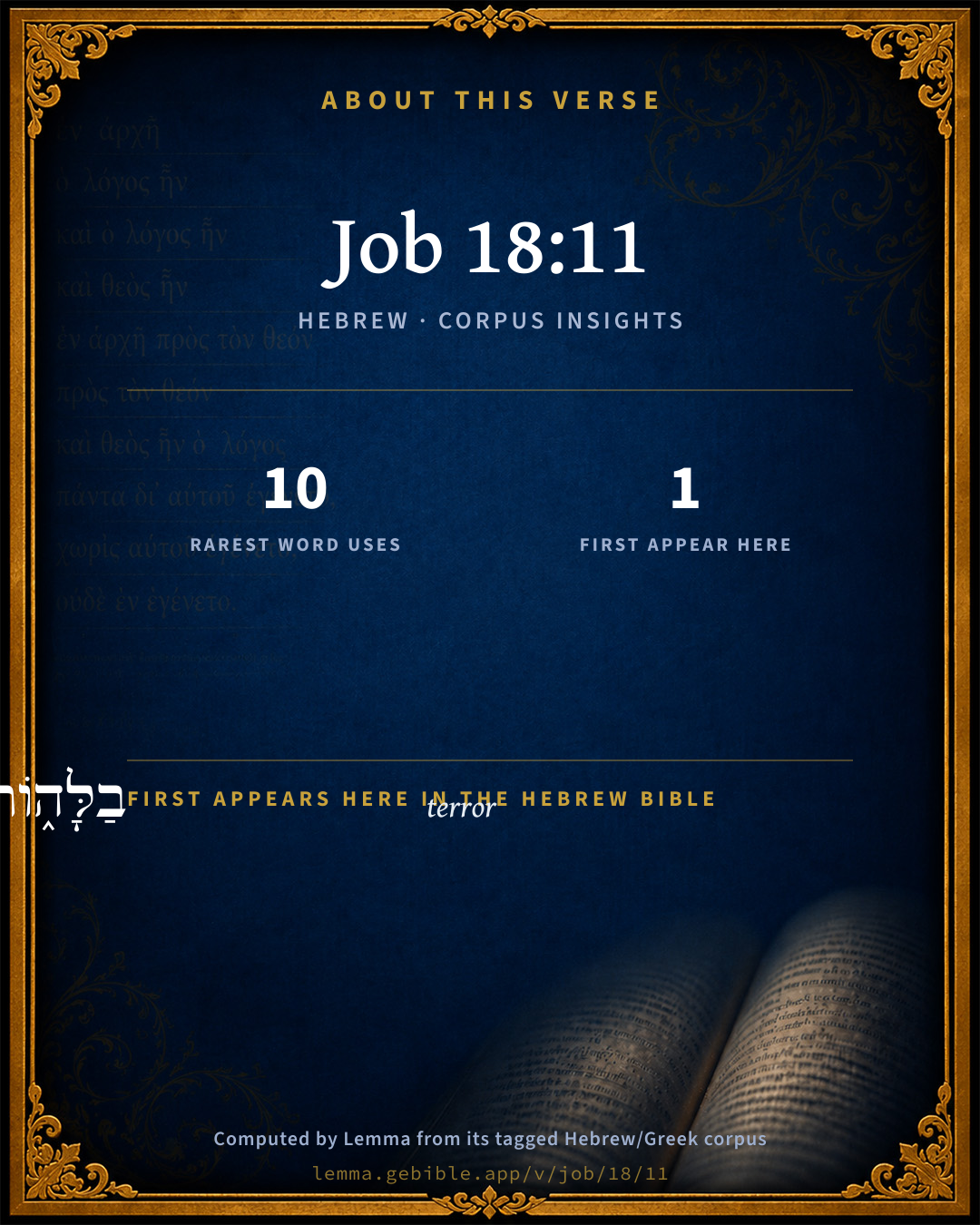
  • 1 first appearance in the Hebrew Bible
Full analysis ↓
Download a study sheet

One document with this verse’s original text, its word-by-word gloss line, the meaning frame, cross-references with their text, attributed commentary, and full source and license credits — printable, and it pastes into notes with its structure intact.

This verse Autodidact and up

Study sheet (.html) Plain text (.txt)

A passage Seminary Student

Up to 50 verses in one chapter. A passage sheet keeps up to 6 commentary sources and 12 cross-references per verse, in the order this page ranks them, and says so on the sheet whenever that leaves anything out. Ask for a single verse and you get the Autodidact verse sheet above.

Everything on this page stays free to read, with no account — the sheet is a download of what is already on screen, not access to it.

Want to remove ads? Support Godless Engineer
Compare translations 3

The same verse in 3 English versions, stacked beneath the original-language interlinear above. Click any original word for its lexicon entry.

Each is an independent rendering of the whole verse — the interlinear is not word-aligned to these translations.

Highlighted words mark where these versions differ — a whole-verse word diff, not a word-by-word alignment.

  • World English Bible Public Domain
    Terrors shall make him afraid on every side, And shall chase him at his heels.
  • King James Version Public Domain
    Terrors shall make him afraid on every side, and shall drive him to his feet.
  • unfoldingWord Literal Text CC BY-SA 4.0
    Terrors on every side will frighten him, and they will chase him at his feet.

unfoldingWord Literal Text — © unfoldingWord, licensed CC BY-SA 4.0. Word-aligned USFM3 via Door43 (git.door43.org/unfoldingWord/en_ult).

Versions to compare (up to 4)

3 of 4 selected

Show all 18 translations

Every available English version of this verse, each an independent rendering of the whole verse.

  • World English Bible Public Domain
    Terrors shall make him afraid on every side, And shall chase him at his heels.
  • Berean Standard Bible Public Domain
    Terrors frighten him on every side and harass his every step.
  • Majority Standard Bible Public Domain
    Terrors frighten him on every side and harass his every step.
  • King James Version Public Domain
    Terrors shall make him afraid on every side, and shall drive him to his feet.
  • American Standard Version (1901) Public Domain
    Terrors shall make him afraid on every side, And shall chase him at his heels.
  • Revised Version (1885) Public Domain
    Terrors shall make him afraid on every side, and shall chase him at his heels.
  • Geneva Bible (1599) Public Domain
    Fearefulnesse shall make him afrayde on euery side, and shall driue him to his feete.
  • Douay-Rheims (1899) Public Domain
    Fears shall terrify him on every side, and shall entangle his feet.
  • Young's Literal Translation Public Domain
    Round about terrified him have terrors, And they have scattered him -- at his feet.
  • Literal Standard Version CC BY-SA 4.0
    Terrors have terrified him all around, || And they have scattered him—at his feet.
  • Unlocked Literal Bible CC BY-SA 4.0
    Terrors will make him afraid on every side; they will chase him at his heels.
  • unfoldingWord Literal Text CC BY-SA 4.0
    Terrors on every side will frighten him, and they will chase him at his feet.
  • Darby Bible Public Domain
    Terrors make him afraid on every side, and chase him at his footsteps.
  • World Messianic Bible Public Domain
    Terrors will make him afraid on every side, and will chase him at his heels.
  • Webster's Bible Public Domain
    Terrors shall make him afraid on every side, and shall drive him to his feet.
  • Free Bible Version CC BY-SA 4.0
    Terrors scare the wicked, coming at them from every side, chasing them, biting at their heels.
  • Bible in Basic English Public Domain
    He is overcome by fears on every side, they go after him at every step.
  • JPS Tanakh (1917) Public Domain
    Terrors shall overwhelm him on every side, and shall entrap him at his feet.

Literal Standard Version (2020), Covenant Press — licensed CC BY-SA 4.0. Text via the HelloAO Bible API (eBible.org). Unlocked Literal Bible (unfoldingWord) — licensed CC BY-SA 4.0. Text via the HelloAO Bible API (eBible.org). unfoldingWord Literal Text — © unfoldingWord, licensed CC BY-SA 4.0. Word-aligned USFM3 via Door43 (git.door43.org/unfoldingWord/en_ult). Free Bible Version, Dr. Jonathan Gallagher — licensed CC BY-SA 4.0. Text via the HelloAO Bible API (eBible.org).

Word by word

More ways to search: Search by grammar → Find every occurrence → Compare this word →

Practice this passage: Drill this verse → Learn its vocabulary →

About this verse

These counts appear in no published source. They are computed here, from the morphology-tagged text and Lemma’s own curated glosses. What Lemma adds →

5
words
5
distinct lemmas
Wisdom
section

Notable vocabulary

The rarest word here is בַלָּה֑וֹת terror H1091 — appearing just 10 times in the whole Hebrew Bible.

First appearance in Scripture

This word makes its first canonical appearance in the Hebrew Bible here:

  • בַלָּה֑וֹת terror H1091

Shared distinctive vocabulary

בַלָּה֑וֹת terror H1091 occurs in 10 verses of the Hebrew Bible. Also found in:

Grammatical profile

  • 2 verbs
  • 3 nouns

Verb forms

  • בִּֽעֲתֻ֣הוּ Piel · Perfect
  • וֶהֱפִיצֻ֥הוּ Hiphil · Perfect

Hebrew & Septuagint length

In English translation the verse runs 15 words from the Hebrew and 13 from the Septuagint (LXX English) — closely comparable.

A rough comparison of the two English renderings, which tokenize alike — not a word-level alignment.

Word counts can differ between the Hebrew and the Greek without any difference in meaning — e.g. the Hebrew direct-object marker אֵת has no separate Greek word, and Greek often adds the article ὁ.

Cross-references

15

Topical passages linked to Job 18:11 in the Treasury of Scripture Knowledge — connected by theme and wording, ordered by reader-vote popularity; previews shown in the World English Bible.

  • Job 15:21 A sound of terrors is in his ears; In prosperity the destroyer shall come on him.
  • Jeremiah 6:25 Don't go forth into the field, nor walk by the way; for the sword of the enemy, [and] terror, are on every side.
  • Leviticus 26:36 "'As for those of you who are left, I will send a faintness into their hearts in the lands of their enemies: and the sound of a driven leaf will put them to flight; and they shall flee, as one flees from the sword; and they will fall when no one pursues.
  • Job 20:25 He draws it forth, and it comes out of his body. Yes, the glittering point comes out of his liver. Terrors are on him.
  • Jeremiah 46:5 Why have I seen it? they are dismayed and are turned backward; and their mighty ones are beaten down, and have fled apace, and don't look back: terror is on every side, says Yahweh.
  • Jeremiah 49:29 Their tents and their flocks shall they take; they shall carry away for themselves their curtains, and all their vessels, and their camels; and they shall cry to them, Terror on every side!
  • 2 Kings 7:6–7 For the Lord had made the host of the Syrians to hear a noise of chariots, and a noise of horses, even the noise of a great host: and they said one to another, Behold, the king of Israel has hired against us the kings of the Hittites, and the kings of the Egyptians, to come on us.
  • Job 6:4 For the arrows of the Almighty are within me, My spirit drinks up their poison. The terrors of God set themselves in array against me.
  • Job 20:8 He shall fly away as a dream, and shall not be found: Yes, he shall be chased away like a vision of the night.
  • Psalms 53:5 There they were in great fear, where no fear was, For God has scattered the bones of him who encamps against you. You have put them to shame, Because God has rejected them.
  • Psalms 73:19 How they are suddenly destroyed! They are completely swept away with terrors.
  • Proverbs 28:1 The wicked flee when no one pursues; But the righteous are as bold as a lion.
  • Jeremiah 20:3–4 It happened on the next day, that Pashhur brought forth Jeremiah out of the stocks. Then said Jeremiah to him, Yahweh has not called your name Pashhur, but Magormissabib.
  • 2 Corinthians 5:11 Knowing therefore the fear of the Lord, we persuade men, but we are revealed to God; and I hope that we are revealed also in your consciences.
  • Revelation 6:15–16 The kings of the earth, the princes, the commanding officers, the rich, the strong, and every slave and free person, hid themselves in the caves and in the rocks of the mountains.

Cross-references courtesy of OpenBible.info (CC BY 4.0).

Hebrew and Greek witnesses Masoretic Hebrew ↔ Greek Septuagint

The same verse in the two great witnesses to the Old Testament, shown verse-for-verse.

These are two independent witnesses, not word-aligned to each other, and the Septuagint is shown in lemma (dictionary) form.

Hebrew Job 18:11 Masoretic · Westminster Leningrad Codex

סָ֭בִיב בִּֽעֲתֻ֣הוּ בַלָּה֑וֹת וֶהֱפִיצֻ֥הוּ לְרַגְלָֽיו

Terrors shall make him afraid on every side, And shall chase him at his heels.

World English Bible · Public Domain

Greek LXX Job 18:11 Septuagint · lemma form

κύκλος ὄλλυμι αὐτός ὀδύνη πολύς δέ περί πούς αὐτός ἔρχομαι ἐν λιμός στενός

Let pains destroy him round about, and let many enemies come about him,

LXX2012 (modern English Septuagint) · Public Domain

Hebrew: Westminster Leningrad Codex (CC BY 4.0). Greek: Septuagint (public domain); English from LXX2012 (modern English Septuagint) (Public Domain). How the Septuagint differs from the Hebrew →

Commentary

Notes on Job 18:11 from classic Christian and Jewish commentators (each source and its license shown beneath its notes). The classic Christian expositions comment on the surrounding passage and are grouped to its opening verse, so a note may address several verses; the Jewish commentaries on the Tanakh (Rashi and others) are per-verse, so they appear only where the commentator wrote on this verse.

Lemma curates 59 commentaries, every one of them public domain or Creative Commons licensed, each selected and text-cleaned for this edition rather than reprinted as found. About our sources →

Matthew Henry's Commentary

Bildad here describes the destruction itself which wicked people are reserved for in the other world, and which, in some degree, often seizes them in this world. Come, and see what a miserable condition the sinner is in when his day comes to fall.

I. See him disheartened and weakened by continual terrors arising from the sense of his own guilt and the dread of God's wrath (Job 18:11, Job 18:12): Terror shall make him afraid on every side. The terrors of his own conscience shall haunt him, so that he shall never be easy. Wherever he goes, these shall follow him; which way soever he looks, these shall stare him in the face. It will make him tremble to see himself fought against by the whole creation, to see Heaven frowning on him, hell gaping for him, and earth sick of him. He that carries his own accuser, and his own tormentor, always in his bosom, cannot but be afraid on every side. This will drive him to his feet, like the malefactor, who, being conscious of his own guilt, takes to his heels and flees when none pursues, Pro 28:1. But his feet will do him no service; they are fast in the snare, Job 18:9. The sinner may as soon overpower the divine omnipotence as flee from the divine omniscience, Amo 9:2, Amo 9:3. No marvel that the sinner is dispirited and distracted with fear, for, 1. He sees his ruin approaching: Destruction shall be ready at his side, to seize him whenever justice gives the word, so that he is brought into desolation in a moment, Psa 73:19. 2. He feels himself utterly unable to grapple with it, either to escape it or to bear up under it. That which he relied upon as his strength (his wealth, power, pomp, friends, and the hardiness of his own spirit) shall fail him in the time of need, and be hunger-bitten, that is, it shall do him no more service than a famished man, pining away for hunger, would do in work or war. The case being thus with him, no marvel that he is a terror to himself. Note, The way of sin is a way of fear, and leads to everlasting confusion, of which the present terrors of an impure and unpacified conscience are earnests, as they were to Cain and Judas.

II. See him devoured and swallowed up by a miserable death; and miserable indeed a wicked man's death is, how secure and jovial soever his life was. 1. See him dying, arrested by the first-born of death (some disease, or some stroke that has in it a more than ordinary resemblance of death itself; so great a death, as it is called, Co2 1:10, a messenger of death that has in it an uncommon strength and terror), weakened by the harbingers of death, which devour the strength of his skin, that is, it shall bring rottenness into his bones and consume them. His confidence shall then be rooted out of his tabernacle (Job 18:14), that is, all that he trusted to for his support shall be taken from him, and he shall have nothing to rely upon, no, not his own tabernacle. His own soul was his confidence, but that shall be rooted out of the tabernacle of the body, as a tree that cumbered the ground. "Thy soul shall be required of thee." 2. See him dead, and see his case then with an eye of faith. (1.) He is then brought to the king of terrors. He was surrounded with terrors while he lived (Job 18:11), and death was the king of all those terrors; they fought against the sinner in death's name, for it is by reason of death that sinners are all their lifetime subject to bondage (Heb 2:15), and at length they will be brought to that which they so long feared, as a captive to the conqueror. Death is terrible to nature; our Saviour himself prayed, Father, save me from this hour. But to the wicked it is in a special manner the king of terrors, both as it is a period to that life in which they placed their happiness and a passage to that life where they will find their endless misery. How happy then are the saints, and how much indebted to the Lord Jesus, by whom death is so far abolished, and the property of it altered, that this king of terrors becomes a friend and servant! (2.) He is then driven from the light into darkness (Job 18:18), from the light of this world, and his prosperous condition in it, into darkness, the darkness of the grave, the darkness of hell, into utter darkness, never to see light (Psa 49:19), not the least gleam, nor any hopes of it. (3.) He is then chased out of the world, hurried and dragged away by the messengers of death, sorely against his will, chased as Adam out of paradise, for the world is his paradise. It intimates that he would fain stay here; he is loth to depart, but go he must; all the world is weary of him, and therefore chases him out, as glad to get rid of him. This is death to a wicked man.

III. See his family sunk and cut off, Job 18:15. The wrath and curse of God light and lie, not only upon his head and heart, but upon his house too, to consume it with the timber and stones thereof, Zac 5:4. Death itself shall dwell in his tabernacle, and, having expelled him, shall take possession of his house, to the terror and destruction of all that he leaves behind. Even the dwelling shall be ruined for the sake of its owner: Brimstone shall be scattered upon his habitation, rained upon it as upon Sodom, to the destruction of which this seems to have reference. Some think he here upbraids Job with the burning of his sheep and servants with fire from heaven. The reason is here given why his tabernacle is thus marked for ruin: Because it is none of his; that is, it was unjustly got, and kept, from the rightful owner, and therefore let him not expect either the comfort or the continuance of it. His children shall perish, either with him or after him, Job 18:16. So that, his roots being in his own person dried up beneath, above his branch (every child of his family) shall be cut off. Thus the houses of Jeroboam, Baasha, and Ahab, were cut off; none that descended from them were left alive. Those who take root in the earth may expect it will thus be dried up; but, if we be rooted in Christ, even our leaf shall not wither, much less shall our branch be cut off. Those who consult the true honour of their family, and the welfare of its branches, will be afraid of withering it by sin. The extirpation of the sinner's family is mentioned again (Job 18:19): He shall neither have son nor nephew, child nor grandchild, to enjoy his estate and bear up his name, nor shall there be any remaining in his dwelling akin to him. Sin entails a curse upon posterity, and the iniquity of the fathers is often visited upon the children. Herein, also, it is probable that Bildad reflects upon the death of Job's children and servants, as a further proof of his being a wicked man; whereas all that are written childless are not thereby written graceless; there is a name better than that of sons and daughters.

IV. See his memory buried with him, or made odious; he shall either be forgotten or spoken of with dishonour (Job 18:17): His remembrance shall perish from the earth; and, if it perish thence, it perishes wholly, for it was never written in heaven, as the names of the saints are, Luk 10:20. All his honour shall be laid and lost in the dust, or stained with perpetual infamy, so that he shall have no name in the street, departing without being desired. Thus the judgments of God follow him, after death, in this world, as an indication of the misery his soul is in after death, and an earnest of that everlasting shame and contempt to which he shall rise in the great day. The memory of the just is blessed, but the name of the wicked shall rot, Pro 10:7.

V. See a universal amazement at his fall, Job 18:20. Those that see it are affrighted, so sudden is the change, so dreadful the execution, so threatening to all about him: and those that come after, and hear the report of it, are astonished at it; their ears are made to tingle, and their hearts to tremble, and they cry out, Lord, how terrible art thou in thy judgments! A place or person utterly ruined is said to be made an astonishment, Deu 28:37; Ch2 7:21; Jer 25:9, Jer 25:18. Horrible sins bring strange punishments.

VI. See all this averred as the unanimous sense of the patriarchal age, grounded upon their knowledge of God and their many observations of his providence (Job 18:21): Surely such are the dwellings of the wicked, and this is the place (this the condition) of him that knows not God! See here what is the beginning, and what is the end, of the wickedness of this wicked world. 1. The beginning of it is ignorance of God, and it is a wilful ignorance, for there is that to be known of him which is sufficient to leave them for ever inexcusable. They know not God, and then they commit all iniquity. Pharaoh knows not the Lord, and therefore will not obey his voice. 2. The end of it, and that is utter destruction. Such, so miserable, are the dwellings of the wicked. Vengeance will be taken of those that know not God, Th2 1:8. For those whom he has not honour from he will get himself honour upon. Let us therefore stand in awe and not sin, for it will certainly be bitterness in the latter end.

Matthew Henry's Commentary on the Whole Bible (1708–1710) — public domain (CC PDM 1.0). Text via the HelloAO Bible API.

Trapp's Complete Commentary

John Trapp

Job 18:11 Terrors shall make him afraid on every side, and shall drive him to his feet.

Ver. 11. Terrors shall make him afraid on every side] These terrors are, as it were, the cruel sergeants and merciless officers of that king of terrors, Job 18:14, arresting him, as it were, in the devil’s name, and bringing him to justice, Apparitores et lictores (Jun.). How can it be but a terrible time with him, when death comes with a writ of Habeas corpus, Let you keep the body, and the devil with a writ of Habeas animam? Let you keep the spirit, when the cold earth must have his body, and hot hell hold his soul, according to that of the psalmist, "Let death seize upon them, and let them go down quick into hell: for wickedness is in their dwellings, and among them," Psa 55:15. The sad forethought hereof causeth many unutterable griefs and grapings, perplexities of spirit and convulsions of soul, a very hell above ground, and a foretaste of eternal torments. The word here rendered terror signifieth utmost frights, such as put a man well nigh out of his wits and distract him. R. Solomon understandeth it to be devils; others to be furies, such as the poets feign. Most certain it is, that a body is not so tormented with stings or torn with stripes as a mind with remembrance of wicked actions and fear of future evils (Cic. Orat. pro Rose. Amer.).

And shall drive him to his feet] As they did Cain, that wretch, Qui factus est a corde sua fugitivus (Tertul.), who would fain have fled from his own conscience (if he could have known whither), and become a fugitive and a vagabond upon the earth, Gen 4:12, seeking to outrun his terrors, which yet dogged him hard at the heels. They shall press him at his feet, so Broughton readeth this text.

John Trapp, A Commentary or Exposition upon All the Books of the Old and New Testament (1647–1656) — public domain. Text from a community e-Sword module.

Joseph Benson's Commentary

Job 18:11-12. Terrors shall make him afraid — Both from men and from God, and also from his own unquiet mind and guilty conscience. And drive him to his feet — Shall force him to flee different ways, being safe nowhere, but pursued by terrors from place to place, which, as Houbigant renders it, shall be spread around his feet. His strength — Either his children, who are, and are called a man’s strength, Gen 49:3; Psa 127:4, or rather, his wealth, power, and prosperity; shall be hunger-bitten — Or famished, that is, utterly consumed. The Vulgate renders it, His strength shall be eaten by famine. And destruction shall be ready at his side — Shall attend him as a constant companion, or follow him at the heels as a diligent servant. Or, he may allude to an arrow fitted to a string, and ready to be discharged at him.

Joseph Benson's Commentary on the Old and New Testaments (1811–1818) — public domain. Text from a community e-Sword module.

Tyndale Open Study Notes

Tyndale Open Resources

18:11-13 Bildad applies the biblical principle of retribution (18:8-10) to Job, as do Eliphaz (15:21-23) and Zophar (20:25).

Tyndale Open Study Notes — © Tyndale Open Resources, licensed CC BY-SA 4.0. Text via the HelloAO Bible API.

Jamieson, Fausset & Brown

Robert Jamieson, A. R. Fausset & David Brown

Terrors--often mentioned in this book (Job 18:14; Job 24:17; &c.). The terrors excited through an evil conscience are here personified. "Magor-missabib" (Jer 20:3).

drive . . . to his feet--rather, "shall pursue" (literally, "scatter," Hab 3:14) him close "at his heels" (literally, "immediately after his feet," Hab 3:5; Sa1 25:42; Hebrew). The image is that of a pursuing conqueror who scatters the enemy [UMBREIT].

Jamieson, Fausset & Brown — Commentary Critical and Explanatory on the Whole Bible (1871) — public domain (CC PDM 1.0). Text via the HelloAO Bible API.

Ellicott's Commentary for English Readers

(11) Shall drive him to his feet.—Comp. Job_15:21. One feels very much tempted to understand this, as the English undoubtedly suggests, shall startle him to his feet, but the true meaning is, more probably, shall chase him at his heels.

A Bible Commentary for English Readers, edited by Charles John Ellicott (1878–1897) — public domain. Text from a community e-Sword module.

The Cambridge Bible for Schools and Colleges

gen. ed. J. J. S. Perowne

11. This verse does not seem to give a picture of the sinner’s conscience, but rather of his consciousness at last. The preceding verses described how he walked on snares unwitting that they were there; now he awakens to the perception of his condition, he feels the complications that surround him, and would flee from the terrors that he has come to realize.

and shall drive him to his feet] Rather, and drive him away at his heels. A spectral host of terrors pursue close behind him.

The Cambridge Bible for Schools and Colleges (gen. ed. J. J. S. Perowne; Cambridge University Press, 1878–1918) — public domain. Text from a community e-Sword module.

John Gill's Exposition

His strength shall be hungerbitten,.... Or "shall be famine" (u), or hunger, that is, shall be weakened by it; famine is a sore evil, and greatly weakens thee natural strength of men; want of food will soon bring down the strength of the strongest man, when the stay and the staff, the sustenance and support of man's nature is taken from him: many of the Jewish writers, by "his strength", understand his children, who are, as Jacob said of Reuben, his might, and the beginning of his strength, Gen 49:3; and when grown up are his protection and defence; and for these to be distressed with hunger, or destroyed by famine, is a sore judgment; so the Targum paraphrases it, his firstborn son; Jarchi interprets it, his son; and Ben Gersom, his seed or offspring:

and destruction shall be ready at his side; or "to his rib" (w); that is, his wife, as the Targum and Jarchi explain it, the Jews calling a man's wife his rib, because the woman was originally made out of one of the ribs of man; and if this could be thought to be the sense of the word here, and what is given by them of the former clause, both make up a complete account of the destruction of a wicked man's family, his wife and children: but rather it signifies some calamity, distress, and trouble at hand, ready prepared for wicked men, just going to be inflicted on them; for God has stores of vengeance for them, and has made ready his bow, and prepared instruments and arrows of death and destruction for them, as well as there is everlasting fire prepared, and blackness of darkness reserved for them in the world to come; for it can hardly be thought that this should be understood literally of any disease in the side, as the pleurisy, &c. which is threatening, or any mortal wound or stab there, such as Joab gave Amass under the fifth rib.

(u) "fames", Beza. (w) "costae ejus", Montanus, Vatablus, Grotius, Schultens.

John Gill's Exposition of the Whole Bible (1746–1763) — public domain (CC PDM 1.0). Text via the HelloAO Bible API.

Albert Barnes' Notes on the Bible

Terrors shall make him afraid - He shall be constantly subject to alarms, and shall never feel secure. “Terrors here are represented as allegorical persons, like the Furies in the Greek poets.” Noyes. The idea here is substantially the same as that given by Eliphaz, Job 15:21-22.

And shall drive him to his feet - Margin, scatter. This is a literal translation of the Hebrew. The idea is, that he will be alarmed by such terrors; his self-composure will be dissipated, and he will “take to his heels.”

Albert Barnes' Notes on the Bible (1834–1885) — public domain. Text from a community e-Sword/MySword module.

Haydock's Catholic Bible Commentary

Fears. Hunters used to place loose feathers round the wood, except where the gin was laid, in order to frighten the prey into it. Puniceæque agitant formidine pennæ. (Georg. iii.)

(Jeremias xlviii. 44.) "Like timid stags, while you avoid the moving feathers, you are entrapped in the strongest nets." (St. Jerome, contra Lucif.) --- Every thing tends to fill the poor beast with alarm. So the devil, conscience, and enemies on all sides, best the wicked. (Calmet)

George Leo Haydock (1774–1849), Haydock's Catholic Family Bible and Commentary, 1859 edition — public domain. Excludes Psalms (Douay-Rheims chapter numbering differs from Protestant) and Deuterocanonical books (Catholic canon only).

Matthew Poole's English Annotations

Terrors; both from men, and from God, and from his own unquiet mind and guilty conscience.

Shall drive him to his feet; shall force him to flee hither and thither, and he knows not whither, being secure and safe no where, but pursued by terrors from place to place.

Matthew Poole's English Annotations on the Holy Bible (1683–1685) — public domain. Text from a community e-Sword/MySword module.

Whedon's Commentary on the Bible

Daniel D. Whedon

11. Drive him — Chase him at his feet. These terrors, personified, resemble the furies of the Greek poets — their pursuit of the wicked man is so close that they are said to be at his heels.

Daniel D. Whedon (gen. ed.), Commentary on the Old and New Testaments (1874–1909) — public domain. Text from a community e-Sword module.

The Pulpit Commentary

Terrors shall make him afraid on every side. Vague fears, panic terrors, no longer subjective, but to his bewildered brain objective, shall seem to menace the wicked man on every side, and shall affright him continually. There is an allusion, doubtless, to what Job has said of the gloomy and terrifying thoughts which come over him from time to time (Job_3:25 Job_7:14 Job_9:28 Job_13:21) and fill him with consternation. And shall drive him to his feet ; rather, shall chase him at his heels (see the Revised Version). Like a pack of hounds, or wolves, or jackals. Jackals are common in Palestine and the adjacent countries. They hunt in lacks, and generally run down their prey; but do not, unless hard pressed by hunger, attack men.

The Pulpit Commentary (1880–1919), ed. H.D.M. Spence-Jones & Joseph S. Exell — public domain. Text from a community e-Sword module.

Rashi

Rabbi Shlomo Yitzchaki (Rashi)

terrors Demons.

and beat him off his fee They knock him down to the ground.

Rashi on the Tanakh — English translations: “The Judaica Press complete Tanach with Rashi, translated by A. J. Rosenberg” (CC BY 4.0); “Pentateuch with Rashi's commentary by M. Rosenbaum and A.M. Silbermann, 1929-1934” (public domain); “The Metsudah Tanach series, Lakewood, N.J” (CC BY 4.0); and “The Book of Joshua, Metsudah Publications, 1997” (CC BY 4.0). Text via Sefaria.

Lesson kit

Teaching starters — assembled from the data on this page, not authored interpretation. Every prompt links to the verse data it draws on. Edit before teaching.

Job, in the Wisdom, opens this verse with 5 words (5 distinct Hebrew lemmas). Its most distinctive word is ballâhâh (“terror”). A historical commentator’s framing appears above. Read the whole chapter for the surrounding context.

Discussion questions

  1. How does “terror” (ballâhâh) shape what this verse is saying?
  2. The word “terror” first appears here in Scripture. What is being introduced at this debut?
  3. Job 18:14 shares the word «terror» with this verse. How do the two illuminate each other?
  4. These translations render this verse differently; the difference is in the English rendering, not the original. What questions does that raise?
  5. The verb «בִּֽעֲתֻ֣הוּ» is Piel Perfect. How does its form color the action?
  6. Reading how Matthew Henry's Commentary and Trapp's Complete Commentary read this verse, where do the two commentators agree and where do they part?

Things to notice

  • 1 word makes its first canonical appearance in Scripture here.
  • These translations choose different wording for 9 words in this verse.
  • 5 distinct Hebrew lemmas span 5 words in this verse.

Reading settings

Reading text

Shown beneath each verse's original-language words.

Old Testament
Old Testament edition

Read the OT as the Masoretic Hebrew (MT) or the Greek Septuagint (LXX).

English shown for the Greek Septuagint (in the Hebrew ↔ Greek comparison).

Comparing translations? Open the Compare panel on any verse page to stack up to four side by side.