
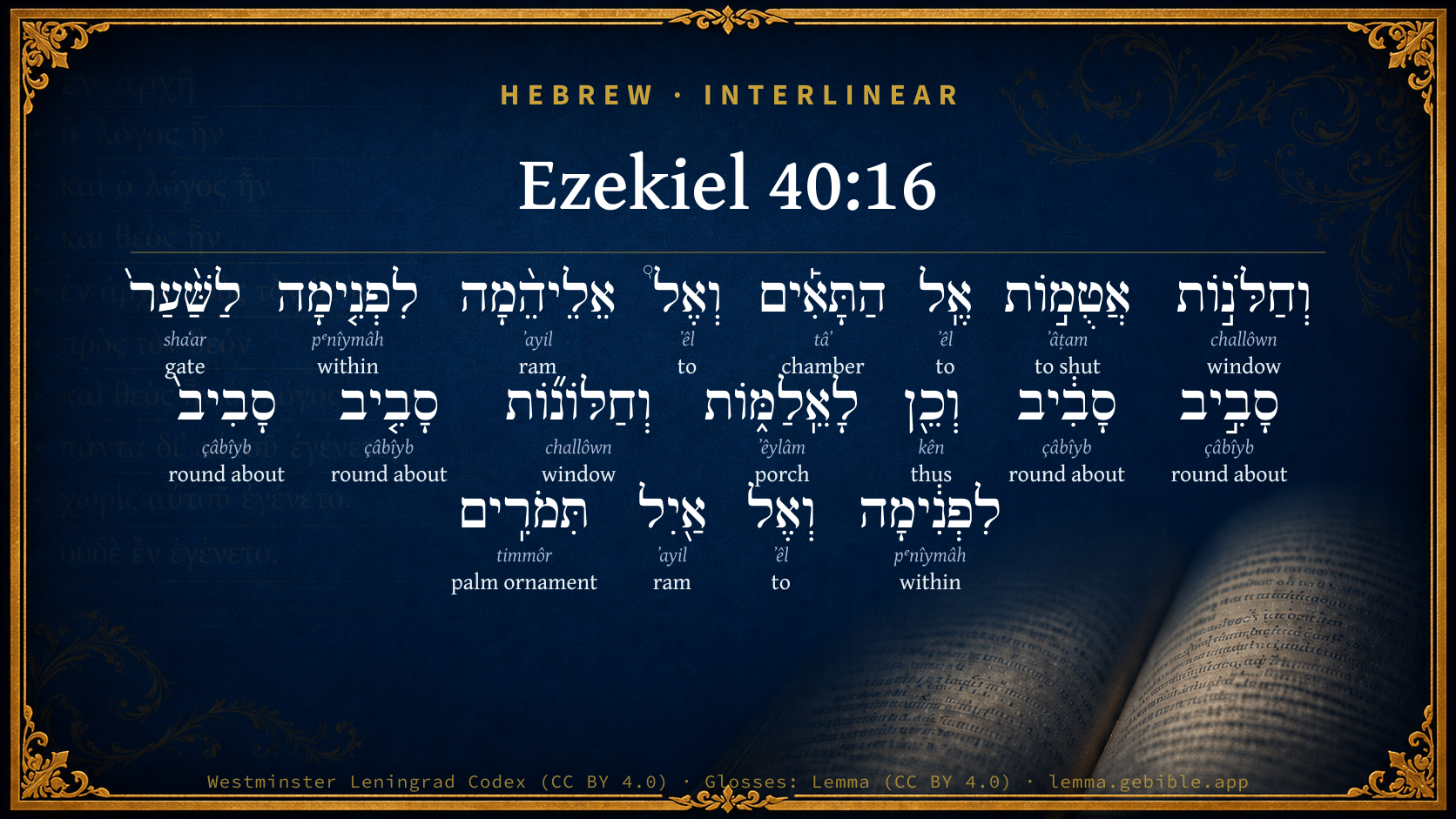
Ezekiel 40:16

Hebrew (Westminster Leningrad Codex) Ezekiel 40:16 appears in the Hebrew Old Testament. The text above is from the Westminster Leningrad Codex. Each word links to its Strong’s number, a concise gloss, and parsing drawn from the Open Scriptures Hebrew Bible morphology. Click any word for its full Brown-Driver-Briggs (BDB) entry.
Download image
Cite this verse

Ezekiel 40:16 (World English Bible). Public Domain. Lemma interlinear Bible study tool, https://lemma.gebible.app/v/ezekiel/40/16.

Show BibTeX & RIS
BibTeX
RIS
English Translation
There were closed windows to the lodges, and to their posts within the gate round about, and likewise to the arches; and windows were round about inward; and on [each] post were palm trees.
World English Bible · Public Domain
Highlights
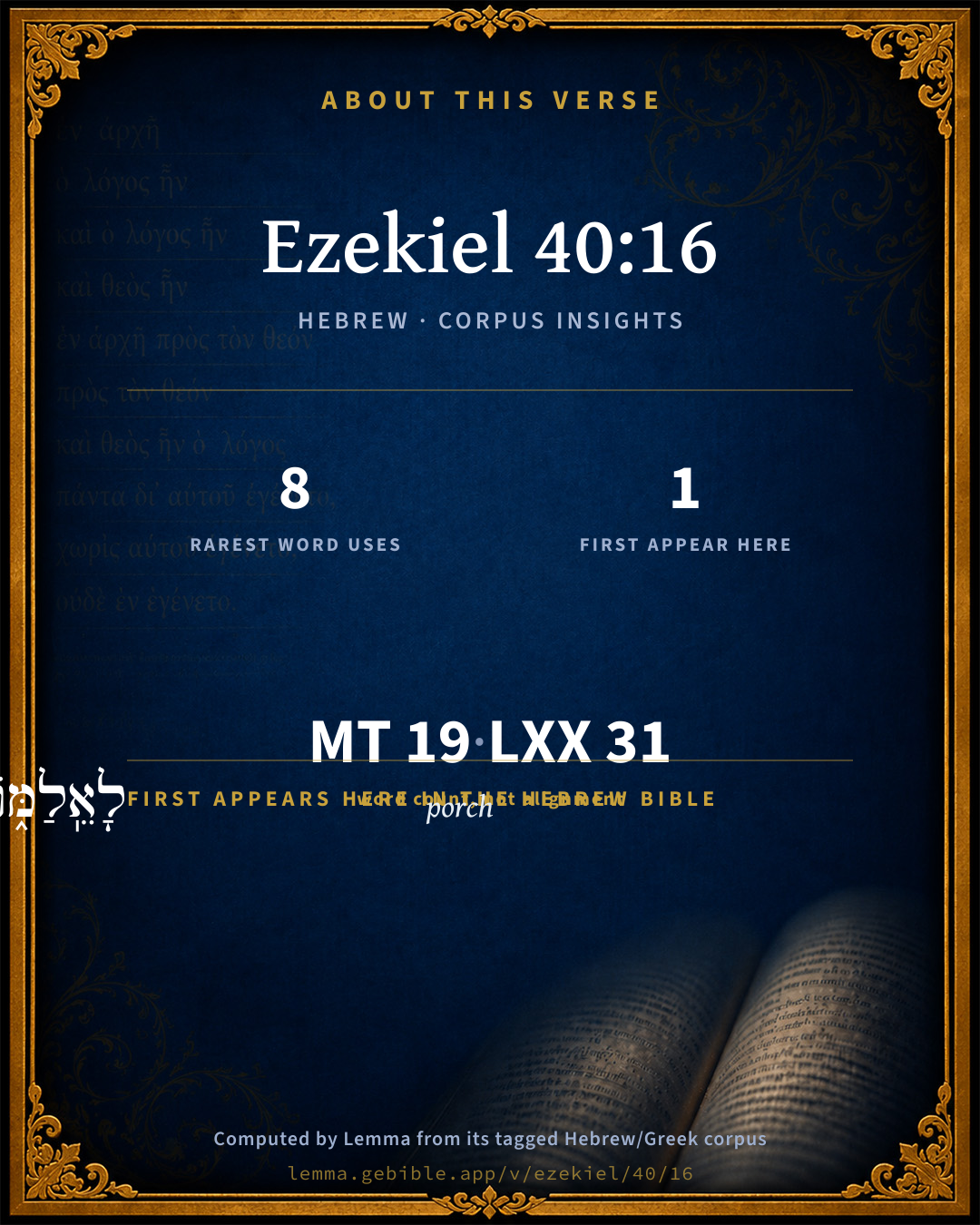
  • 1 first appearance in the Hebrew Bible
Full analysis ↓
Download a study sheet

One document with this verse’s original text, its word-by-word gloss line, the meaning frame, cross-references with their text, attributed commentary, and full source and license credits — printable, and it pastes into notes with its structure intact.

This verse Autodidact and up

Study sheet (.html) Plain text (.txt)

A passage Seminary Student

Up to 50 verses in one chapter. A passage sheet keeps up to 6 commentary sources and 12 cross-references per verse, in the order this page ranks them, and says so on the sheet whenever that leaves anything out. Ask for a single verse and you get the Autodidact verse sheet above.

Everything on this page stays free to read, with no account — the sheet is a download of what is already on screen, not access to it.

Want to remove ads? Support Godless Engineer
Compare translations 3

The same verse in 3 English versions, stacked beneath the original-language interlinear above. Click any original word for its lexicon entry.

Each is an independent rendering of the whole verse — the interlinear is not word-aligned to these translations.

Highlighted words mark where these versions differ — a whole-verse word diff, not a word-by-word alignment.

  • World English Bible Public Domain
    There were closed windows to the lodges, and to their posts within the gate round about, and likewise to the arches; and windows were round about inward; and on [each] post were palm trees.
  • King James Version Public Domain
    And there were narrow windows to the little chambers, and to their posts within the gate round about, and likewise to the arches: and windows were round about inward: and upon each post were palm trees.
  • unfoldingWord Literal Text CC BY-SA 4.0
    There were closed windows toward the chambers and toward their pillars within the gates all around; and likewise for the porches. There were windows all around the inside, and each jamb was decorated with palm trees.

unfoldingWord Literal Text — © unfoldingWord, licensed CC BY-SA 4.0. Word-aligned USFM3 via Door43 (git.door43.org/unfoldingWord/en_ult).

Versions to compare (up to 4)

3 of 4 selected

Show all 18 translations

Every available English version of this verse, each an independent rendering of the whole verse.

  • World English Bible Public Domain
    There were closed windows to the lodges, and to their posts within the gate round about, and likewise to the arches; and windows were round about inward; and on [each] post were palm trees.
  • Berean Standard Bible Public Domain
    The gate chambers and their side pillars had beveled windows all around the inside of the gateway. The porticos also had windows all around on the inside. Each side pillar was decorated with palm trees.
  • Majority Standard Bible Public Domain
    The gate chambers and their side pillars had beveled windows all around the inside of the gateway. The porticos also had windows all around on the inside. Each side pillar was decorated with palm trees.
  • King James Version Public Domain
    And there were narrow windows to the little chambers, and to their posts within the gate round about, and likewise to the arches: and windows were round about inward: and upon each post were palm trees.
  • American Standard Version (1901) Public Domain
    And there were closed windows to the lodges, and to their posts within the gate round about, and likewise to the arches; and windows were round about inward; and upon `each' post were palm-trees.
  • Revised Version (1885) Public Domain
    And there were closed windows to the lodges, and to their posts within the gate round about, and likewise to the arches: and windows were round about inward: and upon each post were palm trees.
  • Geneva Bible (1599) Public Domain
    And there were narrowe windowes in the chambers, and in their postes within the gate round about, and likewise to the arches: and the windowes went rounde about within: and vpon the postes were palme trees.
  • Douay-Rheims (1899) Public Domain
    And slanting windows in the little chambers, and in their fronts, which were within the gate on every side round about: and in like, manner there wore also in the porches windows round about within, and before the fronts the representation of palm trees.
  • Young's Literal Translation Public Domain
    and narrow windows `are' unto the little chambers, and unto their posts at the inside of the gate all round about -- and so to the arches -- and windows all round about `are' at the inside, and at the post `are' palm-trees.
  • Literal Standard Version CC BY-SA 4.0
    and narrow windows [are] in the little chambers, and in their posts on the inside of the gate all around—and so to the arches—and windows all around on the inside, and palm-trees [are] on the post.
  • Unlocked Literal Bible CC BY-SA 4.0
    There were closed windows toward the chambers and toward their pillars within the gates all around; and likewise for the porches. The were windows all around the inside, and each jamb was decorated with palm trees.
  • unfoldingWord Literal Text CC BY-SA 4.0
    There were closed windows toward the chambers and toward their pillars within the gates all around; and likewise for the porches. There were windows all around the inside, and each jamb was decorated with palm trees.
  • Darby Bible Public Domain
    And there were closed windows to the chambers, and to their posts within the gate round about, and likewise to the projections; and the windows round about were inward; and upon [each] post were palm-trees.
  • World Messianic Bible Public Domain
    There were closed windows to the side rooms, and to their posts within the gate all around, and likewise to the arches. Windows were around inward. Palm trees were on each post.
  • Webster's Bible Public Domain
    And there were narrow windows to the little chambers, and to their posts within the gate around, and likewise to the arches: and windows were around inward: and upon each post were palm-trees.
  • Free Bible Version CC BY-SA 4.0
    The alcoves and their pillars had narrow windows on all of the inside of the gateway. The porches also had windows on all of the inside. All the posts were decorated with palm tree designs.
  • Bible in Basic English Public Domain
    And the rooms and their uprights had sloping windows inside the doorway all round, and in the same way the covered way had windows all round on the inside: and on every upright there were palm-trees.
  • JPS Tanakh (1917) Public Domain
    And there were narrow windows to the cells and to their posts within the gate round about, and likewise to the arches; and windows were round about inward; and upon each post were palm-trees.

Literal Standard Version (2020), Covenant Press — licensed CC BY-SA 4.0. Text via the HelloAO Bible API (eBible.org). Unlocked Literal Bible (unfoldingWord) — licensed CC BY-SA 4.0. Text via the HelloAO Bible API (eBible.org). unfoldingWord Literal Text — © unfoldingWord, licensed CC BY-SA 4.0. Word-aligned USFM3 via Door43 (git.door43.org/unfoldingWord/en_ult). Free Bible Version, Dr. Jonathan Gallagher — licensed CC BY-SA 4.0. Text via the HelloAO Bible API (eBible.org).

Word by word

More ways to search: Search by grammar → Find every occurrence → Compare this word →

Practice this passage: Drill this verse → Learn its vocabulary →

אֲטֻמ֣וֹת
ʼâṭam
H331
“shut”
Verb, Qal, Participle Passive, Feminine, Plural, Absolute
Part of Speech
Verb
Stem
Qal
Form
Participle Passive
Gender
Feminine
Number
Plural
State
Absolute
Full BDB Definition

Origin: a primitive root

TWOT: 73

to shut, shut up, close - (Qal) to shut, stop (of lips) - (Hiphil) of the wicked stopping their ears (figuratively)
  1. וְחַלֹּנ֣וֹת challôwn H2474 “and · windows” Conjunction + Noun, Common, Both, Plural, Absolute
  2. אֶֽל ʼêl H413 “to” Preposition
  3. הַתָּאִ֡ים tâʼ H8372 “the · chambers” Particle, Definite Article + Noun, Common, Masculine, Plural, Absolute
  4. וְאֶל֩ ʼêl H413 “and · to” Conjunction + Preposition
  5. אֵלֵיהֵ֨מָה ʼayil H352 “rams · their” Noun, Common, Masculine, Plural, Construct + Suffix, Personal, 3rd Person, Masculine, Plural
  6. לִפְנִ֤ימָה pᵉnîymâh H6441 “to/for · within” Preposition + Adverb
  7. לַשַּׁ֨עַר֙ shaʻar H8179 “to/for the · gate” Preposition, Determined + Noun, Common, Masculine, Singular, Absolute
  8. סָבִ֣יב çâbîyb H5439 “round about” Noun, Common, Both, Singular, Absolute
  9. סָבִ֔יב çâbîyb H5439 “round about” Noun, Common, Both, Singular, Absolute
  10. וְכֵ֖ן kên H3651 “and · thus” Conjunction + Particle, Demonstrative
  11. לָאֵֽלַמּ֑וֹת ʼêylâm H361 “to/for the · porches” Preposition, Determined + Noun, Common, Masculine, Plural, Absolute
  12. וְחַלּוֹנ֞וֹת challôwn H2474 “and · windows” Conjunction + Noun, Common, Both, Plural, Absolute
  13. סָבִ֤יב çâbîyb H5439 “round about” Noun, Common, Both, Singular, Absolute
  14. סָבִיב֙ çâbîyb H5439 “round about” Noun, Common, Both, Singular, Absolute
  15. לִפְנִ֔ימָה pᵉnîymâh H6441 “to/for · within” Preposition + Adverb
  16. וְאֶל ʼêl H413 “and · to” Conjunction + Preposition
  17. אַ֖יִל ʼayil H352 “ram” Noun, Common, Masculine, Singular, Absolute
  18. תִּמֹרִֽים timmôr H8561 “palm ornaments” Noun, Common, Feminine, Plural, Absolute

About this verse

These counts appear in no published source. They are computed here, from the morphology-tagged text and Lemma’s own curated glosses. What Lemma adds →

19
words
11
distinct lemmas
Prophets
section

Notable vocabulary

The rarest word here is אֲטֻמ֣וֹת to shut H331 — appearing just 8 times in the whole Hebrew Bible.

First appearance in Scripture

This word makes its first canonical appearance in the Hebrew Bible here:

  • לָאֵֽלַמּ֑וֹת porch H361

Shared distinctive vocabulary

אֲטֻמ֣וֹת to shut H331 occurs in 8 verses of the Hebrew Bible. Also found in:

Grammatical profile

  • 1 verb
  • 12 nouns
  • 3 prepositions
  • 2 adverbs
  • 1 particle

Verb forms

  • אֲטֻמ֣וֹת Qal · Participle Passive

Repetition

Words recur within this verse — often emphatic in Hebrew:

  • סָבִ֣יב round about H5439 ×4
  • וְחַלֹּנ֣וֹת window H2474 ×2
  • אֵלֵיהֵ֨מָה ram H352 ×2
  • לִפְנִ֤ימָה within H6441 ×2
  • אֶֽל to H413 ×3

Hebrew & Septuagint length

In English translation the verse runs 34 words from the Hebrew and 46 from the Septuagint (LXX English) — closely comparable.

A rough comparison of the two English renderings, which tokenize alike — not a word-level alignment.

Word counts can differ between the Hebrew and the Greek without any difference in meaning — e.g. the Hebrew direct-object marker אֵת has no separate Greek word, and Greek often adds the article ὁ.

In the original languages it is 19 Hebrew tokens and 31 Greek tokens — but the two are counted differently (Hebrew bundles its prefixes and suffixes into one token; the Greek is in lemma form), so that isn’t a like-for-like length.

Cross-references

18

Topical passages linked to Ezekiel 40:16 in the Treasury of Scripture Knowledge — connected by theme and wording, ordered by reader-vote popularity; previews shown in the World English Bible.

  • 1 Kings 6:4 For the house he made windows of fixed lattice-work.
  • 2 Chronicles 3:5 The greater house he made a ceiling with fir-wood, which he overlaid with fine gold, and worked thereon palm trees and chains.
  • Ezekiel 41:26 There were closed windows and palm trees on the one side and on the other side, on the sides of the porch: thus were the side-chambers of the house, and the thresholds.
  • 1 Kings 6:29 He carved all the walls of the house round about with carved figures of cherubim and palm trees and open flowers, inside and outside.
  • 1 Kings 6:32 So [he made] two doors of olive-wood; and he carved on them carvings of cherubim and palm trees and open flowers, and overlaid them with gold; and he spread the gold on the cherubim, and on the palm trees.
  • 1 Kings 6:35 He carved [thereon] cherubim and palm trees and open flowers; and he overlaid them with gold fitted on the engraved work.
  • Ezekiel 40:21–22 The lodges of it were three on this side and three on that side; and the posts of it and the arches of it were after the measure of the first gate: the length of it was fifty cubits, and the breadth twenty-five cubits.
  • Psalms 92:12 The righteous shall flourish like the palm tree. He will grow like a cedar in Lebanon.
  • Ezekiel 40:7 Every lodge was one reed long, and one reed broad; and [the space] between the lodges was five cubits; and the threshold of the gate by the porch of the gate toward the house was one reed.
  • Ezekiel 40:12 and a border before the lodges, one cubit [on this side], and a border, one cubit on that side; and the lodges, six cubits on this side, and six cubits on that side.
  • Ezekiel 40:25 There were windows in it and in the arches of it round about, like those windows: the length was fifty cubits, and the breadth twenty-five cubits.
  • Ezekiel 40:30 There were arches round about, twenty-five cubits long, and five cubits broad.
  • Ezekiel 41:15–16 He measured the length of the building before the separate place which was at the back of it, and the galleries of it on the one side and on the other side, one hundred cubits; and the inner temple, and the porches of the court;
  • Ezekiel 41:18 It was made with cherubim and palm trees; and a palm tree was between cherub and cherub, and every cherub had two faces;
  • Ezekiel 42:3 Over against the twenty [cubits] which belonged to the inner court, and over against the pavement which belonged to the outer court, was gallery against gallery in the third story.
  • John 5:2 Now in Jerusalem by the sheep gate, there is a pool, which is called in Hebrew, "Bethesda," having five porches.
  • 1 Corinthians 13:12 For now we see in a mirror, dimly, but then face to face. Now I know in part, but then I will know fully, even as I was also fully known.
  • Revelation 7:9 After these things I looked, and behold, a great multitude, which no man could number, out of every nation and of all tribes, peoples, and languages, standing before the throne and before the Lamb, dressed in white robes, with palm branches in their hands.

Cross-references courtesy of OpenBible.info (CC BY 4.0).

Hebrew and Greek witnesses Masoretic Hebrew ↔ Greek Septuagint

The same verse in the two great witnesses to the Old Testament, shown verse-for-verse.

These are two independent witnesses, not word-aligned to each other, and the Septuagint is shown in lemma (dictionary) form.

Hebrew Ezekiel 40:16 Masoretic · Westminster Leningrad Codex

וְחַלֹּנ֣וֹת אֲטֻמ֣וֹת אֶֽל הַתָּאִ֡ים וְאֶל֩ אֵלֵיהֵ֨מָה לִפְנִ֤ימָה לַשַּׁ֨עַר֙ סָבִ֣יב סָבִ֔יב וְכֵ֖ן לָאֵֽלַמּ֑וֹת וְחַלּוֹנ֞וֹת סָבִ֤יב סָבִיב֙ לִפְנִ֔ימָה וְאֶל אַ֖יִל תִּמֹרִֽים

There were closed windows to the lodges, and to their posts within the gate round about, and likewise to the arches; and windows were round about inward; and on [each] post were palm trees.

World English Bible · Public Domain

Greek LXX Ezekiel 40:16 Septuagint · lemma form

καί θυρίς κρυπτός ἐπί ὁ θεϊμ καί ἐπί ὁ αιλαμ ἔσωθεν ὁ πύλη ὁ αὐλή κυκλόθεν καί ὡσαύτως ὁ αιλαμ θυρίς κύκλος ἔσωθεν καί ἐπί ὁ αιλαμ φοῖνιξ ἔνθεν καί ἔνθεν

And there were secret windows to the chambers, and to the porches within the gate of the court round about, and in the same manner windows to the porches round about within: and on the porch there were palm-trees on this side and on that side.

LXX2012 (modern English Septuagint) · Public Domain

On this verse, The Cambridge Bible for Schools and Colleges discusses the Septuagint’s reading. Read the note in Commentary ↓

Hebrew: Westminster Leningrad Codex (CC BY 4.0). Greek: Septuagint (public domain); English from LXX2012 (modern English Septuagint) (Public Domain). How the Septuagint differs from the Hebrew →

Targum (Aramaic paraphrase)

1

The Targum is the ancient Jewish Aramaic paraphrase of the Hebrew Scriptures — an interpretive translation, not the Hebrew text itself. Onkelos (literal) and Pseudo-Jonathan (expansive) render the Torah, and Jonathan the Prophets. Coverage is partial: where no permissively-licensed English translation exists for a verse, only the Aramaic is shown. This is verse-level text, not a word-by-word alignment to the Hebrew.

  1. Targum Jonathan Prophets (Joshua–Malachi)
    וְכַיִין סְתִּימָן לְתָוַיָא וּלְאֵילֵיהֶן מִגָיו לְתַרְעָא סְחוֹר סְחוֹר וְכֵן לְאוּלַמַיָא וְכַוִין סְחוֹר סְחוֹר לְגָיו וְעַל אֵילָא כּוֹתַרְתָּא:

    (no public-domain English translation for this verse)

    Targum Jonathan — Aramaic: “Mikraot Gedolot” (public domain). English: “Sefaria Community Translation” (CC0 1.0 (public-domain dedication)); “London "Chaldee Paraphrase," 1871” (public domain). Text via Sefaria.

Commentary

Notes on Ezekiel 40:16 from classic Christian and Jewish commentators (each source and its license shown beneath its notes). The classic Christian expositions comment on the surrounding passage and are grouped to its opening verse, so a note may address several verses; the Jewish commentaries on the Tanakh (Rashi and others) are per-verse, so they appear only where the commentator wrote on this verse.

Lemma curates 59 commentaries, every one of them public domain or Creative Commons licensed, each selected and text-cleaned for this edition rather than reprinted as found. About our sources →

The Cambridge Bible for Schools and Colleges

gen. ed. J. J. S. Perowne

16. The description of the gateway building concludes with a ref. to the way in which it was lighted.

narrow windows] Heb. closed, i.e. fastened, not capable of being opened like ordinary windows (2Ki_13:17). Windows were usually openings with lattice-work. Here they may have been loop-holed, widening out toward the inside. For little chambers, guardrooms.

to their posts] i.e. those of the guardrooms. The ref. is to the 5 cubit thick wall fronts between the guardrooms. Cf. Eze_40:10.

to the arches] Probably: and to the porch there of, i.e. of the gate. There are three words in this chapter which need to be distinguished: (1) “post” (ail), the meaning of which is certain from Eze_40:9. It means the front face (thickness) of a wall that projects forward (Eze_40:9), especially the jamb (on each side) of an entrance, e.g. Eze_40:48, of the entrance to the porch of the house, and Eze_41:3 of the entrance to the house itself, cf. 1Ki_6:31. It seems also certainly used of the front (thickness) of any wall that springs forward, the side of which bounds a space, and so of the fronts of the walls which bounded the guardrooms (previous note and Eze_40:10). (2) The second is “porch” (ulam), the meaning of which is also clear. It refers to the large apartment which lay at the inner end of the outer gate (Eze_40:8-9), and at the outer end of the inner gate, and also to the apartment which formed the outmost of the three divisions of the house (Eze_40:48). (3) The third word is that rendered “arch” (ailam), R.V. marg., colonnade. The term occurs only in this chapter. The punctuators always make it plur., though the text appears to make it sing.: except Eze_40:16; Eze_40:30 (fem. plur.; in Eze_41:15 mas. pl. of ulam). These plurals are of doubtful authenticity. In regard to the word it appears, (1) that it is clearly distinguished from “post” (ail), Eze_40:21; Eze_40:24; Eze_40:29; Eze_40:33; Eze_40:36. (7) The LXX. does not know the pronunciation ulam, uniformly transliterating ailam. (3) Even Heb. uses ailam in the sense of ulam (porch), e.g. certainly Eze_40:31; Eze_40:34; Eze_40:37 (and probably Eze_40:23; Eze_40:26), where it is said that the “porch” (ailam) was towards the outer court There is no evidence that the word has any other sense than “porch.” The pronunciation ailam (êlam) is Assyr. also, the word meaning “anything in front” (Frd. Del., Baer Ezek.).

and windows] Probably: and the windows.

each post were palm trees] The “post” here is that of Eze_40:9, viz. the wall front or jamb on each side of the egress from the porch into the outer court, Fig. 1, no. This alone was decorated with palm trees.

The Cambridge Bible for Schools and Colleges (gen. ed. J. J. S. Perowne; Cambridge University Press, 1878–1918) — public domain. Text from a community e-Sword module.

Trapp's Complete Commentary

John Trapp

Eze 40:16 And [there were] narrow windows to the little chambers, and to their posts within the gate round about, and likewise to the arches: and windows [were] round about inward: and upon [each] post [were] palm trees.

Ver. 16. Narrow windows,] i.e., Narrowed, the better to let in light, and so shadowing out that spiritual illumination and joy wrought in the hearts of the children of light. See Isa 42:7; Isa 49:6; Isa 60:19-20 Mic 7:8 Luk 2:32 Joh 3:19; Joh 8:12; Joh 9:5; Joh 12:35-36; Joh 12:46.

Were palm trees.] As for ornament, so in token of victory gotten by the saints, who do overcome. {Rom 8:31-37 1Co 15:54-55}

John Trapp, A Commentary or Exposition upon All the Books of the Old and New Testament (1647–1656) — public domain. Text from a community e-Sword module.

Tyndale Open Study Notes

Tyndale Open Resources

40:16 The carved palm trees recall the rich fertility of the Garden of Eden (see also 1 Kgs 6:29).

Tyndale Open Study Notes — © Tyndale Open Resources, licensed CC BY-SA 4.0. Text via the HelloAO Bible API.

Jamieson, Fausset & Brown

Robert Jamieson, A. R. Fausset & David Brown

narrow--latticed [HENDERSON]. The ancients had no glass, so they had them latticed, narrow in the interior of the walls, and widening at the exterior. "Made fast," or "firmly fixed in the chambers" [MAURER].

arches--rather, "porches."

Jamieson, Fausset & Brown — Commentary Critical and Explanatory on the Whole Bible (1871) — public domain (CC PDM 1.0). Text via the HelloAO Bible API.

John Gill's Exposition

And there were narrow windows to the little chamber,.... The walls being sloped both within and without, that the light let in might be spread the more: as those "little chambers" signify the several congregated churches of Christ in the Gospel dispensation; See Gill on Eze 40:7, so these windows design the word and ordinances therein administered, which are the means of letting light into them; see Sol 2:9, in attending on these, the light of God's countenance is enjoyed, which lies in the discoveries of his love; in the manifestations of himself; in his gracious presence, and in communion with him; than which nothing is more desirable or delightful: through these ordinances Christ the sun of righteousness shines in upon his people; he looks in at these windows, and shows himself through these lattices; he is seen through the glass of the Gospel; he is held forth in the ordinance of the supper; and by means thereof the souls of God's people are enlightened, comforted, and warmed: also in this way are communicated the illuminations of the Spirit, both at first conversion, and in after discoveries of the things freely given of God; of the doctrines of the Gospel; of the blessings of grace, and of the glories of heaven. The Gospel itself is a great and glorious light; and the ministers of it are the light of the world, and of the churches; and by the light being diffused through these little chambers, the churches, those who are in them see to walk on in Christ, as they have received him, and becoming his Gospel, and their profession of it; and also see to work, not for life, justification, and salvation, but to evidence their faith, and adorn their profession; to glorify God by their shining lights, and to cause others to glorify him; and by the whole, the light of joy, peace, and comfort, is transmitted to all the inhabitants of Zion. These windows are said to be "narrow", or "shut", or "closed" (c); that is, comparatively, not absolutely, for then they would be of no use. The ordinances of the Gospel dispensation are no doubt clearer, and the light of it larger, than of the legal dispensation, but this light has been darkened by the Papacy; and though it increased at the Reformation, yet before the latter day glory will break forth it will be as a twilight, neither clear nor dark, day nor night, Zac 14:6 and though the light that then will break out will be exceeding great, as the light of the sun, and that as the light of seven days, Isa 30:26, yet in comparison of the light of the New Jerusalem state, when there will be no need of the sun or moon, but the Lord will be the everlasting light of his people; and in comparison of the ultimate glory, when the saints shall see face to face; the light even of this dispensation will be like what is let in at narrow windows; see Rev 21:23.

And to their posts within the gate round about; that is, to the posts of the doors that led into these chambers, over the lintel of them, were windows to let in light to those that were entering them, as well as were in them; and so there were to all the chambers round about the porch on one side and the other, between the two gates:

and likewise to the arches; or "porches" (d); to these doors, to which there were windows giving light to those that passed through:

and the windows were round about inward; in all the chambers within the grand porch, on the north and south:

and upon each post were palm trees; that is, on every post, column, or pillar, belonging to the chambers; and very probably on all the other before mentioned, Eze 40:9, these posts or pillars signify either the ministers of the Gospel; so called for their strength, being mighty in the Scriptures, able ministers of the New Testament, capable of retaining and defending the truths of the Gospel, and of bearing reproach and persecution for them, and also the infirmities of weak believers; and for their stability, being steadfast and immovable in the work and cause of Christ, and not to be taken off from it either by the frowns or flatteries of men; and for their usefulness, in supporting the cause and interest of the Redeemer, and the minds of weak Christians, as well as the glorious truths of the Gospel; and may with great propriety be called the pillar and ground of truth; see Pro 9:1, yea, all true believers, and proper members of the churches of Christ, are pillars there, and such as shall never go out, Rev 3:12, the word (e) used has the signification of strength, as pillars should be strong; and such believers are, not in themselves, but in Christ, in his power and grace, and through his Spirit; whereby they can do all things, perform all duties, exercise all grace, and engage with all enemies. They are like pillars that stand firm and stable; grounded in the love of God; secured in election grace; settled in the everlasting covenant; laid on the sure foundation Christ, and established in the truths of the Gospel; so that they never go out of the heart of God, the hands of Christ, the family of the saints, or church of God. They are as pillars; some more useful to support in an external way the interest of religion, giving liberally to the maintenance of ministers, the relief of the poor, and the defraying of all necessary charges; and others to strive and contend for, and so maintain and preserve, the truths and ordinances of the Gospel; and others to comfort and confirm weak believers. Now on these posts or pillars were "palm trees" painted, two on each, one on one side, and one on the other, as appears from Eze 40:26, which are also an emblem of true believers in Christ; see Psa 92:12 comparable to them for their uprightness, Jer 10:5 these looking upwards to Christ by faith, and moving heavenwards in their affections and desires, and being upright in heart and life; and for their bearing pressures, and growing the more under them, as the palm tree does. Saints have many weights on them, a body of sin and death, reproaches, afflictions, and persecution; but they bear up under all, and are not left to desert the cause, they are engaged in; yea, grow the more hereby, in numbers and grace, like the children of Israel, Exo 1:12 the force of the palm tree is in its top or head; if that is taken away it dies: Christ is the believers' head, from him they have their life, grace, strength, nourishment, and fruitfulness; could they be separated from him, all would be gone. The palm tree grows best in sunny places, is fruitful, an ever green, and lasts long: and such are the people of God; they grow most under the warm beams of divine love, and rays of the sun of righteousness; in the churches of Christ, where the Gospel is preached, and ordinances administered, which make their hearts burn within them; they are fruitful in grace and good works, retain their leaf of profession, and never perish. Once more, the palm tree is a token of joy and victory, and has been used on such occasions, Lev 23:40, and may denote the victory and joy upon it, which saints have through Christ, over sin, Satan, the world, and death.

(c) "clausae", Montanus, Vatablus, Junius & Tremellius, Piscator. (d) "in vestibulis", Vatablus, Montanus, Piscator; "porticibus", Cocceius, Starckius. (e) "fortitudo, hinc" "fortis".

John Gill's Exposition of the Whole Bible (1746–1763) — public domain (CC PDM 1.0). Text via the HelloAO Bible API.

Haydock's Catholic Bible Commentary

Slanting, or "lattice." Septuagint, "dark." See 3 Kings vii. 4. (Haydock) --- They were larger within, to afford light, as in Solomon’s temple, and in castles. Interpreters disagree in their sentiments: but all allow that God here insinuated that he would reward people in the Old Testament with temporal, and those in the New with spiritual blessings; first with grace in this life, and with glory in the next. (Worthington) --- Yet we must not suppose that the saints of old were deprived of eternal goods. (Haydock) --- About. The other gates had the like ornaments. (Calmet)

George Leo Haydock (1774–1849), Haydock's Catholic Family Bible and Commentary, 1859 edition — public domain. Excludes Psalms (Douay-Rheims chapter numbering differs from Protestant) and Deuterocanonical books (Catholic canon only).

Matthew Poole's English Annotations

Narrow windows: these lights were made through the thickness of the wall of the chambers, and the wall was sloped for that purpose, both within toward the chamber, and without toward the cloister, this outward sloping gathering the light from without, and the inward sloping did disperse it over all the chamber; so they were windows narrowed inward, to the middle.

The little chambers; the three on each side of the porch.

To their posts; the upper lintel of each door, over which was a window to let in light from that side.

To the arches; windows under the arches between post and post, to give light to the five cubits’ space between chamber and chamber.

Windows were round about inward: these were on both sides of the porch within the gate exactly unlike.

Palm trees, i.e. engraven with curious art for beauty, and whose upper branches spreading themselves along under the arches seemed to bear up the arches.

Matthew Poole's English Annotations on the Holy Bible (1683–1685) — public domain. Text from a community e-Sword/MySword module.

Whedon's Commentary on the Bible

Daniel D. Whedon

16. Narrow windows — R.V., “closed windows.”

Arches — R.V., margin, “colonnade.” Toy translates, “The guardrooms and their pilasters had latticed windows within the gateway round about, and so the vestibule had windows round about within; and beside its jambs stood palm trees.” The palm tree was one of the most common symbolic forms to be seen on the Assyrian sculptures, signifying fruitfulness and fullness of life. Often in ancient architecture pillars are shaped to represent palm trees, or are crowned with palm-tree ornamentation. (Compare 1Ki_6:29-35.)

Daniel D. Whedon (gen. ed.), Commentary on the Old and New Testaments (1874–1909) — public domain. Text from a community e-Sword module.

The Pulpit Commentary

And there were narrow (Hebrew, closed) windows, probably of lattice-work, so fixed as to prevent either egress or ingress. That these "windows" (twOnwO Lj so called from being perforated) were intended to impart light to the gateway, either in whole or in part, is apparent, though it is difficult to form a clear idea of how they were situated. They were in the chambers, and in their posts and in the arches, or colonnades (Revised Version margin). In the chambers, or "lodges," they were most likely in the back walls, and in or near the posts, or pillars, belonging to the doors of these chambers, the clause, "and in their posts," being regarded as epexegetic of the preceding, and designed to furnish a more precise explanation of the particular part of the guard-room in which the windows were. Similar windows existed in the Solomonic temple. (1Ki_6:4) The "arches," or "colonnades" (tyiM lae), were probably wall-projections on the sides of the chambers, to that light was admitted from three sides.

Thus to one standing within, the whole gateway appeared studded round and round with windows. The description of the gate closes with the statement that upon each post were palm trees, which may signify either that the shaft was fashioned like a palm tree, as is sometimes seen in ancient buildings in the East (Dr. Currey, Plumptre) or that it was ornamented with representations of palm branches or palm trees (Keil, Ewald, Kliefoth). Hengstenberg"s idea, that "whole palms beside the pillars are meant," is favored by Smend, who cites, in addition to ver. 26, Eze_41:18, etc., and 1Ki_6:29 1Ki_7:36.

Palms upon the posts: ornamental strength.

each post were palm trees." It is well indeed to bring to the Church of Christ

I THE CONTRIBUTION OF STRENGTH. There are disciples who add little to the Church but feebleness. They want to be continually comforted or corrected; to be shielded or to be sustained. We feel that the community to which they belong would be the stronger for their absence, except as they supply suitable objects for the exercise of Christian kindness, and in this way for the development of the Church"s strength. But it cannot be said that this is at all a satisfactory way of rendering service. We rejoice, and we believe that our Lord himself rejoices, in those who bring a solid contribution of strength to the cause of wisdom and of piety. These are they who, with their Christian principles, bring a trained and robust intelligence, a sacred sagacity, a well-gathered knowledge of men and things; or who bring a liberal spirit, an open hand, a large proportion of their substance; or who bring a loving spirit, a spirit of conciliation and concession into the council, and who are on the side of concord; or who bring warmth, vigor, energy, sustained zeal and hopefulness to the work which is undertaken; or who bring a large measure of devotion, of the spirit of true reverence to the worship of the Church. These are the "posts" of the temple; they "seem to be pillars," and they are such. And there is no reason why the same members of the Church who bring their contribution of strength should not add

II THE ELEMENT OF BEAUTY." Upon each post were palm trees." These posts were not unsightly props, whose one and only service was that of sustaining that which rested upon them; they were so fashioned that they adorned what they upheld. It is not always so in the spiritual temple. Some posts have no palm trees engraved upon them; they are rude, bare, uncomely. They are tolerated for the service they render; but for what they are in themselves they are heartily disliked. But this need never be. Why should not the strong be beautiful as well as helpful? why should they not add grace to power? It is a serious mistake men make when they think that they may dispense with the finer excellences of Christian character and life because they contribute an efficiency which others cannot render. The uncultivated rudeness of many a pillar in the Christian "temple" detracts most seriously from its worth; on the other hand, the palm trees upon the posts constitute a very appreciable addition. Be beautiful as well as strong.

things are lovely and of good report" should be "considered" well, and should be secured as well as "whatsoever things are true, honest, just, and pure." Add to your faith virtue (manliness) and knowledge, but do not fail to add temperance (self-command), patience, and charity as well. Strive after, pray for, carefully cultivate, all that is beautiful in the sight of man, in temper, in bearing, in spirit, in word and deed; so shall the value of your strength be greatly enhanced in the estimate of Christ. C.

The Pulpit Commentary (1880–1919), ed. H.D.M. Spence-Jones & Joseph S. Exell — public domain. Text from a community e-Sword module.

John Wesley's Explanatory Notes

Narrow windows - Windows narrowed inward to the middle. Their posts - The upper lintel of each door over which was a window. To the arches - Windows under the arches between post and post, to give light to the five cubits space between chamber and chamber. Round about - These were on both sides of the porch within the gate, exactly alike.

John Wesley, Explanatory Notes Upon the Whole Bible (1754–1765) — public domain. Text via the GEBible commentary corpus.

Rashi

Rabbi Shlomo Yitzchaki (Rashi)

And narrowing windows [were made] for the cells These cells did not have doors facing the outside, but one open to the other; and so we find in Tractate Middoth (4:3) regarding the cells around the Temple: “Each one had three entrances, one to the cell on the right, one to the cell on the left, and one to the cell above.” But as for the cells in the Court which were only three cells, one beside the other, having no cells above them the middle ones had two entrances: one to the cell on the right and one to the cell on the left; and the outer one, [standing] at the side of the gate, had two entrances: one open to the middle one and one to the side of the gate, and it was likewise with the outer cell of the other second side, on both sides of the gate, as is written above (verse 13): “an entrance opposite an entrance.” Now these [cells] had windows “שְּׁקֻפִים אֲטֻמִים both open and shut” - [I Kings 6:4] - open to the outside and “shut” to the inside, meaning narrow on the inside and wide on the outside to the east. Menahem (p. 180) interpreted שְּׁקֻפִים as being related to the word for looking (הַשְּׁקָפָה), as in (Song 6: 10) “Who is this who looks forth (הַנִשְּׁקָפָה)”; (Ps. 102:20) “For He has looked down (הִשְּׁקִיף) from His holy height.” He interprets [the word “lintel” in] (Exod. 12:22) “to the lintel (אֶל הַמַשְּׁקוֹף)” also, as being related to the word for [over]looking.

and for their doorposts [facing] toward the “inward of the gate” [i.e.], and to the edges of the entrances of the two cells nearest the gate on this side and that side. For their entrances were [facing] towards the inner area of the gate: the entrance of the northern cell on the north of the gate, and the entrance of the southern cell on the south of the gate. The edges of the entrances on each side of the entrance of the cell are the “posts.” And they had windows open to the intervening space - having the width of the gate - which intervened between the cells. Now, he calls that space “inward of the gate,” for when someone enters the area between the protrusions of the cells of here and there, it appears as though he has entered the gate.

and likewise for the halls And so did the halls of every gate have windows.

and windows all around [facing] inward in the wall, on the Court’s side, on the inside.

and to the posts were palm like crowns Jonathan renders: כּוֹתַרְתָּא, crowns at the top of the pillar. They were made like crowns, [each] resembling a palm tree, for in [the account about] Solomon’s Temple (I Kings 6:29) they are translated by the Targum, צוּרַת דִּקְלִין (shapes of palm trees), pomels, crowns.

Rashi on the Tanakh — English translations: “The Judaica Press complete Tanach with Rashi, translated by A. J. Rosenberg” (CC BY 4.0); “Pentateuch with Rashi's commentary by M. Rosenbaum and A.M. Silbermann, 1929-1934” (public domain); “The Metsudah Tanach series, Lakewood, N.J” (CC BY 4.0); and “The Book of Joshua, Metsudah Publications, 1997” (CC BY 4.0). Text via Sefaria.

Lesson kit

Teaching starters — assembled from the data on this page, not authored interpretation. Every prompt links to the verse data it draws on. Edit before teaching.

Ezekiel, in the Prophets, opens this verse with 19 words (11 distinct Hebrew lemmas). Its most distinctive word is ʼâṭam (“to shut”). A historical commentator’s framing appears above. Read the whole chapter for the surrounding context.

Discussion questions

  1. What does “to shut” (ʼâṭam) contribute to the verse as a whole?
  2. The word “porch” first appears here in Scripture. What is being introduced at this debut?
  3. 1 Kings 6:4 shares the word «to shut» with this verse. How do the two illuminate each other?
  4. “round about” occurs 4× in this one verse. What is the effect of the repetition?
  5. These translations render this verse differently; the difference is in the English rendering, not the original. What questions does that raise?
  6. The verb «אֲטֻמ֣וֹת» is Qal Participle Passive. How does its form color the action?
  7. Reading how The Cambridge Bible for Schools and Colleges and Trapp's Complete Commentary read this verse, where do the two commentators agree and where do they part?

Things to notice

Reading settings

Reading text

Shown beneath each verse's original-language words.

Old Testament
Old Testament edition

Read the OT as the Masoretic Hebrew (MT) or the Greek Septuagint (LXX).

English shown for the Greek Septuagint (in the Hebrew ↔ Greek comparison).

Comparing translations? Open the Compare panel on any verse page to stack up to four side by side.