Psalms 76:11

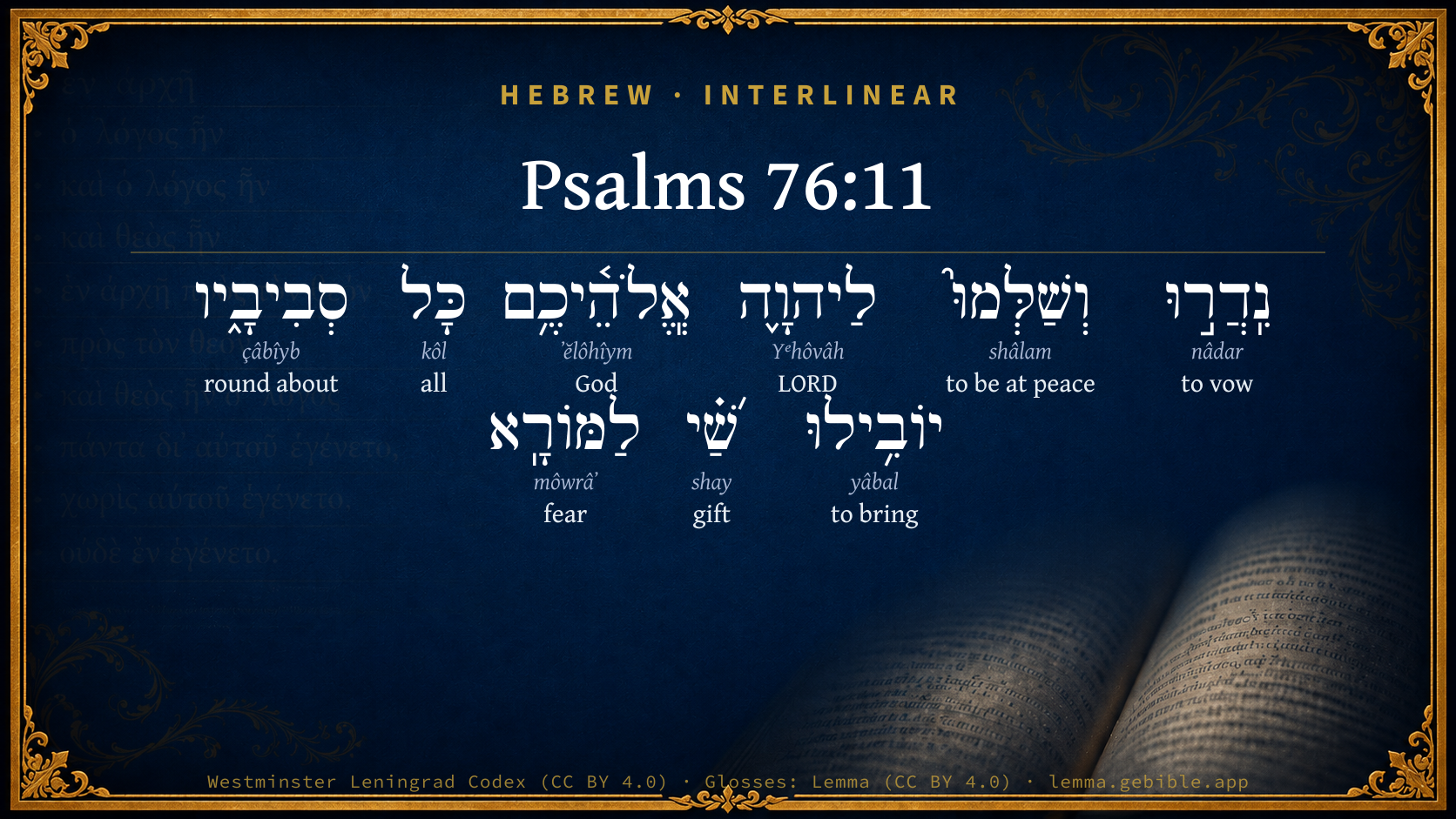
Hebrew (Westminster Leningrad Codex) Psalms 76:11 appears in the Hebrew Old Testament. The text above is from the Westminster Leningrad Codex. Each word links to its Strong’s number, a concise gloss, and parsing drawn from the Open Scriptures Hebrew Bible morphology. Click any word for its full Brown-Driver-Briggs (BDB) entry.
Download image
Cite this verse

Psalms 76:11 (World English Bible). Public Domain. Lemma interlinear Bible study tool, https://lemma.gebible.app/v/psalms/76/11.

Show BibTeX & RIS
BibTeX
RIS
English Translation
Make vows to Yahweh your God, and fulfill them! Let all of his neighbors bring presents to him who is to be feared.
World English Bible · Public Domain
Download a study sheet

One document with this verse’s original text, its word-by-word gloss line, the meaning frame, cross-references with their text, attributed commentary, and full source and license credits — printable, and it pastes into notes with its structure intact.

This verse Autodidact and up

Study sheet (.html) Plain text (.txt)

A passage Seminary Student

Up to 50 verses in one chapter. A passage sheet keeps up to 6 commentary sources and 12 cross-references per verse, in the order this page ranks them, and says so on the sheet whenever that leaves anything out. Ask for a single verse and you get the Autodidact verse sheet above.

Everything on this page stays free to read, with no account — the sheet is a download of what is already on screen, not access to it.

Want to remove ads? Support Godless Engineer
Compare translations 3

The same verse in 3 English versions, stacked beneath the original-language interlinear above. Click any original word for its lexicon entry.

Each is an independent rendering of the whole verse — the interlinear is not word-aligned to these translations.

Highlighted words mark where these versions differ — a whole-verse word diff, not a word-by-word alignment.

  • World English Bible Public Domain
    Make vows to Yahweh your God, and fulfill them! Let all of his neighbors bring presents to him who is to be feared.
  • King James Version Public Domain
    Vow, and pay unto the LORD your God: let all that be round about him bring presents unto him that ought to be feared.
  • unfoldingWord Literal Text CC BY-SA 4.0
    Vow and pay to Yahweh your God; let all who are around him bring a gift to the Fear.

unfoldingWord Literal Text — © unfoldingWord, licensed CC BY-SA 4.0. Word-aligned USFM3 via Door43 (git.door43.org/unfoldingWord/en_ult).

Versions to compare (up to 4)

3 of 4 selected

Show all 18 translations

Every available English version of this verse, each an independent rendering of the whole verse.

  • World English Bible Public Domain
    Make vows to Yahweh your God, and fulfill them! Let all of his neighbors bring presents to him who is to be feared.
  • Berean Standard Bible Public Domain
    Make and fulfill your vows to the LORD your God; let all the neighboring lands bring tribute to Him who is to be feared.
  • Majority Standard Bible Public Domain
    Make and fulfill your vows to the LORD your God; let all the neighboring lands bring tribute to Him who is to be feared.
  • King James Version Public Domain
    Vow, and pay unto the LORD your God: let all that be round about him bring presents unto him that ought to be feared.
  • American Standard Version (1901) Public Domain
    Vow, and pay unto Jehovah your God: Let all that are round about him bring presents unto him that ought to be feared.
  • Revised Version (1885) Public Domain
    Vow, and pay unto the LORD your God: let all that be round about him bring presents unto him that ought to be feared.
  • Geneva Bible (1599) Public Domain
    Vowe and performe vnto the Lord your God, all ye that be rounde about him: let them bring presents vnto him that ought to be feared.
  • Douay-Rheims (1899) Public Domain
    For the thought of man shall give praise to thee: and the remainders of the thought shall keep holiday to thee.
  • Young's Literal Translation Public Domain
    Vow and complete to Jehovah your God, All ye surrounding him. They bring presents to the Fearful One.
  • Literal Standard Version CC BY-SA 4.0
    Vow and complete to your God YHWH, || All you surrounding Him, || They bring presents to the Fearful One.
  • Unlocked Literal Bible CC BY-SA 4.0
    Make vows to Yahweh your God and keep them. May all who surround him bring gifts to him who is to be feared.
  • unfoldingWord Literal Text CC BY-SA 4.0
    Vow and pay to Yahweh your God; let all who are around him bring a gift to the Fear.
  • Darby Bible Public Domain
    Vow and pay unto Jehovah your God: let all that are round about him bring presents unto him that is to be feared.
  • World Messianic Bible Public Domain
    Make vows to the LORD your God, and fulfill them! Let all of his neighbors bring presents to him who is to be feared.
  • Webster's Bible Public Domain
    \\76:10\\Surely the wrath of man shall praise thee: the remainder of wrath wilt thou restrain.
  • Free Bible Version CC BY-SA 4.0
    Make your promises to God and be sure to keep them. Everyone bring gifts to the awe-inspiring one.
  • Bible in Basic English Public Domain
    Give to the Lord your God what is his by right; let all who are round him give offerings to him who is to be feared.
  • JPS Tanakh (1917) Public Domain
    (76-12) Vow, and pay unto the LORD your God; let all that are round about Him bring presents unto Him that is to be feared;

Literal Standard Version (2020), Covenant Press — licensed CC BY-SA 4.0. Text via the HelloAO Bible API (eBible.org). Unlocked Literal Bible (unfoldingWord) — licensed CC BY-SA 4.0. Text via the HelloAO Bible API (eBible.org). unfoldingWord Literal Text — © unfoldingWord, licensed CC BY-SA 4.0. Word-aligned USFM3 via Door43 (git.door43.org/unfoldingWord/en_ult). Free Bible Version, Dr. Jonathan Gallagher — licensed CC BY-SA 4.0. Text via the HelloAO Bible API (eBible.org).

Word by word

More ways to search: Search by grammar → Find every occurrence → Compare this word →

Practice this passage: Drill this verse → Learn its vocabulary →

About this verse

These counts appear in no published source. They are computed here, from the morphology-tagged text and Lemma’s own curated glosses. What Lemma adds →

9
words
9
distinct lemmas
Wisdom
section

Notable vocabulary

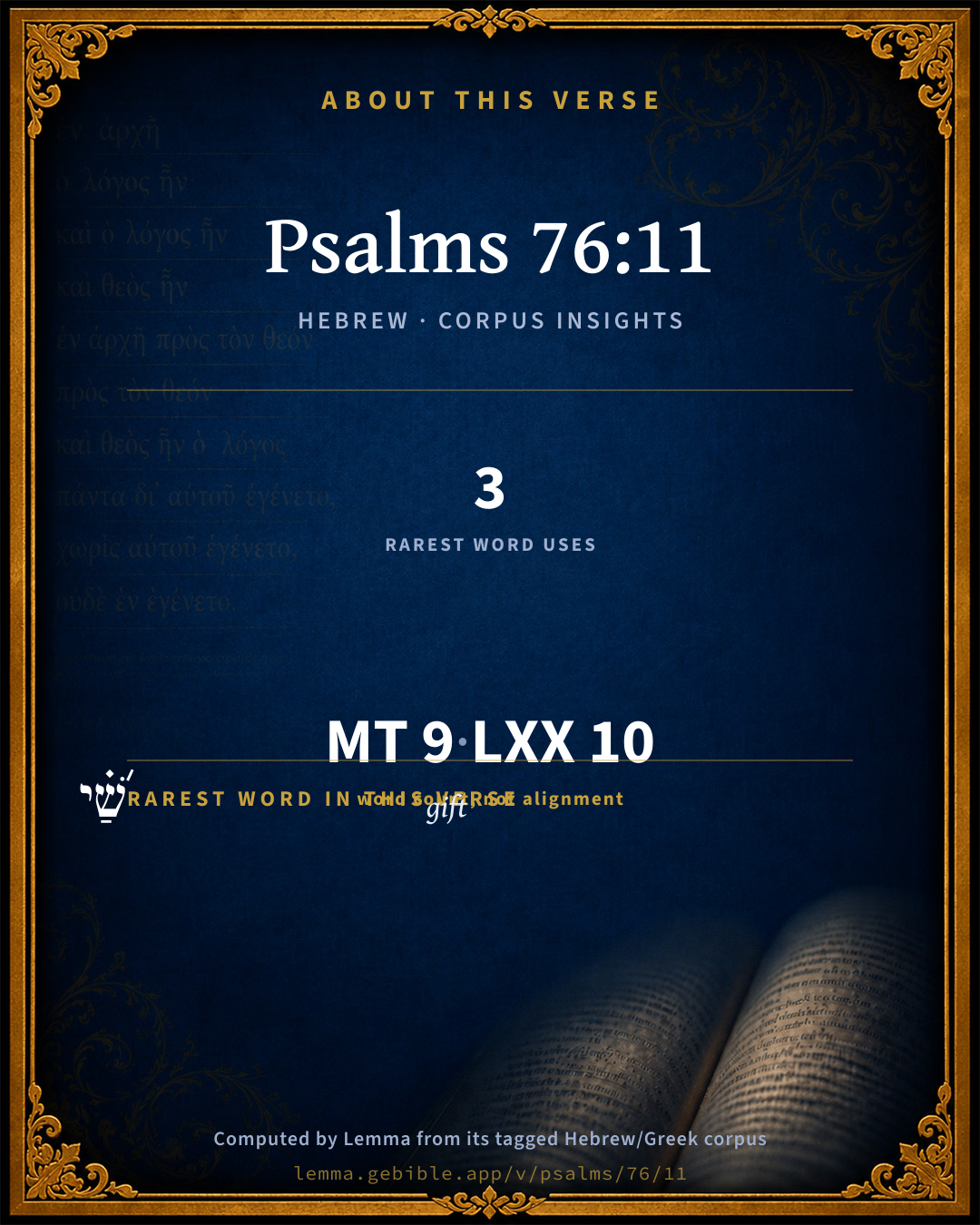
The rarest word here is שַׁ֝֗י gift H7862 — appearing just 3 times in the whole Hebrew Bible.

Shared distinctive vocabulary

שַׁ֝֗י gift H7862 occurs in 3 verses of the Hebrew Bible. Also found in:

Grammatical profile

  • 3 verbs
  • 6 nouns

Verb forms

  • נִֽדֲר֣וּ Qal · Imperative
  • וְשַׁלְּמוּ֮ Piel · Imperative
  • יוֹבִ֥ילוּ Hiphil · Imperfect

Hebrew & Septuagint length

In English translation the verse runs 23 words from the Hebrew and 25 from the Septuagint (LXX English) — closely comparable.

A rough comparison of the two English renderings, which tokenize alike — not a word-level alignment.

Word counts can differ between the Hebrew and the Greek without any difference in meaning — e.g. the Hebrew direct-object marker אֵת has no separate Greek word, and Greek often adds the article ὁ.

In the original languages it is 9 Hebrew tokens and 10 Greek tokens — but the two are counted differently (Hebrew bundles its prefixes and suffixes into one token; the Greek is in lemma form), so that isn’t a like-for-like length.

Cross-references

9

Topical passages linked to Psalms 76:11 in the Treasury of Scripture Knowledge — connected by theme and wording, ordered by reader-vote popularity; previews shown in the World English Bible.

  • Ecclesiastes 5:4–6 When you vow a vow to God, don't defer to pay it; for he has no pleasure in fools. Pay that which you vow.
  • Psalms 50:14 Offer to God the sacrifice of thanksgiving. Pay your vows to the Most High.
  • Psalms 68:29 Because of your temple at Jerusalem, Kings shall bring presents to you.
  • Genesis 31:42 Unless the God of my father, the God of Abraham, and the fear of Isaac, had been with me, surely now you would have sent me away empty. God has seen my affliction and the labor of my hands, and rebuked you last night."
  • Psalms 89:7 A very awesome God in the council of the holy ones, To be feared above all those who are around him?
  • Numbers 30:2 When a man vows a vow to Yahweh, or swears an oath to bind his soul with a bond, he shall not break his word; he shall do according to all that proceeds out of his mouth.
  • Deuteronomy 16:16 Three times in a year shall all your males appear before Yahweh your God in the place which he shall choose: in the feast of unleavened bread, and in the feast of weeks, and in the feast of tents; and they shall not appear before Yahweh empty:
  • 2 Chronicles 32:22–23 Thus Yahweh saved Hezekiah and the inhabitants of Jerusalem from the hand of Sennacherib the king of Assyria, and from the hand of all [others], and guided them on every side.
  • Psalms 119:106 I have sworn, and have confirmed it, That I will obey your righteous ordinances.

Cross-references courtesy of OpenBible.info (CC BY 4.0).

Hebrew and Greek witnesses Masoretic Hebrew ↔ Greek Septuagint

The same verse in the two great witnesses to the Old Testament, shown verse-for-verse.

You’re reading Greek Psalm 75 (Hebrew Psalm 76). The Septuagint counts the superscription, so verse numbers can differ from the Hebrew — chapter-level alignment, not verse-by-verse. Numbering follows Rahlfs.

These are two independent witnesses, not word-aligned to each other, and the Septuagint is shown in lemma (dictionary) form.

Hebrew Psalms 76:11 Masoretic · Westminster Leningrad Codex

נִֽדֲר֣וּ וְשַׁלְּמוּ֮ לַיהוָ֪ה אֱֽלֹהֵ֫יכֶ֥ם כָּל סְבִיבָ֑יו יוֹבִ֥ילוּ שַׁ֝֗י לַמּוֹרָֽא

Make vows to Yahweh your God, and fulfill them! Let all of his neighbors bring presents to him who is to be feared.

World English Bible · Public Domain

Greek LXX Greek Psalm 75:11 Septuagint · lemma form

ὅτι ἐνθύμιος ἄνθρωπος ἐκὁμολογέω σύ καί ἐγκατάλειμμα ἐνθυμίου ἑορτάζω σύ

Vow, and pay your vows to the Lord our God; all that are round about him shall bring gifts, even to him that is terrible,

LXX2012 (modern English Septuagint) · Public Domain

Hebrew: Westminster Leningrad Codex (CC BY 4.0). Greek: Septuagint (public domain); English from LXX2012 (modern English Septuagint) (Public Domain). How the Septuagint differs from the Hebrew →

Commentary

Notes on Psalms 76:11 from classic Christian and Jewish commentators (each source and its license shown beneath its notes). The classic Christian expositions comment on the surrounding passage and are grouped to its opening verse, so a note may address several verses; the Jewish commentaries on the Tanakh (Rashi and others) are per-verse, so they appear only where the commentator wrote on this verse.

Lemma curates 59 commentaries, every one of them public domain or Creative Commons licensed, each selected and text-cleaned for this edition rather than reprinted as found. About our sources →

Trapp's Complete Commentary

John Trapp

Psa 76:11 Vow, and pay unto the LORD your God: let all that be round about him bring presents unto him that ought to be feared.

Ver. 11. Vow, and pay to the Lord] A plain precept; and yet Bellarmine saith, Vovere nusquam est praeceptum. As for vowing to saints, he granteth, that when the Scriptures were written the Church had no such custom (Lib. ii. de Monach. cap. 17; De Cult. Sanetor. cap. 9). Saint worship then is but new worship.

Let all that be round about him] All the neighbouring nations; and so they did, after Assyria’s overthrow, 2Ch 32:21; 2Ch 32:23.

To him that ought to be feared] Heb. to fear, that is, to God, the proper object of fear, called therefore fear, by an appellative property.

John Trapp, A Commentary or Exposition upon All the Books of the Old and New Testament (1647–1656) — public domain. Text from a community e-Sword module.

Joseph Benson's Commentary

Psa 76:11. Vow unto the Lord — Vow a sacrifice of thanksgiving; either at this time, for this wonderful deliverance, or hereafter, in all your future straits and troubles: let this experience encourage you to make such vows to God with confidence of success. And pay — But when God hath accepted your vows, and given you the desired deliverance, forget not to pay your vows. Let all that be round about him — All the tribes of Israel, who have the benefit of this mercy: or, rather, all the neighbouring nations, on every side, to whom the fame of this mighty work of God hath or shall come; bring presents — I advise them, for the future, if they love themselves, to cease from all hostilities against Jehovah and his people, and to submit themselves to the God of Israel; unto him that ought to be feared — Whom, though they do not love, yet they see and feel that they have great reason to fear, and to seek his favour.

Joseph Benson's Commentary on the Old and New Testaments (1811–1818) — public domain. Text from a community e-Sword module.

J. A. Alexander on Psalms

Joseph Addison Alexander

12. (Psa 76:11). Vow and pay unto Jehovah your God, all (ye that are) round about him; let them bring tribute to the Dread (One). The first clause may be understood to mean, pay now what you have vowed before, i.e. before the great deliverance and during the impending danger. The addition of your God shews that the object of address is Israel. Compare Deu 23:21. According to the masoretic interpunction, all that are round about him belongs to the first clause, and denotes the host of Israel, in the midst of whom Jehovah's tent was pitched (Num 2:2). The English Bible, following the ancient versions, throws these words into the last clause, as the subject of the verb that follows, let all that are round about him bring presents, or they shall bring presents. This last word in Hebrew denotes tribute from the conquered or dependent to the conqueror or sovereign. See above, on Psa 68:29, and compare Isa 18:7. This was literally verified in the case of Hezekiah's rescue from the power of Sennacherib. See 2Ch 32:23. God is here called Fear or Terror, as an object to be reverenced or dreaded. Compare the similar expressions in Isa 8:12-13.

Joseph Addison Alexander, The Psalms Translated and Explained (1850) — public domain. Text from a community e-Sword module.

Geneva Bible (1599)

Geneva Bible translators

To wit, the Levites, that dwell about the Tabernacle, or the people among whom he doth dwell.

Geneva Bible (1599) marginal notes — public domain. Text via Bolls.life.

Adam Clarke's Commentary

Verse 11. Vow, and pay unto the Lord] Bind yourselves to him, and forget not your obligations.

Let all that be round about him] All the neighbouring nations, who shall see God's judgments against his enemies, should

Bring presents unto him] Give him that homage which is due unto him.

That ought to be feared.] למורא lammora, "to the terrible One;" lest they be consumed as the Assyrians have been.

Adam Clarke's Commentary on the Bible (1810–1826) — public domain. Text from a community e-Sword/MySword module.

John Calvin's Commentaries

11. Vow and pay to Jehovah your God. The faithful are now exhorted to the exercise of gratitude. As under the law the custom prevailed among the Jews of vowing sacrifices for singular blessings which God had conferred upon them, by which they solemnly acknowledged that their safety depended solely upon him, and that to him they were entirely indebted for it, they are called anew to engage in this exercise of religion; and by the word pay it is intended to inculcate steadfastness, — to teach them that they should not make merely a sudden and inconsiderate acknowledgement, but that they should also testify at all times that the remembrance of their deliverance was deeply fixed in their hearts. Their most important business, no doubt, was seriously to reflect with themselves that God was the author of their salvation; but still it is to be observed, that the solemn profession of religion, by which every man stimulates not only himself but also others to the performance of their duty, is far from being superfluous. In the second clause, those addressed seem to be the neighboring nations; as if it had been said, that such a special manifestation of the goodness of God was worthy of being celebrated even by foreign and uncircumcised nations. But it appears to me, that the sense most agreeable to the context is, that these words are addressed either to the Levites or to all the posterity of Abraham, both of whom are not improperly said to be round about God, both because the tabernacle was pitched in the midst of the camp so long as the Israelites traveled in the wilderness, and also because the resting-place assigned for the ark was mount Zion, whither the people were accustomed to resort from all the surrounding parts of the country. And the Levites had intrusted to them the charge of the temple, and were appointed to keep watch and ward round about it. The word למורא, lammora, is referred to God by the majority of interpreters, and they translate it terrible. The term fear is, however, sometimes taken in a passive sense for God himself. If it is applied to the Gentiles and to irreligious men, the sense will be, that they shall be tributaries to God; because, being stricken with fear, they shall no longer dare to offer him any resistance. But it is more probable that this word has a reference to God, whom the prophet justly declares to be worthy of being feared, after having given such a remarkable proof of his power.

John Calvin's Commentaries (1540-1563) — public domain. Text from the Calvin Translation Society English edition (1840s-50s) via the Christian Classics Ethereal Library (ccel.org). Calvin's coverage is partial (roughly two-thirds of the Bible); uncommented books and verses are honest gaps, never fabricated. The 19th-century editor's footnotes and remarks are omitted so the notes are faithfully Calvin's own voice.

Ellicott's Commentary for English Readers

(11) Vow, and pay . . .—This clause seems to be addressed to the Israelites, the next to the heathen.

A Bible Commentary for English Readers, edited by Charles John Ellicott (1878–1897) — public domain. Text from a community e-Sword module.

The Cambridge Bible for Schools and Colleges

gen. ed. J. J. S. Perowne

11. Let Israel pay the vows it made in its hour of peril (Psa_66:13); let the nations that dwell near God’s city and people bring their presents—a phrase used only of bringing solemn tribute to God (Psa_68:29; Isa_18:7). “Many,” we read in 2Ch_32:23, “brought gifts unto Jehovah to Jerusalem,” after the great deliverance.

unto him that ought to be feared] Lit. unto the fear, the same word as in Isa_8:13.

The Cambridge Bible for Schools and Colleges (gen. ed. J. J. S. Perowne; Cambridge University Press, 1878–1918) — public domain. Text from a community e-Sword module.

John Gill's Exposition

Vow, and pay unto the Lord your God,.... Not monastic vows, which the Papists would infer from these and such like words; nor ceremonial ones, but spiritual sacrifices of praise and thanksgiving, such as men sometimes make in times of distress, or when delivered, Psa 66:13 and which when vowed ought to be paid, Ecc 5:4, not to creatures, angels, or saints, but to God, from whom the mercy desired must be expected, and from whence it comes, Psa 50:14, these words are an address to such who were delivered from wrath, either of God or man:

let all that be round about him; who surround the throne of his grace, gather together in his house to attend his word and ordinances, who are his servants, and constantly and faithfully adhere to him; among whom he grants his presence, they are near to him, and he to them. It is a periphrasis of the assembly of the saints; see Psa 89:7. The Targum is,

"all ye that dwell round about his sanctuary;''

the allusion is to the situation of the camp of Israel, and the tabernacle in the wilderness, Num 2:1 compare with this Rev 4:4,

bring presents unto him that ought to be feared, or "to the fear" (f), which is one of the names of God; see Gen 31:42 and who is and ought to be the object of the fear and reverence of men; the "presents", to be brought to him are the sacrifices of prayer and praise, yea, the whole persons, the souls and bodies, of men; see Psa 72:10, compare with this Ch2 32:22. The Targum is,

"let them bring offerings into the house of the sanctuary of the terrible One;''

of him that is to be feared, with a godly fear by good men, and to be dreaded by evil men, as follows.

(f) "ad verb terrori, timori", Vatsblus; "numini", De Dieu, "venerando et timendo huic numini", Michaelis; so Ainsworth.

John Gill's Exposition of the Whole Bible (1746–1763) — public domain (CC PDM 1.0). Text via the HelloAO Bible API.

Albert Barnes' Notes on the Bible

vow, and pay unto the Lord your God - That is, Pay your vows, or sacredly observe them. On the word “vow,” see the notes at Psa 22:25. Compare Psa 50:14; Psa 56:12; Psa 66:13. The word refers to a voluntary promise made to God.

Let all that be round about him - All that worship him, or that profess to honor him.

Bring presents - Bring gifts or offerings; things expressive of gratitude and homage. See the notes at Psa 45:12. Compare Isa 16:1, note; Isa 18:7, note; Isa 60:5, note.

Unto him that ought to be feared - Margin, “to fear.” The meaning would be well expressed by the word dread; “to the Dread One.” It was not to inspire fear that the presents were to be brought; but they were to be brought to One who had shown that he was the proper object of dread or reverence.

Albert Barnes' Notes on the Bible (1834–1885) — public domain. Text from a community e-Sword/MySword module.

Matthew Poole's English Annotations

Vow a sacrifice of thanksgiving; either at this time, for this wonderful deliverance; or hereafter, in all your future straits and troubles. Let this experience encourage you to make such vows to God with confidence of success. But when God hath accepted your vows, and given you the desired deliverance, forget not to pay your vows.

All that be round about him; either,

1. All the tribes of Israel, who have the benefit of this mercy. Or rather,

2. All the neighbouring nations on every side, to whom the fame of this mighty work of God shall come, I advise them for the future, if they love themselves, to cease from all hostilities against God or his people, and to submit themselves to the God of Israel.

Him that ought to be feared; whom though they do not love, yet they see and feel that they have great reason to fear and to seek his favour.

Matthew Poole's English Annotations on the Holy Bible (1683–1685) — public domain. Text from a community e-Sword/MySword module.

The Treasury of David

Charles H. Spurgeon

Ver. 11. Vow, and pay unto the Lord your God. Well may we do so in memory of such mercies and judgments. To vow or not is a matter of choice, but to discharge our vows is our bounden duty. He who would defraud God, his own God, is a wretch indeed. He keeps his promises, let not his people fail in theirs. He is their faithful God and deserves to have a faithful people.

Let all that be round about him bring presents unto him that ought to be feared. Let surrounding nations submit to the only living God, let his own people with alacrity present their offerings, and let his priests and Levites be leaders in the sacred sacrifice. He who deserves to be praised as our God does, should not have mere verbal homage, but substantial tribute. Dread Sovereign, behold I give myself to thee.

Whole Psalm. No Psalm has a greater right to follow Psalm 75 than this, which is inscribed To the Precentor, with accompaniment of stringed instruments (vid. iv. 1), a Psalm by Asaph, a song. Similar expressions (God of Jacob, Ps 75:10 77:7; saints, wicked of the earth, Ps 75:9 76:10), and the same impress throughout speak in favour of unity of authorship. In other respects too, they form a pair: Psalm 75 prepares the way for the divine deed of judgments as imminent, which Psalm 76 celebrates as having taken place. Franz Delitzsch.

Ver. 11. Round about him. A description of his people, as the twelve tribes pitched round about the tabernacle, Nu 2:2; and the twenty-four elders were round about God's throne, Re 4:4. So the Chaldee expounds it; --Ye that dwell about his sanctuary. Henry Ainsworth.

Ver. 11.

I. To whom vows may be made. Not to man, but God.

II. What vows should be thus made.

1. Of self dedication.

2. Of self service.

3. Of self sacrifice. III. How kept: Vow and pay.

1. From duty.

2. From fear of his displeasure. G. R.

Ver. 11. The propriety, obligation, pleasure, and profit of presenting gifts unto the Lord.

Psalms 76:12*

Charles H. Spurgeon's The Treasury of David (1869–1885) — public domain. Psalms only. Text from a community e-Sword/MySword module.

Whedon's Commentary on the Bible

Daniel D. Whedon

11. Vow, and pay unto the Lord—As the fittest return for all his benefits. Psa_116:12-14; Hos_14:2.

Bring presents unto him— According to Asiatic custom, taxes and tribute often take the form of presents, which the governors of provinces bring to their sovereign. They are a token of submission and loyalty. Thus, those who “brought no presents to Saul,” refused to acknowledge him as their king. 1Sa_10:27. See Psa_68:29; Psa_72:10. The invasion of Sennacherib had been brought on by Hezekiah’s having cast off the tributary yoke of Assyria, which Ahaz, his father, had wickedly assumed, and, in doing so, had revolted from Jehovah. Hezekiah now exhorts the nation to bring tribute to Jehovah, their only lawful sovereign. 2 Kings 16; 2Ch_28:16-25; Isa_7:1-12.

Round about him—That is, the surrounding nations on every side of Judea. Let Jehovah be confessed by them and by all people to be the supreme God. And such should have been the effect of this miracle, especially in regard to Assyria; but it failed, as had also the preaching of Jonah about one hundred years before. To-day men are digging out the buried ruins of Nineveh, the proud capital, from the overlaying mounds of rubbish by which its very site had been lost from history; and among its inscribed and sculptured stone slabs are found the records and memorials of this same Sennacherib, his war with Hezekiah, and his siege of Lachish.

Daniel D. Whedon (gen. ed.), Commentary on the Old and New Testaments (1874–1909) — public domain. Text from a community e-Sword module.

The Pulpit Commentary

Vow, and pay unto the Lord your God. The people of Israel are now addressed. Under the circumstances, they are sure to have made vows to God in the time of their great trouble, before the deliverance came. Now, when the deliverance has come, let them pay these vows. Let all that be round about him bring presents unto him that ought to be feared; literally, unto the Terrible One. By "all that are round about him" the psalmist seems to mean, not Israel only, but those other oppressed ones who had shared the benefit of the deliverance (comp. ver. 9). That presents were brought by some of these is recorded by the writer of Chronicles. (2Ch_32:23)

Following up our vows.

"Vow, and pay unto the Lord your God." Vows were formal promises or engagements made in acknowledgment of Divine mercies, or as conditions on which Divine help was sought. They are illustrated by Jacob"s vow after the vision at Bethel; by King Saul"s vow at Michmash; Absalom"s vow which was made the excuse for starting his revolt; St. Paul"s vow, which explained his presence in the temple courts, etc. The vows of the olden time are precisely represented by our solemn resolves, our good resolutions, which become promises and pledges of what we will do. The psalmist found out, what we have all found out through our own experiences, that it is easy to make vows and promises, and to take solemn pledges, but far easier to neglect them and let them go unfulfilled. Therefore in moments of awakened feeling, he exclaims, "I will pay my vows unto the Lord," and he advises God"s people to "vow and pay to follow up their vows, and never to rest until they are fulfilled. It may be well to note what is the mission of vows. They are helpful in strengthening the will. A purpose may be formed which will stand but little testing, and exert but feeble influence. We strengthen that purpose if, in relation to it, we take open pledge, we make solemn promise. Our own inward purpose may be easily forgotten; no one knows about it but ourselves, and so its power of influence on us is small. Turn our purpose into a public vow, and we are helped by remembering that others, and God, expect us to be faithful to our word. How has it been with the vows we have made in the past? Have we joined "vowing" and "paying"?

I OUR VOWS AT CONFIRMATION, AND UNION WITH CHRIST"S CHURCH.

II OUR VOWS ON BIRTHDAYS, NEW YEAR DAYS, ETC.

III OUR VOWS WHEN ENTERING ON NEW LIFE RELATIONSHIPS MARRIAGE, ETC.

IV OUR VOWS ON RESCUE FROM PERILS, OR RECOVERY FROM SICKNESS.

Thinking over all these vows, who among us can fail to be impressed by the thought of how much is unpaid, and how much we owe to God? Never have we had a year of life in which our payment of vows matched our New Year promises. What a heap of unpaid vows the years have piled up! What a heap of imperfectly paid vows! Very seldom, indeed, have our vows been fully kept; and we search our lives almost in vain to find any single instances in which we have done better than we vowed. It is important that we should have solemn opportunities for calling our vows to remembrance, such as sacramental seasons provide. So we may be set on new efforts to "pay our vows. R.T.

The Pulpit Commentary (1880–1919), ed. H.D.M. Spence-Jones & Joseph S. Exell — public domain. Text from a community e-Sword module.

John Wesley's Explanatory Notes

Vow - A sacrifice of thanksgiving for this wonderful deliverance. Let all - All the neighbouring nations submit to the God of Israel.

John Wesley, Explanatory Notes Upon the Whole Bible (1754–1765) — public domain. Text via the GEBible commentary corpus.

unfoldingWord translationNotes

Door43 World Missions Community

him who is to be feared

"Yahweh, whom they should fear"

He cuts off the spirit of the princes

The phrase "He cuts off the spirit" is an idiom that means He breaks the spirit or He humbles. AT: "He humbles the princes" (See: Idiom)

he is feared by the kings of the earth

This can be stated in active form. AT: "the kings of the earth fear him" (See: Active or Passive)

translationWords

vow

gift

fear

humble

spirit

prince

king

unfoldingWord translationNotes — © Distant Shores Media and the Door43 World Missions Community, licensed CC BY-SA 4.0. Source: git.door43.org/Door43/en_tn.

Rashi

Rabbi Shlomo Yitzchaki (Rashi)

For man’s anger will thank you The anger of the wicked results in the creatures thanking the Holy One, blessed be He. When they show their anger and the Holy One, blessed be He, punishes them, everyone praises Him when they see that their anger is of no avail. As we find (Dan. 3:28) concerning Nebuchadnezzar, when he cast Hananiah, Mishael, and Azariah into the fiery furnace, what is said there? “Blessed be the God of Shadrach, etc.” And thereby...it will prevent the residue of wrath Heb. תחגר. It will prevent and stop; the remaining wicked men are prevented and restrained from showing their pride and their wrath. תחגר is an expression of restraint in the language of the Mishnah (Chul. 18a): “The nick in a knife must be deep enough to catch (תחגר) the nail to disqualify it from slaughtering].” I heard in the name of Rabbi Eleazar the Gaon, the son of Rabbi Isaac, who brought this verse as testimony to that Mishnah (sic). It is also possible to interpret this according to its usual meaning of an expression of girding, and can be explained as follows: It is fitting for You to gird Yourself with wrath and to enwrap Yourself with zeal, for strength and ability are Yours; the expression of “residue” is that since man’s wrath is of no account, the girding of all wrath is reserved for You.

Rashi on the Tanakh — English translations: “The Judaica Press complete Tanach with Rashi, translated by A. J. Rosenberg” (CC BY 4.0); “Pentateuch with Rashi's commentary by M. Rosenbaum and A.M. Silbermann, 1929-1934” (public domain); “The Metsudah Tanach series, Lakewood, N.J” (CC BY 4.0); and “The Book of Joshua, Metsudah Publications, 1997” (CC BY 4.0). Text via Sefaria.

Lesson kit

Teaching starters — assembled from the data on this page, not authored interpretation. Every prompt links to the verse data it draws on. Edit before teaching.

Psalms, in the Wisdom, opens this verse with 9 words (9 distinct Hebrew lemmas). Its most distinctive word is shay (“gift”). A historical commentator’s framing appears above. Read the whole chapter for the surrounding context.

Discussion questions

  1. What does “gift” (shay) contribute to the verse as a whole?
  2. How does Psalms 68:29, which shares the word «gift», read alongside this verse?
  3. These translations render this verse differently; the difference is in the English rendering, not the original. What questions does that raise?
  4. «נִֽדֲר֣וּ» is a Qal Imperative verb. How does that grammatical form shape the action described?
  5. Compare how Trapp's Complete Commentary and Joseph Benson's Commentary read this verse. Where do they agree or differ?

Things to notice

Reading settings

Reading text

Shown beneath each verse's original-language words.

Old Testament
Old Testament edition

Read the OT as the Masoretic Hebrew (MT) or the Greek Septuagint (LXX).

English shown for the Greek Septuagint (in the Hebrew ↔ Greek comparison).

Comparing translations? Open the Compare panel on any verse page to stack up to four side by side.