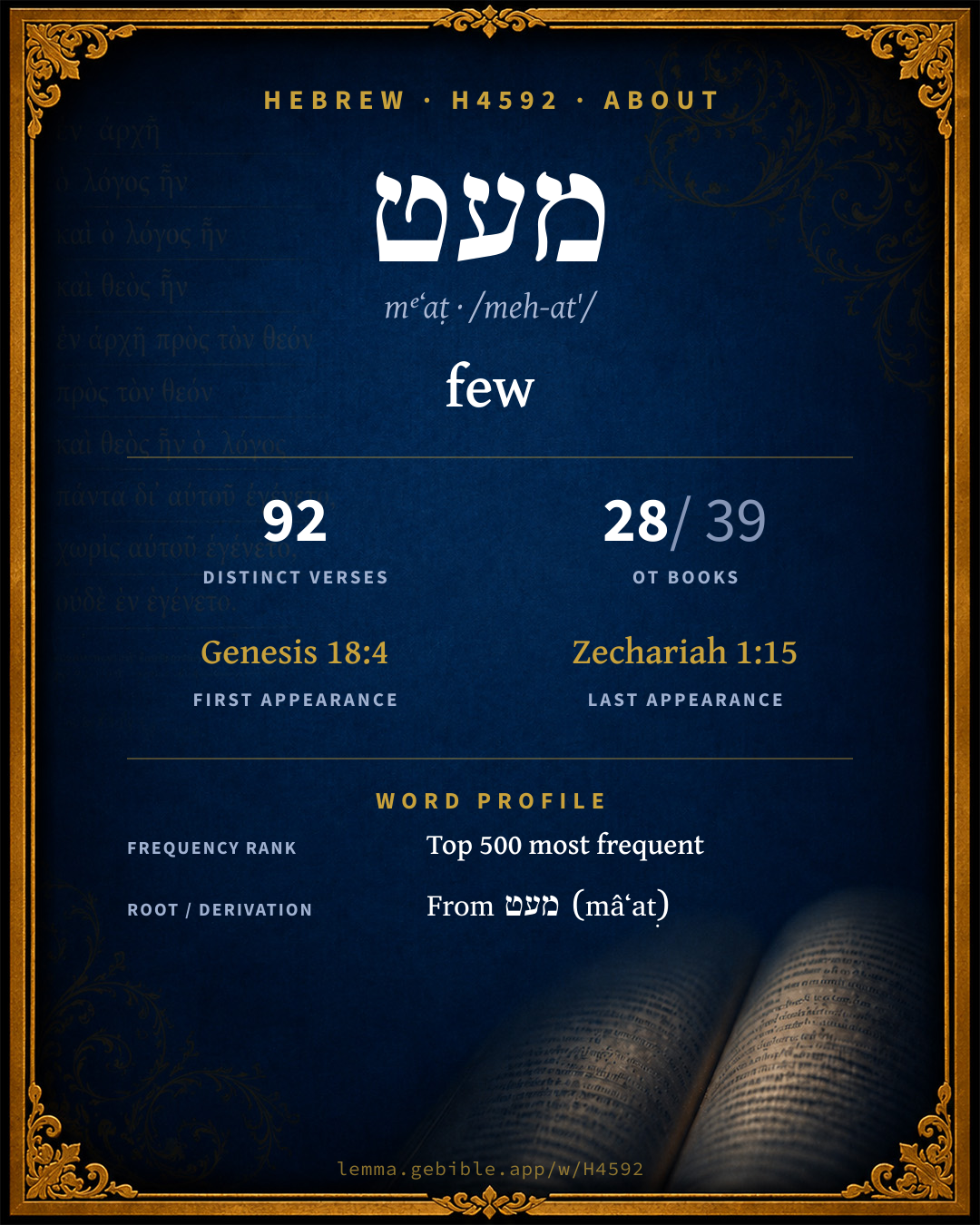
מְעַט
few
also: littleness, a little, fewness fuller range ↓
Full lexicon entry — Brown-Driver-Briggs (BDB)
From Brown-Driver-Briggs (BDB)
Where this word appears
See every Absolute-state word in the Hebrew Bible →
Grammar key — what these labels mean
Part of speech
- Noun
- A naming word — a person, place, thing, or idea.
- Adjective
- A word that describes or qualifies a noun.
- Adverb
- A word that modifies a verb, adjective, or other adverb.
Noun type
- Common
- A common noun — a general class of person, place, or thing (“king,” “city,” “water”), not a specific name.
State
- Absolute
- The independent form of a noun, not bound to a following word.
- Construct
- A noun bound to a following noun in a possessive / “of” relationship (the construct chain).
Gender
- Masculine
- Grammatically masculine.
Number
- Singular
- One.
- Plural
- More than one (in Hebrew, generally three or more).
Grammatical forms
- Noun, Common, Masculine, Singular, Absolute 57 times (56%)
- Noun, Common, Masculine, Singular, Construct 23 times (23%)
- Adjective, Adjective, Masculine, Singular, Absolute 14 times (14%)
- Adverb 5 times (5%)
- Adjective, Adjective, Masculine, Plural, Absolute 2 times (2%)
Parsed forms decoded from the imported morphology (morphhb / Westminster Leningrad Codex — WLC text public domain, morphhb tagging CC BY 4.0), counted across 101 parsed occurrences — not distinct verses.
Every verse where H4592 appears — 92 distinct verses across 28 books. Click any verse to open its interlinear word-by-word view. Verse text shown in the World English Bible for context — . Each verse’s Hebrew form is shown with its reference; the English is not keyword-highlighted, since the data carries no word-level English alignment. Use “Compare translations” on any verse to read it across multiple English versions. This concordance covers the Hebrew Bible; Septuagint (Greek Old Testament) occurrences are not indexed here.
Genesis 10 verses
- Genesis 18:4 מְעַט n c ms cs Now let a little water be fetched, wash your feet, and rest yourselves under the tree.
- Genesis 24:17 מְעַט n c ms cs The servant ran to meet her, and said, "Please give me a drink, a little water from your pitcher."
- Genesis 24:43 מְעַט n c ms cs Behold, I am standing by the spring of water. Let it happen, that the maiden who comes forth to draw, to whom I will say, Give me, I pray you, a little water from your pitcher to drink.
- Genesis 26:10 כִּ֠/מְעַט prep + n c ms Abimelech said, "What is this you have done to us? One of the people might easily have lain with your wife, and you would have brought guilt on us!"
- Genesis 30:15 הַ/מְעַט֙ ptcl inter + n c ms She said to her, "Is it a small matter that you have taken away my husband? Would you take away my son's mandrakes, also?" Rachel said, "Therefore he will lie with you tonight for your son's mandrakes."
- Genesis 30:30 מְעַט֩ n c ms For it was little which you had before I came, and it has increased to a multitude. Yahweh has blessed you wherever I turned. Now when will I provide for my own house also?"
- Genesis 43:2 מְעַט n c ms cs It happened, when they had eaten up the grain which they had brought out of Egypt, their father said to them, "Go again, buy us a little more food."
- Genesis 43:11 מְעַ֤ט וּ/מְעַ֣ט n c ms cs conj + n c ms cs Their father, Israel, said to them, "If it be so now, do this. Take from the choice fruits of the land in your bags, and carry down a present for the man, a little balm, a little honey, spices and myrrh, nuts, and almonds;
- Genesis 44:25 מְעַט n c ms cs Our father said, 'Go again, buy us a little food.'
- Genesis 47:9 מְעַ֣ט n c ms Jacob said to Pharaoh, "The days of the years of my pilgrimage are one hundred thirty years. Few and evil have been the days of the years of my life, and they have not attained to the days of the years of the life of my fathers in the days of their pilgrimage."
Exodus 2 verses
Leviticus 1 verse
Numbers 7 verses
- Numbers 13:18 הַ/מְעַ֥ט ptcl inter + Adjective Adjective ms and see the land, what it is; and the people who dwell therein, whether they are strong or weak, whether they are few or many;
- Numbers 16:9 הַ/מְעַ֣ט ptcl inter + n c ms [seems it but] a small thing to you, that the God of Israel has separated you from the congregation of Israel, to bring you near to himself, to do the service of the tent of Yahweh, and to stand before the congregation to minister to them;
- Numbers 16:13 הַ/מְעַ֗ט ptcl inter + n c ms is it a small thing that you have brought us up out of a land flowing with milk and honey, to kill us in the wilderness, but you must needs make yourself also a prince over us?
- Numbers 26:54 וְ/לַ/מְעַ֕ט conj + prep det + Adjective Adjective ms To the more you shall give the more inheritance, and to the fewer you shall give the less inheritance: to everyone according to those who were numbered of him shall his inheritance be given.
- Numbers 26:56 לִ/מְעָֽט prep + Adjective Adjective ms According to the lot shall their inheritance be divided between the more and the fewer.
- Numbers 33:54 וְ/לַ/מְעַט֙ conj + prep det + Adjective Adjective ms You shall inherit the land by lot according to your families; to the more you shall give the more inheritance, and to the fewer you shall give the less inheritance: wherever the lot falls to any man, that shall be his; according to the tribes of your fathers shall you inherit.
- Numbers 35:8 הַ/מְעַ֖ט ptcl def.art + Adjective Adjective ms Concerning the cities which you shall give of the possession of the children of Israel, from the many you shall take many; and from the few you shall take few: everyone according to his inheritance which he inherits shall give of his cities to the Levites.
Deuteronomy 5 verses
- Deuteronomy 7:7 הַ/מְעַ֖ט ptcl def.art + n c ms Yahweh didn't set his love on you, nor choose you, because you were more in number than any people; for you were the fewest of all peoples:
- Deuteronomy 7:22 מְעַ֣ט מְעָ֑ט adv adv Yahweh your God will cast out those nations before you by little and little: you may not consume them at once, lest the animals of the field increase on you.
- Deuteronomy 26:5 מְעָ֑ט n c ms You shall answer and say before Yahweh your God, A Syrian ready to perish was my father; and he went down into Egypt, and sojourned there, few in number; and he became there a nation, great, mighty, and populous.
- Deuteronomy 28:38 וּ/מְעַ֣ט conj + n c ms You shall carry much seed out into the field, and shall gather little in; for the locust shall consume it.
- Deuteronomy 28:62 מְעָ֔ט n c ms You shall be left few in number, whereas you were as the stars of the sky for multitude; because you didn't listen to the voice of Yahweh your God.
Joshua 2 verses
- Joshua 7:3 מְעַ֖ט n c ms They returned to Joshua, and said to him, Don't let all the people go up; but let about two or three thousand men go up and strike Ai; don't make all the people to toil there; for they are but few.
- Joshua 22:17 הַ/מְעַט ptcl inter + Adjective Adjective ms Is the iniquity of Peor too little for us, from which we have not cleansed ourselves to this day, although there came a plague on the congregation of Yahweh,
Judges 1 verse
Ruth 1 verse
1 Samuel 4 verses
- 1 Samuel 14:6 בִ/מְעָֽט prep + Adjective Adjective ms Jonathan said to the young man who bore his armor, Come, and let us go over to the garrison of these uncircumcised: it may be that Yahweh will work for us; for there is no restraint to Yahweh to save by many or by few.
- 1 Samuel 14:29 מְעַ֖ט n c ms cs Then said Jonathan, My father has troubled the land. Please look how my eyes have been enlightened, because I tasted a little of this honey.
- 1 Samuel 14:43 מְעַ֥ט n c ms cs Then Saul said to Jonathan, Tell me what you have done. Jonathan told him, and said, I did certainly taste a little honey with the end of the rod that was in my hand; and, behold, I must die.
- 1 Samuel 17:28 מְעַ֨ט n c ms cs Eliab his eldest brother heard when he spoke to the men; and Eliab's anger was kindled against David, and he said, Why are you come down? and with whom have you left those few sheep in the wilderness? I know your pride, and the naughtiness of your heart; for you have come down that you might see the battle.
2 Samuel 3 verses
- 2 Samuel 12:8 מְעָ֔ט n c ms I gave you your master's house, and your master's wives into your bosom, and gave you the house of Israel and of Judah; and if that would have been too little, I would have added to you many more such things.
- 2 Samuel 16:1 מְעַט֙ n c ms When David was a little past the top [of the ascent], behold, Ziba the servant of Mephibosheth met him, with a couple of donkeys saddled, and on them two hundred loaves of bread, and one hundred clusters of raisins, and one hundred summer fruits, and a bottle of wine.
- 2 Samuel 19:36 כִּ/מְעַ֞ט prep + n c ms Your servant would but just go over the Jordan with the king: and why should the king recompense it me with such a reward?
1 Kings 2 verses
- 1 Kings 17:10 מְעַט n c ms cs So he arose and went to Zarephath; and when he came to the gate of the city, behold, a widow was there gathering sticks: and he called to her, and said, Please get me a little water in a vessel, that I may drink.
- 1 Kings 17:12 וּ/מְעַט conj + n c ms cs She said, As Yahweh your God lives, I don't have a cake, but a handful of meal in the jar, and a little oil in the jar: and, behold, I am gathering two sticks, that I may go in and bake it for me and my son, that we may eat it, and die.
2 Kings 1 verse
1 Chronicles 1 verse
2 Chronicles 2 verses
- 2 Chronicles 12:7 כִּ/מְעַט֙ prep + n c ms When Yahweh saw that they humbled themselves, the word of Yahweh came to Shemaiah, saying, They have humbled themselves: I will not destroy them; but I will grant them some deliverance, and my wrath shall not be poured out on Jerusalem by the hand of Shishak.
- 2 Chronicles 29:34 לִ/מְעָ֔ט prep + Adjective Adjective ms But the priests were too few, so that they could not flay all the burnt offerings: therefore their brothers the Levites helped them, until the work was ended, and until the priests had sanctified themselves; for the Levites were more upright in heart to sanctify themselves than the priests.
Ezra 1 verse
Nehemiah 2 verses
- Nehemiah 2:12 מְעַט֮ n c ms I arose in the night, I and some few men with me; neither told I any man what my God put into my heart to do for Jerusalem; neither was there any animal with me, except the animal that I rode on.
- Nehemiah 7:4 מְעַ֖ט n c ms Now the city was wide and large; but the people were few therein, and the houses were not built.
Job 4 verses
- Job 10:20 מְעַ֣ט מְּעָֽט n c ms adv Aren't my days few? Cease then, Leave me alone, that I may find a little comfort,
- Job 15:11 הַ/מְעַ֣ט ptcl inter + n c ms Are the consolations of God too small for you, Even the word that is gentle toward you?
- Job 24:24 מְּעַ֨ט adv They are exalted; yet a little while, and they are gone. Yes, they are brought low, they are taken out of the way as all others, And are cut off as the tops of the ears of grain.
- Job 32:22 כִּ֝/מְעַ֗ט prep + n c ms For I don't know how to give flattering titles; Or else my Maker would soon take me away.
Psalms 10 verses
- Psalms 2:12 כִּ/מְעַ֣ט prep + n c ms Kiss the son, lest he be angry, and you perish in the way, For his wrath will soon be kindled. Blessed are all those who take refuge in him.
- Psalms 8:5 מְּ֭עַט n c ms For you have made him a little lower than God, And crowned him with glory and honor.
- Psalms 37:10 מְ֭עַט n c ms For yet a little while, and the wicked will be no more. Yes, though you look for his place, he isn't there.
- Psalms 37:16 מְ֭עַט n c ms Better is a little that the righteous has, Than the abundance of many wicked.
- Psalms 73:2 כִּ֭/מְעַט prep + n c ms But as for me, my feet were almost gone. My steps had nearly slipped.
- Psalms 81:14 כִּ֭/מְעַט prep + n c ms I would soon subdue their enemies, And turn my hand against their adversaries.
- Psalms 94:17 כִּ/מְעַ֓ט prep + n c ms Unless Yahweh had been my help, My soul would have soon lived in silence.
- Psalms 105:12 כִּ֝/מְעַ֗ט prep + n c ms When they were but a few men in number, Yes, very few, and foreigners in it.
- Psalms 109:8 מְעַטִּ֑ים adj Adjective mp Let his days be few. Let another take his office.
- Psalms 119:87 כִּ֭/מְעַט prep + n c ms They had almost wiped me from the earth, But I didn't forsake your precepts.
Proverbs 6 verses
- Proverbs 5:14 כִּ֭/מְעַט prep + n c ms I have come to the brink of utter ruin, In the midst of the gathered assembly."
- Proverbs 6:10 מְעַ֣ט מְעַ֣ט מְעַ֓ט n c ms cs n c ms cs n c ms cs A little sleep, a little slumber, A little folding of the hands to sleep:
- Proverbs 10:20 כִּ/מְעָֽט prep + n c ms The tongue of the righteous is like choice silver. The heart of the wicked is of little worth.
- Proverbs 15:16 מְ֭עַט n c ms Better is little, with the fear of Yahweh, Than great treasure with trouble.
- Proverbs 16:8 מְ֭עַט n c ms Better is a little with righteousness, Than great revenues with injustice.
- Proverbs 24:33 מְעַ֣ט מְעַ֣ט מְעַ֓ט n c ms cs n c ms cs n c ms cs A little sleep, a little slumber, A little folding of the hands to sleep;
Ecclesiastes 4 verses
- Ecclesiastes 5:2 מְעַטִּֽים adj Adjective mp Don't be rash with your mouth, and don't let your heart be hasty to utter anything before God; for God is in heaven, and you on earth. Therefore let your words be few.
- Ecclesiastes 5:12 מְעַ֥ט n c ms The sleep of a laboring man is sweet, whether he eats little or much; but the abundance of the rich will not allow him to sleep.
- Ecclesiastes 9:14 מְעָ֑ט n c ms There was a little city, and few men within it; and a great king came against it, besieged it, and built great bulwarks against it.
- Ecclesiastes 10:1 מְעָֽט adj Adjective ms Dead flies cause the oil of the perfumer to send forth an evil odor; so does a little folly outweigh wisdom and honor.
Song of Solomon 1 verse
Isaiah 7 verses
- Isaiah 1:9 כִּ/מְעָ֑ט prep + n c ms Unless Yahweh of hosts had left to us a very small remnant, We would have been as Sodom; We would have been like Gomorrah.
- Isaiah 7:13 הַ/מְעַ֤ט ptcl inter + n c ms He said, "Listen now, house of David: Is it not enough for you to try the patience of men, that you will try the patience of my God also?
- Isaiah 10:7 מְעָֽט n c ms However he doesn't mean so, neither does his heart think so; but it is in his heart to destroy, and to cut off not a few nations.
- Isaiah 10:25 מְעַ֣ט n c ms cs For yet a very little while, and the indignation [against you] shall be accomplished, and my anger [shall be directed] to his destruction.
- Isaiah 16:14 מְעַ֛ט n c ms But now Yahweh has spoken, saying, Within three years, as the years of a hireling, the glory of Moab shall be brought into contempt, with all his great multitude; and the remnant shall be very small and of no account.
- Isaiah 26:20 כִ/מְעַט prep + n c ms cs Come, my people, enter you into your chambers, and shut your doors about you: hide yourself for a little moment, until the indignation be past.
- Isaiah 29:17 מְעַ֣ט n c ms cs Is it not yet a very little while, and Lebanon shall be turned into a fruitful field, and the fruitful field shall be esteemed as a forest?
Jeremiah 2 verses
- Jeremiah 42:2 מְעַט֙ n c ms and said to Jeremiah the prophet, Let, we pray you, our supplication be presented before you, and pray for us to Yahweh your God, even for all this remnant; for we are left but a few of many, as your eyes do see us:
- Jeremiah 51:33 מְעַ֔ט n c ms For thus says Yahweh of hosts, the God of Israel: The daughter of Babylon is like a threshing floor at the time when it is trodden; yet a little while, and the time of harvest shall come for her.
Ezekiel 5 verses
- Ezekiel 5:3 מְעַ֣ט n c ms You shall take of it a few in number, and bind them in your skirts.
- Ezekiel 11:16 מְעַ֔ט n c ms Therefore say, Thus says the Lord Yahweh: Whereas I have removed them far off among the nations, and whereas I have scattered them among the countries, yet will I be to them a sanctuary for a little while in the countries where they are come.
- Ezekiel 16:20 הַ/מְעַ֖ט ptcl inter + n c ms Moreover you have taken your sons and your daughters, whom you have borne to me, and these have you sacrificed to them to be devoured. Were your prostitution a small matter,
- Ezekiel 16:47 כִּ/מְעַ֣ט prep + n c ms Yet have you not walked in their ways, nor done after their abominations; but, as [if that were] a very little [thing], you were more corrupt than they in all your ways.
- Ezekiel 34:18 הַ/מְעַ֣ט ptcl inter + n c ms Seems it a small thing to you to have fed on the good pasture, but you must tread down with your feet the residue of your pasture? and to have drunk of the clear waters, but you must foul the residue with your feet?
Daniel 2 verses
- Daniel 11:23 בִּ/מְעַט prep + n c ms cs After the league made with him he shall work deceitfully; for he shall come up, and shall become strong, with a small people.
- Daniel 11:34 מְעָ֑ט n c ms Now when they shall fall, they shall be helped with a little help; but many shall join themselves to them with flatteries.
Hosea 2 verses
- Hosea 1:4 מְעַ֗ט adj Adjective ms Yahweh said to him, "Call his name Jezreel; for yet a little while, and I will avenge the blood of Jezreel on the house of Jehu, and will cause the kingdom of the house of Israel to cease.
- Hosea 8:10 מְּעָ֔ט adj Adjective ms But although they sold themselves among the nations, I will now gather them; and they begin to waste away because of the oppression of the king of mighty ones.
Haggai 3 verses
- Haggai 1:6 מְעָ֗ט adj Adjective ms You have sown much, and bring in little. You eat, but you don't have enough. You drink, but you aren't filled with drink. You clothe yourselves, but no one is warm, and he who earns wages earns wages to put them into a bag with holes in it."
- Haggai 1:9 לִ/מְעָ֔ט prep + Adjective Adjective ms "You looked for much, and, behold, it came to little; and when you brought it home, I blew it away. Why?" says Yahweh of Hosts, "Because of my house that lies waste, while each of you is busy with his own house.
- Haggai 2:6 מְעַ֣ט n c ms For this is what Yahweh of Hosts says: 'Yet once, it is a little while, and I will shake the heavens, the earth, the sea, and the dry land;
Zechariah 1 verse
About this entry
At a glance — auto-summarized from this page’s data, not written by a person. Every figure links to its source below. This summary describes the numbers; it doesn’t interpret them.
The Hebrew word מעט centers on the idea of “few.” First canonically at Genesis 18:4, it enters the text early. The Hebrew Bible uses it across 92 verses — moderately common. Beyond “few” it also covers “littleness”, “a little”, and “fewness” — see its full sense range. Related forms include מעט and מעט. Dig into 92-verse concordance and the renderings breakdown below.
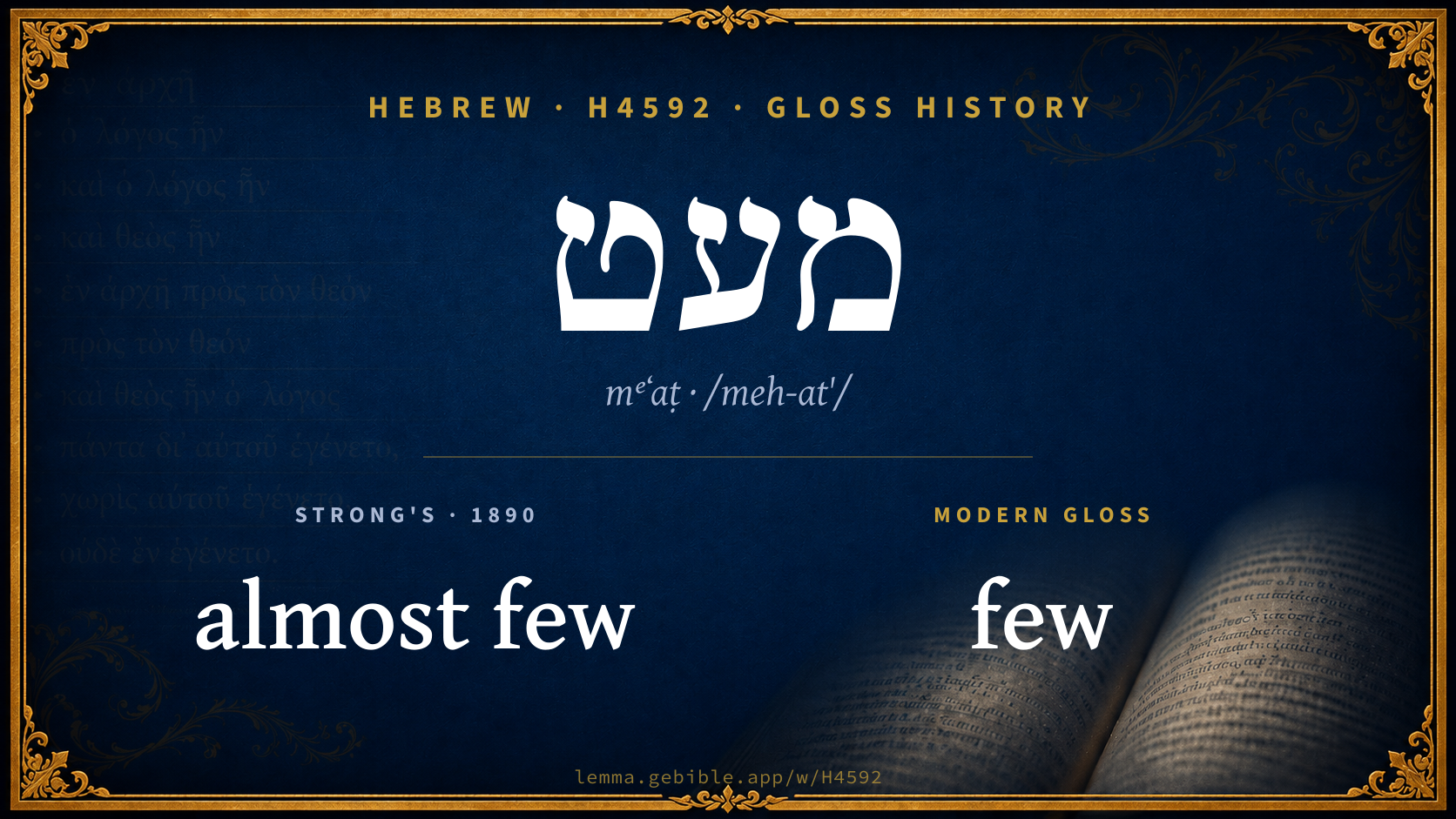
Gloss history
Strong's 1890 vs modern scholarship
About this word
Strong's H4592 catalogs a Hebrew word from the Hebrew Old Testament.
These counts are not copied from any lexicon or concordance. They are computed here, from the morphology-tagged Hebrew Old Testament. What Lemma adds →
- 92
- distinct verses
- The word appears in 92 distinct verses.
- 28 / 39
- OT books
- The word appears in 28 of 39 Old Testament books.
- #421
- by frequency
- Top 500 most frequent Hebrew words (rank 421 of 8,640 Hebrew words by occurrence).
View all 92 occurrences in the concordance →
By section of the Old Testament
By traditional corpus
Conventional, traditional groupings — biblical authorship is debated, so this is a traditional corpus grouping, not an authorship claim. Each share is this word’s portion of its verses in that division of the Hebrew canon. Each figure is a share of the word’s 92 distinct verses.
- Writings (Ketuvim) 34 verses · 37%
- Prophets (Nevi'im) 33 verses · 36%
- Torah (Pentateuch) 25 verses · 27%
How translations render this word
Counts come from each version’s own published word-to-Strong’s tagging or interlinear alignment — an approximate guide to how each version renders this word, not a word-level alignment the data otherwise carries. Because each total is that version’s own tagged count, the per-version totals vary from one another and need not match the appearance or distinct-verse counts above. These counts may also differ from a printed concordance because Lemma counts each distinctly tagged rendering and does not collapse phrase taggings into a single head-word total. This is a fixed set of word-tagged versions (KJV, ASV, BSB, ULT) and does not change with the reading translation you choose elsewhere. Each version’s license is shown beside its name below (and on Sources).
- King James Version: Little 30×, Few 14×, Little while 5×
- American Standard Version: Little 25×, Few 10×, Little while 4×
- Berean Standard Bible: Little 29×, Few 13×, Is it not enough 5×
- unfoldingWord Literal Text: Little 46×, Few 14×, Small 4×
King James Version Public Domain
Renders H4592 across 102 tagged occurrences — most commonly:
Plus 45 renderings that appear only once — usually multi-word phrases or single function words the recovered tagging swept in, not distinct renderings.
American Standard Version Public Domain
Renders H4592 across 103 tagged occurrences — most commonly:
Plus 51 renderings that appear only once — usually multi-word phrases or single function words the recovered tagging swept in, not distinct renderings.
Berean Standard Bible Public Domain
Renders H4592 across 92 tagged occurrences — most commonly:
Plus 30 renderings that appear only once — usually multi-word phrases or single function words the recovered tagging swept in, not distinct renderings. Not rendered by a distinct English word in 9 further occurrences.
unfoldingWord Literal Text CC BY-SA 4.0
Renders H4592 across 108 tagged occurrences — most commonly:
Plus 34 renderings that appear only once — usually multi-word phrases or single function words the recovered tagging swept in, not distinct renderings.
11 senses and sub-senses in the full BDB
What do BDB’s symbols mean?
BDB uses these scholarly abbreviations:
| Symbol | Meaning |
|---|---|
| 𝔊 | the Septuagint (the ancient Greek translation, LXX) |
| 𝔙 | the Vulgate (the Latin translation) |
| 𝔖 | the Syriac version (the Peshitta) |
| 𝔗 | the Targum (the Aramaic translation) |
| ψ | the Psalms |
| √ | root (the underlying root or stem) |
| ‖ | parallel passage (a synonymous or contrasted parallel) |
| † | the dagger: every passage where the word occurs is cited |
The 11 senses and sub-senses the full Brown-Driver-Briggs lexicon distinguishes for this word, in lexicon order (not ranked by frequency), with BDB’s own verbatim wording and sub-sense lettering. Shown in Hebrew script with BDB’s own scholarly abbreviations. The condensed entry is in the Lexicon Entry tab. See also the Forms in the corpus table below.
- 1.
- a. Gn 30:30 מעט אשׁר היה לך לְפָנַי the little that thou hadst, 47:9 מעט ורעים היו ימי שׁני חיי few and evil, Lv 25:52 Nu 26:54 (cf. 33:54) וְלַמְעַט תמעיט נחלתו and to the small (few) thou shalt make small his inheritance, v 56; 35:8 וּמֵאֵת הַֽמְעַט תמעיטו, Dt 7:7 וכי אתם הַֽמְעַט מכל־העמים ye are the fewest out of all peoples, 1 S 14:6 לְהוֹשִׁיעַ בְּרַב אוֹ בִמְעָ֑ט, Je 42:2 כִּי נִשְׁאַרְנוּ מְעַט מֵהַרְבֵּה we are left as few out of many, Ez 5:3 וְלָקַחְתָּ מִשָּׁם מְעַט בְּמִסְפָּר, Hg 1:6 זְרַעְתֶּם הַרְבֵּה וְהָבֵא מְעָ֑ט (cf. v 9), ψ 8:6 ותחסּרהו מעט מאלהים, 37:16 טוֹב מְעַט לַצַּדִּיק (cf. Pr 15:16; 16:8), 2 Ch 29:34 רַק הַבֹּהֲנִים הָיוּ לִמְעָ֑ט; as pred. Nu 13:18 הַמְעַט הוּא אִם־רָ֑ב, Jos 7:3 כִּי מְעַט הֵמָּה, Jb 10:20; Ru 2:7; Ne 7:4; Is 16:14 וּשְׁאָר מְעַט מִזְעָר.—Ho 8:10 וַיָּחֵלּוּ מְעַט and they begin as littleness (=to be minished) because of, &c. but read prob. (𝔊) וְיֶחְדְּלוּ מְעַט מִמְּשֹׁחַ and they shall cease for a little (d) from anointing, etc. e.g. Genesis 30:30
- b. as subst. with foll. gen., Gn 18:4 מְעַט מַיִם a little of water, 24:17, 43, מְעַט אֹכֶל 43:2; 44:25; 1 S 14:43; 17:28 מְעַט הַצֹּאן הָהֵ֫נָּה lit. the fewness of those sheep, Pr 6:10 +; as gen. to a previous subst., מְתֵי מְעָ֑ט men of fewness †Dt 26:5; 28:62; in appos., †Is 10:7 לְהַכְרִית גּוֹיִם לֹא מְעָ֑ט, Ezr 9:8 מִחְיָה מְעַט, Ne 2:12 וַאֲנָשִׁים מְעַט עִמִּי, Ec 9:4; either gen. or appos., 10:1; Dn 11:34 יֵעָֽזְרוּ עֵזֶר מְעָ֑ט with a help of smallness. e.g. Genesis 18:4
- c. twice declined as an adj., ψ 109:8 יִהְיוּ יָמָיו מְעַטִּים, Ec 5:1 על־כן יהיו דבריך מְעַטִּים. e.g. Psalms 109:8
- d. as adverb. acc., of place, 2 S 16:1 וְדָוִד עֹבֵר מְעַט; of time, Jb 10:20b; of degree, 2 K 10:18 אַחְאָב עָבַד אֶת־הַבַּעַל מְעָ֑ט, Ez 11:16 and have been to them for a sanctuary but little, Zc 1:15; repeated מְעַט מְעַט by little, by little=gradually, Ex 23:30; Dt 7:22. e.g. 2 Samuel 16:1
- e. phrases:—a. with the interr. הֲ, †Gn 30:15 הַֽמְעַט קַחְתֵּךְ אֶת־אִישִׁי וְלָקַחַת was thy taking my husband (too) little? and (wilt thou be) for taking also my son’s love-apples? Nu 16:9–10 הַֽמְעַט מִכֶּם כִּי הִבְדִּיל … וּבִקַּשְׁתֶּם גַּם כְּהֻנָּה is it too little for you that J. hath separated, etc., … and do ye seek, etc.? v 13 הַֽמְעַט כִּי הֶעֱלִיתָנוּ … כִּי תִשְׂתָּרֵר גַּם הִשְׂתָּרֵר, Jos 22:17f. הַֽמְעַט לָנוּ … וְאַתֶּם תָּשׁוּבוּ וגו׳, Is 7:13 הַֽמְעַט מִכֶּם הַלְאוֹת אֲנָשִׁים כִּי תַלְאוּ וגו׳ is wearying men too little for you, that you will weary also my God? Ez 34:18 (as Ew Co AV RV), Jb 15:11; הַֽמְעַט מִמְּךָ תַּנְחוּמוֹת אֵל. But Ez 16:20 (si vera l.) was it (too) little because of thy whoredom? (was that insufficient for thee? Köiii. 406 m). b. עוֹד מְעַט וְ׳, †Ex 17:4 עוֹד מְעַט וּסְקָלֻנִי yet a little, and they will stone me, Je 51:33; Ho 1:4 ψ 37:10; עוֹד מְעַט מִזְעָר וְ׳ †Is 10:25; 29:17; cf. Hg 2:6; Jb 24:24. e.g. Genesis 30:15
- 2. †כִּמְעַט like a little: hence
- a. almost (cf. ὀλίγου), of unrealized action, Gn 26:10 כִּמְעַט שָׁכַב … almost had lain …, ψ 73:2 Qr, 94:17; 119:87 Pr 5:14 (all sq. pf.); Ez 16:47 כִּמְעַט קָט וַתַּשְׁחִתִי מֵהֶן like only(?) a little, and thou hadst done more corruptly than they; Ct 3:4 כִּמְעַט שֶׁעָבַרְתִּי מֵהֶם=hardly had I passed. e.g. Genesis 26:10
- b. with impf., just, 2 S 19:37 כמעט יעבר עבדך just would thy servant pass over; lightly, easily, quickly (cf. διʼ ὀλίγου), ψ 2:12 כִּי יִבְעַר כִּמְעַט אַפּוֹ, 81:15 Jb 32:22. e.g. 2 Samuel 19:37
- c. =shortly, 2 Ch 12:7. e.g. 2 Chronicles 12:7
- d. =little worth, Pr 10:20 ולב רשׁעים במעט. e.g. Proverbs 10:20
- e. pleon. for מְעַט, Is 1:9 (accents) שָׂרִיד כִּמְעָ֑ט a little remnant, ψ 105:12 (=1 Ch 16:19) כִּמְעַט וְגָרִים בָּהּ; כִּמְעַט רֶגַע like the littleness of a moment=for a little moment, Is 26:20; Ezr 9:8. e.g. Isaiah 1:9
Senses from the full Brown-Driver-Briggs lexicon (Brown, Driver, Briggs; Oxford 1906 — public domain), digitized via Sefaria, supplemented by the OpenScriptures HebrewLexicon (CC BY 4.0). Full attribution on Sources.
Word origin
subst. a little, fewness, a few;—מ׳ abs. and cstr., מְעָ֑ט Is 10:7 +, pl. מְעַטִּים †ψ 109:8 Ec 5:1;—
— Brown-Driver-Briggs (Oxford 1906, public domain), digitized via Sefaria, supplemented by the OpenScriptures HebrewLexicon (CC BY 4.0). See Sources.
Derived from מעט (mâʻaṭ) (H4591) — to diminish.
Jastrow Dictionary
A second Hebrew/Aramaic lexicon for comparison, covering Aramaic and post-biblical (Talmudic, Targumic, Midrashic) usage that the biblical-Hebrew BDB does not. Matched by lemma rather than by Strong’s number, so a lemma may carry more than one Jastrow headword (shown separately below), and the entries cover usage well beyond the Bible.
מָעַט
- to be thin, minute.—Part. pass. מָעוּט, f. מְעוּטָה; pl. מְעוּטִים, מְעוּטִין; מְעוּטוֹת. Y. Pes. V, 32ᵃ bot.; Y. Snh. I, 18ᶜ bot. גסי רוח ומְעוּטֵי תודה big in spirit (haughty) and small in learning (of narrow capacity). Tosef. Ḥall. I, 7; a. e.—Tam. IV, 2 במעוטה at least (Talm. ed. 31ᵃ במעוטן, comment. במיעוטן on the smallest of the tables).
- 1. to diminish, reduce; to do little. Ab. IV, 10 הוי מְמַעֵט בעסק וכ׳ do less business, and busy thyself with the Law. M. Kat. 22ᵃ, v. עֵסֶק. Taan. I, 7 מְמַעֲטִין במשא וכ׳ we must reduce business transactions, building &c. Ib. IV, 6 משנכנס אב ממעטין בשמחה with the beginning of the month of Ab we must reduce rejoicing. Ḥull. 60ᵇ לכי ומַעֲטִי את עצמך go and make thyself smaller (be reduced). Snh. 17ᵃ הואיל ומִיעַטְתֶּם עצמיכם because you made yourselves small (were modest); Num. R. s. 15. Tosef. Erub. IX (VI), 15 מִיעֲטָהּ באבנים וכ׳ if he reduced the size of the gap by means of stones &c. Y. ib. VII, beg. 24ᵇ ממעטין בכלים you may use utensils for reducing the opening. Bab. ib. 77ᵇ ממעט effects the reduction, i.e. puts the two adjoining places in the legal condition of dwellings connected by a gate; a. fr.
- 2. (interpret.) to limit, qualify, exclude from the rule. Shebu. 26ᵃ היה דורש את כל התורה בריבה ומיעט interpreted the entire Law on the principle of ‘It includes and it excludes’, i.e. on the principle that if, in the Biblical text, a specification is preceded and followed by general terms, both an extension (ריבוי) and a limitation (מיעוט) must be found; e. g. ib. (ref. to Lev. V, 4) או נפש … להרע … מי׳ וכ׳ ‘or if a soul swears’, this is a general expression, ‘for bad or for good’, this limits (the sphere of the law to things which are either an advantage or a disadvantage); ‘whatsoever it be &c.’, this is again a generalization; now what does it include? All kinds of words (vows); ומאי מ׳ מ׳ וכ׳ and what does it exclude? It excludes a religious act (the vow of doing a forbidden thing or not doing a commanded thing). Sifra Tsav, ch. XV, Par. 11 אם מִיעַטְתִּים מסמיכה מרובה לא אֲמַעֲטֵם בתנופה וכ׳ if I exclude them (the gentiles) from the privilege of laying hands on the sacrifice, which has a wider sphere of application, must I not exclude them from the privilege of waving &c.?; a. fr.—Part. pass. מְמוּעָט, v. מוּעָט. e.g. Leviticus 5:4
- to do little, less. Ber. 17ᵃ שמא תאמר אני מרבה והוא מַמְעִיט lest you say, I do much good, and he but little; שנינו אחד המרבה ואחד הממעיט וכ׳ we have learned, whether one does much or little (they are equally worthy), provided one directs his heart &c.; Men. XIII, 11; a. fr.
- to be diminished, reduced. Erub. VII, 5 נ׳ התבן מעשרה וכ׳ if the pile of straw has been reduced to less than ten handbreadths. Ib. 54ᵇ; Ab. Zar. 19ᵃ מִתְמַעֵט he will become less (will decline in learning). Arakh. 30ᵇ נ׳ כספו if his value was reduced. Tosef. Sot. XIV, 10 נִתְמַעֲטוּ הימים וכ׳ the days were reduced, and the years shortened. Ib. התחילו הגוים להתרבות וישראל להִתְמעֵט the nations began to grow and the Israelites to be reduced (in rank). Pesik. R. s. 14 נִתְמַעֲטָה ידו he became reduced in fortune. Midr. Till. to Ps. XII, end נפשם מִתְמַעֶטֶת עליהם their soul within them shrinks, i.e. they feel jealous and angry; Yalk. ib. 659; Lev. R. s. 32, beg. מתמענת (corr. acc.). Sifra l. c. נִתְמַעֶטֶת תנופה the sphere of the act of waving is the smaller one; נִתְמַעֲטָה סמיכה the laying on of hands has the smaller sphere; a. fr.—Erub. 80ᵇ מאי נתמעט נתמטמט ‘it was reduced’ (Mish. ib. VII, 7) means, it was reduced to atoms, v. מִטְמֵט.—B. Mets. 71ᵃ נכסיו מִתְמַעֲטִין, v. מוּט h.—Tosef. Mikv. VI (VII), 14 מִתְמַעֲטִין, v. מָעַךְ.
מְעַט I
- Pa. מַעֵט same, to reduce; to exclude. Yoma 74ᵃ למַעוּטֵי מאי … למַ׳ וכ׳ this ‘none but’ is to exclude what (whom)?… It excludes the king; Shebu. 31ᵃ Ms. M. (ed. לאפוקי); a. fr.
- to be reduced; to be excluded. Erub. 79ᵇ דא׳ מאיתמול when its size was reduced the day before; a. e.
מְעַט II
- preced.) a little, little. Ab. I, 15 אמור מ׳ ועשה הרבה promise little and do much. Sabb. 31ᵇ (ref. to Koh. VII, 16) הא מ׳ לירשע but a little wrong one may do?; a. e.—V. מוּעָט. e.g. Ecclesiastes 7:16
A Dictionary of the Targumim, the Talmud Babli and Yerushalmi, and the Midrashic Literature (Marcus Jastrow; London, Luzac, 1903) — Public Domain. Digitized via Sefaria. Digitized via Sefaria. Full attribution on Sources.
Forms in the corpus
The 52 distinct written forms H4592 takes in the Hebrew Bible, most frequent first — each parse links to that state’s occurrences in the concordance. Hebrew forms include their vowel points and cantillation, so a single lemma takes many written forms.
Same root — word family
Other BDB entries built from the same root as H4592, grouped by Strong’s listed origin. These share a root / origin per the lexicon — not necessarily a shared meaning. Each links to that word’s own entry.
Derives from
Shares the same root
Compare all same-root words → They share a root, not necessarily a meaning.
Septuagint verse parallels
This word appears in 86 verses that also exist in the Greek Old Testament (Septuagint), out of the 92 Hebrew verses it occurs in. You can read those verses in Greek by switching the Old Testament edition to the Septuagint.
Read these verses in the Septuagint
- Genesis 18:4
- Exodus 17:4
- Leviticus 25:52
- Numbers 13:18
- Deuteronomy 7:7
- Joshua 7:3
- Judges 4:19
- Ruth 2:7
- 1 Samuel 14:6
- 2 Samuel 12:8
- 1 Kings 17:10
- 2 Kings 10:18
This is a verse-level parallel only — the same verses exist in both the Hebrew and Greek Old Testaments. No word-level Hebrew↔Greek correspondence is claimed: the data carries no such alignment, so no Greek word is shown as this Hebrew word’s translation. Coverage is not total — the Septuagint omits the deuterocanon and renumbers the Psalms, so some Hebrew verses have no direct Greek parallel.