
Psalms 94:17

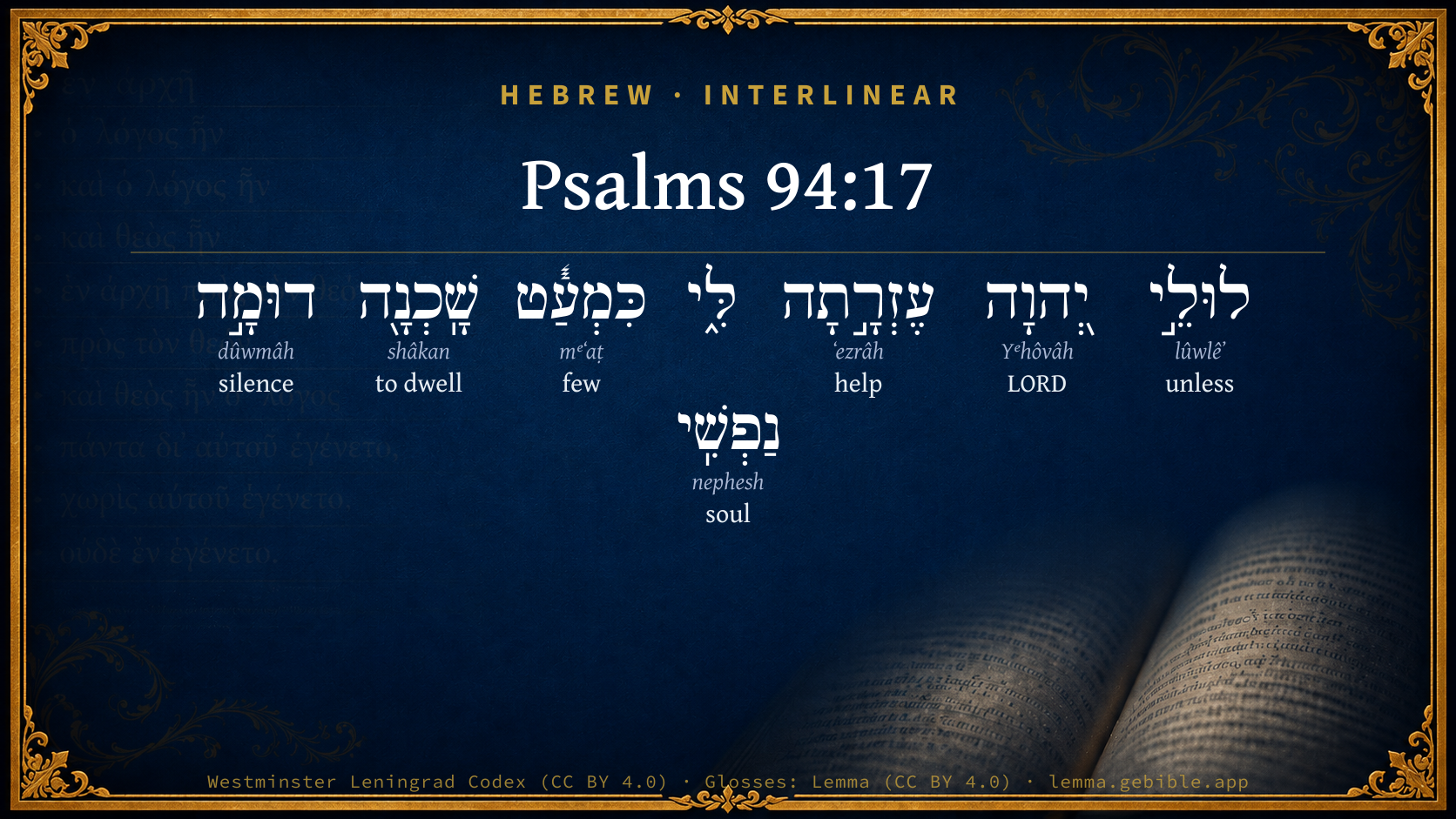
Hebrew (Westminster Leningrad Codex) Psalms 94:17 appears in the Hebrew Old Testament. The text above is from the Westminster Leningrad Codex. Each word links to its Strong’s number, a concise gloss, and parsing drawn from the Open Scriptures Hebrew Bible morphology. Click any word for its full Brown-Driver-Briggs (BDB) entry.
Download image
Cite this verse

Psalms 94:17 (World English Bible). Public Domain. Lemma interlinear Bible study tool, https://lemma.gebible.app/v/psalms/94/17.

Show BibTeX & RIS
BibTeX
RIS
English Translation
Unless Yahweh had been my help, My soul would have soon lived in silence.
World English Bible · Public Domain
Highlights
  • 1 first appearance in the Hebrew Bible
Full analysis ↓
Download a study sheet

One document with this verse’s original text, its word-by-word gloss line, the meaning frame, cross-references with their text, attributed commentary, and full source and license credits — printable, and it pastes into notes with its structure intact.

This verse Autodidact and up

Study sheet (.html) Plain text (.txt)

A passage Seminary Student

Up to 50 verses in one chapter. A passage sheet keeps up to 6 commentary sources and 12 cross-references per verse, in the order this page ranks them, and says so on the sheet whenever that leaves anything out. Ask for a single verse and you get the Autodidact verse sheet above.

Everything on this page stays free to read, with no account — the sheet is a download of what is already on screen, not access to it.

Want to remove ads? Support Godless Engineer
Compare translations 3

The same verse in 3 English versions, stacked beneath the original-language interlinear above. Click any original word for its lexicon entry.

Each is an independent rendering of the whole verse — the interlinear is not word-aligned to these translations.

Highlighted words mark where these versions differ — a whole-verse word diff, not a word-by-word alignment.

  • World English Bible Public Domain
    Unless Yahweh had been my help, My soul would have soon lived in silence.
  • King James Version Public Domain
    Unless the LORD had been my help, my soul had almost dwelt in silence.
  • unfoldingWord Literal Text CC BY-SA 4.0
    Unless Yahweh a help to me, shortly my soul would have dwelt in silence.

unfoldingWord Literal Text — © unfoldingWord, licensed CC BY-SA 4.0. Word-aligned USFM3 via Door43 (git.door43.org/unfoldingWord/en_ult).

Versions to compare (up to 4)

3 of 4 selected

Show all 18 translations

Every available English version of this verse, each an independent rendering of the whole verse.

  • World English Bible Public Domain
    Unless Yahweh had been my help, My soul would have soon lived in silence.
  • Berean Standard Bible Public Domain
    Unless the LORD had been my helper, I would soon have dwelt in the abode of silence.
  • Majority Standard Bible Public Domain
    Unless the LORD had been my helper, I would soon have dwelt in the abode of silence.
  • King James Version Public Domain
    Unless the LORD had been my help, my soul had almost dwelt in silence.
  • American Standard Version (1901) Public Domain
    Unless Jehovah had been my help, My soul had soon dwelt in silence.
  • Revised Version (1885) Public Domain
    Unless the LORD had been my help, my soul had soon dwelt in silence.
  • Geneva Bible (1599) Public Domain
    If the Lord had not holpen me, my soule had almost dwelt in silence.
  • Douay-Rheims (1899) Public Domain
    Unless the Lord had been my helper, my soul had almost dwelt in hell.
  • Young's Literal Translation Public Domain
    Unless Jehovah `were' a help to me, My soul had almost inhabited silence.
  • Literal Standard Version CC BY-SA 4.0
    Unless YHWH [were] a help to me, || My soul had almost inhabited silence.
  • Unlocked Literal Bible CC BY-SA 4.0
    Unless Yahweh had been my help, I would soon be lying down in the place of silence.
  • unfoldingWord Literal Text CC BY-SA 4.0
    Unless Yahweh a help to me, shortly my soul would have dwelt in silence.
  • Darby Bible Public Domain
    If Jehovah had not been my help, my soul had almost dwelt in silence.
  • World Messianic Bible Public Domain
    Unless the LORD had been my help, my soul would have soon lived in silence.
  • Webster's Bible Public Domain
    Unless the LORD had been my help, my soul had almost dwelt in silence.
  • Free Bible Version CC BY-SA 4.0
    If the Lord hadn't helped me, I would have soon gone down into the silence of the grave.
  • Bible in Basic English Public Domain
    If the Lord had not been my helper, my soul would quickly have gone down into death.
  • JPS Tanakh (1917) Public Domain
    Unless the LORD had been my help, my soul had soon dwelt in silence.

Literal Standard Version (2020), Covenant Press — licensed CC BY-SA 4.0. Text via the HelloAO Bible API (eBible.org). Unlocked Literal Bible (unfoldingWord) — licensed CC BY-SA 4.0. Text via the HelloAO Bible API (eBible.org). unfoldingWord Literal Text — © unfoldingWord, licensed CC BY-SA 4.0. Word-aligned USFM3 via Door43 (git.door43.org/unfoldingWord/en_ult). Free Bible Version, Dr. Jonathan Gallagher — licensed CC BY-SA 4.0. Text via the HelloAO Bible API (eBible.org).

Word by word

More ways to search: Search by grammar → Find every occurrence → Compare this word →

Practice this passage: Drill this verse → Learn its vocabulary →

About this verse

These counts appear in no published source. They are computed here, from the morphology-tagged text and Lemma’s own curated glosses. What Lemma adds →

8
words
7
distinct lemmas
Wisdom
section

Notable vocabulary

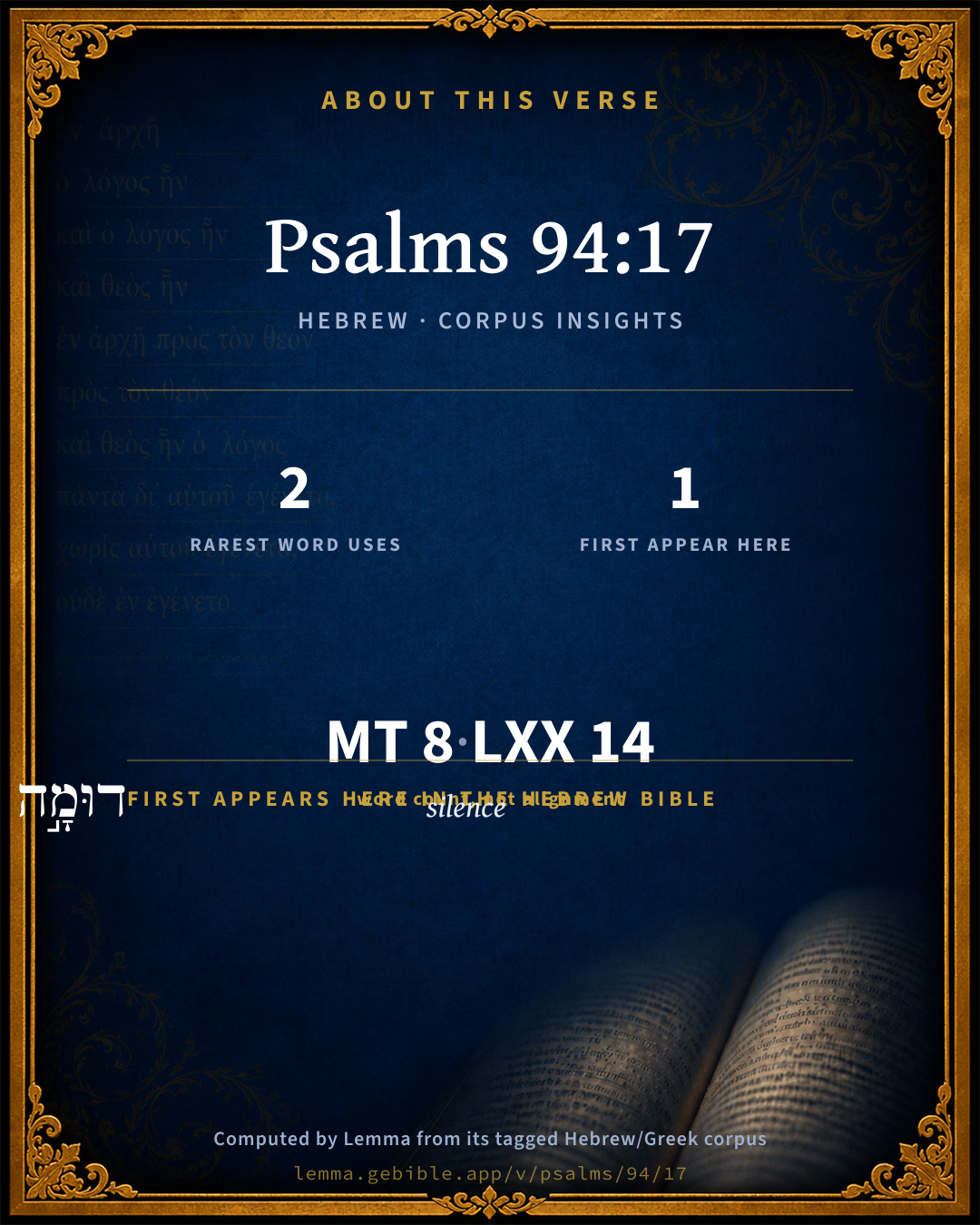
The rarest word here is דוּמָ֣ה silence H1745 — appearing just 2 times in the whole Hebrew Bible.

First appearance in Scripture

This word makes its first canonical appearance in the Hebrew Bible here:

  • דוּמָ֣ה silence H1745

Shared distinctive vocabulary

דוּמָ֣ה silence H1745 occurs in 2 verses of the Hebrew Bible. Also found in:

Grammatical profile

  • 1 verb
  • 5 nouns
  • 1 preposition
  • 1 conjunction

Verb forms

  • שָֽׁכְנָ֖ה Qal · Perfect

Hebrew & Septuagint length

In English translation the verse runs 14 words from the Hebrew and 14 from the Septuagint (LXX English) — the same length.

A rough comparison of the two English renderings, which tokenize alike — not a word-level alignment.

Word counts can differ between the Hebrew and the Greek without any difference in meaning — e.g. the Hebrew direct-object marker אֵת has no separate Greek word, and Greek often adds the article ὁ.

In the original languages it is 8 Hebrew tokens and 14 Greek tokens — but the two are counted differently (Hebrew bundles its prefixes and suffixes into one token; the Greek is in lemma form), so that isn’t a like-for-like length.

Cross-references

10

Topical passages linked to Psalms 94:17 in the Treasury of Scripture Knowledge — connected by theme and wording, ordered by reader-vote popularity; previews shown in the World English Bible.

  • Psalms 124:1–2 If it had not been Yahweh who was on our side, Let Israel now say,
  • Psalms 31:17 Let me not be disappointed, Yahweh, for I have called on you. Let the wicked be disappointed. Let them be silent in Sheol.
  • Psalms 118:13 You pushed me back hard, to make me fall, But Yahweh helped me.
  • 2 Timothy 4:16–17 At my first defense, no one came to help me, but all left me. May it not be held against them.
  • Psalms 13:3 Behold, and answer me, Yahweh, my God. Give light to my eyes, lest I sleep in death;
  • Psalms 115:17 The dead don't praise Yah, Neither any who go down into silence;
  • Psalms 125:1 Those who trust in Yahweh are as Mount Zion, Which can't be moved, but remains forever.
  • Psalms 142:4–5 Look on my right, and see; For there is no one who is concerned for me. Refuge has fled from me. No one cares for my soul.
  • John 16:32 Behold, the time is coming, yes, and has now come, that you will be scattered, everyone to his own place, and you will leave me alone. Yet I am not alone, because the Father is with me.
  • 2 Corinthians 1:8–10 For we don't desire to have you uninformed, brothers, concerning our affliction which happened to us in Asia, that we were weighed down exceedingly, beyond our power, so much that we despaired even of life.

Cross-references courtesy of OpenBible.info (CC BY 4.0).

Hebrew and Greek witnesses Masoretic Hebrew ↔ Greek Septuagint

The same verse in the two great witnesses to the Old Testament, shown verse-for-verse.

You’re reading Greek Psalm 93 (Hebrew Psalm 94). The Septuagint counts the superscription, so verse numbers can differ from the Hebrew — chapter-level alignment, not verse-by-verse. Numbering follows Rahlfs.

These are two independent witnesses, not word-aligned to each other, and the Septuagint is shown in lemma (dictionary) form.

Hebrew Psalms 94:17 Masoretic · Westminster Leningrad Codex

לוּלֵ֣י יְ֭הוָה עֶזְרָ֣תָה לִּ֑י כִּמְעַ֓ט שָֽׁכְנָ֖ה דוּמָ֣ה נַפְשִֽׁי

Unless Yahweh had been my help, My soul would have soon lived in silence.

World English Bible · Public Domain

Greek LXX Greek Psalm 93:17 Septuagint · lemma form

εἰ μή ὅτι κύριος βοηθέω ἐγώ παρά βραχύς παραοἰκέω ὁ ᾅδης ὁ ψυχή ἐγώ

If the Lord had not helped me, my soul had almost sojourned in Hades.

LXX2012 (modern English Septuagint) · Public Domain

On this verse, Adam Clarke's Commentary discusses the Septuagint’s reading. Read the note in Commentary ↓

Hebrew: Westminster Leningrad Codex (CC BY 4.0). Greek: Septuagint (public domain); English from LXX2012 (modern English Septuagint) (Public Domain). How the Septuagint differs from the Hebrew →

Commentary

Notes on Psalms 94:17 from classic Christian and Jewish commentators (each source and its license shown beneath its notes). The classic Christian expositions comment on the surrounding passage and are grouped to its opening verse, so a note may address several verses; the Jewish commentaries on the Tanakh (Rashi and others) are per-verse, so they appear only where the commentator wrote on this verse.

Lemma curates 59 commentaries, every one of them public domain or Creative Commons licensed, each selected and text-cleaned for this edition rather than reprinted as found. About our sources →

Trapp's Complete Commentary

John Trapp

Psa 94:17 Unless the LORD [had been] my help, my soul had almost dwelt in silence.

Ver. 17. Unless the Lord had been my help] He loveth to help at a pinch; he usually reserveth his hand for a dead lift. See 2Ti 4:16-17.

My soul had almost dwelt in silence] i.e. In the dark cloisters of death. The Greek and Latin translators render it, In hell.

John Trapp, A Commentary or Exposition upon All the Books of the Old and New Testament (1647–1656) — public domain. Text from a community e-Sword module.

J. A. Alexander on Psalms

Joseph Addison Alexander

17. (Psa 94:17) Unless Jehovah were a help for me, soon would my soul inhabit silence. The phrase a help for me occurs above, Psa 63:7, and a similar one, Psa 44:26). For the meaning of the phrase translated soon, see above, on Psa 2:12; Psa 81:14. To dwell in (or inhabit) silence is to be constantly surrounded by the silence of the grave or of death. See above, Psa 31:17), and below, Psa 115:17.

Joseph Addison Alexander, The Psalms Translated and Explained (1850) — public domain. Text from a community e-Sword module.

Geneva Bible (1599)

Geneva Bible translators

He complaineth of them which would not help him to resist the enemies: yet was assured that God’s help would not fail.

Geneva Bible (1599) marginal notes — public domain. Text via Bolls.life.

Adam Clarke's Commentary

Verse 17. Unless the Lord had been my help] Had not God in a strange manner supported us while under his chastising hand, we had been utterly cut off.

My soul had almost dwelt in silence.] The Vulgate has in inferno, in hell or the infernal world; the Septuagint, τω αδη, in the invisible world.

Adam Clarke's Commentary on the Bible (1810–1826) — public domain. Text from a community e-Sword/MySword module.

Ellicott's Commentary for English Readers

(17) In silence—i.e., of the grave, as in Psa_31:17.

A Bible Commentary for English Readers, edited by Charles John Ellicott (1878–1897) — public domain. Text from a community e-Sword module.

The Cambridge Bible for Schools and Colleges

gen. ed. J. J. S. Perowne

17. Cp. Psa_124:1 ff.

almost] R.V. soon.

dwelt in silence] The stillness of the grave (Psa_115:17).

The Cambridge Bible for Schools and Colleges (gen. ed. J. J. S. Perowne; Cambridge University Press, 1878–1918) — public domain. Text from a community e-Sword module.

John Gill's Exposition

Unless the Lord had been my help,.... Against her enemies, which were so many and mighty, and her friends so few and feeble, and having no heart to defend her cause; especially this will be the case at the time of the slaying of the witnesses; but the Lord will appear, and help her; the Spirit of life, from him, shall enter into them, and cause them to live again, and to ascend up to heaven; and shall destroy great numbers of their enemies, and the rest shall be frightened, and give glory to God, Rev 11:11,

my soul had almost dwelt in silence; or "within a little", or "must quickly" (e); not only have been, but must have dwelt, continued in silence, in the grave; see Psa 115:17 his case being desperate, like that of the apostles, when they had the sentence of death within themselves, Co2 1:10, this is to be understood not of the soul precisely, and abstractly considered, which dies not, nor is it silent after death; but of the whole person, being a part for the whole; and of the person, with respect to the mortal part, the body, which only dies, and while in a state of separation, or in the grave, is silent, and ceases from all operations of life: perhaps this may have some respect to the silencing of the witnesses, which is a principal thing meant by the slaying of them; a stop put to their ministrations, partly by the edicts of their enemies, and partly by the discouragement of their friends, their shyness, and negligence of them; and which silence will be almost total, if not altogether; though it will last but for a short time; they shall not dwell or continue in silence, but will open their mouths again; signified by the angel flying through the midst of heaven, with the everlasting Gospel, Rev 14:6.

(e) "quasi parum", Montanus, Gejerus, Junius & Tremellius, Piscator.

John Gill's Exposition of the Whole Bible (1746–1763) — public domain (CC PDM 1.0). Text via the HelloAO Bible API.

Albert Barnes' Notes on the Bible

Unless the Lord had been my help - At the time referred to. If I had not had a God to whom I could have gone - if my mind had not been directed to him - if I had not actually found him a refuge and strength, I should have despaired altogether. There was no other one to whom I could go; there was nothing else but the help of God on which I could rely.

My soul had almost dwelt in silence - Margin, quickly. The original is, “It was as it were but little;” that is, there was little lacking to bring this about; a little heavier pressure - a little added to what I was then suffering - a little longer time before relief was obtained - would have brought me down to the land of silence - to the grave. The Latin Vulgate renders this, “My soul had dwelt in inpherno.” The Septuagint, “in Hades” - τᾤ ἅδῃ tō Hadē. See Psa 31:17. The grave is represented as a place of silence, or as the land of silence: Psa 115:17 : “The dead praise not the Lord, neither any that go down into silence.” Compare Amo 8:3.

Albert Barnes' Notes on the Bible (1834–1885) — public domain. Text from a community e-Sword/MySword module.

Matthew Poole's English Annotations

In the place of silence, to wit, the grave. Compare Job 3:17,18; Psa 88:12; 115:17.

Matthew Poole's English Annotations on the Holy Bible (1683–1685) — public domain. Text from a community e-Sword/MySword module.

The Treasury of David

Charles H. Spurgeon

Ver. 17. Unless the Lord had been my help, my soul had almost dwelt in silence. Without Jehovah's help, the psalmist declares that he should have died outright, and gone into the silent land, where no more testimonies can be borne for the living God. Or he may mean that he would not have had a word to speak against his enemies, but would have been wrapped in speechless shame. Blessed be God, we are not left to that condition yet, for the Almighty Lord is still the helper of all those who look to him. Our inmost soul is bowed down when we see the victories of the Lord's enemieswe cannot brook it, we cover our mouths in confusion; but he will yet arise and avenge his own cause, therefore have we hope.

Ver. 17. Had been my help. The word signifieth not only help, but summum et plenum auxilium, an helpfulness, or full help:the Hebrew hath a letter more than ordinary, to increase the signification, as learned Mr. Leigh observeth: there is the sufficiency of help. Nathaniel Whiting, in "The Saints' Dangers, Deliverances, and Duties, "1659.

Charles H. Spurgeon's The Treasury of David (1869–1885) — public domain. Psalms only. Text from a community e-Sword/MySword module.

Whedon's Commentary on the Bible

Daniel D. Whedon

17. My soul had almost dwelt in silence—My soul had in a little time— soon—have inhabited silence; the land of silence, the region of the dead. We had quickly perished had not God been our help. On מעשׂ, little, almost, little time, etc., see Psa_81:14; Isa_26:20

Daniel D. Whedon (gen. ed.), Commentary on the Old and New Testaments (1874–1909) — public domain. Text from a community e-Sword module.

The Pulpit Commentary

Unless the Lord had been my Help, my soul had almost dwelt in silence. No; they are not without a champion; Jehovah is their Help. It is a part of their blessedness (ver. 12), that they are preserved in life and protected from the wicked, by God himself. Otherwise they "had soon dwelt in silence." Their soul had gone down to the pit, to the abyss of Sheol, the silent land. (comp. Psa_115:17)

The Pulpit Commentary (1880–1919), ed. H.D.M. Spence-Jones & Joseph S. Exell — public domain. Text from a community e-Sword module.

John Wesley's Explanatory Notes

Dwelt - In the place of silence, the grave.

John Wesley, Explanatory Notes Upon the Whole Bible (1754–1765) — public domain. Text via the GEBible commentary corpus.

unfoldingWord translationNotes

Door43 World Missions Community

Unless Yahweh had been my help ... silence

This is a hypothetical situation. Yahweh did help him, so he was not lying in the place of silence. (See: Hypothetical Situations)

Unless Yahweh had been my help

The abstract noun "help" can be expressed as a verb. AT: "If Yahweh had not helped me" (See: Abstract Nouns)

I would soon be lying down in the place of silence

Here "would be lying down" refers to "death" and "in the place of silence" refers to the grave." AT: "in a short time, I would be dead, lying in a silent grave" (See: Euphemism)

Your covenant faithfulness, Yahweh, held me up

The abstract noun "faithfulness" can be translated with an adjective. AT: "You, Yahweh, held me up because you are faithful to your covenant" (See: Abstract Nouns)

When cares within me are many, your consolations make me happy

The psalmist speaks of care as if he could count separate cares. The abstract noun "consolations" can be translated with the verb "console" or "comfort." AT: "When I have been worried about many things, you have comforted me and made me happy" (See: Abstract Nouns)

translationWords

covenant faithfulness

comfort

unfoldingWord translationNotes — © Distant Shores Media and the Door43 World Missions Community, licensed CC BY-SA 4.0. Source: git.door43.org/Door43/en_tn.

Lesson kit

Teaching starters — assembled from the data on this page, not authored interpretation. Every prompt links to the verse data it draws on. Edit before teaching.

Psalms, in the Wisdom, opens this verse with 8 words (7 distinct Hebrew lemmas). Its most distinctive word is dûwmâh (“silence”). A historical commentator’s framing appears above. Read the whole chapter for the surrounding context.

Discussion questions

  1. The word dûwmâh carries the sense “silence.” How does it shape the verse?
  2. This is the first place “silence” appears in Scripture (first appears here). What does its debut here establish?
  3. How does Psalms 115:17, which shares the word «silence», read alongside this verse?
  4. These translations render this verse differently. What is at stake in choosing one wording over another?
  5. «שָֽׁכְנָ֖ה» is a Qal Perfect verb. How does that grammatical form shape the action described?
  6. Compare how Trapp's Complete Commentary and J. A. Alexander on Psalms read this verse. Where do they agree or differ?

Things to notice

Reading settings

Reading text

Shown beneath each verse's original-language words.

Old Testament
Old Testament edition

Read the OT as the Masoretic Hebrew (MT) or the Greek Septuagint (LXX).

English shown for the Greek Septuagint (in the Hebrew ↔ Greek comparison).

Comparing translations? Open the Compare panel on any verse page to stack up to four side by side.