Exodus 17:4

Hebrew (Westminster Leningrad Codex) Exodus 17:4 appears in the Hebrew Old Testament. The text above is from the Westminster Leningrad Codex. Each word links to its Strong’s number, a concise gloss, and parsing drawn from the Open Scriptures Hebrew Bible morphology. Click any word for its full Brown-Driver-Briggs (BDB) entry.
Download image
Cite this verse

Exodus 17:4 (World English Bible). Public Domain. Lemma interlinear Bible study tool, https://lemma.gebible.app/v/exodus/17/4.

Show BibTeX & RIS
BibTeX
RIS
English Translation
Moses cried to Yahweh, saying, "What shall I do with these people? They are almost ready to stone me."
World English Bible · Public Domain
Download a study sheet

One document with this verse’s original text, its word-by-word gloss line, the meaning frame, cross-references with their text, attributed commentary, and full source and license credits — printable, and it pastes into notes with its structure intact.

This verse Autodidact and up

Study sheet (.html) Plain text (.txt)

A passage Seminary Student

Up to 50 verses in one chapter. A passage sheet keeps up to 6 commentary sources and 12 cross-references per verse, in the order this page ranks them, and says so on the sheet whenever that leaves anything out. Ask for a single verse and you get the Autodidact verse sheet above.

Everything on this page stays free to read, with no account — the sheet is a download of what is already on screen, not access to it.

Want to remove ads? Support Godless Engineer
Compare translations 3

The same verse in 3 English versions, stacked beneath the original-language interlinear above. Click any original word for its lexicon entry.

Each is an independent rendering of the whole verse — the interlinear is not word-aligned to these translations.

Highlighted words mark where these versions differ — a whole-verse word diff, not a word-by-word alignment.

  • World English Bible Public Domain
    Moses cried to Yahweh, saying, "What shall I do with these people? They are almost ready to stone me."
  • King James Version Public Domain
    And Moses cried unto the LORD, saying, What shall I do unto this people? they be almost ready to stone me.
  • unfoldingWord Literal Text CC BY-SA 4.0
    And Moses cried out to Yahweh, saying, “What should I do for this people? A little longer and they will stone me.”

unfoldingWord Literal Text — © unfoldingWord, licensed CC BY-SA 4.0. Word-aligned USFM3 via Door43 (git.door43.org/unfoldingWord/en_ult).

Versions to compare (up to 4)

3 of 4 selected

Show all 18 translations

Every available English version of this verse, each an independent rendering of the whole verse.

  • World English Bible Public Domain
    Moses cried to Yahweh, saying, "What shall I do with these people? They are almost ready to stone me."
  • Berean Standard Bible Public Domain
    Then Moses cried out to the LORD, “What should I do with these people? A little more and they will stone me!”
  • Majority Standard Bible Public Domain
    Then Moses cried out to the LORD, “What should I do with these people? A little more and they will stone me!”
  • King James Version Public Domain
    And Moses cried unto the LORD, saying, What shall I do unto this people? they be almost ready to stone me.
  • American Standard Version (1901) Public Domain
    And Moses cried unto Jehovah, saying, What shall I do unto this people? They are almost ready to stone me.
  • Revised Version (1885) Public Domain
    And Moses cried unto the LORD, saying, What shall I do unto this people? they be almost ready to stone me.
  • Geneva Bible (1599) Public Domain
    And Moses cried to the Lord, saying, What shall I do to this people? for they be almost ready to stone me.
  • Douay-Rheims (1899) Public Domain
    And Moses cried to the Lord, saying: What shall I do to this people? Yet a little more and they will stone me.
  • Young's Literal Translation Public Domain
    And Moses crieth to Jehovah, saying, `What do I to this people? yet a little, and they have stoned me.'
  • Literal Standard Version CC BY-SA 4.0
    And Moses cries to YHWH, saying, “What do I do to this people? Yet a little, and they have stoned me.”
  • Unlocked Literal Bible CC BY-SA 4.0
    Then Moses cried out to Yahweh, “What should I do with this people? They are almost ready to stone me.”
  • unfoldingWord Literal Text CC BY-SA 4.0
    And Moses cried out to Yahweh, saying, “What should I do for this people? A little longer and they will stone me.”
  • Darby Bible Public Domain
    And Moses cried to Jehovah, saying, What shall I do with this people? Yet a little, and they will stone me!
  • World Messianic Bible Public Domain
    Moses cried to the LORD, saying, “What shall I do with these people? They are almost ready to stone me.”
  • Webster's Bible Public Domain
    And Moses cried to the LORD, saying, What shall I do to this people? they are almost ready to stone me.
  • Free Bible Version CC BY-SA 4.0
    Moses cried out to the Lord, “What am I going to do with these people? A bit more of this and they're going to stone me!”
  • Bible in Basic English Public Domain
    And Moses, crying out to the Lord, said, What am I to do to this people? they are almost ready to put me to death by stoning.
  • JPS Tanakh (1917) Public Domain
    And Moses cried unto the LORD, saying: 'What shall I do unto this people? they are almost ready to stone me.'

Literal Standard Version (2020), Covenant Press — licensed CC BY-SA 4.0. Text via the HelloAO Bible API (eBible.org). Unlocked Literal Bible (unfoldingWord) — licensed CC BY-SA 4.0. Text via the HelloAO Bible API (eBible.org). unfoldingWord Literal Text — © unfoldingWord, licensed CC BY-SA 4.0. Word-aligned USFM3 via Door43 (git.door43.org/unfoldingWord/en_ult). Free Bible Version, Dr. Jonathan Gallagher — licensed CC BY-SA 4.0. Text via the HelloAO Bible API (eBible.org).

Word by word

More ways to search: Search by grammar → Find every occurrence → Compare this word →

Practice this passage: Drill this verse → Learn its vocabulary →

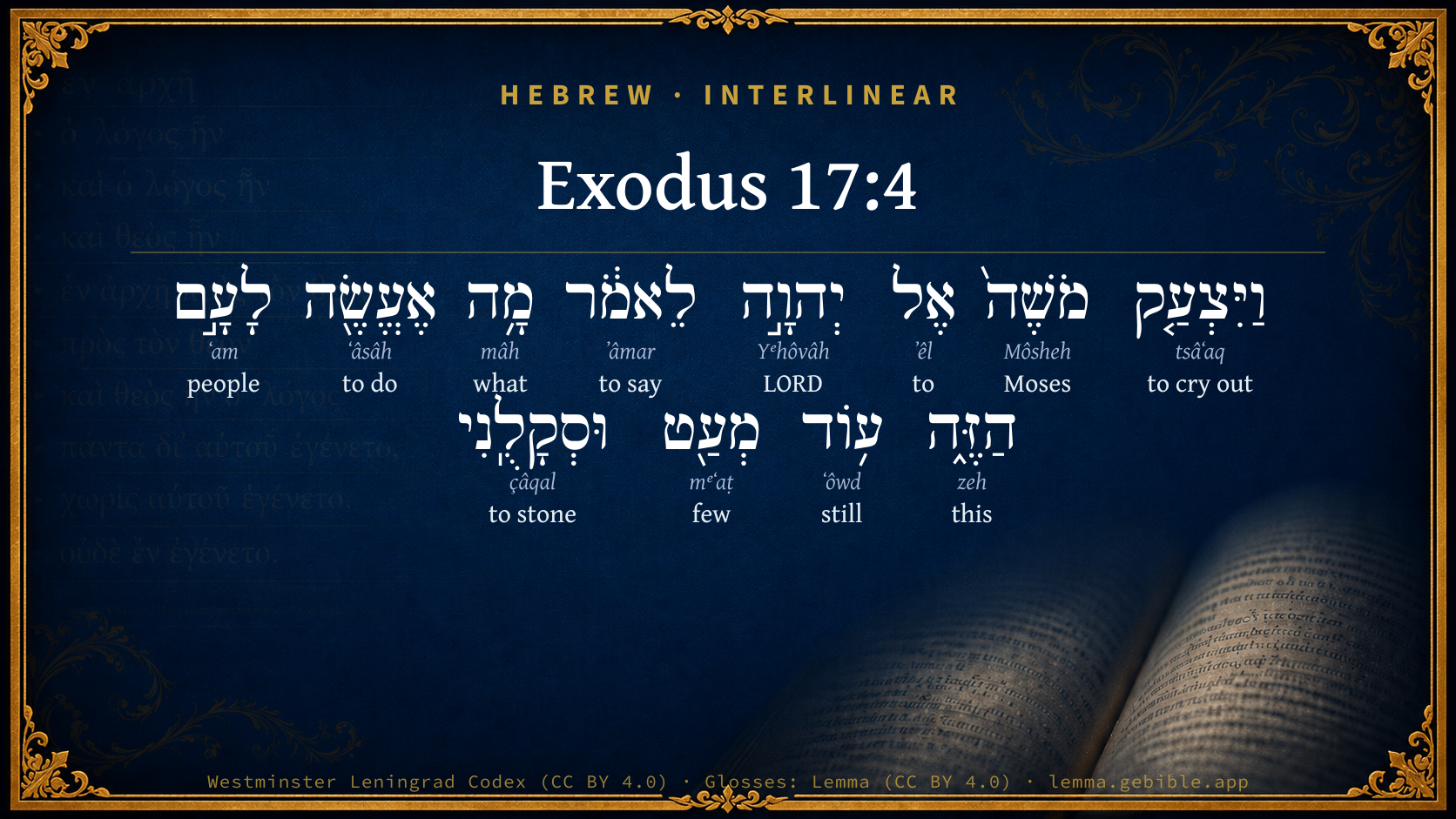
וּסְקָלֻֽנִי
çâqal
H5619
“and · to stone · me”
Conjunction + Verb, Qal, Sequential Perfect, 3rd Person, Common, Plural + Suffix, Personal, 1st Person, Common, Singular
Part of Speech
Conjunction + Verb
Stem
Qal
Form
Sequential Perfect
Person
3rd Person
Gender
Common
Number
Plural
Full BDB Definition

Origin: a primitive root

TWOT: 1541

to stone (to death), put to death by stoning - (Qal) to pelt with stones, stone to death - (Niphal) to be stoned to death - (Piel) - to stone, pelt with stones - to free from stones (of vineyard, highway) - (Pual) to be stoned to death
  1. וַיִּצְעַ֤ק tsâʻaq H6817 “and · to cry out” Conjunction + Verb, Qal, Sequential Imperfect, 3rd Person, Masculine, Singular
  2. מֹשֶׁה֙ Môsheh H4872 “Moses” Noun, Proper
  3. אֶל ʼêl H413 “to” Preposition
  4. יְהוָ֣ה Yᵉhôvâh H3068 “LORD” Noun, Proper
  5. לֵאמֹ֔ר ʼâmar H559 “to say” Preposition + Verb, Qal, Infinitive Construct
  6. מָ֥ה mâh H4100 “what” Particle, Interrogative
  7. אֶעֱשֶׂ֖ה ʻâsâh H6213 “to do” Verb, Qal, Imperfect, 1st Person, Common, Singular
  8. לָעָ֣ם ʻam H5971 “to/for the · people” Preposition, Determined + Noun, Common, Masculine, Singular, Absolute
  9. הַזֶּ֑ה zeh H2088 “the · this” Particle, Definite Article + Pronoun, Demonstrative, Masculine, Singular
  10. ע֥וֹד ʻôwd H5750 “still” Adverb
  11. מְעַ֖ט mᵉʻaṭ H4592 “few” Noun, Common, Masculine, Singular, Absolute

About this verse

These counts appear in no published source. They are computed here, from the morphology-tagged text and Lemma’s own curated glosses. What Lemma adds →

12
words
12
distinct lemmas
Pentateuch
section

Notable vocabulary

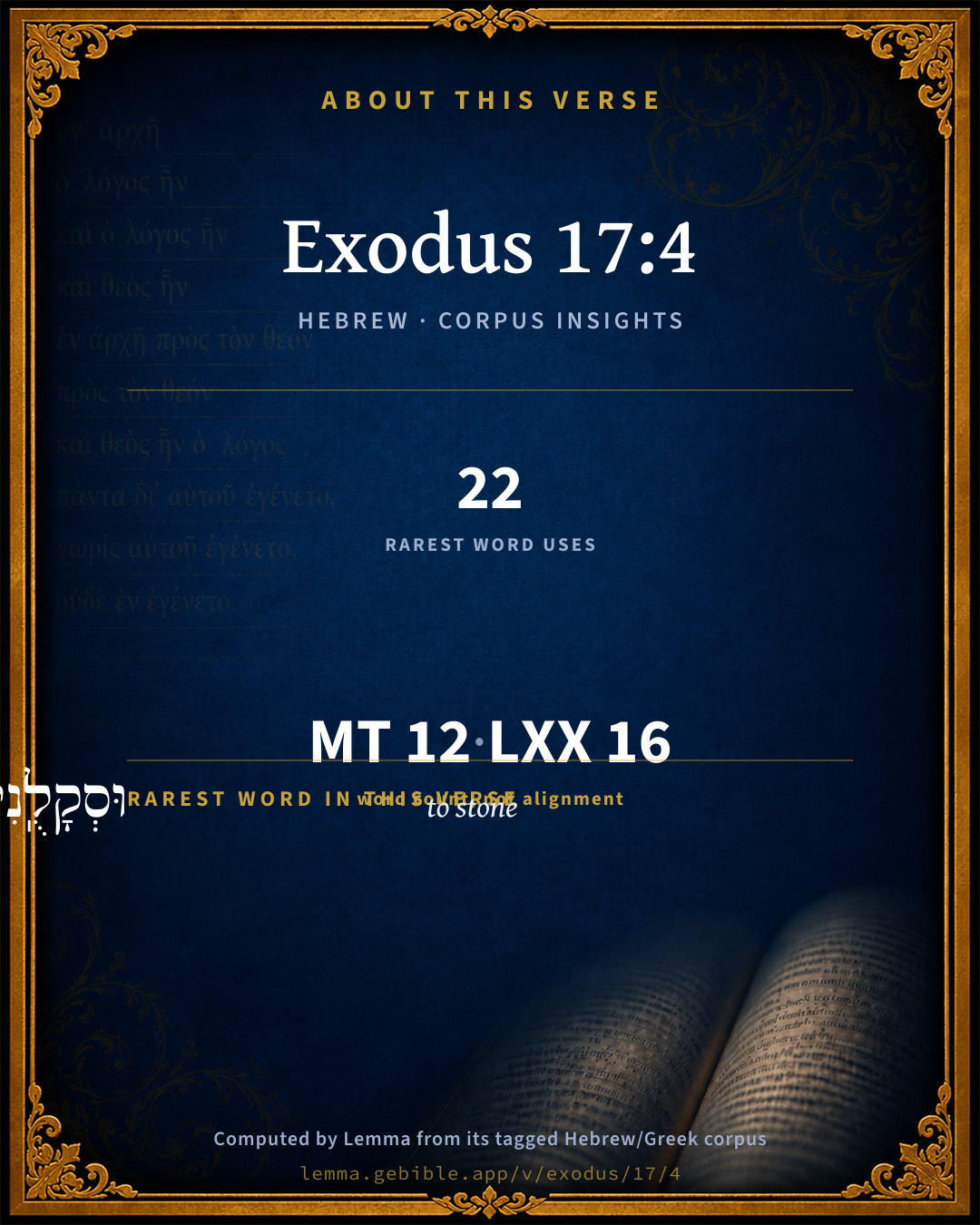
The rarest word here is וּסְקָלֻֽנִי to stone H5619 — appearing just 22 times in the whole Hebrew Bible.

Shared distinctive vocabulary

וּסְקָלֻֽנִי to stone H5619 occurs in 20 verses of the Hebrew Bible. Also found in:

Grammatical profile

  • 4 verbs
  • 4 nouns
  • 1 pronoun
  • 1 preposition
  • 1 adverb
  • 1 particle

Verb forms

  • וַיִּצְעַ֤ק Qal · Sequential Imperfect
  • לֵאמֹ֔ר Qal · Infinitive Construct
  • אֶעֱשֶׂ֖ה Qal · Imperfect
  • וּסְקָלֻֽנִי Qal · Sequential Perfect

Hebrew & Septuagint length

In English translation the verse runs 19 words from the Hebrew and 23 from the Septuagint (LXX English) — closely comparable.

A rough comparison of the two English renderings, which tokenize alike — not a word-level alignment.

Word counts can differ between the Hebrew and the Greek without any difference in meaning — e.g. the Hebrew direct-object marker אֵת has no separate Greek word, and Greek often adds the article ὁ.

In the original languages it is 12 Hebrew tokens and 16 Greek tokens — but the two are counted differently (Hebrew bundles its prefixes and suffixes into one token; the Greek is in lemma form), so that isn’t a like-for-like length.

Cross-references

10

Topical passages linked to Exodus 17:4 in the Treasury of Scripture Knowledge — connected by theme and wording, ordered by reader-vote popularity; previews shown in the World English Bible.

  • 1 Samuel 30:6 David was greatly distressed; for the people spoke of stoning him, because the soul of all the people was grieved, every man for his sons and for his daughters: but David strengthened himself in Yahweh his God.
  • Numbers 14:10 But all the congregation bade stone them with stones. The glory of Yahweh appeared in the tent of meeting to all the children of Israel.
  • John 8:59 Therefore they took up stones to throw at him, but Jesus was hidden, and went out of the temple, having gone through the midst of them, and so passed by.
  • John 10:31 Therefore Jews took up stones again to stone him.
  • Acts 14:19 But some Jews from Antioch and Iconium came there, and having persuaded the multitudes, they stoned Paul, and dragged him out of the city, supposing that he was dead.
  • Exodus 15:25 Then he cried to Yahweh. Yahweh shown him a tree, and he threw it into the waters, and the waters were made sweet. There he made a statute and an ordinance for them, and there he tested them;
  • Numbers 16:19 Korah assembled all the congregation against them to the door of the tent of meeting: and the glory of Yahweh appeared to all the congregation.
  • Acts 7:50 Didn't my hand make all these things?'
  • Exodus 14:15 Yahweh said to Moses, "Why do you cry to me? Speak to the children of Israel, that they go forward.
  • Numbers 11:11 Moses said to Yahweh, Why have you dealt ill with your servant? and why haven't I found favor in your sight, that you lay the burden of all this people on me?

Cross-references courtesy of OpenBible.info (CC BY 4.0).

Hebrew and Greek witnesses Masoretic Hebrew ↔ Greek Septuagint

The same verse in the two great witnesses to the Old Testament, shown verse-for-verse.

These are two independent witnesses, not word-aligned to each other, and the Septuagint is shown in lemma (dictionary) form.

Hebrew Exodus 17:4 Masoretic · Westminster Leningrad Codex

וַיִּצְעַ֤ק מֹשֶׁה֙ אֶל יְהוָ֣ה לֵאמֹ֔ר מָ֥ה אֶעֱשֶׂ֖ה לָעָ֣ם הַזֶּ֑ה ע֥וֹד מְעַ֖ט וּסְקָלֻֽנִי

Moses cried to Yahweh, saying, "What shall I do with these people? They are almost ready to stone me."

World English Bible · Public Domain

Greek LXX Exodus 17:4 Septuagint · lemma form

βοάω δέ μωυσῆς πρός κύριος λέγω τίς ποιέω ὁ λαός οὗτος ἔτι μικρός καί καταλιθοβολέω ἐγώ

And Moses cried to the Lord, saying, What shall I do to this people? yet a little while and they will stone me.

LXX2012 (modern English Septuagint) · Public Domain

Hebrew: Westminster Leningrad Codex (CC BY 4.0). Greek: Septuagint (public domain); English from LXX2012 (modern English Septuagint) (Public Domain). How the Septuagint differs from the Hebrew →

Targum (Aramaic paraphrase)

2

The Targum is the ancient Jewish Aramaic paraphrase of the Hebrew Scriptures — an interpretive translation, not the Hebrew text itself. Onkelos (literal) and Pseudo-Jonathan (expansive) render the Torah, and Jonathan the Prophets. Coverage is partial: where no permissively-licensed English translation exists for a verse, only the Aramaic is shown. This is verse-level text, not a word-by-word alignment to the Hebrew.

  1. Targum Onkelos Torah (Genesis–Deuteronomy)
    וְצַלִי משֶׁה קֳדָם יְיָ לְמֵימַר מָא אֶעְבֵּד לְעַמָא הָדֵין עוֹד זְעֵיר פּוֹן וְיִרְגְמֻנִי:

    (no public-domain English translation for this verse)

    Targum Onkelos — Aramaic: “Onkelos Genesis” (public domain); “Onkelos Exodus” (public domain); “Onkelos Leviticus” (public domain); “Onkelos Numbers” (public domain); “Onkelos Deuteronomy” (public domain). English: “Sefaria Community Translation” (CC0 1.0 (public-domain dedication)); “J.W. Etheridge. The Targums of Onkelos and Jonathan Ben Uzziel on the Pentateuch. London: Longmans, Green, 1862” (public domain). Text via Sefaria.

  2. Targum Pseudo-Jonathan Torah (Genesis–Deuteronomy)
    וְצַלִּי משֶׁה קֳדָם יְיָ לְמֵימַר מַה אַעֲבֵיד לְעַמָּא הָדֵין תּוּב קָלִיל זְעֵיר וְהִינוּן רַגְמִין יָתִי

    And Mosheh prayed before the Lord, saying What shall I do for this people? Yet a very little, and they will stone me.

    Targum Pseudo-Jonathan — Aramaic: “Targum Jonathan on Genesis” (public domain); “Targum Jonathan on Exodus” (public domain); “Targum Jonathan on Leviticus” (public domain); “Targum Jonathan on Numbers” (public domain); “Targum Jonathan on Deuteronomy” (public domain). English: “The Targum of Jonathan ben Uzziel, trans. J. W. Etheridge, London, 1862” (public domain). Text via Sefaria.

Commentary

Notes on Exodus 17:4 from classic Christian and Jewish commentators (each source and its license shown beneath its notes). The classic Christian expositions comment on the surrounding passage and are grouped to its opening verse, so a note may address several verses; the Jewish commentaries on the Tanakh (Rashi and others) are per-verse, so they appear only where the commentator wrote on this verse.

Lemma curates 59 commentaries, every one of them public domain or Creative Commons licensed, each selected and text-cleaned for this edition rather than reprinted as found. About our sources →

Trapp's Complete Commentary

John Trapp

Exo 17:4 And Moses cried unto the LORD, saying, What shall I do unto this people? they be almost ready to stone me.

Ver. 4. Ready to stone me.] Well might he ask with our Saviour, "For which of my good works do ye stone me?" {Joh 10:32} But the belly hath no ears.

John Trapp, A Commentary or Exposition upon All the Books of the Old and New Testament (1647–1656) — public domain. Text from a community e-Sword module.

The Biblical Illustrator

Joseph S. Exell

Exo_17:4-7

Thou shalt smite the rock.

Horeb; or, great mercies from unlikely sources

I. The secular department of human history will furnish abundant illustrations of this principle.

1. Does intelligence conduce to this end? Undoubtedly knowledge tends to make men secularly happy. How often, then, do you find streams of intelligence gushing from the most unlikely sources. Demosthenes was a stammerer; Homer and Milton were blind; Shakespeare was the son of a butcher.

2. Do philanthropic institutions conduce to the secular well-being of man? Unquestionably. If you look to the origin of temperance societies, asylums, provident associations, etc., you will find they have generally sprung from the most unlikely sources.

3. Does political liberty conduce to the secular well-being of man? Undoubtedly. It, too, has come mostly from unlikely sources--Moses, Luther, etc.

II. The spiritual department of human history will furnish still greater illustrations of this principle.

1. See it exemplified in the spiritual Deliverer of the race. Babe in manger; Son of carpenter; Man of sorrows, etc.; malefactor on cross. This rock, says St. Paul, is Christ--is like Christ. How?

(1) In the value of the blessings which emanate therefrom.

(a) Most needed.

(b) Most adequate.

(2) In the method employed to secure the blessing. Rock smitten.

(3) In the fact under notice, the unlikelihood of the source.

2. See it exemplified in the first preachers of the gospel. Poor fishermen, etc.

3. See it exemplified in the missionary enterprise. Carey, the shoemaker; Williams, the blacksmith; Moffat, the gardener, etc.

Conclusion: This subject suggests--

1. Good ground for trusting God in the greatest difficulty.

2. To remove all ground for glorying in your usefulness. God could make the meanest creatures do all and more than you can accomplish. (Homilist.)

Crying unto the Lord for help

Hiacoomes, an early Indian convert, was a remarkable man. Two years after his conversion (1743), having in the meantime been prepared by Mr. Mayhew, he commented teaching to the Indians the things of Christianity. He was not suffered to proceed without opposition from the Paw-Waws, Sachems, and other Indians; but he made this improvement of the injustice done him. I had, he remarked, one hand for injuries and another hand for God; while I received wrong with the one, I laid the faster hold on God with the other. These words should be written in gold. (New York Independent.)

The needful things of life providentially supplied

I. That men are sometimes brought into great straits through lack of the ordinary things of life. And there was no water for the people to drink. Thus the Israelites lacked water. They had lacked bread only a few days previously.

1. It is not the lot of man to be long free from trial of some kind. Trials come successively. Job, Joseph, David. They are diversified according to the station in which our tent is fixed. Every sphere of life has something of perplexity connected with it, which tests our moral nature and brings the mercy of God near to us. We must learn both how to want and how to abound, to be sorrowful and yet always rejoicing.

2. Thus by the varied trials of life man is made to feel that earth cannot give him abiding satisfaction, and he is led to anticipate the rest of heaven. There the wilderness is unknown, and hunger and thirst are not experienced. The Lamb feeds them. They drink of the River of the Water of Life.

3. But we see from this narrative that each occasion of want on the part of Israel was signalized by a rich manifestation of the mercy of God. Their hunger was met by the manna. Their thirst was met by the streams of Horeb. The hour of mans need is often the hour of Gods richest gift and blessing.

II. That when men are brought into great straits through lack of the ordinary things of life, they often appeal to human agencies rather than to divine. Wherefore the people did chide with Moses, and said, Give us water that we may drink. How foolish, for did not he suffer from the same calamity? nor was it in his power to create fountains. How cruel, for was not he seeking their freedom? How fickle the approbation of men, it varies with the circumstances of life. People often go to the human in trouble when they ought to go to the Divine.

III. That when men are brought into straits through the lack of things they very much need, they often get them in the providence of God from the most unlikely sources. Behold, I will stand before thee there upon the rock in Horeb; and thou shalt smite the rock, and there shall come water out of it, that the people may drink. Thus we see that God did not flash immediate judgment upon these rebellious people. He is long-suffering toward the race. We must learn to be patient with those who injure us. God has regard to human need, and evil in men will not turn Him away from His promise, None need despair of His mercy. When the people chide, the minister should pray. Our heavenly Father is never absent from the good; goodness and mercy follow them all their days.

IV. That when men are brought into straits, the way in which they act therein will leave irreparable memorials of sin or victory. And he called the name of the place Massah, and Meribah, because of the chiding of the children of Israel, etc. Let us not leave behind in our life memorials of strife and unbelief, but of faith and good works. Such memorials are abiding; once erected, they cannot be removed; hence the need that they should be worthy. Lessons:

1. That man is frequently called upon in this life to endure great physical need.

2. That the physical needs of life often reveal our real and inner character.

3. That the physical needs of life are no indication that God has failed us.

4. That the physical needs of life give us a great insight into the wealth and method of the Divine mercy. (J. S. Exell, M. A.)

The smitten rock

I. The rock a type of Christ.

1. Its situation. In midst of wilderness.

2. Its stability (Isa_28:16).

3. Its durability. Jesus Christ is the same yesterday, to-day, and for ever.

II. Moses striking the rock. An act of violence required. When man is to be saved, the rod of Divine wrath strikes the Saviour, and the rock pours forth streams of everlasting salvation.

III. The purpose of the miracle. (I. Saunders.)

Water out of the rock, a type of Christ

I. As a rock it elegantly typed out Jesus Christ, fitly compared to a rock in five resemblances.

1. For the despicable appearance. The rock is in appearance dry and barren, the most unlikely thing in all the world to afford water, so as it was incredible to Moses and Aaron themselves to fetch water out of a rock. Even so Jesus Christ was (for outward form and appearance in the world) most unlikely of all men to afford any such waters of grace and salvation (Isa_53:2).

2. A Rock for exaltation and advancement. A rock is a promontory lifted up above the earth. Such a Rock was Christ advanced above the earth, yea, and the heavens; advanced above all men and creatures--

(1) In holiness and purity.

(2) In power and authority.

(3) In place and dignity(Joh_3:31).

3. A Rock for firmness and stability. He is the strength of Israel (Mat_16:18). Hence He is a rock of defence and safety to His chosen; and every wise man builds his house on this Rock.

4. A Rock of scandal and offence to wicked men (Rom_9:32).

5. A Rock for weight and danger and unavoidable judgment upon His adversaries, which, on whomsoever it shall fall, it will grind him to powder (Mat_21:44).

II. It was a type of Christ, as it sent out water in abundance to the people of Israel ready to perish for thirst. For so Jesus Christ is the only Rock that sends from Himself all the sweet waters of life for the salvation of His elect, otherwise ready to perish eternally. For explanation whereof, mark--

1. As from that rock issued waters to wash and cleanse themselves and their garments, so from this Rock stream waters of ablution or washing, which serve to wash away both the guilt of sin and stain of sin.

2. As from that rook issued waters to cool and comfort Israel in their weariness and wanderings, so from Jesus Christ do issue the waters of refrigeration and comfort, to cool and refresh the dry and thirsty soul; to allay the heat of a raging and accusing conscience, and to revive with new strength the fainting soul in temptation or persecution.

3. As from that rock streamed abundance of waters to make fruitful that barren wilderness wheresoever they ran, so only from the true Rock issue plentiful waters of grace to make our dry and barren hearts fruitful in all works of righteousness (Isa_44:3-4).

III. In the manner of attaining this water are many sweet resemblances.

1. The people might ask Moses for water, but Moses cannot give it. It is God must give it, and miraculously fetch it out of a rock.

2. The rock gives water, but not till it be smitten (verse 6).

3. It was the rod in Moses hand that smites and breaks the rock. Even so it was the Law given by Moses hand and our transgression against it that breaks the true Rock (Isa_53:5; Gal_3:13).

4. The rock was smitten, but it was not so much the striking on the rock, but the Lords standing upon it that gets water for Israel (verse 6). There was no virtue in the stroke, but all depended on Gods commandment and presence; even so it is not the death of Christ, nor an abundance of price and merit of His blood, nor the striking on this rock before mens eyes in the ministry of the Word and sacraments that can bring one drop of true water of comfort, but by the presence and word of Gods blessing. The efficacy of grace depends not on any means or work wrought, but it is Gods word and presence that doth all in them. (T. Taylor, D. D.)

Help from an unlikely source

The manna was simply sent from heaven, but the water, on the contrary, was brought out of the smitten rock--the most unlikely place that could be imagined. Some men went about collecting funds for an important charity. They arrived in course of time at a very rich mans door who was known to be churlish in his manner and niggardly in his gifts; whereupon they said that there was no need to call on him, he is not likely to give. However, they entered, and laid their case before him, and to their surprise he at once responded by giving them the largest donation they had yet received. Rephidim-Rock was a most unlikely place from which to receive supplies of water.

The Biblical Illustrator, edited by Joseph S. Exell (c. 1880s–1900s) — public domain. Text from a community e-Sword module.

Geneva Bible (1599)

Geneva Bible translators

How ready the people are for their own matters to slay the true Prophets, and how slow they are to revenge God’s cause against his enemies and false Prophets.

Geneva Bible (1599) marginal notes — public domain. Text via Bolls.life.

Jamieson, Fausset & Brown

Robert Jamieson, A. R. Fausset & David Brown

Moses cried unto the Lord, saying, What shall I do unto this people?--His language, instead of betraying any signs of resentment or vindictive imprecation on a people who had given him a cruel and unmerited treatment, was the expression of an anxious wish to know what was the best to be done in the circumstances (compare Mat 5:44; Rom 12:21).

Jamieson, Fausset & Brown — Commentary Critical and Explanatory on the Whole Bible (1871) — public domain (CC PDM 1.0). Text via the HelloAO Bible API.

Ellicott's Commentary for English Readers

(4) They be almost ready to stone me.—Heb., Yet a little and they will stone me. On tumultuary stoning, see the second Note on Exo_8:26.

A Bible Commentary for English Readers, edited by Charles John Ellicott (1878–1897) — public domain. Text from a community e-Sword module.

The Cambridge Bible for Schools and Colleges

gen. ed. J. J. S. Perowne

4. cried unto Jehovah] Exo_14:15, Exo_15:25.

to stone me] Cf. 1Sa_30:6.

The Cambridge Bible for Schools and Colleges (gen. ed. J. J. S. Perowne; Cambridge University Press, 1878–1918) — public domain. Text from a community e-Sword module.

John Gill's Exposition

And Moses cried unto the Lord..... Or prayed unto him, as the Targums of Onkelos and Jonathan; which shows the distress he was thrown into, the vehemence of his prayer, and perhaps the loud and lamentable tone in which he expressed it: this was the method he always took, and the refuge he fled unto in all his times of trouble; in which he did well, and set a good example of piety and devotion to God, of faith and trust in him: saying:

what shall I do unto this people? or, "for this people" (h); to relieve them in their present exigency; suggesting his own inability to do any thing for them: yet not despairing of relief, but rather expressing faith in the power and goodness of God to keep them, by his application to him; desiring that he would open a way for their help, and direct him what he must do in this case for them: something, he intimates, must be done speedily for the glory of God, for his own safety, and to prevent the people sinning yet more and more, and so bring destruction upon them; for, adds he:

they be almost ready to stone me or, "yet a little, and they will stone me" (i); if the time of help is protracted, if relief is not in a short time given, he had reason to believe from the menaces they had given out, the impatience they had showed, the rage they were in, they would certainly take up stones and stone him, being in a stony and rocky place; and this they would do, not as a formal punishment of him as a false prophet, telling them they should be brought to Canaan, when they were brought into the wilderness and perishing there; which law respecting such an one was not yet in being; but this he supposed as what an enraged multitude was wont to do, and which was more ready at hand for them to do than anything else, see Exo 8:26.

(h) "populo haic", V. L. Pagninus, Montanus, &c. (i) "adhuc paululum et lapidabit me." V. L. "parum abest", Tigurine version; "adhuc modicum", Pagninus, Montanus; "adhuc paulisper", Junius & Tremellius, Piscator; so Ainsworth.

John Gill's Exposition of the Whole Bible (1746–1763) — public domain (CC PDM 1.0). Text via the HelloAO Bible API.

Whedon's Commentary on the Bible

Daniel D. Whedon

4. What shall I do — There was now another mutiny, as in the Desert of Sin, but apparently more dangerous, for Moses regards his life as in peril. Yet, though himself in as great perplexity as the people, he consults Jehovah in simple faith, and meekly bears the threats of the insurgent crowd.

Daniel D. Whedon (gen. ed.), Commentary on the Old and New Testaments (1874–1909) — public domain. Text from a community e-Sword module.

The Pulpit Commentary

And Moses cried unto the Lord. It is one of the most prominent traits of the character of Moses, that, at the occurrence of a difficulty, he always carries it straight to God. (see Exo_15:25 Exo_24:15 Exo_32:30 Exo_33:8; Num_11:2, 11 12:11 14:13-19, etc.) They be almost ready to stone me. This is the first which we hear of stoning as a punishment. It is naturally one of the easiest modes of wreaking popular vengeance on an obnoxious individual, and was known to the Greeks as early as the time of the Persian war (Heb_9:5), to the Macedonians (Q. Curt. Vit. Alex. 6:11, 38), and others. There is, however, no trace of it among the Egyptians.

The Pulpit Commentary (1880–1919), ed. H.D.M. Spence-Jones & Joseph S. Exell — public domain. Text from a community e-Sword module.

unfoldingWord translationNotes

Door43 World Missions Community

Massah

a place in the desert whose name means "testing" (See: How to Translate Names)

Meribah

a place in the desert whose name means "complaining" (See: How to Translate Names)

translationWords

stone

elder

staff

Horeb

call

lord

unfoldingWord translationNotes — © Distant Shores Media and the Door43 World Missions Community, licensed CC BY-SA 4.0. Source: git.door43.org/Door43/en_tn.

Rashi

Rabbi Shlomo Yitzchaki (Rashi)

עוד מעט YET A LITTLE means, if I wait but a little more they will stone me.

Rashi on the Tanakh — English translations: “The Judaica Press complete Tanach with Rashi, translated by A. J. Rosenberg” (CC BY 4.0); “Pentateuch with Rashi's commentary by M. Rosenbaum and A.M. Silbermann, 1929-1934” (public domain); “The Metsudah Tanach series, Lakewood, N.J” (CC BY 4.0); and “The Book of Joshua, Metsudah Publications, 1997” (CC BY 4.0). Text via Sefaria.

Lesson kit

Teaching starters — assembled from the data on this page, not authored interpretation. Every prompt links to the verse data it draws on. Edit before teaching.

Exodus, in the Pentateuch, opens this verse with 12 words (12 distinct Hebrew lemmas). Its most distinctive word is çâqal (“to stone”). A historical commentator’s framing appears above. Read the whole chapter for the surrounding context.

Discussion questions

  1. The word çâqal carries the sense “to stone.” How does it shape the verse?
  2. Exodus 8:26 shares the word «to stone» with this verse. How do the two illuminate each other?
  3. These translations render this verse differently. What is at stake in choosing one wording over another?
  4. The verb «וַיִּצְעַ֤ק» is Qal Sequential Imperfect. How does its form color the action?
  5. Reading how Trapp's Complete Commentary and The Biblical Illustrator read this verse, where do the two commentators agree and where do they part?

Things to notice

Reading settings

Reading text

Shown beneath each verse's original-language words.

Old Testament
Old Testament edition

Read the OT as the Masoretic Hebrew (MT) or the Greek Septuagint (LXX).

English shown for the Greek Septuagint (in the Hebrew ↔ Greek comparison).

Comparing translations? Open the Compare panel on any verse page to stack up to four side by side.